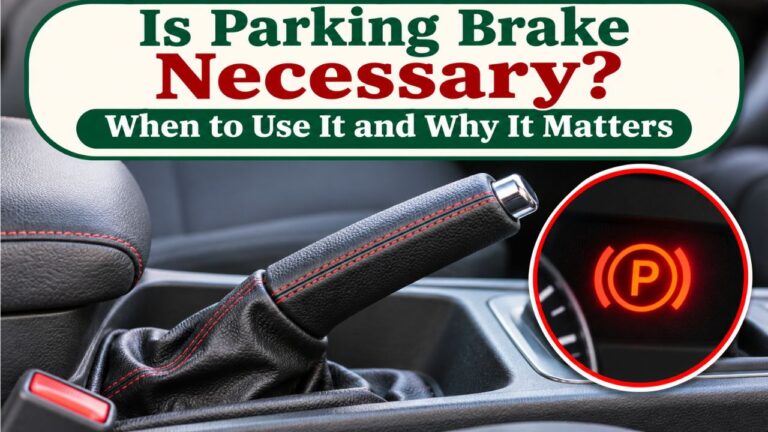
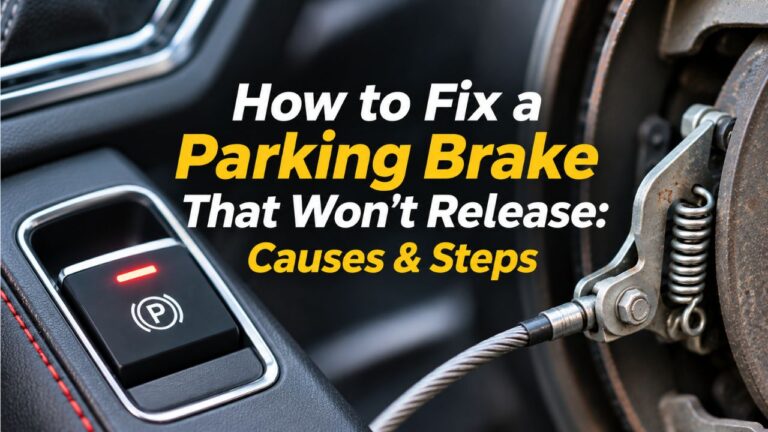
How to Unlock Parking Brake: Lever, Foot Pedal, and EPB Steps
To unlock a parking brake, hold down the regular brake pedal and release the parking brake using the control fitted to your vehicle. For a handbrake lever, lift it slightly, press the release button, and lower it completely. For a foot-operated parking brake, press the pedal again or pull the designated release handle. An electronic parking brake generally releases when you press its switch while holding the service brake.
The exact procedure depends on your vehicle’s design. Some cars release their parking brakes automatically when you shift into gear, while others require a manual action. If the parking brake is stuck, forcing the lever or accelerating against the engaged brakes can damage components and create a safety hazard.
A parking brake that won’t release may have a seized cable, frozen mechanism, electrical fault, or failed actuator. Understanding the difference between a normal release procedure and a mechanical failure helps prevent unnecessary repairs.
This guide explains how to unlock manual, foot-operated, and electronic parking brakes step by step, how to handle a stuck brake safely, and how to confirm that the system has fully disengaged.
How to Unlock Parking Brake Safely: Identify Your Control
Before attempting to release the parking brake, identify the type installed in your vehicle.
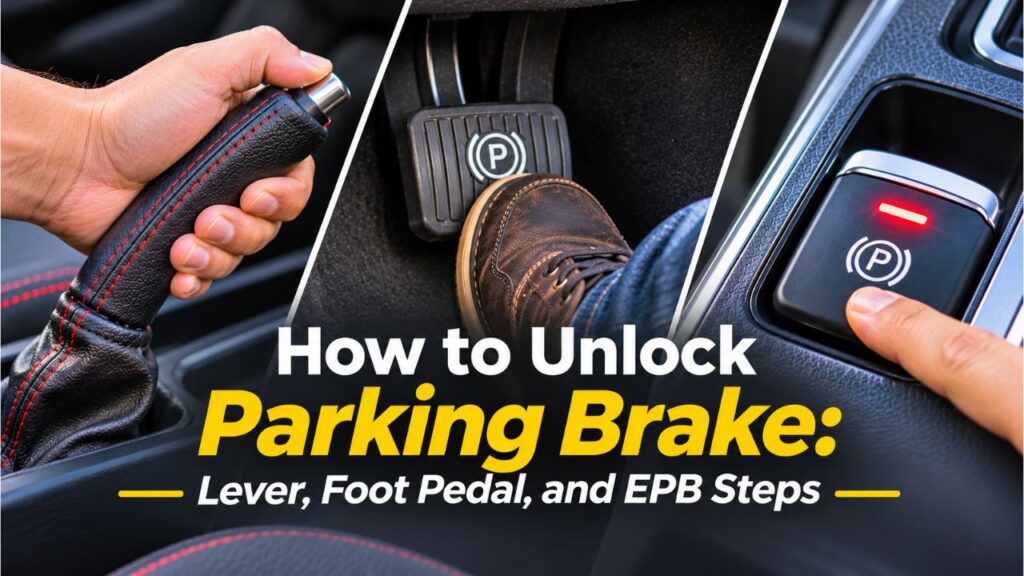
Most passenger vehicles use one of three common arrangements:
| Parking Brake Type | Typical Location | Normal Release Method |
| Handbrake lever | Between front seats or beside driver | Lift slightly, press button, lower lever |
| Foot-operated parking brake | Lower left side of driver’s footwell | Press pedal again or pull release handle |
| Electronic parking brake (EPB) | Center console or dashboard | Hold brake pedal and operate EPB switch |
The parking brake controls a holding mechanism that normally remains applied until you release it. Depending on the vehicle, it may operate through cables, rear brake calipers, separate parking brake shoes, or electric actuators.
Important: Always keep your foot firmly on the regular brake pedal before releasing the parking brake. This prevents the vehicle from rolling unexpectedly, especially when parked on an incline.
If your regular brake pedal does not work correctly, do not release the parking brake unless the vehicle has been otherwise secured by a qualified person.
How to Unlock a Traditional Handbrake Lever
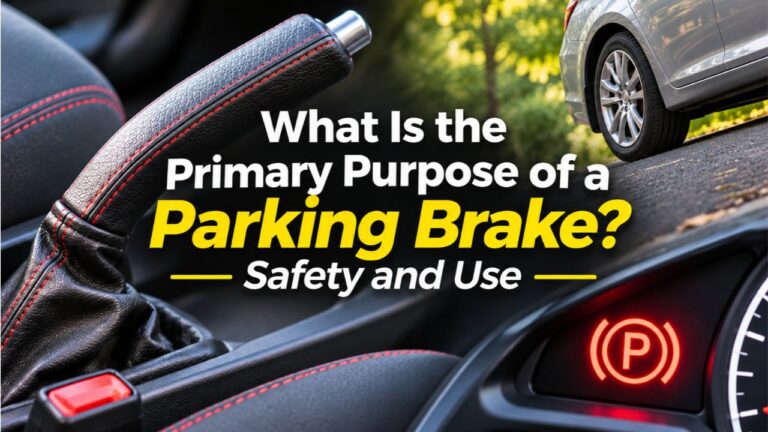
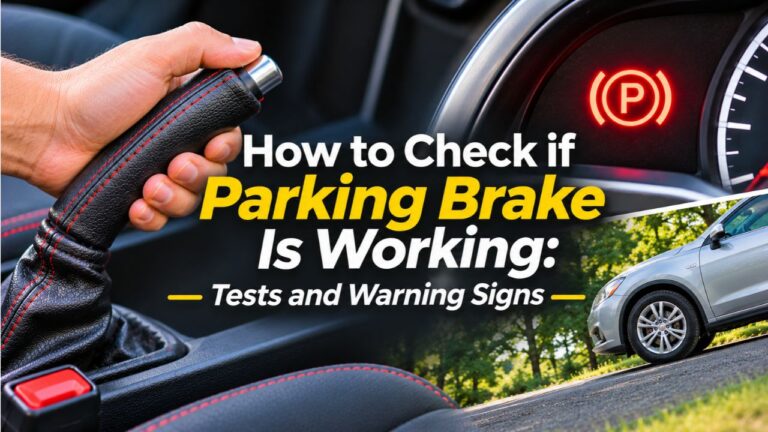
A manual handbrake usually has a long lever with a release button at the end. Pulling the lever engages the parking brake, while pressing the button allows the lever to return to its released position.
Step 01: Press and Hold the Regular Brake Pedal
Sit in the driver’s seat and press the regular brake pedal firmly with your right foot.
Keep the vehicle stationary throughout the release process. If you have an automatic transmission, leave the selector in Park until you’re ready to move. For a manual transmission, follow the correct starting and gear-selection procedure while keeping the car secured.
Check that the handbrake lever is raised. A raised lever usually indicates that the parking brake is engaged, although its exact position varies by vehicle.
Step 02: Lift the Lever Slightly and Press the Release Button
Grip the handbrake lever firmly. Pull it upward just enough to relieve pressure on the locking mechanism.
While holding the lever, press the release button located at its tip. This button disengages the ratchet that keeps the lever in its raised position.
If the button feels difficult to press, do not force it. Raising the lever slightly may reduce tension and allow the button to move normally.
Toyota’s parking brake operating instructions describe this approach for lever-operated systems: raise the lever slightly, press the release button, and return the lever completely to its lowered position.
Step 03: Lower the Handbrake Lever Completely
Keep the release button pressed while gradually lowering the lever toward its resting position.
Do not let the lever snap downward. Guide it smoothly until it reaches its normal released position.
After lowering it, release the button and check whether the parking brake indicator has turned off.
If the lever lowers normally but the vehicle still feels restrained, do not assume the brakes are free. A seized cable or rear brake mechanism may remain engaged even though the lever is down.
How to Unlock a Foot-Operated Parking Brake
A foot-operated parking brake uses a separate pedal, generally positioned to the far left of the regular brake pedal.
There are two common release designs:
- Push-to-release: Pressing the parking brake pedal a second time releases its locking mechanism.
- Handle-release: Pulling a separate release handle near the lower dashboard unlocks the parking brake pedal.
Identify the correct mechanism before operating it.
Step 01: Locate the Parking Brake Pedal and Release Control
Look near the lower left side of the dashboard or driver’s footwell.
The parking brake pedal may be labeled PARKING BRAKE, marked with a brake symbol, or identified in the owner’s manual.
Check whether there is a release handle nearby. Some vehicles use a small handle marked with a circled P or a parking brake symbol.
Do not confuse the parking brake pedal with the regular brake pedal or a footrest.
Step 02: Keep the Service Brake Pressed
Press the regular brake pedal with your right foot.
If your vehicle uses a push-to-release parking brake, press the parking brake pedal downward with your left foot according to the manufacturer’s instructions.
The parking brake mechanism should release, allowing the pedal to return upward.
For vehicles with a release handle, keep the regular brake pedal pressed and pull the parking brake release handle as directed.
Avoid pulling dashboard trim or unrelated levers if the release control is difficult to identify.
Step 03: Confirm That the Parking Brake Pedal Has Returned
After releasing the mechanism, observe whether the parking brake pedal has returned to its normal resting position.
A pedal that remains partially depressed may indicate a sticking cable, damaged return mechanism, or another fault.
Check the parking brake warning indicator. If it remains illuminated, verify that the control has released fully.
Do not repeatedly stamp on a stuck parking brake pedal. Excessive force can damage its locking mechanism without releasing the brakes.
How to Unlock an Electronic Parking Brake
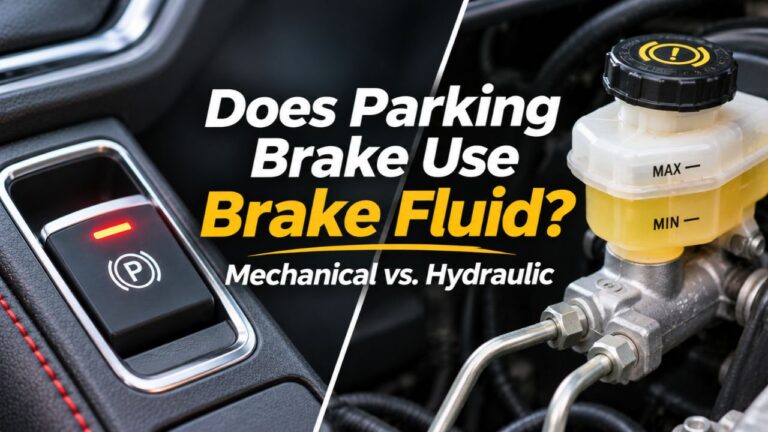
An electronic parking brake (EPB) uses an electrical switch to control the parking brake mechanism.
The switch is commonly located near the gear selector, on the center console, or along the dashboard. It often displays a circled P symbol.
Some EPB systems have automatic application and release functions, but the manual release procedure is usually straightforward.
Step 01: Turn On the Vehicle’s Electrical System
Sit in the driver’s seat and confirm that the vehicle is securely parked.
Switch the ignition to the required operating mode. Some vehicles need the ignition ON, while others have specific power or READY requirements.
A fully discharged 12-volt battery may prevent an electric parking brake from releasing.
Do not attempt to manually force electric brake actuators simply because the dashboard switch is unresponsive.
Step 02: Press and Hold the Regular Brake Pedal
Keep your right foot firmly on the service brake.
Many electronic parking brake systems use this brake-pedal input as a safety condition before allowing manual release.
Locate the parking brake switch and check its operating direction.
On many vehicles, pulling the switch applies the brake, while pressing it downward releases the brake. Other systems may have different switch arrangements.
Toyota’s electronic parking brake owner’s manual explains that the parking brake can be released manually by pressing the switch while depressing the brake pedal. It also describes automatic release functions and the conditions required for them.
Step 03: Operate the Parking Brake Release Switch
While holding the regular brake pedal, press the EPB switch in the release direction specified by the manufacturer.
You may hear a short electric motor sound near the rear wheels. This can be normal because an electric actuator is moving the parking brake mechanism.
Watch the instrument cluster for the parking brake indicator to turn off.
If the switch does not respond, check the ignition mode and any dashboard message before trying again.
Avoid repeatedly operating the switch in quick succession. Some EPB systems temporarily restrict operation when actuators overheat.
Step 04: Check Automatic Release Settings
Some vehicles automatically disengage the parking brake when the driver prepares to move.
Depending on the manufacturer, automatic release may require:
- The driver’s door to be closed.
- The driver’s seat belt to be fastened.
- A suitable gear to be selected.
- The engine or drive system to be operating.
- No active parking brake malfunction.
If automatic release fails, use the normal manual switch procedure rather than accelerating against the engaged brakes.
Automatic release is a convenience feature, not a reason to ignore parking brake warnings. Confirm that the system has released before moving.
How to Unlock a Parking Brake That Is Stuck
A stuck parking brake requires a different approach from normal disengagement.
The control may appear released while the brakes remain mechanically engaged. Alternatively, the control itself may refuse to move.
Possible causes include a seized parking brake cable, frozen linkage, corroded brake components, failed electronic actuator, or insufficient electrical power.
Step 01: Secure the Vehicle Before Troubleshooting
Stop attempting to move the vehicle if you notice strong resistance, dragging, grinding, or a parking brake warning.
Keep the transmission in the appropriate parked position and make sure the vehicle cannot roll.
On a slope, use properly positioned wheel chocks when safe and appropriate. Never crawl underneath a vehicle supported only by a jack.
If the car is parked on a steep incline and the service brake is unreliable, arrange professional assistance before releasing the holding mechanism.
Step 02: Check Whether the Release Control Is Jammed
For a manual lever, check whether the release button moves normally and whether the lever can lower completely.
For a foot-operated brake, inspect the pedal area for loose floor mats or objects interfering with pedal movement.
For an electronic system, check the instrument cluster for messages such as Parking Brake Malfunction or Parking Brake Not Released.
Do not force a jammed lever, strike the foot pedal, or dismantle the electronic switch.
If the control has already moved to its released position but the wheels remain restrained, the problem may be farther downstream in the cables or brake mechanism.
Step 03: Consider Frozen or Corroded Brake Components
Cold temperatures can allow moisture around parking brake cables, shoes, or linkages to freeze.
If the brake became stuck after freezing weather, warming the vehicle in a suitable sheltered location may help the mechanism thaw. This should be done without driving against the engaged brakes.
Avoid pouring boiling water over the brakes, using an open flame, or applying direct high heat. These methods can damage components or create additional freezing and safety problems.
Long periods of parking can also allow rust to form between brake friction surfaces. This may cause the brakes to stick even when the release control operates normally.
If the brakes remain seized, arrange inspection rather than repeatedly rocking the vehicle or applying engine power to break them free.
Step 04: Check Battery Power on Electronic Parking Brakes
A weak or discharged 12-volt battery can prevent an electronic parking brake from responding.
The dashboard may remain dark, the EPB switch may do nothing, or a low-voltage warning may appear.
Some vehicles permit release after restoring adequate electrical power.
For example, Ford’s electronic parking brake instructions for a discharged battery explain that the EPB cannot operate without sufficient battery power and describe connecting a booster battery to enable release.
Follow the vehicle’s exact jump-starting procedure. Hybrid and electric vehicles may have special 12-volt access points or electrical safety requirements.
Do not disconnect the battery, remove actuator wiring, or turn rear brake motors manually in an attempt to force release. Some vehicles have manufacturer-approved emergency release procedures, but these are not universal.
Step 05: Arrange Repair if the Brake Still Will Not Unlock
If the brake remains engaged after the correct release procedure, stop troubleshooting with force.
A technician may need to inspect the parking brake cables, rear calipers, internal drum mechanism, return springs, actuators, or electronic control system.
Releasing a seized brake may require removing components or using a manufacturer-specific service procedure.
If the wheels are locked, inform the towing provider so the vehicle can be moved with suitable equipment without dragging the locked wheels across the road.
A temporary release does not prove the underlying mechanism is safe. Have the fault corrected before returning the vehicle to normal use.
Why Is the Parking Brake Released but the Car Still Won’t Move?
Sometimes the parking brake is not actually responsible for the problem.
An automatic transmission may remain locked in Park because of a shift-interlock issue, low electrical power, or another transmission-related fault. That is different from a parking brake that remains applied.
Likewise, vehicles with an automatic brake-hold function can keep the service brakes applied temporarily at a stop. Auto Hold is not necessarily the same as the parking brake, although some systems coordinate their functions.
Other possibilities include seized brake calipers, frozen rear brakes, or an unrelated drivetrain problem.
Before diagnosing the parking brake, determine whether the gear selector operates normally and whether the parking brake warning indicator confirms release.
Never assume that applying more throttle is the appropriate solution to a car that resists moving.
How to Confirm the Parking Brake Is Fully Unlocked
After following the correct release procedure, verify that the parking brake is no longer engaged.
Step 01: Check the Parking Brake Indicator
Look at the instrument cluster.
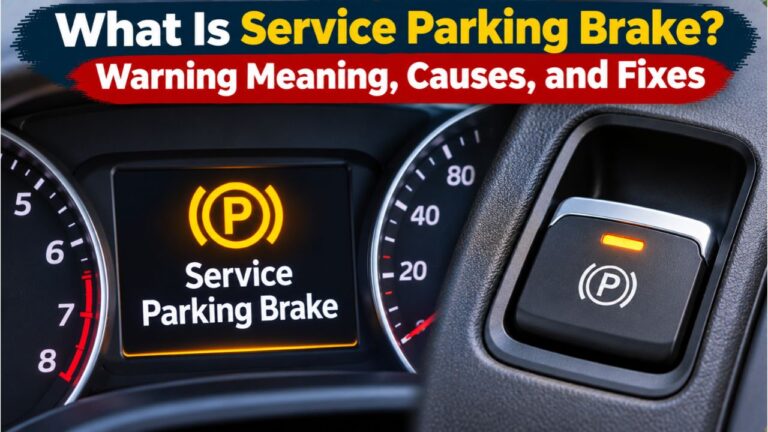
On many vehicles, the red BRAKE indicator or circled P light turns off after successful parking brake release. However, the same warning area may indicate low brake fluid or another brake-system problem.
A flashing electronic parking brake warning can also indicate a malfunction.
Do not assume that the parking brake has released simply because the light turns off. Mechanical components can remain stuck even when the control indicates release.
Step 02: Check the Lever, Pedal, or Switch Position
For a manual handbrake, confirm the lever is completely lowered.
For a foot-operated brake, verify that the pedal has returned to its normal position.
For an electronic parking brake, confirm that the system reports successful release without a malfunction message.
The vehicle should not produce an ongoing parking brake warning or unusual actuator noise.
Step 03: Check for Normal Movement Only When Safe
If the release is confirmed and there are no signs of a brake fault, move the vehicle gently in a safe, level, unobstructed area.
There should be no unusual resistance, dragging noise, or indication that the parking brake is still applied.
Stop immediately if the vehicle strains to move or the brakes feel abnormal. Do not attempt a road test when the parking brake was previously seized or the system continues displaying warnings.
A qualified technician should verify that the wheels rotate freely and that the parking brake can hold and release correctly after a mechanical repair.
Mistakes to Avoid When Releasing a Parking Brake
Improper release attempts can damage the braking system or allow a parked vehicle to move unexpectedly.
Releasing the brake without holding the service pedal: The vehicle can roll, particularly on a hill or when the transmission is not securely holding it.
Driving with the parking brake partly applied: Brake pads, shoes, rotors, and other components can overheat and suffer excessive wear.
Forcing a stuck handbrake lever: Excessive force can break the release button, ratchet, cable connection, or associated hardware.
Accelerating against a seized brake: Engine power can damage brake components and may cause unexpected vehicle movement if the brake suddenly releases.
Disconnecting electronic parking brake components without instructions: EPB actuators may require specific service or diagnostic procedures. Uncontrolled disassembly can damage the mechanism or leave the vehicle unsecured.
Ignoring a warning after release: An illuminated brake warning may indicate a separate hydraulic problem even if the parking brake is no longer applied.
The correct response to a stuck parking brake is to identify the cause, not overpower the holding mechanism.
FAQs About How to Unlock Parking Brake
How Do You Unlock a Parking Brake With a Button?
If your vehicle has a manual handbrake lever, hold the regular brake pedal, raise the lever slightly, press its release button, and lower the lever completely. For an electronic parking brake, use the switch as directed by the owner’s manual.
How Do You Release a Parking Brake When the Car Is Off?
A traditional handbrake or mechanical foot-operated parking brake can generally be released with the engine off. Electronic parking brakes often require the ignition or vehicle electrical system to be switched on.
Why Won’t My Parking Brake Release?
Possible causes include a jammed lever, seized cable, frozen brake mechanism, faulty EPB actuator, or insufficient battery power. Check the correct release procedure first, then arrange diagnosis if the brake remains engaged.
Can You Manually Release an Electronic Parking Brake?
Most electronic parking brakes allow manual release through the dashboard or console switch when the required conditions are met. Some have special emergency release procedures, but these vary by model.
Can a Parking Brake Get Stuck After Sitting for a Long Time?
Yes. Moisture and corrosion can cause cables, linkages, brake shoes, or caliper mechanisms to seize during extended parking. The control may release even though the brakes remain stuck.
Is It Safe to Drive With the Parking Brake Light On?
Not until the reason for the warning is known. The parking brake may still be engaged, or the light may indicate another brake-system problem. Resolve the warning before normal driving.
Unlock Your Parking Brake Without Damaging the Braking System
Knowing how to unlock parking brake controls begins with identifying the type installed in your vehicle. A manual handbrake usually releases by pressing its button while lowering the lever. A foot-operated system uses a pedal or release handle, while an electronic parking brake generally requires the correct switch operation and electrical power.
If the parking brake refuses to disengage, the problem may involve a frozen mechanism, seized cable, damaged brake component, or electronic fault. Avoid forcing the controls or driving against the brakes, and confirm that the system has completely released.
The safest approach is to follow your vehicle’s owner’s manual, keep the regular brake pedal applied during release, and arrange professional repair when a brake remains stuck. A correctly released parking brake should allow normal vehicle movement without dragging, overheating, or warning messages.