How to Deactivate Parking Brake: Lever, Pedal, and EPB Steps
To deactivate a parking brake, hold the regular brake pedal and release the parking-brake control fitted to your vehicle. Lower a handbrake lever while pressing its release button, use the proper release method for a foot-operated pedal, or press the electric parking brake (EPB) switch with the vehicle powered on and your foot on the brake.
Releasing the parking brake is different from disabling its automatic operation. Some modern cars apply the EPB whenever you shift into Park or turn off the ignition, and changing that behavior requires model-specific instructions.
An unsuccessful release can also be a mechanical problem. A seized cable, frozen brake shoe, weak battery, or EPB fault may hold the wheels even when the dashboard indicator changes. This guide explains the normal release methods in clear steps, how to verify that the brake is free, what automatic settings mean, and when to stop and have the system repaired.
How to Deactivate Parking Brake Safely: 12 Clear Steps
These steps cover the main types of parking brake. Complete the common preparation steps, follow only the release step that matches your vehicle, then continue with the final checks. Do not operate every type of control in sequence.
Step 01: Secure the Vehicle Before Releasing the Brake
Sit in the driver’s seat and make sure the path ahead and behind the car is clear. If the car is on a slope, pay particular attention to its direction of possible movement. Keep an automatic transmission in Park until you are ready to select a driving gear. On a manual vehicle, follow the owner’s manual for the proper gear and starting procedure.
Never release the parking brake from outside the vehicle simply to see whether it is stuck. The car may begin rolling without warning, particularly if the transmission is in Neutral. For maintenance, use proper wheel chocks and follow the service procedure.
Step 02: Press and Hold the Regular Brake Pedal
Place your right foot on the main service-brake pedal and maintain firm, steady pressure. The regular brakes prevent the car from moving while the parking-brake mechanism lets go. Keep pressing until the correct release control has been operated and you are ready to drive.
A vehicle may move slightly when the parking brake releases, particularly if the transmission is not in Park. If the service pedal feels abnormally soft, sinks toward the floor, or cannot reliably hold the vehicle, stop and arrange an inspection before proceeding.
Step 03: Identify the Parking-Brake Control
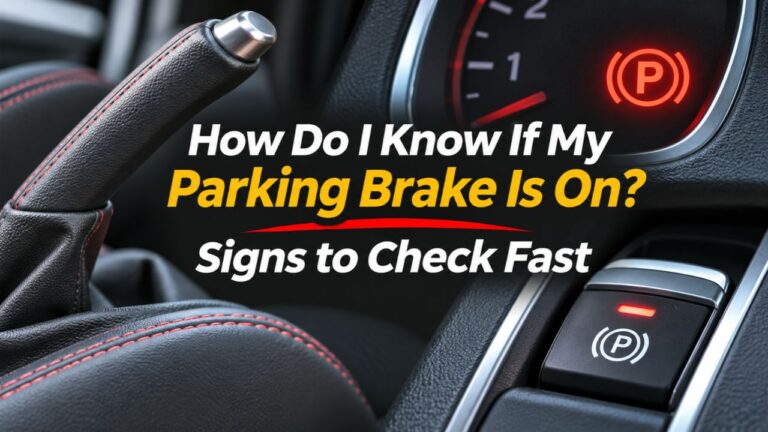
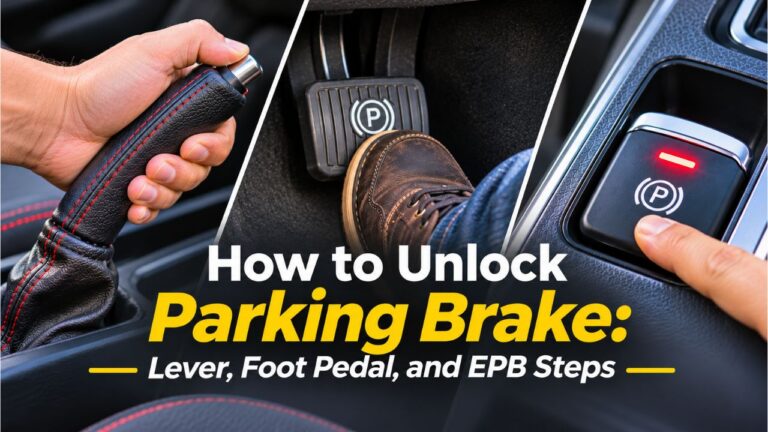
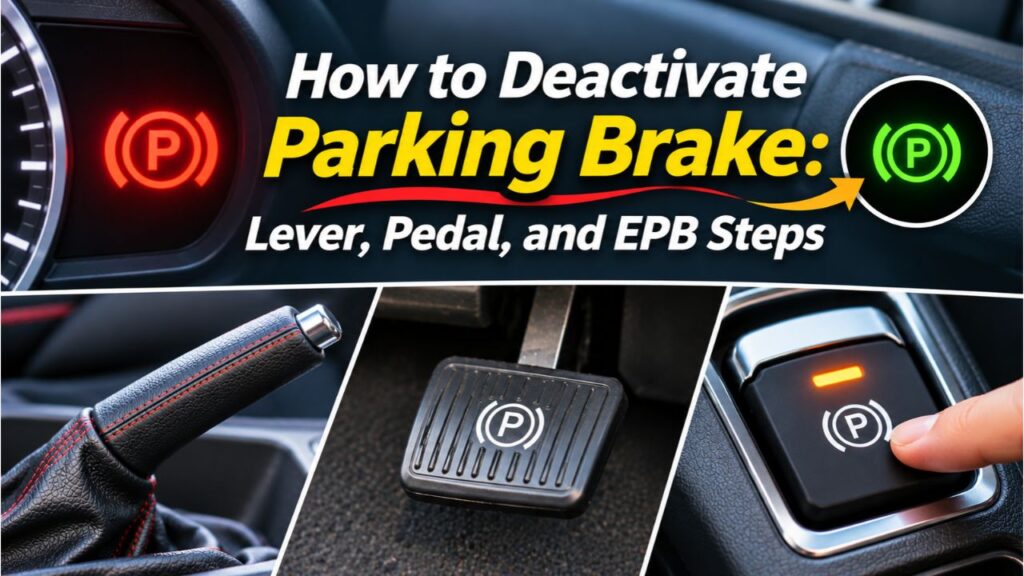
Look for a lever between the seats, a small pedal to the left of the driver’s footwell, a separate release handle under the dashboard, or an electric switch marked with a P inside a circle. Some foot pedals release when pressed a second time; others release only when a handle is pulled.
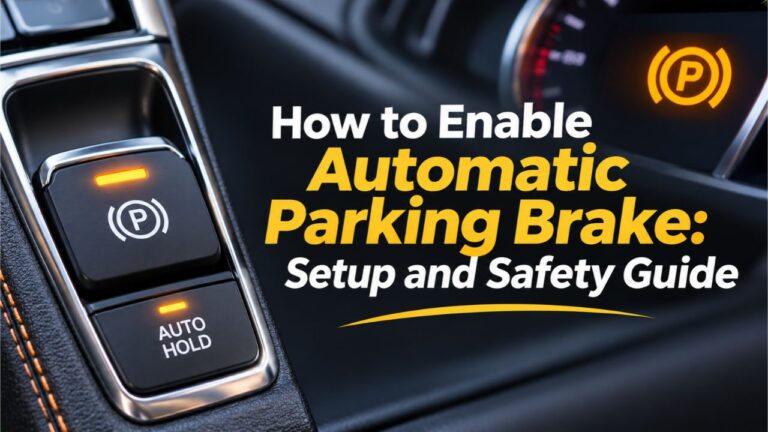
Do not confuse an EPB switch with Auto Hold, which may temporarily maintain service-brake pressure after a stop. If you cannot identify the exact control, consult the vehicle’s owner’s manual before pressing or pulling anything.
Step 04: Release a Hand-Operated Parking Brake Lever
Keep holding the service brake. Grasp the parking-brake lever and lift it slightly to remove pressure from its locking ratchet. Press the button at the tip of the lever, hold it in, then lower the lever completely to its resting position. Let go of the button once the lever is down.
Mazda’s 2026 MX-5 parking-brake instructions describe this lift-button-lower sequence while holding the brake pedal. This approach applies to many handbrakes. If the lever will not lower with normal effort, do not strike it or force the button; check for a jammed latch or damaged cable.
Step 05: Release a Push-On, Push-Off Foot Parking Brake
Some vehicles have a separate parking-brake pedal that alternates between applied and released positions when pressed. With your right foot still holding the service brake, press the parking-brake pedal again using your left foot. It should unlatch and return toward its raised position.
Make sure the pedal returns fully, not just partway. A foot pedal remaining close to the floor may indicate a sticky release mechanism or an incorrectly identified design. Do not repeatedly stamp on a pedal that will not release. Check whether the vehicle actually uses a separate release handle before trying another method.
Step 06: Release a Foot Brake With a Dashboard Handle
Other cars and trucks use a foot pedal to apply the parking brake and a pull handle to release it. Look beneath the dashboard near the steering column or driver’s left knee for a handle labeled PARK BRAKE or showing the parking-brake symbol. Keep the service brake pressed and pull the handle according to the manual.
The small parking-brake pedal should move back to its released position. Listen for normal latch movement and look at the pedal rather than relying only on the sound. If the handle pulls unusually far or the pedal stays down, the cable or release linkage may need service. Do not reach under the dashboard while the vehicle is moving.
Step 07: Deactivate an Electric Parking Brake With the Switch
Switch the ignition or vehicle power to the state required by the manufacturer, often ON or READY. Keep your foot on the service brake, find the EPB switch, and press it in the release direction. On many vehicles, pressing down releases the brake, while pulling up applies it. Wait for the actuator to finish operating and look for the parking-brake indicator to switch off.
The 2025 Ford Explorer owner’s manual instructions for manual EPB release specify turning the ignition on, holding the brake pedal, and pushing the switch down. Controls vary by model. If the switch flashes or a warning says the brake did not release, do not accelerate against it.
Step 08: Check Whether Automatic Release Is Enabled
Some EPB systems release automatically when the driver selects a gear and begins moving under approved conditions. Depending on the vehicle, those conditions may include a closed driver’s door, fastened seat belt, running engine or ready drive system, and no active brake-system faults.
Automatic release is not guaranteed just because you shifted into Drive. If the parking-brake light stays on, use the prescribed manual switch method while holding the service brake. Do not raise engine speed to overpower a brake that appears stuck.
Step 09: Verify the Parking-Brake Indicator and Control Position
Check the instrument cluster after the release command. The red parking-brake indicator normally goes out when the system confirms release, although a brake warning lamp can also remain illuminated for other reasons. With a mechanical system, the hand lever should be fully lowered or the parking-brake pedal should have returned to its normal position.
If a warning message reads Parking Brake Not Released, Service Parking Brake, or similar, follow the owner’s manual and stop if the cause is unclear. A light going out does not prove the brakes are free.
Step 10: Confirm the Wheels Are Not Being Held Back
If the vehicle has no fault messages, the controls have returned normally, and the service brakes work properly, prepare to move away using the normal driving procedure. As you begin moving slowly in a clear area, pay attention to unusual resistance, pulling, scraping, or a burning smell. Do not use high throttle to test a questionable release.
If the vehicle resists moving or a wheel feels locked, stop immediately and keep it secured. A seized cable, caliper mechanism, or parking-brake shoe can remain engaged even when the driver control is released. Have it inspected before further movement.
Step 11: Select Your Driving Gear and Move Away Carefully
With the service brake still pressed, select the appropriate gear. On a hill, coordinate the service brake, clutch if fitted, and accelerator using the vehicle’s normal hill-start method. Ease off the foot brake only when the parking brake is released and you are ready to drive.
Verify the response even when an EPB operates automatically. If you choose not to leave, secure the transmission and reapply the parking brake rather than relying on the foot brake while getting out.
Step 12: Stop if the Parking Brake Will Not Deactivate
If the switch does not respond, the pedal remains latched, or the rear wheels stay locked, do not bypass the system. Read the dashboard message and the manufacturer’s release instructions. A low battery might prevent an EPB motor from operating, while rust or damaged hardware can jam mechanical brakes.
For an unresolved fault, arrange professional assistance or suitable towing. Tell the recovery operator that a parking brake may be stuck so locked wheels are not dragged across the ground.
How to Turn Off Automatic Parking Brake Operation
Manually releasing an EPB is not the same as turning off automatic application. Some vehicles apply the parking brake when the transmission enters Park, when the ignition switches off, or when Auto Hold transfers control to the EPB. You may want temporary cancellation for a specific service procedure or a conveyor-style car wash, but the availability and method vary widely.
Mazda’s 2026 Mazda3 EPB settings instructions describe both shift-linked release settings and temporary cancellation of automatic parking-brake application. The manual also warns that certain canceled functions return when vehicle power is switched back on and gives separate precautions for securing the car. Do not copy that switch sequence to a different model.
If the owner’s manual provides an automatic-mode OFF setting, change it only while stopped and follow the displayed confirmation. Keep the vehicle appropriately secured whenever automatic application is turned off. Do not disconnect fuses, sensors, cables, or actuators simply to prevent automatic parking-brake operation. Doing so can disable safety functions or create unexpected faults.
Why the Parking Brake May Refuse to Release
Seized Cable or Rear Brake Hardware
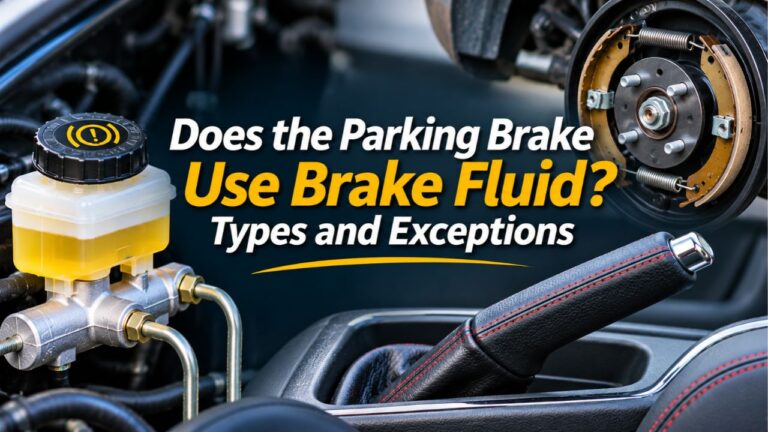
Water, corrosion, worn return springs, or damaged shoes can keep a mechanical parking brake engaged after its cabin control releases. In cold weather, moisture around a cable or brake assembly can freeze. A dragging rear caliper can create similar symptoms on designs that use its piston or lever for parking-brake application.
Do not use open flames, boiling water, or repeated acceleration to free a stuck brake. Damaged cables, calipers, or shoes need proper inspection and repair.
Weak Battery or Electronic Parking-Brake Fault
An electric parking brake generally needs sufficient electrical power to command its actuator. A discharged 12-volt battery, damaged wiring, failed switch, motor problem, or module fault can interfere with release. Some manufacturers provide a battery-support or recovery procedure; others require diagnostic equipment.
Use only the model-specific method. Never supply power directly to a brake motor or retract an electronic caliper by force to make the vehicle move.
Brake Warning Light Remains On
A red brake warning can mean the parking brake is applied, but it can also indicate a brake-fluid or hydraulic problem. Yellow or amber EPB warnings often relate to electronic control faults. Read the message rather than assuming the indicator is broken.
If the service-brake pedal feels abnormal or the system reports a brake malfunction, avoid driving even if the EPB seems to have released.
Parking Brake Release Versus Auto Hold and Transmission Park
These functions can interact without being identical:
| Function | What It Does | How It Is Normally Released |
| Parking brake | Holds the parked vehicle using a dedicated holding mechanism | Lever, pedal, or EPB command |
| Auto Hold | Holds service-brake pressure after some stops | Model-specific switch or drive-away logic |
| Transmission Park | Mechanically restrains an automatic drivetrain on many vehicles | Select another gear while following shift-interlock rules |
Turning off Auto Hold does not necessarily release an applied EPB. Similarly, shifting out of Park does not guarantee every car will release its parking brake. Identify which function is actually engaged before trying to move.
When You Should Not Try to Deactivate the Parking Brake
Keep the parking brake engaged whenever an unattended vehicle must remain secured. If the car is on a hill, confirm the proper transmission position and use wheel chocks where appropriate before any maintenance or recovery work. Do not release the holding brake while someone is working under the vehicle unless the approved service process provides another secure restraint.
If the brake is overheated, stuck, or displaying a malfunction, normal release steps may not solve the problem. Allow hot parts to cool without touching them, and arrange diagnosis rather than driving to see whether the problem disappears.
FAQs About How to Deactivate Parking Brake
Can I Deactivate an Electric Parking Brake With the Engine Off?
Some EPBs can be released with the ignition or vehicle power ON even if the engine is not running. Other models have additional conditions. Follow the manual, especially if the battery is weak.
How Do I Turn Off a Parking Brake That Has a Foot Pedal?
Keep your foot on the main brake, then either push the parking-brake pedal again or pull its separate release handle. The correct method depends on the vehicle.
Why Does My Electric Parking Brake Turn On Again Automatically?
Some models apply the EPB when you select Park or switch off vehicle power. That can be normal. Check the owner’s manual for any supported automatic-mode setting.
Can I Permanently Disable the Parking Brake?
Permanently defeating the parking-brake system is unsafe and may violate applicable vehicle requirements. Use only manufacturer-supported settings or temporary service procedures when needed.
Why Is the Parking Brake Light On After I Release It?
The brake may still be engaged, its position sensor may have a fault, or another brake-system warning may be active. Do not drive until you understand the warning and verify braking is safe.
Release the Parking Brake Properly Before Driving
Knowing how to deactivate parking brake controls starts with identifying the system: hand lever, foot pedal, or electric switch. Hold the service brake while releasing it, use the correct control method, and confirm that the indicator and mechanism both show a successful release.
For automatic EPB features, use the vehicle’s documented settings rather than attempting to disable safety components. A setting that changes automatic application is different from releasing the parking brake for a normal trip.
If the brake stays stuck, a warning remains, or the vehicle drags when moving, stop and arrange inspection. A confirmed, fully released parking brake is safer than forcing the vehicle forward and risking overheated brakes.