Loaded vs Semi Loaded Brake Caliper: Key Differences Explained
When buying a replacement brake caliper, you may see terms such as loaded caliper, semi-loaded caliper, and bare caliper. These names describe what parts come with the caliper, not how powerful the brake is. Understanding loaded vs semi loaded brake caliper options can help you avoid buying duplicate parts or discovering halfway through a brake job that important hardware is missing.
A loaded brake caliper normally comes with brake pads and most installation hardware already included, while a semi-loaded caliper usually includes the caliper and mounting hardware but not the brake pads.
The exact contents can vary between manufacturers and retailers, so you should always check the product description before ordering. One company may call a caliper “semi-loaded” because it includes a bracket and slide pins, while another may package slightly different hardware under the same term.
For a complete brake job, a loaded caliper can reduce the number of separate parts you need to purchase. A semi-loaded caliper gives you more freedom to choose your own brake pads while still providing more components than a bare caliper.
This guide explains the differences, what typically comes with each type, the advantages and disadvantages, and which option makes the most sense for different brake repairs.
Loaded vs Semi Loaded Brake Caliper: What Is the Difference?
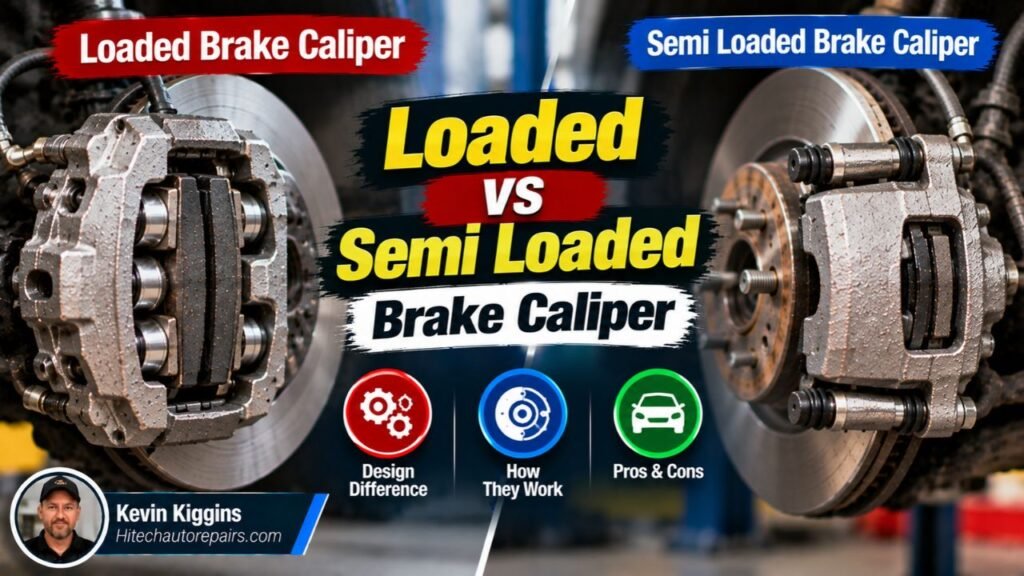
The main difference between a loaded and semi-loaded brake caliper is the included brake pads.
A loaded brake caliper generally arrives with the brake pads installed or packaged with the caliper, along with commonly required mounting hardware.
A semi-loaded brake caliper generally includes the caliper body and some associated hardware but does not include brake pads.
A typical comparison looks like this:
| Feature | Loaded Caliper | Semi-Loaded Caliper |
| Caliper body | Yes | Yes |
| Caliper piston | Yes | Yes |
| Piston seals | Yes | Yes |
| Mounting bracket | Usually | Often |
| Slide pins | Usually | Often |
| Brake pads | Usually yes | Usually no |
| Pad hardware/clips | Often | May vary |
| Ready for installation | More complete | Requires pads |
| Pad choice flexibility | Lower | Higher |
Because terminology is not perfectly standardized, verify the actual package contents before purchasing.
What Is a Loaded Brake Caliper?
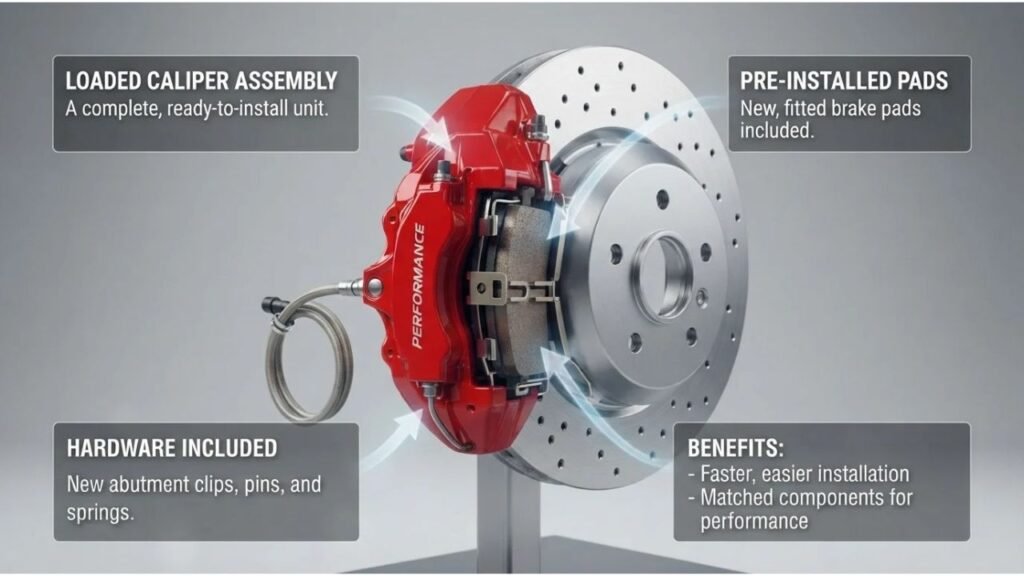
A loaded brake caliper is a replacement caliper assembly that normally comes with brake pads and much of the hardware required for installation.
Depending on the product, it may include:
- Caliper housing
- Caliper piston or pistons
- Piston seals
- Dust boots
- Caliper mounting bracket
- Slide pins
- Slide-pin boots
- Brake pads
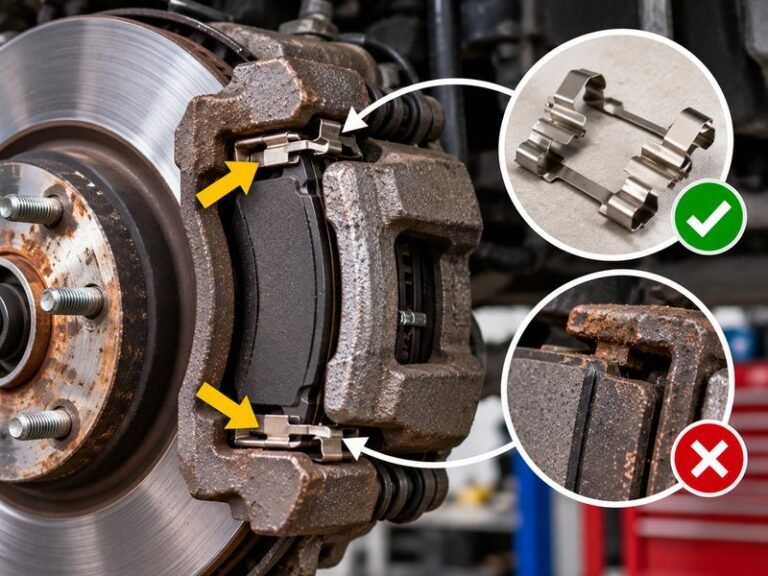
- Pad clips or abutment hardware
Some loaded calipers arrive with the pads already positioned in the bracket, making installation more convenient.
Why Is It Called “Loaded”?
The word “loaded” means the caliper is supplied with additional brake components rather than only the basic hydraulic caliper body.
It does not mean that the caliper has more braking force.
A loaded and semi-loaded version designed for the same vehicle can provide the same braking performance once the correct pads and hardware are installed.
What Is a Semi-Loaded Brake Caliper?
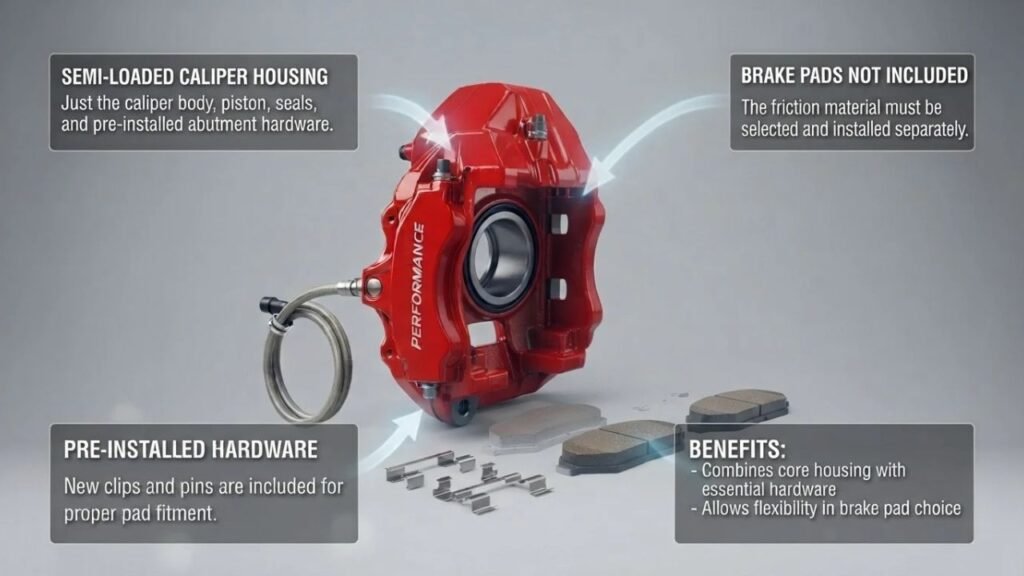
A semi-loaded brake caliper is a more complete assembly than a bare caliper but normally does not include brake pads.
It may come with:
- Caliper body
- Piston
- Hydraulic seals
- Dust boot
- Mounting bracket
- Slide pins
- Slide-pin boots
- Some mounting hardware
You then purchase the brake pads separately.
Semi-loaded calipers are useful when you want a ready-to-install caliper assembly but prefer to choose your own pad material or brand.
What Is a Bare Brake Caliper?
A bare caliper generally includes fewer components than either a loaded or semi-loaded caliper.
Depending on the application, it may include only the primary caliper body with piston and seals.
You may need to reuse or purchase separately:
- Mounting bracket
- Slide pins
- Boots
- Pad clips
- Brake pads
Bare calipers can cost less upfront, but they may require more cleaning, inspection, and parts transfer during installation.
Loaded vs Semi Loaded vs Bare Brake Caliper
The three categories mainly differ in how much of the brake assembly is included.
| Caliper Type | Pads Included | Bracket Usually Included | Hardware Level | Best For |
| Loaded | Yes | Usually | Most complete | Convenient replacement |
| Semi-loaded | No | Often | Moderate to high | Choosing separate pads |
| Bare | No | Sometimes not | Minimal | Reusing existing hardware |
Always compare the actual contents rather than relying on the product name alone.
Advantages of a Loaded Brake Caliper
A loaded caliper can simplify a brake repair because many components arrive together.
Fewer Parts to Buy Separately
You may not need to purchase:
- Pads
- Some clips
- Slide hardware
- Brackets
This reduces the chance of forgetting an important component.
Faster Installation
Because the pads and hardware are often already matched to the caliper, less preparation may be required.
This can be helpful for DIY brake jobs or professional shops trying to reduce installation time.
Matching Components
The included pads are selected to fit the supplied caliper.
That reduces concerns about ordering the wrong pad shape for the caliper.
Useful for Heavily Worn Brake Systems
If an old caliper is badly rusted and its hardware is also worn, buying a loaded assembly can replace several questionable components at once.
Disadvantages of a Loaded Brake Caliper
Loaded calipers are convenient, but they are not always the best choice.
Less Control Over Brake Pad Selection
You may prefer a particular:
- Ceramic pad
- Semi-metallic pad
- Low-dust pad
- Performance pad
- Premium pad brand
A loaded caliper may come with pads you would not have chosen separately.
Higher Initial Price
Because more components are included, loaded calipers can cost more than semi-loaded or bare versions.
However, the final total may still be competitive once separate pads and hardware are added to other options.
Included Pads May Be Basic
Some loaded assemblies include standard replacement pads rather than premium friction material.
Check the pad specifications if noise, dust, towing performance, or high-temperature braking matters to you.
Advantages of a Semi-Loaded Brake Caliper
A semi-loaded caliper provides a useful balance between convenience and flexibility.
You Choose Your Own Brake Pads
This is the biggest advantage.
You can select pads based on:
- Driving style
- Noise level
- Brake dust
- Towing
- Performance
- Price
Important Caliper Hardware May Already Be Included
Unlike a bare caliper, a semi-loaded caliper may include the bracket, slide pins, and boots.
This reduces the amount of old hardware you need to reuse.
Good for Complete Brake Jobs
If you already planned to buy a specific pad set, a semi-loaded caliper lets you replace the caliper without paying for an additional set of pads you do not want.
Disadvantages of a Semi-Loaded Brake Caliper
The main disadvantage is that more parts must be selected separately.
You need to make sure the replacement pads:
- Fit the vehicle
- Match the caliper
- Are suitable for the intended use
Some semi-loaded calipers may also exclude certain hardware, so check the package carefully.
Does a Semi-Loaded Caliper Come With a Bracket?
Often, but not always.
Many semi-loaded calipers include the caliper mounting bracket, slide pins, and boots.
However, product terminology varies.
Some suppliers may use “semi-loaded” for a caliper assembly with a bracket, while others may include different combinations of hardware.
Check the listing for terms such as:
- Bracket included
- Hardware included
- Slide pins included
- Mounting hardware included
Do not assume the bracket is present based only on the words “semi-loaded.”
Does a Loaded Caliper Always Include Brake Pads?
Usually, yes.
Brake pads are generally what distinguishes a loaded caliper from a semi-loaded one.
However, the exact definition can vary by supplier.
Before ordering, verify that the package specifically lists:
- Inner brake pad
- Outer brake pad
- Pad hardware
If the listing is unclear, check the manufacturer’s parts description.
Does a Loaded Caliper Include a Brake Hose?
Usually not.
A brake hose is generally a separate component.
A loaded caliper typically focuses on the caliper, pads, bracket, and related mounting hardware.
If your brake hose is damaged, cracked, swollen, leaking, or internally restricted, it may need to be replaced separately.
Does a Loaded Caliper Include a Rotor?
No, normally not.
Brake rotors are usually sold separately from calipers.
A complete brake repair may therefore require:
- Caliper
- Brake pads
- Brake rotor
- Brake hose
- Brake fluid
Which parts actually need replacement depends on their condition.
Which Is Better: Loaded or Semi-Loaded Brake Caliper?
Neither type is automatically better.
The best choice depends on what you need from the brake repair.
Choose a loaded caliper when:
- You need pads anyway.
- You want fewer separate parts.
- Convenience matters.
- Old brake hardware is badly worn.
- You want a more complete assembly.
Choose a semi-loaded caliper when:
- You already bought brake pads.
- You want a specific brake-pad brand.
- You prefer premium ceramic or performance pads.
- You want more control over friction material.
- Your brake job requires specialized pads.
For many DIY repairs, a loaded caliper is convenient. For drivers who are particular about brake-pad performance, a semi-loaded caliper may make more sense.
Are Loaded Calipers More Expensive?
Loaded calipers usually cost more than equivalent semi-loaded versions because additional components are included.
However, compare the total repair cost rather than only the caliper price.
For example:
Loaded option:
Caliper + bracket + hardware + pads
Semi-loaded option:
Caliper + bracket + hardware + separately purchased pads
Once separate brake pads are included, the difference in total price may become much smaller.
Do Loaded Calipers Save Labor Time?
They can.
If pads and hardware are already installed or matched to the assembly, there may be less time spent:
- Cleaning old brackets
- Removing corroded hardware
- Lubricating replacement slide pins
- Installing pad clips
- Transferring parts
This can make loaded calipers especially useful when the original assembly is heavily rusted.
Installation procedures still vary by vehicle.
Can You Change the Pads on a Loaded Caliper?
Yes.
If you purchase a loaded caliper but prefer different brake pads, you can normally remove the included pads and install compatible replacements.
However, doing so may eliminate part of the financial advantage of buying the loaded version.
If you already know you want specific pads, buying a semi-loaded caliper may be more economical.
Do You Need to Replace Calipers in Pairs?
Not always.
A failed caliper can often be replaced individually if the opposite-side caliper is still operating correctly.
However, inspect both calipers on the axle.
Replacing both may be reasonable when:
- Both are heavily corroded.
- Both have similar mileage.
- Both show sticking or damaged boots.
- One failed because of age-related deterioration that is also present on the other side.
Brake pads, on the other hand, are generally replaced on both sides of the same axle.
Should You Replace Brake Pads With a New Caliper?
Usually, especially if the old caliper caused abnormal pad wear.
Replace the pads if they are:
- Unevenly worn
- Overheated
- Contaminated with brake fluid
- Below minimum thickness
- Cracked or damaged
Pads should generally be replaced as an axle set rather than replacing only one wheel’s friction material.
Should You Replace the Rotor Too?
Not automatically.
Inspect the rotor for:
- Thickness
- Deep scoring
- Heat spots
- Cracking
- Excessive rust
- Uneven wear
If a sticking caliper overheated the rotor, replacement may be necessary.
The rotor should meet the vehicle manufacturer’s minimum thickness specifications.
New vs Remanufactured Loaded Calipers
Loaded and semi-loaded calipers may be available as either new or remanufactured parts.
New Caliper
A new caliper is manufactured with new major components.
It may cost more depending on the vehicle.
Remanufactured Caliper
A remanufactured caliper starts with a reusable original housing that has been disassembled, cleaned, inspected, and fitted with replacement wear components.
Quality can vary by manufacturer.
A reputable remanufactured caliper can be a practical replacement for many vehicles.
Some remanufactured calipers may also require a core charge, which is refunded when you return your old caliper.
What to Check Before Ordering a Brake Caliper
Brake calipers can differ even between vehicles with the same model name.
Before ordering, confirm:
- Vehicle year
- Make
- Model
- Engine if relevant
- Trim
- Front or rear position
- Left or right side
- Rotor size
- Brake package
- Piston count
- Electronic parking brake configuration
Some vehicles have different brake packages based on wheel size, towing package, performance trim, or manufacturing date.
The VIN can sometimes help confirm the correct brake configuration.
Installation Considerations
Replacing a caliper involves opening the hydraulic brake system.
That means the brake system normally needs to be bled after installation.
During the repair, make sure:
- Brake hose is not twisted.
- Banjo bolt washers are replaced if required.
- Caliper bolts are tightened to specification.
- Slide pins move freely.
- Pads are installed correctly.
- Brake fluid remains at the correct level.
- Hydraulic connections do not leak.
Never allow a caliper to hang from the flexible brake hose.
Support it appropriately during service.
Brake Fluid Contamination Matters
If an old caliper leaked brake fluid onto the pads, those pads should generally be replaced.
Brake friction material can absorb fluid, reducing braking performance.
Clean or replace contaminated components according to the vehicle manufacturer’s service guidance.
Do not attempt to restore heavily contaminated brake pads simply by wiping them off.
Common Mistakes When Choosing a Replacement Caliper
One common mistake is assuming every loaded caliper contains exactly the same parts.
Another is ordering based only on vehicle make and model without checking the specific brake package.
Other mistakes include:
- Buying the wrong side
- Assuming a bracket is included
- Assuming pads are premium quality
- Reusing damaged slide hardware
- Ignoring a restricted brake hose
- Replacing a caliper without diagnosing the original problem
- Forgetting that opening the hydraulic system requires bleeding
Checking package contents before starting the repair prevents many of these problems.
FAQs About Loaded vs Semi Loaded Brake Caliper
What does loaded brake caliper mean?
A loaded brake caliper normally means the caliper comes with brake pads and much of the related mounting hardware.
It is designed to provide a more complete replacement assembly.
What does semi-loaded brake caliper mean?
A semi-loaded caliper generally includes the caliper and some mounting components but does not include brake pads.
The exact hardware included varies by manufacturer.
Does a semi-loaded caliper include brake pads?
Usually not.
The absence of brake pads is generally the main difference between semi-loaded and loaded calipers.
Always check the product description because terminology can vary.
Does a loaded brake caliper include the bracket?
Most loaded calipers include the mounting bracket, but this is not guaranteed.
Verify the listing before purchase.
Is a loaded caliper easier to install?
It can be.
Because the pads, bracket, and hardware may already be included, fewer old components need to be cleaned or transferred.
The hydraulic connection and brake bleeding process are still required.
Are loaded calipers better than unloaded calipers?
Not necessarily.
Loaded calipers are more convenient, while less-complete calipers allow you to select more of the components yourself.
The actual braking performance depends on the quality and condition of the complete brake system.
Are semi-loaded calipers cheaper?
They are often less expensive upfront because brake pads are not included.
However, adding a separate pad set may reduce the overall price difference.
Can I use premium pads with a semi-loaded caliper?
Yes.
This is one of the main reasons to choose a semi-loaded caliper. You can select compatible ceramic, semi-metallic, performance, towing, or other brake pads based on your needs.
Conclusion
The key difference in loaded vs semi loaded brake caliper options is usually the brake pads. A loaded caliper generally comes with pads and most necessary mounting hardware, while a semi-loaded caliper normally includes the caliper, bracket, and related hardware but leaves the brake pads for you to purchase separately.
Choose a loaded caliper if you want a convenient, more complete package. Choose a semi-loaded caliper if you want greater control over the brake pads you install.
Because manufacturers do not always use these terms in exactly the same way, the safest approach is to check the actual included components before ordering. That small step can prevent missing parts, duplicate purchases, and delays during your brake repair.