Brake Rotor vs Caliper: Key Differences, Functions, and Problems
The brake rotor and brake caliper work together every time you press the brake pedal, but they perform completely different jobs. The rotor is the large metal disc that spins with the wheel, while the caliper sits around part of the rotor and pushes the brake pads against it.
In simple terms, the brake rotor is the spinning surface the pads squeeze, while the caliper is the hydraulic component that applies the squeezing force.
Understanding brake rotor vs caliper differences is useful when diagnosing brake noise, vibration, pulling, uneven pad wear, or repair estimates. A damaged rotor can cause pulsation and rough braking, while a bad caliper can cause dragging brakes, overheating, fluid leaks, or uneven braking.
Although these components work as one braking system, their failure symptoms, replacement procedures, service life, and costs can be very different. This guide explains what rotors and calipers do, how they interact with brake pads, how to recognize problems, and when each part may need repair or replacement.
Brake Rotor vs Caliper: What Is the Difference?
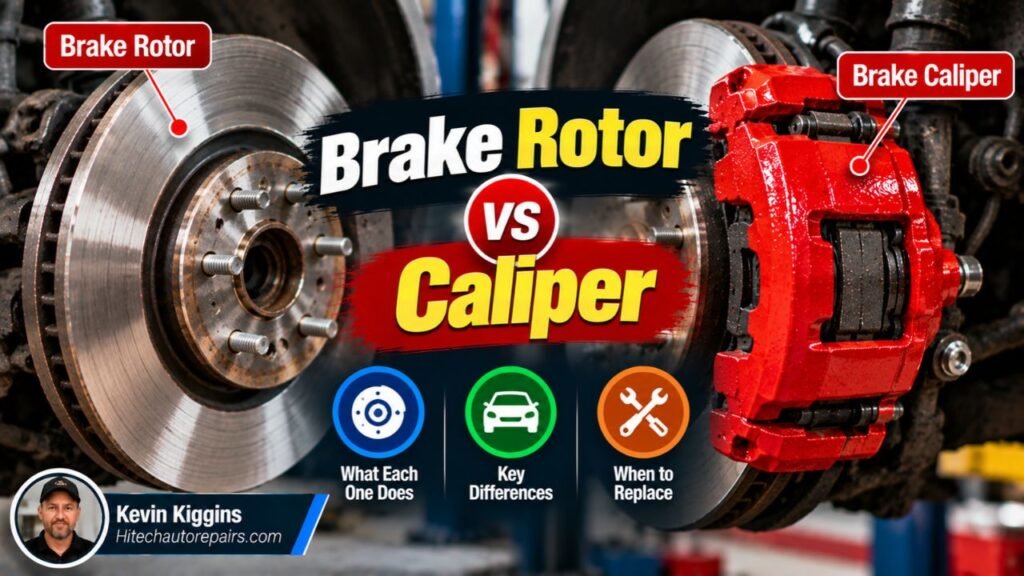
The main difference is that the brake rotor rotates with the wheel, while the brake caliper remains stationary and squeezes the brake pads against the rotor.
When you press the brake pedal, hydraulic pressure travels through the brake lines to the caliper. The caliper piston pushes the brake pads against both sides of the rotor. Friction between the pads and rotor slows the wheel.
Here is a quick comparison:
| Feature | Brake Rotor | Brake Caliper |
| Main job | Provides friction surface | Applies braking force |
| Movement | Rotates with wheel | Remains stationary |
| Location | Mounted to wheel hub | Mounted around rotor |
| Works with | Brake pads and caliper | Pads, rotor, hydraulic fluid |
| Common problems | Warping, scoring, cracking, rust | Seizing, leaking, sticking |
| Typical replacement | Often replaced in pairs | Usually replaced only when faulty |
| Wear item | Yes | Usually not |
| Hydraulic component | No | Yes |
The rotor handles friction and heat. The caliper controls how the brake pads contact that rotor.
What Is a Brake Rotor?
A brake rotor, also called a brake disc, is a round metal disc attached to the wheel hub.
The rotor spins whenever the wheel spins.
When the brake pads clamp onto the rotor, friction converts the vehicle’s motion into heat. That process slows the wheel and eventually brings the vehicle to a stop.
What Are Brake Rotors Made Of?
Most everyday brake rotors are made from cast iron because it handles heat well and provides a suitable friction surface.
Some performance vehicles may use:
- High-carbon iron
- Composite rotors
- Two-piece rotors
- Carbon-ceramic rotors
For most passenger cars, trucks, and SUVs, traditional cast-iron rotors remain the most common.
What Is a Brake Caliper?
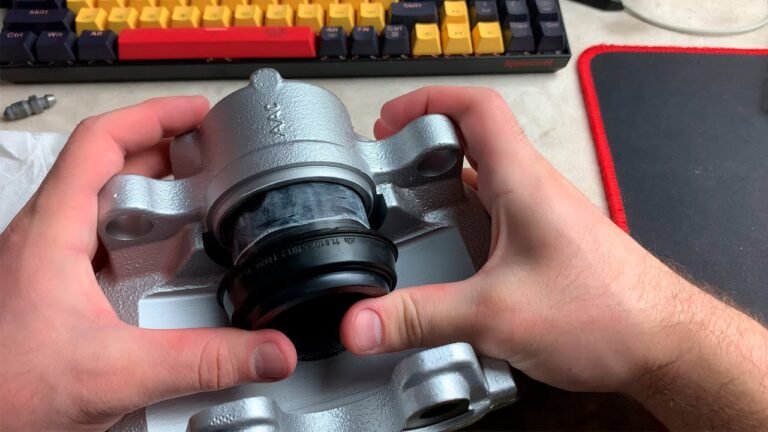
A brake caliper is the component that holds the brake pads and uses hydraulic pressure to push them against the rotor.
The caliper contains one or more pistons.
When you press the brake pedal:
- The master cylinder creates hydraulic pressure.
- Brake fluid carries that pressure through the brake lines.
- Pressure reaches the caliper.
- The caliper piston moves outward.
- The brake pads press against the rotor.
- Friction slows the wheel.
Without the caliper, the pads would have no mechanism for applying controlled pressure to the rotor.
How the Rotor and Caliper Work Together
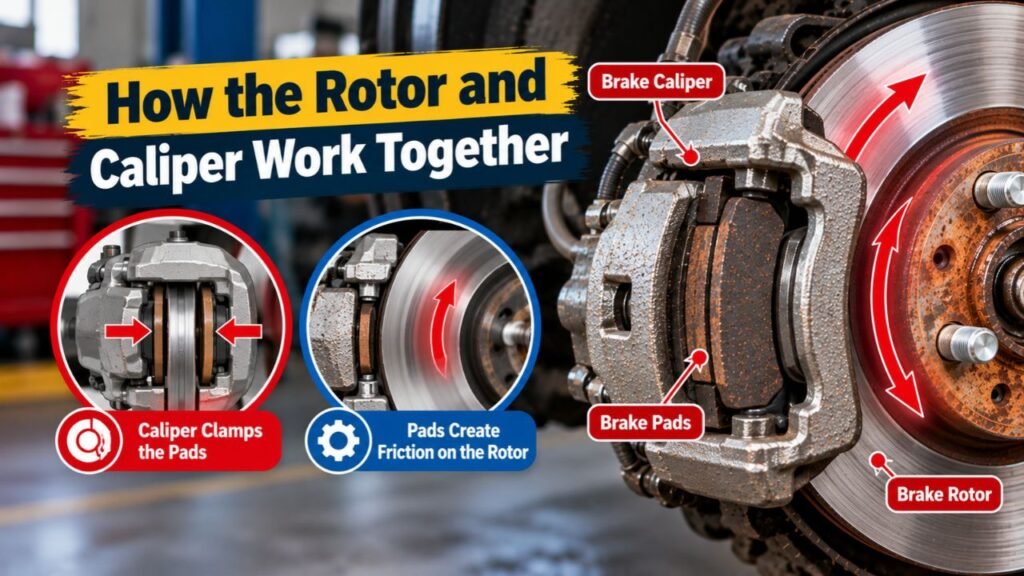
The rotor and caliper are separate parts, but neither can perform its job alone.
The rotor provides the rotating friction surface.
The caliper supplies the clamping force.
The brake pads sit between the caliper and rotor and provide the actual friction material.
The process looks like this:
Brake pedal → hydraulic pressure → caliper piston → brake pads → rotor → wheel slows
This relationship is the foundation of a typical disc brake system.
Where Are the Rotor and Caliper Located?
Both components sit inside the wheel assembly.
The brake rotor is mounted to the wheel hub.
The caliper is bolted to a bracket or steering knuckle and sits over part of the rotor’s outer edge.
If you look through an open-spoke wheel, you can often see:
- A large silver or gray circular disc — the rotor
- A smaller metal housing covering part of the disc — the caliper
On some vehicles, the caliper may be painted red, blue, yellow, black, or another color.
Types of Brake Rotors
Brake rotors come in several designs.
Solid Rotors
Solid rotors are made from a single solid section of metal.
They are commonly used on rear brakes or lighter vehicles.
Vented Rotors
Vented rotors have internal air passages between two friction surfaces.
These passages help release heat.
They are very common on front brakes because front brakes usually handle more braking load.
Drilled Rotors
Drilled rotors have holes through the friction surface.
They are commonly associated with performance or appearance upgrades.
Slotted Rotors
Slotted rotors contain machined grooves in the friction surface.
The slots can help manage gases, dust, and surface contamination in certain applications.
Drilled and Slotted Rotors
Some aftermarket rotors combine both drilled holes and slots.
For normal street driving, standard high-quality rotors are often completely adequate.
Types of Brake Calipers
Calipers also come in different designs.
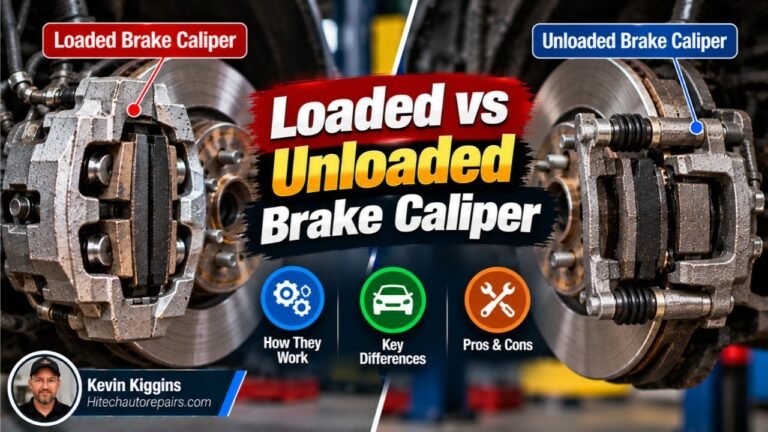
Floating Calipers
A floating caliper usually has pistons on one side.
When the piston pushes one pad toward the rotor, the caliper body slides so the opposite pad also contacts the rotor.
This design is common because it is relatively simple and affordable.
Fixed Calipers
A fixed caliper does not slide.
Instead, it normally uses pistons on both sides of the rotor.
Fixed calipers are common on high-performance vehicles and may use:
- Four pistons
- Six pistons
- Eight pistons
- Even more in specialized applications
These calipers can provide more even pad pressure and stronger performance, but they are usually more expensive.
Which Part Wears Out Faster?
The rotor generally wears faster than the caliper.
Brake rotors are considered wear components.
Every time the brakes are applied, the pads create friction against the rotor surface. Over thousands of braking events, the rotor gradually becomes thinner.
Calipers normally last much longer because they are not designed to wear away during normal operation.
However, calipers can still fail because of:
- Corrosion
- Damaged seals
- Sticking pistons
- Seized slide pins
- Brake fluid leaks
- Contamination
Brake Rotor Failure Symptoms
Rotor problems usually affect braking smoothness and surface condition.
Common symptoms include:
- Brake pedal pulsation
- Steering wheel vibration while braking
- Grinding noises
- Deep scoring
- Visible cracks
- Heavy rust
- Blue heat spots
- Uneven braking feel
Brake Pedal Pulsation
A pedal that pulses during braking can indicate rotor thickness variation or an uneven braking surface.
The sensation may become more noticeable at higher speeds.
Steering Wheel Vibration
Front rotor problems may cause the steering wheel to shake while braking.
This can happen when the brake pads contact an uneven rotor surface.
Grinding
Grinding may indicate that worn brake pads have allowed metal components to contact the rotor.
Severe grinding can damage the rotor quickly.
Brake Caliper Failure Symptoms
Caliper problems usually affect brake application or release.
Common signs include:
- Vehicle pulling while braking
- One wheel overheating
- Burning smell
- Uneven brake pad wear
- Brake fluid leak
- Brake dragging
- Poor braking on one side
- Reduced fuel economy from brake drag
Vehicle Pulling to One Side
If one caliper applies more or less pressure than the other, the vehicle may pull to one side during braking.
However, pulling can have other causes too, including:
- Tire pressure differences
- Alignment problems
- Brake hose issues
- Suspension problems
One Wheel Gets Very Hot
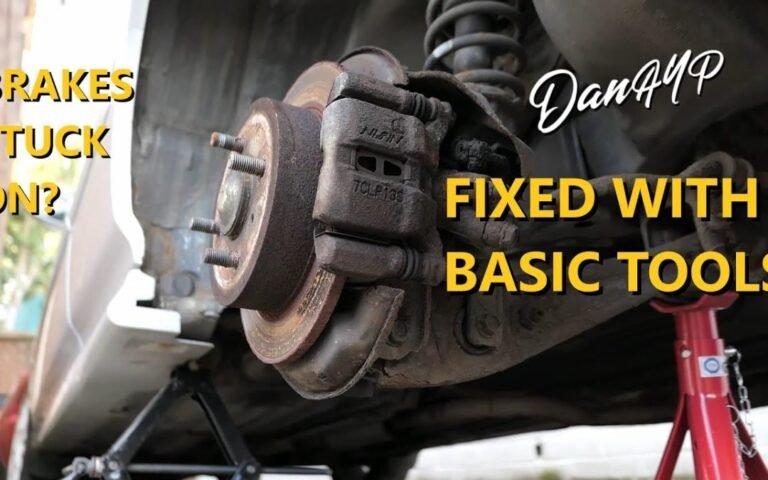
A stuck caliper can keep the brake pad pressed against the rotor after you release the pedal.
The friction creates excessive heat.
You may notice:
- Hot wheel
- Burning odor
- Smoke
- Reduced acceleration
- Poor fuel economy
A severely dragging brake should be inspected promptly.
Can a Bad Caliper Damage a Rotor?
Yes.
A bad caliper can damage a rotor very quickly.
If the caliper piston or slide pins stick, the brake pad may remain pressed against the rotor continuously.
This can create excessive heat and cause:
- Rotor discoloration
- Cracking
- Scoring
- Uneven wear
- Rotor distortion
- Premature pad failure
A failed caliper can therefore turn what might have been a caliper repair into a caliper, rotor, and brake pad replacement.
Can a Bad Rotor Damage a Caliper?
Usually, rotor damage does not directly destroy a caliper.
However, severe rotor problems can create:
- Excessive vibration
- Abnormal pad movement
- Additional heat
- Uneven braking forces
These conditions can contribute to wear elsewhere in the braking system.
If a rotor is badly damaged, the entire brake assembly should be inspected.
Brake Rotor vs Caliper Replacement Frequency
Brake rotors are replaced much more frequently than calipers.
Rotor Replacement
Rotors may need replacement when:
- They reach minimum thickness.
- They are deeply scored.
- They are cracked.
- They are badly corroded.
- Heat damage is severe.
- Surface problems cause vibration.
- Resurfacing is not practical.
Caliper Replacement
Calipers are generally replaced only when they develop a specific fault.
Common reasons include:
- Brake fluid leak
- Seized piston
- Damaged bore
- Severe corrosion
- Broken mounting point
- Persistent sticking
- Internal mechanical failure
There is no normal mileage interval requiring every caliper to be replaced.
Do Rotors Need to Be Replaced in Pairs?
Usually, yes.
If one front rotor needs replacement, both front rotors are normally replaced together.
The same principle applies to rear rotors.
Replacing rotors in axle pairs helps maintain consistent:
- Thickness
- Friction characteristics
- Heat response
- Braking performance
Brake pads should also normally be replaced as an axle set.
Do Calipers Need to Be Replaced in Pairs?
Not always.
If only one caliper has failed and the caliper on the opposite wheel works correctly, replacing only the faulty caliper may be acceptable.
However, a technician may recommend replacing both when:
- Both are severely corroded.
- Both are very old.
- The opposite caliper is beginning to stick.
- Matching performance is a concern.
An inspection is more useful than an automatic rule.
Brake Rotor vs Caliper Replacement Cost
Calipers generally cost more to replace than individual rotors.
Typical professional repair costs vary widely by vehicle, parts quality, and location.
A general comparison might look like this:
| Repair | Typical Relative Cost |
| One rotor | Low to moderate |
| Two rotors and pads | Moderate |
| One caliper | Moderate to high |
| Caliper plus pads and rotor | High |
| Performance caliper | Very high |
Caliper replacement costs more because the hydraulic brake line may need to be disconnected and the system must then be properly bled.
Rotor replacement does not normally require opening the hydraulic system.
Why Brake Rotors Get Hot
Heat is normal during braking.
The pads press against the spinning rotor and create friction.
That friction transforms kinetic energy into heat.
Rotors are designed to absorb and release that heat.
Problems occur when temperatures become excessive because of:
- Heavy repeated braking
- Towing
- Mountain driving
- Sticking caliper
- Aggressive driving
- Poor-quality components
- Insufficient cooling
Severe overheating may discolor or damage the rotor.
Why Brake Calipers Seize
A caliper may seize because of several problems.
Corrosion
Moisture and road salt can corrode:
- Caliper pistons
- Slide pins
- Brackets
- Hardware
This can prevent free movement.
Damaged Piston Boot
The rubber dust boot helps keep dirt and moisture away from the piston.
If it tears, corrosion may develop.
Seized Slide Pins
Floating calipers depend on smooth slide-pin movement.
Dry, rusty, or contaminated pins can prevent the caliper from applying and releasing evenly.
Old Brake Fluid
Brake fluid absorbs moisture over time.
Excess moisture can contribute to internal corrosion within brake components.
How to Tell Whether the Rotor or Caliper Is Bad
Symptoms often provide useful clues.
More Likely a Rotor Problem
Suspect the rotor when you notice:
- Pulsation mainly while braking
- Steering wheel vibration under braking
- Deep grooves
- Visible cracks
- Excessive rust on the braking surface
More Likely a Caliper Problem
Suspect the caliper when you notice:
- One wheel unusually hot
- Vehicle pulls while braking
- One brake pad wears much faster
- Brake remains partially applied
- Brake fluid leaks around the caliper
Some problems can involve both parts.
For example, a seized caliper may overheat and damage the rotor, creating both dragging and pulsation.
What About Brake Pads?
Brake pads are the third major part of the disc brake assembly.
They fit inside or against the caliper and contact the rotor during braking.
Brake pads are designed to wear faster than the rotor.
If they become too thin, the backing plate may eventually contact the rotor, creating grinding and serious rotor damage.
A complete brake inspection should consider:
- Pad thickness
- Rotor thickness
- Rotor surface condition
- Caliper movement
- Brake hoses
- Brake fluid leaks
- Slide pins
Can You Drive With a Bad Rotor?
It depends on the severity, but brake problems should not be ignored.
A lightly grooved rotor may still provide usable braking temporarily.
A rotor that is:
- Cracked
- Extremely thin
- Severely damaged
- Producing heavy vibration
needs prompt attention.
If braking performance feels unsafe, do not continue driving normally.
Can You Drive With a Bad Caliper?
A failing caliper can be more urgent because it may affect whether a brake applies or releases.
A seized caliper can cause:
- Extreme heat
- Brake fade
- Smoke
- Rotor damage
- Reduced fuel economy
- Wheel bearing stress
A leaking caliper can also reduce brake fluid and hydraulic pressure.
If there is a significant leak, smoke, severe pulling, or major brake drag, the vehicle should not be driven until repaired.
Which Is More Important: Rotor or Caliper?
Both are essential.
The rotor provides the surface needed to create friction.
The caliper applies the pressure that creates that friction.
If either part fails badly, braking performance can be compromised.
It is more useful to think of them as parts of one system rather than ranking one as more important.
Brake Rotor vs Caliper Maintenance
Rotors and calipers require different maintenance.
Rotor Maintenance
Rotors generally do not require regular lubrication.
Maintenance mainly involves:
- Periodic inspection
- Thickness measurement
- Checking for cracks
- Checking for scoring
- Watching for corrosion
Caliper Maintenance
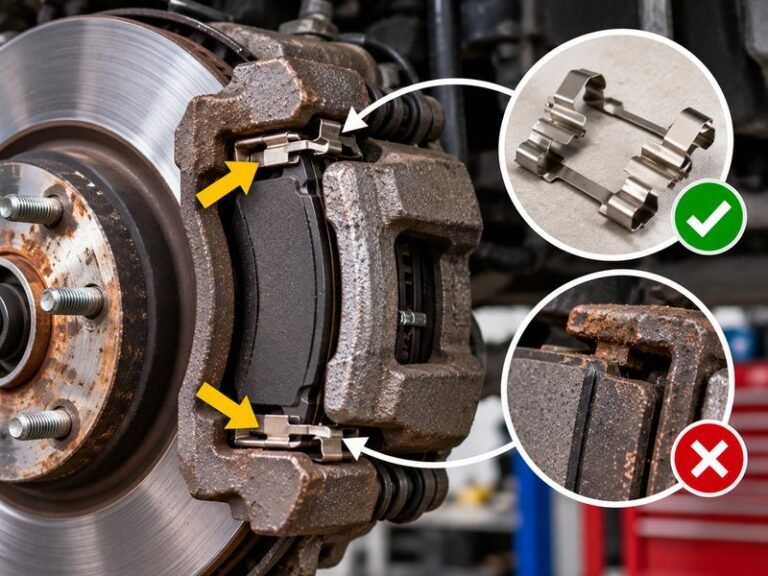
Floating calipers may require service of:
- Slide pins
- Rubber boots
- Mounting hardware
Slide pins typically need the correct brake-compatible lubricant.
Do not apply ordinary grease randomly to braking surfaces.
Common Misconceptions
“A Warped Rotor Means the Caliper Is Bad”
Not necessarily.
Rotor pulsation can occur without caliper failure.
However, a dragging caliper can overheat and damage the rotor.
“Calipers Need Replacement Every Brake Job”
False.
Calipers are not routine replacement items.
Pads and rotors wear much more commonly.
“A New Caliper Fixes Any Brake Vibration”
Not always.
Vibration may come from rotor thickness variation, wheel problems, suspension issues, or other causes.
Proper diagnosis matters.
FAQs About Brake Rotor vs Caliper
Is a Brake Caliper the Same as a Brake Rotor?
No.
The rotor is the spinning metal disc attached to the wheel hub.
The caliper is the stationary hydraulic component that squeezes the brake pads against the rotor.
Which Costs More to Replace, a Rotor or Caliper?
A caliper often costs more to replace, especially because the hydraulic system may need to be opened and bled.
However, vehicle-specific pricing varies significantly.
Can I Replace a Caliper Without Replacing the Rotor?
Yes, if the rotor remains within specification and has not been damaged by the faulty caliper.
The rotor should always be inspected before deciding.
Can I Replace Rotors Without Replacing Calipers?
Yes.
This is very common.
If the calipers work correctly, there is no reason to replace them simply because the rotors are worn.
What Happens If a Caliper Gets Stuck?
A stuck caliper may keep a pad pressed against the rotor.
This can cause overheating, excessive pad wear, rotor damage, burning smells, and vehicle pulling.
How Do I Know If My Rotor Is Bad?
Common clues include vibration while braking, pedal pulsation, deep scoring, cracks, heavy rust, or thickness below the manufacturer’s limit.
How Long Do Brake Calipers Last?
Calipers do not have a fixed replacement interval.
Many last a very long time, while others fail early because of corrosion, damaged seals, or poor slide-pin movement.
Are Rotors Supposed to Be Replaced With Brake Pads?
Not every time.
Rotors should be measured and inspected during pad replacement. They need replacement if they are too thin, damaged, badly corroded, or otherwise unsuitable for continued use.
Conclusion
The key difference in brake rotor vs caliper is straightforward: the rotor spins with the wheel and provides the friction surface, while the caliper uses hydraulic pressure to squeeze the brake pads against that rotor.
Rotors are normal wear components and may eventually become thin, scored, cracked, or uneven. Calipers usually last much longer but can fail because of leaks, corrosion, seized pistons, or sticking slide pins.
Because one faulty component can damage the others, brake diagnosis should look at the entire assembly rather than just one part. If you notice vibration, pulling, grinding, overheating, fluid leakage, or uneven pad wear, having the rotor, caliper, pads, and related hardware inspected together is the best way to identify the real problem.