Temporary Fix for Stuck Brake Caliper: Safe Short-Term Steps
A stuck brake caliper is not something you should ignore. When a caliper piston or slide mechanism fails to release properly, the brake pad can remain pressed against the rotor even after you take your foot off the brake pedal. That can create excessive heat, rapid brake wear, pulling, poor fuel economy, and in severe cases, loss of braking performance.
A temporary fix for stuck brake caliper may sometimes reduce the problem long enough to move the vehicle to a safer location or repair facility, but it is not a substitute for proper brake repair.
If the wheel is extremely hot, the car strongly pulls to one side, you smell burning brakes, or the brake is completely locked, driving is not recommended. The safest option is usually to have the vehicle towed.
The correct short-term approach depends on what is actually sticking. A frozen caliper piston, seized slide pin, collapsed brake hose, or badly rusted brake hardware can all produce similar symptoms but require different repairs.
Temporary Fix for Stuck Brake Caliper
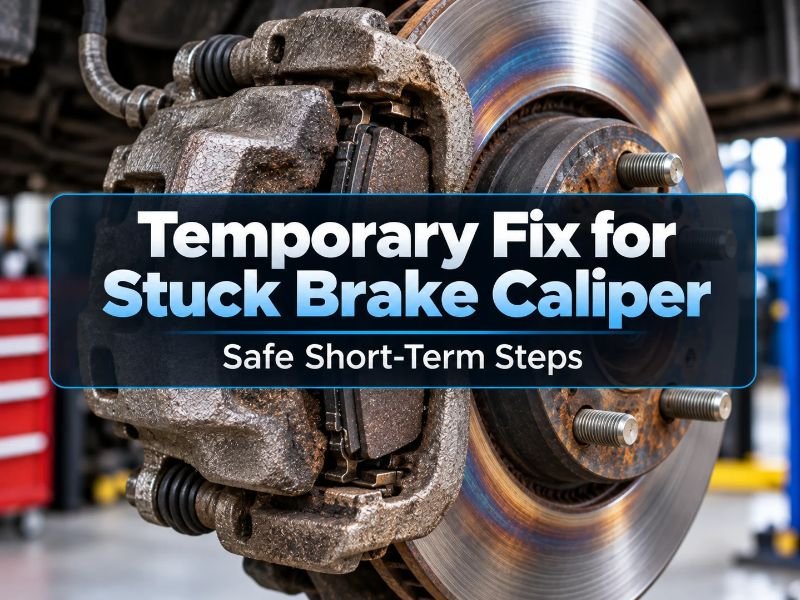
The safest temporary fix for stuck brake caliper problems is to identify whether the issue is caused by a sticking slide pin, binding brake pad, or seized piston and correct the underlying mechanical problem before driving.
If the caliper is only beginning to bind, several short-term steps may help:
- Allow overheated brakes to cool completely.
- Inspect the caliper slide pins for sticking.
- Clean and lubricate serviceable slide pins with proper brake lubricant.
- Make sure the brake pads can move freely in the bracket.
- Remove rust or debris that is causing the pads to bind.
- Replace damaged brake hardware when possible.
However, if the caliper piston itself is seized, there is usually no dependable temporary repair. The caliper generally needs to be rebuilt or replaced.
Do not attempt to keep driving by repeatedly forcing a stuck piston back into the caliper.
What Does a Stuck Brake Caliper Mean?
A brake caliper contains one or more pistons that push the brake pads against the rotor when you press the brake pedal.
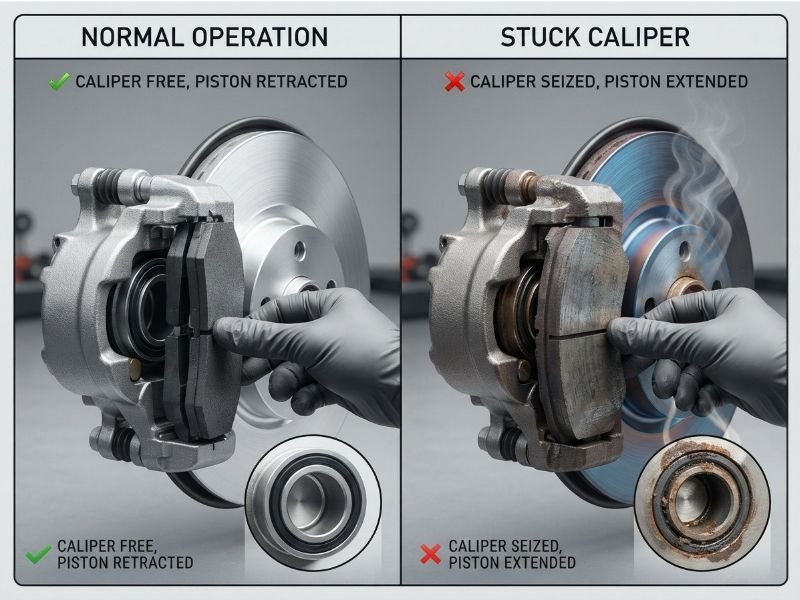
When you release the pedal, hydraulic pressure drops and the pads should release enough to stop creating significant braking force.
A caliper is considered stuck or seized when part of that mechanism cannot move normally.
The problem may involve:
- Caliper piston
- Slide pins
- Brake pads
- Caliper bracket
- Brake hose
- Parking brake mechanism on certain rear calipers
The symptoms can feel almost identical even though the failed component is different.
Signs You May Have a Stuck Brake Caliper
A dragging caliper often gives several warning signs.
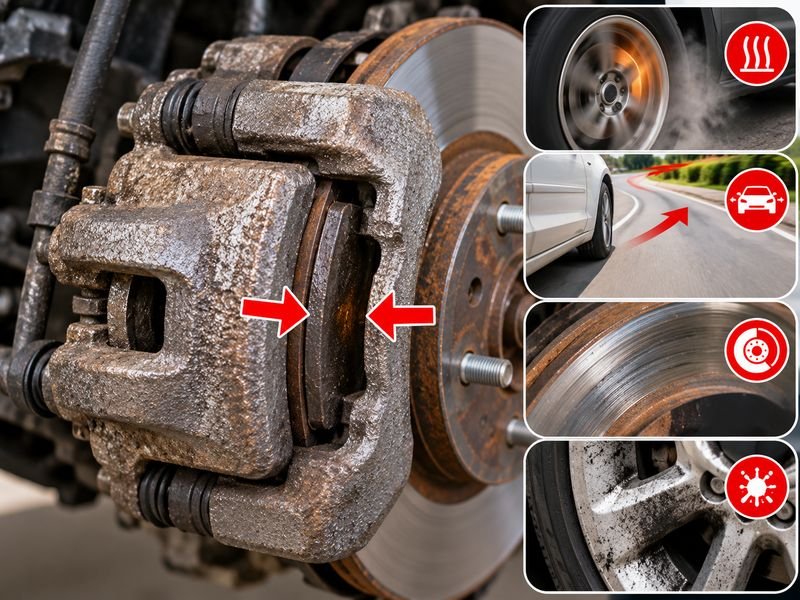
Common symptoms include:
- Vehicle pulls to one side
- One wheel becomes unusually hot
- Burning smell near a wheel
- Reduced acceleration
- Poor fuel economy
- Excessive brake dust on one wheel
- Brake pedal feels unusual
- Car does not roll freely
- Grinding or scraping noise
- One brake pad wears much faster than the other
- Smoke from the wheel area in severe cases
A very hot wheel after a short drive is a particularly important warning sign.
Do not touch the rotor or caliper immediately because brake components can become hot enough to cause serious burns.
Can You Drive With a Stuck Brake Caliper?
You should avoid driving with a clearly stuck brake caliper.
A lightly dragging brake may still allow the car to move, but friction continuously generates heat.
As temperature rises, several problems can occur.
The brake fluid may overheat, the rotor can become damaged, and the brake pads can wear rapidly.
A severely overheated brake can also cause brake fade, where braking performance decreases because components become too hot.
If the caliper is firmly seized, the wheel may lock or the vehicle may pull strongly.
In that situation, tow the vehicle rather than driving it.
What If the Caliper Is Only Slightly Sticking?
A mildly sticking caliper can sometimes be caused by corrosion or lack of lubrication in the slide pins rather than a failed piston.
If the brake has not severely overheated and you are comfortable performing brake work, removing the caliper and inspecting the slide system may reveal the problem.
The slide pins should generally move smoothly through their normal travel.
If one pin is rusty or dry, it may prevent the caliper from centering correctly.
Cleaning and properly lubricating the slide pin can sometimes restore normal movement.
This may actually solve the problem rather than merely provide a temporary fix.
Temporary Fix for Stuck Caliper Slide Pins
Sticking slide pins are one of the easier caliper-related problems to correct.
Remove the Caliper Safely
Support the vehicle securely on proper jack stands before working underneath or around a raised wheel.
Never rely only on a hydraulic jack.
Remove the wheel and inspect the caliper.
Check the Slide Pins
Caliper slide pins should move without excessive resistance.
If a pin is difficult to remove or move, corrosion may be present.
Clean the Pins
Remove old grease, rust, and contamination.
A severely pitted or damaged pin should be replaced rather than reused.
Apply Proper Brake Lubricant
Use a lubricant specifically designed for brake caliper slide pins and compatible with the rubber boots.
Do not use ordinary chassis grease or random petroleum grease.
Some lubricants can damage rubber components.
Inspect the Rubber Boots
A torn slide-pin boot can allow water and dirt inside.
If the boot is damaged, replace it.
Otherwise, the pin may seize again quickly.
Can You Free a Stuck Caliper Piston Temporarily?
Sometimes a piston that is only beginning to stick may move when pressure is applied or released, but repeatedly forcing it back is not a reliable repair.
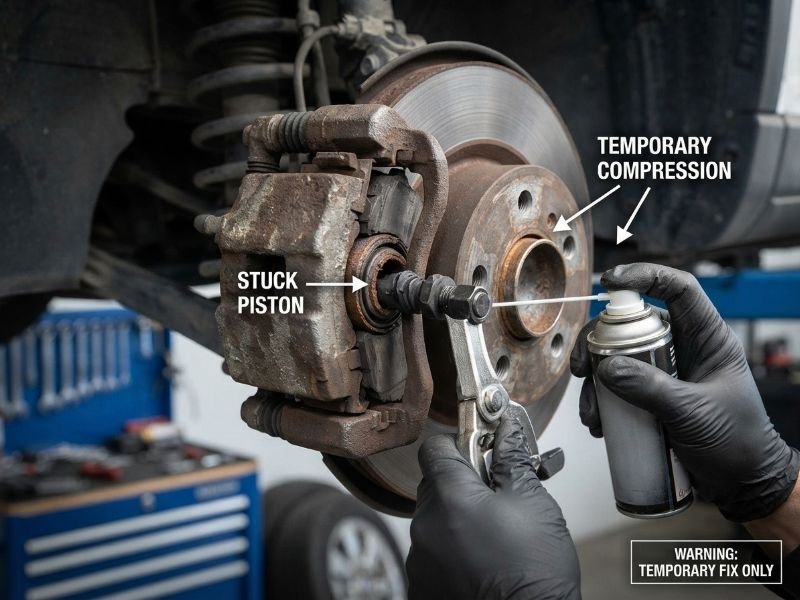
A piston commonly sticks because of:
- Rust
- Corrosion
- Damaged piston surface
- Failed piston seal
- Contaminated brake fluid
- Internal caliper damage
If corrosion is causing the piston to bind, pushing it back once does not remove the corrosion.
The piston may stick again as soon as you use the brakes.
For that reason, a caliper with a confirmed sticking piston should generally be replaced or professionally rebuilt.
Why Tapping a Stuck Caliper Is Not a Real Fix
You may hear advice to tap the caliper with a hammer to free it.
This is not a dependable repair.
A light tap might occasionally change the position of a stuck component, but striking the caliper can also damage:
- Caliper body
- Slide mechanism
- Piston
- Brake hose connection
- Bleeder screw
Even if tapping temporarily releases the brake, the underlying corrosion or mechanical problem remains.
Treat any improvement as evidence that a component is sticking, not as a completed repair.
Can Cooling the Brake Help?
If a dragging caliper has overheated, allowing it to cool may reduce temporary binding caused by thermal expansion.
However, cooling does not fix the caliper.
Do not pour cold water onto a very hot rotor.
Rapid cooling can create thermal stress and may damage the rotor.
Park the vehicle safely and allow the brakes to cool naturally.
After they cool, inspect the braking system before deciding whether the vehicle should be moved.
Check Whether the Brake Pads Are Binding
Sometimes the caliper is blamed when the pads themselves are stuck in the bracket.
Brake pads need to slide slightly as the caliper operates.
Rust can build underneath the abutment clips, reducing the available space.
The pads may then become wedged tightly in the bracket.
This can keep the pad touching the rotor even when the piston releases.
Check whether the pads can move normally in their mounting surfaces.
If corrosion is present, the bracket may need to be cleaned and new hardware installed.
Do not grind excessive amounts from the brake pad just to make it fit.
Could the Brake Hose Be Causing the Caliper to Stick?
Yes.
A damaged flexible brake hose can sometimes fail internally and behave like a one-way valve.
Brake pressure travels toward the caliper when you press the pedal but does not release properly afterward.
The result can feel exactly like a seized caliper.
Possible clues include:
- Brake releases after opening the bleeder screw
- Piston itself moves normally
- Caliper repeatedly locks again after braking
Brake hose diagnosis should be performed carefully because opening the hydraulic system introduces air and requires proper bleeding afterward.
If the hose is internally damaged, replacement is the correct repair.
Can Opening the Bleeder Screw Release a Stuck Brake?
Sometimes.
If trapped hydraulic pressure is keeping the brake applied, carefully opening the caliper bleeder may release that pressure.
If the wheel immediately becomes free afterward, the problem may involve:
- Brake hose
- Master cylinder
- ABS hydraulic system
- Other hydraulic restriction
This is a diagnostic clue, not a road-going temporary fix.
Opening the bleeder introduces the possibility of air entering the brake system, and the brakes may need to be properly bled before the vehicle is driven.
Do not use a loose bleeder screw as a way to keep a sticking brake operational.
What About a Stuck Rear Brake Caliper?
Rear calipers can be somewhat different because many vehicles integrate the parking brake mechanism into the rear caliper.
Depending on the design, the piston may need to rotate while being pushed back.
Some newer vehicles use an electronic parking brake, or EPB.
These systems may require a scan tool or service mode before the piston can be retracted safely.
Forcing an electronic parking brake caliper backward can damage:
- Electric parking brake motor
- Internal gears
- Caliper mechanism
Check the correct service procedure for the vehicle before attempting rear-caliper repairs.
Can a Stuck Parking Brake Look Like a Stuck Caliper?
Yes.
A rear wheel that remains partially braked may have a parking brake problem rather than a conventional caliper piston problem.
Possible causes include:
- Seized parking brake cable
- Frozen lever mechanism
- Electronic parking brake fault
- Corroded internal parking brake components
Diagnosis should determine whether the service brake or parking brake is actually holding the wheel.
Is Lubricating the Caliper a Temporary Fix?
Lubrication can help only if the problem is located at a component designed to be lubricated.
Appropriate places may include:
- Slide pins
- Certain pad contact points
- Specified brake hardware surfaces
Do not apply lubricant to:
- Brake rotor
- Brake pad friction material
- Piston friction surface
- Tire
- Wheel braking surfaces
Grease on the pad or rotor can significantly reduce braking ability.
Use only brake-compatible lubricant and only where the vehicle or brake component manufacturer specifies it.
Can WD-40 Free a Stuck Brake Caliper?
Do not spray WD-40 or similar general-purpose penetrants onto brake friction surfaces.
If the product gets onto the rotor or brake pads, braking performance can be compromised.
Penetrating oil may sometimes be used carefully on external rusty fasteners during disassembly, but it is not a repair for a seized caliper piston.
Keep any petroleum-based product away from rubber brake seals unless the manufacturer specifically states it is compatible.
Can You Push the Caliper Piston Back and Keep Driving?
If the piston compresses normally and the real problem was pad binding or slide-pin corrosion, repairing those issues may restore proper operation.
If the piston itself was difficult to push back, that is a warning sign.
A healthy piston should retract according to the brake system’s design without excessive force.
A piston that repeatedly sticks should not be trusted simply because you managed to push it back once.
Replace or rebuild the caliper.
How Long Will a Temporary Fix Last?
There is no reliable timeframe.
A caliper that releases once may stick again:
- At the next stop
- A few miles later
- After the brakes heat up
- After the vehicle sits overnight
That unpredictability is why temporary caliper fixes should not be relied upon for normal driving.
If you have confirmed a mechanical failure, repair it before continuing regular use.
When Should You Tow the Vehicle?
Towing is the safer choice if you notice any of the following:
- Wheel is extremely hot
- Smoke comes from the brake
- Strong burning smell
- Vehicle pulls severely
- Wheel is difficult or impossible to rotate
- Brake fluid is leaking
- Pedal feels unsafe
- Caliper piston is completely seized
- Brake warning appears with poor braking performance
A short tow is usually much cheaper than replacing a damaged rotor, wheel bearing, tire, or other components after severe brake overheating.
What Damage Can a Stuck Caliper Cause?
Continued driving with a dragging brake can damage more than the caliper.
Brake Pads
The pad may wear extremely quickly.
One pad can become much thinner than the others.
Brake Rotor
Continuous friction can overheat the rotor.
You may see:
- Blue discoloration
- Heat spots
- Scoring
- Cracking
- Severe thickness variation
Brake Fluid
Excess heat can raise brake fluid temperature and reduce braking performance.
Wheel Bearing
Extreme brake heat can transfer into the hub and bearing assembly.
Tire and Nearby Components
Severe overheating can affect nearby rubber and plastic components.
Does a Stuck Caliper Always Need Replacement?
Not always.
If the problem is only:
- Dry slide pin
- Corroded pad hardware
- Dirty bracket surface
the caliper itself may still be usable.
However, replacement is usually appropriate when the caliper has:
- Seized piston
- Torn piston boot with corrosion
- Leaking seal
- Damaged piston
- Cracked housing
- Severe corrosion
A complete inspection determines whether repair or replacement is appropriate.
Should You Replace Calipers in Pairs?
It is not always mandatory to replace both calipers on the same axle, but there are situations where doing so makes sense.
Replacing both may be considered if:
- Both are similarly old
- Both show corrosion
- Vehicle has very high mileage
- One has seized and the other is also deteriorated
However, a good caliper does not automatically need replacement simply because the opposite one failed.
Brake pads are normally replaced in axle sets, meaning both left and right sides are serviced together.
Should You Replace Brake Pads After a Stuck Caliper?
Often, yes.
A dragging caliper can overheat and unevenly wear the brake pads.
If one side has been significantly hotter than the other, replacing the pads on both sides of the axle may be necessary.
Do not replace only one brake pad.
Inspect the rotor as well because overheating may have damaged it.
Does a Stuck Caliper Mean the Rotor Must Be Replaced?
Not automatically.
The rotor should be inspected for:
- Excessive wear
- Cracking
- Deep scoring
- Heat discoloration
- Thickness below specification
- Excessive runout or thickness variation
A severely overheated or damaged rotor may require replacement.
If the rotor remains within specification and shows no significant heat damage, it may still be usable depending on manufacturer recommendations.
What Is the Permanent Fix for a Stuck Brake Caliper?
The permanent repair depends on the cause.
| Cause | Proper Repair |
| Dry slide pin | Clean, inspect, and lubricate correctly |
| Rusted slide pin | Replace pin, boot, or bracket as necessary |
| Binding brake pads | Clean bracket and install correct hardware |
| Seized caliper piston | Replace or rebuild caliper |
| Collapsed brake hose | Replace hose and bleed brakes |
| Stuck parking brake | Repair cable, actuator, or mechanism |
| Hydraulic pressure problem | Diagnose master cylinder or ABS system |
Replacing parts without identifying the actual cause can result in the same problem returning.
Common Mistakes With a Stuck Caliper
One common mistake is assuming every dragging brake means the caliper piston is seized.
Slide pins, brake pads, and hoses should also be checked.
Other mistakes include:
- Driving until the rotor smokes
- Pouring cold water on hot brakes
- Spraying lubricant on rotors or pads
- Forcing a rear EPB piston backward
- Reusing severely overheated brake pads
- Ignoring damaged rubber boots
- Failing to bleed the brakes after opening the hydraulic system
Brake repairs should be completed according to the correct procedure for the specific vehicle.
FAQs About Temporary Fix for Stuck Brake Caliper
Can You Temporarily Free a Stuck Brake Caliper?
Sometimes, if the problem is caused by a sticking slide pin or binding brake pad.
Cleaning and properly lubricating the affected parts may release the brake.
A seized piston generally requires caliper replacement or rebuilding.
Can You Drive a Few Miles With a Stuck Caliper?
It is not recommended if the brake is noticeably dragging.
Even a short drive can generate significant heat and damage the pads, rotor, and nearby components.
If the wheel is very hot or the vehicle pulls strongly, have it towed.
Will a Stuck Caliper Release When It Cools Down?
It may temporarily loosen as components cool and contract, but cooling does not repair the underlying problem.
The brake can seize again the next time it heats up.
Can You Spray Lubricant on a Stuck Caliper?
Only approved brake lubricant should be used on designated moving surfaces such as slide pins.
Never spray lubricant onto the rotor or brake pad friction surfaces.
Can a Stuck Caliper Fix Itself?
No.
Symptoms may temporarily disappear, but corrosion, damaged seals, or sticking hardware will not reliably repair themselves.
How Do I Know If the Piston or Slide Pin Is Stuck?
If the caliper cannot slide freely on its guide pins, the pins may be seized.
If the slide system works normally but the piston will not retract properly, the piston may be the problem.
Further diagnosis may be needed to rule out trapped hydraulic pressure.
Can a Bad Brake Hose Make a Caliper Stay Engaged?
Yes.
An internally damaged hose can trap hydraulic pressure at the caliper and make the brake drag even when the caliper itself is mechanically functional.
Is a Sticking Brake Caliper Dangerous?
Yes.
A dragging brake can overheat, reduce braking performance, damage components, and cause unpredictable handling.
Prompt repair is recommended.
Conclusion
A temporary fix for stuck brake caliper problems may be possible when the issue is limited to dry slide pins, rust beneath brake hardware, or brake pads binding in the bracket. Cleaning, inspecting, and properly lubricating serviceable components can sometimes restore normal movement.
A seized caliper piston, collapsed brake hose, leaking caliper, or severely overheated brake is different. Those problems require proper repair rather than a temporary workaround.
If the wheel is extremely hot, smoking, locked, or causing the vehicle to pull strongly, do not keep driving. Let the brakes cool naturally and have the vehicle repaired or towed. With a safety-critical system like the brakes, a temporary release is useful only for diagnosis or moving the vehicle out of immediate danger—not as a substitute for fixing the failed component.