How Does a Screw in Brake Caliper Work: Practical Guide and Tips
How does a screw in brake caliper work? A screw-in brake caliper uses a threaded piston to create braking force and, on many rear disc brake systems, to operate the mechanical parking brake. The piston still moves outward when hydraulic pressure rises, but its built-in threads also allow the parking-brake mechanism to adjust pad clearance and hold the vehicle when the hydraulic system is not pressurized.
One common misconception is that the entire caliper screws into place. Usually, “screw-in” describes the caliper piston, not the caliper body or its mounting bolts. Understanding that distinction explains both normal brake operation and why this type of piston must be rotated during service.
What a screw-in caliper contains
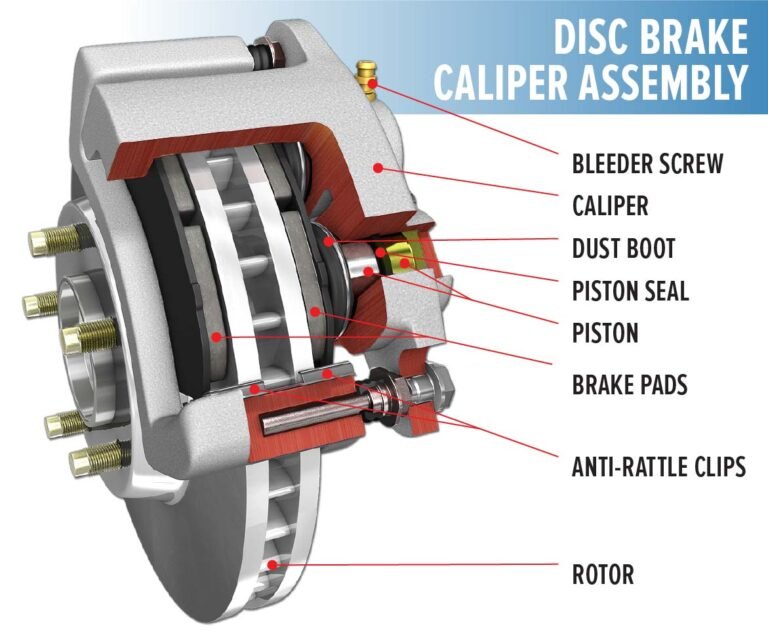
A typical screw-in caliper has the same basic parts as other disc brake calipers:
- A caliper body mounted over the brake rotor
- One or more hydraulic pistons
- Brake pads positioned on both sides of the rotor
- A rubber piston seal and dust boot
- A mechanical parking-brake actuator on many rear calipers
- A threaded piston or threaded internal mechanism
The important difference is inside the piston assembly. Instead of sliding freely in and out during every function, the piston engages a threaded screw, spindle, or adjuster. The threads convert rotary movement from the parking-brake lever or motor into linear piston movement.
Some calipers use a piston with external threads. Others place the threaded mechanism inside the piston. The exact design varies by vehicle, but the operating principle is similar: hydraulic pressure applies the service brake, while a mechanical actuator uses the screw mechanism for parking-brake operation and automatic adjustment.
How does a screw in brake caliper work?
How does a screw in brake caliper work? When the driver presses the brake pedal, the master cylinder sends pressurized brake fluid through the brake line. That pressure enters the caliper and pushes the piston toward the inner brake pad.
The piston presses the inner pad against the rotor. The caliper body then reacts to that force and slides, or flexes slightly in some fixed designs, so the outer pad contacts the opposite side of the rotor. Friction between the pads and rotor slows the wheel.
During ordinary hydraulic braking, the piston does not need to spin every time the brake pedal is pressed. It moves a short distance outward under fluid pressure. The piston seal deforms slightly as the piston moves, then helps pull the piston back a small amount when pressure is released. That small return movement creates running clearance between the pads and rotor.
The threaded portion becomes especially important when the parking brake is applied or when pad wear increases. A lever, cable, electric motor, or internal actuator turns the screw. The screw advances the piston outward without requiring hydraulic pressure.

Hydraulic braking operation
For service braking, the screw-in caliper works mostly like a standard floating caliper. The sequence is straightforward:
- Pedal force moves the master-cylinder piston.
- Brake fluid pressure travels through the hydraulic circuit.
- Pressure enters the caliper bore.
- The piston moves outward and pushes the inner pad.
- Reaction force moves the caliper body or opposing piston.
- Both pads clamp the rotor and create friction.
The threaded mechanism does not replace hydraulic pressure for normal driving. Instead, it provides a mechanical path for applying the brake when the parking brake is engaged. Hydraulic pressure handles repeated service braking, while the screw mechanism maintains the correct position and parking-brake force.
As the pads wear, the piston must remain farther out of the caliper bore to keep the pads near the rotor. An internal adjuster allows the piston position to change gradually. This prevents excessive pedal travel and helps preserve consistent brake response.
How the parking brake uses the screw
On a rear screw-in caliper, the parking-brake lever is commonly connected to a cable. Pulling the parking-brake handle or pressing the parking-brake pedal tensions the cable, which rotates a lever on the caliper. That lever turns the internal screw.
As the screw turns, it pushes the piston outward. The piston then presses the pads against the rotor without hydraulic pressure. The screw’s threads provide mechanical advantage and prevent the piston from simply moving back under the load of the pads.
When the parking brake is released, the lever returns toward its resting position. The piston does not necessarily retract a large distance. Instead, the internal mechanism leaves the piston close enough to the rotor for normal braking while allowing the pads to release.
Many designs also include a clutch, spring, ratchet, or threaded self-adjusting arrangement. These parts compensate for gradual pad and rotor wear. If the system is working correctly, the parking-brake lever returns to a specified position while the piston remains properly adjusted.
Why the piston must be rotated
A standard floating-caliper piston can usually be pushed straight back into its bore during pad replacement. A screw-in piston is different because forcing it straight inward can damage the internal adjuster, parking-brake mechanism, dust boot, or piston seal.
Service tools rotate the piston while applying inward pressure. The rotation retracts the threaded piston through the adjuster rather than forcing the mechanism against its threads. Some pistons turn clockwise; others turn counterclockwise, so the correct direction depends on the vehicle and caliper design.
On many vehicles, the piston face includes two notches, holes, or flats for a cube-style tool or dedicated caliper-winding adapter. The tool must engage securely and remain aligned with the piston. Slipping can damage the piston face or tear the dust boot.
Not every rear caliper should be manually rotated. Some vehicles use an **electronic parking brake**. In those systems, a scan tool or manufacturer-approved service mode may be required to retract the electric actuator before the piston is moved. Trying to turn that piston by force can damage the actuator or caliper.
Pad replacement and piston retraction
Before retracting a screw-in piston, I would confirm the vehicle’s repair procedure rather than assume that every rear caliper uses the same method. The procedure normally includes these essential steps:
- Secure the vehicle on a level surface and support it with approved jack stands.
- Release the parking brake unless the service procedure says otherwise.
- Remove the caliper as required and inspect the brake hose for twisting or damage.
- Check the brake-fluid reservoir before pushing the piston inward.
- Use the correct wind-back tool to rotate and compress the piston.
- Align any piston notches as required by the back of the brake pad.
- Install the pads and caliper using the specified hardware and torque values.
- Operate the pedal several times before moving the vehicle.
- Test the parking-brake function and verify that the wheel turns normally when released.
Brake fluid level can rise as the piston is retracted. If the reservoir is already near the maximum mark, fluid may overflow. Brake fluid can damage painted surfaces, so any spill should be handled promptly according to the fluid manufacturer’s guidance.
The piston should never be forced past unusual resistance. Excessive resistance can indicate a seized screw mechanism, a corroded piston, an incorrect rotation direction, an engaged parking brake, or an electronic actuator that has not been placed in service mode.
Self-adjustment and pad clearance
A screw-in caliper must balance two needs: the piston must stay close enough to the rotor for a firm pedal, but the pads must release enough to prevent constant drag. The adjuster helps maintain that balance as friction material wears.
During a parking-brake application, the mechanism advances the piston. During normal hydraulic braking, piston movement and seal deformation provide the small amount of motion needed for clamping. When wear creates more clearance than the design allows, the internal adjuster can take up additional threaded travel.
If the adjuster sticks, the piston may not extend correctly. If the piston cannot retract or the parking-brake lever cannot return, the brake may drag. If the mechanism fails to maintain position, the parking brake may hold poorly or the pedal may travel farther than expected.
Signs of a problem
A faulty screw-in caliper can produce several recognizable symptoms:
- A rear wheel becomes unusually hot after normal driving.
- The vehicle pulls to one side during braking.
- The parking-brake lever does not return fully.
- The parking brake holds weakly even after proper adjustment.
- The brake pad wears unevenly or much faster on one side.
- The piston will not rotate or retract during service.
- The brake pedal feels unusually long after pad replacement.
- A grinding, scraping, or burning smell comes from one wheel.
Heat and drag can result from a seized piston, corroded adjuster, damaged hose, incorrectly installed pad, or parking-brake cable that does not release. A weak parking brake can result from a damaged internal mechanism, excessive clearance, a stretched cable, or incorrect service adjustment.
A small amount of resistance when turning a serviced wheel can be normal, but a wheel that is difficult to rotate or quickly becomes hot needs inspection. Brake problems affect vehicle control, so a suspected seized caliper should not be ignored or tested through extended driving.
Caliper bolts are a separate issue
The phrase “screw-in brake caliper” can also cause confusion with caliper mounting bolts. Those bolts secure the caliper bracket or caliper body to the steering knuckle. They do not normally control piston movement and are not what makes a caliper a screw-in design.
Mounting bolts must be installed to the vehicle manufacturer’s torque specification. Loose or improperly tightened fasteners can allow caliper movement, while damaged threads can prevent secure mounting. This is separate from rotating the piston during pad service.
Important service cautions
Brake components should be serviced with the correct vehicle-specific procedure. The piston rotation direction, parking-brake release method, pad orientation, actuator design, and adjustment procedure can differ between models.
Never press the brake pedal while a caliper or pad is removed unless the procedure specifically requires it. The piston can extend too far, lose its seal, or allow air and fluid leakage. Do not clamp a flexible brake hose to control piston movement, because internal hose damage can create a brake restriction.
After reassembly, pump the brake pedal until it feels firm before selecting a gear or driving. Confirm that the parking brake releases completely, check for leaks, and make a cautious low-speed brake test in a safe area. If the pedal remains soft, the vehicle pulls, or a wheel drags, stop and diagnose the problem before normal driving.
Conclusion
A screw-in caliper uses hydraulic pressure to apply the service brake and a threaded mechanical adjuster to operate the parking brake and maintain piston position. The key answer to how does a screw in brake caliper work is that the piston moves outward hydraulically for pedal braking, while a screw mechanism rotates to provide mechanical parking-brake force and controlled adjustment. Because of that design, the piston usually must be rotated and compressed with the correct tool during service, and electronic parking-brake systems may require a special service mode.