When to Replace Brake Calipers: Signs, Timing, and Costs
Brake calipers are a critical part of a vehicle’s disc brake system. They squeeze the brake pads against the rotor when you press the brake pedal, creating the friction that slows and stops the vehicle. Because of that role, a damaged or sticking caliper can affect braking performance, cause uneven pad wear, overheat a wheel, and in some cases make the vehicle pull to one side.
If you are wondering when to replace brake calipers, the answer is usually based on condition rather than mileage alone. Brake calipers do not have a universal replacement interval like brake pads. Many can last well over 75,000 miles, and some remain functional for much longer, but corrosion, torn seals, seized slide pins, leaking brake fluid, or sticking pistons can cause earlier failure.
The most important warning signs include uneven brake pad wear, a vehicle pulling while braking, a wheel that becomes unusually hot, brake fluid leaking around the caliper, reduced braking performance, or a caliper piston that will not retract properly.
This guide explains when brake calipers should be replaced, how to recognize common failure symptoms, how calipers differ from pads and rotors, and when professional inspection is the safest choice.
When to Replace Brake Calipers on a Vehicle
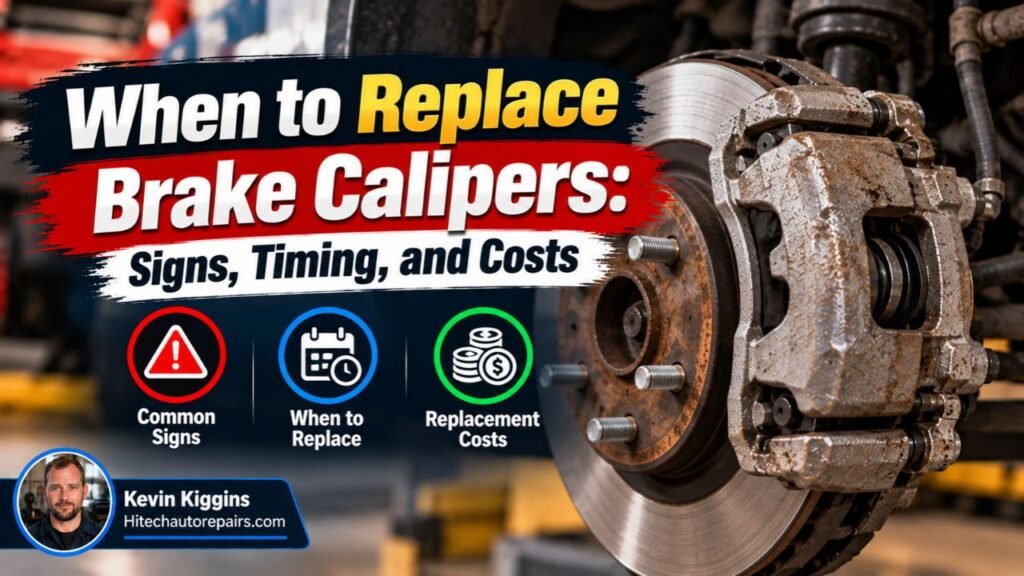
You should replace a brake caliper when it is leaking, seized, badly corroded, physically damaged, or unable to move and apply/release the brake pads correctly.
A caliper does not normally need replacement just because the brake pads are worn.
Replacement is usually appropriate when one or more of these conditions are present:
- Brake fluid is leaking from the caliper.
- The caliper piston is seized.
- The piston cannot retract properly.
- The caliper housing is cracked or damaged.
- Severe corrosion affects caliper operation.
- The caliper repeatedly causes uneven brake pad wear.
- The brake remains applied after you release the pedal.
- A repair kit cannot safely restore normal function.
A qualified technician can determine whether the caliper itself has failed or whether the problem is limited to slide pins, hardware, brake pads, hoses, or other brake components.
How Brake Calipers Work
A disc brake system typically includes:
- Brake caliper
- Brake pads
- Brake rotor
- Caliper piston or pistons
- Slide pins on floating-caliper designs
- Brake hose
- Brake fluid
When you press the brake pedal, hydraulic pressure pushes the caliper piston outward.
The piston forces the brake pads against the rotor.
The resulting friction slows the wheel.
When you release the brake pedal, hydraulic pressure drops, and the caliper should allow the pads to release enough for the rotor to turn freely.
If the piston, seals, or slide mechanism cannot move correctly, the brake can remain partially applied.
How Long Do Brake Calipers Last?
Brake calipers often last longer than brake pads and rotors.
There is no fixed replacement mileage that applies to every vehicle.
Some brake calipers may last for the life of the vehicle, while others can fail much earlier because of:
- Road salt
- Moisture
- Rust
- Contaminated brake fluid
- Damaged dust boots
- Lack of slide-pin lubrication
- High brake temperatures
- Long periods of vehicle storage
Vehicles driven in areas where winter road salt is common may experience caliper corrosion sooner than vehicles in dry climates.
Instead of replacing calipers at a specific mileage, they should be inspected whenever the brakes are serviced.
Main Signs a Brake Caliper Needs Replacement
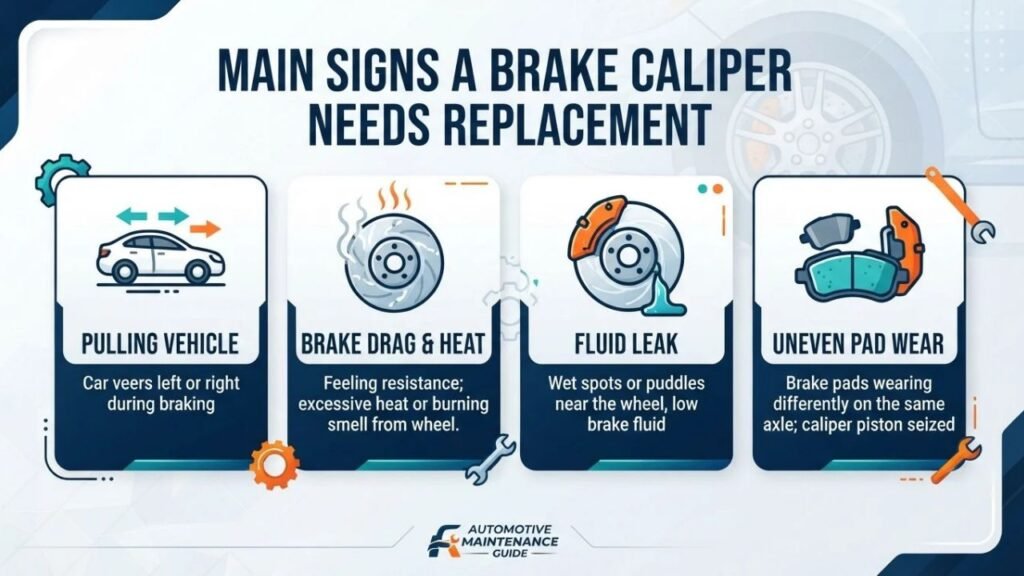
Several symptoms can indicate caliper trouble.
Uneven Brake Pad Wear
Uneven pad wear is one of the most common signs of a sticking caliper.
For example, one brake pad may be almost completely worn while the pad on the opposite side remains relatively thick.
A seized slide pin can cause similar wear, so uneven pads do not automatically mean the entire caliper must be replaced.
The caliper and hardware should be inspected to identify the exact cause.
Vehicle Pulls to One Side When Braking
A vehicle that pulls left or right while braking may have a caliper that is not applying or releasing correctly.
If one front brake produces more braking force than the other, the vehicle can pull toward the side with greater braking force.
However, pulling can also be caused by:
- Tire problems
- Alignment issues
- Brake hose restrictions
- Suspension problems
- Uneven rotor or pad conditions
Brake inspection is necessary before replacing parts.
One Wheel Becomes Very Hot
A sticking caliper can keep the brake pads pressed against the rotor even after the brake pedal is released.
This creates continuous friction and heat.
Possible signs include:
- Burning smell
- Excessive heat near one wheel
- Brake fade
- Smoke in severe cases
Do not touch a suspected overheated rotor or wheel because brake components can become extremely hot.
If a brake is dragging badly, continuing to drive can damage the rotor, pads, wheel bearing, and other components.
Brake Fluid Leak Around the Caliper
A brake-fluid leak around the caliper is a serious warning sign.
The fluid may leak from:
- Piston seal
- Brake hose connection
- Bleeder screw
- Damaged caliper body
A leaking hydraulic brake component can reduce braking pressure.
If brake fluid is visibly leaking, the vehicle should be inspected promptly and may not be safe to drive.
Sticking or Seized Caliper Piston
A healthy piston should move smoothly when hydraulic pressure is applied and retract appropriately during service.
A piston that cannot be compressed during brake-pad replacement may be:
- Corroded
- Seized
- Contaminated
- Mechanically damaged
Some rear calipers use pistons that must be rotated while being compressed because the parking-brake mechanism is built into the caliper.
Using the wrong procedure can make a healthy caliper appear seized.
Always confirm the correct service method for the vehicle.
Brake Drag
Brake drag means the pads continue rubbing against the rotor more than they should.
Possible symptoms include:
- Poor fuel economy
- Vehicle feels slow to coast
- Burning odor
- Excessive brake dust on one wheel
- Hot rotor
- Premature pad wear
A sticking caliper piston or seized slide pin can cause brake drag.
Brake Caliper vs. Slide Pin Problems
A stuck brake does not always require a complete caliper replacement.
Many vehicles use a floating caliper, which moves on lubricated slide pins.
If a slide pin becomes dry, rusted, or seized, the caliper may not move properly even if the piston is still good.
In some cases, servicing or replacing the slide pins and boots may solve the problem.
A full caliper replacement may be more appropriate when:
- The piston is seized.
- The piston bore is badly corroded.
- The caliper leaks.
- The housing is damaged.
- The bleeder screw is broken or severely corroded.
- The caliper cannot be safely rebuilt.
Can a Brake Caliper Be Rebuilt Instead of Replaced?
Sometimes.
Brake calipers can often be rebuilt using new seals, boots, and sometimes pistons.
However, rebuilding is only reasonable if the caliper body and bore are still in usable condition.
Replacement may be better when:
- Corrosion is severe.
- The piston bore is deeply pitted.
- The housing is cracked.
- The caliper has suffered heat damage.
- A professionally remanufactured replacement is readily available.
For many everyday vehicles, replacing the complete caliper is simpler and more predictable than rebuilding one.
Should Brake Calipers Be Replaced in Pairs?
Brake calipers do not always have to be replaced in pairs.
If one caliper fails and the caliper on the opposite side is working properly, replacing only the failed unit may be acceptable.
However, replacing both sides can make sense when:
- Both calipers are similarly old.
- Both show significant corrosion.
- Both have experienced similar wear.
- The opposite caliper is beginning to stick.
- The vehicle has very high mileage.
Brake pads, however, are normally replaced in axle sets so braking remains balanced.
Ask your technician to inspect the opposite caliper rather than replacing it automatically.
Do You Need New Brake Pads When Replacing a Caliper?
Often, yes.
If a failed caliper caused uneven, overheated, contaminated, or severely worn pads, the pads should usually be replaced.
Brake pads are generally replaced as a set across the axle.
For example, if a front caliper fails and damages one front pad, replacing both left and right front pad sets helps maintain even braking.
If brake fluid has contaminated the friction material, the affected pads should not normally be reused.
Do You Need New Rotors When Replacing Calipers?
Not always.
The rotors should be inspected.
Replacement may be necessary if a failed caliper caused:
- Severe overheating
- Deep scoring
- Cracks
- Excessive rust
- Thickness below the minimum specification
- Significant distortion
A rotor that has been overheated by a dragging brake may become discolored or develop surface damage.
Rotor condition should be checked rather than assuming replacement is always necessary.
Difference Between Brake Pad Failure and Caliper Failure
Brake pads are friction materials designed to wear down.
Calipers are mechanical and hydraulic components that should operate for a much longer period.
Common worn-pad symptoms include:
- Squealing
- Reduced pad thickness
- Brake wear indicator noise
Caliper problems are more likely to produce:
- Uneven pad wear
- Brake drag
- One hot wheel
- Fluid leaks
- Pulling
- A piston that will not move normally
The symptoms can overlap, which is why inspection matters.
Can You Drive With a Bad Brake Caliper?
Driving with a bad caliper can be unsafe.
A sticking caliper can overheat the braking system and damage nearby components.
A leaking or non-functioning caliper can reduce braking force.
If you notice severe pulling, smoke, a burning smell, brake fluid leakage, or a very hot wheel, stop driving as soon as it is safe to do so and arrange inspection or towing.
Brake problems can worsen quickly.
What Causes Brake Calipers to Fail?
Several conditions can shorten caliper life.
Corrosion
Rust can affect the piston, bore, slide pins, bleeder screw, or caliper housing.
Road salt and moisture accelerate corrosion.
Torn Dust Boot
A rubber dust boot helps protect the caliper piston from dirt and moisture.
If the boot tears, contaminants can reach the piston and cause corrosion.
Old Brake Fluid
Brake fluid absorbs moisture over time.
Excess moisture can contribute to internal corrosion.
Following the vehicle manufacturer’s brake-fluid service recommendations can help protect the hydraulic system.
Lack of Slide-Pin Lubrication
Dry slide pins can stick.
Brake service should include inspection and proper lubrication of applicable slide pins using the correct brake lubricant.
Excessive Heat
Repeated heavy braking, towing, mountain driving, or a dragging brake can expose calipers to extreme heat.
Heat can damage seals and other components.
What Happens if You Do Not Replace a Bad Caliper?
Ignoring a failed caliper can lead to additional brake damage.
Possible consequences include:
- Destroyed brake pads
- Damaged rotor
- Brake overheating
- Reduced stopping ability
- Pulling during braking
- Wheel-bearing stress
- Tire damage from excessive heat
- Brake fluid loss
A relatively small caliper problem can become a much more expensive repair if the brake continues dragging.
How Mechanics Diagnose a Bad Brake Caliper
A technician may inspect:
- Brake pad thickness
- Rotor condition
- Caliper piston movement
- Slide-pin movement
- Brake hose condition
- Brake fluid leakage
- Wheel temperature
- Brake pressure
- Parking-brake mechanism
A brake that stays applied can sometimes be caused by a internally damaged brake hose rather than the caliper itself.
A restricted hose may allow pressure into the caliper but prevent it from releasing quickly.
Correct diagnosis prevents unnecessary caliper replacement.
Brake Caliper Replacement Cost Factors
Brake caliper replacement cost varies considerably by vehicle.
The final price depends on:
- Vehicle make and model
- Front or rear caliper
- Single- or multi-piston design
- New vs. remanufactured caliper
- Labor rate
- Whether pads and rotors also need replacement
- Brake-fluid service requirements
Performance cars, trucks, luxury vehicles, and vehicles with electronic parking-brake systems may cost more to repair.
Because prices vary by location and model, a vehicle-specific estimate is more useful than a broad national average.
What to Check During Brake Service
Whenever brake pads or rotors are replaced, the calipers should be inspected.
Important checks include:
- Piston condition
- Dust boot condition
- Fluid leaks
- Slide-pin movement
- Mounting hardware
- Corrosion
- Brake hose condition
Catching a sticking caliper early can prevent excessive pad and rotor damage.
FAQs About When to Replace Brake Calipers
How do I know if my brake caliper is bad?
Common signs include uneven brake pad wear, pulling during braking, brake drag, one wheel running unusually hot, brake-fluid leakage, or a piston that does not move properly.
A professional inspection can confirm whether the caliper itself is the cause.
At what mileage should brake calipers be replaced?
There is no universal mileage interval.
Brake calipers are generally replaced based on condition rather than mileage.
They may last many years if the seals, pistons, slides, and hydraulic system remain in good condition.
Should I replace calipers when I replace brake pads?
Usually not.
Brake pads wear much faster than calipers.
Replace a caliper only if inspection shows a mechanical, hydraulic, or corrosion-related problem.
Is a sticking caliper dangerous?
Yes, it can be.
A sticking caliper can cause excessive heat, uneven braking, accelerated brake wear, and potentially reduced braking performance.
It should be inspected promptly.
Can a bad brake hose look like a bad caliper?
Yes.
A damaged brake hose can sometimes trap hydraulic pressure and keep a caliper applied.
A technician may need to test both the caliper and hose before replacing parts.
Should I replace both front brake calipers at the same time?
Not necessarily.
If only one caliper is defective and the other is in good condition, replacing one may be sufficient.
Replacing both may be reasonable if both are similarly corroded or worn.
Can a brake caliper fail suddenly?
Some failures develop gradually, but others can become noticeable quickly.
A seal may begin leaking, a piston may seize, or corrosion may suddenly prevent normal movement.
Any sudden change in braking should be investigated immediately.
Can a bad caliper damage the rotor?
Yes.
A dragging caliper can keep the brake pads pressed against the rotor, creating excessive heat and wear.
This can score, overheat, or permanently damage the rotor.
Conclusion
Knowing when to replace brake calipers comes down to recognizing mechanical or hydraulic failure rather than following a fixed mileage schedule. A caliper should generally be replaced when it leaks, seizes, becomes severely corroded, is physically damaged, or can no longer apply and release the brake pads correctly.
Uneven brake wear, pulling, excessive wheel heat, fluid leaks, and brake drag are all reasons to have the braking system inspected.
Because similar symptoms can also come from slide pins, brake hoses, pads, rotors, or suspension problems, proper diagnosis is important before replacing parts. When a caliper is truly failing, addressing it early can protect the rest of the braking system and help maintain safe, predictable stopping performance.