Brakes Rattle When Hitting Bumps: Causes, Diagnosis and Fixes
If your brakes rattle when hitting bumps, the most likely causes are loose brake pads, worn or missing anti-rattle clips, excessive caliper movement, worn guide pins, or loose caliper hardware. A useful clue is whether the noise becomes quieter or disappears when you lightly apply the brakes. If light brake pressure stops the rattle, movement somewhere in the brake pad or caliper assembly becomes much more likely.
However, not every rattle near a wheel is actually caused by the brakes. Worn sway bar links, control arm bushings, ball joints, strut mounts, loose heat shields, parking-brake hardware, and other suspension or chassis components can create almost the same metallic rattle over rough pavement.
The important question is not simply where the sound seems to come from, but what changes the noise. This guide covers brake pad rattle, brake caliper rattle over bumps, loose caliper sounds, worn hardware, rear parking-brake components, suspension look-alikes, diagnosis, safety concerns, and the correct repairs.
Why Do Brakes Rattle When Hitting Bumps?
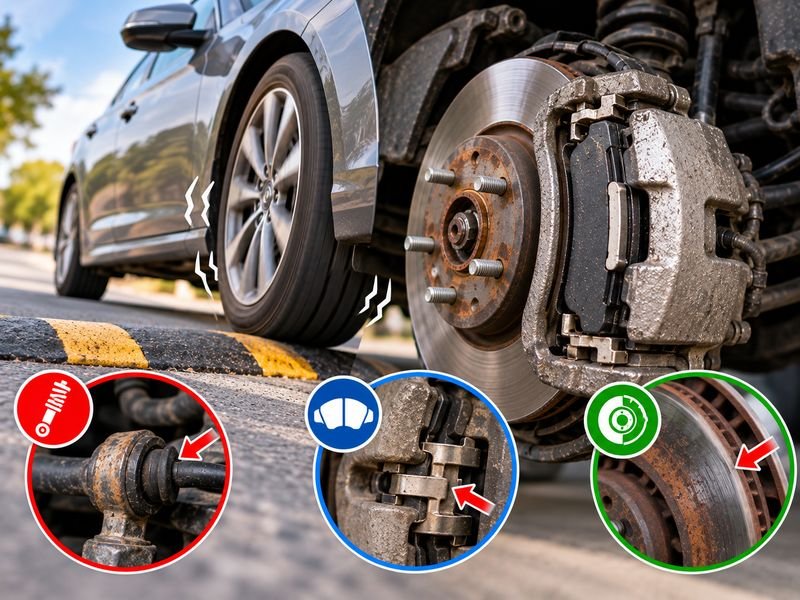
When brakes rattle when hitting bumps, something around the wheel is usually moving enough to strike another component as the suspension travels up and down.
Disc brakes contain several parts that must remain secure while still allowing controlled movement. The brake pads need enough freedom to slide in the bracket, and a floating caliper needs to move on its guide pins. At the same time, springs, clips, bushings, and mounting bolts must prevent these components from bouncing around.
If clearances become excessive or hardware loses tension, bumps can shake the brake assembly and produce a metallic rattle or clunk.
Brake manufacturers specifically identify loose caliper components and brake-pad hardware as possible causes of rattling over bumps. Anti-rattle and abutment clips help keep the pads correctly positioned when the brakes are released.
One of the best diagnostic clues is that the noise may disappear when the brake pads are lightly loaded against the rotor. Service information has documented brake-hardware rattles that become quiet with light brake application because the pads can no longer move freely in the caliper bracket.
Brake Pad Rattle Over Bumps
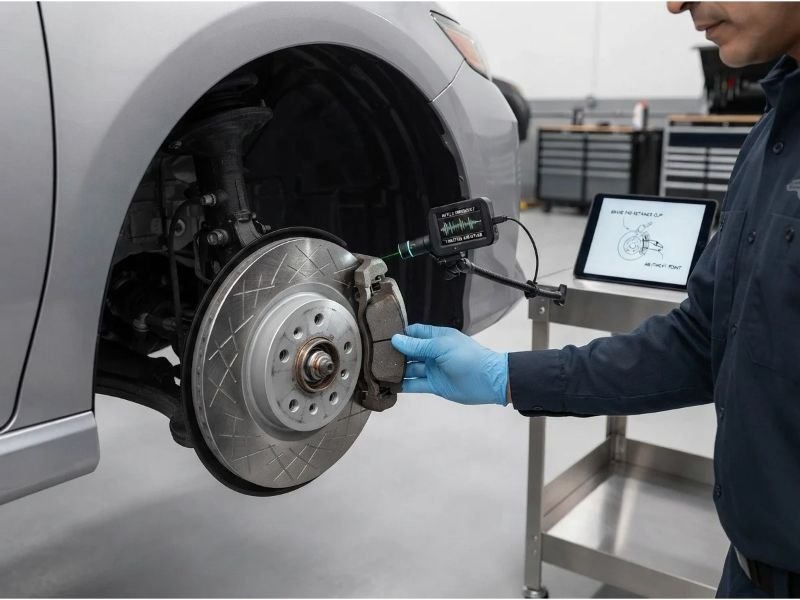
Brake pad rattle over bumps is one of the most common brake-related explanations.
Brake pads are not permanently fixed to the caliper bracket. They need a small amount of clearance so they can move when you apply and release the brakes.
That movement is controlled by hardware such as abutment clips, anti-rattle springs, shims, and retaining clips.
If those parts become worn, damaged, incorrectly installed, or missing, the pads may have too much room to move.
When the wheel hits a pothole or rough surface, the pads can strike the caliper bracket and create a metallic clicking or rattling noise.
How Brake Pad Rattle Usually Sounds
Brake pad rattle often sounds like:
- A light metallic clatter
- A repeated clicking over small bumps
- A loose metal piece near one wheel
- A brief clunk when changing between forward and reverse
- A rattle that disappears when the brake pedal is lightly pressed
A click when changing direction can also occur when pads move inside the caliper bracket because the hardware no longer controls that movement properly.
Missing or Worn Anti-Rattle Clips
Anti-rattle clips are small pieces of spring steel that help control brake-pad movement.
They may look insignificant, but they perform an important job.
The clips help keep the pads located correctly while still allowing them to move as the brakes are applied and released.
Over years of heating and cooling, spring hardware can lose tension. Rust can also deform the clips or the bracket surface underneath them.
If the clips are missing or weak, the pads can move excessively and make noise.
Brake-hardware manufacturers generally recommend installing appropriate new hardware when replacing brake pads because worn clips can contribute to noise, binding, and uneven pad movement.
Can You Drive Without Brake Caliper Clips?
The vehicle may physically move, but missing required brake hardware should not be treated as normal.
The clips are part of the intended pad-retention and movement-control system.
Without them, you may experience rattling, clicking, improper pad movement, or uneven wear.
If your brake noise began immediately after a brake job, confirming that all required hardware was installed correctly should be one of the first checks.
Brake Caliper Rattle Over Bumps
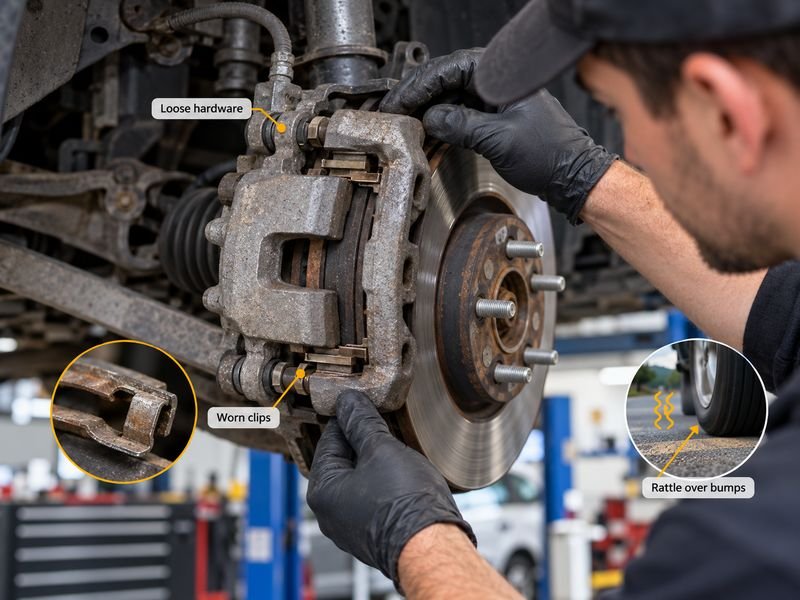
A brake caliper rattle over bumps can occur when the floating portion of the caliper has excessive movement.
Most passenger vehicles use floating or sliding calipers.
The caliper moves laterally on guide pins or slide pins so both brake pads can clamp the rotor.
Some movement is normal.
Loose, worn, or incorrectly assembled components are not.
Possible caliper-related causes include:
- Worn guide pins
- Worn guide-pin bushings
- Excessive clearance inside guide-pin bores
- Loose caliper guide bolts
- Damaged rubber pin boots
- Incorrect replacement hardware
- Worn caliper mounting surfaces
When those parts develop too much play, bumps can shake the caliper and produce a metallic knock or rattle.
Brake Caliper Noise Over Bumps From Worn Slide Pins
Caliper guide pins allow a floating caliper to move smoothly.
They should fit accurately and move freely without excessive looseness.
As the system ages, the pins or their bushings can wear. Corrosion can also damage the surfaces.
A badly worn guide-pin arrangement can allow the caliper body to move more than intended.
You may hear the noise when:
- Driving over rough pavement
- Crossing speed bumps
- Hitting small potholes
- Driving over expansion joints
The sound may reduce when the brake pedal is applied because braking force loads the caliper and pads against each other.
Worn vs Seized Caliper Pins
These two conditions should not be confused.
A worn or loose slide pin can contribute to rattling because there is too much movement.
A seized slide pin usually creates the opposite problem: insufficient caliper movement.
Seized pins are more commonly associated with uneven brake-pad wear, brake drag, overheating, or pulling.
It is possible for a badly corroded caliper assembly to have several problems at the same time, so the pins should be inspected rather than diagnosed from sound alone.
Loose Brake Caliper Sound While Driving
A loose brake caliper sound while driving is often described as a heavier metallic clunk compared with ordinary pad rattle.
This deserves prompt inspection.
There are two general sets of fasteners to consider on many floating-caliper systems:
Caliper guide-pin bolts
Caliper bracket mounting bolts
The guide bolts secure the moving caliper to the bracket.
The larger bracket bolts secure the caliper bracket to the steering knuckle or suspension assembly.
These are safety-critical fasteners.
A loose caliper bracket bolt has been specifically identified in brake technical guidance as a possible source of thumping or clunking noise.
If a caliper or bracket is genuinely loose, do not continue treating the problem as a harmless rattle.
Loose Caliper Bracket Bolts
The caliper bracket supports the brake pads and the caliper assembly.
Its bolts are normally tightened to a vehicle-specific torque specification and, on some applications, may require additional procedures or specified thread-locking material.
If one backs out, the bracket can shift whenever braking or suspension movement loads it.
Possible signs include:
- A heavy clunk at the wheel
- Noise when braking and releasing
- Noise over bumps
- Sudden change in pedal or braking feel
- Visible movement of the brake assembly
In severe cases, continued driving could allow components to move far enough to interfere with the rotor or wheel.
This is not a condition to postpone.
Brake fasteners should always be tightened using the vehicle manufacturer’s specified procedure and torque rather than simply tightened “as hard as possible.”
Worn Caliper Bracket or Pad Contact Points
The brake pads slide along specific contact surfaces on the caliper bracket.
Over time, rust and repeated pad movement can wear these areas.
In some cases, the bracket develops grooves or enlarged contact areas that allow the brake pads to move more than intended.
Installing new anti-rattle clips may reduce the movement, but severely worn bracket surfaces may require additional repair or bracket replacement.
Rust underneath new stainless hardware can also create problems.
Corrosion can push the clip inward and make the pad bind, while worn surfaces can create excessive clearance and allow rattling.
A proper brake service includes cleaning and inspecting these contact points before installing new hardware.
Wrong Brake Pads Can Rattle
A replacement brake pad can look almost identical to the correct pad and still have slightly different dimensions.
If the pad’s mounting ears are too small for the bracket, the pad can have excessive clearance.
That can create a rattle even with new hardware installed.
This is more likely when:
- The noise began immediately after brake replacement
- A different pad brand or part number was installed
- One side rattles while the other does not
- The pads move noticeably in the bracket
- The anti-rattle clips appear correctly installed
Always verify the exact brake-pad part number for the vehicle, axle, brake package, and model year.
Some vehicles were offered with multiple brake systems during the same year.
New Brake Pads Rattle Over Bumps
New pads should not automatically be assumed good just because they were recently installed.
If the rattle began after a brake job, possible causes include:
- Missing anti-rattle clips
- Old hardware reused
- Hardware installed incorrectly
- Incorrect brake pads
- Caliper bolts not properly tightened
- Pad shims omitted
- Slide-pin components assembled incorrectly
- Wrong caliper bracket
A freshly completed brake job gives you an important diagnostic clue because the noise may be related directly to something that was disturbed during the repair.
Inspect that work before searching for unrelated suspension problems.
Brake Pad Shims and Rattle
Brake pad shims are often fitted to the back of the pads.
Their main purpose is generally to help control vibration and brake noise.
Depending on the design, they may be separate pieces or permanently attached to the brake pad.
Damaged, loose, or incorrectly installed shims can contribute to noise.
However, a missing shim does not automatically explain every rattle over bumps.
When the noise sounds like a loose pad physically moving in the bracket, anti-rattle hardware and pad fit are usually more direct areas to inspect.
Can Worn Brake Pads Cause Rattling?
They can contribute.
As pads wear, the relationship between the pad, piston, caliper, and hardware changes.
Worn hardware may also be present because it has gone through the same heat cycles and mileage as the pads.
A severely worn pad may have more opportunity to move, particularly if the retaining hardware has lost tension.
However, normal friction-material wear alone should not create a loud caliper clunk.
If there is substantial movement, inspect the hardware and mounting components.
Loose Brake Pad Wear Indicator
Many brake pads use a small metal wear indicator.
When the friction material becomes thin, the indicator contacts the rotor and usually creates a high-pitched squeal rather than a bump-related rattle.
If an indicator is bent, damaged, or loosely attached, however, it can create abnormal metallic sounds.
This is less common than loose pad hardware, but it should be inspected when checking the pads.
Caliper Piston Problems and Rattling
A bad caliper piston is generally not one of the main causes of a rattle only when hitting bumps.
Piston problems more commonly create:
- Brake drag
- Uneven pad wear
- Overheating
- Pulling during braking
- Fluid leakage
A piston that does not retract properly can change pad behavior, but if the primary symptom is a metallic noise over rough pavement, pad hardware, guide pins, and mounting components usually deserve attention first.
Loose Brake Hose or Brake Cable
Not every brake-related noise comes from the pads or caliper.
A brake hose, ABS wire, or parking-brake cable that has escaped its retaining bracket can move as the suspension travels.
A loose parking-brake cable can strike the body or suspension and create a thumping noise. Brake technical information specifically lists excessive brake-cable slack as one possible noise source.
Inspect clips and brackets that secure:
- Brake hoses
- ABS sensor wiring
- Parking-brake cables
None of these parts should rub against the tire, wheel, axle, or moving suspension components.
Rear Parking Brake Hardware Can Rattle
Many vehicles use a rear parking-brake mechanism that is separate from the normal disc-brake pads.
A common design uses small drum-style parking brake shoes inside the center section of the rear rotor.
The parking-brake assembly can contain:
- Shoes
- Return springs
- Hold-down hardware
- Adjuster
- Actuating lever
If a spring or retaining part breaks, components can rattle inside the rotor.
This noise can easily sound like a loose rear caliper.
If the front brakes appear normal but the rattle comes from the rear, the parking-brake hardware should not be overlooked.
Loose Brake Dust Shield or Backing Plate
Behind the brake rotor is usually a thin metal shield.
This shield helps protect brake components from road debris and water.
If it becomes bent, rusted, or loose, it can vibrate and create metallic noises.
A shield normally produces more of a scraping or tinny vibration than a heavy caliper clunk, but bumps can make a loose shield rattle.
Look for:
- Broken mounting points
- Heavy corrosion
- Shield touching the rotor
- Small stones trapped between the rotor and shield
Do not bend the shield against the rotor while trying to silence it.
There should be adequate clearance around the rotating brake components.
Can the Brake Rotor Rattle Over Bumps?
The rotor itself normally should not rattle.
With the wheel installed and properly tightened, the rotor is clamped against the hub.
A rotor that appears loose after the wheel has been removed may simply be normal on vehicles where the wheel and lug nuts provide the final clamping force.
If there is genuine movement with the wheel installed, inspect the wheel mounting, hub, and related components immediately.
Never assume a loose wheel or hub is merely harmless “rotor noise.”
Loose Wheel or Lug Nuts
A loose wheel can create knocking, clicking, or clunking noises that may be mistaken for brake noise.
This is a serious safety issue.
If the noise began after:
- A tire rotation
- Brake service
- Wheel replacement
- Suspension work
- check wheel security promptly.
Do not continue driving a vehicle if you suspect loose lug nuts or a loose wheel.
The correct tightening sequence and torque specification should be used.
Wheel Bearing Noise vs Brake Rattle
A worn wheel bearing usually produces a humming, growling, or roaring noise that changes with road speed rather than a light metallic rattle only over bumps.
However, a severely worn bearing can develop wheel play.
That movement can affect the brake rotor and create additional noises.
If there is noticeable wheel looseness, the bearing, suspension joints, and steering components should all be inspected.
What if the Rattle Stops When You Press the Brake?
This is one of the strongest clues that the noise may come from the brake pads or caliper hardware.
Applying the brakes clamps the pads against the rotor and loads the caliper assembly.
Loose components that were previously free to bounce can no longer move as easily.
Technical brake guidance specifically recommends observing whether slight brake application changes a bump-related noise; if the sound disappears, loose brake hardware becomes more likely.
This does not provide a 100% diagnosis.
Braking also transfers vehicle weight and changes suspension loading, so some suspension noises can change as well.
But it is an excellent place to start.
Rattle Only When Braking Over Bumps
If the noise occurs specifically while you are braking, the pads, caliper, and mounting hardware deserve close inspection.
Braking puts force through the entire assembly.
- Loose pad hardware may shift.
- A worn caliper pin may knock.
- A loose bracket bolt can move under load.
However, suspension components also change position when the vehicle’s weight transfers forward during braking.
A clunk that happens only under braking is therefore not automatically a caliper problem.
Rattle When Driving but Not When Braking
A rattle that occurs while coasting over bumps and disappears when the brakes are lightly applied strongly suggests that something in the brake assembly may be loose enough to move when unloaded.
Possible causes include:
- Brake pad movement
- Anti-rattle clips
- Caliper guide-pin play
- Caliper hardware
This is a classic pattern worth reporting to your mechanic because it can significantly shorten diagnosis time.
Rattle When Changing From Reverse to Drive
A single click or clunk when switching direction is commonly associated with brake pads shifting in their mounts.
When the vehicle reverses, braking force loads the pad toward one side of the bracket.
The next time the brakes are applied while moving forward, the pad can shift in the opposite direction.
Fresh, properly fitted hardware normally controls excessive movement.
Service guidance notes that clicking specifically when changing vehicle direction can indicate pads shifting in the caliper mount.
Brakes Rattle After a Brake Job
A new rattle immediately after brake service should be investigated rather than dismissed as normal break-in noise.
Check whether:
- All required clips were installed
- New hardware matched the pads
- Pad shims are correctly positioned
- Guide-pin bolts are secure
- Caliper bracket bolts are properly torqued
- The brake hose is routed correctly
- The dust shield was accidentally bent
- The replacement pads fit the bracket correctly
Normal pad bedding may cause temporary smell or changes in braking feel, but it should not cause a loose metallic clatter over every bump.
Brake Rattle vs Suspension Rattle
This is where diagnosis becomes more complicated.
Suspension parts are located immediately beside the brakes, and noises travel through the steering knuckle, body, and chassis.
A sound that seems to come from the caliper may actually be caused by a worn suspension joint.
If the brake assembly checks out, inspect the suspension rather than repeatedly replacing brake components.
Bad Sway Bar Link
A worn sway bar end link is one of the common sources of front-end rattling or clunking over small bumps.
The link contains joints or bushings that can develop play.
Small, rapid road imperfections can make a worn link rattle repeatedly.
The noise often sounds extremely close to the brake caliper because both components sit near the wheel.
Unlike loose pads, sway bar noise normally does not consistently disappear just because the brake pads are lightly applied.
Worn Control Arm Bushings
Control arm bushings isolate suspension movement from the vehicle body.
When the rubber tears or separates, the control arm can move more than intended and produce a clunk over bumps.
Control-arm problems can produce front-end noise over potholes and other road impacts.
You may also notice:
- Poor steering stability
- Alignment changes
- Uneven tire wear
- Movement during braking
A heavy suspension clunk usually sounds deeper than a light pad rattle.
Worn Ball Joint
Ball joints allow the steering knuckle and suspension to move.
Excessive ball-joint play can produce knocking or clunking over bumps.
Because the brake caliper is attached to the steering knuckle, the sound may appear to originate from the brakes.
A badly worn ball joint is a safety concern and should be inspected promptly.
Bad Strut Mount or Shock
A worn strut mount can create a knock or clunk whenever the suspension compresses.
A loose or damaged shock mount can produce a similar sound.
There are documented cases where a bump-related clunk initially associated with the caliper was ultimately traced to a bad strut.
This demonstrates why replacing brake hardware solely because the sound appears to come from a wheel can lead to unnecessary repairs.
Tie Rod and Steering Components
Loose tie-rod ends and other steering joints can also generate knocking around the front wheel.
You may additionally notice:
- Steering looseness
- Vehicle wandering
- Uneven tire wear
- Noise while changing steering direction
If the wheel has abnormal play, do not assume the brakes are responsible.
Steering and suspension joints should be checked at the same time.
Exhaust or Heat Shield Rattle
A loose exhaust heat shield can create a metallic rattle that becomes louder when the vehicle hits bumps.
Because vibrations travel through the floor and body, the noise may seem to come from a wheel or brake assembly.
Heat-shield rattles often have a lighter, tinny character and may also occur:
- At certain engine RPM
- When starting the engine
- When shutting the engine off
- When driving over rough pavement
If brake application does not affect the sound, inspect other underbody components as well.
How to Diagnose Brakes Rattling Over Bumps
The most effective diagnosis follows the noise systematically instead of replacing parts based on guesses.
Start by Reproducing the Noise
Pay attention to exactly when the sound occurs.
Does it happen on every bump or only sharp bumps?
Does it come from the front or rear?
Does it disappear when you apply light brake pressure?
Does it happen when changing between forward and reverse?
Did it begin after brake or suspension work?
These details can greatly narrow the possibilities.
Inspect the Brake Pads and Hardware
With the vehicle safely lifted and supported according to proper service procedures, remove the wheel and inspect the suspected brake assembly.
Look for damaged or missing hardware and excessive pad movement.
Pay particular attention to:
- Anti-rattle clips
- Abutment clips
- Pad fit
- Pad shims
- Guide pins
- Guide-pin boots
- Caliper bolts
- Bracket bolts
Never rely on a hydraulic jack alone while working around a wheel or brake assembly.
Check Caliper Movement
A floating caliper should move in the way its design requires, but it should not feel as though it is loosely knocking around.
Inspect the guide pins for wear, rust, damaged bushings, or excessive clearance.
If the pins are seized, they may require cleaning or replacement depending on condition.
If the pins or bores are excessively worn, lubrication alone will not permanently remove the extra clearance.
Verify All Fasteners
Brake fasteners are safety-critical.
Do not judge tightness by simply pulling harder on a wrench.
Check the correct factory torque specification for the exact vehicle.
Some fasteners may also have replacement or thread-locker requirements.
Inspect Nearby Suspension Parts
If the brake assembly appears correct, continue outward to the suspension and steering.
Check the sway bar links, control arm bushings, ball joints, tie rods, wheel bearing, strut mounting, and any loose underbody shields or brackets.
How to Fix Brake Pad Rattle Over Bumps
The correct fix depends on what is actually loose.
If the brake pads have excessive movement because the anti-rattle hardware is worn, install the correct replacement hardware and verify pad fit.
Clean corrosion from the appropriate bracket contact surfaces before installing new clips.
Do not grind or modify brake pads simply to eliminate noise unless an approved service procedure specifically calls for such work.
If the replacement pad itself is incorrectly sized, install the correct pads rather than trying to compensate with excessive grease or improvised shims.
How to Fix Brake Caliper Rattle Over Bumps
If excessive movement comes from worn slide pins, inspect the pins, bushings, boots, and caliper bracket.
Slightly dry but otherwise undamaged guide pins may simply require correct cleaning and brake-compatible lubrication as part of service.
Worn pins or enlarged mounting bores need replacement of the affected components.
If a caliper mounting bolt has loosened, determine why before simply tightening it.
Confirm the correct hardware, thread condition, required thread-locking procedure, and torque specification.
A damaged thread or incorrect bolt requires proper repair.
Should You Put Grease on Brake Hardware to Stop Rattling?
Brake lubricant is useful at specific contact points, but grease is not a substitute for correct parts.
Use only brake-compatible high-temperature lubricant in locations specified by the manufacturer.
Common approved areas may include certain guide-pin surfaces and pad-to-hardware contact points.
Do not put lubricant on:
- Brake pad friction material
- Rotor friction surfaces
- Parts where the manufacturer specifies dry installation
- Excess lubricant can contaminate the brakes and attract dirt.
If the pads are loose because a clip is missing or the bracket is worn, adding grease will not correctly repair the problem.
Is Brake Rattle Dangerous?
The severity depends entirely on the cause.
A light pad rattle from worn anti-rattle hardware may not immediately reduce braking force.
A loose caliper bracket, loose wheel, failing ball joint, or badly worn suspension joint is much more serious.
Because those problems can initially sound similar, a new metallic rattle from the wheel area deserves inspection.
Treat the problem as more urgent if you also notice:
- Changes in braking feel
- Vehicle pulling
- Steering looseness
- Wheel movement
- Grinding
- Brake fluid leakage
- Overheating
- A heavy clunk
- Visible loose components
Can You Drive With Brake Caliper Rattle?
Do not assume it is safe until you know what is rattling.
If the noise is confirmed to be only harmless pad movement caused by worn retaining hardware, the immediate risk may be relatively low, although repair is still appropriate.
If the caliper itself, caliper bracket, wheel, or suspension is loose, continued driving can be unsafe.
When the source has not been identified, inspection is a better choice than continuing to drive and waiting for the noise to worsen.
Why Does Brake Rattle Sometimes Disappear After New Pads?
A new pad may fit more tightly than the worn pad it replaces, temporarily removing excessive clearance.
New hardware may also restore spring tension that was lost in the old clips.
This is why replacing worn pads and hardware together can eliminate rattling.
However, if the caliper bracket or guide pins are worn, installing new pads may only hide the noise temporarily.
The entire assembly should still be inspected.
Why Can Brake Rattle Return After a Few Months?
A returning rattle suggests that something more than normal pad wear may be involved.
Possible reasons include incorrect or low-quality hardware, corrosion underneath the clips, worn guide-pin bores, incorrect pads, or a worn caliper bracket.
If new hardware repeatedly becomes loose, investigate the underlying fit rather than continually replacing clips.
Front vs Rear Brake Rattle
Front brake rattles are commonly associated with disc pads, caliper hardware, guide pins, and nearby suspension components.
Rear brake rattles can involve all of those same parts plus additional parking-brake hardware.
If the rear uses an internal drum-style parking brake, broken shoe springs or retaining hardware can create noise that is invisible until the rotor is removed.
Knowing whether the sound comes from the front or rear helps narrow the inspection.
FAQs About Brakes Rattle When Hitting Bumps
Why Do My Brakes Rattle When I Hit Bumps?
The most common brake-related causes are loose brake pads, missing or worn anti-rattle clips, worn caliper guide pins, excessive pad-to-bracket clearance, or loose brake hardware.
Suspension components can create nearly identical noises, so the source should be confirmed before replacing parts.
Why Does My Brake Rattle Stop When I Press the Pedal?
Applying the brakes loads the pads against the rotor and removes some of the free movement in the caliper assembly.
If the rattle disappears with light brake application, loose pads or caliper hardware become more likely.
What Does a Loose Brake Caliper Sound Like?
A loose caliper may produce a metallic clunk, knock, or heavier rattle near the wheel.
The noise can occur over bumps, when braking, or when load changes direction.
Because loose caliper mounting hardware can be safety-critical, it should be inspected promptly.
Can Brake Pads Rattle Over Bumps?
Yes.
Pads can rattle if anti-rattle clips are worn or missing, the wrong pads were installed, the caliper bracket is worn, or there is excessive clearance at the pad contact points.
Can Missing Brake Clips Cause Rattling?
Yes.
Anti-rattle and abutment clips help control brake-pad movement. Missing or worn clips can allow the pads to move and strike the caliper bracket.
Can Worn Caliper Pins Cause a Rattle?
Yes.
Excessive clearance around guide pins or bushings can allow a floating caliper to move and knock over bumps.
Seized pins more commonly cause brake drag and uneven wear rather than a loose rattle.
Why Did My Brakes Start Rattling After New Pads?
The new hardware may be missing, reused, installed incorrectly, or incompatible with the pads.
The replacement pads may also have excessive clearance, or a caliper bolt may not have been tightened correctly.
Have the recent brake work checked first.
Can Suspension Problems Sound Like Brake Rattle?
Yes.
Sway bar links, control arm bushings, ball joints, strut mounts, tie rods, and other suspension parts sit close to the brakes and can produce very similar noises over bumps. Worn control-arm components, for example, can cause front-end clunking over road impacts.
Conclusion
If your brakes rattle when hitting bumps, begin with the brake pads and caliper hardware, especially if the noise becomes quieter or disappears when you lightly apply the brakes.
Loose pads, worn anti-rattle clips, excessive guide-pin play, incorrect brake-pad fit, worn caliper brackets, and loose mounting hardware can all cause a brake caliper rattle over bumps or brake pad rattle over bumps.
Do not stop the diagnosis at the brakes if everything there is secure. Sway bar links, control arm bushings, ball joints, strut mounts, parking