What Is an Unbracketed Brake Caliper: Clear Answers and Key Facts
When a brake caliper has no separate metal carrier behind it, the caliper body itself usually provides the structure needed to hold the brake pads and move across the rotor. That design is commonly called a floating or sliding caliper.
What is an unbracketed brake caliper? It is a brake caliper that mounts directly to the steering knuckle or another suspension component instead of attaching to a separate caliper bracket, also called a carrier. The caliper slides on guide pins or mounting bolts so it can apply pressure to both sides of the brake rotor.
What an unbracketed brake caliper is
An unbracketed brake caliper is a sliding brake caliper without a separate bracket or carrier. Its housing is secured to the vehicle through guide hardware, and the caliper moves laterally as the brake is applied.
The word “unbracketed” describes the mounting arrangement, not the absence of all support. The caliper still has mounting points, guide pins, bolts, bushings, or other hardware. It simply does not use a distinct bracket between the caliper and the steering knuckle.
In this design, the brake pads are usually positioned in the caliper or in guides formed by the caliper and the mounting area. When hydraulic pressure reaches the piston, the piston pushes the inner pad against the rotor. The resulting reaction force pulls or slides the caliper toward the opposite side, allowing the outer pad to press against the rotor as well.
How it works
A typical unbracketed caliper operates through three related movements:
- Brake fluid pressure pushes the caliper piston outward.
- The inner brake pad contacts one face of the rotor.
- Reaction force slides the caliper so the outer pad contacts the opposite face.
Because the caliper must move, its guide pins or sliding surfaces are critical. They need to remain properly lubricated with the correct brake-hardware lubricant, protected by intact boots, and free of rust or contamination.
The caliper does not normally move a large distance. It travels only enough to take up pad clearance and maintain even contact with the rotor. A piston seal and the normal elasticity of the brake components help the piston retract slightly when hydraulic pressure is released, while the sliding mechanism allows the caliper to remain centered over the rotor.
Unbracketed versus bracketed calipers
The main difference is where the caliper receives its support.
| Feature | Unbracketed caliper | Bracketed caliper |
|---|---|---|
| Separate carrier | Usually no | Yes |
| Mounting method | Caliper mounts directly to the knuckle or related component | Caliper attaches to a separate bracket or carrier |
| Caliper movement | Slides on guide hardware or designed mounting surfaces | Often slides on pins attached to the bracket |
| Pad support | Provided by the caliper and its mounting area | Often provided primarily by the bracket |
Both designs can use a single piston and both can be floating calipers. “Bracketed” and “unbracketed” identify the mounting structure, while “fixed” and “floating” describe whether the caliper body moves during braking.
A fixed caliper does not slide back and forth over the rotor. It is mounted rigidly and commonly uses pistons on both sides of the rotor. It should not be confused with an unbracketed sliding caliper simply because both may appear to mount directly to a suspension component.
Key parts of the design
Although exact construction varies by vehicle, an unbracketed caliper commonly includes these parts:
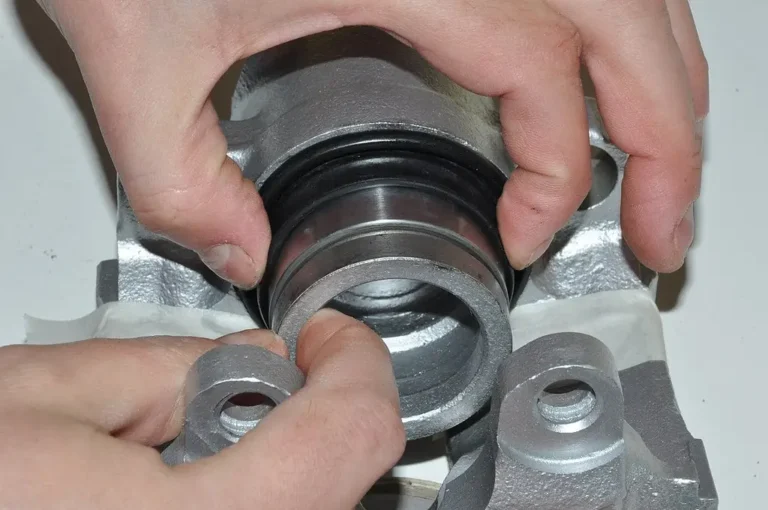
- Caliper body: The housing that contains the piston and helps locate the brake pads.
- Piston: The hydraulic actuator that pushes the inner pad toward the rotor.
- Piston seal: A fluid seal that also supports slight piston retraction after braking.
- Guide pins or sliding bolts: Hardware that allows controlled lateral movement.
- Dust boots: Flexible covers that help keep water and debris away from sliding surfaces.
- Brake pads: Friction materials that clamp the rotor when the caliper operates.
- Pad clips or abutment surfaces: Features that position the pads and allow them to move as designed.
Some unbracketed systems use guide pins. Others use bolts, sleeves, bushings, or a specially shaped caliper that slides on machined surfaces. The appearance of the mounting hardware is therefore not identical across all vehicles.
Why manufacturers use an unbracketed design
An unbracketed caliper can reduce the number of separate components in the brake assembly. Eliminating a carrier may reduce part count, simplify the package around the wheel, and provide a practical way to fit the brake system into the available space.
The design can also make the caliper and its mounting arrangement relatively compact. However, fewer visible parts do not mean the system is maintenance-free. The guide mechanism, pad contact points, piston, and mounting bolts still require correct inspection and service.
Whether the design is appropriate depends on the vehicle’s braking requirements, wheel clearance, suspension layout, cost targets, and engineering specifications. An unbracketed caliper is not automatically better or worse than a bracketed one. It is a different way to support and operate the caliper.
How to identify one
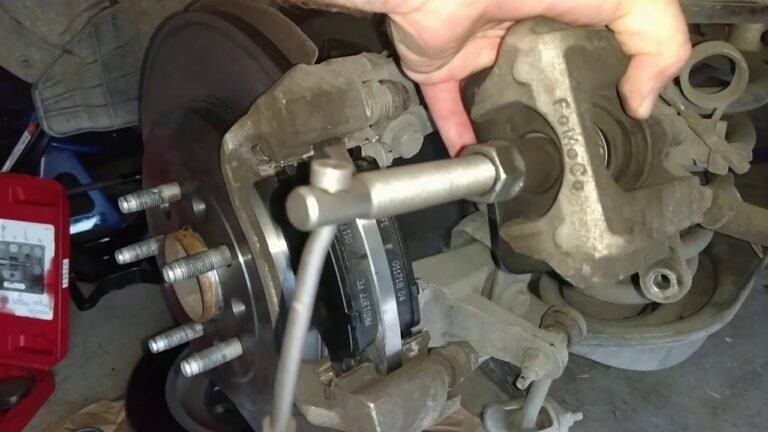
Identification should begin with the area behind the brake rotor. If the caliper appears to bolt directly to the steering knuckle and no separate carrier holds the pads or caliper, it may be an unbracketed design.
Look for these visual clues:
- The caliper body has its own mounting ears or attachment points.
- There is no distinct bracket spanning around the rotor behind the caliper.
- The caliper is connected to the mounting area by guide pins, sleeves, or sliding bolts.
- The caliper can move laterally relative to the rotor when properly installed.
- The pad support surfaces appear to be part of the caliper or the steering-knuckle area rather than a separate carrier.
Visual inspection can be misleading because some brackets are compact or partly hidden. A parts catalog, factory repair manual, or vehicle-specific service information is the reliable way to confirm the arrangement before ordering parts.
Do not identify the design solely by the number of pistons. A single-piston caliper is often a sliding type, but piston count alone does not establish whether a separate bracket is used.
Service and maintenance points
The most important service issue is free, controlled caliper movement. A seized guide pin, damaged boot, corroded mounting surface, or incorrectly installed pad can prevent the caliper from centering over the rotor.
During service, a qualified technician generally checks the following:
- Guide pins, sleeves, and bushings for corrosion, wear, or binding.
- Dust boots for tears, distortion, or loss of retention.
- Pad ears and contact surfaces for rust buildup or restricted movement.
- The piston and piston boot for leakage or damage.
- Mounting bolts, threads, and contact surfaces for damage.
- Brake hose routing for twisting, kinking, or interference.
- Pad and rotor wear for signs of uneven pressure.
Only use the lubricant specified for brake guide hardware. Petroleum-based grease or an incompatible product can damage rubber components or affect the sliding action. Brake parts should also be kept free of friction-reducing substances such as grease, oil, and anti-seize compound unless a manufacturer specifically directs otherwise.
Mounting bolts must be installed and tightened according to the vehicle manufacturer’s procedure. Torque requirements, thread-locking instructions, replacement rules, and caliper-piston reset methods vary by vehicle. The caliper should never be left hanging from the flexible brake hose during repair.
Common problems and symptoms
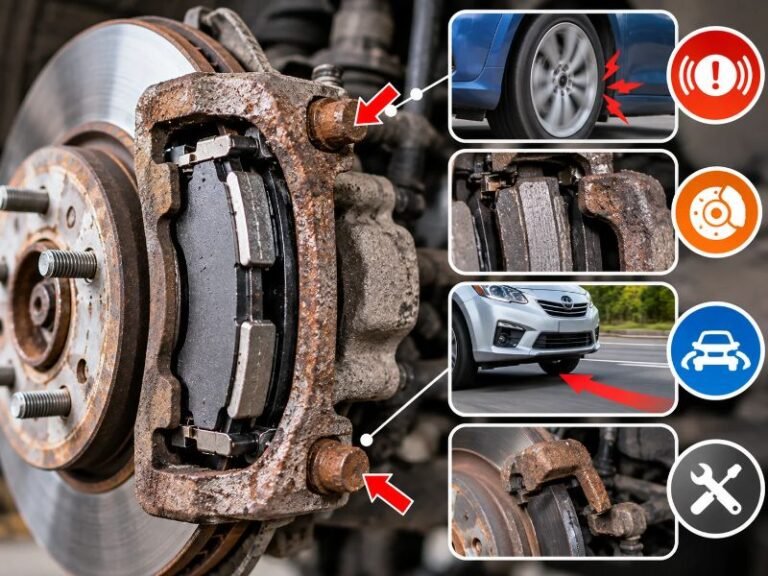
A problem in an unbracketed caliper often affects how evenly the two brake pads contact the rotor. Symptoms can include:
- Uneven inner and outer pad wear.
- Brake pull to one side.
- Dragging brakes or a wheel that becomes unusually hot.
- Premature pad or rotor wear.
- Brake noise caused by restricted pad movement.
- A caliper that does not return or center correctly after braking.
These symptoms do not prove that the caliper itself is defective. A collapsed brake hose, contaminated fluid, incorrect pad fit, rotor condition, wheel-bearing movement, or another suspension problem can produce similar results.
A seized guide pin can stop the caliper from moving toward the outer pad. A stuck piston can prevent the inner pad from releasing or applying normally. Rust at the pad contact points can also restrict movement even when the guide pins appear serviceable.
Because brake faults affect vehicle control, unusual heat, fluid leakage, severe pulling, grinding, or a soft pedal should be inspected promptly. Brake components should be repaired using vehicle-specific procedures rather than adjusted by guesswork.
Important terminology
Several names may describe related designs, but they are not always exact synonyms:
- Floating caliper: A caliper that moves laterally relative to the rotor.
- Sliding caliper: A floating caliper that moves on pins, bolts, sleeves, or other sliding surfaces.
- Unbracketed caliper: A caliper without a separate carrier or mounting bracket.
- Bracketed caliper: A caliper that uses a separate carrier to support the caliper or brake pads.
- Fixed caliper: A caliper that is mounted rigidly and does not slide across the rotor.
Manufacturers, parts suppliers, and repair manuals may use these terms differently. For accurate part selection, the vehicle’s year, make, model, engine, axle, and original brake configuration matter more than a general visual description.
Conclusion
An unbracketed brake caliper mounts directly to the steering knuckle or related component without a separate caliper carrier. It normally works as a sliding or floating caliper, using hydraulic pressure, guide hardware, and reaction force to clamp brake pads against both sides of the rotor. Keeping its pins, boots, pads, piston, and mounting bolts in proper condition is essential for even braking and safe operation. Understanding what is an unbracketed brake caliper makes it easier to identify the correct parts and follow the right service procedure.