Brake Knocking Noise: Causes, Diagnosis, and Fixes Explained
A brake knocking noise usually means something in the brake, suspension, steering, or drivetrain is moving when it should remain securely positioned. Common causes include loose brake pads, worn caliper hardware, loose caliper bolts, worn control arm bushings, damaged ball joints, CV joint problems, or excessive movement in suspension components.
The exact cause often depends on when the sound appears. A single knock as you first press the brake pedal may point toward brake pad or caliper movement, while repeated knocking when braking over rough roads may be more closely related to suspension components. A knocking sound that appears while braking and turning can point toward a CV joint, ball joint, control arm, or steering-related problem.
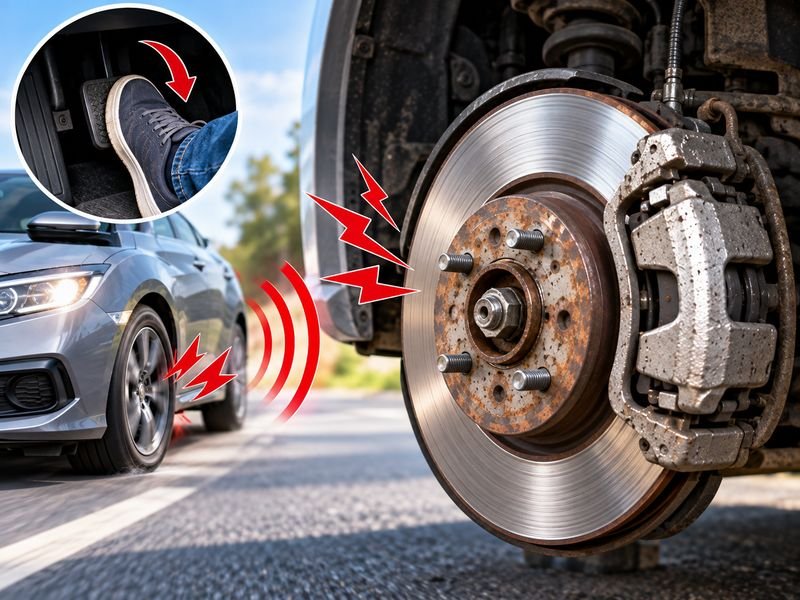
Some causes are relatively simple, but others can affect braking or vehicle control. Paying attention to whether the sound comes from the front or rear, whether it occurs at low or high speed, and whether steering or road bumps change the noise can make diagnosis much easier.
Below, you will learn the most common causes of brake knocking, what different types of knocking can indicate, how to diagnose the problem safely, and when the vehicle should be inspected immediately.
What Causes Brake Knocking Noise?
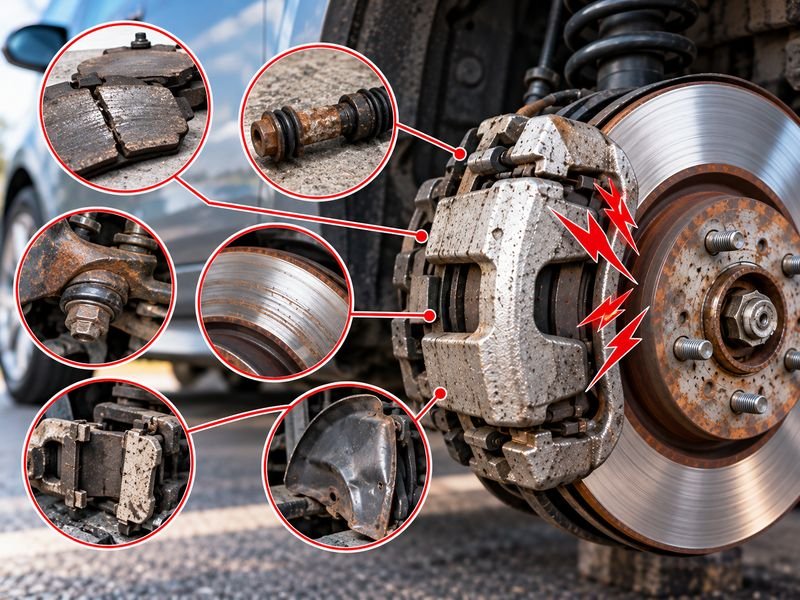
A brake knocking noise happens when a brake, wheel, suspension, steering, or drivetrain component shifts, contacts another component, or develops excessive free play during braking.
When you press the brake pedal, braking force transfers vehicle weight toward the front wheels. That sudden change in force loads several components at once, including the:
- Brake pads
- Brake calipers
- Caliper brackets
- Rotors
- Wheel bearings
- Control arms
- Control arm bushings
- Ball joints
- Tie rods
- Struts and shocks
- Engine and transmission mounts
If one of these components is worn or loose, the change in load can cause it to move suddenly and create a knock or clunk sound when braking.
The most common causes include the following.
Loose or Moving Brake Pads
Brake pads are designed to move slightly inside the caliper bracket so they can contact and release from the rotor. However, excessive movement can create a noticeable knock.
This may happen because of:
- Missing anti-rattle clips
- Incorrect brake pads
- Worn pad mounting surfaces
- Improperly installed brake hardware
- Excessive clearance between the pad and bracket
When braking force first pushes the pad against the rotor, the pad can shift suddenly and hit the caliper bracket.
This often creates a single clunk when braking at low speed, especially when changing direction.
For example, you may hear a clunk after reversing out of a parking space and then pressing the brake while driving forward.
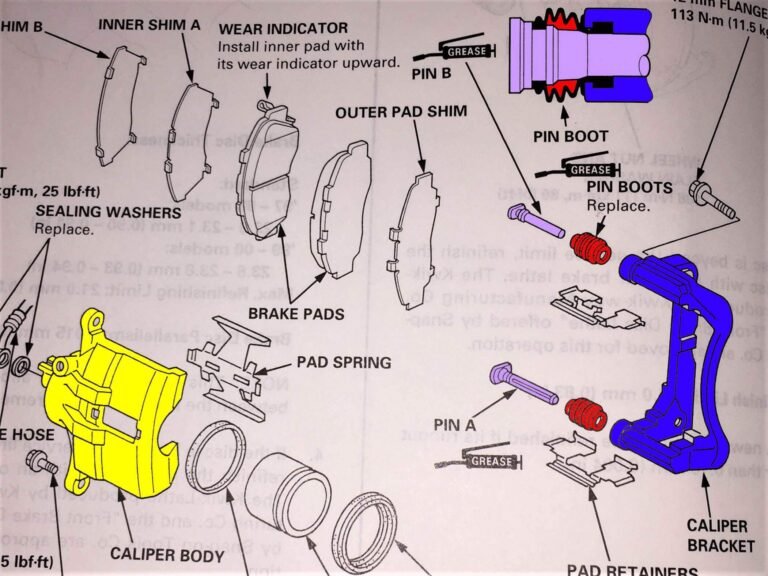
Loose Brake Caliper Bolts
The brake caliper is normally secured to the caliper bracket or steering knuckle using mounting bolts.
If these bolts become loose, the caliper can move when the brakes are applied.
This can produce:
- A heavy knocking noise
- A metallic clunk
- Vibration while braking
- Uneven braking
- Abnormal pad wear
A loose caliper is potentially dangerous because excessive movement can interfere with proper braking.
If you suspect a loose caliper, the vehicle should be inspected before normal driving continues.
Loose Caliper Bracket Bolts
The caliper bracket holds the brake pads and provides a mounting point for the caliper.
Bracket bolts are subjected to substantial braking forces. If one becomes loose, the bracket may shift when braking.
The result can be a strong knocking sound when brakes are applied.
This problem may become more noticeable:
- During harder braking
- When changing direction
- When driving over uneven roads
- At lower speeds where other road noise is minimal
Caliper mounting hardware should always be tightened according to the vehicle manufacturer’s specifications.
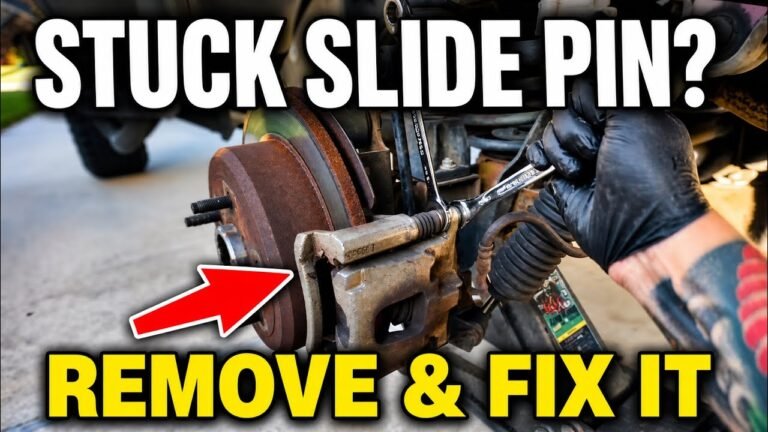
Worn or Dry Caliper Slide Pins
Floating brake calipers move along slide pins so the caliper can apply pressure evenly to both brake pads.
If the slide pins become worn, damaged, improperly lubricated, or loose inside their bores, excessive movement can occur.
Possible symptoms include:
- Brake knocking
- Uneven brake pad wear
- Dragging brakes
- Reduced braking efficiency
- A clunk when applying or releasing the brakes
Slide pin problems are particularly common after brake service when old or damaged hardware is reused.
Missing or Damaged Brake Hardware
Modern disc brake systems use small clips, shims, springs, and retainers to keep brake components properly positioned.
These parts are sometimes called anti-rattle hardware.
If they are missing, damaged, incorrectly fitted, or heavily corroded, the brake pads may move excessively.
This can cause a clunk or knock when the brakes engage.
Replacing brake pads without replacing severely worn hardware can sometimes allow this problem to continue.
Knocking When Braking at Slow Speed
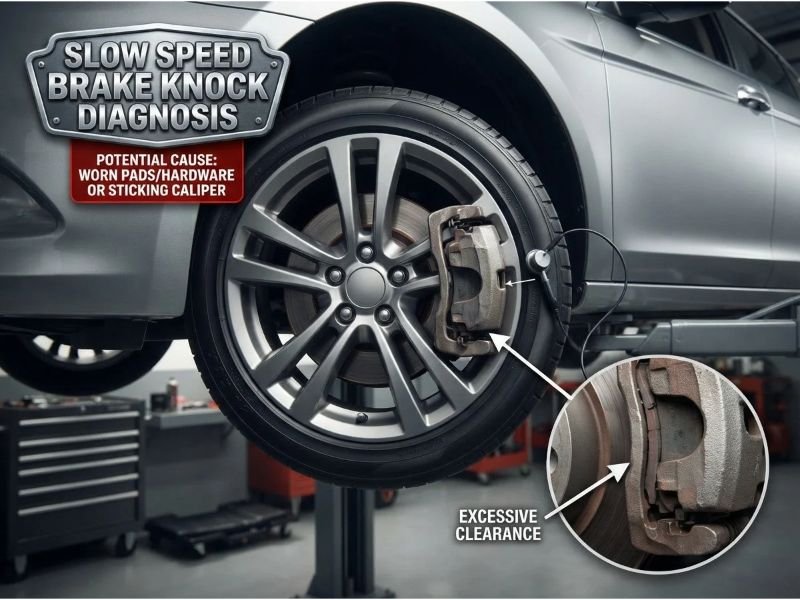
Knocking when braking at slow speed often points toward movement in the brake pads, calipers, suspension bushings, or steering components.
Low-speed braking creates less tire and wind noise, so small mechanical noises are easier to hear.
Common causes include:
- Loose brake pads
- Missing anti-rattle clips
- Loose caliper hardware
- Control arm bushing movement
- Ball joint wear
- Tie rod movement
- Engine mount movement
If the knock happens only once when you first press the brake pedal, brake pad movement becomes especially likely.
Knocking When Braking at Slow Speed Then Stops
If you notice knocking when braking at slow speed then stops, the component may be shifting into position when braking force is first applied.
For example, a loose brake pad might move several millimeters inside its bracket. When you press the brake pedal, it shifts forward and hits the bracket once.
After that movement occurs, the pad stays against the bracket while braking continues, so the noise disappears.
The same thing can happen with worn suspension bushings.
Once the suspension component loads in one direction, it may remain in that position until vehicle forces change again.
Why Brakes Knock at Low Speed
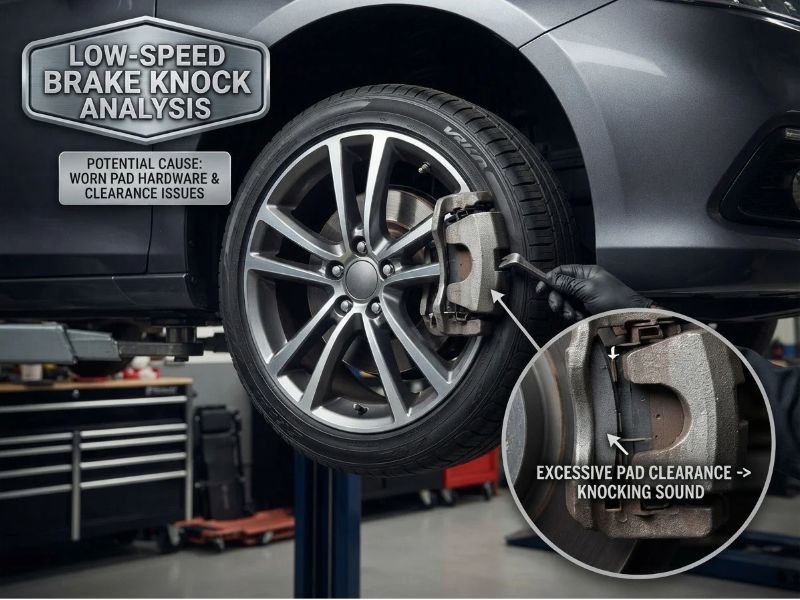
Brakes knocking at low speed can sometimes be traced directly to the braking system, particularly after recent brake pad or rotor replacement.
Possible causes include:
Incorrect Brake Pad Fitment
Two brake pads may look almost identical but have slightly different dimensions.
If an incorrect pad is installed, excessive movement inside the bracket can occur.
Always confirm the exact brake pad application for the vehicle’s:
- Model
- Year
- Trim
- Brake package
- Rotor size
Some vehicles offer multiple brake configurations even within the same model year.
Worn Caliper Brackets
Brake pad mounting surfaces can gradually wear or corrode.
If these surfaces become enlarged, the pads may move farther than intended.
This movement can create a noticeable knock every time braking force changes direction.
Loose Wheel Components
Although less common, improperly tightened wheel fasteners can also produce knocking or clunking sounds.
A loose wheel is a serious safety problem and should be checked immediately.
Clunk Noise When Braking at Low Speeds
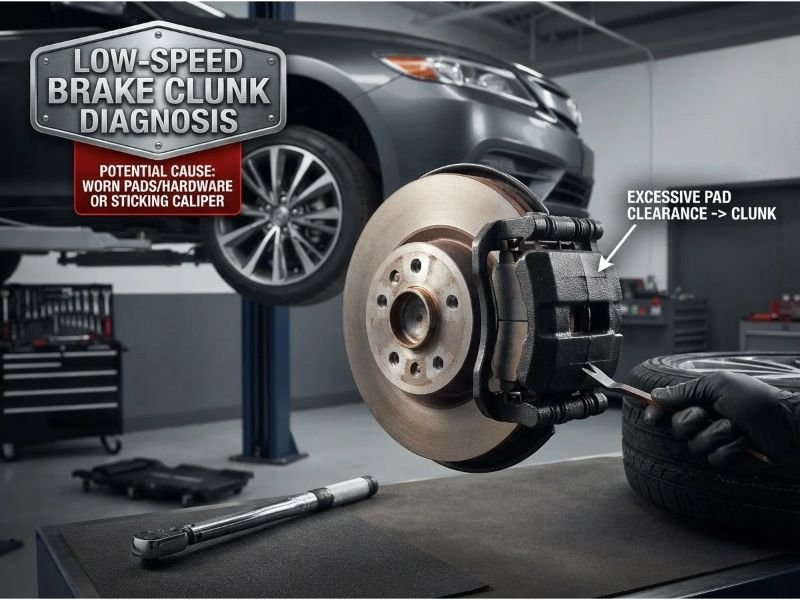
A clunk noise when braking at low speeds often sounds deeper and heavier than ordinary brake squeal.
Brake squeal usually comes from vibration between pads and rotors. A clunk typically indicates physical movement between components.
Common causes include:
- Caliper movement
- Brake pad movement
- Loose suspension bushings
- Ball joints
- Tie rods
- Engine mounts
- CV joints
- Loose subframe hardware
A single clunk when braking at low speed is particularly useful diagnostically because it suggests that something is shifting position once rather than rotating continuously.
Knocking Noise When Braking at High Speeds
A knocking noise when braking at high speeds deserves careful attention because higher braking forces place much greater loads on the brake and suspension systems.
Possible causes include:
- Loose caliper components
- Worn suspension bushings
- Ball joint movement
- Damaged wheel bearings
- Loose wheel or hub components
- Severely worn brake parts
High-speed braking may also expose problems that are barely noticeable around town.
For example, a worn control arm bushing may allow the wheel assembly to move backward slightly under heavy braking.
This movement may create both a knock and a change in steering feel.
Do Warped Brake Rotors Cause Knocking?
Brake rotors that have thickness variation or runout more commonly cause brake pedal pulsation or steering wheel vibration than a single knocking sound.
However, severe rotor damage or unusual brake component movement could create additional noises.
If braking produces rhythmic vibration rather than an isolated knock, the rotor and hub assembly should be inspected.
Knocking Sound When Brakes Applied
A knocking sound when brakes applied usually means that braking force is triggering movement somewhere in the wheel or suspension assembly.
The timing of the sound can provide important clues.
If the knock happens:
Immediately after touching the brake pedal:
Check brake pads, caliper hardware, and suspension bushings.
During continuous braking:
Check rotating parts such as the rotor, hub, wheel bearing, and CV axle.
When releasing the brake:
Check pad movement, caliper movement, suspension bushings, and drivetrain mounts.
Only after changing driving direction:
Brake pad movement or worn suspension bushings become more likely.
Knocking Sound When Braking and Turning
A knocking sound when braking and turning can involve more components because both braking and steering forces are acting on the wheel simultaneously.
Possible causes include:
- Worn CV joints
- Ball joints
- Control arm bushings
- Tie rod ends
- Strut mounts
- Sway bar links
- Loose brake components
CV Joint Problems
A worn CV joint commonly causes clicking during turns, but advanced wear can sometimes create knocking or clunking.
Braking changes the load through the axle, potentially making the noise more noticeable.
Ball Joint Wear
Ball joints connect suspension components while allowing steering and suspension movement.
Excessive ball joint play may produce:
- Clunking
- Knocking
- Wandering steering
- Uneven tire wear
- Changes in wheel alignment
A severely worn ball joint can become a major safety concern.
Control Arm Bushings
Control arm bushings allow controlled suspension movement while limiting unwanted wheel movement.
When the rubber deteriorates or separates from its sleeve, the control arm can move excessively during braking.
This may create a deep clunk from the front suspension.
Knocking Sound When Braking From the Front
A knocking sound when braking front areas are involved is common because braking transfers weight toward the front axle.
Front brakes usually handle a large portion of the braking load, and front suspension components experience significant force.
Possible front-end causes include:
- Front brake pads
- Caliper bolts
- Caliper bracket bolts
- Control arm bushings
- Ball joints
- Tie rod ends
- Strut mounts
- Sway bar links
- Wheel bearings
- CV joints
One useful clue is whether the steering wheel reacts when the sound occurs.
If the steering wheel suddenly shifts, vibrates, or pulls when the knock happens, suspension or steering components deserve particular attention.
Knocking Sound When Braking From the Rear
A knocking sound when braking rear areas are involved may come from either disc or drum brake components, depending on the vehicle.
Rear disc brake causes can include:
- Loose brake pads
- Caliper movement
- Parking brake hardware
- Loose caliper brackets
Rear drum brake systems can develop noises from:
- Loose brake shoes
- Weak retaining springs
- Damaged return springs
- Parking brake hardware
- Components moving inside the drum
Some vehicles also use a small drum-style parking brake inside the rear rotor hat.
Loose parking brake shoes or hardware inside this assembly can occasionally create a knock or rattle.
Clunking Noise When Braking and Going Over Bumps
A clunking noise when braking and going over bumps often indicates a suspension problem rather than the brake pads themselves.
When the wheel hits a bump while braking, suspension components experience both vertical movement and braking load.
Common causes include:
- Worn control arm bushings
- Loose sway bar links
- Ball joints
- Strut mounts
- Loose shock absorber mounts
- Subframe movement
- Loose caliper components
If the vehicle also clunks when driving over bumps without braking, suspension components become even more likely.
Sway Bar Links
Sway bar links connect the anti-roll bar to the suspension.
Worn ball sockets inside the links can create knocking or clunking over uneven surfaces.
These noises may become more obvious during braking because suspension weight transfer changes component loading.
Strut Mounts
The upper strut mount secures the strut assembly to the vehicle body.
Worn mounts can create:
- Clunks over bumps
- Knocks while turning
- Steering noises
- Suspension movement
Combining braking and road bumps may amplify the noise.
Why Do I Hear a Knocking Sound When I Brake?
If you are asking, why do I hear a knocking sound when I brake, the answer usually comes down to unwanted movement.
Braking suddenly changes the direction and amount of force acting on the wheel assembly.
A component that feels quiet while cruising may move when braking force is applied.
This means the noise does not necessarily originate from the brake friction surfaces themselves.
A proper diagnosis should inspect both the brakes and nearby suspension components.
Why Is My Car Knocking When I Brake?
If you’re wondering why is my car knocking when I brake, consider what else happens at the same time.
Ask yourself:
- Does it happen once or repeatedly?
- Does it happen only at low speed?
- Does it happen when reversing?
- Does turning change the sound?
- Does the steering wheel move?
- Does the brake pedal vibrate?
- Does the vehicle pull to one side?
- Does it happen over bumps?
- Did the noise start after brake service?
These details can dramatically narrow the possible causes.
Brake Knocking After Replacing Brake Pads
If brake knocking starts immediately after a brake job, inspect the recently serviced components first.
Common installation-related causes include:
Incorrect Pad Hardware
Anti-rattle clips may be:
- Missing
- Installed backward
- Damaged
- Incorrect for the brake system
Caliper Bolts Not Properly Tightened
Caliper bolts must be installed correctly and tightened according to the manufacturer specifications.
Improper tightening can allow dangerous caliper movement.
Incorrect Brake Pads
Pads that do not fit the caliper bracket properly can shift and knock.
Slide Pins Installed Incorrectly
Some vehicles use different upper and lower caliper slide pins.
Mixing their positions can affect caliper movement.
Always follow the vehicle’s service information.
Can Worn Control Arm Bushings Cause Brake Knocking?
Yes. Worn control arm bushings can cause knocking during braking because the wheel assembly experiences strong fore-and-aft forces.
A damaged bushing may allow the control arm to shift when the vehicle slows down.
Other possible symptoms include:
- Steering instability
- Vehicle wandering
- Uneven tire wear
- Clunking over bumps
- Steering wheel movement during braking
Visible cracking alone does not always prove a bushing has failed. The important question is whether excessive movement exists under load.
Can Bad Ball Joints Cause Knocking When Braking?
Yes. Worn ball joints can create knocking because braking changes the load on the steering knuckle and suspension.
A technician may check ball joint play by lifting the vehicle correctly and testing movement according to the suspension design.
Different suspension systems require different testing methods, so manufacturer service procedures should be followed.
Can Bad Engine Mounts Cause a Clunk When Braking?
Yes. Damaged engine or transmission mounts can sometimes create a clunk during braking.
When the vehicle slows, the drivetrain can shift slightly because of inertia.
A worn mount may allow excessive movement, causing the engine or transmission assembly to contact or pull against another component.
This problem may also cause clunks when:
- Accelerating
- Shifting between Drive and Reverse
- Starting or stopping the engine
Can a Bad Wheel Bearing Cause Knocking During Braking?
A wheel bearing more commonly causes humming, grinding, or growling, but severe looseness may produce clunking or knocking.
Wheel bearing problems may also cause:
- Wheel play
- ABS-related problems
- Steering vibration
- Changes in noise while turning
Excessive wheel bearing play should be addressed promptly.
Can Brake Pads Make a Clunk Sound?
Yes. A clunk sound when braking can come from brake pads moving inside the caliper bracket.
A small amount of pad movement can be normal depending on the brake design, but excessive movement may indicate:
- Missing clips
- Worn bracket surfaces
- Incorrect pads
- Poor-quality hardware
- Installation problems
If the sound began immediately after brake service, the brake pad fitment should be inspected.
How to Diagnose a Brake Knocking Noise
Diagnosing the problem methodically can prevent unnecessary parts replacement.
1. Identify When the Noise Happens
Drive only if the vehicle feels safe.
Pay attention to whether the noise appears:
- During light braking
- During hard braking
- At low speed
- At highway speed
- While turning
- Over bumps
- When reversing
- When releasing the brake pedal
Do not perform aggressive braking tests on public roads.
2. Determine Where the Sound Comes From
Try to identify whether it sounds like it comes from:
- Front left
- Front right
- Rear left
- Rear right
- Center of the vehicle
Sound can travel through the chassis, so this is only a starting point.
3. Inspect the Brake Pads
Check that the pads fit correctly inside the bracket.
Look for:
- Excessive movement
- Missing hardware
- Uneven wear
- Broken friction material
- Incorrect installation
4. Inspect the Caliper
Check the caliper for unexpected movement.
Inspect:
- Caliper mounting bolts
- Bracket bolts
- Slide pins
- Boots
- Hardware
Any obviously loose brake mounting component should be addressed before driving.
5. Check Suspension Components
Inspect the:
- Control arm bushings
- Ball joints
- Tie rod ends
- Sway bar links
- Strut mounts
Look for excessive free play, damaged rubber, loose fasteners, or contact marks.
6. Inspect Wheel Bearings
Check for wheel bearing looseness using the proper procedure for the vehicle.
Some bearing designs can have different allowable movement, so service specifications matter.
7. Check CV Axles
Inspect CV boots for:
- Tears
- Grease leakage
- Damage
Listen for clicking or knocking when turning.
8. Inspect Engine and Transmission Mounts
Look for:
- Separated rubber
- Cracked mounts
- Excessive drivetrain movement
- Metal-to-metal contact
Brake Knock Diagnosis by Symptom
| Symptom | Possible Causes |
| Single clunk when braking | Pad movement, loose caliper, worn bushing |
| Knock after changing direction | Brake pad movement, suspension bushing play |
| Knock while turning and braking | CV joint, ball joint, control arm, tie rod |
| Clunk over bumps and braking | Bushings, sway bar links, strut mounts |
| Repeated knocking while braking | Rotor/hub issue, loose rotating component |
| Front knocking while braking | Front brake or suspension components |
| Rear knocking while braking | Rear brakes, parking brake hardware, suspension |
| Knock with steering movement | Control arm, ball joint, tie rod, wheel bearing |
This table can help narrow the possibilities, but it should not replace a physical inspection.
Is Brake Knocking Dangerous?
It can be.
Some brake knocking causes are relatively minor, such as brake pads shifting slightly inside a bracket.
Other causes can involve critical components such as:
- Loose calipers
- Ball joints
- Wheel bearings
- Suspension bolts
- Wheel fasteners
These problems can affect braking or steering control.
Do not ignore a new, loud, or rapidly worsening brake knock.
Immediate inspection is especially important if the knocking is accompanied by:
- Reduced braking
- Brake pedal changes
- Steering instability
- Vehicle pulling
- Wheel movement
- Severe vibration
- Grinding
- ABS or brake warning lights
- A loose-feeling wheel
Can You Drive With a Knocking Brake?
That depends on the cause, but driving should be minimized until the source is known.
If a brake caliper or suspension component is loose, continued driving could allow the problem to become significantly worse.
Stop driving and arrange inspection if the vehicle:
- Pulls strongly while braking
- Feels unstable
- Has reduced brake effectiveness
- Produces heavy metallic impacts
- Has visible loose brake components
- Shows excessive wheel movement
A mild isolated noise still deserves investigation because sound alone cannot reveal whether the underlying component is safe.
How Is Brake Knocking Fixed?
The repair depends entirely on the failed component.
Possible repairs include:
- Installing correct brake pad hardware
- Replacing improperly fitting brake pads
- Replacing worn caliper brackets
- Servicing or replacing caliper slide pins
- Correctly securing caliper hardware
- Replacing control arm bushings
- Replacing worn ball joints
- Replacing damaged sway bar links
- Repairing strut mounts
- Replacing worn wheel bearings
- Repairing CV axle problems
- Replacing damaged engine mounts
Do not tighten suspension or brake hardware to guessed specifications. Use the correct manufacturer torque values and repair procedures.
Common Mistakes When Diagnosing Brake Knocking
Assuming Every Brake Noise Comes From the Brake Pads
Braking loads the entire suspension system.
A worn control arm bushing can sound almost exactly like a loose brake component.
Replacing Rotors Automatically
Rotor problems frequently cause pulsation rather than a single clunk.
Replacing rotors without confirming the cause may leave the original noise unchanged.
Ignoring Recent Repair Work
If knocking appears immediately after brake or suspension work, inspect the serviced area first.
Installation or hardware issues are possible.
Reusing Damaged Brake Hardware
Old anti-rattle clips and heavily corroded hardware may allow pad movement.
Replacement hardware should match the brake system.
Guessing Bolt Tightness
Brake and suspension bolts often require specific torque procedures.
Use manufacturer service information rather than simply tightening bolts as much as possible.
Safety Precautions During Brake Inspection
Brake and suspension inspection often requires lifting the vehicle, so safety is essential.
Park on a firm, level surface whenever possible.
Use the proper lifting points specified for the vehicle.
Never work underneath a vehicle supported only by a hydraulic jack. Use appropriately rated jack stands positioned correctly.
Before removing wheels:
- Apply the parking brake when appropriate
- Use wheel chocks
- Keep the vehicle in Park or in gear as appropriate
- Avoid touching hot brake components
- Wear eye protection around rust and debris
Brake dust should not be blown around with compressed air.
If you are not confident inspecting safety-critical brake or suspension components, professional diagnosis is the safer option.
Frequently Asked Questions About Brake Knocking Noise
Why do I hear a knocking sound when I brake?
A knocking sound during braking usually means a brake, suspension, steering, or drivetrain component is moving under load. Loose brake pads, caliper hardware, worn bushings, and ball joints are common possibilities.
The exact timing and location of the sound can help narrow down the cause.
Why is my car knocking when I brake at low speed?
Low-speed brake knocking commonly comes from brake pad movement, caliper hardware, or worn suspension bushings. Low speeds also make mechanical noises easier to hear because tire and wind noise are reduced.
A single knock can be especially consistent with a component shifting once under braking force.
What causes a single clunk when braking at low speed?
A single clunk often occurs when a component moves suddenly into a loaded position. Brake pads, calipers, control arm bushings, or drivetrain mounts can produce this type of noise.
If the sound occurs after changing from reverse to forward, brake pad movement should be inspected.
Why do my brakes knock after changing direction?
Brake pads can shift slightly inside the caliper bracket when vehicle direction changes. Excessive clearance or missing anti-rattle hardware may make this movement loud enough to hear.
Suspension bushings can also shift when load direction changes.
Can bad brake calipers cause knocking?
Yes, a loose or excessively worn brake caliper can create knocking or clunking during braking. Worn slide pins or improperly secured mounting bolts may allow unwanted movement.
Loose caliper hardware should be treated as a safety issue.
Read More : Symptoms of a Bad Brake Caliper? 12 Key Signs
Why do I hear a knocking sound when braking and turning?
Braking and turning place simultaneous loads on the brakes, steering, suspension, and CV joints. Worn ball joints, control arm bushings, CV joints, tie rods, or brake hardware can create knocking under these conditions.
An inspection should consider more than just the brake pads.
Can control arm bushings cause a clunk noise when braking?
Yes, worn control arm bushings can allow the wheel assembly to move during braking and produce a clunk. The noise may also occur over bumps or during acceleration.
Severe bushing wear can affect alignment and steering stability.
Why is there a clunking noise when braking and going over bumps?
A clunk over bumps while braking often points toward suspension movement. Control arm bushings, sway bar links, strut mounts, ball joints, or loose brake components are common possibilities.
If the noise also occurs without braking, suspension components become more likely.
Is brake knocking dangerous?
Brake knocking can be dangerous if it comes from a loose caliper, wheel bearing, ball joint, suspension fastener, or wheel component. Even mild noises should be investigated because the sound alone cannot determine the severity.
Avoid driving if braking or steering feels abnormal.
Will brake knocking go away on its own?
Mechanical knocking should not be expected to permanently disappear without addressing the underlying cause. A noise may temporarily stop as components change position, temperature, or load, but the original wear or looseness usually remains.
Inspection is the best way to determine whether repair is necessary.
Conclusion
A brake knocking noise is usually caused by unwanted movement somewhere in the braking, suspension, steering, or drivetrain system. Loose brake pads, missing anti-rattle hardware, worn caliper slide pins, loose caliper mounting components, control arm bushings, ball joints, and CV joints are among the most common areas to investigate.
The pattern of the noise provides valuable clues. Knocking when braking at slow speed often suggests brake pad, caliper, or suspension movement, while a knocking sound when braking and turning can point more strongly toward steering, suspension, or CV components. A clunking noise when braking and going over bumps often deserves a closer suspension inspection.
Because some causes involve safety-critical parts, do not assume a brake knock is harmless simply because the vehicle still stops normally. A careful inspection of the brakes and surrounding suspension components is the most reliable way to find the cause and determine the correct repair.