What Is a Brake Caliper? What It Does, Looks Like, and Location
A brake caliper is one of the main components that makes a modern disc brake system work. Mounted around part of the brake rotor, the caliper holds the brake pads and uses hydraulic pressure to squeeze them against the spinning rotor whenever you press the brake pedal. This friction slows the wheel and allows your vehicle to reduce speed or come to a complete stop.
If you are trying to understand what is a brake caliper, it also helps to know how the component works, what it looks like behind the wheel, and exactly where it is installed. A brake caliper may look like a relatively simple metal housing, but inside it are pistons and seals that must operate smoothly every time you use the brakes.
In this guide, you will learn what does a brake caliper do, how hydraulic pressure moves the caliper piston, what does a brake caliper look like, and where are brake calipers located on a vehicle. We will also cover the main parts of a caliper, different caliper designs, how front and rear calipers differ, common signs of caliper trouble, and what can happen when a caliper starts sticking or fails.
By the end, you should have a clear picture of how the brake caliper, brake pads, brake rotor, and hydraulic braking system work together to stop your vehicle safely.
What Is a Brake Caliper?
A brake caliper is a mechanical and hydraulic component used in a vehicle’s disc brake system. Its main job is to hold the brake pads on either side of the brake rotor and apply pressure to those pads when the driver presses the brake pedal.
The easiest way to picture a caliper is to think of it as a powerful clamp positioned around the outer edge of the brake rotor.
When you press the brake pedal, hydraulic pressure created in the braking system reaches the caliper. That pressure moves one or more pistons inside the caliper. The pistons force the brake pads against the rotor, creating the friction necessary to slow the wheel.
The basic sequence is:
Brake pedal → brake fluid pressure → caliper piston → brake pads → brake rotor → wheel slows down
The brake rotor spins with the wheel, while the caliper remains mounted in a fixed position around a portion of the rotor. Every time the pads clamp onto the spinning rotor, some of the vehicle’s motion is converted into heat through friction.
Although the caliper itself does not normally require replacement as frequently as brake pads, it is essential to the operation of the braking system.
Is a Brake Caliper Part of the Brake System?
Yes. The caliper is one of the primary components of a disc brake system.
A typical disc brake assembly includes:
- Brake caliper
- Brake pads
- Brake rotor
- Caliper piston
- Caliper bracket
- Brake hose
- Slide or guide pins
- Piston seals
- Dust boots
- Bleeder screw
These components work together whenever you apply the brakes.
The rotor provides the rotating surface, the brake pads provide friction, and the caliper provides the force needed to press the pads against the rotor.
What Does a Brake Caliper Do?
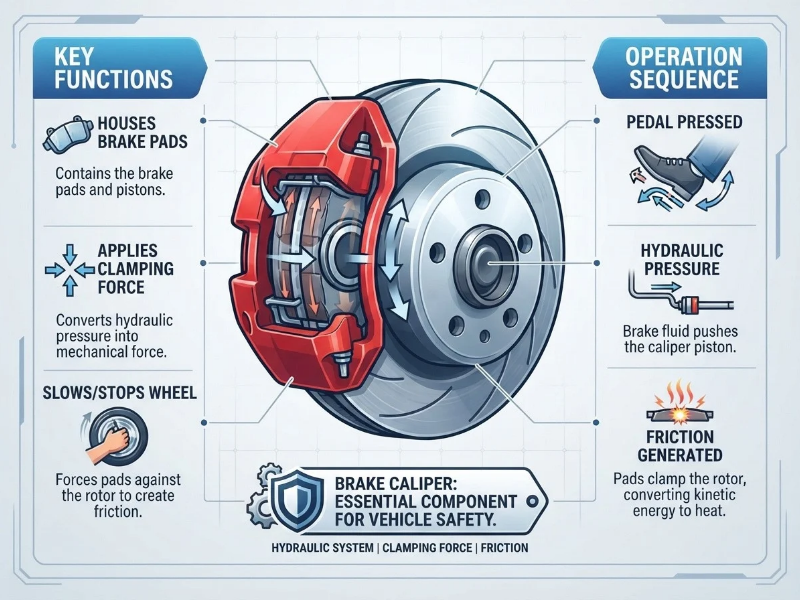
The simplest answer to what does a brake caliper do is that it squeezes the brake pads against the brake rotor so the vehicle can slow down or stop.
However, the caliper performs several important jobs during this process.
It Holds the Brake Pads in Position
Brake pads must remain correctly positioned on both sides of the rotor.
The caliper assembly keeps the pads aligned so they can contact the rotor evenly whenever braking force is required.
When the brakes are released, the pads remain extremely close to the rotor without applying significant pressure.
This close positioning allows the brakes to respond almost immediately when you press the pedal again.
It Converts Hydraulic Pressure Into Mechanical Force
Your foot does not directly push the brake pads against the rotors.
Instead, pressing the brake pedal creates hydraulic pressure through the master cylinder and brake fluid.
That pressure travels through the brake lines and flexible brake hoses until it reaches the brake caliper.
Inside the caliper, hydraulic pressure acts on the piston.
The piston then converts that pressure into mechanical movement and pushes the brake pad toward the rotor.
It Squeezes the Brake Rotor
Once the brake pads contact the rotor, the caliper creates a clamping action.
The rotor is squeezed between the inner and outer brake pads.
Since the rotor is connected to the wheel hub, slowing the rotor also slows the wheel.
The harder you press the brake pedal, the greater the hydraulic pressure and, within the system’s design limits, the greater the clamping force applied by the caliper.
It Helps Control Vehicle Speed
Brake calipers do more than bring the car to a complete stop.
They are working whenever you:
- Slow down for traffic
- Approach an intersection
- Reduce speed before a turn
- Control speed on a downhill road
- Make a normal stop
- Brake suddenly in an emergency
The calipers must apply pressure smoothly and consistently so that braking remains predictable.
It Releases the Rotor When You Let Off the Brake Pedal
A healthy brake caliper must release properly as well as apply the brakes.
When you remove your foot from the brake pedal, hydraulic pressure decreases.
The piston retracts slightly, reducing the clamping force on the brake pads.
The rotor can then rotate freely again with only minimal normal contact between the pad and rotor surfaces.
If the caliper fails to release correctly, the brake may continue dragging even after the pedal is released.
How Does a Brake Caliper Work?
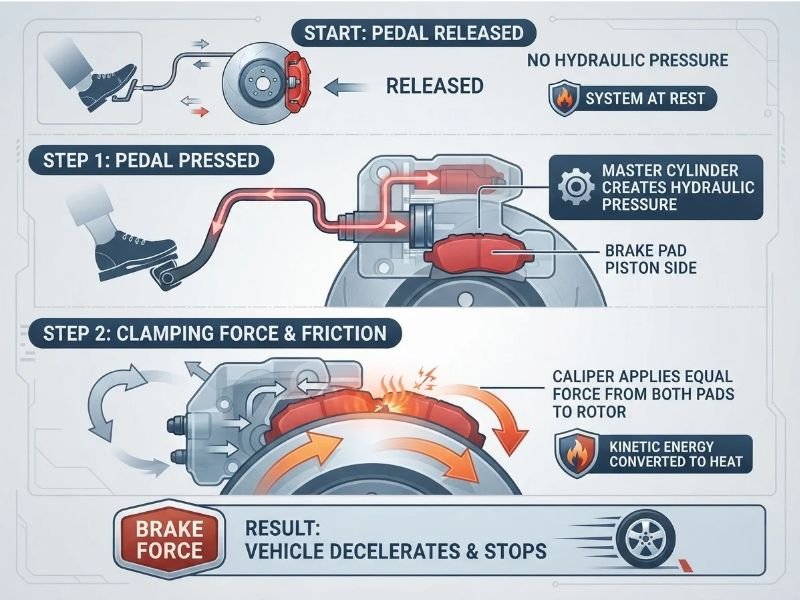
Understanding how a brake caliper works makes the entire disc brake system easier to understand.
Step 1: You Press the Brake Pedal
The process begins when you push the brake pedal.
The force from your foot is transferred to the brake master cylinder, usually with assistance from a brake booster on modern vehicles.
Step 2: The Master Cylinder Creates Hydraulic Pressure
The master cylinder pressurizes the brake fluid.
Because brake fluid transfers pressure efficiently through a sealed hydraulic system, the force can travel from the master cylinder toward the brakes at each wheel.
Step 3: Brake Fluid Reaches the Caliper
Pressurized brake fluid travels through metal brake lines and flexible brake hoses.
At the wheel, the pressure enters the brake caliper.
Step 4: The Caliper Piston Moves
Hydraulic pressure acts against the caliper piston.
The piston moves outward and pushes the brake pad toward the rotor.
How this force is applied depends partly on whether the vehicle uses a floating or fixed caliper.
Step 5: The Brake Pads Clamp the Rotor
The inner and outer brake pads move into contact with the rotor.
The rotor becomes squeezed between the friction surfaces of the pads.
Step 6: Friction Slows the Wheel
Friction between the pads and rotor resists the rotor’s rotation.
Because the rotor is connected to the wheel hub, the wheel slows down with it.
The vehicle therefore begins to decelerate.
Step 7: The Brakes Release
When you lift your foot from the pedal, hydraulic pressure decreases.
The caliper piston retracts slightly, reducing pressure between the brake pads and rotor.
The wheel can then rotate normally again.
This entire process occurs in a fraction of a second.
What Does a Brake Caliper Look Like?
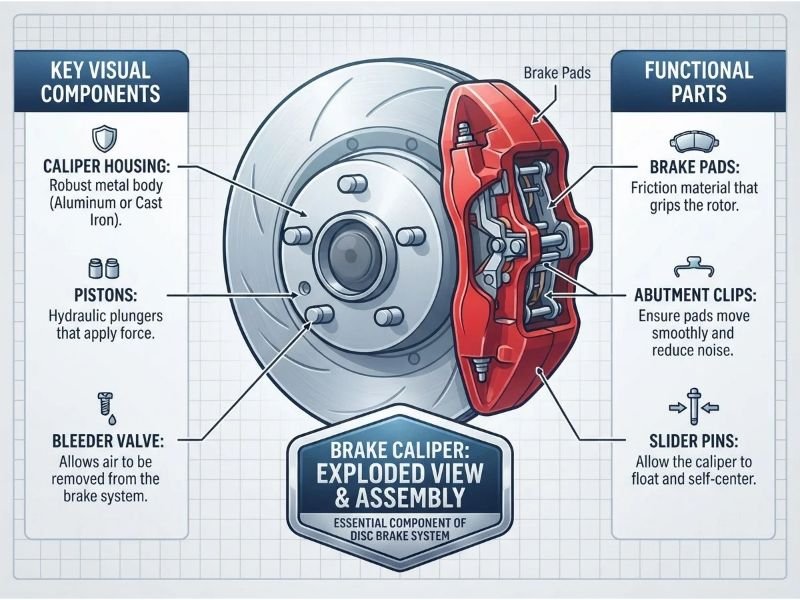
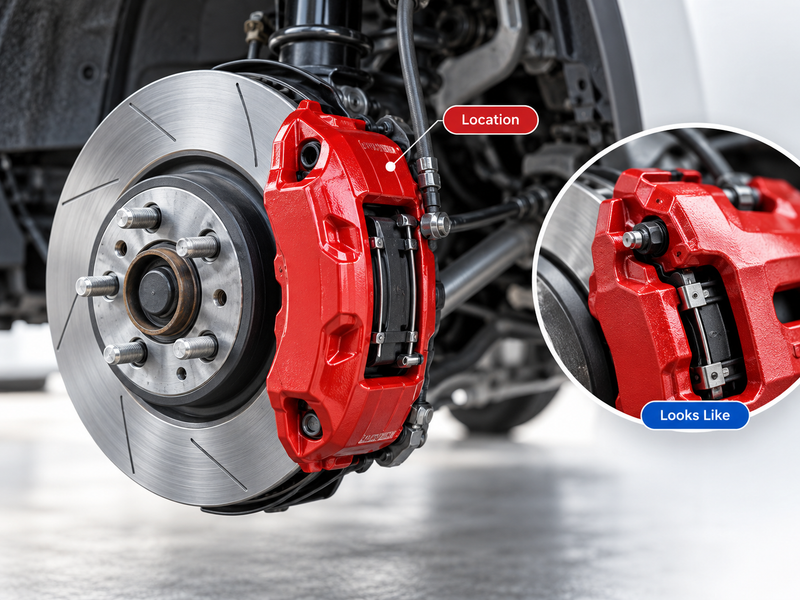
If you are wondering what does a brake caliper look like, it generally resembles a thick metal clamp or housing positioned around the outer portion of a round brake rotor.
Its exact appearance varies by vehicle and caliper design.
Most everyday vehicles use relatively compact cast-metal calipers, while sports cars and high-performance vehicles may use much larger multi-piston calipers.
Common Features of a Brake Caliper
When looking at a caliper, you may notice:
- A thick metal body
- A curved opening that fits around the rotor
- One or more piston housings
- A brake hose connected to the body
- A small bleeder screw
- Mounting bolts
- A separate caliper bracket on some designs
- Brake pads positioned inside the assembly
- Slide pins on floating calipers
Brake calipers are commonly made from cast iron or aluminum.
They may appear:
- Gray
- Black
- Silver
- Metallic
- Rust-colored from surface corrosion
- Painted in bright colors on some performance vehicles
Red, yellow, blue, and other colored calipers are particularly common on sports cars or vehicles with aftermarket brake systems.
What Does a Brake Caliper Look Like Behind the Wheel?
On a vehicle with an open-spoke wheel, the caliper can often be seen without removing the wheel.
Look through the wheel spokes.
You should first notice a large round metal disc. That is the brake rotor.
Then look along the outer edge of the rotor.
You should see a thick stationary metal component covering a portion of the rotor. That is the brake caliper.
An important visual difference is that the rotor turns with the wheel while the caliper remains stationary.
What Does the Inside of a Brake Caliper Look Like?
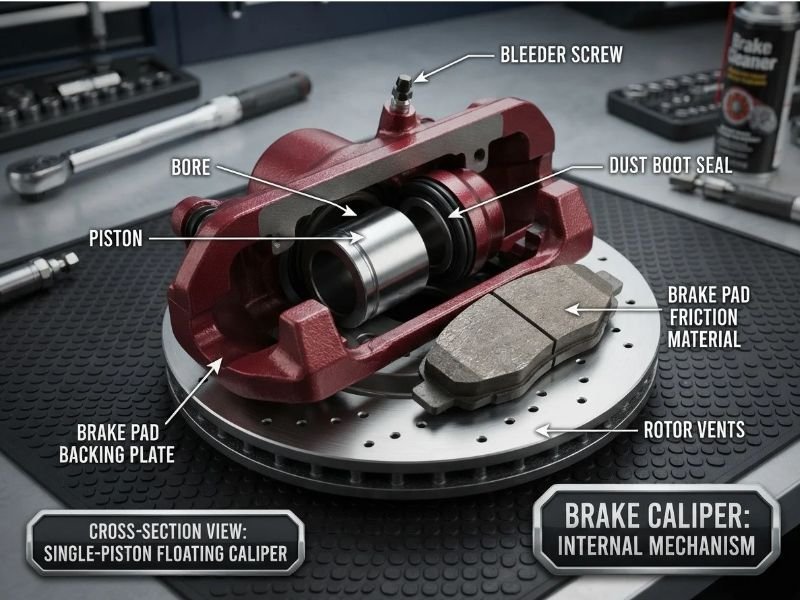
Inside a brake caliper are components that allow hydraulic pressure to produce braking force.
The most important internal component is the caliper piston.
Depending on the design, a caliper may contain one piston or several pistons.
Around the piston are seals designed to keep brake fluid inside the hydraulic system.
A flexible dust boot helps protect the piston area from moisture and road contamination.
The brake pads are positioned between the piston and rotor surfaces.
Although much of the caliper’s working mechanism is hidden during normal inspection, these internal parts must move smoothly and remain properly sealed for reliable braking.
Main Parts of a Brake Caliper
A brake caliper consists of several important components.
Caliper Body
The caliper body provides the main structural housing.
It has to withstand:
- Hydraulic pressure
- High braking temperatures
- Strong clamping forces
- Road vibration
- Water and dirt exposure
Caliper bodies are generally made from durable cast iron or aluminum.
Caliper Piston
The piston is one of the most important parts of the caliper.
Brake fluid pressure pushes the piston outward, which forces the brake pad against the rotor.
Some calipers use one large piston, while others use multiple smaller pistons.
Piston Seal
The piston seal prevents brake fluid from leaking around the piston.
It also helps control the very small amount of piston movement needed when the brakes are applied and released.
A damaged seal can result in a brake fluid leak or caliper malfunction.
Dust Boot
The dust boot covers the exposed portion around the piston.
Its purpose is to prevent:
- Dirt
- Moisture
- Salt
- Brake dust
- Road debris
from entering the piston area.
If the boot tears, corrosion can develop and eventually cause the piston to stick.
Caliper Bracket
Many floating calipers mount to a separate bracket.
The bracket helps hold the brake pads and supports the caliper assembly around the rotor.
Slide Pins
Floating calipers typically move along guide or slide pins.
These pins must remain clean and properly lubricated.
If a slide pin becomes seized, the caliper may not apply or release evenly.
Bleeder Screw
The bleeder screw is a small valve used during brake bleeding.
It allows air and old brake fluid to be removed from the hydraulic system.
Air trapped in the brake system can cause a soft or spongy brake pedal.
Brake Hose Connection
A flexible brake hose connects the hydraulic brake system to the caliper.
This hose delivers pressurized brake fluid whenever the pedal is pressed.
Where Are Brake Calipers Located?
If you are asking where are brake calipers located, they are normally found directly behind the wheels on any wheel equipped with disc brakes.
The caliper is mounted around part of the brake rotor.
It remains stationary while the wheel and brake rotor rotate.
Depending on the vehicle, calipers may be positioned toward the front, rear, upper, or lower side of the rotor. The exact mounting position depends on suspension and brake system design.
Where Are the Front Brake Calipers Located?
Front brake calipers are located behind the front wheels.
If you remove a front wheel, the brake rotor will be one of the most obvious components.
The caliper sits around the outer edge of that rotor.
On many vehicles, you can also see the front caliper through the wheel spokes.
Front brakes typically perform a greater share of the vehicle’s braking work because weight transfers toward the front during deceleration.
For this reason, front brakes commonly use:
- Larger rotors
- Larger brake pads
- Larger caliper pistons
- Greater braking capacity
than the rear brakes.
Where Are the Rear Brake Calipers Located?
On vehicles equipped with rear disc brakes, the rear brake calipers are located behind the rear wheels around the rear brake rotors.
Rear calipers are often smaller than the front calipers because the rear brakes normally handle less braking force.
Some rear calipers also incorporate the parking brake mechanism.
Depending on the vehicle, the parking brake may operate through:
- A mechanical cable
- An electric parking brake motor
- A separate internal mechanism
This can make rear brake caliper service different from front brake service.
Do All Four Wheels Have Brake Calipers?
No. Whether all four wheels have calipers depends on the vehicle’s braking system.
A vehicle with four-wheel disc brakes normally has a brake caliper at each wheel.
That means:
- Left front caliper
- Right front caliper
- Left rear caliper
- Right rear caliper
However, some vehicles use disc brakes at the front and drum brakes at the rear.
Drum brakes do not use conventional brake calipers.
Instead, they typically use brake shoes, wheel cylinders, springs, and a brake drum.
Therefore, a vehicle with front disc brakes and rear drum brakes may only have two calipers.
Front Brake Calipers vs. Rear Brake Calipers
Front and rear brake calipers perform the same basic function, but they do not always have the same size or design.
Front Brake Calipers
Front calipers normally handle more braking force.
When a vehicle slows down, its weight shifts toward the front.
This increases the braking demand placed on the front wheels.
As a result, the front braking system may use:
- Larger calipers
- Larger pistons
- Larger pads
- Larger rotors
Front brake pads also commonly wear faster than rear pads.
Rear Brake Calipers
Rear calipers help balance braking force and keep the vehicle stable.
Because the rear wheels generally require less braking force, rear calipers may be smaller.
However, some performance vehicles use large multi-piston rear calipers as part of a high-performance brake system.
Rear calipers may also include components for the parking brake.
What Are the Different Types of Brake Calipers?
Most automotive disc brake systems use one of two primary caliper designs:
- Floating calipers
- Fixed calipers
Each achieves the same basic goal but operates differently.
What Is a Floating Brake Caliper?
A floating caliper, also called a sliding caliper, is extremely common on passenger cars, SUVs, and light trucks.
The piston or pistons are usually located on only one side of the rotor.
When hydraulic pressure pushes the piston outward, the inner brake pad contacts the rotor.
The caliper body then slides on its guide pins, pulling the outer pad against the other side of the rotor.
This creates clamping pressure on both sides of the rotor.
Advantages of Floating Calipers
Floating calipers are generally:
- Simple
- Compact
- Cost-effective
- Relatively lightweight
- Easy to manufacture
- Suitable for everyday driving
One potential problem is that the slide pins can become corroded or seized.
When that happens, brake pad pressure may become uneven.
What Is a Fixed Brake Caliper?
A fixed caliper does not slide along guide pins.
Instead, it normally has pistons positioned on both sides of the brake rotor.
When the brake pedal is pressed, pistons from both sides push the brake pads toward the rotor.
This design can provide very consistent clamping pressure.
Fixed calipers are commonly found on:
- Sports cars
- Performance vehicles
- High-end brake systems
- Some heavy-duty applications
They may use two, four, six, eight, or even more pistons depending on the design.
How Many Pistons Are in a Brake Caliper?
The number of pistons depends on the caliper design and vehicle.
A basic brake caliper may have only one piston.
Other common designs include:
- Two-piston calipers
- Four-piston calipers
- Six-piston calipers
- Eight-piston calipers
Some specialized high-performance systems may use even more.
Multiple pistons can help spread clamping pressure across a larger brake pad.
However, the number of pistons alone does not determine how well a vehicle stops.
Overall braking performance also depends on:
- Tire grip
- Brake pad material
- Rotor size
- Brake temperature
- Vehicle weight
- Hydraulic system design
- ABS operation
- Suspension setup
Brake Caliper vs. Brake Pad: What Is the Difference?
The brake caliper and brake pad are two different components that work together.
The brake caliper creates and applies clamping force.
The brake pad provides the friction material that presses against the rotor.
When you press the brake pedal:
- Brake fluid pressure reaches the caliper.
- The caliper piston moves outward.
- The piston pushes the brake pad.
- The pads squeeze the rotor.
- Friction slows the vehicle.
Brake pads are designed to wear gradually and require periodic replacement.
Calipers normally last much longer.
Brake Caliper vs. Brake Rotor
The brake rotor is the round metal disc that rotates with the wheel.
The brake caliper remains stationary around part of the rotor.
During braking, the caliper pushes the brake pads against both sides of the rotating rotor.
In simple terms:
Brake caliper: Provides the clamping force.
Brake pads: Provide friction.
Brake rotor: Provides the rotating surface the pads clamp against.
All three components must work correctly for smooth and effective braking.
What Happens When a Brake Caliper Goes Bad?
A brake caliper operates in a harsh environment.
It is constantly exposed to:
- High temperatures
- Water
- Dirt
- Brake dust
- Road salt
- Vibration
- Temperature changes
Eventually, the piston, seals, dust boots, slide pins, or other parts can deteriorate.
A bad caliper may fail in different ways.
It can:
- Stick in the applied position
- Fail to apply enough pressure
- Leak brake fluid
- Develop seized slide pins
- Cause uneven brake pad wear
- Overheat the rotor and pads
Some caliper problems develop gradually, while others can become serious relatively quickly.
What Are the Signs of a Bad Brake Caliper?
Several symptoms can suggest that a brake caliper is not operating correctly.
Vehicle Pulls to One Side While Braking
A sticking caliper can cause one wheel to receive more braking force than the other.
The vehicle may pull to the left or right when you press the brake pedal.
However, pulling can also result from:
- Tire problems
- Wheel alignment
- Suspension damage
- Brake hose problems
- Uneven brake pad wear
so the system should be properly inspected.
One Brake Pad Wears Faster Than the Other
Uneven brake pad wear is a common sign of caliper or slide-pin problems.
For example, the inside brake pad may be almost completely worn while the outer pad still has substantial material remaining.
This can occur when:
- The piston sticks
- Slide pins seize
- The pad becomes stuck in the bracket
One Wheel Becomes Very Hot
A brake caliper that does not fully release can keep the brake pad touching the rotor.
Continuous friction creates excessive heat.
After driving, one wheel may feel much hotter than the others.
Do not touch the rotor or caliper directly because braking components can become hot enough to cause burns.
Burning Smell From One Wheel
A dragging brake can produce a noticeable burning smell.
In severe cases, smoke may appear from the wheel area.
This is a sign that the brake should be inspected promptly.
Brake Fluid Leak
A damaged caliper seal can allow brake fluid to escape.
You may notice wet fluid around the caliper or inside the wheel.
Brake fluid leaks can reduce hydraulic pressure and compromise braking performance.
Reduced Braking Performance
A caliper that does not apply properly can reduce the braking force available at one wheel.
The vehicle may take longer to stop or feel unstable during braking.
Grinding or Unusual Brake Noise
A malfunctioning caliper may cause uneven brake pad wear.
Once a pad becomes excessively worn, metal components may begin contacting the rotor and create grinding sounds.
Unusual brake noises can have several causes, so inspection is necessary to identify the actual problem.
What Causes a Brake Caliper to Stick?
A sticking or seized caliper can develop for several reasons.
Corroded Caliper Piston
A damaged dust boot can allow moisture to reach the caliper piston.
Over time, rust may form and prevent the piston from moving smoothly.
Seized Slide Pins
Floating brake calipers rely on slide pins.
If the pins become dry, rusted, or contaminated, the caliper may no longer move freely.
This can cause uneven pad pressure and brake drag.
Damaged Brake Hose
A deteriorated brake hose can sometimes restrict fluid flow.
Pressure may reach the caliper when the pedal is pressed but fail to release properly afterward.
This can make the caliper appear to be seized even when the piston itself is still functional.
Old or Contaminated Brake Fluid
Brake fluid absorbs moisture over time.
Excess moisture can contribute to internal corrosion in hydraulic brake components, including the calipers.
Following the vehicle manufacturer’s brake fluid service recommendations can help reduce this risk.
Can You Drive With a Bad Brake Caliper?
A suspected brake caliper problem should not be ignored.
A bad or sticking caliper can lead to:
- Reduced braking performance
- Pulling during braking
- Excessive brake heat
- Premature pad wear
- Rotor damage
- Increased stopping distance
- Brake fluid overheating
- Reduced fuel economy from brake drag
A severely seized caliper may keep one brake applied continuously.
That can generate enough heat to damage the rotor, pads, wheel bearing, tire, or nearby components.
Because brake system problems directly affect vehicle safety, the vehicle should be inspected as soon as practical when caliper failure is suspected.
Can a Bad Brake Caliper Damage the Rotor?
Yes.
A sticking caliper can keep the brake pad pressed against the rotor even when the driver is not braking.
Continuous contact creates excessive heat and friction.
Possible rotor damage includes:
- Scoring
- Deep grooves
- Uneven wear
- Heat spots
- Discoloration
- Surface cracking in severe cases
- Changes in rotor thickness
If the rotor has been significantly damaged or overheated, replacing only the caliper may not be enough.
The pads and rotor may also need replacement.
Can a Bad Brake Caliper Cause Vibration?
Yes, although the caliper may not always be the direct cause.
A sticking brake caliper can overheat the rotor and create uneven friction conditions.
Over time, the driver may notice:
- Brake pedal pulsation
- Steering wheel vibration
- Vehicle shaking while braking
However, braking vibration can also be caused by:
- Rotor thickness variation
- Tire problems
- Wheel imbalance
- Suspension wear
- Hub problems
- Uneven brake pad deposits
A proper inspection is important before replacing parts.
How Long Do Brake Calipers Last?
Brake calipers do not normally have a fixed replacement interval like brake pads.
A well-maintained caliper may last for many years and through several sets of brake pads.
Its lifespan depends on:
- Driving environment
- Road salt exposure
- Vehicle age
- Brake fluid condition
- Caliper material
- Condition of the seals
- Condition of the dust boots
- Slide pin maintenance
- Driving habits
Vehicles operated in wet or heavily salted climates may experience caliper corrosion sooner than vehicles used in dry environments.
Calipers should generally be replaced based on condition rather than mileage alone.
Do Brake Calipers Need Maintenance?
The caliper itself does not require frequent routine service, but several related parts should be checked during brake maintenance.
A brake inspection may include checking:
- Caliper piston movement
- Brake fluid leaks
- Dust boots
- Slide pins
- Guide pin boots
- Brake pad movement
- Mounting hardware
- Brake hoses
- Pad wear patterns
- Rotor condition
Floating caliper slide pins are particularly important.
They must move freely so the caliper can apply equal pressure to both sides of the rotor.
Only lubricant specifically suitable for brake components should be used where required.
Should Brake Calipers Be Replaced in Pairs?
Brake calipers do not always have to be replaced in pairs, but there are situations where replacing both calipers on the same axle may make sense.
If one caliper has failed due to:
- Severe corrosion
- Advanced age
- Similar exposure conditions
- Internal deterioration
the caliper on the opposite side may also be approaching the end of its service life.
Replacing both can provide more consistent condition across the axle.
However, if the opposite caliper is functioning correctly and is in good condition, replacing it may not always be necessary.
The decision should be based on inspection, vehicle condition, and manufacturer or repair guidance.
Can You See a Brake Caliper Without Removing the Wheel?
In many vehicles, yes.
If the wheels have wide or open spokes, look through them toward the brake rotor.
The large circular metal disc is the rotor.
The caliper will appear as a thick metal housing wrapped around part of its outer edge.
On wheels with very small openings, steel wheels, or wheel covers, the caliper may be difficult or impossible to see clearly without removing the wheel.
How Can You Tell Which Brake Caliper Is Bad?
Identifying the faulty caliper usually requires comparing the brakes on both sides of the axle.
Possible clues include:
- One wheel much hotter than the other
- Uneven brake pad wear
- A rotor showing excessive heat damage
- Brake fluid around one caliper
- A piston that does not move properly
- Seized slide pins
- One wheel that is difficult to rotate with the brake released
However, similar symptoms can sometimes result from a restricted brake hose or other brake-system problem.
For that reason, the caliper should not automatically be blamed without inspecting the rest of the braking system.
Frequently Asked Questions About Brake Calipers
What Is a Brake Caliper in Simple Terms?
A brake caliper is the part of a disc brake system that holds the brake pads and squeezes them against the brake rotor. This creates the friction needed to slow or stop the vehicle.
What Does a Brake Caliper Do?
A brake caliper uses hydraulic pressure to push the brake pads against the rotor. The resulting friction slows the rotor, wheel, and vehicle.
What Does a Brake Caliper Look Like?
A brake caliper usually looks like a thick metal clamp positioned around part of the brake rotor. It contains one or more pistons and may be gray, black, silver, or painted another color.
Where Are Brake Calipers Located?
Brake calipers are located behind the wheels on wheels equipped with disc brakes. Each caliper is mounted around a section of the brake rotor.
Are Brake Calipers on the Front or Back of a Car?
They can be on both. Vehicles with four-wheel disc brakes normally have calipers at all four wheels. Vehicles with rear drum brakes usually have calipers only at the front.
Does Every Car Have Brake Calipers?
Most modern vehicles use at least front disc brakes and therefore have front brake calipers. However, wheels equipped with drum brakes do not use conventional brake calipers.
Does a Brake Caliper Move?
A floating caliper slides slightly along guide pins when the brakes are applied. A fixed caliper stays in position while pistons on each side move toward the rotor.
Is a Brake Caliper the Same as a Brake Pad?
No. The brake caliper is the mechanism that applies clamping force. The brake pad is the friction material that the caliper presses against the rotor.
Can a Brake Caliper Get Stuck?
Yes. A piston may seize from corrosion, or the slide pins of a floating caliper may become stuck. This can cause brake dragging, overheating, and uneven pad wear.
How Many Brake Calipers Does a Car Have?
A vehicle with disc brakes on all four wheels generally has four calipers. A vehicle with front disc brakes and rear drum brakes commonly has two calipers.
Conclusion
Understanding what is a brake caliper is important because the caliper is one of the components that directly turns brake pedal pressure into the friction needed to stop your vehicle. It holds the brake pads around the rotor and uses hydraulic pressure to move its piston or pistons whenever the brakes are applied.
So, what does a brake caliper do? It squeezes the brake pads against the rotating brake rotor, creating friction that slows the wheel. When the brake pedal is released, the caliper must also allow the pads to release so the wheel can rotate normally again.
For anyone wondering what does a brake caliper look like, it normally appears as a thick metal housing or clamp wrapped around part of the round brake rotor. You may be able to see it through the wheel spokes without removing the wheel.
And where are brake calipers located? They are positioned behind the wheels on every wheel that uses a disc brake system. Vehicles with four-wheel disc brakes generally have four calipers, while vehicles with rear drum brakes may have calipers only at the front.
A healthy caliper can last much longer than brake pads, but corrosion, seized pistons, damaged seals, sticking slide pins, and brake fluid problems can eventually cause failure. If you notice uneven brake pad wear, excessive heat at one wheel, brake fluid leakage, pulling during braking, or persistent brake drag, the braking system should be inspected before the problem causes additional damage.