Does Brake Fluid Go Bad? Signs, Causes, and When to Change It
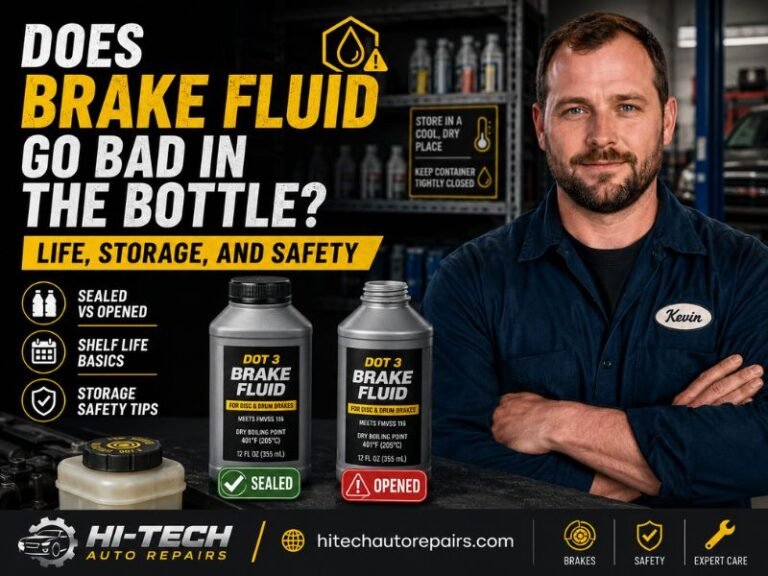
Does brake fluid go bad? Yes. Brake fluid gradually degrades while it is inside your vehicle, mainly because common glycol-based fluids absorb moisture over time. The change is usually slow, so you may not notice a problem during everyday driving until the brakes are placed under heavier demand.
Brake fluid is designed to transfer hydraulic pressure while handling the high temperatures created during braking. As moisture accumulates, its boiling point falls and its high-temperature performance becomes less reliable. Ford specifically notes that brake fluid absorbs water over time and should be changed at the vehicle’s specified service interval to prevent degraded braking performance.
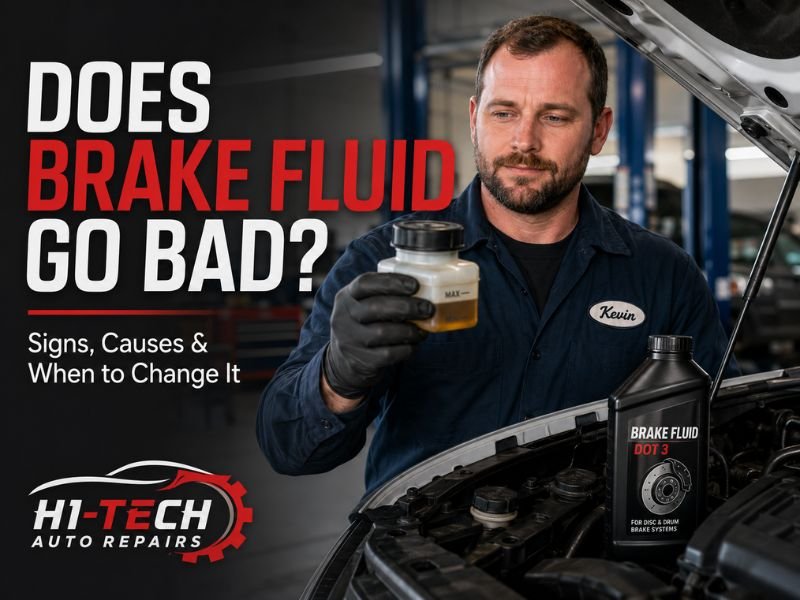
When I evaluate older brake fluid, I do not rely only on its color. I also consider the vehicle’s service history, driving conditions, moisture exposure, and how the pedal behaves when the brakes get hot.
Understanding how brake fluid ages can help you replace it before deterioration turns into a braking problem.
Why Does Brake Fluid Go Bad?
Brake fluid does not suddenly expire on a specific day. Its condition changes gradually while it remains inside the hydraulic braking system.
Several factors contribute to that process.
Brake Fluid Absorbs Moisture
Most passenger vehicles use glycol-based brake fluids such as DOT 3, DOT 4, or DOT 5.1. These fluids are hygroscopic, meaning they absorb moisture from their surroundings.
Even though the brake system is closed, it is not completely isolated from the environment forever. Moisture can gradually enter through seals, hoses, reservoir venting, and normal servicing.
Brembo explains that moisture absorbed over time lowers the fluid’s boiling point and can eventually contribute to vapor lock under high brake temperatures.
This is one of the main reasons brake fluid requires periodic maintenance even when there is no visible leak.
Repeated Heat Cycles Affect Fluid
Every time you use the brakes, kinetic energy is converted into heat.
Normal commuting may create moderate temperatures, while towing, mountain driving, repeated emergency stops, or performance driving can generate much more heat.
The brake fluid itself is designed to tolerate these conditions, but moisture-contaminated fluid has less temperature margin than fresh fluid.
You may therefore have no noticeable issue during normal driving but experience a softer pedal after repeated braking.
Contamination Can Enter the System
Moisture is not the only concern.
Dirt, water, petroleum products, or other foreign materials can damage hydraulic components if they enter the reservoir. Ford specifically warns that contamination with dirt, water, or petroleum products may lead to brake-system damage or failure.
This is why you should keep the reservoir cap clean and use brake fluid only from a clean, sealed container.
The Fluid Simply Stays in Service Too Long
Brake fluid can remain inside a vehicle for years without looking obviously bad.
That does not mean its original properties are unchanged.
The fluid may gradually collect moisture and impurities even while the brakes continue feeling normal in everyday driving.
What Happens to Brake Fluid as It Ages?
The aging process usually begins before you notice any obvious symptom.
First, moisture content gradually rises.
As moisture increases, the fluid’s boiling point decreases. Brembo notes that even relatively small amounts of water can significantly reduce the boiling performance of brake fluid.
This matters because brake fluid must remain liquid to transfer pressure properly.
If moisture-heavy fluid becomes hot enough, vapor bubbles can form. Unlike liquid brake fluid, vapor is compressible.
Instead of all your pedal force being transmitted through the hydraulic system, some pedal movement may compress the vapor.
That can result in a soft or spongy pedal during severe brake use.
Moisture can also contribute to corrosion inside metal hydraulic components over long periods. Possible areas include the master cylinder, calipers, wheel cylinders, brake lines, and ABS hydraulic unit.
The important point is that brake fluid can degrade before you feel anything unusual from the driver’s seat.
6 Signs Your Brake Fluid May Have Gone Bad
1. Brake Fluid Looks Very Dark or Cloudy
Fresh brake fluid is commonly clear to light amber, although the exact appearance varies by product.
As it ages, it may become darker.
Brembo notes that dark and cloudy fluid can indicate that it has collected impurities and may need replacement.
However, I would not condemn brake fluid based on color alone.
Some fluid naturally darkens with use, while moisture contamination may not always be visible.
2. Pedal Feel Changes When the Brakes Get Hot
This is more meaningful than fluid color alone.
You may have a normal, firm pedal during the first part of a drive, then notice that it feels softer after repeated braking.
Old, moisture-heavy brake fluid can be one possible cause because its boiling point may be lower.
If the pedal suddenly changes under any condition, however, you should also rule out air, leaks, master cylinder problems, and other hydraulic faults.
3. Brake Fade During Repeated Stops
Brake fade means braking performance becomes weaker as temperatures rise.
Moisture-contaminated fluid can contribute to hydraulic fade if it gets hot enough to form vapor.
This is more likely during:
- long downhill driving
- towing
- repeated hard stops
- track or performance driving
- heavy stop-and-go use
Brake pads themselves can also fade from heat, so you should not automatically blame the fluid.
4. The Service History Is Unknown
Sometimes the strongest warning is simply not knowing when the brake fluid was last serviced.
A used car may have excellent-looking brake fluid but no maintenance documentation.
If I am working on an older vehicle with unknown fluid history, I consider the manufacturer’s maintenance schedule and may test the fluid rather than assuming it is still good.
5. Visible Sediment or Debris
Brake fluid should not contain obvious floating material or sediment.
If you see particles, unusual cloudiness, rust-colored material, or separation inside the reservoir, the system deserves closer inspection.
Do not simply remove the dirty fluid and refill the reservoir without asking where the contamination came from.
6. Corrosion Is Found During Brake Service
Sometimes old brake fluid is discovered because hydraulic components already show corrosion.
A technician may find rust inside a wheel cylinder, caliper bore, master cylinder, or other hydraulic component during repair.
That does not automatically prove brake fluid neglect caused all the damage, but long-term moisture exposure can contribute to internal corrosion.
Does Brake Fluid Go Bad Even If You Barely Drive?
Yes.
Low mileage does not stop brake fluid from aging.
A vehicle that travels only 2,000 miles per year can still have old brake fluid if it has been sitting in the system for many years.
This is especially relevant for:
- collector cars
- seasonal vehicles
- second vehicles
- convertibles stored during winter
- cars owned by drivers who work from home
Brake fluid aging is partly time-based, not only mileage-based.
A ten-year-old car with 20,000 miles could potentially have much older brake fluid than a three-year-old car with 60,000 miles.
That is why you should consider time and maintenance history, not just the odometer.
Does Brake Fluid Go Bad Faster in Certain Conditions?
Yes. How the vehicle is used can affect how demanding its brake-fluid environment becomes.
Humid Conditions
High environmental humidity can increase moisture exposure over time.
That does not mean every vehicle in a humid state needs constant fluid replacement, but climate is one factor worth considering.
Towing
Towing adds weight, which means the brakes must absorb more energy when slowing the vehicle.
More braking work generally creates more heat.
Old fluid with reduced boiling performance gives you less safety margin under these conditions.
Mountain Driving
Long descents can require repeated or sustained braking.
That makes high-temperature brake-fluid performance more important than during ordinary flat-road commuting.
Performance Driving
Track days and aggressive driving can create brake temperatures far beyond typical daily use.
Fluid condition becomes particularly important in those situations.
Long Periods of Storage
A parked car is not frozen in time.
Brake fluid can continue aging even while the vehicle is rarely driven.
How Long Does Brake Fluid Last in a Car?
There is no single replacement interval that applies to every vehicle.
The correct schedule depends on the manufacturer, vehicle design, fluid specification, and sometimes the type of service the vehicle experiences.
Brembo generally recommends replacing automotive brake fluid every two to three years, but your vehicle manufacturer’s schedule should take priority.
Ford likewise instructs owners to change brake fluid at the specified interval because absorbed water degrades its effectiveness.
When I service a vehicle, I follow its maintenance information rather than applying one universal interval to every car.
You should check your owner’s manual or manufacturer maintenance guide for your exact model.
Can Bad Brake Fluid Damage Your Brake System?
It can contribute to problems over time.
The first concern is reduced boiling performance.
A moisture-heavy fluid may be more likely to form vapor under severe braking, reducing hydraulic effectiveness.
Moisture may also promote internal corrosion.
That can affect parts such as the:
- master cylinder
- brake calipers
- wheel cylinders
- steel brake lines
- ABS hydraulic unit
Contamination with the wrong substances can be even more serious.
Ford warns that dirt, water, petroleum products, and other contaminants may cause brake-system damage or failure.
However, old-looking fluid does not automatically mean those components are already damaged.
Can You Tell Brake Fluid Is Bad Just by Looking at It?
Not reliably.
Visual inspection is useful, but it has limits.
Fluid that is cloudy, full of sediment, or obviously contaminated deserves attention.
But clean-looking fluid can still contain moisture.
That means a clear reservoir is not proof that the fluid still has its original boiling performance.
If the condition is uncertain, you can use service history along with appropriate moisture or boiling-point testing.
When the fluid looks questionable but I do not have enough information, I prefer testing or following the manufacturer’s replacement schedule instead of guessing.
Should You Change Brake Fluid If It Still Looks Clean?
Possibly.
Brake fluid appearance should not override the maintenance schedule.
If the vehicle manufacturer says the fluid is due for replacement, clear color is not necessarily a reason to leave it in service longer.
You should also consider replacement if the vehicle has:
- unknown maintenance history
- demanding towing use
- frequent mountain driving
- high moisture test results
- hydraulic repairs that require fresh fluid
Fresh-looking fluid can still contain absorbed water.
Brake Fluid Change vs. Brake Fluid Flush
The terms are often used interchangeably, but they can describe slightly different service approaches.
A brake fluid change or exchange generally means removing old fluid and replacing it with fresh fluid throughout the hydraulic system.
The term “flush” is often used for a more complete replacement process.
The important part is not the wording. It is following the correct procedure for the vehicle.
Modern ABS, hybrid, and electronically controlled brake systems may have special bleeding or fluid replacement procedures.
You should use the manufacturer-approved process rather than assuming every braking system should be serviced in exactly the same way.
Can You Just Add Fresh Fluid to Old Brake Fluid?
Adding fresh fluid does not make all the old fluid inside the system fresh again.
The reservoir contains only part of the fluid.
Older fluid remains inside:
- brake lines
- calipers
- wheel cylinders
- ABS hydraulic passages
Topping off is useful when the level legitimately needs correction, but it is not a substitute for scheduled fluid replacement.
Topping off is not the same as replacing brake fluid.
Also, do not add fluid simply because the level is slightly below MAX. Ford notes that a level between MIN and MAX is within the normal operating range and does not require additional fluid.
When Should You Change Brake Fluid?
The simplest answer is to follow your vehicle manufacturer’s maintenance schedule.
You should also consider testing or service when:
- the maintenance history is unknown
- the fluid contains visible contamination
- moisture testing indicates deterioration
- the vehicle is used in demanding braking conditions
- hydraulic components have been repaired
- pedal performance changes under heat
Do not wait for the pedal to become dangerously soft before thinking about fluid maintenance.
Brake fluid replacement is preventive maintenance.
FAQs About Brake Fluid Going Bad
Does brake fluid expire inside a car?
It does not suddenly expire on a specific day. Its properties gradually change as moisture and contaminants accumulate.
Can brake fluid last 10 years?
It can physically remain inside the system for ten years, but that does not mean it still meets the manufacturer’s maintenance requirements or retains ideal performance.
Does brake fluid go bad if you do not drive?
Yes. Brake fluid ages with time as well as use, so low-mileage and stored vehicles still need maintenance.
Can bad brake fluid cause brake fade?
Yes. Moisture-contaminated fluid can have a lower boiling point, which may contribute to hydraulic brake fade under high temperatures.
Can clear brake fluid still be bad?
Yes. Moisture cannot always be identified visually.
Does changing brake fluid improve braking?
Replacing degraded fluid restores fresh fluid properties, but it will not repair worn pads, damaged rotors, leaks, or failed hydraulic components.
Is old brake fluid dangerous?
It can become a safety concern if moisture or contamination significantly reduces performance, particularly during high-temperature braking.
Conclusion
So, does brake fluid go bad? Yes. Brake fluid gradually changes as it absorbs moisture, experiences repeated heat cycles, and remains inside the hydraulic system for years.
The important part is that deterioration may begin long before you notice an obvious symptom.
When I evaluate brake fluid, I consider more than its color. Service history, vehicle age, driving conditions, fluid testing, and manufacturer recommendations provide a much better picture of its condition.
You should follow the maintenance schedule for your specific vehicle rather than waiting for brake fade or a soft pedal to appear.
If the fluid is overdue, contaminated, or performs poorly during testing, replacing it with the correct fresh specification helps maintain reliable hydraulic braking and protects expensive brake components.