Low Brake Fluid Symptoms and Signs of Low Brake Fluid Explained
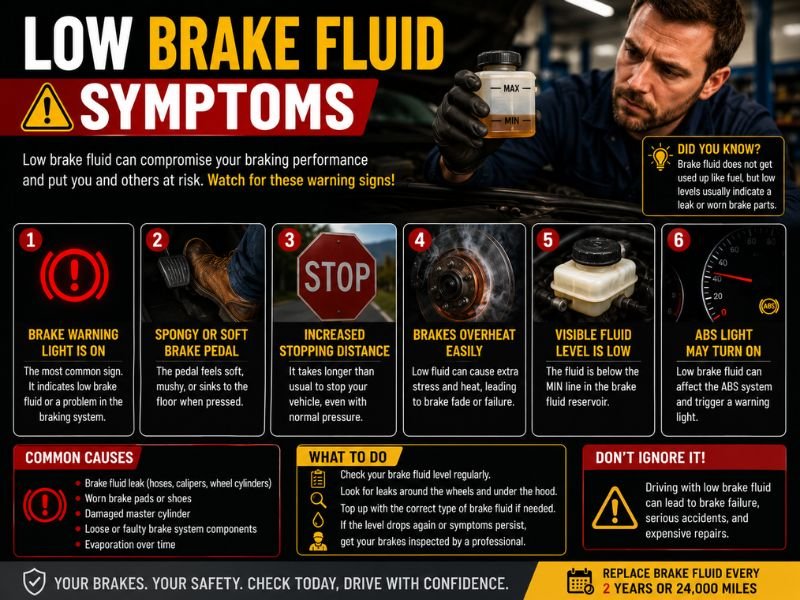
Common low brake fluid symptoms include fluid below the MIN mark, a red brake warning light, a soft or spongy pedal, excessive pedal travel, visible leaks, and braking that no longer feels normal.
A low reservoir should not automatically be treated as a simple “add more fluid” situation because the level may have dropped from normal pad wear, a hydraulic leak, or another brake-system problem.
Brake-related defects continue to be a major safety concern. During the 2025 CVSA International Roadcheck, inspectors recorded 5,561 brake-related out-of-service violations, representing 41.1% of all vehicle out-of-service violations found during the event.
During 2025 Brake Safety Week, inspectors checked 15,175 commercial vehicles and placed 2,296, or 15.1%, out of service for brake-related violations.
These figures involve commercial vehicles rather than ordinary passenger cars, but they show why brake-system problems should never be taken casually.
When I find low brake fluid, I do not immediately pour more into the reservoir. I first consider pad wear, look for leaks, check pedal feel, and determine whether the level dropped slowly or suddenly.
You should take the same approach. The fluid level itself is only one clue. Understanding why it became low is what helps you decide whether you need a simple maintenance correction or an actual brake repair.
What Does Low Brake Fluid Actually Mean?
Low brake fluid means the fluid level in the reservoir has dropped below the normal operating range specified by the vehicle manufacturer.
On many vehicles, the reservoir has clearly marked MIN and MAX lines. Ford, for example, states that fluid between the MIN and MAX marks is acceptable and recommends having the vehicle checked when the level falls below MIN or rises above MAX.
But the reason for a low level matters.
A small, gradual drop may occur as disc brake pads wear. As the pads become thinner, the caliper pistons stay farther outward. More brake fluid remains inside the calipers, so the reservoir level gradually falls.
That is different from fluid physically leaking out of the system.
A damaged hose, corroded brake line, leaking caliper, wheel cylinder, or master cylinder can cause the fluid level to fall much faster.
The most important distinction is this:
Low brake fluid is a condition, not a diagnosis.
You need to determine whether the level change comes from normal brake wear or hydraulic fluid loss.
A reservoir that is slightly lower than it was several months ago is not the same situation as a reservoir that becomes nearly empty in two days.
10 Common Low Brake Fluid Symptoms
1. Brake Fluid Is Below the MIN Mark
The most obvious sign is a reservoir level below the manufacturer’s MIN line.
Many modern brake fluid reservoirs are made from translucent plastic, allowing you to check the level without removing the cap.
Park the vehicle on level ground and look at the side of the reservoir. Do not judge the level based on whether the container looks “half full.” Use the actual MIN and MAX markings.
Ford specifically warns that brake-system performance can be affected when the fluid is outside the marked operating range.
If the fluid is only slightly above MIN and the brakes feel normal, you still need to understand why it is lower.
If it is below MIN, the system deserves closer inspection.
2. Red Brake Warning Light Comes On
A red BRAKE warning light can be one of the signs of low brake fluid.
Many hydraulic brake systems use a warning indicator when fluid falls below a certain level or when another brake-system problem is detected. NHTSA has long required applicable hydraulic brake systems to provide warning indications for low fluid level or hydraulic failure conditions.
The exact warning behavior varies between vehicles.
The same red light may also illuminate when the parking brake is engaged. On some models, other brake-system faults can trigger it as well.
If the light stays on after you fully release the parking brake, check the owner’s manual.
Do not assume the warning can be ignored simply because the vehicle still stops normally.
3. Soft or Spongy Brake Pedal
Low fluid can contribute to a soft or spongy brake pedal, especially if the level falls far enough for air to enter the hydraulic system.
Brake fluid transfers pressure efficiently because liquids are essentially incompressible under normal braking conditions.
Air behaves differently.
When you press the brake pedal with air trapped in the system, part of your pedal movement compresses the air rather than immediately moving the caliper pistons.
The result may feel soft, springy, or inconsistent.
You may also notice that pumping the pedal temporarily makes it firmer.
Low fluid is not the only possible cause, though. Air left after improper bleeding, a damaged hose, hydraulic leak, or failing master cylinder can create similar symptoms.
If the pedal suddenly becomes soft, you need to diagnose the hydraulic system rather than simply top off the reservoir.
4. Brake Pedal Travels Farther Than Normal
Another possible symptom is excessive brake pedal travel.
You may find that the pedal moves farther toward the floor before the brakes begin responding.
This can happen when hydraulic pressure does not build normally because of air, fluid loss, or another brake-system problem.
A gradual increase in pedal travel can also be related to mechanical brake wear or adjustment issues on some brake designs.
If I see longer pedal travel together with a low reservoir, I start looking for fluid loss and air in the system.
You should also compare the pedal feel with how the vehicle normally behaves rather than judging it against another car.
5. Brake Pedal Sinks Toward the Floor
A sinking pedal is more serious than a slightly soft pedal.
You may press the brake pedal and feel it continue moving toward the floor while you hold steady pressure.
Severe fluid loss can contribute to this condition if the system can no longer maintain hydraulic pressure.
A failing master cylinder may also cause similar behavior even when the reservoir still contains fluid.
If your pedal suddenly approaches the floor or the vehicle becomes difficult to stop, do not continue normal driving.
This is not a symptom that should be “tested” repeatedly on public roads.
6. Braking Feels Weak or Delayed
Low brake fluid may appear together with braking that feels weaker or less predictable than usual.
You might need more pedal travel before the vehicle starts slowing, or braking may feel different from one stop to another.
However, this symptom needs careful interpretation.
Worn brake pads, damaged rotors, overheated brakes, poor tires, or caliper problems can all affect stopping performance.
Low fluid becomes more suspicious when weak braking appears together with a low reservoir, pedal changes, or visible fluid loss.
7. Stopping Distance Seems Longer
A serious hydraulic problem can increase the distance needed to stop the vehicle.
This is especially concerning during emergency braking, where even a small reduction in braking effectiveness can matter.
Do not assume every long stop is caused by low fluid.
Tires, wet roads, vehicle load, brake pad condition, and rotor condition all affect stopping distance.
But if the vehicle suddenly takes longer to stop and the brake fluid level is below MIN, you should have the system checked promptly.
8. Visible Brake Fluid Leak
A visible hydraulic leak is one of the strongest clues that low fluid is not simply related to pad wear.
Brake fluid may appear around:
- a brake caliper
- a wheel cylinder
- a flexible brake hose
- a steel brake line
- hydraulic fittings
- the master cylinder
Leaks do not always create a puddle on the ground.
A wheel cylinder may leak inside a brake drum. A caliper may leak inside the wheel. A small brake line leak may only release fluid when the system is pressurized.
If you see unexplained wetness near braking components, investigate before adding more fluid.
9. Fluid Level Keeps Dropping After You Add More
A reservoir that repeatedly becomes low is a major warning sign.
Brake fluid is not consumed by the engine like fuel or motor oil.
If you add fluid and the level falls again quickly, there is a reason.
If I top off a reservoir and it drops again, I stop treating the issue as routine maintenance and start tracing the hydraulic circuit.
You should do the same.
Repeated topping off can hide a worsening leak until pedal feel changes or braking pressure drops.
10. Braking Changes After Hard or Repeated Stops
Some drivers first notice a hydraulic issue when the brakes become hot.
After repeated stops, the pedal may feel different or braking may become less consistent.
Low fluid itself is not always the direct cause. Air in the system or degraded brake fluid may also become more noticeable under heat.
This symptom is especially important if you tow, drive in the mountains, or regularly encounter heavy stop-and-go traffic.
If braking feels normal when cold but changes noticeably after repeated use, you should have the system inspected rather than assuming it is normal heat behavior.
Signs of Low Brake Fluid vs Other Brake Problems
Many brake symptoms overlap, so one symptom should not be used as a complete diagnosis.
| Symptom | Low Brake Fluid Possible? | Other Common Causes |
| Soft pedal | Yes | Air, leak, poor bleeding, master cylinder |
| Pedal to floor | Yes | Major leak, master cylinder failure |
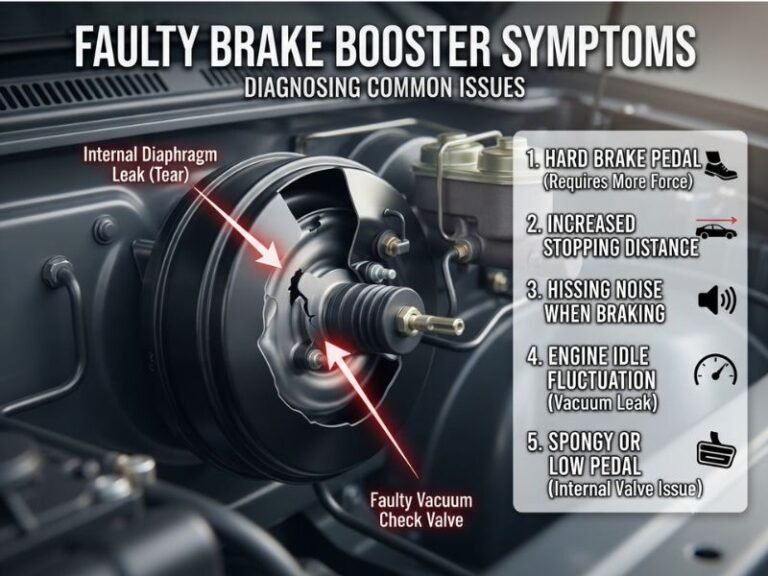
| Hard pedal | Usually not | Brake booster or vacuum problem |
| Squeaking | Usually not directly | Pads, rotors, hardware |
| Pulling | Possible indirectly | Caliper, tires, alignment, contaminated pads |
| Red brake light | Yes | Parking brake or hydraulic fault |
| ABS light | Not necessarily | Wheel-speed sensor, wiring, ABS module |
| Grinding | Usually not directly | Severely worn brake pads or rotor damage |
This distinction is important.
For example, a hard pedal usually points toward brake assist rather than low fluid.
Squeaking normally comes from friction components, not the fluid level.
If several symptoms appear together, you need to look at the whole pattern.
A low reservoir plus a soft pedal and visible fluid around one wheel tells you much more than any of those symptoms alone.
Why Does Brake Fluid Get Low?
Normal Brake Pad Wear
Brake pad wear is one of the few reasons the reservoir can gradually drop without fluid actually leaving the system.
As disc brake pads wear, the caliper pistons extend farther outward.
The space behind those pistons fills with brake fluid, lowering the reservoir level slightly.
This process is gradual.
It should not normally make a healthy reservoir suddenly empty.
Leaking Brake Caliper
Brake calipers contain hydraulic seals that keep fluid around the piston.
If a seal fails, fluid can escape around the piston or caliper body.
You may see wetness inside the wheel or on the caliper.
Fluid can also contaminate the brake pad, which may reduce friction and require additional repair.
Leaking Wheel Cylinder
Drum brakes commonly use hydraulic wheel cylinders.
When a wheel cylinder leaks, fluid often stays inside the brake drum.
That means you may have a low reservoir without seeing a puddle under the vehicle.
You may instead notice contaminated brake shoes or weaker braking from that wheel.
Damaged Flexible Brake Hose
Flexible hoses allow the wheels and suspension to move while still carrying hydraulic pressure.
Age, abrasion, incorrect installation, or damaged fittings can cause a hose to leak.
Some leaks become noticeable only when someone presses the brake pedal and pressure rises.
Corroded Steel Brake Line
Steel brake lines can rust over time.
Vehicles in areas that use heavy winter road salt may be especially vulnerable.
A severely corroded line can develop a pinhole leak or rupture under braking pressure.
This can turn a slow fluid loss into a sudden hydraulic failure.
Master Cylinder Leak
The master cylinder sits near the brake fluid reservoir and converts pedal movement into hydraulic pressure.
External seal failure can allow brake fluid to leak around the master cylinder.
Some leaks may collect near the brake booster or other areas and be difficult to see at first glance.
A master cylinder can also fail internally, causing pedal problems without obvious external fluid loss.
Recent Brake Repair
Brake fluid level can change after brake service.
Bleeding, caliper replacement, master cylinder work, or other hydraulic repairs may alter the fluid level.
The system should always be checked after service to make sure the final level is correct and no air remains.
Can Worn Brake Pads Cause Low Brake Fluid?
Yes, worn brake pads can lower the reservoir level gradually.
Imagine a new brake pad that is relatively thick.
The caliper piston sits farther inside its bore because the pad does not need much piston extension.
As the pad wears, the piston moves farther outward to keep the friction material close to the rotor.
More brake fluid remains behind the piston.
That fluid comes from the reservoir.
This is why a slightly lower reservoir can sometimes be a normal sign of pad wear rather than a leak.
If the fluid is mildly low and the pads are near replacement thickness, I check the pad condition before automatically topping up the reservoir.
There is also a practical reason for this.
When new pads are installed, the caliper pistons are pushed back into their bores. Fluid returns to the reservoir.
If someone previously filled the reservoir to the top while the pads were badly worn, the returning fluid can overfill the reservoir.
Worn pads may explain a slow, small decrease.
They do not normally explain a sudden or severe loss of brake fluid.
How Low Is Too Low for Brake Fluid?
The best reference is the reservoir itself.
If the fluid is between the manufacturer’s MIN and MAX markings, it is generally within the intended operating range. Ford specifically states that fluid in this range is acceptable.
You do not need to fill the reservoir to the MAX line simply because it is slightly below it.
Below MIN is different.
A level below the minimum mark deserves attention because it may indicate excessive pad wear, fluid loss, or another brake-system problem.
A nearly empty reservoir is much more urgent.
At that point, air may already have entered the hydraulic system.
Do not judge the situation by percentages such as “the reservoir is one-third full.” Different reservoirs are shaped differently.
Use the marked operating range.
How to Check Your Brake Fluid Level Correctly
Step 1: Park on Level Ground
Park the vehicle on a flat surface.
This helps you get a more accurate reading and prevents a sloped vehicle from making the fluid appear higher or lower on one side of the reservoir.
Step 2: Locate the Brake Fluid Reservoir
Open the hood and locate the reservoir.
On most conventional passenger vehicles, it is mounted near the master cylinder toward the driver’s side of the firewall.
Your owner’s manual can show the exact location.
Step 3: Find the MIN and MAX Marks
Look at the side of the reservoir.
Do not remove the cap unless necessary.
Most translucent reservoirs allow you to see the level from outside.
Ford instructs owners to compare the fluid directly with the MIN and MAX marks while the vehicle is on a level surface.
Step 4: Inspect the Fluid Without Opening the Reservoir
Look for the level first.
You can also note obvious cloudiness or contamination through the plastic where visibility allows.
Avoid opening the cap simply to “have a look” if you can already see what you need.
Step 5: Clean Around the Cap Before Opening
If you need to add fluid, clean dirt from around the cap first.
Brake hydraulic systems are sensitive to contamination.
Ford warns that dirt, water, petroleum products, and other contaminants can damage the brake system and recommends using fluid from a sealed container.
Step 6: Look for Leaks
If the level is low, inspect around the master cylinder and under the vehicle.
Look near each wheel for unusual wetness.
Do not crawl underneath a car unless it is properly supported.
Step 7: Consider Brake Pad Wear
If the fluid is only slightly low and no leak is visible, check the brake pad condition.
A professional brake inspection may be the easiest way to determine whether normal pad wear explains the change.
What Color Should Brake Fluid Be?
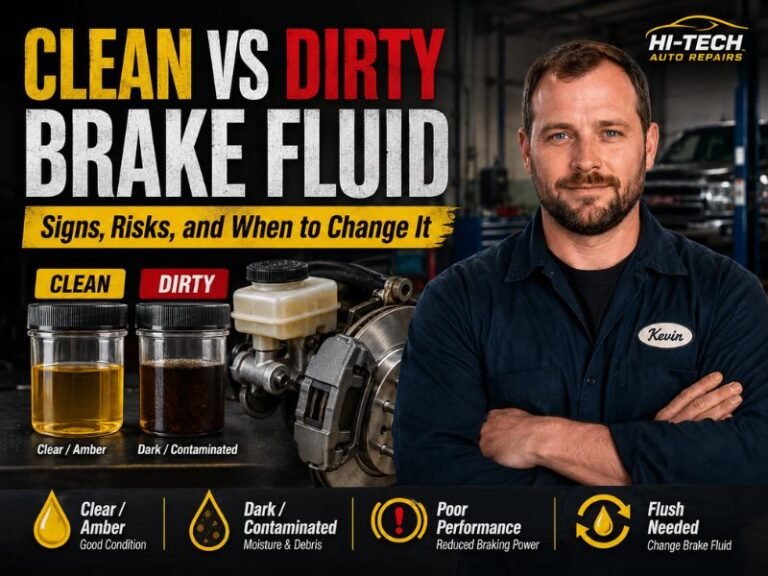
Fresh brake fluid is often clear, pale yellow, or light amber, depending on the formulation and brand.
It may darken as it ages.
However, fluid color and fluid level are two different issues.
Color gives you clues about condition. The MIN and MAX marks tell you quantity.
A reservoir can contain clean-looking fluid and still be too low.
It can also be completely full while the fluid is old or contaminated.
Cloudiness, visible particles, or unusual separation deserve attention, but you should not decide that fluid is low simply because it looks dark.
Likewise, fresh-looking fluid does not rule out a hydraulic leak.
Low Brake Fluid vs Dirty Brake Fluid
These are related topics, but they describe different problems.
Low Brake Fluid
This is mainly a quantity issue.
There is less fluid in the reservoir than expected.
Common explanations include:
- brake pad wear
- external hydraulic leak
- recent brake service
Dirty Brake Fluid
This is mainly a condition or quality issue.
The system may still be completely full, but the fluid can contain moisture, debris, corrosion particles, or other contamination.
A vehicle can therefore have:
- low but clean brake fluid
- full but dirty brake fluid
- low and dirty brake fluid
You should not treat these conditions as interchangeable.
If the reservoir is low, find out where the fluid went.
If the fluid is contaminated, find out why it became contaminated and whether replacement or further repair is required.
Low Brake Fluid vs Brake Fluid Leak
A brake fluid leak can cause a low reservoir, but not every low reservoir automatically means there is a leak.
Think of it this way:
Low fluid is the condition. A leak is one possible cause.
Normal pad wear usually produces a slow change.
A leak is more likely when you notice:
- a rapid level drop
- visible wetness
- fluid under the vehicle
- repeated topping off
- a softening pedal
- a nearly empty reservoir
If the pads are worn but there is no leak, replacing the pads may eventually restore the reservoir level when the caliper pistons are pushed back.
If fluid is physically escaping the hydraulic system, the leak must be repaired.
Can Low Brake Fluid Cause a Soft or Spongy Pedal?
Yes, but usually only when the fluid level becomes low enough for air to enter the hydraulic circuit.
Brake fluid itself does not produce the spongy feeling simply because the reservoir is slightly below MAX.
The real problem begins when hydraulic pressure cannot be transmitted normally.
Air trapped in the lines compresses when you press the pedal.
That can create:
- a soft pedal
- longer pedal travel
- inconsistent response
- temporary improvement after pumping
If I see low fluid together with a spongy pedal, I look for the source of fluid loss first.
After the leak is repaired, the system may need bleeding to remove trapped air.
You should not rely on adding fluid alone if the pedal remains abnormal.
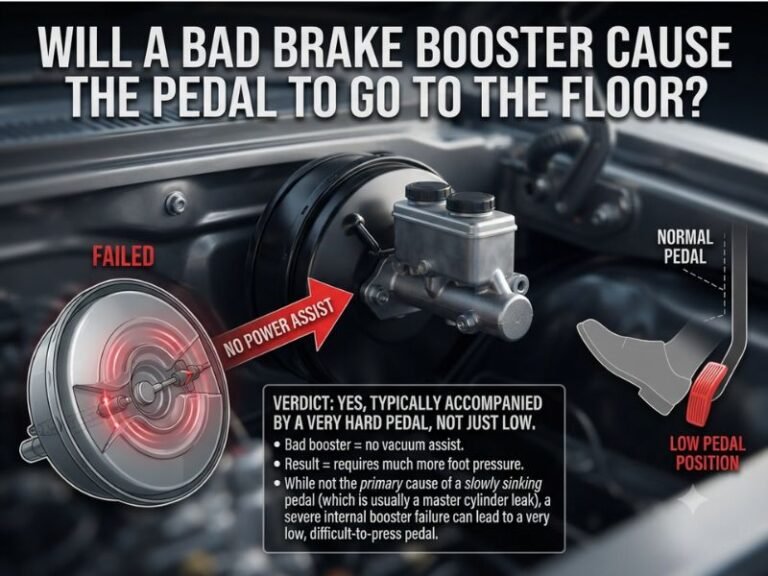
Can Low Brake Fluid Make the Brake Pedal Go to the Floor?
Severe fluid loss can contribute to a pedal that travels toward the floor.
If the reservoir runs very low or empty, the master cylinder can draw air into the hydraulic system.
The pedal may then lose normal resistance.
However, a pedal going to the floor can also indicate:
- a major brake line leak
- failed hose
- leaking caliper
- leaking wheel cylinder
- master cylinder failure
This is a serious symptom.
If the pedal suddenly reaches or approaches the floor, you should stop driving and have the vehicle inspected or towed.
Do not keep pumping the pedal and continue driving simply because you can temporarily build some pressure.
Can Low Brake Fluid Turn On the Brake Warning Light?
Yes.
Many vehicles use a fluid-level sensor as part of the red brake warning system.
NHTSA standards and interpretations recognize low brake fluid or hydraulic failure as conditions associated with brake-system warning indicators.
However, the red BRAKE light may also have other meanings.
The parking brake can activate the same light on many vehicles.
Some manufacturers use the warning for additional hydraulic faults.
Check the parking brake first.
If it is fully released and the light remains on, check the fluid level and owner’s manual.
A brake warning light combined with pedal changes should be taken seriously.
Can Low Brake Fluid Cause the ABS Light?
Not necessarily.
An ABS warning light is more commonly related to the anti-lock braking system itself.
Possible causes include:
- wheel-speed sensor problems
- damaged tone rings
- wiring faults
- ABS pump problems
- ABS control module faults
Some vehicles may illuminate multiple brake-related lights when there is a serious hydraulic issue, so the warnings can overlap.
Do not assume that adding fluid will automatically turn off an ABS warning.
If the ABS light stays on, the system may need diagnostic scanning even when the brake fluid level has been corrected.
Can You Drive With Low Brake Fluid?
The answer depends on how low the level is and whether braking performance has changed.
Slightly Low With Normal Pedal Feel
If the fluid is near MIN but still within the specified range and the pedal feels normal, you should inspect pad wear and monitor the system.
Do not automatically fill it to the top.
Below MIN With Unknown Cause
This deserves prompt attention.
You need to determine whether the low level comes from worn pads or fluid loss.
Very Low Fluid With a Soft Pedal
Do not continue normal driving.
A soft pedal may mean air has entered the system or a leak has become serious.
Nearly Empty Reservoir
A nearly empty reservoir can indicate major hydraulic fluid loss.
In that situation, towing is much safer than driving to a repair shop.
Ford recommends having a vehicle checked when brake fluid falls outside the normal MIN-to-MAX range.
What Happens If You Keep Driving With Low Brake Fluid?
A low reservoir may start as a small maintenance clue and become a serious hydraulic problem if fluid continues to disappear.
The progression can look like this:
- The level gradually drops.
- The fluid falls below MIN.
- A leak or wear condition continues.
- Air enters the hydraulic system.
- Pedal travel increases.
- Braking becomes inconsistent.
- One hydraulic circuit may lose effectiveness.
Many modern brake systems use divided hydraulic circuits to provide some redundancy.
That does not mean you should rely on the remaining circuit and keep driving.
A failing line or hose can worsen suddenly under braking pressure.
You may have enough braking for several normal stops and then experience a much larger loss when you need an emergency stop.
Should You Just Add Brake Fluid?
Sometimes adding brake fluid is appropriate.
But you should first understand why the level is low.
A small correction may be reasonable when:
- the manufacturer’s procedure calls for it
- the fluid is slightly below the correct range
- no active leak is present
- the correct fluid specification is known
Do not use topping off as the only repair when:
- the reservoir is repeatedly low
- the level drops rapidly
- the reservoir is nearly empty
- the brake pedal feels soft
- a visible leak is present
Adding brake fluid fixes the level, not the reason it became low.
If I see evidence of an active leak, I repair the leak before treating the reservoir level as the main problem.
How to Add Brake Fluid Safely
1. Confirm the Correct Fluid
Check the owner’s manual or reservoir cap.
Common types include DOT 3, DOT 4, DOT 5, and DOT 5.1.
Do not assume they are all interchangeable.
2. Clean the Reservoir Area
Wipe dirt away from the cap before opening it.
You do not want debris falling into the hydraulic system.
3. Use a Fresh, Sealed Container
Ford specifically recommends brake fluid from a sealed container and warns against contamination.
Do not use an old open bottle with an unknown storage history.
4. Add a Small Amount at a Time
Pour carefully.
Do not fill beyond MAX.
5. Reinstall the Cap
Make sure it is secure.
6. Recheck the System
If the level was low because of a leak, adding fluid does not make the vehicle safe.
Continue diagnosis before driving.
Do You Need to Bleed the Brakes After Adding Fluid?
Not automatically.
If the reservoir never became low enough for air to enter the hydraulic system, correcting the level may not require bleeding.
Bleeding becomes more likely when:
- the reservoir ran empty
- a brake line was opened
- a hydraulic leak was repaired
- a caliper or wheel cylinder was replaced
- the pedal remains soft or spongy
Some modern ABS, hybrid, and electronically controlled braking systems require special procedures or scan-tool commands during bleeding.
Follow manufacturer-specific service information rather than assuming every vehicle can be bled the same way.
When Low Brake Fluid Becomes an Emergency
Low brake fluid becomes urgent when it affects hydraulic braking performance.
Stop driving if you notice:
- the pedal goes to the floor
- the pedal suddenly becomes very soft
- the reservoir is nearly empty
- fluid is actively leaking
- stopping distance increases sharply
- the red brake warning light appears with weak braking
- braking becomes unpredictable
A low-fluid warning exists because the condition can be associated with hydraulic brake failure. NHTSA recognizes low fluid level as a brake-system warning condition in applicable hydraulic systems.
If you are not confident the vehicle can stop normally every time you press the pedal, arrange a tow.
How to Prevent Low Brake Fluid Problems
You cannot prevent normal brake pad wear, but you can prevent small hydraulic issues from becoming large ones.
Check the Reservoir During Routine Maintenance
Look at the level when checking other under-hood fluids.
You do not need to open the cap every time.
Inspect Brake Pads Regularly
Knowing how much pad material remains helps explain gradual changes in reservoir level.
Look for Leaks Early
Pay attention to wetness around wheels, brake lines, and the master cylinder.
Repair Corroded Brake Lines
Do not ignore heavily rusted steel brake lines.
They may eventually leak or rupture.
Avoid Repeated Topping Off
If the reservoir repeatedly becomes low, diagnose the cause.
Do not keep adding fluid indefinitely.
Use the Correct Brake Fluid
Incorrect or contaminated fluid can create additional brake problems.
Always follow the manufacturer’s required specification.
Keep the Reservoir Clean
Dirt entering the reservoir can contaminate hydraulic components.
Keep the cap closed unless you actually need to add fluid.
FAQs About Low Brake Fluid
What Is the First Sign of Low Brake Fluid?
The first sign may simply be a reservoir level approaching or falling below MIN.
On some vehicles, a red brake warning light may also appear when the fluid becomes low.
Can Worn Brake Pads Cause Low Brake Fluid?
Yes.
As disc brake pads wear, the caliper pistons extend farther outward, which can gradually lower the reservoir level.
A sudden or severe drop usually needs further investigation.
Why Is My Brake Fluid Low but I Cannot Find a Leak?
Worn brake pads may explain a slow decrease.
You can also have hidden leaks, such as a wheel cylinder leaking inside a brake drum or a small hydraulic leak that appears mainly under pressure.
Will Adding Brake Fluid Fix a Soft Pedal?
Not necessarily.
If air has entered the system or a hydraulic leak exists, you need to repair the fault and may need to bleed the brakes.
How Quickly Can Low Brake Fluid Become Dangerous?
There is no reliable timeframe.
A slow leak can remain small for a while or suddenly worsen under hydraulic pressure.
That is why repeated fluid loss should not be ignored.
Should Brake Fluid Always Be at the MAX Line?
No.
Fluid between MIN and MAX is generally acceptable. Ford specifically states that there is no need to add fluid when the level remains within that range.
Can Brake Fluid Get Low Without a Leak?
Yes.
Normal brake pad wear can gradually reduce the reservoir level.
However, rapid or repeated fluid loss is more suggestive of a hydraulic leak.
What Should I Do if the Brake Fluid Reservoir Is Empty?
Do not simply fill it and continue driving.
An empty reservoir may mean a major leak and may have allowed air into the hydraulic system.
The leak should be found and repaired, the correct fluid added, and the system properly bled before the vehicle returns to normal use.
Conclusion
Understanding low brake fluid symptoms helps you tell the difference between a normal gradual level change and a brake-system problem that needs immediate attention.
Fluid below MIN, a red brake warning light, a soft or sinking pedal, excessive pedal travel, visible leaks, and repeated fluid loss are among the most important signs of low brake fluid.
When I find a slightly low reservoir, I consider brake pad wear before automatically adding fluid. If the level has dropped quickly, I start looking for leakage and hydraulic pressure loss.
You should take the same balanced approach.
A reservoir that is slightly lower because the pads are worn is very different from one that is nearly empty because a brake line has failed.
Check the level, look for leaks, pay attention to pedal feel, and use the correct brake fluid when a top-off is genuinely appropriate.
Most importantly, if the pedal becomes soft, sinks toward the floor, or braking performance changes, stop treating the problem as routine maintenance. Have the hydraulic brake system inspected and repaired before returning the vehicle to normal driving.