Can I Drive With Parking Brake Malfunction? Risks and Next Steps
Driving with a parking brake malfunction is not recommended until you know what has failed. If the parking brake is stuck engaged, the regular brake pedal feels abnormal, or a red brake-system warning appears, stop safely and arrange professional assistance. If only the parking brake’s electronic control has failed, the service brakes may still work, but that does not automatically make continued driving safe.
A parking brake malfunction can mean several different things. The brake might not apply when you park, refuse to release when you want to drive, or display an electronic parking brake (EPB) warning because of an electrical fault. Some problems affect only the parking brake, while others can involve shared braking components or control systems.
The biggest mistake is assuming that a warning message always means the same thing. Driving against an engaged parking brake can overheat the brakes, while ignoring a broader brake-system fault can compromise stopping ability.
This guide explains when driving is unsafe, what different warnings mean, how to respond if the malfunction appears while driving, and when towing is the safer choice.
Can I Drive With Parking Brake Malfunction? The Safe Answer
Whether the vehicle can move safely depends on the actual failure, not simply the warning message. A disabled parking brake that has completely released presents a different risk from a parking brake that remains partially applied.
However, an electronic parking brake malfunction may also affect other functions, including automatic brake hold or electronically controlled braking features.
Use the following guidance to understand the different situations.
| Parking Brake Condition | Recommended Action |
| Parking brake stuck engaged | Do not drive; arrange towing |
| Burning smell or dragging brakes | Stop safely and do not continue |
| Red brake-system warning or abnormal brake pedal | Stop safely and seek immediate assistance |
| Amber EPB malfunction warning | Stop safely and follow the owner’s manual |
| Parking brake cannot hold the vehicle | Avoid driving until evaluated; secure on level ground |
| Warning appeared briefly and disappeared | Check the manual and arrange inspection if it returns |
A vehicle with a parking brake fault may still have functioning hydraulic service brakes. That does not confirm that the parking brake is fully released or that no related faults exist.
Never use the ability to accelerate as proof that a malfunctioning parking brake is safe to drive with.
What Does a Parking Brake Malfunction Warning Mean?
A parking brake malfunction warning indicates that the vehicle has detected a problem with parking brake operation, monitoring, or control.
The exact meaning depends on the warning color, displayed message, and vehicle manufacturer.
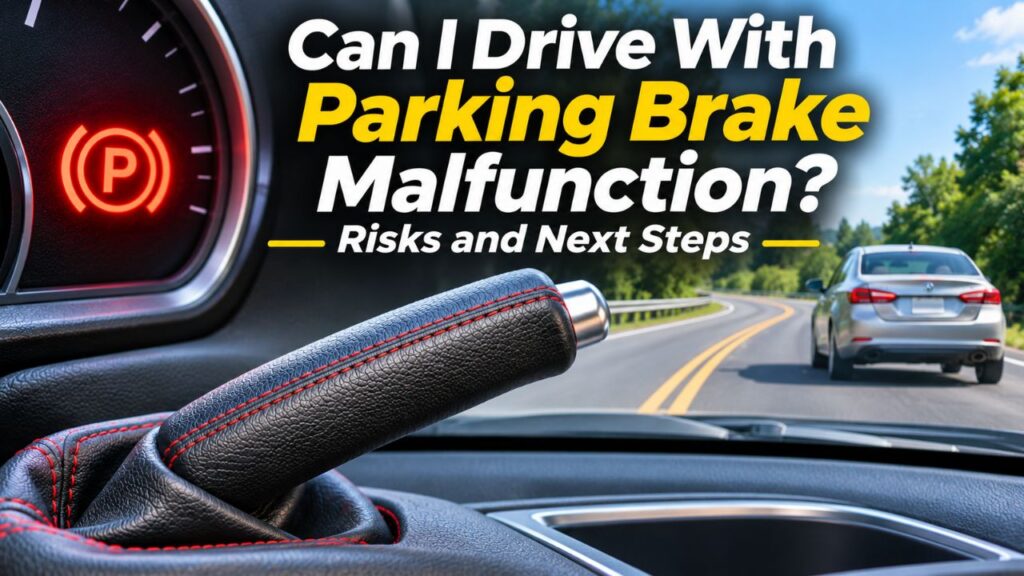
Amber Electronic Parking Brake Warning
An amber or yellow EPB warning commonly indicates a fault in the electronic parking brake system.
Possible problems include an actuator fault, wiring problem, switch malfunction, or an issue with the control electronics.
The Ford 2025 Explorer owner’s manual instructs drivers to stop as soon as it is safe when the yellow electric parking brake malfunction indicator appears and have the vehicle checked promptly.
An amber light does not necessarily mean the parking brake is currently engaged.
It also does not guarantee that the system will apply or release correctly.
Red Brake Warning Light
A red brake-system warning deserves greater urgency because it may indicate something beyond an electronic parking brake fault.
Depending on the vehicle, the red indicator can mean that the parking brake is applied, brake fluid is low, or the hydraulic braking system has a problem.
Chevrolet’s official warning-light guidance advises drivers to stop carefully when a brake-system warning appears while driving. It also warns that the pedal may become harder to press and stopping distances may increase.
If the light remains illuminated after the parking brake has been released, do not assume the problem is merely a defective dashboard sensor.
Parking Brake Not Released or Not Applied Message
A message stating Parking Brake Not Released suggests that the system cannot confirm successful release.
The parking brake may still be holding one or both rear wheels.
A Parking Brake Not Applied message indicates that the brake may not be securing the parked vehicle.
These warnings represent different mechanical risks and require different responses.
Other messages, including Parking Brake Limited Function or Service Parking Brake, indicate that the system needs diagnosis rather than a universal reset procedure.
When Driving With a Parking Brake Malfunction Becomes Dangerous
The Parking Brake Is Stuck Engaged
Driving with an engaged parking brake can create excessive friction between the brake pads or shoes and their mating surfaces.
As the vehicle moves, this friction generates heat.
The resulting damage can include:
- Premature brake pad or shoe wear
- Overheated brake rotors or drums
- Damaged caliper components
- Reduced braking effectiveness
- Burning odors or smoke
- Damage to nearby brake hardware
A partially engaged parking brake may allow the car to move while continuously dragging.
That situation can be especially misleading because the driver may notice only sluggish acceleration or an unusual smell.
If the parking brake has not fully released, do not continue driving.
The Regular Brake Pedal Feels Different
An EPB fault does not always affect normal service braking, but some vehicles use shared sensors, electronic controls, and rear brake components.
A malfunction involving those systems may appear alongside other braking problems.
Stop immediately when safe if you notice a brake pedal that:
- Feels unusually soft or spongy
- Travels much farther than normal
- Becomes unexpectedly hard
- Slowly sinks under steady pressure
- Requires noticeably more force to stop the vehicle
These symptoms can indicate hydraulic or brake-assistance problems unrelated to the parking brake itself.
Continuing to drive without knowing the cause is unsafe.
The Parking Brake Cannot Hold the Parked Vehicle
A parking brake that fails to apply presents a different hazard.
The regular brakes may still stop the vehicle normally, but the car may not remain securely parked.
An automatic transmission’s Park position provides mechanical resistance to movement. However, the parking brake remains an important additional safeguard.
A manual-transmission vehicle may rely on its selected gear and the parking brake to resist movement.
Do not assume that the transmission alone will safely secure a vehicle on a steep hill.
What to Do if Parking Brake Malfunction Appears While Driving
If the warning appears during normal driving, prioritize stopping safely rather than immediately operating the parking brake switch.
Step 01: Stay Calm and Reduce Speed
Release the accelerator gradually and maintain control of the steering wheel.
Avoid sudden braking or abrupt maneuvers unless necessary to avoid an immediate hazard.
Pay attention to changes in pedal feel, unusual noises, or the vehicle pulling to one side.
Step 02: Find a Safe Place to Stop
Move toward a safe roadside location, parking lot, or level shoulder.
Signal appropriately and avoid stopping where the vehicle would obstruct traffic.
If the regular brakes feel abnormal, begin slowing earlier and use controlled brake pressure.
Do not intentionally apply the electronic parking brake while moving to test whether it works. Some vehicles interpret that action as an emergency braking request.
Step 03: Check the Exact Dashboard Message
Once stopped, keep the service brake depressed and read the warning carefully.
Determine whether the display indicates:
- EPB malfunction
- Parking brake still applied
- Parking brake unavailable
- Brake system malfunction
- Low brake fluid
- ABS or stability-control malfunction
The exact wording helps distinguish a parking brake control fault from a potentially broader braking problem.
Step 04: Check Whether the Parking Brake Has Released
Use the normal release procedure described in the owner’s manual while keeping the vehicle stationary.
On many electronic parking brake systems, that requires the correct power mode and pressing the service brake pedal while operating the EPB switch.
Watch for confirmation that the brake has released.
Do not repeatedly operate the switch if the system reports a persistent fault or refuses to release.
Step 05: Look for Evidence of Brake Dragging
From a safe position, check for unusual odors, smoke, or obvious brake-related problems.
A burning smell or smoke near a wheel can indicate overheated friction components.
Do not touch the wheels, brake rotors, or calipers. They may be extremely hot.
If dragging or overheating is suspected, arrange professional recovery rather than attempting to drive farther.
Step 06: Decide Whether the Vehicle Needs Towing
If the warning remains, a brake does not release, or normal braking is uncertain, contact roadside assistance.
Explain the exact warning message and whether the vehicle can roll freely.
For an electronic parking brake that will not release, a flatbed tow truck may be necessary.
Common Causes of Parking Brake Malfunction
Weak or Discharged 12-Volt Battery
Electronic parking brakes rely on electrical power to operate their actuators and control electronics.
Low battery voltage may prevent the system from applying or releasing correctly.
This can happen after a discharged battery, charging-system problem, or an electrical interruption.
However, a low-voltage warning does not automatically prove the battery is the only problem.
Faulty Electronic Parking Brake Actuator
Many EPB systems use electric motors mounted directly to the rear brake calipers.
These actuators operate a mechanical mechanism that applies or releases braking force.
A damaged motor, failed internal gear, or mechanical obstruction can prevent normal operation.
An actuator may make clicking or grinding sounds when commanded to move.
Damaged Wiring or Parking Brake Switch
Corroded connectors, damaged wiring, and faulty switches may interrupt communication between the parking brake control module and actuator.
Because wiring near rear wheels is exposed to moisture and road debris, connection problems can develop over time.
An intermittent electrical fault may cause a warning that appears and disappears.
Seized Calipers or Parking Brake Mechanisms
Mechanical failures can also trigger electronic warnings.
A seized rear caliper, corroded cable, or jammed parking brake mechanism may prevent an actuator from completing its commanded movement.
This is why replacing an electrical switch without inspecting the mechanical system may not solve the problem.
Can You Drive to a Mechanic With a Parking Brake Malfunction?
There is no universal yes-or-no answer for every vehicle.
A confirmed parking-brake-only fault, with the brake completely released and normal service brakes, is different from a vehicle with dragging brakes or an unknown red brake warning.
However, some manufacturers explicitly instruct drivers to stop as soon as safe when an EPB fault appears. A malfunction warning should not be treated as permission to continue normal driving.
If the parking brake is confirmed released, the regular braking system has been evaluated, and the owner’s manual permits limited vehicle movement, carefully relocating it to a safe location or repair facility may be appropriate.
That decision depends on the exact model and fault.
Choose towing instead if:
- The parking brake cannot be confirmed fully released.
- A red brake-system warning remains on.
- The brake pedal feels abnormal.
- The vehicle pulls, drags, or makes grinding noises.
- Smoke or a burning smell appears.
- Multiple braking-related warnings are displayed.
- The manufacturer’s instructions prohibit driving.
Hyundai’s official electronic parking brake instructions advise using a flatbed tow truck when the EPB does not release normally.
Towing prevents additional damage and avoids exposing the driver to uncertain braking performance.
How to Park Safely With a Malfunctioning Parking Brake
A parking brake that cannot apply creates a risk even after you have stopped.
Choose level ground away from traffic whenever possible.
Keep the service brake depressed while selecting Park on an automatic transmission or the appropriate parking gear on a manual transmission.
Use properly sized wheel chocks when necessary to prevent rolling.
Do not depend on the transmission alone when parking on a steep incline.
If the vehicle cannot be secured reliably, arrange recovery to a location where it can be safely stored.
For vehicles with electronic parking brakes, remember that automatic application may occur when shifting into Park or switching off the vehicle.
Do not place your hands near brake components while the system has power and may activate unexpectedly.
Can You Reset a Parking Brake Malfunction and Continue Driving?
A warning may occasionally disappear after the vehicle is restarted.
Some electronic systems register temporary communication or voltage-related faults that do not remain active after normal conditions return.
However, a warning disappearing does not prove that the parking brake is mechanically sound.
Do not repeatedly disconnect the battery, pull fuses, or perform undocumented switch sequences to clear a warning.
Those actions may erase useful diagnostic information or create additional faults.
If a warning returns or the parking brake fails to apply or release normally, the system needs inspection.
A repair facility can retrieve diagnostic trouble codes, verify battery voltage, inspect wiring, test actuators, and check mechanical operation.
Certain vehicles require an EPB calibration or initialization procedure after rear brake repairs.
The correct service procedure depends on the manufacturer and system design.
How Much Does a Parking Brake Malfunction Repair Involve?
The repair can be relatively straightforward or require more extensive work.
A loose electrical connector may need cleaning or repair. A damaged parking brake switch may require replacement.
A failed rear caliper actuator, seized caliper, or damaged cable assembly can involve significantly more labor.
Electronic parking brake faults may also require a compatible diagnostic scan tool to command actuator movement or perform calibration.
The most important step is identifying the failed component before replacing parts.
A dashboard warning alone cannot determine whether the problem is electrical, mechanical, or related to another braking system.
Ask the repair facility to confirm that the parking brake fully applies, holds the vehicle under the specified conditions, and releases correctly.
FAQs About Can I Drive With Parking Brake Malfunction
Can I Drive With an Amber Parking Brake Warning Light?
An amber EPB warning indicates a possible electronic parking brake fault. Regular brakes may still function, but you should stop safely and follow the owner’s manual. Do not assume continued driving is safe without identifying the problem.
What Happens if I Drive With the Parking Brake Stuck On?
The brake pads or shoes can overheat, causing premature wear, damaged rotors, and reduced braking performance. Stop safely and arrange towing rather than driving against the engaged brake.
Does Parking Brake Malfunction Affect Normal Brakes?
Not always. A parking-brake-only fault may leave normal service braking functional. However, shared brake components or electronic control failures can affect other functions, so abnormal pedal behavior requires immediate attention.
Can a Low Battery Cause Parking Brake Malfunction?
Yes. A weak 12-volt battery can prevent electronic parking brake actuators from operating properly. Battery voltage should be checked along with related wiring, motors, and control modules.
Can I Ignore a Parking Brake Malfunction if My Car Is in Park?
No. Park is a separate transmission holding mechanism and does not repair the parking brake. The vehicle may be less secure when parked, particularly on an incline.
Will a Parking Brake Malfunction Go Away on Its Own?
Some temporary warnings may disappear after normal electrical conditions return, but persistent or recurring faults require diagnosis. A disappearing warning does not confirm reliable parking brake operation.
Should I Tow My Car if the Electronic Parking Brake Won’t Release?
Yes. If the EPB cannot be released using the manufacturer’s normal procedure, arrange appropriate towing, commonly on a flatbed. Do not force the car to move against a locked brake.
Protect Your Brakes Before Driving With a Parking Brake Fault
If you’re wondering can I drive with parking brake malfunction, the safest answer is to avoid continued driving until the fault is identified. A warning involving only the parking brake may not disable normal braking, but a stuck actuator, dragging rear brake, or related hydraulic fault can make driving dangerous.
Stop safely, read the exact warning, and determine whether the parking brake has released completely. Never continue driving against an engaged brake, and treat red brake-system warnings or abnormal pedal behavior as reasons for immediate assistance.
When the cause remains uncertain, professional diagnosis and towing are safer than risking brake damage or unreliable stopping. Repair the verified fault and confirm proper parking brake application and release before returning the vehicle to normal use.