What Is a Brake Power Booster? Functions, Types, and Symptoms
A brake power booster is a device that helps you apply the brakes with less foot pressure. It increases the force reaching the brake master cylinder, making it easier to slow or stop a vehicle. Most conventional boosters use a difference in air pressure, although some vehicles use hydraulic or electric assistance.
You may also hear the same component called a power brake booster, brake booster, or vacuum brake booster. Those names are often used interchangeably, but the word vacuum describes one particular operating method. The basic purpose remains the same: assist the driver’s braking effort.
Different booster designs can also produce different pedal sensations and warning symptoms. Knowing what the booster does is useful when the brake pedal feels unusually hard, a hissing noise appears during braking, or you are identifying parts beneath the hood.
This overview covers its appearance, location, components, operating principles, different designs, warning signs, simple checks, maintenance, and replacement considerations. The goal is to explain the complete role of a brake booster without getting lost in complicated repair procedures.
What Is a Brake Power Booster?
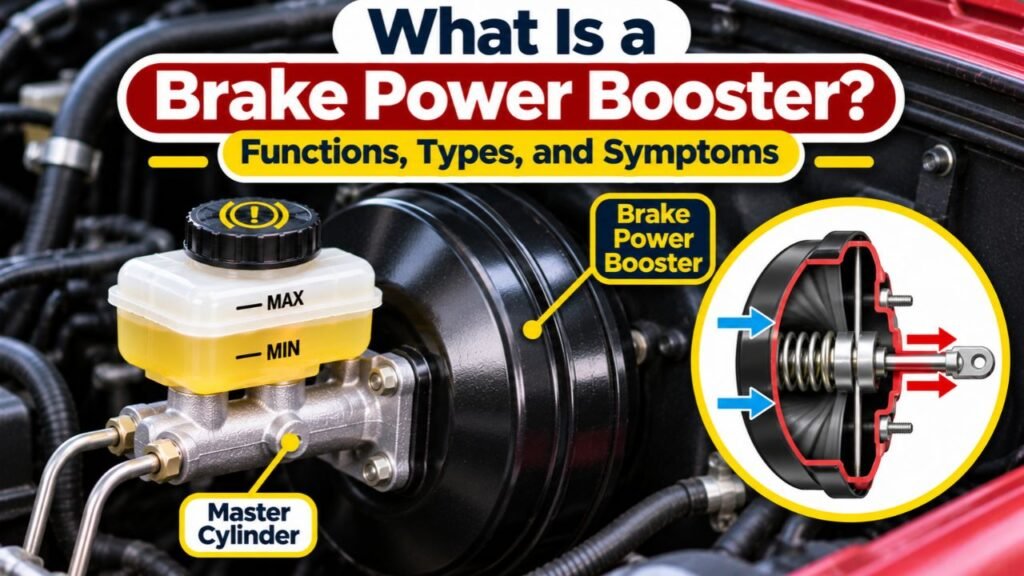
A brake power booster is an assist unit that increases the force used to operate a vehicle’s brakes. In many conventional cars, it sits directly behind the brake master cylinder on the engine-compartment side of the firewall. When you press the brake pedal, the booster adds force to the input you provide.
The term power does not mean the booster applies the brakes without driver control on every vehicle. In a conventional setup, the driver still initiates and regulates braking. The booster simply reduces the effort needed to produce a given level of hydraulic pressure.
A brake booster is not the device that holds the brake fluid or presses the brake pads against the rotors. Those jobs belong to other parts of the system. Its role is to provide power assistance, making the whole system easier to operate.
What Is a Power Booster for Brakes Used For?
The main benefit of a power booster for brakes is lower pedal effort, particularly during stronger stops. Without adequate assistance, the driver may need to push much harder to generate the same hydraulic pressure.
That difference matters in daily traffic, where drivers brake repeatedly and must react quickly. The booster can also help provide a more manageable pedal feel across gentle and firm braking. It does not, by itself, guarantee shorter stopping distances; tire grip, brake condition, road surface, and driver response remain important.
Power-assisted brakes are common in passenger cars, pickups, SUVs, and many other road vehicles. Some older or specialty vehicles have manual brakes designed with different pedal geometry and master-cylinder sizing. A correctly engineered manual setup is not automatically defective because it lacks a booster.
What Does a Brake Booster Look Like?
A traditional vacuum brake booster resembles a large, shallow, round metal canister. It is often black or dark-colored and positioned upright on the firewall. The brake master cylinder projects forward from its center, with a brake-fluid reservoir usually attached above the master cylinder.
Look for a fairly broad circular housing, a seam around its outer edge, mounting studs, and a thick vacuum hose attached through a fitting or check valve. The exact shape and finish depend on the manufacturer. Some units are smaller, thicker, or partly concealed beneath plastic covers.
The NAPA brake booster replacement guide describes the typical booster as a short, wide round unit located between the master cylinder and the firewall. That arrangement provides a useful visual starting point when inspecting a conventional engine bay.
Where Is the Power Brake Booster Located?
In many left-hand-drive vehicles sold in the United States, the booster is on the driver’s side of the firewall, near the rear of the engine compartment. The brake pedal connects to its rear side through a pushrod passing through the firewall.
Some vehicles use remote boosters, unusual mounting arrangements, or integrated electronic brake units. If there is no recognizable round canister behind the brake-fluid reservoir, consult the model-specific service information before assuming the vehicle lacks power assistance.
How Can You Tell the Booster From the Master Cylinder?
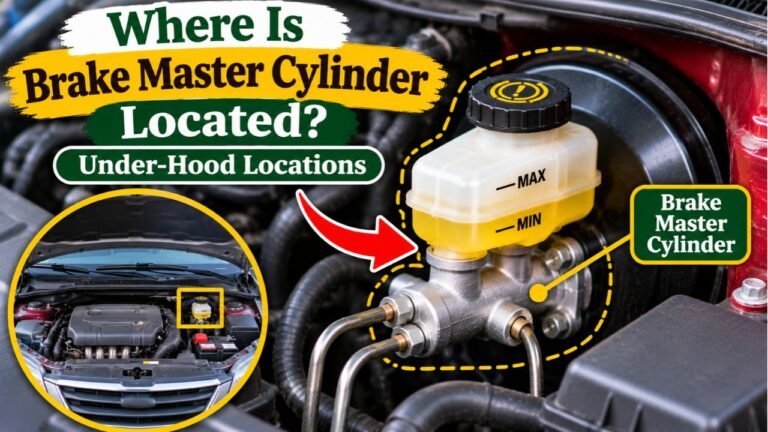
The booster is usually the larger round housing nearest the firewall. The master cylinder is the smaller hydraulic assembly fastened to the front of it, often with a plastic fluid reservoir on top.
This distinction matters because the parts can fail differently. Brake fluid leaking from the rear of a master cylinder can collect around the booster mounting area, but that does not mean the booster is the original source of the fluid.
Main Parts of a Vacuum Power Brake Booster
The outside may look like a simple sealed container, but several components work together inside. Their arrangement varies by booster design.
Housing and Diaphragm
The housing provides a sealed space for the assist mechanism. A flexible diaphragm, supported by an internal plate or piston, separates pressure areas inside a typical vacuum booster.
When pressure differs on opposite sides of the diaphragm, the resulting force helps move the output mechanism toward the master cylinder. A damaged diaphragm or leaking housing can reduce that assistance.
Air Control Valve and Return Spring
An internal valve controls when outside air enters and when vacuum is restored. Its movement follows the driver’s pedal input, allowing the booster to provide variable assistance rather than only an on-or-off response.
A spring helps return the internal assembly as the driver releases the brake. The valve seals and return mechanism also help the brakes return to their normal released state.
Input Rod and Output Rod
The input rod connects the brake pedal to the booster. The output rod transfers the combined driver and assist force to the master-cylinder piston.
These are mechanical connections, but their clearances and alignment are important. Incorrect pushrod adjustment can contribute to excessive pedal travel or brakes that do not release properly.
Vacuum Hose and Check Valve
A hose connects a conventional booster to its vacuum supply. A one-way check valve helps retain vacuum in the booster when the supply falls or the engine stops.
A split hose, loose connection, or faulty check valve can reduce available assistance even if the main booster housing remains intact. Some systems also include vacuum sensors, reservoirs, or electrically driven pumps.
How a Power Brake Booster Works
A power brake booster adds force to the driver’s pedal input before that force operates the master cylinder. The master cylinder then creates hydraulic pressure that travels through the brake lines to the wheel brakes.
The exact source of assistance depends on the design. Traditional vacuum boosters use an air-pressure difference, hydraulic boosters use pressurized fluid from a suitable hydraulic source, and electromechanical units use motor-driven assistance. The end goal is similar, but the internal parts are not interchangeable.
How a Vacuum Brake Booster Works
In a conventional vacuum-suspended design, both sides of the diaphragm are under reduced air pressure while the brake pedal is released. Pressing the pedal changes the internal valve position and allows atmospheric air into one chamber. The higher pressure on that side pushes against the diaphragm and adds force to the master-cylinder pushrod.
As the driver presses harder, the valve responds to the requested braking effort. Releasing the pedal allows the pressure difference to diminish and the internal mechanism to return. Bosch Mobility’s vacuum brake booster explanation describes this two-chamber pressure difference and how it assists the master cylinder.
The booster does not create brake fluid pressure through its own fluid circuit. It helps push the master-cylinder pistons, which produce the hydraulic pressure needed by the wheel brakes.
What Happens When the Engine Is Turned Off?
A conventional vacuum booster may hold enough stored vacuum for limited assisted brake applications after the engine stops. Repeated pedal applications gradually use that reserve if no new vacuum is available.
The pedal then normally becomes harder, because the driver is supplying more of the force directly. This behavior is different from a pedal that suddenly sinks to the floor, which can indicate a separate and potentially serious hydraulic problem.
Where Does Brake Booster Vacuum Come From?
Many gasoline engines can supply vacuum from the intake manifold under suitable operating conditions. That vacuum is carried through a hose to the booster and managed by its check valve.
However, not every gasoline engine produces enough manifold vacuum under all conditions. Some modern engines, modified engines with certain camshaft profiles, and turbocharged configurations may use a separate vacuum pump or supplemental system. Diesel engines commonly rely on a dedicated pump because their intake systems generally do not supply vacuum in the same way as traditional throttled gasoline engines.
The vacuum source is an important part of diagnosis. A good booster cannot provide its intended assistance if the supply hose is disconnected, the pump is not operating, or the available vacuum is insufficient.
Types of Brake Power Boosters
The familiar round vacuum booster is only one form of brake assistance. Different vehicles use different designs based on available power sources and braking requirements.
Vacuum Brake Booster
This is the conventional diaphragm-based design widely found on gasoline-powered vehicles. It uses vacuum and atmospheric pressure to reduce pedal effort. Some vehicles employ a single diaphragm, while tandem-diaphragm designs use additional working area to provide more assistance within the available mounting space.
Hydraulic Brake Booster or Hydro-Boost
A hydraulic booster uses pressurized fluid rather than engine vacuum to create assistance. Traditional Hydro-Boost setups commonly obtain hydraulic power from a compatible power-steering pump or shared hydraulic circuit.
These units are often more compact than large round vacuum boosters and may be found on selected trucks, vans, and other vehicles. Their hoses, seals, and hydraulic supply differ from those of vacuum boosters.
Electric Vacuum Pump With a Conventional Booster
Some systems retain a familiar vacuum diaphragm booster but generate the vacuum with an electric pump. This arrangement can provide vacuum assistance when engine manifold vacuum is low or when an engine is temporarily stopped.
The booster itself still operates through air-pressure differences. It is the vacuum source, not necessarily the booster mechanism, that has changed.
Electromechanical and Integrated Brake Boosters
Other vehicles use an electric motor and electronic controls to provide assist without a traditional vacuum source. Bosch Mobility’s iBooster technical overview describes an electromechanical unit that uses pedal-travel sensing, a control unit, and a motor-driven mechanism to assist hydraulic braking.
Electric and hybrid vehicles may also use integrated braking systems that coordinate friction brakes with regenerative braking. Their appearance and service procedures can be very different from those of a round vacuum unit.
| Booster Type | Main Assist Source | Typical Distinguishing Feature |
| Vacuum | Pressure difference between air chambers | Round diaphragm housing and vacuum hose |
| Hydraulic | Pressurized hydraulic fluid | Hydraulic pressure and return connections |
| Electric-vacuum system | Electric pump supplies vacuum | Traditional booster plus electric pump |
| Electromechanical | Controlled electric motor | Motor, sensors, and electronic control hardware |
Brake Booster vs. Master Cylinder, ABS, and Manual Brakes
These components are related, but they do not do the same job. Confusing them can lead to replacing a working part while the actual brake problem remains.
| Component or System | Main Job |
| Brake booster | Reduces the foot force needed to operate the brakes |
| Master cylinder | Converts mechanical input into hydraulic brake pressure |
| ABS | Modulates brake pressure to limit wheel lockup during braking |
| Brake caliper or wheel cylinder | Applies force to pads or shoes at the wheels |
| Manual brake system | Uses driver force and mechanical leverage without a power booster |
The booster works alongside these parts rather than replacing them. A car can have a perfectly functioning booster and still brake poorly because of worn friction components, leaking hydraulic lines, contaminated pads, or damaged tires.
Likewise, a brake warning light does not uniquely identify a bad booster. It may be associated with low fluid, ABS faults, parking-brake status, or electronically monitored assist components, depending on the vehicle.
How a Healthy Brake Booster Should Feel
In a conventional vacuum-assisted vehicle, the brake pedal is typically firmer with the engine off after stored vacuum has been used. When the engine starts and assist becomes available, a pedal held under steady moderate foot pressure may move downward slightly.
During normal driving, the pedal should respond predictably as pressure increases. A healthy booster helps make the brake effort manageable; it should not produce loud, persistent hissing, erratic assistance, or a pedal that remains unusually hard.
Pedal feel alone is not a complete health check. Some newer electronically controlled brake systems deliberately provide a different response, and brake-pad compounds, hydraulic condition, and vehicle design also influence what the driver feels.
Symptoms of a Bad Brake Power Booster
A failing booster often changes how much force you need to apply to the pedal. Some symptoms overlap with vacuum-line faults, master-cylinder problems, and other brake defects, so diagnosis matters.
Hard Brake Pedal or Increased Pedal Effort
A suddenly hard brake pedal is a classic sign that assistance may be missing. The car might still have some braking ability, but achieving normal deceleration can require far more force than expected.
A hard pedal is not proof that the booster itself has failed. Check the vacuum supply or relevant hydraulic/electronic assist system before drawing that conclusion.
Hissing Noise When Pressing the Brake Pedal
Air moving through a vacuum leak can produce a hissing sound near the dashboard or booster. A brief operating sound may occur on some designs, but persistent or unusually loud hissing deserves inspection.
A leak may be in the booster, check valve, hose, or related connection. The sound’s location is a clue, not a final diagnosis.
Engine Idle Changes During Braking
A substantial vacuum leak may affect the engine’s air mixture or idle behavior on vehicles where booster vacuum comes from the intake system. The engine may stumble, run roughly, or change speed when the pedal is pressed.
This symptom is less useful for vehicles with independent vacuum sources or vacuum-free electric braking. Other engine problems can also produce similar idle changes.
Longer Stopping Distance or Inconsistent Assistance
Loss of assist can make it harder for the driver to produce the braking force expected during a stop. The amount of extra stopping distance depends on vehicle speed, brake design, driver input, and road conditions.
Intermittent assistance can feel especially unpredictable. Do not continue driving to see whether the symptom disappears.
What Causes Brake Booster Problems?
Common problems in traditional vacuum systems include a cracked supply hose, leaking check valve, damaged diaphragm, internal valve wear, and insufficient vacuum production. Age, heat, contamination, and deteriorated rubber can contribute.
A leaking master-cylinder rear seal can also allow brake fluid to reach the booster. This may damage certain internal components, so replacing the booster without correcting the fluid leak can lead to repeated trouble.
Hydraulic boosters can suffer from fluid supply, hose, seal, or pump issues. Electric-assist designs may develop sensor, wiring, motor, power-supply, or control faults. The correct troubleshooting method therefore depends on the system type.
How to Check Whether a Brake Booster Works
A commonly used basic vacuum-booster check begins with the vehicle parked securely, engine off, and the driver pressing the brake pedal several times to use stored vacuum. The pedal should generally become firmer.
With steady, moderate pressure held on the pedal, starting the engine may cause the pedal to move down slightly as assist develops. This observation can suggest that the vacuum booster is responding, but it is not a complete test and does not establish that the entire brake system is safe.
An inspection may also include checking the vacuum hose and check valve for visible damage. More precise diagnosis uses the manufacturer’s service procedure, suitable vacuum measurements, and checks appropriate to the vehicle. Do not open brake hydraulic connections or disconnect hoses while driving to test assist.
On hybrid, electric, Hydro-Boost, and integrated brake systems, this conventional vacuum test may be inappropriate. Use the specific diagnostic procedure for that vehicle.
Is It Safe to Drive With a Bad Brake Booster?
Do not drive a vehicle with suspected loss of brake assistance or unpredictable pedal behavior. A conventional hydraulic brake system may retain some mechanical braking capability after vacuum assist is lost, but required pedal effort can rise sharply and stopping may be impaired.
Modern electronically assisted systems may enter vehicle-specific fallback modes, making assumptions about remaining braking capability unsafe. Stop in a safe location and arrange professional diagnosis or towing rather than attempting a road test.
A brake pedal that sinks, visible brake-fluid leakage, warning messages, or a lack of normal stopping response can indicate faults beyond the booster. All require prompt attention.
How Long Does a Brake Power Booster Last?
There is no universal replacement mileage or age for brake boosters. Many remain in service for years, while others fail early because of leaks, contamination, corrosion, or problems with the vacuum or hydraulic supply.
Normal brake maintenance should include attention to changing pedal feel and condition of accessible hoses and connections. The vehicle service schedule is a better reference than an arbitrary booster replacement interval.
A booster that works properly usually does not need replacement merely because the vehicle has reached a particular mileage. Condition and verified symptoms matter more than age alone.
Can a Brake Power Booster Be Repaired or Replaced?
Some booster designs can be professionally rebuilt, but many vehicle manufacturers treat their original assemblies as replaceable units. A worn check valve or vacuum hose may be separately serviceable, while a failed sealed booster often requires a complete replacement.
Replacement commonly involves disconnecting the booster from the pedal linkage and master-cylinder mounting, then restoring the correct mechanical and vacuum or hydraulic connections. Procedures differ by vehicle, and certain hydraulic or electric units require additional service steps and diagnostic equipment.
Pushrod length, pedal retention, fastener specifications, and system bleeding requirements must be correct. Improper work can create dragging brakes, excessive pedal travel, or complete loss of braking. This is a safety-critical repair, not a good place for guesswork.
How Much Does Brake Booster Replacement Cost?
The cost can range widely depending on the vehicle, part availability, type of assist system, and labor access. Conventional vacuum boosters may be less complex to replace than some integrated electronic brake units, but that is not true for every vehicle.
Labor can rise when the booster is buried behind other engine-bay components or difficult to reach under the dashboard. A shop should also identify whether the actual fault lies in the booster, a hose, a check valve, or another supply component before replacing expensive parts.
Ask for an estimate that separates parts, labor, fluid service if needed, and any diagnostic work. A model-specific quotation is more useful than a single national price estimate.
Choosing the Correct Replacement Brake Booster
Match the replacement to the vehicle’s year, make, model, engine, braking system, and original equipment configuration. Two boosters that look alike may have different mounting patterns, pushrod dimensions, vacuum connections, or assist characteristics.
For modified vehicles, match the booster to the complete brake setup, including pedal geometry, master-cylinder bore, and available vacuum or hydraulic supply. A larger housing is not automatically a better booster.
Choose a compatible, properly supported part and follow vehicle-specific installation instructions. If the car has stability control, regenerative braking, or an integrated electronic brake unit, additional calibration or service procedures may apply.
Brake Booster Maintenance and Prevention
Traditional vacuum boosters generally require no routine internal lubrication or adjustment. The useful maintenance tasks are mostly indirect: keep the engine’s vacuum system in good condition, inspect visibly deteriorated hoses, and address fluid leaks promptly.
Avoid ignoring a changing pedal feel or repeatedly topping off brake fluid without finding the cause of the loss. Keep brake service work clean, because contamination and incorrect fluid can damage the hydraulic system.
For hydraulic and electronic boosters, use the specified fluid, diagnostic procedures, and service intervals. Preventive checks cannot eliminate every failure, but they can help identify related faults before braking performance changes.
Conclusion
The answer to “what is a brake power booster?” is straightforward: it adds assistance so the driver can operate the brakes with less physical effort. In conventional vehicles, a vacuum-operated diaphragm helps move the master-cylinder piston; other vehicles achieve assistance with hydraulic pressure or electric motors.
The familiar round booster behind the master cylinder is only one design. Knowing its location, basic operation, common failure signs, and relationship to the master cylinder makes it easier to recognize when professional brake diagnosis is needed. Any sudden loss of assistance deserves immediate attention.
FAQs About What Is a Brake Power Booster
Is a Power Brake Booster the Same as a Vacuum Booster?
Often, but not always. A vacuum booster is one type of power brake booster. Hydraulic and electromechanical designs also provide brake assistance without relying on the same vacuum mechanism.
Can a Car Have Power Brakes Without a Vacuum Booster?
Yes. Some vehicles use hydraulic boost, electric-motor assistance, or integrated electronic brake units. The correct design depends on the manufacturer’s braking architecture.
Does the Brake Booster Contain Brake Fluid?
A conventional vacuum booster does not use brake fluid as its working medium. Brake fluid belongs in the separate hydraulic circuit. Fluid found inside a vacuum booster can indicate a leaking master-cylinder seal.
Does a Brake Booster Work When the Engine Is Off?
A vacuum booster may provide limited assistance using stored vacuum after the engine stops. Once that reserve is depleted, pedal effort normally increases. Electric and hydraulic designs have different vehicle-specific behavior.
Can a Bad Brake Booster Cause a Spongy Pedal?
A bad booster more commonly causes a hard pedal or missing assistance. A spongy pedal can indicate air in the hydraulic system, flexible hoses, or other brake faults, although symptoms can overlap.
Is a Brake Booster Needed for Disc Brakes?
Not in every vehicle. Properly engineered manual disc brakes can operate without a booster. However, a vehicle originally designed for power assistance may require major system changes to work safely without it.
Can the Brake Booster Affect ABS?
The booster and ABS have different jobs, but they work within the same braking system. Loss of assist can affect the driver’s ability to generate braking force, while electronically integrated brake systems may report related faults through their control modules.