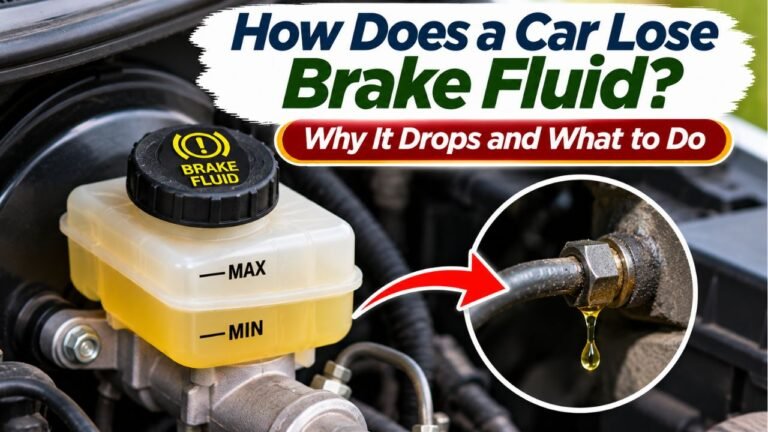
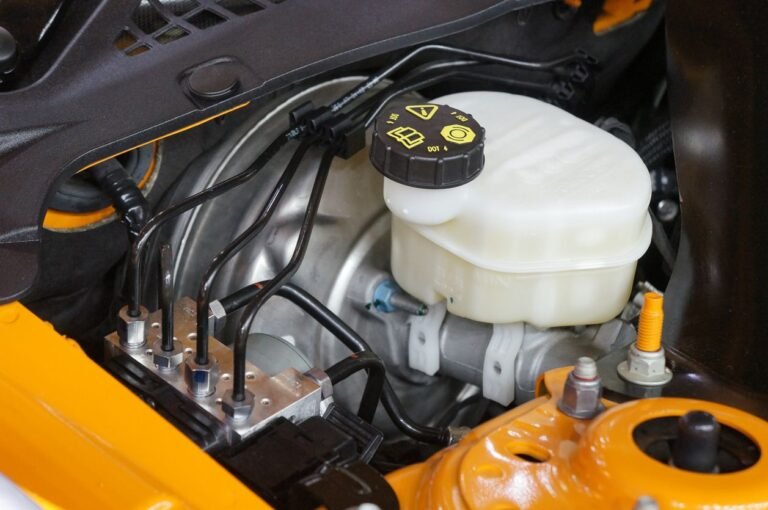
Does DOT 3 Brake Fluid Expire? Safe Storage and Fluid Changes
Yes, DOT 3 brake fluid can become unsuitable for use over time, especially after a bottle has been opened. It is hygroscopic, meaning it absorbs moisture from the air. Moisture lowers its boiling point and can contribute to corrosion inside a vehicle’s hydraulic brake system. A sealed bottle generally lasts much longer, but there is no universal expiration period for every brand.
For example, TotalEnergies specifies a two-year shelf life for properly stored, unopened small containers and recommends using opened fluid as soon as possible, within a few months. Other products may carry different storage limits. An old, unopened bottle is therefore not automatically safe simply because its cap has never been removed.
Fluid already inside a car is another situation. It accumulates moisture gradually through normal service and must be replaced according to the vehicle manufacturer’s maintenance schedule, even if the reservoir still looks full.
In this article, I explain how long unopened and opened DOT 3 fluid can last, what causes deterioration, and how to identify an outdated bottle. I also cover fluid in the brake system, boiling-point specifications, safe storage, testing limitations, and when to discard or replace it.
Does DOT 3 Brake Fluid Expire in the Bottle?
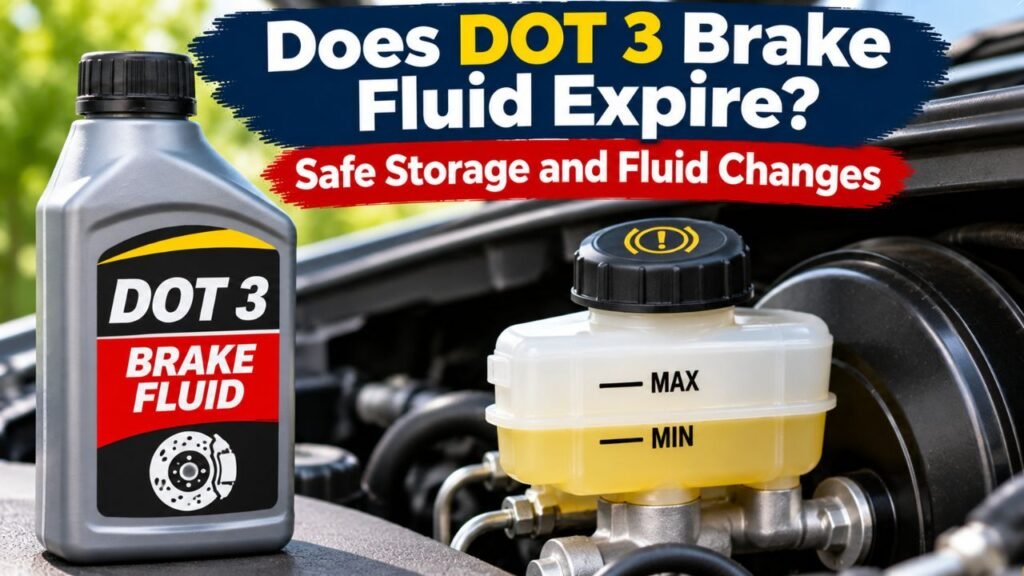
DOT 3 brake fluid has a limited storage life that depends on the manufacturer, packaging, storage conditions, and whether the container has been opened.
An unopened bottle with an intact factory seal is better protected from moisture than a partially used bottle.
However, no single expiration date applies to every DOT 3 product.
Some manufacturers specify a shelf life of two years, while others permit longer storage under appropriate conditions.
DOT 3 Brake Fluid Shelf Life Chart
| Fluid condition | Shelf-life guidance | Recommendation |
| New, factory-sealed bottle | Manufacturer-specific; two years is one published example | Follow the product’s stated shelf life |
| Unopened bottle stored for several years | Depends on brand, packaging, and storage | Verify the manufacturer’s guidance |
| Bottle opened recently | Moisture exposure begins once opened | Prefer using it promptly |
| Bottle opened several months ago | May have absorbed moisture | Replace unless manufacturer guidance supports continued use |
| Previously opened bottle of unknown age | Condition cannot be trusted | Discard |
| Fluid already in a vehicle | Follow the vehicle’s maintenance interval | Replace as scheduled or when testing indicates a problem |
These are practical guidelines rather than universal expiration rules.
Manufacturer Shelf-Life Recommendations
According to the TotalEnergies brake fluid handling guidelines, properly stored brake fluid has the following recommended shelf life:
- Unopened small containers: 2 years
- Unopened drums under specified storage conditions: 3 years
- Properly stored bulk fluid: 2 years
- Opened containers: Use as soon as possible, within a few months
These figures apply to the manufacturer’s described products and storage arrangements.
Other brands may specify different periods.
Key Takeaway: Do not assume DOT 3 brake fluid lasts indefinitely in a sealed bottle or remains safe for a fixed number of months after opening.
How Long Does Unopened DOT 3 Brake Fluid Last?
An unopened bottle of DOT 3 brake fluid can remain usable for years when stored correctly, but its actual recommended shelf life depends on the product.
The original factory seal helps protect the fluid from moisture and contamination.
However, the bottle’s material, age, and storage environment still matter.
Does Unopened Brake Fluid Have an Expiration Date?
Some manufacturers print an expiration date.
Others provide a manufacturing date, packaging date, or batch number.
Certain products specify shelf life in their technical data sheets rather than directly on the bottle.
A manufacturing date is not necessarily the expiration date.
For example, a bottle manufactured two years ago may still be within one brand’s recommended shelf life but beyond another brand’s limit.
Always check the relevant product information.
Can You Use 2-Year-Old Unopened DOT 3 Fluid?
Possibly.
If the bottle is genuinely unopened, has been stored correctly, and remains within the manufacturer’s recommended shelf life, it may be suitable.
However, do not assume every two-year-old bottle is acceptable.
For products with a stated two-year limit, verify whether the bottle is still within that period.
Can You Use 5-Year-Old Unopened DOT 3 Fluid?
The safest approach is to replace it unless the manufacturer specifically confirms a longer shelf life and the storage conditions meet its requirements.
An intact seal does not prove that a five-year-old bottle still meets its original specifications.
For a safety-critical system such as hydraulic brakes, buying fresh fluid is generally more sensible than relying on uncertain old stock.
What About a 10-Year-Old Sealed Bottle?
I would not recommend using it without specific manufacturer confirmation and appropriate quality verification.
Even if the fluid appears clear, its condition cannot be established visually.
Packaging deterioration and unknown storage conditions create additional uncertainty.
The safer choice is a fresh, factory-sealed bottle that meets the vehicle’s specifications.
How Long Does DOT 3 Brake Fluid Last After Opening?
Opened DOT 3 brake fluid should be used promptly because exposure to air allows it to absorb moisture.
Even if the cap is replaced immediately, the original factory-sealed condition has been lost.
Moisture may enter when the bottle is opened, during pouring, or through imperfect resealing.
Does DOT 3 Expire Immediately After Opening?
No.
Opening a bottle does not instantly make the fluid unusable.
However, it begins a period of increased moisture-exposure risk.
The amount absorbed depends on:
- Humidity
- Time exposed to air
- Frequency of opening
- Storage temperature
- Container seal quality
- Headspace inside the container
A bottle opened briefly in a dry environment may behave differently from one repeatedly opened in a humid garage.
However, there is no simple way to calculate its remaining useful life from the opening date alone.
Is DOT 3 Brake Fluid Good for 3 Months After Opening?
Some manufacturers permit short-term storage of opened brake fluid when it is properly resealed.
TotalEnergies advises using opened fluid within a few months.
However, this is not a guarantee that every DOT 3 bottle remains safe for three months.
For important brake maintenance, using a new, sealed container reduces uncertainty.
Is DOT 3 Brake Fluid Good for 1 Year After Opening?
I would not recommend relying on a bottle that has been open for a year.
Its moisture content and remaining boiling-point performance may be unknown.
Even a tightly closed cap does not restore the original factory seal.
If the bottle was opened a year ago, purchasing fresh fluid is the safer choice.
Can You Reuse Leftover Brake Fluid?
Unused fluid remaining in a recently opened bottle may be usable only when the manufacturer’s instructions allow it and storage conditions have been appropriate.
However, fluid that has been poured into a drain pan, bleeding container, or other unclean vessel must never be returned to the brake system.
For brake bleeding or a complete fluid replacement, a freshly opened container is preferable.
Why Does DOT 3 Brake Fluid Go Bad?
DOT 3 brake fluid is generally glycol-ether-based.
Its hygroscopic properties allow it to absorb moisture from the surrounding environment.
This characteristic is central to its deterioration in storage and service.
1. Moisture Absorption
Water vapor is present in ordinary air.
When DOT 3 fluid is exposed to humid air, it can absorb moisture.
The process may occur gradually, making it difficult to identify without testing.
An opened bottle is particularly vulnerable because the fluid comes directly into contact with ambient air.
2. Lower Boiling Point
Brake systems generate substantial heat during braking.
The hydraulic fluid must maintain appropriate performance at elevated temperatures.
As water accumulates, the fluid’s boiling point decreases.
This can reduce the system’s resistance to vapor formation.
3. Internal Corrosion
Moisture can contribute to corrosion inside the hydraulic brake system.
Potentially affected components include:
- Steel brake lines
- Master-cylinder components
- Caliper internal components
- Wheel-cylinder components
- ABS hydraulic components
Brake fluid contains corrosion inhibitors, but its protective performance is not unlimited.
4. Contamination
Brake fluid can also become unsuitable through contamination with other substances.
Examples include:
- Petroleum-based oils
- Water
- Dirt
- Incorrect hydraulic fluid
- Cleaning chemicals
- Material introduced through dirty tools
Petroleum contamination is particularly serious because it can damage rubber seals designed for glycol-based brake fluid.
5. Long-Term Chemical Changes
Brake fluid contains additives that help maintain performance and protect system components.
Its formulation may experience changes under unsuitable storage or service conditions.
However, moisture contamination is one of the main reasons DOT 3 fluid requires special handling.
What Happens When DOT 3 Brake Fluid Expires?
Old or moisture-contaminated brake fluid may no longer provide the intended resistance to boiling or corrosion.
The effects can become particularly important during demanding braking.
Reduced Boiling-Point Protection
DOT 3 brake fluid is required to meet minimum dry and wet boiling-point specifications when tested under the applicable standard.
| DOT 3 specification | Minimum boiling point |
| Dry boiling point | 401°F (205°C) |
| Wet boiling point | 284°F (140°C) |
These are minimum performance requirements, not the exact boiling points of every DOT 3 product.
The values are defined in Federal Motor Vehicle Safety Standard No. 116, 49 CFR § 571.116.
What Does Dry Boiling Point Mean?
The dry boiling point describes the performance of fluid tested before the standardized moisture-conditioning process.
It is relevant to fresh brake fluid.
A higher boiling point provides a greater margin against vapor formation under high braking temperatures.
What Does Wet Boiling Point Mean?
The wet boiling point is measured after the fluid undergoes a specified laboratory humidification procedure.
It represents an important measure of moisture-related performance.
It is not simply a prediction that every bottle will reach 284°F after a particular number of months.
Why Can Boiling Brake Fluid Be Dangerous?
When brake fluid boils, vapor bubbles can form inside the hydraulic system.
Liquid brake fluid is relatively incompressible, while vapor is compressible.
When the driver presses the brake pedal, some pedal movement may compress vapor rather than transfer the intended hydraulic force.
Possible symptoms include:
- Soft or spongy brake pedal
- Increased pedal travel
- Reduced braking effectiveness
- Brake fade during heavy use
- Potential loss of effective braking
If braking performance is abnormal, stop driving when safe and arrange professional inspection.
Do not assume a complete fluid change alone will correct every brake-system fault.
How to Tell if DOT 3 Brake Fluid Has Expired
There is no reliable visual test that proves DOT 3 brake fluid is still safe to use.
A bottle may look normal even when its moisture content is elevated.
However, several checks can help determine whether it should be discarded.
Check the Bottle Date
Look for:
- Manufacturing date
- Packaging date
- Expiration date
- Batch or lot code
- Manufacturer storage instructions
If a date code is unclear, contact the manufacturer or supplier.
Do not assume the numbers printed on the bottle automatically represent an expiration date.
Inspect the Factory Seal
Check whether the original seal is intact.
An unopened cap does not necessarily mean the inner seal is undamaged.
Avoid using fluid from a bottle with a broken seal, leaking cap, or evidence of tampering.
Examine the Container
Potential concerns include:
- Cracked packaging
- Leaks
- Damaged cap
- Severe container deformation
- Evidence of improper storage
A damaged container may not have protected the fluid adequately.
Look for Abnormal Appearance
Fresh DOT 3 fluid is generally clear to amber.
Cloudiness, visible particles, or unusual separation may indicate contamination.
However, clear fluid is not proof that it is moisture-free or within specification.
Do not judge brake fluid solely by color.
Consider Storage History
Ask whether the bottle has been:
- Opened previously
- Stored in a humid environment
- Left in direct sunlight
- Exposed to extreme temperatures
- Transferred into another container
- Stored without a secure cap
If the history is unknown, replacement is preferable.
Can You Test Old DOT 3 Brake Fluid?
Yes. Brake fluid condition can be evaluated using appropriate testing methods.
However, not all testing devices provide equally reliable results.
Moisture Testers
Some handheld brake fluid testers estimate water contamination.
They may use electrical conductivity or other indirect measurements.
However, conductivity can vary with fluid formulation and contamination.
A low-cost tester should not automatically be treated as a precise laboratory measurement.
Boiling-Point Testers
Professional brake-fluid testing equipment may estimate or measure boiling-point performance.
Such tests can provide more useful information about whether fluid has retained adequate thermal performance.
Results should be interpreted according to the fluid specification and test method.
Can a Tester Prove an Old Bottle Is Safe?
Not necessarily.
A single test may not establish that every required property of the fluid remains satisfactory.
For example, boiling-point testing alone may not fully assess contamination, corrosion-inhibitor condition, or material compatibility.
For an old opened bottle, buying new brake fluid is generally more practical than attempting to certify its remaining service life.
Is Dark Brake Fluid Automatically Expired?
No.
Darkening may occur through aging, contamination, or contact with brake-system components.
It can be a reason to investigate the fluid.
However, color alone cannot establish the water content or boiling point.
Likewise, clear-looking fluid can still require replacement.
How Long Does DOT 3 Brake Fluid Last in a Car?
DOT 3 fluid already circulating in a vehicle has a different service life from fluid stored in an unopened bottle.
Moisture can gradually enter the hydraulic brake system through components and normal service exposure.
This can happen even when the vehicle is not driven frequently.
How Often Should DOT 3 Brake Fluid Be Replaced?
The correct interval depends on the vehicle manufacturer.
Some vehicles require replacement approximately every two or three years, while other service schedules differ.
For example, Formula Honda’s brake fluid replacement guide states that Honda Canada recommends replacing Honda-approved DOT 3 brake fluid every three years.
That is an example of manufacturer guidance, not a universal DOT 3 replacement interval.
Always follow the maintenance schedule for your specific vehicle.
Does DOT 3 Fluid Expire Even if You Don’t Drive?
Yes, fluid condition can deteriorate with time.
Brake fluid may absorb moisture even when the car is parked.
Therefore, low mileage alone does not mean the fluid remains suitable indefinitely.
A car that travels only a few thousand miles annually may still require scheduled brake fluid replacement.
Can DOT 3 Last 5 Years in a Brake System?
It is possible for brake fluid to remain in a vehicle that long, but that does not establish that it remains suitable.
If the manufacturer specifies a shorter interval, the fluid is overdue for maintenance.
The absence of brake problems does not prove adequate boiling-point performance.
What About Fluid in ABS Systems?
Vehicles equipped with anti-lock braking systems use hydraulic components that depend on clean, compatible brake fluid.
Contamination can contribute to corrosion and other hydraulic problems.
Some brake-fluid replacement procedures require specialized equipment or scan-tool functions.
Follow the manufacturer’s service procedure rather than assuming every ABS system can be flushed the same way.
DOT 3 Brake Fluid in a Bottle vs in a Car
These conditions should not be confused.
| Question | Stored bottle | Vehicle brake system |
| Main concern | Shelf life and packaging integrity | Service aging and contamination |
| Moisture exposure | Greater after opening | Gradual exposure during use |
| How long does it last? | Manufacturer-specific | Vehicle maintenance schedule |
| Is appearance enough to judge condition? | No | No |
| Can it be tested? | Yes, using appropriate methods | Yes, using appropriate methods |
| Best replacement decision | Use fresh fluid within shelf-life guidance | Follow service interval and inspection results |
An unopened bottle does not require replacement on the same schedule as brake fluid already installed in a vehicle.
Likewise, a vehicle’s service interval does not tell you how long a new bottle can remain stored on a shelf.
Can You Use Expired DOT 3 Brake Fluid to Top Off a Reservoir?
No. Do not use expired, contaminated, or questionable DOT 3 brake fluid to top off a vehicle’s reservoir.
Adding old fluid creates uncertainty about the condition of the hydraulic system.
It is safer to use fresh fluid that meets the vehicle manufacturer’s specification.
What If the Brake Fluid Level Is Low?
First, determine why the level has decreased.
Possible causes include:
- Normal brake-pad wear
- External hydraulic leaks
- Problems with brake-system components
- Previous incorrect servicing
A slight change in reservoir level can occur as brake pads wear.
However, a level at or below the minimum mark requires attention.
Do not repeatedly top off the reservoir without investigating the cause.
Can Adding Fresh Fluid Restore Old Brake Fluid?
Not reliably.
Adding a small amount of fresh DOT 3 does not remove the moisture or contamination already present throughout the system.
If the fluid requires replacement, a proper brake fluid change or flush should be performed according to the vehicle’s service procedure.
Can You Mix DOT 3 and DOT 4?
DOT 3 and DOT 4 are generally glycol-based fluids and are chemically compatible in many applications.
However, compatibility does not mean either fluid automatically meets every vehicle’s requirements.
Follow the specification printed on the reservoir cap or stated in the owner’s manual.
Do not mix conventional glycol-based DOT 3 fluid with silicone-based DOT 5 fluid.
If the incorrect fluid has entered the braking system, have a qualified technician assess it before driving.
How to Store DOT 3 Brake Fluid Properly
Correct storage helps preserve brake fluid quality.
Use the original packaging and follow the manufacturer instructions.
Step 1: Keep the Original Container
Store DOT 3 brake fluid in its original labeled bottle.
Do not transfer it into an ordinary water bottle, food container, or unidentified plastic container.
Some packaging materials may be unsuitable for long-term storage.
Step 2: Keep It Tightly Sealed
Keep the factory seal intact until the fluid is needed.
After opening, replace the cap immediately.
This reduces exposure to humid air but does not restore the original sealed condition.
Step 3: Store in a Cool, Dry Location
Choose a clean storage area protected from excessive heat and moisture.
Avoid locations exposed to direct sunlight or major temperature fluctuations.
Follow any temperature limits specified by the product manufacturer.
Step 4: Keep It Away From Other Automotive Fluids
Store DOT 3 separately from substances such as:
- Engine oil
- Power steering fluid
- Transmission fluid
- Petroleum-based hydraulic oil
- Cleaning chemicals
This reduces the risk of accidentally using the wrong product.
Step 5: Avoid Contamination
Never return leftover brake fluid from a service operation to the original container.
Do not insert contaminated tools into the bottle.
Use clean, dry equipment during servicing.
Step 6: Record the Opening Date
If the manufacturer permits short-term storage after opening, write the opening date on the bottle.
This helps track its age.
However, a known opening date does not prove the fluid remains suitable if it was stored incorrectly.
Step 7: Buy the Right Quantity
For occasional DIY brake maintenance, buying smaller sealed bottles may reduce leftover waste.
A large bottle can be less economical if most of its contents are discarded after opening.
What Should You Do With Expired DOT 3 Brake Fluid?
Do not pour expired brake fluid into the braking system.
It should be handled as automotive chemical waste.
Safe Disposal
Depending on local requirements, disposal options may include:
- Household hazardous waste collection facilities
- Authorized automotive waste collection programs
- Repair shops that accept compatible waste fluids
Keep the fluid in a clearly labeled, suitable container until disposal.
Do not pour it into:
- Household drains
- Storm drains
- Soil
- Surface water
- Ordinary household trash unless local rules explicitly permit the container and contents
Never mix brake fluid with used motor oil or other wastes unless the collection program specifically accepts the mixture.
Can You Recycle Brake Fluid?
Some specialized waste-management services can recover or process brake fluid.
However, not all automotive recycling centers accept it.
Contact the facility before bringing it in.
Can You Use Old DOT 3 for Another Purpose?
Avoid repurposing expired brake fluid as a household cleaner, lubricant, or solvent.
Brake fluid can damage painted surfaces and certain materials.
It should be disposed of through an appropriate waste-management channel.
Common Mistakes With DOT 3 Brake Fluid Shelf Life
| Mistake | Why it matters | Better approach |
| Assuming sealed fluid never expires | Manufacturers may specify a shelf life | Check product guidance |
| Keeping an opened bottle for years | Moisture contamination becomes a concern | Use fresh fluid |
| Judging fluid only by its color | Clear fluid may still contain moisture | Use appropriate testing and service intervals |
| Applying a car’s service interval to an unopened bottle | Storage life and service life differ | Check both separately |
| Adding expired fluid to a low reservoir | Introduces questionable fluid | Use fresh, specified fluid after checking the cause |
| Assuming fresh fluid fixes a serious brake problem | Mechanical or hydraulic faults may remain | Inspect and repair the system |
| Leaving the cap loose | Increases moisture exposure | Reseal promptly |
| Mixing fluid with engine oil or power steering fluid | Can damage brake-system components | Keep fluids separate |
| Ignoring a spongy pedal | May indicate a serious brake fault | Stop driving safely and arrange inspection |
| Flushing ABS systems without the correct procedure | May leave air or fluid in hydraulic components | Follow manufacturer service instructions |
Is a Few-Month-Old Open Bottle Always Bad?
Not necessarily, but its suitability cannot be established from age alone.
Some manufacturers permit short-term storage.
However, humidity, sealing, and storage history influence the condition.
When uncertain, replace it.
Does Heating Brake Fluid Make It Usable Again?
No.
Heating or attempting to boil moisture out of brake fluid at home is not a safe or reliable restoration method.
It can introduce hazards and does not certify the remaining fluid’s performance.
Use fresh fluid instead.
Is It Safe to Drive With Old Brake Fluid?
Old brake fluid does not necessarily cause an immediate, noticeable problem.
However, moisture contamination can reduce boiling-point protection and contribute to internal corrosion.
If the vehicle is overdue for brake-fluid service, schedule the required maintenance.
If braking performance is abnormal, do not continue driving until the problem is assessed.
Conclusion
DOT 3 brake fluid can expire or become unsuitable for safe use, especially after its container has been opened.
Fresh, factory-sealed fluid generally has a longer storage life, but there is no universal expiration date for every product. Some manufacturers recommend approximately two years for unopened small bottles, while others may specify different periods.
Once opened, DOT 3 brake fluid becomes more vulnerable to atmospheric moisture. A bottle stored for months or years after opening should not automatically be trusted.
Fluid inside a vehicle also changes over time and must be replaced according to the manufacturer’s service schedule.
I recommend using a fresh, sealed bottle whenever servicing a brake system, checking the product’s storage instructions, and discarding fluid of uncertain age or condition.
Never rely on color alone to determine whether brake fluid is suitable.
Because hydraulic brakes are safety-critical, the small cost of fresh DOT 3 fluid is usually preferable to the uncertainty of using an old bottle.
FAQs About DOT 3 Brake Fluid Expiration
Does DOT 3 Brake Fluid Have an Expiration Date?
Some DOT 3 products have a stated shelf life or expiration date.
Others use manufacturing or packaging dates that must be interpreted using the manufacturer’s guidance.
There is no single expiration period applicable to every DOT 3 brake fluid brand.
How Long Does Unopened DOT 3 Brake Fluid Last?
It depends on the manufacturer and storage conditions.
For example, TotalEnergies specifies two years for properly stored, unopened small containers.
Other manufacturers may specify different periods.
Check the specific product’s technical information.
Does DOT 3 Brake Fluid Expire After Opening?
Yes, opened DOT 3 fluid can gradually absorb moisture from the air.
Some manufacturers advise using it within a few months.
For safety-critical brake servicing, a freshly opened bottle is generally the preferable choice.
Can I Use DOT 3 Brake Fluid That Is 3 Years Old?
Possibly, if it remains factory sealed and the manufacturer confirms that its shelf life includes that age.
However, if the bottle has been opened or its storage history is unknown, replace it.
Do not assume all three-year-old fluid is acceptable.
Is 5-Year-Old Unopened DOT 3 Brake Fluid Still Good?
It cannot be confirmed from age and appearance alone.
If the bottle exceeds the manufacturer’s recommended shelf life, purchasing fresh fluid is the safer option.
An intact factory seal does not guarantee indefinite usability.
How Long Does DOT 3 Brake Fluid Last in a Car?
The correct interval depends on the vehicle manufacturer.
Some maintenance schedules specify replacement every two or three years, while others differ.
Follow the owner’s manual rather than using a universal interval.
Does DOT 3 Brake Fluid Absorb Moisture While Sealed?
An intact factory-sealed container is designed to protect the fluid from moisture.
However, packaging quality and long-term storage conditions still matter.
Once opened, the fluid becomes more vulnerable to atmospheric moisture.
What Happens if You Use Expired DOT 3 Brake Fluid?
Moisture-contaminated fluid may have reduced boiling-point protection and contribute to corrosion.
Under demanding braking conditions, vapor formation can cause a soft pedal and reduced braking effectiveness.
Do not deliberately use expired or questionable brake fluid.
Can You Tell if DOT 3 Brake Fluid Is Bad by Color?
No.
Dark or cloudy fluid may suggest contamination, but clear fluid can also contain excessive moisture.
Color alone does not establish fluid condition.
Can You Mix New DOT 3 With Old DOT 3?
The fluids may mix physically, but adding fresh fluid does not remove moisture or other contamination from old fluid.
If the fluid is overdue for replacement or fails an appropriate test, perform the correct brake fluid service rather than simply topping off the reservoir.
Can DOT 3 and DOT 4 Brake Fluid Be Mixed?
They are generally chemically compatible because both are glycol-based.
However, the vehicle manufacturer’s fluid specification must still be followed.
Do not mix conventional DOT 3 with silicone-based DOT 5 brake fluid.
Can DOT 3 Brake Fluid Be Stored in a Garage?
Yes, if the manufacturer permits the storage conditions and the original container is protected from moisture, temperature extremes, and contamination.
A cool, dry storage area is preferable to a damp or excessively hot garage.
Should I Throw Away DOT 3 Brake Fluid After Bleeding Brakes?
Do not reuse fluid collected during bleeding.
Unused fluid remaining in the original bottle should be handled according to the manufacturer’s opened-container guidance.
For future brake work, fresh sealed fluid is the safest practical choice.
Does Brake Fluid Expire Even if the Car Is Never Driven?
Yes, fluid inside a vehicle can deteriorate with time even when mileage is low.
Moisture can gradually enter the hydraulic system.
Follow the time-based brake-fluid maintenance requirements for the vehicle, regardless of how infrequently it is driven.