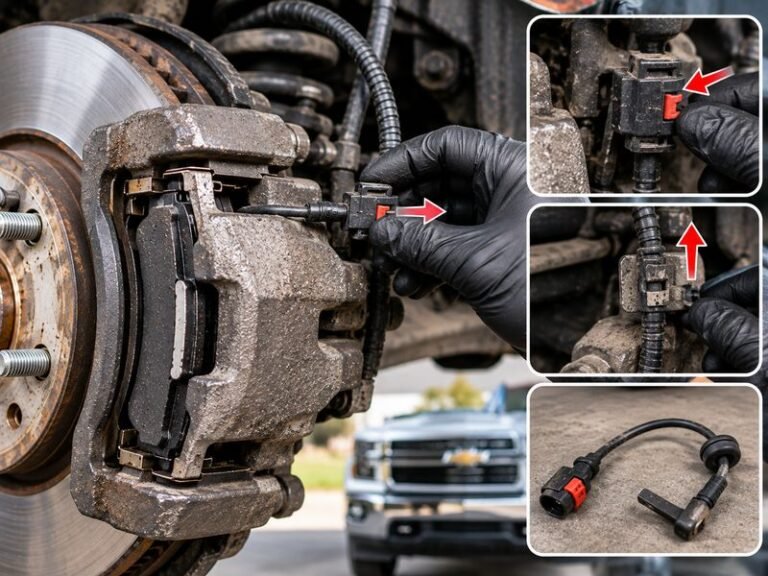
Do Front Brake Pads Wear Faster Than Rear? Reasons Explained
Yes. On many cars and light trucks, the front pads normally wear sooner because braking transfers weight toward the front axle, so the front brakes handle more stopping force and heat. Still, modern brake-control systems can narrow that difference, and some vehicles may wear rear pads as fast as—or faster than—the fronts.
Assuming the front pads will always wear first can hide a real brake issue. A rear caliper that drags, a stuck slide pin, an electronic parking-brake fault, or heavy use of stability-control functions can change the wear pattern. A large left-to-right difference can point to a fault rather than normal front-to-rear bias.
Compare pad thickness at all four wheels instead of guessing from mileage. This can reveal which axle wears faster and flag a brake that may be staying applied after pedal release.
A 2020 Federal Register notice published by NHTSA reported Mercedes-Benz data for affected vehicle platforms showing about 71.9% to 75.5% of braking force at the front axle. Mercedes-Benz also stated that the front pads could wear about 1.5 to 2 times as often as the rear pads, with driving style affecting the rate.
So, do front brake pads wear faster than rear pads in every vehicle? No. The traditional pattern is front pads first, but electronic brake-force distribution, stability control, adaptive driver-assistance features, regenerative braking layouts, and rear-brake hardware can shift wear toward the rear.
What stood out to me in the research is that axle position alone is no longer enough to judge brake wear on a late-model vehicle. The sections below explain the physics behind front-pad wear, the cases that reverse the pattern, what uneven wear can mean, and how to decide which brakes actually need service.
Why Do Front Brake Pads Wear Faster Than Rear Pads?
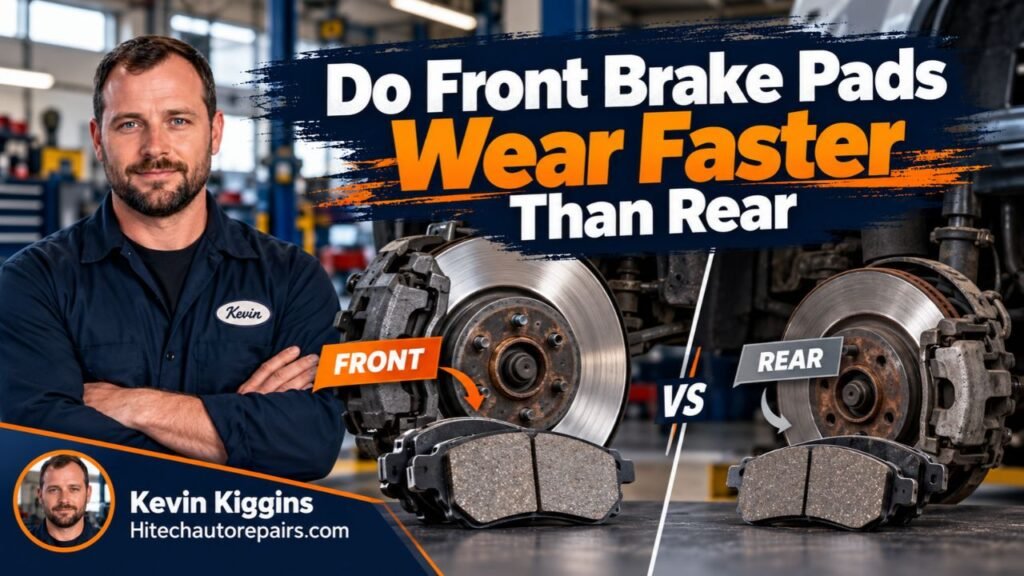
Front pads often wear sooner because the front axle carries more braking load during deceleration. The reason is weight transfer: as the vehicle slows, load moves toward the front tires and away from the rear tires.
That lets the front tires generate more braking force before they lose traction. Vehicle engineers account for this with brake sizing and hydraulic or electronic brake-force distribution.
Weight Transfer Loads the Front Tires More Heavily
During braking, the vehicle’s center of mass keeps moving forward while the tires slow the vehicle. The body pitches forward, front suspension compresses, and load on the front tires rises.
More tire load gives the front axle more grip to use for braking. If the rear brakes were asked to do the same share while the rear tires were lightly loaded, the rear wheels could approach lockup sooner.
Weight transfer changes with deceleration, vehicle height, wheelbase, load placement, and suspension behavior. Hard stops usually shift more load forward.
Brake Systems Usually Have Front Bias
A front-biased brake system sends a larger share of braking force to the front axle. Older vehicles may use a hydraulic proportioning valve. Newer vehicles often use electronic brake-force distribution, or EBD, through the ABS hydraulic unit.
Toyota service information filed with NHTSA describes EBD as a system that changes rear brake force according to driving conditions, vehicle load, and deceleration. That means the front-to-rear split is not always fixed.
Front brake hardware is also often larger. Many passenger vehicles use larger front rotors, larger calipers, thicker pads, or more piston area at the front because that axle must absorb more braking energy.
More Braking Work Creates More Heat and Friction
Brake pads wear because friction converts vehicle motion into heat. If the front brakes repeatedly handle more of that energy, the front friction material usually disappears sooner.
Stop-and-go traffic, steep descents, towing, heavy loads, and late hard braking all raise the amount of heat the pads must handle. The effect may show up first at the front on a vehicle with strong front brake bias.
Key Takeaway: Front pads commonly wear first because weight transfer gives the front axle more grip and the brake system assigns it more stopping work.
How Much Faster Do Front Brake Pads Wear Than Rear Pads?
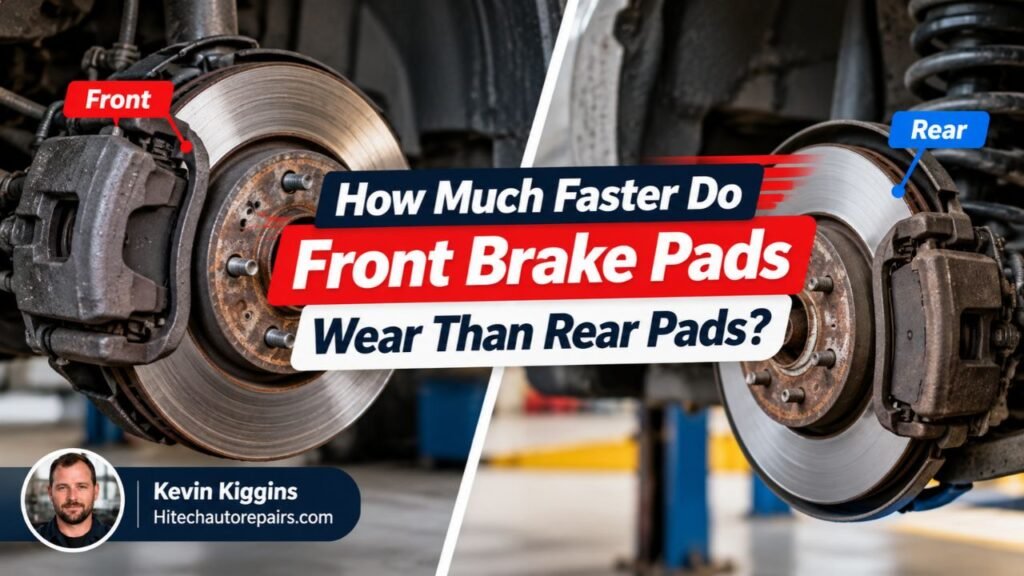
There is no single front-to-rear wear ratio that applies to every car. A 2:1 pattern may occur on one vehicle, while another may wear both axles at nearly the same rate.
Pad compound, rotor size, caliper design, vehicle mass, driving conditions, brake-control software, and maintenance condition all affect the result.
A 1.5-to-2-Times Difference Can Be Normal on Some Vehicles
The Mercedes-Benz data cited in the NHTSA notice is a useful real-world example. On the affected platforms, the maker reported roughly 72% to 75.5% front brake-force share and front-pad replacement about 1.5 to 2 times as often as rear-pad replacement.
That figure should not be treated as a universal specification. Another model can use a different front/rear balance, different pad sizes, or software that calls on the rear brakes more often.
Driving Style Can Widen or Narrow the Gap
Frequent hard braking tends to increase front load transfer. Repeated deceleration from highway speed can also put substantial heat into the front rotors and pads.
Gentler braking may let EBD use more rear brake force because the rear tires retain more load than they do during a hard stop. That can bring front and rear wear closer together on some vehicles.
City driving often produces more pad wear per mile than steady highway travel because each stop consumes friction material.
Vehicle Design Matters More Than Drivetrain Labels
Front-wheel drive does not automatically mean the front pads wear faster solely because the front wheels drive the car. Braking weight transfer is the main reason the front axle usually carries more stopping work.
Rear-wheel-drive and all-wheel-drive vehicles can still have front-biased braking. AWD also does not mean all four brake pads should wear at the same rate.
My preference is to judge wear from actual measurements rather than drivetrain assumptions. Pad thickness at each wheel gives a clearer answer than the badge on the trunk.
Key Takeaway: Front pads may wear much sooner than rear pads, but there is no universal ratio; vehicle design and driving conditions set the real rate.
When Can Rear Brake Pads Wear Faster Than Front Pads?
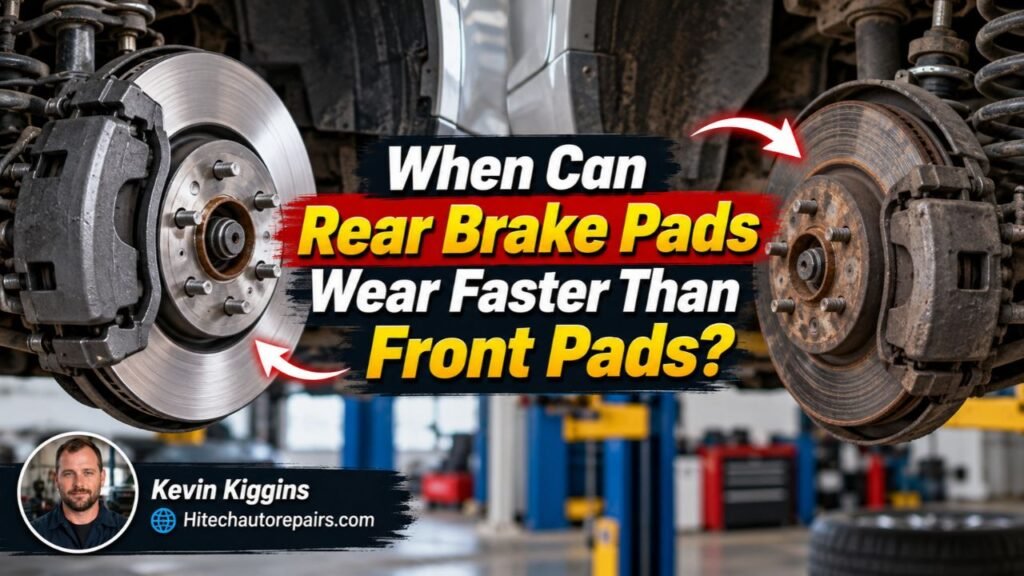
Rear-first wear is not automatically a defect on a late-model car. Modern brake systems use the rear brakes for tasks beyond basic pedal braking, and some designs use them more often than older systems did.
Mitsubishi Motors has explained that features such as adaptive cruise control, all-wheel-control systems, automatic emergency braking, electronic parking brakes, hill-hold, and hill-descent functions can place extra use on rear brakes in some vehicles.
Electronic Stability and Traction Systems Can Apply Individual Brakes
Electronic stability control can apply one or more brakes to correct a developing skid or help the vehicle follow the driver’s intended path. Brake-based traction control can also slow a spinning wheel.
Some torque-vectoring systems use selective braking during cornering. If the rear brakes are called on often, rear pad life can drop even though normal pedal braking remains front-biased.
Adaptive Cruise and Automated Braking Can Change Wear
Some driver-assistance systems use the service brakes to manage speed or vehicle spacing. The exact brake strategy differs by make, model, speed, road condition, and software calibration.
It is not safe to assume that every adaptive-cruise system uses the rear brakes in the same way. If a late-model vehicle wears rear pads first, service information for that exact model is more useful than a general rule.
Electronic Parking Brakes Can Add Rear-Brake Issues
An electronic parking brake, or EPB, usually operates through the rear brakes. Normal EPB use should not destroy pads quickly, but a fault that keeps a rear brake partly applied can create rapid wear and heat.
Rear calipers with integrated parking-brake mechanisms may also require a service mode before pad replacement. Forcing the piston back without the specified procedure can damage the mechanism.
Regenerative Braking Can Change the Pattern Again
Hybrids and electric vehicles may use the traction motor to slow the vehicle and recover energy. That reduces friction-brake use during many deceleration events.
The amount of regeneration at each axle varies with vehicle layout. A front-drive hybrid may remove more workload from the front friction brakes, while another EV may use a different axle strategy. Regeneration can therefore make old front-versus-rear wear rules less predictable.
Key Takeaway: Rear pads can wear first when electronic control systems, parking-brake hardware, or regenerative-braking strategy changes how often each axle uses its friction brakes.
Normal Front-to-Rear Wear vs. Abnormal Brake Pad Wear
A front/rear difference can be normal. A large difference between the left and right wheels on the same axle deserves more attention.
The wear pattern across each individual pad also matters. A pad that is thin at one end or an inner pad that is far thinner than its partner may point to a caliper or hardware problem.
| Wear pattern | What it may mean | Best next check |
| Both front wheels wear faster than both rears | Often normal front brake bias | Compare with vehicle service data |
| Both rear wheels wear faster on a late-model vehicle | May be normal system behavior or rear-brake overuse | Check model-specific brake strategy and EPB operation |
| One wheel wears much faster than the opposite wheel | Possible dragging caliper, hose, hardware, or hydraulic issue | Inspect that brake before fitting new pads |
| Inner and outer pad thickness differ sharply | Caliper piston, slide pin, or pad-fit issue may be present | Check caliper movement and pad fit |
| Tapered pad wear | Caliper movement or hardware may be uneven | Inspect slide pins, bracket, and pad seating |
| Grinding, smoke, or a very hot wheel | Severe wear or dragging brake may be present | Stop driving if braking safety is in doubt and inspect promptly |
Left-to-Right Differences Are More Suspicious
If both front pads wear faster than both rears, that can fit normal brake bias. If the left-front pads are nearly gone while the right-front pads have much more material, the pattern needs diagnosis.
Firestone notes that driver-side versus passenger-side differences can be tied to calipers, rotors, or pads rather than ordinary front/rear wear.
A dragging caliper can keep a pad touching the rotor after pedal release. The affected wheel may run hotter, create a burning smell, pull the vehicle, or wear pads far sooner than the opposite side.
Inner-to-Outer Pad Wear Can Point to Caliper Movement
Many passenger vehicles use floating calipers. The piston pushes the inner pad, then the caliper slides so the outer pad clamps the other side of the rotor.
If the caliper cannot slide freely, the pads may not apply and release evenly. Bendix identifies seized guide pins, poor caliper retraction, corrosion, and related hardware faults as causes of uneven inner/outer or tapered wear.
Replacing pads alone does not correct a sticking slide or piston. The new pads can repeat the same wear pattern.
Heat, Noise, Pulling, and Pedal Changes Need Attention
Pad thickness is only one clue. A wheel that is much hotter than the others after ordinary driving can point to brake drag.
Grinding usually means the friction material may be worn through far enough for metal parts to contact the rotor. A brake warning lamp, fluid leak, soft pedal, strong pull, smoke, or major loss of braking response should be treated as a safety issue.
Safety Tip: If braking ability changes suddenly, a wheel smokes, or the pedal feels abnormally soft, do not keep driving just to compare pad wear. Have the brake system checked before normal road use resumes.
Key Takeaway: Front-to-rear differences can be normal; large differences on the same axle or between pads in one caliper are stronger signs of a mechanical or hydraulic problem.
Should Front and Rear Brake Pads Be Replaced Together?
Front and rear pads do not need automatic replacement together. Service should be based on measured pad thickness, rotor condition, manufacturer limits, and the condition of the hardware.
Replacing good rear pads simply because the fronts are worn adds cost without fixing anything. The same logic applies when the rear pads wear first.
Replace Brake Pads as an Axle Set
If the left-front pads need replacement from normal wear, the right-front pads are normally replaced at the same service. Matching friction material across an axle keeps braking behavior consistent.
The same principle applies at the rear. Replacing only one wheel’s pads can leave uneven braking behavior or an unfixed wear problem.
If one side is worn far more than the other, find the cause before installing the new axle set.
Inspect the Opposite Axle During Brake Service
A front brake job is a good time to measure the rear pads, and a rear brake job is a good time to check the fronts.
Check pad thickness at more than one point if access permits. Also inspect rotor condition, brake hoses, caliper boots, hardware, and evidence of heat or fluid leakage.
Rotor Condition Matters With Pad Replacement
New pads need a suitable rotor surface. Deep grooves, heat damage, heavy corrosion, cracks, or a rotor below its minimum thickness can require rotor replacement.
Minimum rotor thickness is vehicle-specific and is often marked on the rotor or listed in service information. Do not use a generic thickness number for every vehicle.
I would also check caliper movement before finishing the job if the old pads show tapered or uneven wear. That extra inspection can prevent the new set from wearing out in the same pattern.
Key Takeaway: Replace pads by axle according to measured wear, and inspect the opposite axle rather than replacing all four corners by habit.
What Makes Front Brake Pads Wear Out Faster Than Expected?
Normal front bias explains why front pads may go first, but it does not explain every short pad life. A set that disappears far sooner than expected may be dealing with extra heat, drag, poor hardware movement, or severe operating conditions.
Frequent Hard Stops Generate More Front Brake Heat
Hard deceleration increases forward weight transfer and asks the front brakes to absorb a larger share of the vehicle’s kinetic energy.
Repeated hard stops with little cooling time can raise pad and rotor temperature. Heat can change friction behavior and speed wear, especially if the vehicle is heavily loaded.
Leaving more following distance and braking earlier reduces the need for repeated high-force stops.
A Sticking Front Caliper Can Wear One Set Rapidly
A caliper piston, slide pin, pad ear, or hydraulic restriction can keep a front brake from releasing fully. That creates constant friction even while cruising.
A dragging brake may produce rapid pad wear, extra brake dust, heat, a burning odor, reduced fuel economy, or a pull.
Towing, Hills, and Heavy Loads Increase Brake Work
More vehicle mass means more energy must be removed during a stop. Towing and cargo can therefore raise brake workload.
Long descents can be hard on friction brakes if speed is controlled mainly with the pedal. Use the vehicle maker’s downhill-driving and towing instructions, including suitable transmission or drive modes, rather than riding the brakes for long periods.
Key Takeaway: Front pads can wear abnormally fast from repeated heat, brake drag, heavy loads, or driving conditions that demand frequent high-force stops.
How to Check Front and Rear Brake Pad Wear Correctly
A quick visual glance through a wheel can be useful, but it may show only the outer pad. The inner pad can be thinner, so a complete inspection should account for both sides of each rotor.
Use the vehicle’s service information for the minimum friction-material thickness and inspection procedure.
Compare All Four Wheels
Record pad thickness for the left front, right front, left rear, and right rear. If possible, note inner and outer pad measurements separately.
This makes the wear pattern much easier to interpret. A consistent front/rear difference suggests brake bias or system design, while a single outlier deserves closer inspection.
Measure Friction Material, Not the Backing Plate
Brake pad thickness discussions can be confusing because some measurements include the steel backing plate and others refer only to friction material.
Service limits normally specify exactly what must be measured. Follow that method instead of comparing a visual estimate with a number from another vehicle.
Use the Vehicle’s Wear Limit, Not a Universal Rule
Many shops start discussing replacement as pads get thin, but the actual service limit varies by manufacturer and application. Some vehicles also use electronic or mechanical wear indicators.
The safest decision comes from the maker’s specification plus the physical condition of the pads and rotors. If the pad is near its limit and the vehicle will not be inspected again for a long interval, a technician may recommend replacement before it reaches the absolute minimum.
Key Takeaway: Measure all four corners and use the exact vehicle specification; a single outside-pad glance can miss the wear pattern that matters.
Conclusion
For most conventional passenger vehicles, do front brake pads wear faster than rear has a simple general answer: yes. Weight transfers forward during braking, and the front axle often handles more stopping force, so front pads commonly wear sooner.
That pattern is not universal. EBD, stability control, adaptive braking functions, electronic parking brakes, regenerative braking, and vehicle-specific brake calibration can make rear wear much closer to the front or cause the rear pads to wear first.
The most useful check is actual pad thickness at every wheel. If one axle wears evenly faster than the other, the pattern may fit the vehicle’s design. If one wheel, one pad, or one edge is far thinner than its partner, inspect the caliper, slides, hardware, rotor, and hydraulic system before simply installing new pads.
I would treat the service manual and measured wear pattern as the deciding evidence. Brake position gives a useful expectation, but the condition of the parts tells you what the vehicle needs.
FAQs About Front and Rear Brake Pad Wear
How much faster do front brake pads wear than rear pads?
There is no fixed ratio. On some front-biased vehicles, front pads may need replacement around 1.5 to 2 times as often as rear pads. Other cars wear the two axles much more evenly. Brake design, pad size, driving style, electronic controls, load, and maintenance condition all change the rate.
Is it normal to replace front brakes before rear brakes?
Yes. On many vehicles, replacing the front pads before the rear pads is normal because the front brakes handle more stopping work. The rear pads should still be inspected at the same service. If the rears have plenty of friction material and no damage, they do not need replacement simply because the fronts are due.
Why are my rear brake pads wearing faster than the front?
Rear-first wear can come from normal vehicle design, electronic stability functions, brake-based torque control, some adaptive braking strategies, an electronic parking-brake issue, or a dragging rear caliper. Compare both rear wheels. If one rear wheel is much worse than the other or runs hot, a mechanical fault becomes more likely.
Do front-wheel-drive cars wear front brakes faster?
They often do, but front-wheel drive is not the main reason. The front axle usually carries more braking load because weight moves forward during deceleration. Rear-wheel-drive and all-wheel-drive vehicles often show the same basic front-biased brake pattern.
Can AWD make brake pads wear evenly?
AWD does not guarantee even brake wear. The driveline distributes propulsion torque, while the brake system controls stopping force. EBD, stability control, torque-vectoring functions, pad size, and vehicle calibration can produce different wear rates at each axle even on an AWD vehicle.
Should all four brake pads be replaced together?
Not automatically. Pads are normally serviced as a complete set on the affected axle. If the front pads are worn and the rears remain within specification, only the front axle may need pads. The rear brakes should still be inspected for thickness, rotor condition, and free caliper movement.
What causes one front brake pad to wear faster than the other?
A large difference can come from a sticking caliper piston, seized or dry slide pins, a pad binding in its bracket, a hydraulic restriction, damaged hardware, or rotor issues. The cause should be diagnosed before fitting new pads, or the replacement set may develop the same uneven wear.