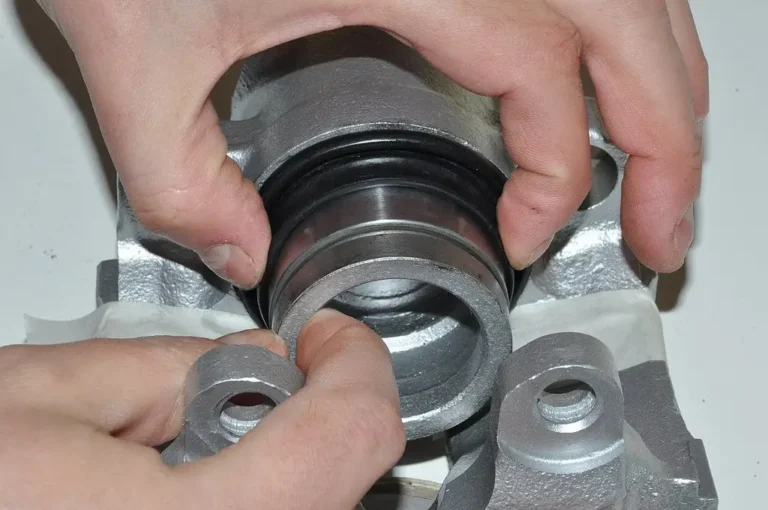
Fixed vs Floating Brake Calipers: Differences, Pros and Cons
A fixed brake caliper stays rigidly mounted over the rotor and normally uses pistons on both sides, while a floating brake caliper slides sideways on guide pins and usually uses piston(s) on only one side.
The basic job of every brake caliper is the same: squeeze the brake pads against the rotor to create friction and slow the vehicle. The way the caliper produces that clamping force, however, depends heavily on whether it uses a fixed or floating design.
Understanding fixed vs floating brake calipers is useful when diagnosing uneven brake-pad wear, replacing calipers, considering a brake upgrade, or simply trying to understand why a sports car may have large multi-piston calipers while an everyday sedan uses a much simpler design.
Floating calipers are extremely common on passenger cars, SUVs, and light trucks because they are compact, economical, and effective for normal driving. Fixed calipers are commonly associated with performance vehicles and heavy-duty braking systems because their rigid construction and multiple opposed pistons can provide excellent pressure distribution, pedal response, and resistance to demanding repeated braking.
Neither design is automatically “better” for every vehicle. The correct choice depends on the vehicle’s weight, intended use, brake rotor size, available wheel space, hydraulic system, manufacturing cost, and required braking performance.
Fixed vs Floating Brake Calipers: What Is the Difference?
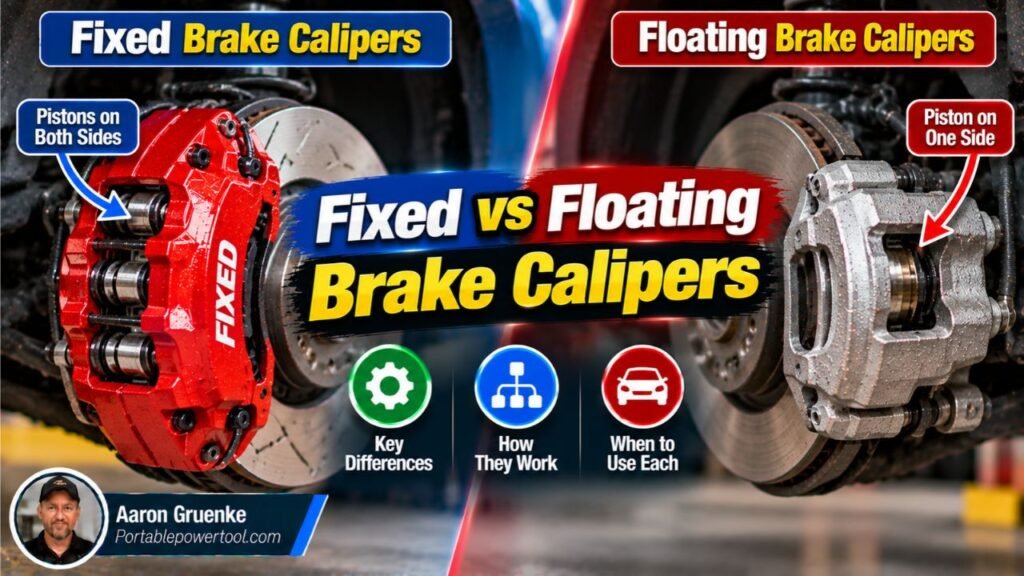
The main difference between fixed vs floating brake calipers is whether the caliper body moves when the brakes are applied.
A fixed caliper is bolted rigidly in position over the brake rotor. It does not slide sideways. Pistons are positioned on both sides of the rotor, allowing the inner and outer pads to be pushed inward simultaneously.
A floating caliper, sometimes called a sliding caliper, is mounted on guide pins or slides. Its piston or pistons are normally located on the inboard side. When hydraulic pressure pushes the inner pad against the rotor, the caliper body slides in the opposite direction, pulling the outer pad against the other side of the rotor.
Here is a quick comparison:
| Feature | Fixed Brake Caliper | Floating Brake Caliper |
| Caliper body moves | No | Yes |
| Typical piston arrangement | Pistons on both sides | Pistons usually on one side |
| Number of pistons | Often 2, 4, 6, 8 or more | Commonly 1 or 2 |
| Guide/slide pins | Generally no | Yes |
| Construction | More complex | Simpler |
| Size | Often larger | Usually more compact |
| Cost | Generally higher | Generally lower |
| Performance potential | High | Excellent for normal road use |
| Pad pressure distribution | Can be very even | Depends on slide condition |
| Common use | Performance and high-demand applications | Most everyday vehicles |
| Common maintenance issue | Pistons/seals | Slide pins and boots |
What Is a Fixed Brake Caliper?
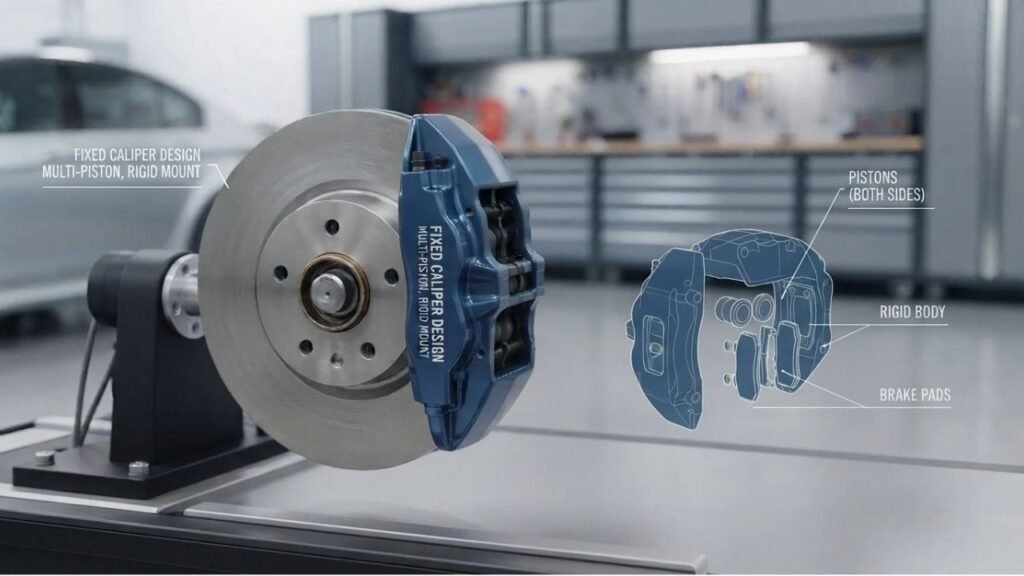
A fixed brake caliper is mounted securely to the steering knuckle, caliper adapter, or another stationary suspension component.
The caliper housing remains centered over the brake rotor.
Instead of moving the entire caliper to engage the outer pad, hydraulic pistons are located on both sides of the rotor.
When the driver presses the brake pedal:
- Hydraulic brake fluid enters the caliper.
- Pressure acts on the caliper pistons.
- Pistons on both sides move toward the rotor.
- Both brake pads clamp the rotor.
- Friction slows the rotor and wheel.
Because the caliper itself does not need to slide, it does not use the same guide-pin arrangement found on a typical floating caliper.
How Many Pistons Does a Fixed Caliper Have?
Fixed calipers commonly use multiple pistons.
Typical designs may have:
- Two pistons
- Four pistons
- Six pistons
- Eight pistons
Specialized braking systems can use other configurations as well.
A four-piston fixed caliper, for example, might have two pistons on the inside of the rotor and two on the outside.
A six-piston caliper may use three opposed pairs.
More pistons do not automatically mean a vehicle will stop in a shorter distance. Piston size, rotor size, brake pads, tire grip, vehicle weight, ABS calibration, and many other factors influence actual braking performance.
What Is a Floating Brake Caliper?
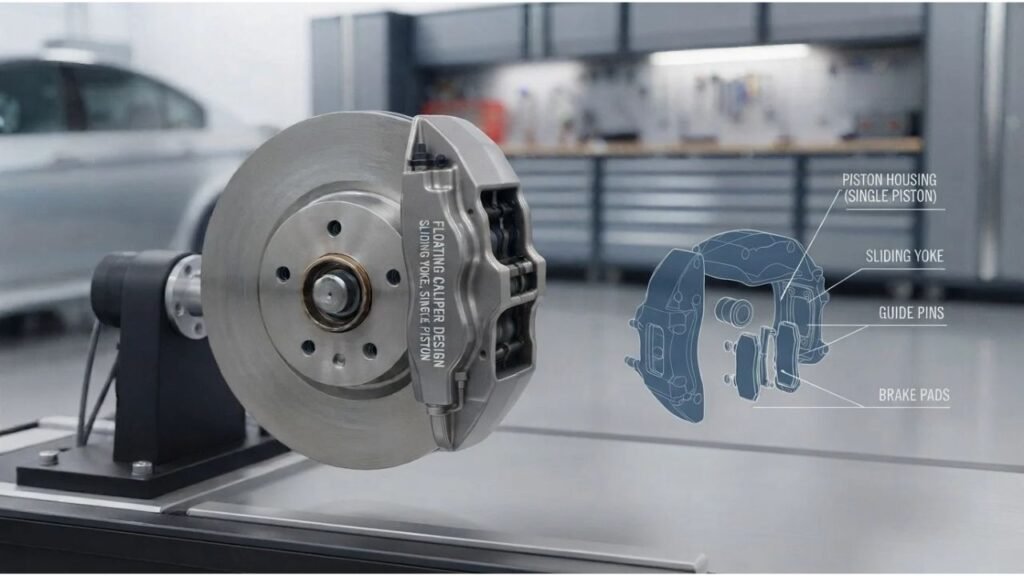
A floating brake caliper is mounted so that the caliper body can move sideways relative to the rotor.
The caliper usually slides along lubricated guide pins, also called:
- Slide pins
- Slider pins
- Guide bolts
- Caliper pins
Most floating designs have one or two hydraulic pistons on the inboard side of the rotor.
When hydraulic pressure pushes the piston outward, the inner pad contacts the rotor first.
Because the caliper is free to slide, the reaction force moves the caliper body in the opposite direction. This brings the outer pad against the outside face of the rotor.
Both sides of the rotor are therefore squeezed even though the hydraulic piston is located on only one side.
Why Is It Called a Floating Caliper?
The word floating refers to the caliper’s ability to move laterally on its mounting hardware.
The caliper does not literally float freely.
It is securely attached to the vehicle but can move a controlled distance along guide pins or sliding surfaces.
This movement allows a single-sided piston arrangement to apply both brake pads.
Fixed Caliper vs Floating Caliper Design
The designs accomplish the same basic task in different ways.
Fixed Caliper Design
A fixed caliper relies on opposed pistons.
The housing remains stationary while hydraulic pressure moves pistons from both sides toward the rotor.
Floating Caliper Design
A floating caliper uses hydraulic pressure on one side combined with controlled caliper movement.
The piston pushes one pad, while movement of the caliper housing applies the opposite pad.
This simpler layout requires fewer hydraulic components.
Fixed Caliper Advantages
Fixed calipers have several characteristics that make them attractive for high-performance braking systems.
Greater Caliper Rigidity
A well-designed fixed caliper can be extremely rigid.
Less caliper flex can help maintain consistent pad contact under heavy braking.
This can contribute to a firmer and more predictable pedal feel.
Better Pressure Distribution
Multiple pistons can distribute clamping force across a large brake pad more evenly.
Some performance calipers even use pistons of different diameters to optimize pad pressure and wear.
Excellent High-Performance Potential
Fixed calipers work well with:
- Large rotors
- Large brake pads
- High-performance friction materials
- Repeated hard braking
This is one reason they are common on sports cars, performance packages, and racing vehicles.
No Caliper Slide Pins
A conventional fixed caliper does not rely on the entire caliper moving along guide pins.
Therefore, it avoids one of the most common floating-caliper problems: seized slide pins.
Multiple Piston Options
Using several pistons allows engineers to design calipers around large pad areas and demanding braking requirements.
Fixed Caliper Disadvantages
Fixed calipers also have drawbacks.
Higher Cost
Their more complicated housing, additional pistons, seals, machining, and manufacturing requirements generally make fixed calipers more expensive.
More Hydraulic Components
More pistons mean more:
- Piston seals
- Dust boots
- Piston bores
Any of these components can eventually develop corrosion, contamination, or leakage.
Larger Packaging Requirements
Performance fixed calipers can occupy considerable space inside the wheel.
Wheel spoke and barrel clearance can therefore become an issue.
Potentially More Expensive Repairs
Replacing or rebuilding a multi-piston performance caliper can cost considerably more than replacing a basic single-piston floating caliper.
Floating Caliper Advantages
Floating calipers are popular because they provide good braking performance with relatively simple construction.
Lower Manufacturing Cost
A floating caliper can produce clamping force on both sides of the rotor using pistons primarily on one side.
Fewer pistons and a simpler housing reduce manufacturing complexity.
Compact Design
Floating calipers are usually relatively compact.
That makes them easier to package inside wheels on everyday passenger vehicles.
Fewer Pistons and Seals
A common single-piston floating caliper requires fewer hydraulic components than a multi-piston fixed caliper.
That helps keep replacement costs reasonable.
Easy and Affordable Replacement
Floating calipers are widely available for common vehicles.
Replacement calipers, brackets, pins, boots, and hardware are usually easy to obtain.
More Than Enough for Normal Driving
A properly designed floating brake caliper can provide excellent braking for normal street vehicles.
Using a floating caliper does not mean a vehicle has poor brakes.
Manufacturers can match the caliper with appropriately sized rotors, pads, master cylinder components, ABS, and tires to achieve the desired braking performance.
Floating Caliper Disadvantages
The sliding mechanism introduces its own potential problems.
Slide Pins Can Seize
The caliper depends on smooth movement along the guide pins.
If a pin becomes:
- Rusty
- Dry
- Contaminated
- Bent
- Seized
the caliper cannot center itself correctly.
Rubber Boots Can Fail
Guide-pin boots help prevent water and road debris from reaching the sliding surfaces.
A torn boot can allow moisture into the pin bore, eventually causing corrosion.
Uneven Pad Wear
A binding floating caliper may cause the inner and outer pads to wear at very different rates.
More Dependence on Routine Hardware Condition
Pads, guide pins, brackets, clips, and boots all need to move correctly.
Even a perfectly good hydraulic piston cannot compensate for severely seized guide hardware.
Which Has Better Braking Performance?
A fixed caliper generally provides greater performance potential, particularly under demanding conditions, but that does not mean every fixed-caliper vehicle stops faster than every floating-caliper vehicle.
Maximum stopping distance is heavily influenced by tire traction.
Once the brakes can produce enough torque to reach the tire’s grip limit and activate ABS, installing a more powerful caliper alone may not shorten a single emergency stop significantly.
Where high-performance fixed calipers can have a major advantage is during repeated hard braking.
For example:
- Track driving
- Repeated mountain descents
- High-speed braking
- Performance driving
- Certain heavy-duty applications
Large fixed calipers combined with suitable rotors and pads can provide excellent consistency, modulation, and heat-management capability.
Which Caliper Has Better Pedal Feel?
Fixed calipers often provide the potential for a firmer, more immediate pedal response because a rigid caliper housing can reduce flex.
However, pedal feel depends on much more than caliper design.
Other important factors include:
- Brake-hose expansion
- Brake fluid condition
- Air in the hydraulic system
- Master-cylinder design
- Brake booster characteristics
- Caliper stiffness
- Pad material
- ABS hydraulic system
A floating-caliper vehicle in excellent condition can still have a very firm, responsive brake pedal.
Which Caliper Has More Pistons?
Fixed calipers generally have more pistons.
A common floating caliper may use:
- One piston
- Two pistons
A fixed performance caliper may have:
- Four pistons
- Six pistons
- Eight pistons
But piston count by itself should not be used to judge braking performance.
Piston Area Matters
A caliper with four small pistons does not necessarily produce more hydraulic clamping force than a caliper with two larger pistons.
Engineers consider the total effective piston area.
Changing piston area can also affect:
- Pedal travel
- Hydraulic pressure requirements
- Brake balance
- Master-cylinder compatibility
That is one reason random caliper swaps should be avoided.
Why Do Many Cars Use Floating Calipers?
Floating calipers offer an excellent combination of:
- Braking performance
- Low cost
- Compact size
- Low complexity
- Easy serviceability
For an ordinary commuter vehicle, there may be little reason to install an expensive six-piston fixed caliper when a well-engineered floating system already provides the required braking performance.
Vehicle manufacturers have to balance performance with:
- Cost
- Weight
- Packaging
- Reliability
- Fuel economy
- Ease of maintenance
A floating design works very well for that purpose.
Why Do Performance Cars Use Fixed Calipers?
Performance vehicles may repeatedly generate much more braking heat than an ordinary street car.
A fixed multi-piston caliper can be designed around larger pads and rotors while offering high structural rigidity.
Performance fixed calipers can also provide more consistent pad pressure during severe braking.
That makes them particularly useful for vehicles expected to perform repeated high-speed stops.
Fixed calipers are commonly seen on:
- Sports cars
- Supercars
- High-performance sedans
- Track cars
- Performance SUVs
- Some heavy-duty braking applications
Fixed vs Floating Brake Caliper Maintenance
The maintenance priorities differ slightly.
Maintaining Floating Calipers
Floating calipers require particular attention to the guide mechanism.
During brake service, inspect:
- Guide pins
- Pin lubricant
- Rubber boots
- Caliper bracket
- Pad abutment clips
- Pad movement
Guide pins should move smoothly through their intended range.
Use only the appropriate brake-specific, rubber-compatible lubricant specified for the application.
Maintaining Fixed Calipers
Fixed calipers do not normally have caliper slide pins, but their multiple pistons need to operate correctly.
Inspect for:
- Brake-fluid leakage
- Torn piston boots
- Corrosion
- Sticking pistons
- Uneven piston movement
- Abnormal pad wear
A multi-piston caliper can develop a problem where one piston sticks while the others continue working.
Common Floating Caliper Problems
Because floating calipers must slide freely, several failures can affect their operation.
Seized Slide Pins
This is one of the most common problems.
A stuck guide pin can prevent the caliper from moving correctly.
Torn Guide-Pin Boots
Damaged boots allow contamination into the sliding mechanism.
Rusty Caliper Bracket
Corrosion under pad clips can prevent the pads from moving normally.
Sticking Piston
The hydraulic piston itself can also seize.
A moving caliper does not necessarily mean the piston is healthy.
Uneven Inner and Outer Pad Wear
Significant differences in pad thickness can indicate a problem with the piston, guide pins, pads, or bracket.
Common Fixed Caliper Problems
Fixed designs have fewer sliding components but more hydraulic pistons in many applications.
Possible problems include:
- One piston sticking
- Piston seal leakage
- Torn dust boots
- Corrosion around pistons
- Uneven pad wear
- Fluid leakage between caliper sections on certain multi-piece designs
- Heat-related seal deterioration
A fixed caliper should not automatically be considered maintenance-free simply because it lacks guide pins.
Which Type Is More Likely to Wear Pads Unevenly?
Both designs can produce uneven brake-pad wear if something fails.
A floating caliper may produce uneven wear when:
- Slide pin seizes
- Pad sticks in bracket
- Piston sticks
- Bracket becomes heavily corroded
A fixed caliper can develop uneven wear if:
- One piston sticks
- Pistons apply unevenly
- A pad cannot move normally
- Rotor or mounting problems exist
Pad-wear patterns are useful diagnostic clues, but they should not be used alone to identify the failed component.
Fixed Caliper vs Floating Caliper Weight
It is tempting to assume one design is always lighter, but weight depends on the exact caliper.
A basic floating caliper can be lightweight because it uses a simple housing and fewer pistons.
A large cast-iron floating truck caliper, however, may be considerably heavier than an advanced aluminum fixed caliper.
Performance fixed calipers are often made from aluminum alloys to combine high stiffness with relatively low weight.
Therefore, caliper type alone does not determine weight.
Fixed Caliper vs Floating Caliper Cost
Floating calipers are generally less expensive.
Their simpler construction reduces:
- Manufacturing cost
- Number of hydraulic pistons
- Number of seals
- Machining complexity
Fixed multi-piston calipers can become considerably more expensive, particularly when made from lightweight aluminum or designed for performance use.
Replacement costs also vary dramatically by vehicle.
Does a Fixed Caliper Stop a Car Faster?
Not automatically.
A fixed caliper can provide excellent clamping consistency and high-performance capability, but stopping distance depends on the complete vehicle.
Important factors include:
- Tires
- Road surface
- Vehicle weight
- Brake pads
- Rotor diameter
- Brake temperature
- ABS
- Suspension
- Weight distribution
If the existing braking system can already lock the wheels or activate ABS, simply adding a more powerful caliper does not automatically create more tire grip.
Does a Floating Caliper Have Brakes on Both Sides of the Rotor?
Yes.
This is a common misconception.
A floating caliper normally has brake pads on both sides of the rotor, even though its hydraulic piston may be located on only one side.
The caliper’s sliding action brings the outer pad into contact with the opposite rotor face.
Is a Floating Caliper the Same as a Floating Rotor?
No.
These are completely different terms.
A floating caliper describes how the brake caliper is mounted and moves.
A floating rotor, also called a floating brake disc, describes how the rotor’s friction ring is connected to its center hat.
A vehicle can therefore have:
- Floating calipers with conventional rotors
- Fixed calipers with floating rotors
- Other combinations
Do not confuse the two technologies.
How Can You Tell Which Caliper Your Vehicle Has?
A basic visual inspection usually makes identification fairly easy.
Signs of a Floating Caliper
Look for:
- Guide pins or slide bolts
- Piston housing mainly on one side
- Caliper capable of lateral movement
- Usually one or two visible piston locations
Signs of a Fixed Caliper
Look for:
- Large rigid caliper housing
- No conventional caliper slide pins
- Piston housings on both sides
- Multiple piston bulges or bores
Vehicle service information or parts catalogs can confirm the design.
Can You Replace a Floating Caliper With a Fixed Caliper?
Not as a simple direct substitution in most cases.
A fixed-caliper conversion may require an engineered big brake kit containing:
- Fixed calipers
- Caliper mounting brackets
- Larger rotors
- Correct brake pads
- Brake hoses
- Appropriate mounting hardware
You may also need different wheels because larger calipers require additional clearance.
A brake conversion must also maintain appropriate:
- Hydraulic balance
- Front-to-rear brake bias
- Master-cylinder compatibility
- ABS operation
- Mechanical clearance
Installing a random multi-piston caliper simply because it can be physically adapted to the vehicle can create poor or unpredictable braking behavior.
Are Fixed Calipers Always Better for Upgrades?
Not necessarily.
For an everyday street vehicle, better tires, quality brake pads, fresh brake fluid, properly operating calipers, and good rotors may provide more practical benefit than changing caliper architecture.
A fixed-caliper upgrade makes more sense when the existing system cannot meet the thermal or performance demands of the vehicle’s intended use.
Examples include:
- Frequent track sessions
- Repeated high-speed braking
- Major performance modifications
- Properly engineered heavy-duty applications
Upgrade the braking system as a complete system rather than focusing only on piston count.
Which Brake Caliper Is Better for Daily Driving?
For normal commuting and everyday road use, a floating caliper is usually more than adequate when the braking system is properly engineered and maintained.
Advantages for daily vehicles include:
- Lower replacement cost
- Simple service
- Compact dimensions
- Good reliability
- Excellent normal-road performance
This explains why floating calipers are so widespread.
There is nothing inherently low-quality about a vehicle simply because it uses floating calipers.
Which Is Better for Track Driving?
A well-designed fixed multi-piston system generally offers advantages for sustained performance use.
The combination of:
- Rigid caliper body
- Multiple opposed pistons
- Large pads
- Large rotors
- Better pressure distribution
can help deliver consistent braking through repeated hard stops.
However, calipers are only one part of a track-ready brake system.
Proper:
- Brake pads
- Rotors
- Fluid
- Cooling
- Tires
are equally important.
Can Floating Calipers Be High Performance?
Yes.
Caliper architecture alone does not determine whether a braking system performs well.
Some powerful vehicles use sophisticated floating-caliper systems successfully.
Engineers can improve braking performance through:
- Larger piston area
- Larger rotors
- High-quality pads
- Strong caliper brackets
- Optimized hydraulic systems
- Effective cooling
Fixed calipers offer particular engineering advantages, but floating calipers are capable of strong braking performance.
Safety Considerations When Servicing Either Type
Brake calipers are part of a vehicle’s primary safety system.
If you service either fixed or floating calipers:
- Support the vehicle with appropriately rated jack stands.
- Never rely only on a hydraulic jack.
- Keep brake fluid and grease away from pad and rotor friction surfaces.
- Inspect flexible brake hoses.
- Use the specified brake fluid.
- Torque mounting fasteners to manufacturer specifications.
- Bleed the system correctly if a hydraulic connection is opened.
- Verify there are no leaks.
- Confirm a firm brake pedal before driving.
- Test braking carefully at low speed before returning to normal traffic.
Multi-piston fixed calipers may have specific bleeding procedures involving more than one bleeder screw.
Follow the service procedure for the exact vehicle.
FAQs About Fixed vs Floating Brake Calipers
Which is better, fixed or floating brake calipers?
Neither is universally better.
Fixed calipers offer excellent rigidity and performance potential, while floating calipers are simpler, more compact, less expensive, and highly effective for everyday vehicles.
The better design depends on the application.
Do fixed calipers have slide pins?
Conventional fixed calipers generally do not use slide pins to move the caliper body.
The caliper remains stationary while opposed pistons move toward the rotor.
Do floating calipers have pistons on both sides?
Usually no.
Most floating calipers place the hydraulic piston or pistons on one side of the rotor. The caliper then slides so the outer pad contacts the opposite side.
Are four-piston calipers always fixed?
No.
Although four-piston calipers are commonly fixed designs, piston count alone does not define whether a caliper is fixed or floating.
Check how the caliper mounts and operates.
Why do fixed calipers use pistons on both sides?
Because the caliper body itself does not move.
Pistons on opposite sides must push both pads inward toward the rotor.
Why do floating calipers have slide pins?
Slide pins allow the caliper body to move sideways.
That movement enables a piston located on one side to create clamping force on both brake pads.
Do fixed calipers last longer than floating calipers?
Not necessarily.
Both can last a long time with proper maintenance.
Floating calipers can suffer from seized guide pins, while fixed calipers have multiple pistons and seals that can develop problems.
Are fixed calipers more expensive?
Generally, yes.
Multiple pistons, additional seals, a more complex housing, and performance-oriented construction typically make fixed calipers more expensive to manufacture and replace.
Conclusion
The main distinction in fixed vs floating brake calipers is how the caliper produces clamping force. A fixed caliper remains stationary and normally uses opposed pistons on both sides of the rotor, while a floating caliper uses guide pins that allow the caliper body to slide and apply the outer brake pad.
Fixed calipers offer strong rigidity, excellent pressure distribution, and high performance potential, making them popular for demanding performance applications. Floating calipers are simpler, more compact, and generally more affordable, which makes them an excellent choice for millions of everyday cars, SUVs, and trucks.
Neither design should be judged by piston count or appearance alone. Properly matched rotors, pads, tires, hydraulic components, and regular maintenance ultimately determine how well the complete braking system performs.