Brake Pad vs Brake Caliper: Key Differences Explained
If you are trying to understand your vehicle’s disc brakes, the difference between a brake pad and a brake caliper is one of the most important basics to learn. Both components work together every time you press the brake pedal, but they perform completely different jobs and wear at very different rates.
In simple terms, brake pads create the friction that slows the vehicle, while the brake caliper holds and pushes the pads against the brake rotor. Brake pads are normal wear items that need periodic replacement; brake calipers usually last much longer and are replaced only when they stick, leak, seize, or become damaged.
Understanding brake pad vs brake caliper differences can help you interpret repair estimates, recognize common brake problems, and avoid replacing expensive parts unnecessarily. A worn brake pad does not automatically mean the caliper is bad, and a sticking caliper can destroy otherwise good brake pads surprisingly quickly.
This guide explains how brake pads and calipers work, how they interact with the rotor, their common failure symptoms, replacement differences, costs, and how to tell which component may be causing a braking problem.
Brake Pad vs Brake Caliper: What Is the Difference?
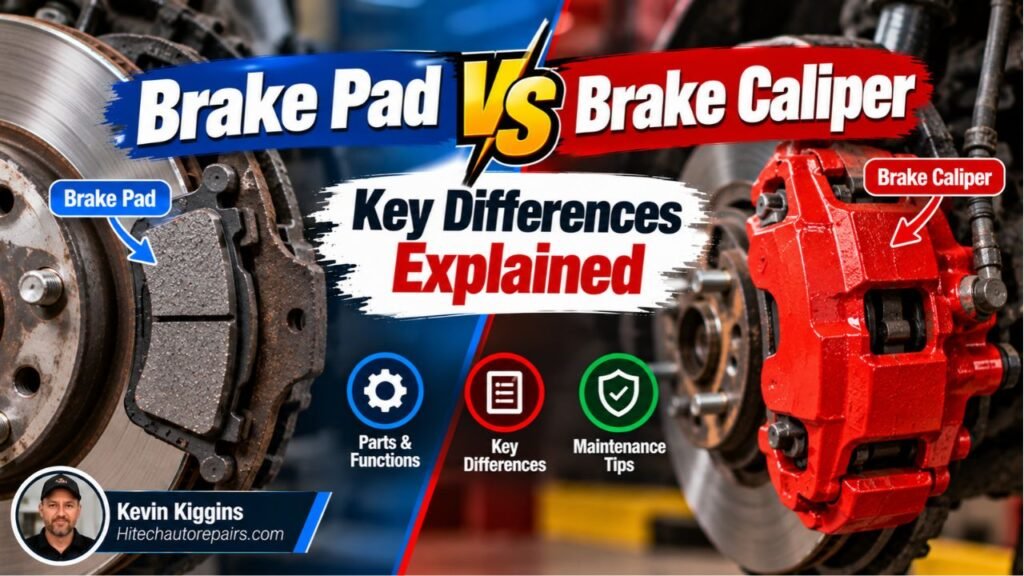
The main difference between a brake pad vs brake caliper is their function.
A brake pad is a replaceable friction component. A brake caliper is a mechanical and hydraulic assembly that moves the brake pads.
When you press the brake pedal, hydraulic pressure causes the caliper piston to move. The piston pushes the brake pads against the spinning brake rotor. Friction between the brake pads and rotor slows the wheel.
Here is the basic comparison:
| Feature | Brake Pad | Brake Caliper |
| Main purpose | Creates friction | Applies the brake pads |
| Location | Inside the caliper around the rotor | Mounted around the rotor |
| Normal wear item | Yes | Usually no |
| Replacement frequency | Periodic | Only when faulty or damaged |
| Contains friction material | Yes | No |
| Contains piston | No | Yes |
| Can leak brake fluid | No | Yes |
| Can seize | Not usually | Yes |
| Usually replaced in pairs/sets | Yes, per axle | Not always |
Both components are essential, but they fail in different ways.
What Is a Brake Pad?
A brake pad is a friction component that presses against the brake rotor to slow the vehicle.
A typical disc brake system has two pads per wheel:
- An inner brake pad
- An outer brake pad
The pads sit inside or alongside the caliper and contact both sides of the rotor.
Brake pads consist of a metal backing plate with friction material bonded or attached to it.
Common friction-material categories include:
- Ceramic
- Semi-metallic
- Organic or non-asbestos organic
Different pad materials can affect noise, dust, braking feel, heat resistance, and cost.
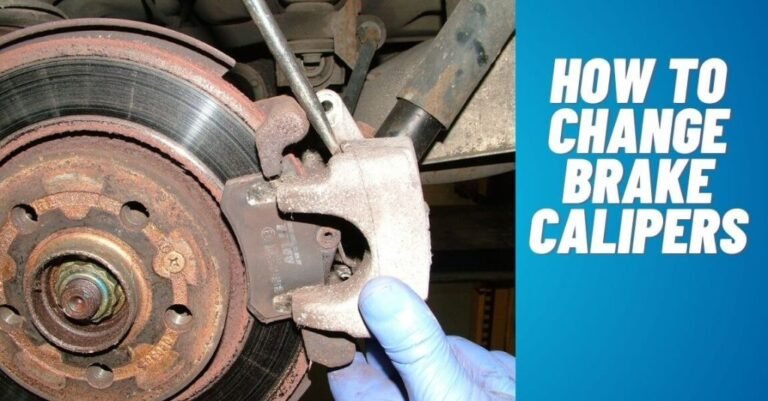
What Is a Brake Caliper?
A brake caliper is the component that holds the brake pads and uses hydraulic force to press them against the rotor.
The caliper normally includes:
- One or more pistons
- Piston seals
- Dust boots
- Caliper housing
- Bleeder screw
- Brake hose connection
Floating calipers also use slide pins or guide pins that allow the caliper to move sideways slightly as the brakes are applied.
The brake caliper itself does not create most of the friction used to stop the vehicle. Its job is to apply the brake pads with controlled pressure.
How Brake Pads and Calipers Work Together
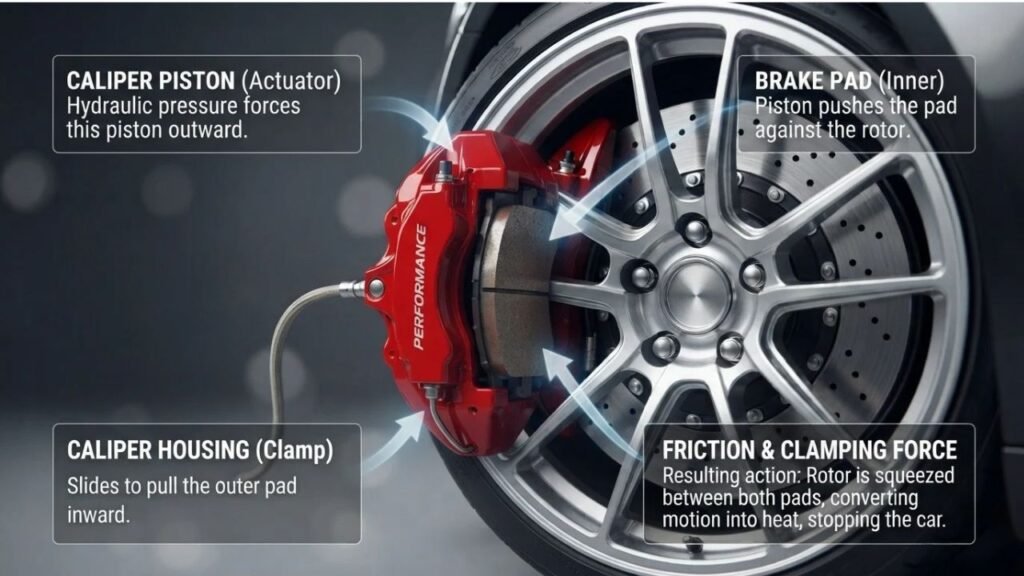
The braking process begins when you press the brake pedal.
The sequence is roughly:
- The brake pedal moves the master cylinder.
- Brake fluid becomes pressurized.
- Hydraulic pressure travels through the brake lines.
- Pressure enters the brake caliper.
- The caliper piston moves outward.
- The brake pads contact the rotor.
- Friction converts vehicle motion into heat.
- The vehicle slows down.
When you release the brake pedal, hydraulic pressure decreases.
The piston retracts slightly, allowing the pads to release enough pressure from the rotor so the wheel can rotate normally.
A problem anywhere in this process can produce poor braking, uneven wear, dragging brakes, or unusual noises.
Brake Pads Are Designed to Wear Out
Brake pads are consumable parts.
Every time the pads press against the rotor, a tiny amount of friction material wears away.
Eventually, the material becomes too thin and the pads must be replaced.
How quickly brake pads wear depends on factors such as:
- Driving style
- Vehicle weight
- Stop-and-go traffic
- Highway vs. city driving
- Pad material
- Rotor condition
- Towing
- Mountain driving
- Brake system condition
There is no single mileage interval that applies to every vehicle.
Inspection of actual pad thickness is more reliable than assuming replacement is due at a specific mileage.
Brake Calipers Are Not Normal Wear Items
Calipers are generally designed to last much longer than brake pads.
A caliper may remain in service through several sets of brake pads.
However, age, heat, corrosion, damaged seals, contaminated brake fluid, or seized slide pins can eventually cause a caliper problem.
A caliper may need replacement if:
- The piston seizes.
- The piston leaks.
- The housing is damaged.
- The bleeder screw is unusable.
- Severe corrosion prevents proper operation.
- Internal seals fail.
- The caliper cannot release properly.
Calipers do not normally have a scheduled replacement interval.
Symptoms of Worn Brake Pads
Worn pads often produce symptoms that are different from a failed caliper.
Common signs include:
- Squealing or squeaking
- Grinding when severely worn
- Brake wear warning light on some vehicles
- Reduced pad thickness
- Longer stopping distance in severe cases
- Visible wear indicator contacting the rotor
A high-pitched squeal may come from a mechanical wear indicator built into the pad.
If the friction material wears away completely, the metal backing plate can contact the rotor and create a grinding sound.
Driving with pads in that condition can quickly damage the rotor.
Symptoms of a Bad Brake Caliper
A faulty brake caliper can cause more complicated symptoms.
Possible signs include:
- Vehicle pulling while braking
- One wheel becoming much hotter than the others
- Burning smell from one wheel
- Brake drag
- Uneven brake pad wear
- Brake fluid leaking around the caliper
- Smoke from an overheated wheel
- Reduced fuel economy from brake drag
- Car pulling even when the brake pedal is released
- One brake pad wearing much faster than its opposite pad
A seized caliper can sometimes keep a brake pad pressed against the rotor continuously.
That generates heat even when you are not braking.
Brake Pad Wear Caused by a Bad Caliper
Brake pads sometimes wear prematurely because of a caliper problem.
For example, a seized piston may fail to retract properly.
The pad then remains in contact with the rotor and can wear rapidly.
A stuck slide pin can cause one pad to receive more pressure than the other.
This may create a wear pattern such as:
- Inner pad almost completely worn
- Outer pad still relatively thick
or the opposite, depending on the failure.
If one pad is dramatically more worn than the other on the same wheel, the caliper and slide mechanism should be inspected rather than simply installing new pads.
Brake Caliper Slide Pins vs. Caliper Failure
A sticking brake does not always mean the complete caliper needs replacement.
Floating calipers depend on slide pins to move smoothly.
The pins may become:
- Dry
- Rusty
- Corroded
- Contaminated
- Seized inside the bracket
If the caliper body and piston remain healthy, servicing or replacing the slide pins may solve the problem.
This is generally much less expensive than replacing the entire caliper.
A proper brake inspection should identify whether the issue is the:
- Brake pad
- Caliper piston
- Slide pin
- Caliper bracket
- Brake hose
- Rotor
- Other brake hardware
Brake Pad Replacement vs. Caliper Replacement
Brake pad replacement is typically routine maintenance.
The process generally involves:
- Removing the wheel
- Removing or repositioning the caliper
- Removing the old pads
- Inspecting the rotor
- Compressing or retracting the piston
- Installing new pads
- Servicing appropriate hardware
- Reassembling the brakes
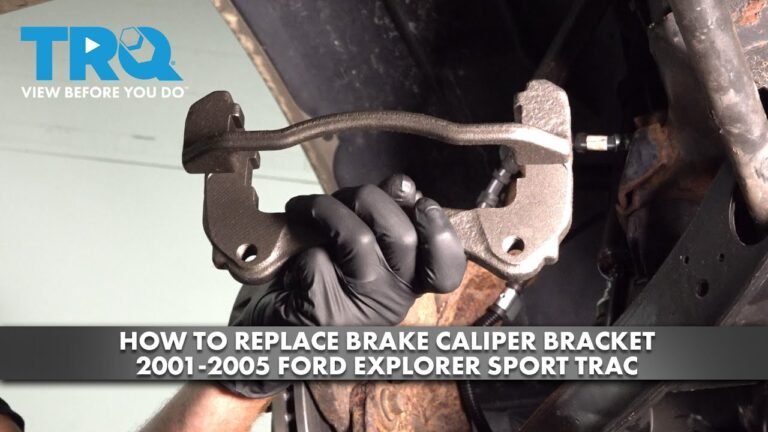
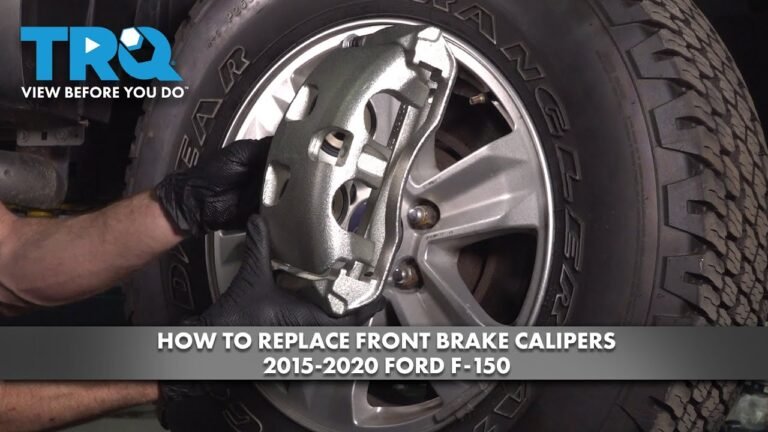
Caliper replacement is more involved because the hydraulic brake system must be opened.
A mechanic typically must:
- Disconnect the brake hose
- Remove the old caliper
- Install the replacement caliper
- Reconnect the hydraulic line
- Refill fluid as necessary
- Bleed air from the brake system
- Check carefully for leaks
Because brake bleeding is required, caliper replacement usually involves more labor and more opportunity for safety-critical mistakes.
Do Brake Pads Have to Be Replaced in Pairs?
Brake pads are normally replaced as a complete axle set.
That means both front wheels or both rear wheels receive new pads at the same time.
For example, if one front pad is badly worn, you typically replace the pads on both front brakes.
Replacing pads on only one wheel can lead to uneven braking characteristics.
Do Brake Calipers Have to Be Replaced in Pairs?
Not necessarily.
If one caliper has failed and the opposite caliper is operating correctly, replacing only the faulty caliper may be acceptable.
However, replacing both calipers on the same axle may make sense if:
- Both are heavily corroded.
- Both are very old.
- The opposite caliper is beginning to stick.
- Both have similar seal deterioration.
- The vehicle is undergoing a major brake overhaul.
The opposite caliper should be inspected rather than automatically replaced.
Brake Pad vs Brake Caliper Cost
Brake pads are usually much cheaper to replace than brake calipers.
A basic brake pad job involves relatively inexpensive friction components and does not normally require opening the hydraulic system.
A caliper repair can cost more because:
- The caliper itself is more expensive.
- Hydraulic lines must be disconnected.
- The system must be bled.
- Additional brake fluid may be required.
- Pads and rotors may already be damaged.
- Labor time can increase.
The final price depends heavily on the vehicle.
Luxury and performance vehicles can use much more expensive pads, rotors, and multi-piston calipers than ordinary passenger cars.
Can a Bad Caliper Damage a Rotor?
Yes.
A seized caliper can keep a brake pad rubbing against the rotor continuously.
The resulting heat can damage the rotor.
Possible damage includes:
- Deep scoring
- Heat spots
- Cracks in severe cases
- Excessive wear
- Surface discoloration
- Thickness variation
A severely overheated brake can also damage pads, seals, wheel bearings, and nearby components.
That is why a dragging brake should not be ignored.
Can Worn Brake Pads Damage a Caliper?
Worn pads do not usually damage the caliper directly during normal replacement intervals.
However, extremely worn pads can allow the caliper piston to extend farther than normal.
If the pads are allowed to wear far beyond their service limit, braking components can suffer additional stress or damage.
Metal-on-metal braking can also create extreme heat, which is harmful to the entire brake assembly.
Replacing worn pads before they reach that stage helps protect the caliper and rotor.
Can a Bad Brake Hose Mimic a Bad Caliper?
Yes.
A damaged flexible brake hose can sometimes behave like a one-way valve.
Brake pressure reaches the caliper when the pedal is pressed, but pressure does not release properly afterward.
This can keep the brake applied and create symptoms nearly identical to a seized caliper.
A technician may need to determine whether trapped hydraulic pressure or a mechanically seized caliper is causing the drag.
Replacing the caliper alone will not fix a collapsed brake hose.
How to Tell Whether the Pad or Caliper Is the Problem
Start with the symptoms.
If the pads are simply thin but wear evenly and the wheel rotates normally, the caliper may be functioning properly.
If one side is much more worn, the wheel becomes unusually hot, or the brake does not release, investigate the caliper system.
A useful comparison is:
| Symptom | More Likely Cause |
| Pads thin evenly on both sides | Normal pad wear |
| Squealing from wear indicator | Worn brake pads |
| Metal grinding | Severely worn pad or rotor damage |
| One wheel extremely hot | Sticking caliper or brake hose |
| One pad much thinner than the other | Slide pin or caliper problem |
| Brake fluid around caliper | Caliper/seal leak |
| Vehicle pulls during braking | Caliper or other brake imbalance |
| Brake drags after pedal release | Sticking caliper or hydraulic problem |
These symptoms are not definitive diagnoses by themselves.
Brake systems should be inspected properly before parts are replaced.
What Happens if You Replace Pads but Ignore a Bad Caliper?
New pads installed on a faulty caliper may wear out very quickly.
If the piston is sticking, the new pad can remain pressed against the rotor.
Possible results include:
- Rapid pad wear
- Rotor overheating
- Burning smell
- Reduced fuel economy
- Brake fade
- Vehicle pulling
- Repeated brake repairs
If the old pads show unusual wear, determine why before installing replacements.
What Happens if You Replace a Caliper but Keep Bad Pads?
A new caliper should not be paired with brake pads that are worn beyond specification, contaminated, overheated, or badly uneven.
If one failed caliper has destroyed the pads on that axle, the pads should generally be replaced as an axle set.
The rotors should also be measured and inspected.
Installing a new caliper without addressing damaged friction components can leave the brake system performing poorly.
Brake Pads vs Brake Caliper Maintenance
Brake pads mainly require inspection for thickness and condition.
Calipers require inspection for:
- Fluid leaks
- Piston movement
- Torn dust boots
- Slide-pin movement
- Corrosion
- Damaged mounting hardware
During a brake service, the mechanic should also inspect:
- Rotors
- Brake hoses
- Hardware
- Fluid condition
- Wheel-end components
A good inspection considers the entire braking system rather than focusing on only one part.
Which Is More Dangerous: Bad Pads or a Bad Caliper?
Either can become dangerous if the problem is severe.
Extremely worn brake pads can reduce braking effectiveness and damage the rotors.
A leaking caliper can cause loss of brake fluid and hydraulic pressure.
A seized caliper can overheat the brake assembly.
Seek prompt inspection if you notice:
- Significant brake-fluid leakage
- Grinding brakes
- Smoke from a wheel
- Strong burning smell
- Very hot wheel
- Soft or sinking brake pedal
- Severe pulling while braking
- Noticeably reduced stopping ability
If braking performance is significantly compromised, do not continue driving the vehicle.
FAQs About Brake Pad vs Brake Caliper
Are brake pads and brake calipers the same thing?
No.
Brake pads are friction materials that contact the rotor. The brake caliper is the hydraulic and mechanical assembly that pushes those pads against the rotor.
Does a brake caliper come with brake pads?
Sometimes replacement calipers are sold with certain hardware, but brake pads are usually purchased separately.
Always check exactly what is included with the replacement part.
Can you replace brake pads without replacing the calipers?
Yes.
This is the normal situation.
Brake pads are replaced much more frequently than calipers. If the caliper operates correctly and has no leaks or damage, there is generally no reason to replace it during every pad service.
How do I know if I need pads or a caliper?
Thin but evenly worn pads usually indicate normal pad replacement.
Uneven pad wear, brake drag, leakage, excessive wheel heat, or a piston that cannot retract can indicate a caliper-related problem.
Can a stuck caliper ruin new brake pads?
Yes.
A stuck piston or slide mechanism can keep the pad against the rotor and quickly wear or overheat a new set of pads.
The cause of abnormal wear should be repaired before new pads are installed.
Which costs more, brake pads or brake calipers?
Brake calipers generally cost more.
Caliper replacement also requires opening and bleeding the hydraulic brake system, which usually adds labor compared with a straightforward pad replacement.
How often should brake pads and calipers be replaced?
Brake pads are replaced according to wear rather than one universal mileage interval.
Calipers normally have no routine replacement schedule and can often last through several sets of pads. They are replaced when they leak, seize, become damaged, or stop operating correctly.
Should I replace the rotor when replacing a bad caliper?
Not automatically.
The rotor should be inspected and measured. If a sticking caliper caused severe overheating, scoring, excessive wear, or other damage, rotor replacement may be necessary.
Conclusion
The main brake pad vs brake caliper difference is simple: the brake pad provides the friction that slows the rotor, while the brake caliper supplies the force that presses the pad against it.
Brake pads are normal wear items and require periodic replacement. Calipers are longer-lasting components that usually need replacement only after a mechanical, hydraulic, or corrosion-related failure.
If your brakes have normal, even pad wear, you may need nothing more than routine brake service. If you see severe uneven wear, brake-fluid leakage, excessive heat, dragging, or a wheel that does not release properly, the caliper, slide pins, brake hose, and other related components should be inspected before new pads are installed.