Signs of Bad Caliper Piston: Symptoms, Causes, Tests & Fixes
The most common signs of bad caliper piston problems are a vehicle pulling while braking, one wheel getting unusually hot, uneven brake pad wear, reduced braking performance, a burning smell, brake fluid leakage, and a wheel that does not spin freely after the brake pedal is released.
A bad piston can become stuck either extended or retracted. A piston stuck outward may keep the brake pad pressed against the rotor, causing constant brake drag and overheating. A piston that will not move outward properly may prevent that wheel from producing enough braking force.
Because the brake caliper is part of the vehicle’s primary braking system, symptoms of a sticking or damaged piston should be investigated promptly.
Signs of Bad Caliper Piston You Should Watch For
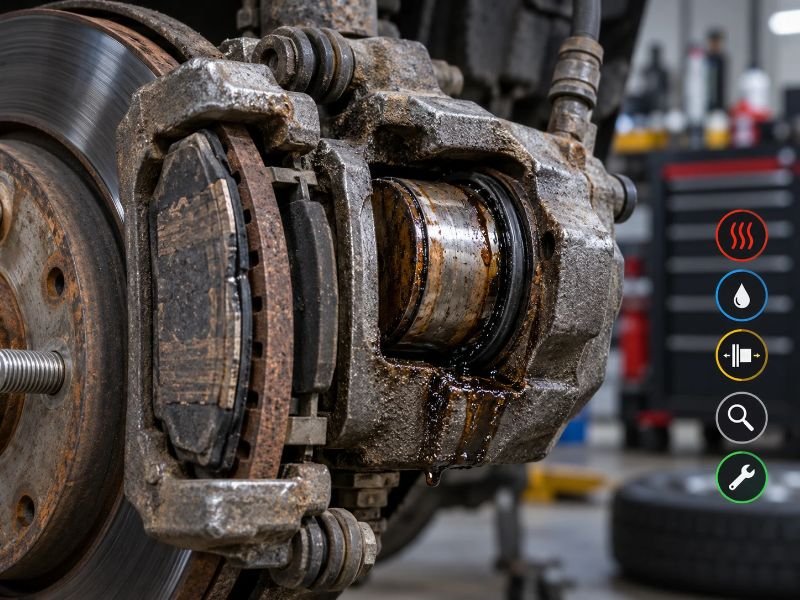
The signs of bad caliper piston problems depend on how the piston fails.
A seized piston can cause the brake to remain partially applied, while a piston that does not extend properly can reduce braking at that wheel.
Common symptoms include:
- Vehicle pulling to one side
- One wheel noticeably hotter than the others
- Uneven brake pad wear
- Constant brake drag
- Burning smell near a wheel
- Poor acceleration or reduced fuel economy
- Brake fluid around the caliper
- Reduced braking performance
- Brake pedal changes
- Smoke from the wheel area in severe cases
Not every one of these symptoms automatically means the piston is bad. Sticking caliper slide pins, collapsed brake hoses, worn pads, and other brake problems can produce similar symptoms.
What Is a Brake Caliper Piston?
A brake caliper piston is the moving part inside the caliper that pushes the brake pad against the rotor.
When you press the brake pedal, hydraulic pressure travels through the brake fluid to the caliper.
That pressure pushes the piston outward.
The piston presses the inner brake pad against the rotor, while the caliper assembly allows the opposite pad to clamp the other side of the rotor.
When you release the brake pedal, hydraulic pressure drops and the piston retracts slightly so the pads no longer strongly clamp the rotor.
If the piston becomes corroded, damaged, contaminated, or stuck, normal brake operation can be affected.
Vehicle Pulls to One Side While Braking
A vehicle pulling left or right during braking is one of the more noticeable symptoms of uneven braking force.
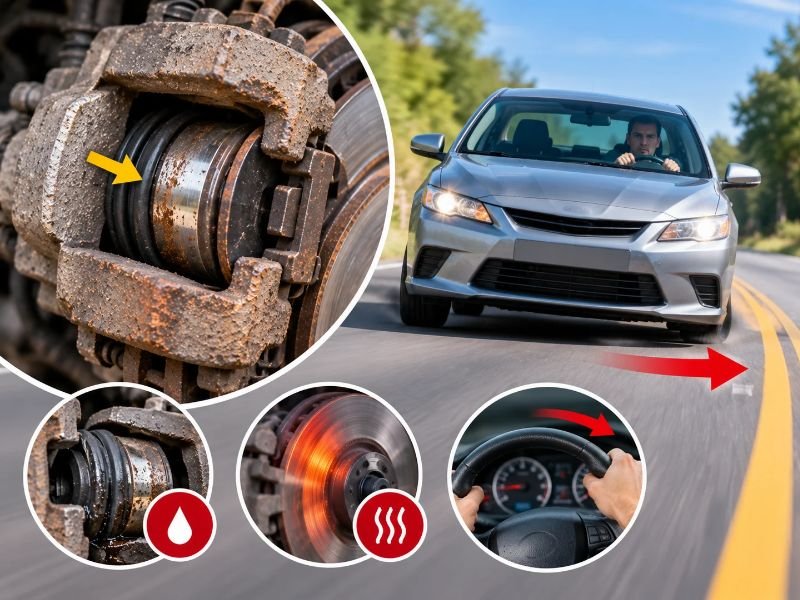
If a caliper piston on one side does not apply properly, the opposite wheel may produce more braking force.
The vehicle may then pull toward the side providing stronger braking.
A piston stuck in the applied position can create a different type of pull because one brake continues dragging even after the pedal is released.
However, pulling can also be caused by:
- Sticking caliper slide pins
- Contaminated brake pads
- Different tire pressures
- Suspension problems
- Brake hose restrictions
- Uneven rotor condition
A proper inspection is necessary before blaming the piston.
One Wheel Gets Much Hotter Than the Others
A very hot wheel is a classic sign of a dragging brake.
If a caliper piston cannot retract normally, the brake pad may remain pressed against the rotor while the vehicle is moving.
The friction continually generates heat.
You may notice:
- Excessive heat near one wheel
- Hot smell after driving
- Very hot rotor
- Discolored brake components
- Heat coming through the wheel
Do not touch a suspected hot rotor or caliper with your bare hand. Brake components can become hot enough to cause burns.
If one wheel is dramatically hotter than the others after ordinary driving, the brake should be inspected.
Uneven Brake Pad Wear
A bad caliper piston can cause one set of brake pads to wear much faster than expected.
If the piston remains partially extended, the pad can stay in contact with the rotor.
This causes continuous friction and rapid pad wear.
During inspection, you may find:
- One wheel has much thinner pads than the opposite wheel
- Inner and outer pads have significantly different thicknesses
- One pad has worn down unusually quickly
- Pads show signs of overheating
Uneven inner-to-outer pad wear is not automatically proof of a bad piston.
Sticking caliper slide pins are another common cause.
The piston and slide mechanism should both be checked.
Brake Drag After Releasing the Pedal
A properly functioning brake should release enough for the wheel to rotate without severe resistance once hydraulic pressure is removed.
A sticking caliper piston can prevent this.
You may notice that the vehicle:
- Feels harder to move
- Does not coast normally
- Requires more throttle than usual
- Seems to slow down quickly when you release the accelerator
On a lift or securely supported vehicle, a technician may also notice that one wheel is much harder to rotate by hand.
Brake drag should be diagnosed carefully because a restricted flexible brake hose can also trap hydraulic pressure and create similar symptoms.
Burning Smell From One Wheel
A strong burning smell after driving can indicate that a brake is overheating.
When a caliper piston remains stuck outward, the pad continuously rubs against the rotor.
The resulting heat can affect:
- Brake pads
- Rotor
- Caliper seals
- Brake fluid
- Nearby components
The smell may resemble burnt friction material or hot metal.
If the smell is strong or smoke is visible, stop driving when it is safe to do so and allow the brake to be inspected.
Continuing to drive with an overheated brake can cause additional damage and reduce braking performance.
Smoke Coming From the Brake Area
Smoke from a wheel is a more serious warning sign.
A severely dragging brake can generate enough heat to smoke the brake pads or nearby contaminants.
At that point, the rotor and caliper may be extremely hot.
Do not continue driving simply because the vehicle still moves.
Excessive brake heat can damage:
- Pads
- Rotors
- Caliper seals
- Wheel bearings
- Brake fluid
The safest approach is to stop using the vehicle until the cause has been diagnosed.
Brake Fluid Leaking Around the Caliper
The caliper piston is surrounded by a hydraulic seal that keeps brake fluid inside the caliper.
If the piston surface becomes heavily corroded or damaged, it can damage the seal.
You may see brake fluid:
- Around the piston boot
- On the caliper body
- Inside the wheel
- On the brake pad
- Around the rotor area
A leaking caliper is a safety issue because the braking system can lose hydraulic fluid and pressure.
Brake fluid can also contaminate the brake pads, reducing friction.
A caliper with an active hydraulic leak generally requires immediate repair or replacement.
Reduced Braking Performance
A piston that is seized in the retracted position may fail to apply enough pressure to the brake pads.
This can reduce braking force at that wheel.
The driver may experience:
- Longer stopping distances
- Vehicle pulling during braking
- Poor braking response
- Unbalanced braking
The remaining brakes may compensate to some degree, which can make the problem less obvious at first.
That does not make the condition safe.
Every wheel should contribute the braking force intended by the vehicle’s braking system.
Brake Pedal Feels Different
A bad caliper piston does not always cause a noticeable pedal change, but certain caliper failures can affect pedal feel.
You may notice:
- Soft pedal if brake fluid is leaking
- Longer pedal travel
- Unusual braking response
- Pedal that feels inconsistent
A soft brake pedal has several possible causes, including air in the hydraulic system, a fluid leak, master cylinder problems, or other brake system faults.
Do not diagnose the caliper piston based on pedal feel alone.
Poor Acceleration or Vehicle Feels Sluggish
A dragging brake acts like the vehicle is partially braking all the time.
The engine must work harder to overcome that resistance.
You may notice that the vehicle:
- Accelerates more slowly
- Feels unusually heavy
- Requires more throttle
- Does not roll freely
A severe dragging brake may be noticeable even at low speeds.
This symptom is especially suspicious when combined with excessive heat from one wheel.
Reduced Fuel Economy
Constant brake drag creates additional rolling resistance.
The engine needs more energy to keep the vehicle moving, which can reduce fuel economy.
A small change in fuel consumption alone is not enough to diagnose a caliper piston because many factors affect fuel economy.
However, reduced mileage combined with a hot wheel, burning smell, or uneven brake wear can support a brake-drag diagnosis.
Car Pulls Even When You Are Not Braking
A severely stuck piston may keep one brake applied continuously.
This can cause the vehicle to drift or pull while driving normally, not just when the brake pedal is pressed.
The pull may become stronger as the affected brake heats up.
A constant pull can also result from:
- Tire problems
- Wheel alignment
- Suspension damage
- Wheel bearing problems
Check brake temperature and drag before assuming the caliper piston is responsible.
Why Does a Caliper Piston Go Bad?
Several conditions can cause a piston to seize or become damaged.
Corrosion on the Piston
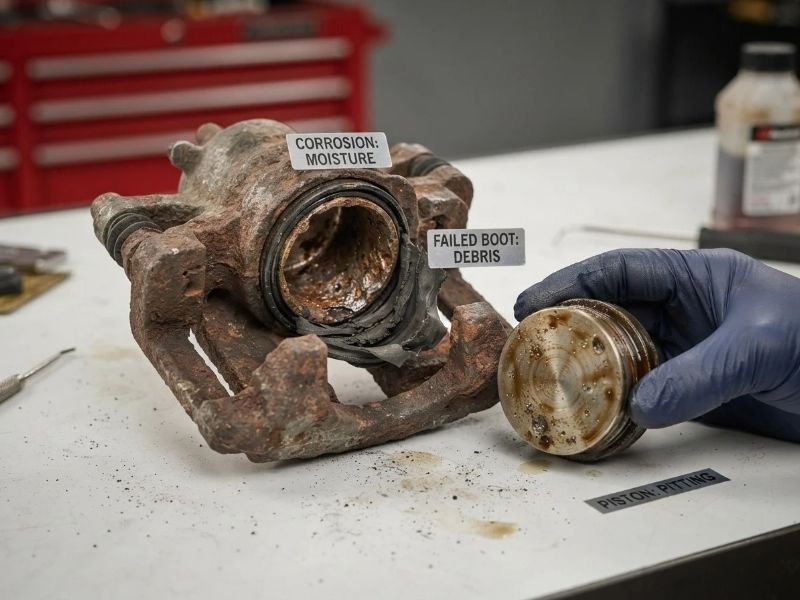
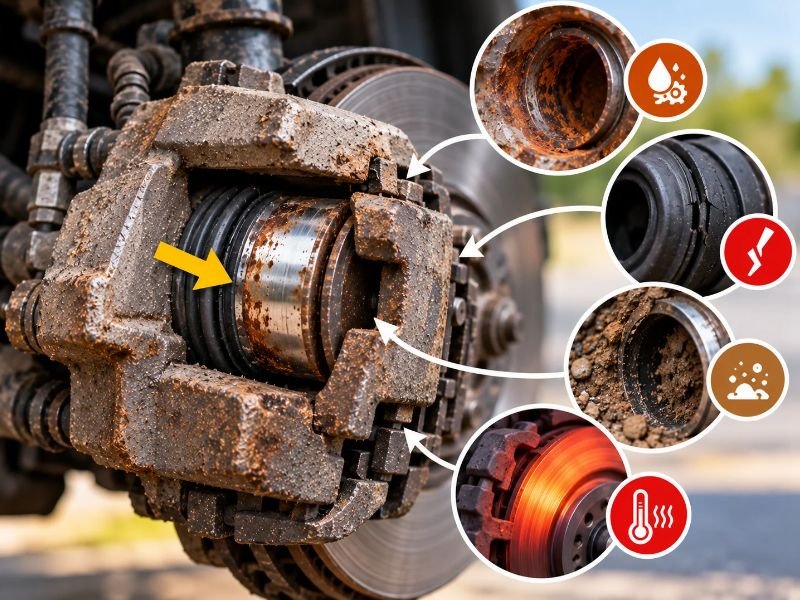
Corrosion is one of the most common causes of caliper piston problems.
The piston is protected by a rubber dust boot.
If the boot tears or separates, moisture and road contamination can reach the piston surface.
Rust can then form and prevent the piston from moving smoothly through the seal.
Vehicles exposed to road salt and wet climates may be particularly vulnerable.
Torn Caliper Piston Boot
The outer dust boot prevents dirt, moisture, and road debris from reaching the piston.
A torn boot may not immediately cause the piston to fail.
Over time, however, contamination can enter the area and cause corrosion.
When inspecting brakes, check the boot for:
- Cracks
- Tears
- Missing sections
- Separation from the caliper
- Heavy contamination
A damaged boot is a warning that piston condition should be examined.
Old or Contaminated Brake Fluid
Brake fluid absorbs moisture over time.
Moisture and contamination within the hydraulic system can contribute to corrosion of internal brake components.
Proper brake fluid maintenance can help protect:
- Calipers
- Master cylinder
- ABS hydraulic components
- Brake lines
Follow the vehicle manufacturer’s brake fluid inspection and replacement recommendations.
Overheated Brakes
Repeated severe overheating can damage caliper seals and protective components.
Common causes of overheating include:
- Existing brake drag
- Aggressive braking
- Mountain driving
- Towing heavy loads
- Incorrect brake assembly
Once the piston seals or boot are damaged, further contamination and corrosion can occur.
Damaged Piston Surface
Scratches, pitting, or corrosion on the piston surface can prevent the piston from sliding smoothly through its seal.
A severely damaged piston may also create a brake fluid leak.
This is one reason simply pushing a rusty piston back into the caliper is not always a proper repair.
Bad Caliper Piston vs Stuck Slide Pins
These two problems are often confused.
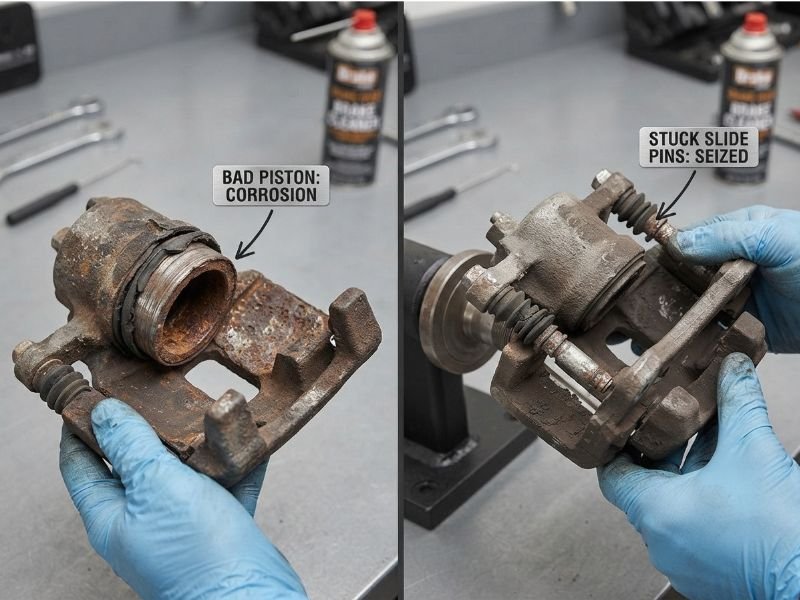
A floating brake caliper uses slide pins to allow the caliper body to move sideways.
If the slide pins seize, one pad may remain in contact with the rotor or wear unevenly.
A seized piston can cause similar symptoms.
Signs More Consistent With a Piston Problem
Possible clues include:
- Piston extremely difficult to compress
- Corrosion visible around the piston
- Damaged piston boot
- Brake fluid leakage near the piston
- Pad remains applied even with functioning slide pins
Signs More Consistent With Slide Pin Problems
Possible clues include:
- One pad wears dramatically differently from the other
- Slide pins cannot be moved by hand after removal
- Pins are rusty or dry
- Rubber slide boots are damaged
Both problems can exist at the same time.
A complete brake inspection should check the piston and slide pins.
Bad Caliper Piston vs Collapsed Brake Hose
A damaged flexible brake hose can mimic a seized caliper piston.
The inside of an old brake hose can sometimes deteriorate in a way that allows hydraulic pressure to reach the caliper but prevents it from releasing normally.
The brake then remains applied.
One diagnostic method used by technicians is to determine whether releasing hydraulic pressure allows the brake to free up.
If the brake releases when trapped hydraulic pressure is relieved, the hose or another upstream hydraulic restriction may be responsible rather than the piston itself.
Because this test involves the braking system, it should be performed carefully and followed by proper bleeding if the hydraulic circuit is opened.
How to Check for a Bad Caliper Piston
Several tests can help confirm the problem.
Compare Wheel Temperatures
After a short normal drive with minimal heavy braking, compare the temperature of the wheels.
A non-contact infrared thermometer is useful because it lets you compare temperatures without touching hot brake components.
One wheel being substantially hotter than the others can indicate brake drag.
Temperature alone does not identify whether the piston, slide pins, parking brake, or hose is responsible.
Inspect Brake Pad Wear
Remove the wheel and inspect pad thickness.
Compare:
- Inner vs outer pad
- Left side vs right side
Significant differences can reveal a caliper problem.
Check the Slide Pins
Make sure the caliper slide pins move smoothly.
If the pins are free but the piston is extremely difficult to retract, the piston becomes a stronger suspect.
Inspect the Piston Boot
Look carefully for:
- Rust
- Tears
- Fluid
- Damaged rubber
- Contamination
Do not place fingers between the piston and caliper where they could be pinched.
Test Piston Retraction
During brake service, the piston normally needs to be retracted to make room for new pads.
A healthy piston should retract using the correct tool and procedure without unreasonable force.
If it will not move or moves only with extreme force, the caliper may be seized.
Some rear calipers incorporate the parking brake and must be rotated while being pushed inward. Trying to simply compress one of these pistons can damage the caliper.
Always confirm the correct procedure for your vehicle.
Can a Bad Caliper Piston Be Repaired?
Sometimes.
A rebuild may be possible if the caliper body and piston are still in suitable condition and replacement seals are available.
A rebuild typically involves:
- Removing the piston
- Cleaning the caliper bore
- Inspecting the piston
- Replacing seals
- Replacing the dust boot
- Reassembling correctly
- Bleeding the brake system
However, replacing the complete caliper is often more practical for everyday vehicle repairs.
A replacement caliper can reduce the uncertainty associated with hidden corrosion, damaged seals, or worn internal components.
Should You Replace One Caliper or Both?
You do not automatically have to replace both calipers on the same axle simply because one fails.
The condition, age, and type of failure matter.
However, both sides should be inspected carefully.
If both calipers are similarly old and exposed to the same corrosion conditions, the other side may also show deterioration.
Brake pads are normally replaced as an axle set rather than on only one wheel.
Rotor condition should also be checked if a caliper has been dragging or overheating.
Can a Bad Caliper Piston Damage the Rotor?
Yes.
A piston that keeps the brake applied can cause severe rotor overheating.
Possible results include:
- Blue or dark heat spots
- Surface cracking
- Accelerated wear
- Thickness variation
- Permanent heat damage
The brake pads can also become glazed or damaged by excessive heat.
When replacing a seized caliper, inspect the pads and rotor rather than assuming the caliper is the only component that needs attention.
Can a Bad Caliper Piston Damage the Wheel Bearing?
Severe brake overheating can transfer substantial heat into nearby components.
The wheel bearing is located close to the brake assembly, so extreme or prolonged heat can potentially shorten its life.
This does not mean every seized caliper automatically damages a bearing.
However, a brake that has been severely overheated should prompt inspection of surrounding components.
Can You Drive With a Bad Caliper Piston?
Driving with a suspected bad caliper piston is not recommended.
A stuck piston can create unpredictable braking and may lead to:
- Severe brake overheating
- Rapid pad wear
- Rotor damage
- Reduced braking force
- Brake fluid overheating
- Vehicle pulling
- Smoke from the wheel
If the brake is heavily dragging, smoking, leaking fluid, or causing a strong pull, stop driving the vehicle and arrange for repair.
A mild symptom may still become worse unexpectedly, so brake problems should not be postponed.
What Happens If You Ignore a Stuck Caliper Piston?
A small caliper problem can turn into a much larger repair.
Continued driving may damage:
- Brake pads
- Rotor
- Caliper
- Brake hose
- Wheel bearing
- Nearby rubber components
The additional heat can also reduce braking performance.
Repairing the problem early may prevent several other components from requiring replacement.
How to Prevent Caliper Piston Problems
You cannot prevent every caliper failure, but routine maintenance can reduce the risk.
Inspect the Brakes Regularly
Brake pad replacement is a good opportunity to inspect:
- Piston boots
- Slide pins
- Caliper condition
- Brake hoses
- Rotors
Replace Damaged Boots
A torn dust boot allows contamination to reach the piston.
Addressing it early may help prevent corrosion.
Maintain Brake Fluid
Follow the manufacturer’s brake fluid service recommendations.
Old contaminated fluid can contribute to internal brake-system corrosion.
Keep Slide Pins Properly Serviced
Use the correct brake lubricant on slide pins when servicing the brakes.
Do not use ordinary grease that may damage rubber components.
When Should a Mechanic Inspect the Caliper?
Professional inspection is a good idea when:
- The vehicle pulls during braking
- One wheel becomes extremely hot
- Brake fluid is leaking
- The piston will not retract
- Brake pads show severe uneven wear
- Smoke comes from the wheel
- The brake pedal becomes soft
- You are unsure whether the caliper or brake hose is causing the drag
Brake systems are safety-critical. If you are not comfortable diagnosing hydraulic or mechanical brake problems, professional repair is the safer choice.
FAQs About Signs of Bad Caliper Piston
What Is the Most Common Sign of a Bad Caliper Piston?
A common sign is brake drag that causes one wheel to become much hotter than the others.
You may also notice a burning smell, uneven pad wear, or the vehicle pulling.
How Do I Know If My Caliper Piston Is Seized?
A seized piston may be extremely difficult or impossible to retract during brake service.
The affected brake may also remain applied after the pedal is released.
Slide pins and brake hose condition should also be checked because they can create similar symptoms.
Can a Bad Caliper Piston Cause Uneven Brake Pad Wear?
Yes.
A piston that remains partially applied can keep one pad against the rotor and cause accelerated wear.
Sticking slide pins can also cause uneven pad wear.
Can a Bad Caliper Piston Cause the Car to Pull?
Yes.
Unequal braking force between the left and right sides can cause the vehicle to pull during braking.
A continuously dragging brake may also cause pulling while driving.
Can a Bad Caliper Piston Cause a Burning Smell?
Yes.
If the piston keeps the pads pressed against the rotor, friction generates excessive heat.
The overheated brake pads can produce a strong burning smell.
Can a Bad Caliper Piston Leak Brake Fluid?
Yes.
Corrosion or damage around the piston can damage the hydraulic seal and allow brake fluid to escape.
Any brake fluid leak should be repaired promptly.
Can a Caliper Piston Be Stuck Without Leaking?
Yes.
A piston can seize from corrosion or contamination while the hydraulic seal still holds brake fluid.
Brake drag may occur without any visible leak.
How Can I Tell a Bad Caliper Piston From a Bad Brake Hose?
Both can cause a brake to remain applied.
A technician can test whether trapped hydraulic pressure is keeping the brake engaged. If releasing pressure frees the brake, a restricted hose or upstream hydraulic problem may be involved.
Conclusion
The main signs of bad caliper piston problems include brake drag, one wheel running unusually hot, uneven brake pad wear, pulling during braking, a burning smell, reduced braking performance, and brake fluid leakage.
A stuck piston can remain applied and overheat the brake, or it can fail to move properly and reduce braking force at that wheel.
Because sticking slide pins and restricted brake hoses can produce similar symptoms, proper diagnosis matters. If the caliper is leaking, severely overheating, smoking, or causing a strong pull, avoid continued driving and have the braking system inspected and repaired before the problem causes additional damage.