Are Carbon Fiber Brake Pads Good? Pros, Cons, and Who Needs Them
Yes, carbon-fiber-reinforced brake pads can be a good upgrade when the compound matches the vehicle and driving use. Most street versions combine carbon fiber with a ceramic friction material, giving drivers a clean, quiet pad with strong street braking. They are not automatically better than semi-metallic or OE pads in every heat range or duty cycle.
Brake pads live in a difficult part of the car: they must create predictable friction while handling repeated heat cycles, road contamination, vibration, and wear. A pad that feels smooth on a commuter may be a poor match for a truck that tows on long grades, so the material name alone does not settle the choice.
A well-matched carbon-fiber ceramic pad can mean cleaner wheels, less squeal, steady pedal feel, and good service life during normal road use. The wrong compound may give weaker cold bite than you expect, cost more than a standard replacement pad, or fail to suit repeated high-heat braking.
U.S. brake rules also show why pad selection should be viewed as part of the full brake system. Under NHTSA’s FMVSS No. 135 cold braking procedure, covered light vehicles are tested against a stopping-distance limit of 70 meters from 100 km/h under specified conditions. NHTSA also states that no federal motor vehicle safety standard applies specifically to aftermarket brake pads; federal standards regulate the brake system as a whole.
For anyone asking are carbon fiber brake pads good, the short answer is yes for many street cars, SUVs, performance road cars, and some towing applications, but only when the pad was formulated for that job. The phrase “carbon fiber” can describe very different friction compounds, so checking the manufacturer’s intended use matters more than buying by the label.
What stood out to me in the material and manufacturer data was how often the carbon fiber is paired with a ceramic base rather than used as a pure carbon pad. That distinction matters because the real-world traits usually resemble an upgraded ceramic pad: low dust, quiet use, and street-friendly behavior, with the carbon reinforcement intended to support the compound under higher demand.
The sections below explain what these pads actually are, where they perform well, where they can fall short, how they compare with ceramic and semi-metallic pads, and which driving situations make the extra cost sensible.
What Are Carbon Fiber Brake Pads?
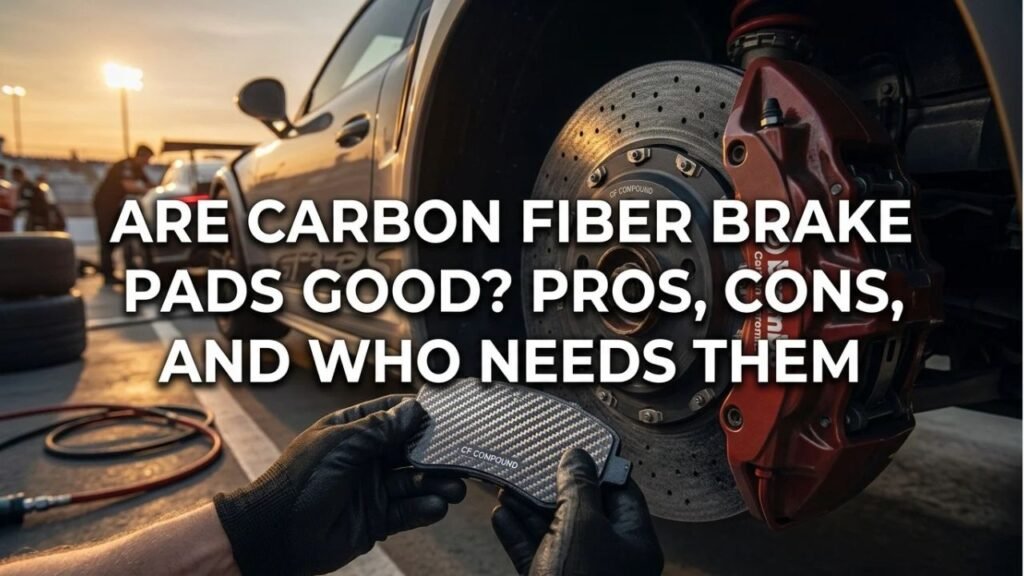
“Carbon fiber brake pads” is a broad retail term. In normal passenger-vehicle replacement parts, it often refers to a carbon-fiber-reinforced ceramic friction compound rather than a pad made entirely from carbon fiber.
The friction layer is a mixture of fibers, fillers, resins, abrasives, lubricants, and other materials engineered to create a target friction curve. Carbon fibers can be added as reinforcement inside that mix. Some street-performance products use carbon fiber in a ceramic formulation, while other specialty compounds may combine carbon with metallic or organic materials.
That is very different from carbon-carbon racing brakes and carbon-ceramic brake rotors. Carbon-carbon systems use carbon-based discs and pads and are associated with high-temperature racing or aircraft use. Carbon-ceramic rotor systems use composite rotors and matching friction materials. An ordinary aftermarket pad set marketed as carbon-fiber ceramic is not the same technology as an exotic carbon-ceramic rotor package.
Why Carbon Fiber Is Added to the Friction Compound
The carbon component can reinforce the friction mix and support stable braking behavior as temperature rises. The exact outcome depends on the whole recipe, not one ingredient.
Manufacturers selling carbon-fiber ceramic pads commonly target one or more of these goals:
- Stronger street braking than a basic comfort-oriented ceramic pad
- Lower dust than many semi-metallic compounds
- Reduced brake noise
- More resistance to fade during repeated street stops
- A firmer or more responsive pedal feel
A material label cannot promise all five. Pad shape, shims, slots, rotor condition, caliper health, bedding, vehicle weight, and operating temperature also affect what the driver feels.
Carbon Fiber Ceramic Is Not a Universal Formula
Two pad boxes may both say carbon-fiber ceramic while using different resin systems, fiber content, abrasive packages, and friction modifiers. One may target commuting, another muscle cars, and another towing.
I would treat the application rating as more meaningful than the carbon-fiber wording. A pad made for a daily driver and a pad made for a loaded tow vehicle should not be assumed interchangeable simply because both contain carbon fiber.
Key Takeaway: Most street carbon fiber pads are reinforced ceramic compounds, and their real traits come from the full friction formula and intended vehicle use.
Are Carbon Fiber Brake Pads Good for Daily Driving?
Yes. A quality carbon-fiber ceramic pad can be a strong fit for everyday driving, especially if you care about low dust, quiet braking, and a smooth street pedal feel.
Many current aftermarket carbon-fiber ceramic lines are sold specifically for commuting cars, crossovers, SUVs, and street-performance vehicles. Their attraction is that they try to add more braking capability than a basic ceramic pad without giving up the cleaner, quieter manners that make ceramic pads popular.
For a normal commute, school run, highway trip, or suburban driving, brake temperatures usually stay far below what a track-focused friction compound needs. That makes a street carbon-fiber ceramic formulation a sensible middle ground.
They Can Produce Less Visible Brake Dust
Ceramic-based pads are widely associated with lower visible dust than many semi-metallic pads. Carbon-fiber ceramic products often preserve that trait.
Less dust matters most on vehicles with open-spoke alloy wheels, where dark brake residue is obvious after a short period of driving. The amount still varies by compound, rotor surface, driving style, and vehicle mass.
They Are Often Quieter Than Semi-Metallic Pads
Ceramic friction materials generally have good noise behavior, and premium pad sets often combine the compound with multilayer shims, chamfers, and slots.
A quiet friction material does not fix every squeal. Rusted abutment clips, dry contact points, seized slide pins, worn rotors, pad vibration, or poor bedding can make almost any pad noisy.
Street Stopping Feel Can Be Strong and Predictable
A well-designed carbon-fiber ceramic street pad can deliver firm initial response and stable friction across common road temperatures. Some performance-oriented versions are aimed at heavier cars, larger wheels, or increased horsepower.
Do not assume that a more aggressive pad will shorten every emergency stop by a large amount. Tires, ABS calibration, road grip, rotor condition, brake fluid, caliper operation, and vehicle weight all affect stopping distance. Once a brake system can lock a wheel or trigger ABS, tire-road traction becomes a major limit.
Key Takeaway: Carbon-fiber ceramic pads suit many daily drivers because they can combine clean wheels, low noise, and strong street braking without the harsher manners of some metallic pads.
Main Benefits of Carbon Fiber Brake Pads
The strongest reasons to choose this pad type are street comfort plus higher-demand capability within the product’s rated use.
Low Dust and Cleaner Wheels
Low-dust operation is one of the most common selling points. Ceramic-heavy formulas tend to create lighter, less visible residue than many metallic compounds.
Drivers with polished, painted, or complex alloy wheels may notice this benefit more than drivers using plain steel wheels.
Good Fade Resistance for Street Use
Brake fade is a temporary drop in braking response after the system becomes very hot. Friction material can change behavior with temperature, and brake fluid or other components can also contribute to fade.
Carbon-fiber ceramic pads marketed for performance street use are often formulated to remain stable during harder road driving than a basic economy pad. Some truck versions are built around towing and hauling rather than commuting.
This does not make every carbon-fiber pad a track pad. Repeated braking from high speed on a circuit creates a heat load far beyond typical street driving.
Reduced Noise
Ceramic compounds are often chosen for their quiet operating character. SAE research comparing ceramic and semi-metallic friction materials found lower noise and lower pad and rotor wear in the ceramic formulations tested, while the semi-metallic sample produced higher friction. The exact result varies with formulation, which is why material family alone should not be treated as a performance score.
Long Pad Life Is Possible
A quality ceramic-based compound may wear slowly during normal road use. Long pad life is most likely when the rotors are healthy, calipers release fully, hardware moves freely, and the pad is operating inside its intended temperature range.
A dragging caliper can destroy a premium pad quickly, so unusually short life should trigger inspection rather than an automatic switch to a harder compound.
Key Takeaway: The main attractions are lower dust, quiet road use, controlled street heat behavior, and the potential for long wear when the pad is matched to the vehicle.
Drawbacks of Carbon Fiber Brake Pads
Carbon fiber in the product name does not remove the tradeoffs found in friction materials.
They Usually Cost More Than Basic Replacement Pads
Carbon-fiber ceramic pads are generally positioned above entry-level organic or standard ceramic products. Paying more makes sense if you want the compound’s noise, dust, or performance traits.
For a lightly driven economy car with basic wheels, a high-quality OE-style ceramic pad may give all the braking behavior the car needs for less money.
Some Compounds May Have Less Aggressive Cold Bite
Street ceramic pads are usually tuned to work from cold, but drivers switching from a more aggressive semi-metallic pad may notice a different first-stop feel.
“Less bite” does not automatically mean unsafe braking. Pedal feel and friction response differ between compounds. The pad still needs to match the vehicle, rotor, and intended service.
Extreme Heat May Favor Other Pad Families
Repeated track braking places a different demand on friction material than fast street driving. Dedicated semi-metallic, ferro-carbon, or motorsport compounds may handle sustained high temperatures better than comfort-focused carbon-fiber ceramic pads.
The same caution applies to heavy trucks. Some carbon-fiber ceramic pads are built specifically for towing, yet a generic passenger-car carbon ceramic pad should not be assumed suitable for a loaded truck.
Marketing Terms Can Be Confusing
“Carbon fiber,” “carbon ceramic,” “carbon-fiber ceramic,” and “ceramic carbon” are not always used consistently across the aftermarket.
Read the application notes instead of treating the name as a material certification. Look for the vehicle fitment, intended use, friction material description, hardware package, and bedding instructions.
Key Takeaway: The biggest limits are higher price, possible differences in cold bite, and the fact that a street carbon-fiber ceramic formula may not be the best pad for sustained race-level heat or severe service.
Carbon Fiber vs Ceramic vs Semi-Metallic Brake Pads
A simple side-by-side view makes the tradeoffs easier to see.
| Feature | Carbon-Fiber Ceramic | Standard Ceramic | Semi-Metallic |
| Brake dust | Low on many street formulas | Low | Usually higher |
| Noise | Usually low | Usually low | Often higher |
| Street braking | Strong with the correct formula | Smooth and predictable | Strong initial bite |
| Repeated high heat | Varies by product | Often less suited to severe heat | Often strong |
| Rotor wear | Often moderate | Often low | Can be higher |
| Cost | Mid to high | Mid to high | Low to high |
| Best fit | Street performance, clean daily use, application-specific towing | Commuting and comfort | Heavy use, heat, towing, performance applications |
Carbon-Fiber Ceramic vs Standard Ceramic
The difference is not simply “carbon is stronger.” A carbon-fiber ceramic pad adds carbon reinforcement to a ceramic-based friction mix, often with a performance-oriented target.
Standard ceramic pads may be the better buy for a normal commuter if quiet stops and low dust are the only goals. Carbon-fiber ceramic becomes more attractive when the manufacturer has designed the pad for extra vehicle weight, larger wheels, performance street use, or towing.
Carbon-Fiber Ceramic vs Semi-Metallic
Semi-metallic pads use a larger share of metallic fibers or particles in the friction material. They are widely used where heat transfer, strong bite, and demanding duty matter.
They can create more dark dust and noise, and some compounds can wear rotors faster. Carbon-fiber ceramic pads usually lean toward cleaner and quieter road manners.
My preference is to pick between these two based on heat duty first and wheel cleanliness second. A driver repeatedly descending steep grades with a loaded trailer has a different brake job from someone commuting on flat suburban roads.
Key Takeaway: Carbon-fiber ceramic sits between comfort-oriented ceramic behavior and higher-demand street braking, while semi-metallic pads remain a strong choice for applications centered on heat and heavy duty.
Are Carbon Fiber Brake Pads Good for Towing?
They can be, but only if the pad is specifically rated for towing or heavy-load use.
Some manufacturers sell carbon-fiber ceramic compounds made for trucks, SUVs, hauling, off-road use, mountain driving, and larger tires. Those pads are not the same as a carbon-fiber ceramic pad intended for an ordinary passenger car.
Towing converts more kinetic and potential energy into brake heat because the brake system is slowing more mass. Long downhill grades can keep brake temperatures high for extended periods.
I would not choose a towing pad solely because the package mentions carbon fiber. Check that the exact part number is listed for the vehicle and that the manufacturer places it in a towing, severe-duty, or truck line.
If a manufacturer recommends a semi-metallic severe-duty pad for your use, there is little reason to reject it just to get a carbon-fiber label.
Will Carbon Fiber Brake Pads Wear Rotors Faster?
Not necessarily.
Rotor wear depends on the friction compound, abrasive content, operating temperature, rotor metallurgy, contamination, pad pressure, and driving pattern. Ceramic families often show lower rotor wear than semi-metallic materials in controlled testing, but there is no rule that every carbon-fiber ceramic pad will be gentle on every rotor.
An aggressive street-performance compound may trade a little more rotor wear for stronger friction at higher temperatures. A comfort-focused ceramic may prioritize quiet operation and longer rotor life.
Inspect the rotor before installing new pads. Deep scoring, heavy corrosion, thickness below the service limit, heat checking, or runout problems can ruin the feel of new pads and shorten their life.
How to Decide If Carbon Fiber Brake Pads Are Right for Your Car
Start with the vehicle manufacturer’s requirements, then look at how the vehicle is actually used.
A carbon-fiber ceramic pad makes sense when:
- The exact pad is listed for your year, make, model, and axle
- You want less visible brake dust
- Low brake noise matters
- The vehicle is mainly street driven
- You want a performance-oriented street pad without moving to a noisy race compound
- The pad line is specifically rated for your towing or truck use
A different friction material may make more sense when:
- The vehicle sees frequent track sessions
- It spends long periods under severe brake heat
- The manufacturer calls for another compound
- Maximum cold bite matters more than dust or noise
- You want the lowest-cost basic replacement for light commuting
Also inspect the rest of the brake system. New friction material cannot correct a sticking caliper, contaminated rotor, failing hose, worn wheel bearing, old fluid, or poor tire grip.
Safety Tip: Replace brake pads by axle, not one wheel at a time. Use the correct service procedure and torque specifications for the vehicle, and do not drive on a braking system with leaks, seized parts, damaged rotors, or an abnormal pedal.
Bedding Carbon Fiber Brake Pads Matters
Many performance replacement pads need a defined bed-in procedure after installation. Bedding transfers a controlled layer of friction material onto the rotor surface and mates the pad face to the rotor.
The correct sequence varies by manufacturer. One brand may specify repeated moderate stops followed by harder stops and a cooling period, while another pad may arrive pre-scorched and use a different procedure.
Do not copy a generic bedding routine if instructions are supplied with the pads. Follow the exact pad maker’s process and avoid sitting stationary with the brake pedal clamped hard immediately after a hot bedding stop, since uneven material transfer can contribute to brake judder.
Fresh pads also need rotors that are within specification. Installing premium pads on badly grooved, cracked, or undersized rotors is a poor way to judge the friction compound.
Conclusion
For most street applications, are carbon fiber brake pads good has a positive answer: a quality carbon-fiber ceramic pad can provide strong road braking, low dust, quiet operation, and good wear characteristics. The material name still needs to match the vehicle and driving job.
Daily drivers and street-performance cars are common fits. Trucks can also use this type successfully when the exact pad is built for towing or severe duty. Track cars and repeated extreme-heat applications may be better served by a dedicated motorsport or metallic compound.
I would choose the pad by fitment, duty rating, friction behavior, and manufacturer instructions before paying attention to the carbon-fiber wording on the box. A correctly matched mid-range pad on healthy rotors is a better brake setup than an expensive compound installed for the wrong job.
FAQs About Carbon Fiber Brake Pads
Are carbon fiber brake pads better than ceramic pads?
They can be better for drivers who want a more performance-oriented street compound, but many carbon fiber pads are themselves carbon-fiber-reinforced ceramic pads. A standard ceramic pad may be enough for quiet commuting and low dust. The carbon-fiber version makes more sense when its manufacturer has tuned the compound for higher street demand, vehicle weight, towing, or performance use.
Do carbon fiber brake pads make a lot of dust?
Most carbon-fiber ceramic street pads are marketed as low-dust products and generally produce less visible residue than many semi-metallic pads. Actual dust levels still vary by formula, rotor condition, vehicle weight, and driving style. Hard braking, dragging calipers, or rough rotors can increase pad wear and dust even with a low-dust compound.
Are carbon fiber brake pads noisy?
Quality carbon-fiber ceramic pads are usually quiet during normal street use. Many are paired with shims, chamfers, and slots that control vibration. Squealing after installation can also come from worn hardware, rust, incorrect lubrication at approved contact points, rotor problems, poor bedding, or a sticking caliper rather than the friction material itself.
Are carbon fiber brake pads good for trucks?
Yes, if the specific pad is designed for the truck’s weight and duty. Some carbon-fiber ceramic lines are built for towing, hauling, off-road driving, large tires, and mountain use. A passenger-car performance pad should not be treated as a heavy-duty truck pad simply because both products contain carbon fiber.
How long do carbon fiber brake pads last?
There is no reliable mileage figure that applies to every carbon-fiber pad. Service life changes with vehicle weight, front-to-rear brake balance, driving style, hills, towing, rotor condition, caliper operation, and friction formula. Inspect pad thickness during normal brake service rather than using a fixed mileage number as the replacement point.
Do carbon fiber brake pads need special rotors?
Most street carbon-fiber ceramic replacement pads are designed to work with compatible iron rotors listed by the pad manufacturer. They do not automatically require carbon-ceramic rotors. Check the exact pad instructions because specialty racing compounds and exotic brake systems may have different rotor requirements.
Are carbon fiber brake pads worth the extra cost?
They are worth considering if cleaner wheels, quiet stops, and stronger street-oriented braking matter to you and the pad is rated for your vehicle. For a basic commuter that never sees hard braking, a premium standard ceramic pad may deliver similar day-to-day satisfaction for less money. Pay for the application and friction behavior you need, not the carbon-fiber name alone.