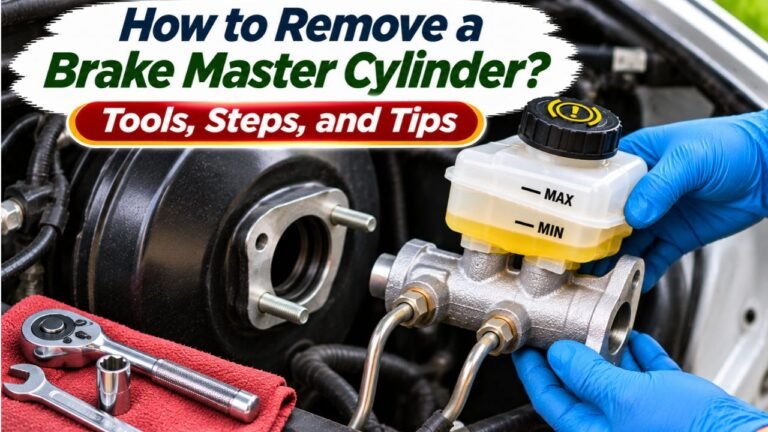
What Does a Brake Master Cylinder Look Like? Parts and Location
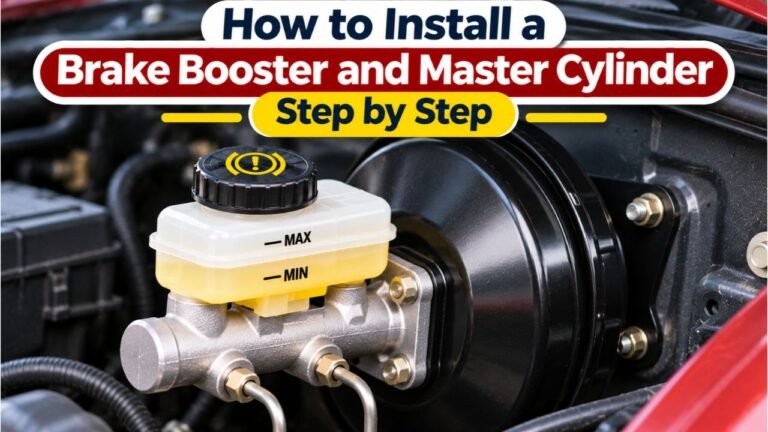
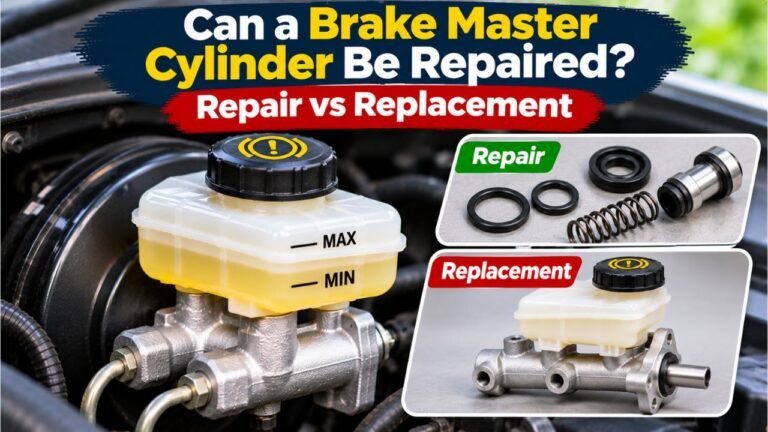
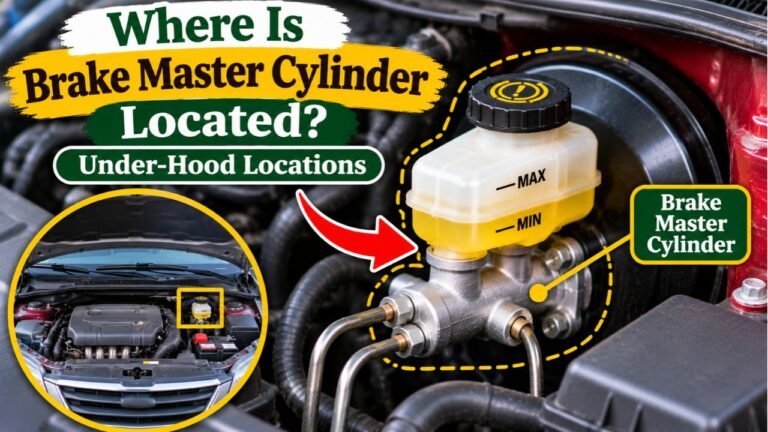
A brake master cylinder usually looks like a short, horizontally mounted metal cylinder with a translucent plastic brake fluid reservoir attached above it. Thin metal brake lines connect to the cylinder, and the assembly is often mounted in front of a large, round brake booster near the rear of the engine compartment. Its metal body is commonly silver, gray, or dark-colored, while the reservoir is often white or yellowish translucent plastic.
The master cylinder is relatively easy to recognize once you know which parts belong to the assembly. The reservoir has a removable cap, often marked with the required brake fluid specification. Below it, the metal housing contains internal pistons, seals, and hydraulic chambers.
However, the exact appearance varies by vehicle. Some older cars have metal reservoirs, while modern cars may use compact assemblies or electronically controlled braking components. A few vehicles also position the reservoir remotely from the cylinder.
Identifying the component correctly is important because the brake fluid reservoir should never be confused with the power steering, coolant, or clutch fluid reservoir.
In this article, I explain what a brake master cylinder looks like, where to find it under the hood, and how to identify its main visible parts. I also compare different master cylinder designs, explain how to distinguish the assembly from the brake booster and ABS module, and cover visual signs of leakage or damage.
What Does a Brake Master Cylinder Look Like Under the Hood?
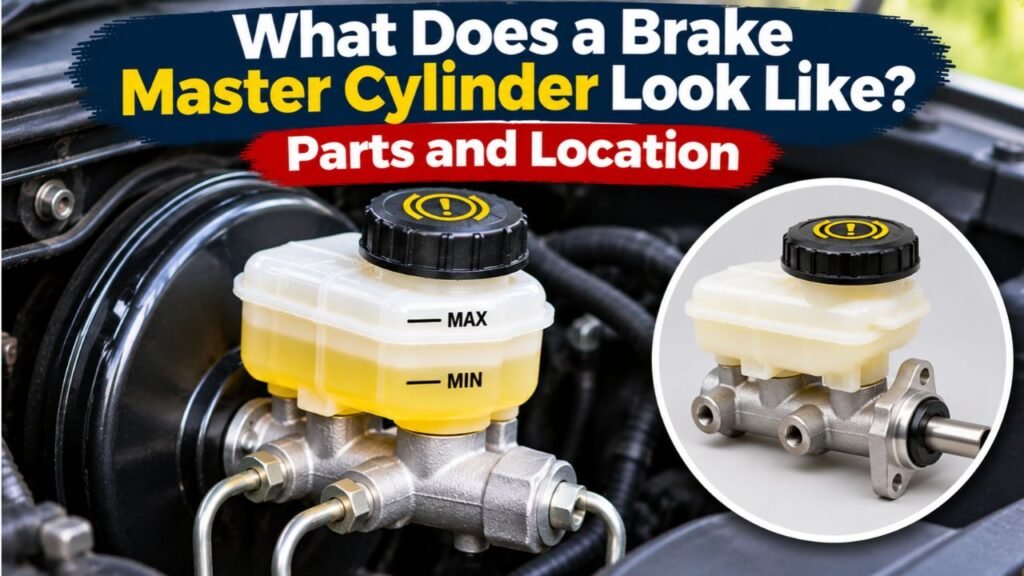
On many conventional cars, the brake master cylinder looks like a compact hydraulic assembly attached to the firewall.
Its most noticeable features are the brake fluid reservoir, metal cylinder housing, and hydraulic outlet lines.
Main Visual Characteristics
| Component | Typical appearance | Where to look |
| Brake fluid reservoir | Translucent white or yellowish plastic container | Above the master cylinder |
| Reservoir cap | Black or dark plastic screw-on cap | Top of the reservoir |
| Master cylinder body | Silver, gray, or dark metal cylinder | Directly below the reservoir |
| Mounting flange | Metal flange with mounting bolts or nuts | Rear of the cylinder |
| Brake line fittings | Small threaded metal connections | Side or front of the cylinder |
| Brake lines | Thin rigid metal tubes | Extending from the hydraulic ports |
| Brake booster | Large round black or metallic housing | Behind the master cylinder |
| Fluid-level sensor | Small electrical connector | Often on the reservoir |
According to the CarParts.com guide reviewed by an ASE-certified master technician, the master cylinder is usually mounted near the driver’s side of the engine compartment, below the brake fluid reservoir and in front of the brake booster.
Does the Master Cylinder Look Like a Tube?
The hydraulic body is generally cylindrical or elongated, although castings often have irregular external shapes.
It is not usually a perfectly smooth tube.
You may see:
- Casting ribs.
- Hydraulic outlet fittings.
- Mounting flanges.
- Reservoir mounting points.
- Electrical sensor connections.
- Machined metal surfaces.
The shape depends on the vehicle and manufacturer.
How Big Is a Brake Master Cylinder?
A conventional passenger-car master cylinder is usually a relatively compact assembly.
The metal hydraulic body can often be held in one hand after removal.
However, the complete assembly with its reservoir is substantially larger.
There is no universal dimension.
Heavy-duty vehicles and specialized braking systems may use different designs.
What Color Is a Brake Master Cylinder?
The metal housing is commonly:
- Silver.
- Gray.
- Black.
- Dark cast-metal color.
The reservoir is often translucent white plastic.
Older reservoirs may become yellowish from age and exposure.
Color is not a reliable way to identify the exact vehicle application.
Where Is the Brake Master Cylinder Located?
On many conventional vehicles, the master cylinder is mounted on the firewall.
This is the structure separating the engine compartment from the passenger cabin.
Driver’s Side Location
In a typical U.S. left-hand-drive car, it is commonly found toward the driver’s side of the engine compartment.
It is often near the area directly ahead of the brake pedal.
However, vehicle layouts vary.
On right-hand-drive vehicles, the position may be different.
Attached to the Brake Booster
Most modern conventional power-assisted brake systems mount the master cylinder to the front of the brake booster.
The booster is often a large, round housing.
This makes the assembly easier to recognize.
Can the Master Cylinder Be Hidden?
Yes.
Depending on the vehicle, parts of the assembly may be obscured by:
- Engine covers.
- Intake components.
- Electrical modules.
- Structural supports.
- Plastic panels.
- Other engine-compartment equipment.
In some designs, the reservoir may be easier to see than the metal cylinder.
Do Electric Vehicles Have the Same Layout?
Not always.
Some electric vehicles and hybrids use integrated electro-hydraulic braking systems.
These may combine hydraulic pressure generation, electronic control, and assistance functions in compact assemblies.
Their appearance can differ substantially from a conventional vacuum-booster arrangement.
Use vehicle-specific service information when the layout is unfamiliar.
How to Find a Brake Master Cylinder Step by Step
You can often identify a conventional master cylinder through a visual inspection without removing any components.
Step 1: Park the Vehicle Safely
Park on a level surface.
Switch off the engine or propulsion system.
Secure the vehicle according to the owner’s manual.
Avoid reaching near hot or moving components.
Step 2: Open the Hood
Release the hood latch.
Raise and secure the hood according to the vehicle’s instructions.
Step 3: Look Toward the Firewall
Look near the back of the engine compartment.
On many U.S. left-hand-drive vehicles, the master cylinder is positioned toward the driver’s side.
Step 4: Locate the Brake Fluid Reservoir
Look for a plastic reservoir with a marked cap.
The cap may identify:
- DOT 3.
- DOT 4.
- Another specified brake fluid.
However, cap markings depend on the manufacturer.
Do not assume the fluid specification based on the appearance alone.
Step 5: Look Below the Reservoir
The metal housing directly underneath or connected to the reservoir is often the master cylinder.
In some designs, the reservoir may be positioned remotely.
Step 6: Identify the Brake Lines
Look for narrow, rigid metal tubes connected to the hydraulic outlet ports.
These lines carry brake fluid pressure toward other parts of the braking system.
Step 7: Identify the Brake Booster
Behind the master cylinder, you may see a large, round black housing.
That is commonly the brake booster.
It is a separate component from the master cylinder.
Step 8: Confirm With the Owner’s Manual
If the layout is unusual, consult the vehicle’s manual or service information.
Do not disconnect any hydraulic lines simply to identify the component.
Key Takeaway: The easiest way to recognize a conventional brake master cylinder is to locate the brake fluid reservoir and follow it to the metal hydraulic housing connected to the brake lines.
What Does the Brake Fluid Reservoir Look Like?
The reservoir is usually the most recognizable part of the assembly.
Plastic Reservoir
Most modern conventional vehicles use a translucent plastic reservoir.
This makes it possible to see the fluid level without removing the cap.
Reservoir Shape
The reservoir can be:
- Rectangular.
- Rounded.
- Oval.
- Irregularly shaped.
Its shape depends on the available engine-compartment space and hydraulic design.
MIN and MAX Marks
Many reservoirs have molded fluid-level marks.
These indicate the manufacturer-defined operating range under specified conditions.
The correct checking procedure may depend on brake pad wear and other factors.
Fluid-Level Sensor
Some reservoirs contain an electrical sensor.
A small connector may be visible near the reservoir body or cap.
The sensor can support a low-fluid warning function.
What Color Should the Fluid Be?
Fresh glycol-based brake fluid is often clear to amber.
However, fluid appearance varies by product and condition.
Color alone cannot confirm whether the fluid is suitable for continued service.
Should You Remove the Cap to Check the Level?
Not unless necessary.
Many reservoirs allow an external level check.
Glycol-based brake fluid can absorb moisture from the air.
Opening the reservoir unnecessarily also increases the risk of contamination.
Follow the manufacturer’s instructions.
What Does the Metal Master Cylinder Body Look Like?
The metal housing is the pressure-generating portion of the assembly.
It contains the hydraulic piston and seal mechanisms.
External Shape
The housing is often an elongated casting.
It may have:
- A main cylindrical section.
- Reservoir mounting openings.
- Hydraulic ports.
- A rear mounting flange.
- Threaded fittings.
- A machined mounting surface.
Some designs are relatively smooth.
Others have more complex cast shapes.
Common Materials
The housing may be made from:
- Aluminum alloy.
- Cast iron.
- Other suitable engineered materials.
The material depends on the manufacturer and application.
Are the Pistons Visible?
No, not during a normal external inspection.
The pistons operate inside the precision-machined bore.
The primary and secondary piston assemblies are hidden by the housing.
Are the Springs Visible?
No.
Internal return springs are also located inside the hydraulic assembly.
They normally cannot be seen without disassembly.
Can You Identify a Bad Master Cylinder From Its Shape?
No.
Two master cylinders may look almost identical but differ in:
- Bore diameter.
- Internal piston configuration.
- Hydraulic outlet arrangement.
- Reservoir mounting.
- Pushrod requirements.
- ABS compatibility.
- Vehicle application.
Visual similarity does not establish compatibility.
Brake Master Cylinder vs Brake Booster: Visual Differences
The master cylinder and brake booster are often attached directly to one another.
This can make them easy to confuse.
Brake Master Cylinder Appearance
The master cylinder is usually the smaller metal hydraulic body with brake line connections.
A brake fluid reservoir is often mounted above it.
Brake Booster Appearance
The conventional vacuum brake booster typically looks like a large, round metal housing.
It may be black or metallic.
It is mounted behind the master cylinder.
Comparison Table
| Visual feature | Brake master cylinder | Brake booster |
| Typical shape | Short elongated metal cylinder | Large round housing |
| Relative size | Smaller | Larger |
| Brake fluid reservoir | Usually attached | Not a fluid storage component |
| Metal brake lines | Usually connected directly | Generally not the main line connection point |
| Main function | Generate hydraulic pressure | Assist brake pedal force |
| Typical position | In front of booster | Against firewall, behind cylinder |
Is the Round Black Part the Master Cylinder?
Usually not.
In a conventional vacuum-assisted arrangement, the large round black housing is the booster.
The master cylinder is the smaller metal component attached to its front.
The Official Nissan Parts Store’s master cylinder guide explains the hydraulic components and their relationship with the brake pedal.
Brake Master Cylinder vs ABS Module: How to Tell Them Apart
The ABS hydraulic control unit may also have multiple metal brake lines.
However, its appearance is often different.
Master Cylinder
A conventional master cylinder generally has:
- An elongated hydraulic body.
- A reservoir mounted above or connected remotely.
- Brake line outlets.
- A connection to the pedal or booster.
ABS Hydraulic Control Unit
A conventional ABS module often appears as a metal hydraulic block with several brake line connections.
It may have:
- An attached electronic control module.
- A wiring connector.
- Multiple hydraulic ports.
- Solenoid valve components.
- Pump components.
Comparison Table
| Feature | Master cylinder | ABS module |
| Common body shape | Elongated cylinder | Compact hydraulic block |
| Reservoir | Usually associated with it | Usually supplied by the brake hydraulic system |
| Electrical module | May have a level sensor | Often has a larger electronic control assembly |
| Brake lines | Typically a few primary outlets | Often several hydraulic connections |
| Main function | Generate pressure | Modulate pressure when required |
Can the Two Be Combined?
Certain integrated brake-control systems combine functions differently.
In those vehicles, simple external identification rules may not apply.
Consult factory service information.
Brake Master Cylinder vs Clutch Master Cylinder
Some manual-transmission vehicles have both a brake master cylinder and a clutch master cylinder.
These are separate hydraulic components.
Brake Master Cylinder
The brake master cylinder supplies hydraulic pressure to the service brakes.
It is connected to the brake pedal.
Clutch Master Cylinder
The clutch master cylinder supplies hydraulic pressure to operate the clutch release mechanism.
It is connected to the clutch pedal.
Visual Differences
| Feature | Brake master cylinder | Clutch master cylinder |
| Operated by | Brake pedal | Clutch pedal |
| Main function | Hydraulic braking | Hydraulic clutch operation |
| Common circuit arrangement | Two brake circuits | Usually one clutch circuit |
| Typical size | Often larger | Often smaller |
| Reservoir | Usually attached or remotely connected | Attached, remote, or shared reservoir |
| Hydraulic lines | Brake circuits | Clutch hydraulic line |
Can the Reservoir Be Shared?
Yes, in some vehicles.
A clutch hydraulic circuit may draw fluid from a shared brake fluid reservoir.
However, the brake and clutch pressure-generating cylinders remain separate components.
Do not assume that every manual-transmission car uses a shared reservoir.
How Do You Identify the Correct One?
Use the owner’s manual and the connection to the relevant pedal system.
Do not rely on container size or color alone.
What Does a Single-Circuit Master Cylinder Look Like?
A single-circuit master cylinder is generally simpler internally than a tandem design.
It has one hydraulic pressure circuit.
Typical Appearance
An older single-circuit master cylinder may have:
- A cylindrical metal body.
- A single hydraulic outlet.
- A metal or plastic reservoir.
- A mounting flange.
- A mechanical pushrod connection.
Some older vehicles have metal reservoirs with removable covers.
Are Single-Circuit Master Cylinders Still Used?
They may appear on older vehicles and selected specialty equipment.
Modern passenger cars generally use dual-circuit service braking systems.
Can You Identify It by the Reservoir?
Not reliably.
Reservoir designs vary.
The internal hydraulic configuration and service documentation are more useful than appearance alone.
What Does a Tandem Master Cylinder Look Like?
A tandem master cylinder contains two pressure-generating piston sections in one assembly.
Externally, it may resemble a slightly elongated metal cylinder with multiple hydraulic outlets.
Typical External Features
You may see:
- A plastic reservoir.
- Two hydraulic outlet ports.
- A mounting flange.
- A metal cylinder body.
- A fluid-level sensor.
However, some designs have different line configurations.
Does It Have Two Separate Reservoirs?
Not necessarily.
A single external plastic reservoir may contain separate internal compartments feeding the two circuits.
The internal partitions are not always obvious from outside.
Are Two Brake Lines Proof of a Tandem Design?
Not by themselves.
The external line count can be affected by combination valves, adapters, and hydraulic routing.
Use the correct technical information to confirm the design.
Why Is the Tandem Design Important?
Its two circuits provide a measure of braking redundancy.
If one circuit fails, the other may retain partial braking functionality.
However, a circuit failure can still create dramatically reduced braking effectiveness.
What Does a Bad Brake Master Cylinder Look Like?
A failing master cylinder doesn’t always show visible damage.
Internal seal leakage can occur while the external housing appears completely normal.
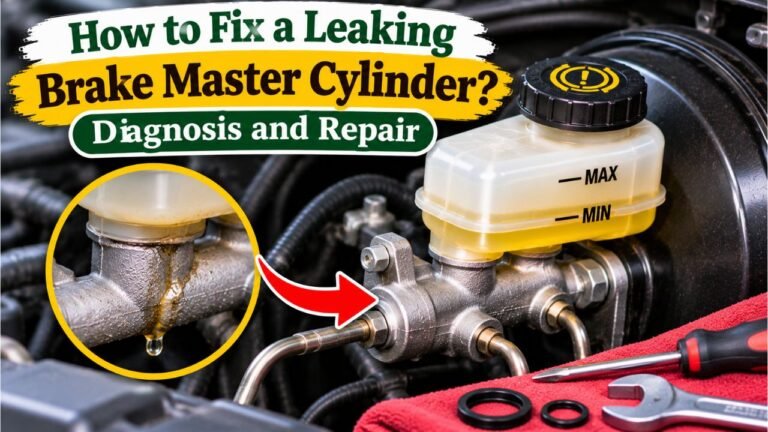
Visible Brake Fluid Leaks
An external leak may leave wet residue around:
- Hydraulic fittings.
- Reservoir connections.
- The rear seal area.
- The master cylinder mounting flange.
However, the source of the fluid must be confirmed.
Fluid may originate from another nearby component.
Wetness Near the Booster
Brake fluid can sometimes leak from the rear of the master cylinder toward the brake booster.
This may not always be visible from outside.
Some leaks require professional inspection.
Damaged Reservoir
Look for:
- Cracks.
- Broken mounting points.
- Fluid seepage.
- Damage around the cap or sensor.
A cracked reservoir may cause fluid loss or contamination.
Corrosion
External corrosion may be visible on the metal housing or nearby fittings.
However, surface corrosion alone doesn’t establish that the master cylinder has failed internally.
Damaged Brake Lines
Rust, cracks, or wet hydraulic fittings near the master cylinder require prompt attention.
The fault may involve the brake line rather than the cylinder itself.
Can a Master Cylinder Look Normal but Be Bad?
Yes.
Worn internal seals may allow fluid to bypass without any obvious external leakage.
The brake pedal may slowly sink while steady pressure is applied.
However, other hydraulic faults can cause similar symptoms.
The CarParts.com guide to testing a brake master cylinder explains that visual inspection alone cannot reliably identify every internal master cylinder failure.
Key Takeaway: A master cylinder may appear clean and undamaged even when its internal hydraulic seals are failing.
Visual Signs of a Brake Master Cylinder Problem
The following observations can help identify an area requiring inspection.
| Visible condition | Possible concern | What it means |
| Fluid around reservoir connection | Reservoir seal leak | Requires inspection |
| Wet fluid around outlet fitting | Hydraulic connection leak | Safety-critical |
| Damaged reservoir | Potential fluid leakage or contamination | Repair may be necessary |
| Severe corrosion on brake fittings | Hydraulic line deterioration | Requires prompt evaluation |
| Fluid traces near booster | Possible master cylinder rear leak | Source needs confirmation |
| Normal external appearance | Internal condition unknown | Does not rule out failure |
| Falling reservoir level | Fluid loss or normal pad-wear-related displacement | Cause must be identified |
Do not open hydraulic connections merely to inspect for leaks.
If the pedal response is abnormal or brake fluid is escaping, stop using the vehicle until the braking system is evaluated.
How to Identify the Correct Replacement Brake Master Cylinder
The appearance alone isn’t enough to select the correct replacement.
Two parts may look very similar while having different internal specifications.
Check the Vehicle Information
Identify:
- Make.
- Model.
- Model year.
- Engine or powertrain.
- Relevant brake package.
- Vehicle identification number when required.
Check the Complete Part Number
Use the original equipment part number or a properly verified replacement catalog.
The exact number may depend on trim, brake configuration, and production changes.
Compare Mounting Features
A compatible replacement must match the required mounting arrangement.
However, matching bolt locations alone doesn’t prove hydraulic compatibility.
Verify Bore Diameter
Different master cylinder bore sizes change pressure and fluid displacement characteristics.
Use the specified design.
Verify Hydraulic Ports
Check outlet sizes, thread types, and circuit connections.
Never force incompatible fittings.
Verify Reservoir and Sensor Connections
Confirm that the reservoir, seals, and any fluid-level sensor match the vehicle.
Check ABS and Brake System Compatibility
Some vehicles use different master cylinders depending on ABS, electronic stability control, or other braking equipment.
Follow the manufacturer-approved replacement specifications.
Can You Identify the Master Cylinder Without Removing Anything?
Often, yes.
On many conventional vehicles, the reservoir, metal body, booster, and brake lines can be identified visually.
Safe Visual Inspection
You can generally look for:
- Reservoir location.
- Fluid-level markings.
- Visible damage.
- External fluid residue.
- Brake line connections.
However, avoid reaching near moving engine components.
Do not remove brake lines, reservoirs, or hydraulic fittings solely for identification.
Should You Open the Reservoir Cap?
Not usually.
A translucent reservoir commonly permits an external level check.
Opening it unnecessarily can introduce moisture and contamination.
Can You Diagnose a Fault Through Visual Inspection?
Only to a limited extent.
An obvious leak or cracked reservoir may be visible.
Internal seal failure generally requires further diagnosis.
What if You Cannot Find the Master Cylinder?
Some modern vehicles have unusual brake-control assemblies.
Consult the owner’s manual, service documentation, or a qualified mechanic.
Do not assume that a nearby hydraulic-looking component is the master cylinder without confirmation.
Common Mistakes When Identifying a Brake Master Cylinder
Confusing the Booster With the Master Cylinder
The booster is commonly the larger round housing behind the smaller metal master cylinder.
Assuming the Entire Reservoir Is the Cylinder
The reservoir stores brake fluid.
The hydraulic pistons and pressure chambers are located inside the metal cylinder body.
Mistaking the ABS Module for the Master Cylinder
Both can have brake line connections.
However, the ABS unit often resembles a hydraulic block with attached electronic components.
Identifying the Part by Color Alone
Colors vary by manufacturer and material.
Assuming Every Car Has a Visible Vacuum Booster
Some vehicles use hydraulic, electric, or integrated braking systems.
Assuming a Clean Master Cylinder Is Healthy
Internal seal bypass can occur without external leakage.
Assuming Every Master Cylinder Has Two Visible Brake Lines
Hydraulic routing and component design vary.
Buying a Replacement Based Only on Appearance
Bore size, ports, mounting details, and vehicle compatibility must match.
Opening the Brake Fluid Reservoir Unnecessarily
This increases the risk of moisture or dirt contamination.
Ignoring Visible Hydraulic Leaks
Brake fluid leakage can compromise braking and requires prompt diagnosis.
Conclusion
A conventional brake master cylinder usually looks like a compact metal cylinder mounted underneath a translucent brake fluid reservoir, with thin metal brake lines connected to its hydraulic outlets.
It is commonly attached to the front of a large, round brake booster near the firewall.
The reservoir is usually the easiest part to spot because it often has a dark cap and visible fluid-level markings.
The actual pressure-generating mechanism is inside the metal cylinder housing, so the pistons and seals are not visible during normal inspection.
I recommend using the reservoir, brake lines, booster, and firewall location together to identify the component rather than relying on its shape or color alone.
Remember that some modern vehicles have integrated brake-control designs that look different from traditional assemblies.
If you see hydraulic fluid leaking or notice abnormal braking behavior, have the system inspected before driving.
The reservoir identifies where the brake fluid is stored, while the metal master cylinder beneath it generates the hydraulic pressure used to operate the brakes.
FAQs About What Does a Brake Master Cylinder Look Like
What Does a Brake Master Cylinder Look Like on a Car?
It usually appears as an elongated metal hydraulic body with a translucent brake fluid reservoir above it. Metal brake lines connect to the housing, and a brake booster is commonly positioned behind it.
Where Can I Find the Brake Master Cylinder Under the Hood?
Look near the firewall at the rear of the engine compartment. On many U.S. left-hand-drive vehicles, it is located toward the driver’s side, often attached to the brake booster.
Is the Brake Master Cylinder the Big Round Black Part?
Usually not. The large round black housing is commonly the vacuum brake booster. The master cylinder is the smaller metal hydraulic component mounted in front of it.
What Color Is a Brake Master Cylinder?
The metal body is often silver, gray, or dark-colored. The reservoir is usually translucent white plastic and may become yellowish with age. Colors vary by manufacturer.
Does a Brake Master Cylinder Have Two Brake Lines?
Many tandem master cylinders have two primary hydraulic outlet connections, but the visible line arrangement varies by vehicle. The number of external lines alone doesn’t confirm the internal design.
What Does a Leaking Brake Master Cylinder Look Like?
You may notice wet fluid near the reservoir, hydraulic fittings, or the rear of the metal body. However, some leaks are hidden, and internal seal problems may occur without visible fluid loss.
Can a Brake Master Cylinder Look Good but Be Bad?
Yes. Internal piston seals can fail even when the exterior appears normal. A slowly sinking brake pedal or abnormal hydraulic response may indicate a problem, but professional diagnosis is necessary to confirm the cause.