What Do Worn Brake Pads Look Like? Visual Signs and Thickness
Worn brake pads usually have a noticeably thin layer of friction material compared with new pads. The pad may also show an almost-gone center groove, uneven thickness, tapering, cracks, a shiny glazed surface, or areas worn down close to the metal backing plate. Severe wear can leave almost no friction material at all.
Visual inspection matters because a pad can look acceptable from one side of the caliper while the pad on the other side is nearly worn out. Uneven wear may point to a sticking caliper piston, seized slide pin, rusty hardware, or a pad that cannot move freely in its bracket.
Recognizing wear early gives you time to replace the pads before their steel backing plates contact the rotors. Metal-to-metal contact can score the rotor surface and turn a routine pad replacement into a more expensive brake repair.
The Federal Highway Administration reports that the United States had about 298 million registered motor vehicles in 2024. With that many vehicles in service, brake-pad inspection remains a routine part of vehicle maintenance across the country.
During my research on what do worn brake pads look like, one detail stood out: thickness is only part of the inspection. The shape and surface of the remaining material can reveal problems that a simple measurement may miss, especially if one pad is thinner than its matching pad.
Brembo currently describes new brake pads as roughly 10–12 mm thick and advises replacement once the friction material falls below about 3 mm. The exact service limit can differ by vehicle and pad maker, so the vehicle manufacturer’s specification should control the final decision.
The sections below show the visual differences between healthy and worn pads, what uneven, tapered, glazed, cracked, and contaminated pads look like, how to inspect them through the wheel, and which wear patterns point to another brake-system fault.
What Do Worn Brake Pads Look Like at a Glance?
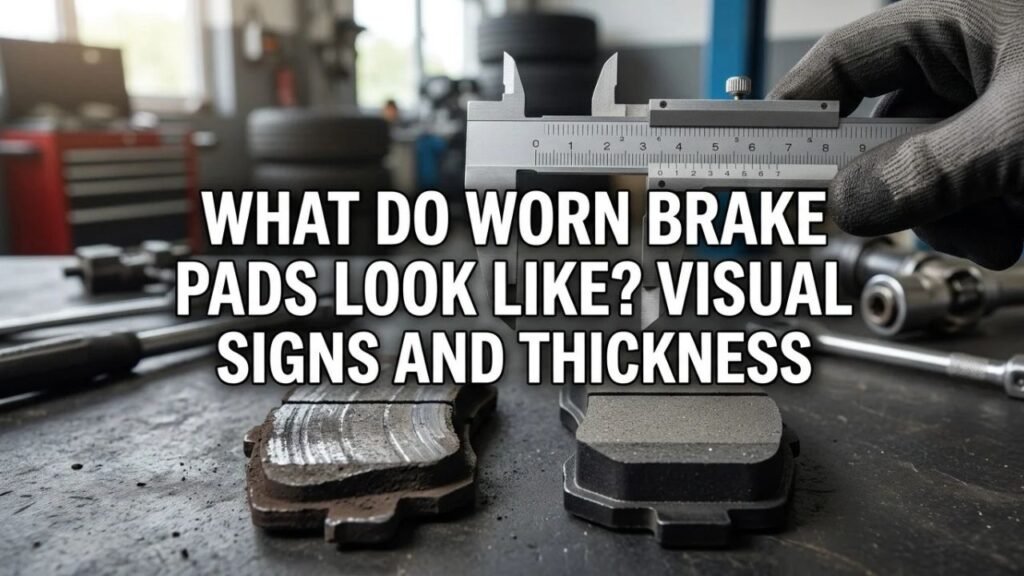
The easiest visual clue is the thickness of the friction material. This is the block of material bonded to the steel backing plate and pressed against the rotor during braking.
A fresh pad has a thick, clearly defined friction block. As it wears, that block becomes progressively thinner while the metal backing plate stays nearly the same thickness.
The Friction Material Looks Thin
Look at the pad from its edge rather than judging only the broad friction face.
A new pad often has around 10–12 mm of friction material before use, though exact new thickness varies by application. A heavily used pad may have only a few millimeters remaining.
Do not include the steel backing plate when estimating pad thickness. The part that wears is the friction material between the rotor and backing plate.
Once very little friction material remains, the pad can appear almost flat against its backing plate.
The Center Wear Slot Is Nearly Gone
Some pads have a groove cut into the center of the friction material.
That groove serves several purposes, and it can also provide a simple visual reference for wear. As the pad becomes thinner, the groove becomes shallower.
Wagner notes that when a wear-indicator slot is gone or barely visible, the pad is due for replacement.
Not every pad has this style of groove, so the absence of a slot does not automatically mean the pad is worn.
The Backing Plate Is Close to the Rotor
A severely worn pad may have almost no visible friction material separating the steel backing plate from the rotor.
At that stage, replacement is overdue.
If the friction material is completely gone, the steel backing plate can grind directly against the rotor. Wagner describes completely worn friction material as a worn-out pad condition that can damage the rotor and create loud brake noise.
The Pad May Look Different From Its Matching Pad
Do not inspect one pad and assume the other is in the same condition.
The inner and outer pads should normally wear at similar rates. Wagner states that a large difference between them can indicate sticking slide pins, a dragging piston, binding pads, or another caliper problem.
This is one reason looking through a wheel opening is useful for a quick check but may not reveal the complete condition of the brake assembly.
Key Takeaway: A worn pad usually has a thin friction layer, a shallow or missing wear groove, and much less material between the rotor and steel backing plate. Always compare the inner and outer pads.
What Different Worn Brake Pad Patterns Look Like
Normal brake-pad wear should be reasonably flat and even across the friction surface.
Odd shapes, surface changes, or large differences between pads may indicate that something else needs attention before new pads are installed.
Evenly Worn Brake Pads
Normal wear leaves the friction surface relatively flat from one end of the pad to the other.
Both pads on the same caliper should also have reasonably similar remaining thickness.
A pad worn evenly down to its service limit usually points to normal friction-material consumption rather than a major caliper fault.
The replacement should still include an inspection of the rotor, hardware, slide pins, and caliper movement.
Uneven Inner and Outer Pad Wear
One pad may be much thinner than the other.
For example, the outer pad might be nearly worn out while the inner pad still looks thick. Wagner says this pattern can point to seized or restricted caliper slide pins.
The opposite pattern can also occur. If the inner pad is badly worn while the outer pad retains much more material, a dragging caliper piston may be keeping pressure on the inside pad.
Replacing the pads alone will not correct the source of that wear.
Tapered Brake Pad Wear
A tapered pad is thicker at one end and thinner at the other.
Viewed from the side, the friction block looks wedge-shaped instead of having nearly parallel surfaces.
Wagner’s brake-pad wear chart links tapered wear with possible caliper distortion, sticking slides, a sticking piston, or excessive caliper clearance.
A new set of pads can develop the same pattern if the caliper fault remains.
Cracked Brake Pads
A cracked pad may have one or more visible fractures in the friction material.
Small cracks can form around the center or edges, while severe damage may cause sections of material to chip away.
Wagner identifies stress and pad movement problems among possible causes of cracking. Its technical chart recommends checking pad movement, caliper slides, and guide pins rather than treating the crack only as cosmetic damage.
Large cracks, loose chunks, or separating friction material call for replacement.
Glazed Brake Pads
A glazed pad often has a smooth, shiny, glass-like friction surface instead of a normal dull or slightly textured appearance.
High brake temperature can polish or harden the pad surface.
Glazing may be associated with noise or reduced friction until the surface condition changes. Wagner links pad glazing with short periods of high temperature.
Repeated glazing deserves a check for driving conditions, rotor condition, dragging brakes, or an unsuitable pad compound.
Overheated or Charred Pads
An overheated pad may show unusual discoloration around the friction material.
Edges can look pale, whitish, charred, brittle, or damaged after excessive heat exposure. Wagner describes this appearance as “ashing” and associates it with prolonged high temperature or brake drag.
Heat damage can also appear alongside cracks and rapid wear.
A pad showing severe heat damage should prompt an inspection for a sticking caliper or other condition that keeps the brake applied.
Oil- or Grease-Contaminated Pads
Contaminated friction material can look dark, wet, greasy, or stained.
Brake fluid, oil, grease, or other petroleum products should not be present on the friction surface.
Wagner’s technical guidance recommends replacement when pad material is contaminated with oil, grease, or brake fluid.
Trying to judge a contaminated pad only by its remaining thickness misses the real problem.
Key Takeaway: Flat, even wear is normal. Major thickness differences, tapering, cracks, glazing, heat damage, or oily surfaces can point to caliper, hardware, rotor, heat, or contamination problems.
How Thick Do Worn Brake Pads Look?
Brake-pad thickness is easier to judge once you separate the friction material from the backing plate.
A new pad may look surprisingly thick next to a pad near the end of its service life.
Brembo currently gives about 10–12 mm as a typical new-pad thickness and recommends replacement below roughly 3 mm. PowerStop uses a more conservative recommendation, suggesting replacement around 4.5 mm and below in its brake-warning guidance.
Those different recommendations are a good reason not to treat one number as a universal legal or mechanical limit.
A practical visual reference looks like this:
| Friction Material | What It Usually Looks Like | Practical Action |
| Around 10–12 mm | Thick friction block | Common new-pad range |
| Around 6 mm | Clearly used but substantial material remains | Inspect periodically |
| Around 4–5 mm | Noticeably thinner | Plan replacement and check specifications |
| Around 3 mm | Thin friction layer | Common replacement territory |
| Around 1–2 mm | Very thin, backing plate close to rotor | Replace promptly |
| Friction material gone | Steel backing plate exposed to rotor | Do not continue normal driving |
The numbers above are visual reference points rather than a substitute for the vehicle’s service information.
Why 3 mm Can Look Thinner Than Expected
Three millimeters is only about 0.12 inch, so a pad near that thickness can look like a narrow strip beside the backing plate.
From an angle, the pad may appear thicker because you are seeing part of the steel plate or shim behind it.
Use a flashlight and view the friction material as squarely as possible.
If access permits, a brake-pad thickness gauge gives a more reliable reading than estimating by eye.
Do Not Compare Total Pad Thickness
The steel backing plate does not count as usable friction material.
A worn pad can still look physically substantial if you include:
- Backing plate
- Noise-control shim
- Retaining clips
- Friction material
Measure only the material that actually contacts the rotor.
Key Takeaway: A worn pad may still look thick if the backing plate is included. Judge the friction material alone, and use the vehicle or pad manufacturer’s service limit rather than one universal number.
How to Check What Your Brake Pads Look Like
A quick inspection can often be done through the wheel, but a full check may require wheel removal.
Safety matters because brake components sit next to a vehicle that may need to be raised for access.
Look Through the Wheel First
Many alloy wheels have openings large enough to see the caliper and outer brake pad.
Use a flashlight and locate the brake rotor first. Then find the pad sitting beside it inside the caliper.
Look for the friction material between the rotor and the pad’s steel backing plate.
Wagner notes that many vehicles allow a basic pad-thickness check through wheel openings.
This method is useful for spotting a very thin outer pad, but it does not always give a clear view of the inner pad.
Check Both Sides of the Rotor
The inner pad can wear faster than the outer one if the piston drags or the brake hardware does not release correctly.
That means a thick outer pad does not prove the brake is healthy.
If there are symptoms such as pulling, excessive heat, grinding, or one wheel producing much more brake dust than the other, a closer inspection is sensible even if the visible pad still looks thick.
Remove the Wheel for a Better View
If you cannot see the pad clearly through the wheel, removing the wheel provides far better access.
Use a level surface, the proper lifting point, and rated jack stands. Never depend on a hydraulic jack alone while your hands are near the brake assembly.
With the wheel removed, inspect:
- Outer pad thickness
- Inner pad thickness
- Surface condition
- Wear groove
- Rotor condition
- Caliper slide boots
- Visible hardware
- Signs of fluid or grease contamination
You may still need to remove the caliper for a full inspection of both pad faces.
Compare Left and Right Sides
Brake pads on the same axle should generally have similar wear.
If one front wheel has thick pads and the other has almost none left, do not assume normal mileage caused the difference.
Look for a sticking caliper, restricted hose, binding pad, or slide-pin problem.
Safety Tip: If you are not comfortable raising the vehicle or removing brake parts, have the pads measured professionally. A visual estimate through the wheel is useful, but it cannot expose every form of uneven wear.
Key Takeaway: Start with a flashlight through the wheel, then inspect both inner and outer pads if wear is uncertain. A healthy-looking outer pad can hide a much thinner inner pad.
What Does a Completely Worn Brake Pad Look Like?
A completely worn pad has little or no friction material left on the backing plate.
Instead of seeing a thick dark friction block, you may see bare or nearly bare metal close to the rotor.
This is far beyond normal replacement timing.
Once the friction layer disappears, the steel backing plate can contact the rotor directly.
The rotor may then develop:
- Deep circular grooves
- Heavy scoring
- Shiny metal contact areas
- Heat discoloration
- Rough friction surfaces
Wagner links grinding or growling during braking with pads worn through to metal-on-metal contact and notes that severely worn pads can leave deep grooves in the rotor.
At that stage, the rotor may also need replacement or professional measurement.
Do not keep driving simply because the vehicle can still stop. The brake assembly has moved beyond ordinary pad wear into a condition that can damage other components and reduce braking consistency.
Can a Brake Pad Look Good but Still Be Bad?
Yes.
Thickness is only one part of pad condition.
A pad may still have plenty of friction material yet be unsuitable for service because it is:
- Cracked
- Contaminated with brake fluid or grease
- Glazed
- Separating from its backing plate
- Worn into a severe taper
- Heat-damaged
- Binding in its bracket
This is also why replacing pads based solely on a mileage number is less useful than inspecting their physical condition.
What stood out to me during the research was how often abnormal pad appearance points back to another component. A new pad fitted into a sticking or rusty brake assembly can quickly develop the same wear pattern.
What Brake Pad Wear Says About the Caliper
Brake-pad wear can act like a record of how the caliper has been moving.
A pair of pads with similar, flat wear generally suggests that force has been distributed more evenly.
Very different wear patterns deserve further diagnosis.
Outer Pad Worn More Than Inner Pad
On a floating caliper, excessive outer-pad wear can be associated with slide pins that do not move freely.
The caliper may stay pulled toward the outer pad instead of releasing correctly.
Wagner lists seized slide pins as a possible cause when the outer pad is badly worn while the inner pad remains relatively new.
Inner Pad Worn More Than Outer Pad
A much thinner inner pad can point to a piston that continues pressing the pad after the brake pedal is released.
Wagner also notes that a restricted brake hose can contribute to caliper-release problems.
The condition should be diagnosed before fitting another set of pads.
Both Pads Worn at an Angle
Tapered wear can be linked to poor caliper alignment, slide problems, piston problems, or irregular rotor contact.
Replacing the pads without correcting the mechanical cause may produce another tapered set.
Key Takeaway: Inner-versus-outer wear differences and tapered pads can provide clues about slide pins, pistons, hoses, bracket movement, and rotor contact.
When Should Worn Brake Pads Be Replaced?
Replacement timing should come from measured friction-material thickness, pad condition, warning systems, and the vehicle manufacturer’s specification.
Do not wait for the friction material to disappear.
Brembo places replacement below about 3 mm in its current maintenance guidance, while PowerStop recommends considering replacement around 4.5 mm and below.
A pad may need replacement sooner if it has:
- Serious cracking
- Contamination
- Friction-material separation
- Severe taper
- Abnormal heat damage
- Uneven wear caused by a brake fault
A dashboard wear warning or mechanical squealer can also indicate that the pads have reached their designed service range.
Grinding is different. A harsh grinding sound may mean the friction material has already worn away and metal parts are contacting the rotor.
I would treat grinding as a reason to stop relying on visual checks alone and have the brakes inspected before further normal driving.
Conclusion
For anyone asking what do worn brake pads look like, the clearest sign is a thin layer of friction material between the rotor and the steel backing plate. The center wear groove may be shallow or gone, and severe wear can leave the backing plate nearly touching the rotor.
Shape and surface matter too. Uneven inner-to-outer thickness, tapering, cracks, glazing, heat damage, and oily contamination can reveal problems that a basic thickness check misses.
I recommend comparing both pads on the same caliper rather than judging the visible outer pad alone. If one pad looks dramatically different from the other, diagnose the caliper, slide pins, bracket, hose, and rotor before installing replacements.
Measure the remaining friction material whenever possible and compare it with the vehicle manufacturer’s service specification. Replacing worn pads before they reach the backing plate reduces the chance of rotor damage and a larger brake repair.
FAQs About Worn Brake Pads
What Does a New Brake Pad Look Like Compared With a Worn One?
A new pad has a thick friction block with plenty of material standing above the backing plate. Many new pads are roughly 10–12 mm thick at the friction material.
A worn pad looks much flatter and thinner. Near the end of its service life, only a narrow layer of friction material may remain between the rotor and steel backing plate.
Is 3 mm of Brake Pad Considered Worn?
Three millimeters is generally considered thin. Brembo currently recommends replacement once pad friction material drops below about 3 mm.
Some manufacturers and service providers recommend acting earlier, so check the specification for the exact vehicle and pad. A 3 mm pad may also need immediate attention if it is cracked, contaminated, or wearing unevenly.
Can I See Worn Brake Pads Without Taking the Wheel Off?
Often, yes. Many wheels have openings that allow you to see the outer brake pad with a flashlight.
The limitation is that the inner pad may be difficult or impossible to inspect clearly. Because inner and outer pads can wear at different rates, wheel removal may be needed for a complete check.
What Does a Glazed Brake Pad Look Like?
A glazed pad often has a smooth, shiny, polished-looking friction surface instead of the normal dull texture.
Glazing is associated with high pad temperature and may come with squealing or changes in brake feel. Repeated glazing should lead to an inspection of brake drag, rotor condition, driving conditions, and pad suitability.
What Does Uneven Brake Pad Wear Look Like?
Uneven wear may show up as one pad being far thinner than the other, or one end of a single pad being thinner than the opposite end.
A wedge-shaped pad is called tapered wear. Large differences can point to sticking slide pins, a dragging caliper piston, binding hardware, or another brake-system fault.
What Do Brake Pads Look Like When They Are Completely Gone?
The friction material is almost or completely missing, leaving the steel backing plate exposed near the rotor.
The rotor may also show deep scoring or grooves from metal contact. Grinding during braking commonly accompanies this stage, and the brakes should be inspected before the vehicle returns to normal use.
Can Brake Pads Look Thick but Still Need Replacement?
Yes. A pad can retain substantial thickness yet have cracks, oil or brake-fluid contamination, severe glazing, heat damage, friction-material separation, or abnormal taper.
Pad thickness should be checked together with surface condition and wear pattern rather than used as the only replacement test.