How Often to Change Brake Fluid Toyota? Model and Mileage Guide
Toyota brake fluid replacement intervals vary by vehicle model, model year, and country. Some Toyota models require replacement every 20,000 miles, while many U.S.-market models specify regular brake fluid inspections without a fixed replacement interval. For a Toyota without a prescribed replacement schedule, a preventive brake fluid change every 2–3 years is a reasonable option to discuss with a technician, but it is not a universal Toyota factory requirement.
For example, the 2025 U.S.-market Toyota Camry maintenance guide calls for inspecting the brake fluid level and condition at regular service intervals. The 2025 GR Corolla, however, has a specific brake fluid replacement requirement every 20,000 miles. Canadian Toyota schedules can also differ from U.S. schedules.
Brake fluid condition matters because most conventional brake fluids gradually absorb moisture. As moisture accumulates, the fluid’s boiling point may decrease, and internal brake components can become more vulnerable to corrosion.
Even if your Toyota stops normally, aging or contaminated brake fluid may need attention.
In this article, I explain how often to change brake fluid in a Toyota, including differences between the Camry, Corolla, RAV4, Prius, and other models. I also cover Toyota’s official maintenance schedules, the effects of driving conditions, warning signs of degraded fluid, replacement costs, fluid specifications, and whether a brake fluid flush is necessary.
How Often to Change Brake Fluid Toyota? Recommended Intervals
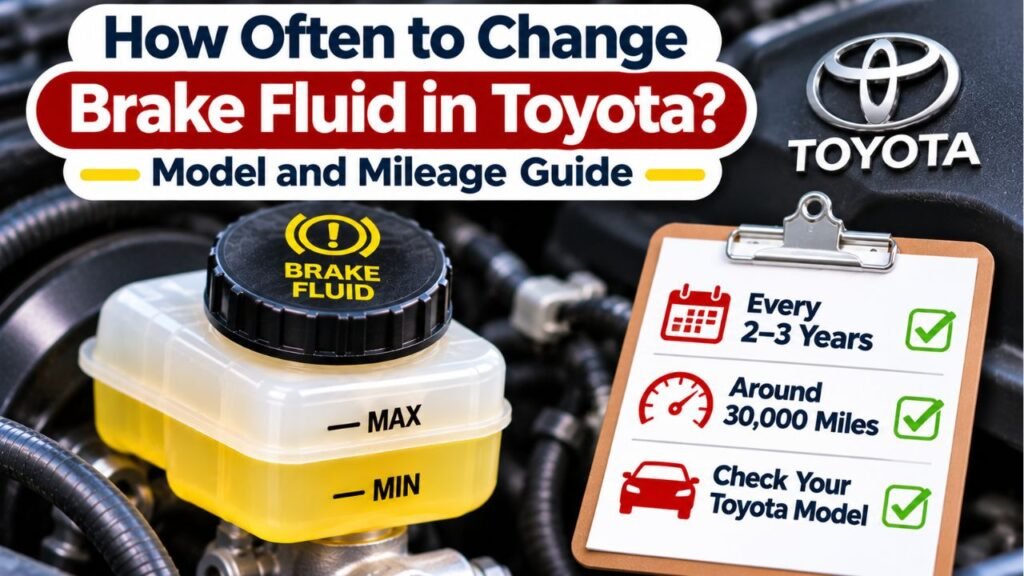
There is no single brake fluid replacement interval that applies to every Toyota. The correct schedule depends on the specific vehicle’s official maintenance guide.
Some Toyota maintenance schedules prescribe replacement at specific mileage intervals.
Others require regular inspection and recommend additional service when the condition of the fluid or braking system warrants it.
Toyota Brake Fluid Change Interval Chart
| Toyota Model or Example | Official Maintenance Guidance | Important Note |
| 2025 Toyota Camry, U.S. | Inspect fluid level and condition at 5,000-mile service intervals | No fixed replacement interval listed in the guide |
| 2025 Toyota GR Corolla, U.S. | Replace every 20,000 miles | A specific factory replacement requirement |
| 2025 Toyota Corolla LE CVT, Canada | Replace at 48,000 km and subsequent scheduled intervals | Canadian schedule; not interchangeable with U.S. guidance |
| Toyota RAV4 | Check exact model-year maintenance guide | U.S. schedules may emphasize condition-based inspections |
| Toyota Corolla, standard U.S. models | Check exact model-year maintenance guide | Do not apply the GR Corolla schedule automatically |
| Toyota Prius | Check model-year and market-specific schedule | Hybrid brake service procedures can differ |
| Toyota Highlander | Check exact maintenance guide | Interval depends on model and market |
| Toyota Tacoma | Check exact maintenance guide | Follow the factory schedule and inspection findings |
| Toyota 4Runner | Check exact maintenance guide | Driving conditions may influence service needs |
| Toyota Sienna | Check exact maintenance guide | Check manufacturer requirements for its braking system |
These examples illustrate why a blanket recommendation such as “Toyota brake fluid must be changed every 30,000 miles” can be misleading.
What Does Toyota Recommend for the 2025 Camry?
The official 2025 Toyota Camry Warranty & Maintenance Guide lists inspections of all fluid levels at each 5,000-mile maintenance interval.
A footnote specifies that this includes inspecting brake fluid level and condition.
The guide does not list a mandatory brake fluid replacement at a fixed mileage.
Toyota also notes that additional services may be recommended based on inspection results.
What Does Toyota Recommend for the 2025 GR Corolla?
The official 2025 Toyota GR Corolla Warranty & Maintenance Guide specifically lists brake fluid replacement at:
- 20,000 miles.
- 40,000 miles.
- 60,000 miles.
- 80,000 miles.
- 100,000 miles.
The chart continues with scheduled replacements at later intervals.
This is a clear example of a Toyota with a factory-specified brake fluid replacement schedule.
What About Toyota Models Sold in Canada?
Toyota’s Canadian maintenance schedules may prescribe different intervals.
For example, the official Toyota Canada 2025 Corolla LE CVT maintenance schedule lists brake fluid replacement at 48,000 km and again at 96,000 km.
The first replacement occurs at approximately three years in the example schedule.
This demonstrates that even vehicles sharing the Corolla name can have different maintenance requirements by market.
Key Takeaway: Check the exact Toyota maintenance guide for your vehicle. Some models specify a fixed replacement interval, while others rely on periodic inspections.
Should You Change Toyota Brake Fluid Every 2 or 3 Years?
For Toyota models without a fixed manufacturer replacement interval, a 2–3-year preventive service interval can be a practical maintenance strategy.
However, it is important to distinguish between a manufacturer’s requirement and a preventive recommendation.
Why Two Years Is Commonly Recommended
Brake fluid gradually absorbs moisture in normal use.
Environmental conditions, seal characteristics, fluid quality, and age influence how quickly the fluid changes.
Replacing conventional glycol-based fluid periodically can help maintain:
- Suitable boiling-point performance.
- Hydraulic system cleanliness.
- Corrosion protection.
- Reliable braking operation.
Some repair shops recommend replacement approximately every two years as a preventive measure.
However, Toyota does not universally prescribe a two-year interval for every model sold in the United States.
Is Three Years Too Long?
Not necessarily.
Some manufacturer schedules allow approximately three years between replacements.
The appropriate interval depends on the vehicle and its operating conditions.
For example, the Canadian 2025 Corolla schedule cited earlier includes replacement at 48,000 km, occurring at roughly three years in its illustrated schedule.
However, a vehicle driven in severe conditions may require earlier attention.
What if Toyota Doesn’t Specify a Replacement Interval?
If the official guide lists inspection but no fixed replacement schedule:
- Follow the required inspection intervals.
- Review any previous brake fluid service records.
- Ask a qualified technician to assess fluid condition.
- Consider moisture or boiling-point testing when appropriate.
- Discuss preventive replacement based on the fluid’s age and operating conditions.
A two- or three-year service interval may be reasonable for preventive maintenance, but it should not be presented as a mandatory Toyota requirement unless the relevant guide specifies it.
Does Mileage or Time Matter More?
Both can matter.
Mileage reflects how much the vehicle is used, but glycol-based brake fluid can absorb moisture even when the car is driven infrequently.
A low-mileage Toyota can therefore have aging brake fluid.
Likewise, demanding driving conditions can expose the braking system to greater heat and operational stress.
Key Takeaway: A preventive two- or three-year fluid change can make sense, but Toyota’s official schedule and the actual fluid condition should guide the decision.
Toyota Camry Brake Fluid Change Interval
The Toyota Camry is one of the most popular passenger cars in the United States.
Its brake fluid maintenance requirements depend on the model year.
2025 Toyota Camry
The 2025 U.S. Camry maintenance guide includes regular inspections of brake fluid level and condition.
The maintenance chart schedules these fluid inspections at 5,000-mile intervals.
It does not establish a fixed brake fluid replacement mileage.
Should You Replace Camry Brake Fluid Anyway?
Possibly.
Even without a fixed factory replacement requirement, a technician may recommend changing the fluid if:
- It contains excessive moisture.
- Its boiling-point performance is inadequate.
- The hydraulic system has been contaminated.
- Brake repairs require fluid replacement.
- Its condition raises other concerns.
How About Older Camry Models?
Do not assume every Camry generation follows the same schedule.
Maintenance requirements can change between model years and markets.
Check the guide supplied with your specific Camry.
Does a Hybrid Camry Need Brake Fluid Changes?
Yes, when required by its maintenance schedule or fluid condition.
Hybrid regenerative braking reduces the need for friction braking in some driving situations, but the vehicle still contains hydraulic braking components.
Brake fluid can age even when the friction brakes are used less frequently.
Toyota Corolla Brake Fluid Change Interval
Corolla brake fluid maintenance also varies by model and market.
Standard Toyota Corolla
Many U.S.-market Corolla maintenance schedules emphasize regular inspection of fluid levels and brake components.
However, the exact replacement requirement should be checked against the individual vehicle’s guide.
GR Corolla
The 2025 U.S.-market GR Corolla has a specific brake fluid replacement schedule of every 20,000 miles.
This is different from the inspection-focused schedule used by some standard Toyota models.
Canadian Corolla
The 2025 Canadian Corolla LE CVT example includes brake fluid replacement at 48,000 km.
This corresponds to approximately 29,826 miles.
However, do not apply that schedule automatically to a U.S.-market Corolla.
Why Are the Intervals Different?
Toyota determines maintenance requirements for specific vehicles and markets.
Factors can include:
- Brake system design.
- Vehicle application.
- Operating environment.
- Regional maintenance policies.
- Manufacturer testing.
- Model-specific engineering requirements.
The correct schedule is the one intended for the vehicle being serviced.
Key Takeaway: A standard Corolla, GR Corolla, and Canadian-market Corolla may not share the same brake fluid replacement interval.
Toyota RAV4 Brake Fluid Change Interval
The Toyota RAV4 is available in gasoline, hybrid, and plug-in hybrid configurations across different model years.
The braking systems and maintenance guidance can vary.
How Often Should RAV4 Brake Fluid Be Inspected?
Many recent U.S.-market RAV4 maintenance guides include inspection of brake fluid level and condition as part of regular service.
A 5,000-mile or six-month maintenance visit is a common opportunity to check the fluid.
However, inspection is not the same as scheduled replacement.
Does a RAV4 Need Brake Fluid Replacement Every 30,000 Miles?
Not automatically.
A dealership may recommend replacement based on age, condition, or preventive maintenance preferences.
That does not mean every RAV4 has a mandatory 30,000-mile replacement requirement.
Check the specific model-year guide.
What About the RAV4 Hybrid?
The RAV4 Hybrid still relies on a hydraulic braking system.
It also uses regenerative braking under suitable conditions.
Brake fluid maintenance remains important because hydraulic components still require suitable fluid.
Can RAV4 Brake Fluid Last Five Years?
It may remain serviceable for an extended period under some conditions, but age alone cannot establish safety.
Fluid condition should be assessed according to Toyota’s requirements.
Do not assume that a five-year-old fluid is automatically safe or unsafe without considering the vehicle’s service history and inspection findings.
Toyota Prius Brake Fluid Change Interval
The Prius uses regenerative braking alongside hydraulic braking.
Its brake system can differ significantly from a conventional gasoline-only vehicle.
Does Regenerative Braking Eliminate Brake Fluid Maintenance?
No.
Regenerative braking uses the electric drive system to recover energy during slowing.
However, the vehicle still needs hydraulic friction brakes.
Brake fluid remains essential for safe braking operation.
How Often Should Prius Brake Fluid Be Changed?
Follow the maintenance guide for the exact Prius model year and market.
Some U.S. schedules emphasize regular inspection rather than a universal mileage-based replacement.
If the fluid’s condition indicates replacement is necessary, the system should be serviced properly.
Are Prius Brake Fluid Changes Different?
They can be.
Certain Toyota hybrid brake systems contain electronically controlled hydraulic components and accumulators.
Replacing or bleeding fluid on these systems may require specific service procedures and diagnostic equipment.
Incorrect bleeding can leave air inside important hydraulic passages or cause system faults.
Should You Change Prius Brake Fluid Yourself?
For owners without appropriate training and equipment, professional brake fluid service is the safer choice.
Use the exact procedure for the specific Prius generation.
Key Takeaway: Prius brake fluid still requires maintenance, even though regenerative braking can reduce friction-brake use.
Toyota Highlander, Tacoma, 4Runner, and Sienna Brake Fluid Intervals
Toyota SUVs, trucks, and minivans also require model-specific maintenance.
Toyota Highlander
Check the Highlander’s Warranty & Maintenance Guide for the relevant model year.
The schedule may include periodic fluid inspections without a fixed replacement mileage.
Follow any specific requirements stated for your vehicle.
Toyota Tacoma
The Tacoma’s braking system may experience demanding conditions associated with towing, off-road use, or heavy loads.
However, these conditions do not justify inventing a universal brake fluid replacement interval.
Follow Toyota’s maintenance guidance and have the fluid inspected when needed.
Toyota 4Runner
A 4Runner used frequently in mountainous terrain or demanding conditions may expose the braking system to substantial heat.
The correct fluid specification and service schedule remain important.
Toyota Sienna
Sienna models may use hybrid braking technology depending on their generation.
Follow the appropriate maintenance guide and manufacturer-approved bleeding procedures.
Toyota Tundra
Tundra models may be used for towing and other demanding applications.
Regular brake inspections are important.
Brake fluid replacement should follow the official schedule and the results of appropriate condition checks.
Key Takeaway: Vehicle use can influence brake fluid condition, but the replacement interval should come from the correct Toyota maintenance guidance rather than a generic model-name assumption.
Why Does Toyota Brake Fluid Need Changing?
Brake fluid provides hydraulic pressure transmission and protects the braking system under demanding conditions.
However, conventional glycol-based brake fluid gradually changes with age and exposure to moisture.
Brake Fluid Absorbs Moisture
Most Toyota vehicles use glycol-based brake fluids such as DOT 3 or DOT 4, depending on the specific vehicle.
These fluids are hygroscopic, meaning they can absorb moisture.
Over time, moisture may enter through the hydraulic system’s normal exposure to the environment.
Moisture Can Lower the Boiling Point
Fresh brake fluid has a specified boiling-point performance.
As moisture content increases, the boiling point generally decreases.
This matters because braking generates heat.
Under demanding conditions, contaminated fluid can become more vulnerable to vapor formation.
Vapor Can Reduce Braking Performance
Brake fluid is designed to transmit hydraulic pressure efficiently.
Vapor compresses much more easily than liquid.
If vapor forms inside the hydraulic system, the brake pedal may feel soft or spongy.
Braking performance can also decrease.
Corrosion Can Develop
Moisture contamination may contribute to corrosion inside hydraulic components.
Potentially affected parts include:
- Master cylinders.
- Brake calipers.
- Wheel cylinders.
- Hydraulic control units.
- Brake pipes and fittings.
Internal corrosion can create long-term maintenance problems.
Fluid Can Become Contaminated
Brake fluid may also accumulate contaminants from deteriorating seals or other components.
However, contamination should be assessed through proper inspection rather than color alone.
Key Takeaway: Brake fluid replacement helps maintain suitable hydraulic performance and reduce the risks associated with moisture and contamination.
Signs Your Toyota Needs a Brake Fluid Change
Some brake fluid problems produce symptoms, while others develop without noticeable changes in normal driving.
1. Excessive Moisture Content
A technician may find that the fluid contains excessive moisture.
This can support a recommendation for replacement.
However, moisture-test results must be interpreted according to the test method and vehicle requirements.
2. Reduced Boiling-Point Performance
A suitable boiling-point test can help evaluate the fluid’s thermal performance.
Fluid with inadequate boiling-point performance should be replaced according to the appropriate service procedure.
3. Contaminated Brake Fluid
Fluid containing unwanted debris or incompatible substances may require replacement and further inspection.
If petroleum-based fluid has entered the brake system, replacing the liquid alone may not be sufficient.
4. Soft or Spongy Brake Pedal
A soft pedal can indicate air in the hydraulic system or another brake problem.
However, it is not proof that the brake fluid simply needs routine replacement.
A hydraulic leak, damaged component, or other fault may be responsible.
5. Brake Pedal Sinking Toward the Floor
This is a serious warning sign.
A sinking pedal can indicate hydraulic pressure loss.
Do not continue driving.
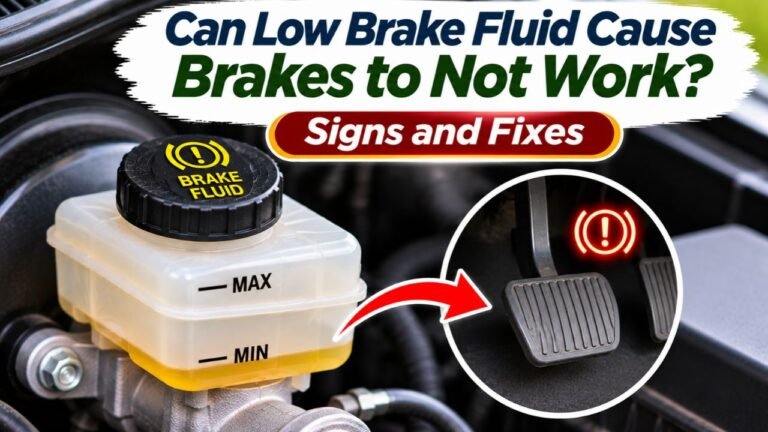
6. Brake Warning Light
A red brake warning light may indicate low fluid or another braking system problem.
Check the vehicle’s owner’s manual for the exact meaning.
Do not assume the light is only a reminder to change brake fluid.
7. Unknown Brake Fluid Service History
If you purchase a used Toyota and cannot determine when the brake fluid was last replaced, arrange an inspection.
A preventive change may be reasonable depending on the vehicle’s schedule and condition.
8. Fluid Leakage
A falling fluid level can indicate brake wear or a hydraulic leak.
A leak requires diagnosis and repair.
Simply flushing or topping up the fluid does not fix a leaking component.
Warning Signs Table
| Symptom | Possible Cause | What to Do |
| Brake fluid fails condition test | Moisture or other degradation | Replace as recommended |
| Dark fluid | Aging or contamination may be present | Inspect; color alone is inconclusive |
| Soft brake pedal | Air or hydraulic fault | Do not drive until assessed |
| Sinking brake pedal | Potential hydraulic pressure failure | Stop driving and arrange towing |
| Low reservoir level | Pad wear or leak | Inspect braking system |
| Fluid leak | Damaged hydraulic component | Repair before driving |
| Red brake warning light | Low fluid or system fault | Follow owner’s manual; stop safely |
| Unknown service history | Maintenance uncertainty | Inspect fluid and service records |
Key Takeaway: Brake fluid may need replacement before obvious symptoms appear. However, serious pedal problems require diagnosis, not just a fluid flush.
How to Check Toyota Brake Fluid Condition
A basic visual inspection can help determine whether your Toyota needs further attention.
However, checking reservoir level is not the same as measuring fluid condition.
Step 1: Park on Level Ground
Park safely and turn off the vehicle.
Follow the owner’s manual for the correct inspection conditions.
Step 2: Locate the Reservoir
The brake fluid reservoir is normally in the engine compartment.
Its exact position depends on the model.
On some Toyota hybrids, the reservoir and related brake components may be arranged differently from conventional vehicles.
Use the owner’s manual to confirm the location.
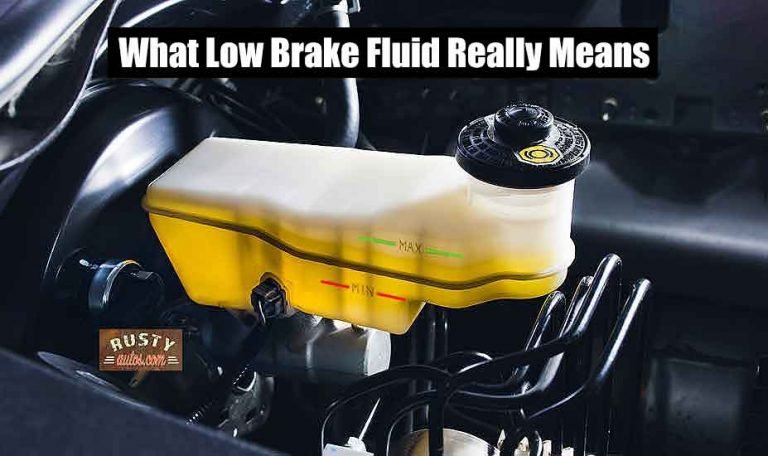
Step 3: Check the MIN and MAX Markings
Most reservoirs have minimum and maximum level markings.
Check the fluid level through the translucent container when possible.
Do not open the reservoir cap unnecessarily.
Step 4: Check for Unexpected Changes
A gradual decrease may occur as brake pads wear.
However, a sudden reduction or repeated need for fluid can indicate a leak.
Do not assume low fluid automatically means it is time for a routine flush.
Step 5: Inspect the Fluid’s Appearance
Brake fluid may become darker with age.
However, color is not a reliable measurement of moisture content or boiling point.
A fluid can look relatively clean while its performance has deteriorated.
Step 6: Ask for an Appropriate Fluid Test
A technician may use suitable equipment to assess brake fluid condition.
Possible approaches include:
- Moisture testing.
- Boiling-point testing.
- Inspection for contamination.
- Assessment of service history.
Some inexpensive electronic testers provide only an indirect indication of fluid condition.
Their results should not be treated as definitive without considering the test method and manufacturer guidance.
Step 7: Follow the Service Recommendation
If the official Toyota schedule requires replacement, perform it at the specified interval.
If the guide requires inspection, use the results and a qualified technician’s assessment to decide when replacement is needed.
Key Takeaway: The reservoir level, fluid color, and fluid age provide clues, but the correct maintenance decision also depends on manufacturer guidance and actual fluid condition.
Does Toyota Brake Fluid Go Bad Even if You Don’t Drive?
Yes, brake fluid can age while the vehicle is parked.
Mileage is not the only factor affecting condition.
Why Time Matters
Glycol-based brake fluid can gradually absorb moisture.
A Toyota driven only a few thousand miles per year may still develop moisture contamination.
Does Storage Prevent Brake Fluid Aging?
Not completely.
Keeping a vehicle in a dry garage may reduce some environmental exposure, but it does not guarantee that brake fluid remains in perfect condition indefinitely.
What About a Toyota Stored for Several Years?
Before returning a long-stored vehicle to service, have the braking system inspected.
The inspection may include:
- Brake fluid condition.
- Hydraulic leaks.
- Corroded lines.
- Caliper operation.
- Brake hoses.
- Brake pads and rotors.
A vehicle may require additional maintenance beyond a fluid replacement.
Should Low-Mileage Owners Change Fluid Every Two Years?
That may be a reasonable preventive approach, but it depends on the Toyota’s specified maintenance schedule and fluid condition.
Do not skip a required time-based replacement simply because the odometer shows little mileage.
Key Takeaway: Low mileage does not guarantee healthy brake fluid. Time and storage conditions also matter.
Should Toyota Brake Fluid Be Changed More Often in Hot or Humid Weather?
Environmental conditions can affect brake fluid and overall braking-system performance.
However, the correct maintenance adjustment depends on the vehicle and its official service guidance.
Humid Environments
Conventional glycol-based brake fluid can absorb moisture.
High environmental humidity may increase the importance of monitoring fluid condition.
However, climate alone does not establish a precise replacement interval for every Toyota.
Mountain Driving
Frequent downhill braking can produce substantial heat.
Brake fluid with reduced boiling-point performance may be less suitable for demanding braking conditions.
Correct gear selection and braking technique also matter.
Towing and Heavy Loads
Towing can place greater demands on the braking system.
A qualified technician may recommend additional inspections based on how the vehicle is used.
Stop-and-Go Traffic
Frequent braking produces repeated heat cycles.
However, ordinary urban driving does not automatically mean every Toyota needs a brake fluid flush at a specific shortened mileage.
Coastal and Salt-Exposure Conditions
Coastal environments and road salt can contribute to corrosion of exposed braking components.
Brake pipes, hoses, fittings, and related parts deserve attention during inspections.
Should You Use a Universal Severe-Service Interval?
No.
Some manufacturer schedules specify special operating conditions.
Others require inspections without changing the brake fluid replacement interval.
Follow the guidance for the exact vehicle.
What Brake Fluid Does Toyota Use?
Toyota brake fluid specifications depend on the vehicle model and year.
Many Toyota vehicles specify DOT 3 or DOT 4 glycol-based brake fluid.
However, you should not assume all models use the same fluid.
DOT 3 Brake Fluid
DOT 3 is commonly used in hydraulic brake systems.
Its minimum standardized dry boiling point is 401°F (205°C).
Its minimum wet boiling point is 284°F (140°C).
DOT 4 Brake Fluid
DOT 4 has higher minimum boiling-point requirements than DOT 3.
Its minimum dry boiling point is 446°F (230°C), and its minimum wet boiling point is 311°F (155°C).
However, DOT 4 is not automatically the correct fluid for every Toyota that specifies DOT 3.
DOT 4 Low-Viscosity Fluids
Some modern braking systems require particular low-temperature viscosity characteristics.
The relevant fluid may need to satisfy an additional manufacturer specification.
A standard DOT 4 product does not automatically meet every specialized low-viscosity requirement.
What About DOT 5?
DOT 5 is silicone-based and should not be mixed with conventional glycol-based DOT 3, DOT 4, or DOT 5.1 brake fluids.
It is not a universal upgrade.
How Do You Find the Correct Fluid?
Check:
- Your Toyota owner’s manual.
- The brake fluid reservoir cap.
- The specified DOT classification.
- Any additional Toyota performance requirements.
Do not choose brake fluid based only on the model name.
Key Takeaway: Use the exact fluid specification required for your Toyota. A higher DOT number does not automatically mean better compatibility.
Toyota Brake Fluid Change vs. Brake Fluid Flush
The terms brake fluid change and brake fluid flush are often used interchangeably, but they can describe different service methods.
What Is a Brake Fluid Change?
A proper brake fluid replacement removes old fluid from the hydraulic system and introduces suitable fresh fluid according to the vehicle’s service procedure.
The process typically involves moving fresh fluid through the hydraulic circuits.
What Is a Brake Fluid Flush?
A brake fluid flush generally refers to replacing the old fluid throughout the braking system.
The service may use pressure bleeding or another manufacturer-approved method.
The exact procedure depends on the brake system design.
Is Removing Fluid From the Reservoir Enough?
No.
Removing fluid only from the reservoir does not replace all the fluid inside:
- Brake lines.
- Calipers.
- Wheel cylinders.
- Hydraulic control components.
A complete service must follow the applicable hydraulic procedure.
Is Brake Bleeding the Same as a Fluid Flush?
Not exactly.
Brake bleeding primarily removes air from the hydraulic system.
A fluid replacement procedure may also involve bleeding to remove old fluid and ensure that no air remains.
However, the service objectives are not always identical.
Does Every Toyota Need a Machine Flush?
No.
The appropriate procedure depends on the vehicle.
Some systems can be serviced using conventional bleeding equipment.
Other Toyota models, particularly certain hybrids, may require specialized service steps.
Always follow the Toyota repair manual.
Key Takeaway: A proper brake fluid replacement addresses fluid throughout the applicable hydraulic circuits, not just the reservoir.
How Is Toyota Brake Fluid Changed?
Brake fluid service must be performed carefully because mistakes can affect braking safety.
The exact procedure varies by model.
Step 1: Confirm the Correct Fluid
The technician identifies the required fluid specification using Toyota’s service information.
Step 2: Inspect the Brake System
Before replacing fluid, the technician checks for signs of:
- Hydraulic leaks.
- Damaged hoses.
- Corrosion.
- Brake component problems.
- Contamination.
A significant hydraulic defect must be repaired.
Step 3: Prepare the Vehicle
The vehicle is prepared according to the manufacturer’s procedure.
Some Toyota hybrid systems have specific requirements for disabling or controlling electronically managed brake components.
Step 4: Replace the Old Fluid
The technician removes the old fluid using a suitable method and introduces the specified replacement fluid.
The reservoir level is maintained appropriately during the procedure.
Step 5: Bleed the Hydraulic Circuits
Air is removed according to the correct sequence and service procedure.
Certain ABS systems may require additional steps.
Step 6: Check the Reservoir Level
The correct fluid level is established according to the Toyota instructions.
Step 7: Inspect for Leaks
The hydraulic system is checked for proper sealing.
Step 8: Verify Brake Operation
The technician checks brake pedal response and the system’s operation before returning the vehicle to service.
Can You Change Toyota Brake Fluid Yourself?
Some conventional brake systems can be serviced by experienced owners with proper tools.
However, brake fluid replacement is safety-critical work.
Toyota hybrids and other electronically controlled brake systems can require specialized procedures or diagnostic equipment.
For drivers unfamiliar with hydraulic brake service, professional maintenance is the safer option.
How Much Does a Toyota Brake Fluid Change Cost?
Brake fluid replacement pricing depends on the vehicle, service provider, location, and braking-system design.
There is no single fixed price for every Toyota.
What Affects the Cost?
Common factors include:
- Vehicle model.
- Brake fluid specification.
- Labor rates.
- Whether specialized bleeding equipment is needed.
- Hydraulic-system complexity.
- Whether other brake repairs are required.
Dealer vs. Independent Mechanic
A Toyota dealership may have direct access to model-specific service information and diagnostic tools.
An independent repair shop may also perform the service properly when equipped and trained for the particular vehicle.
Compare service descriptions rather than choosing only by price.
What Should the Quote Include?
Ask whether the quote covers:
- Correct brake fluid.
- Replacement throughout the required circuits.
- Proper bleeding.
- Fluid disposal.
- Brake-system inspection.
- Additional required service procedures.
Is the Service Worth Paying For?
Yes, when replacement is required by the maintenance schedule or fluid condition.
Brake fluid plays an essential role in hydraulic braking.
However, a shop should be able to explain why replacement is recommended if the manufacturer’s schedule does not prescribe a fixed interval.
Key Takeaway: Compare the actual service procedure, not just the quoted price. An inspection-based recommendation should be supported by a clear reason.
Can You Wait Longer Than Toyota’s Brake Fluid Change Interval?
If your Toyota specifies a fixed replacement interval, follow it.
Delaying required brake maintenance may increase the risk of deterioration or reduced performance.
What If the Fluid Still Looks Clean?
Appearance alone cannot establish fluid condition.
A fluid may contain moisture even when its color is relatively clear.
What If You Don’t Drive Much?
Brake fluid can age with time.
If the maintenance schedule includes a time limit, do not ignore it because mileage is low.
What If Toyota Doesn’t List a Fixed Interval?
In that case, continue following the official inspection schedule.
Use a technician’s findings, service records, and fluid-condition testing when appropriate to decide whether replacement is necessary.
Can Brake Fluid Last the Lifetime of the Car?
Do not assume so.
Even if a particular U.S. Toyota maintenance chart does not specify a fixed replacement interval, that does not mean the fluid is guaranteed to remain serviceable forever.
Fluid condition and hydraulic-system health still require monitoring.
Can You Just Add Brake Fluid Instead of Changing It?
No. Topping up the reservoir and replacing the fluid serve different purposes.
What Does Topping Up Do?
Adding brake fluid increases the amount of fluid in the reservoir.
It does not remove accumulated moisture or contaminants from the hydraulic system.
Why Does the Fluid Level Drop?
The level may decrease because:
- Brake pads wear.
- Brake caliper pistons extend.
- Hydraulic components leak.
- A previous service affected the fluid quantity.
Is a Gradual Level Drop Normal?
As brake pads wear thinner, the caliper pistons remain extended farther.
More fluid moves from the reservoir into the calipers.
This can gradually reduce the visible reservoir level without any external leak.
Should You Always Top Up to MAX?
Not automatically.
Adding fluid without considering brake pad wear can create an overfilled condition when caliper pistons are retracted during pad replacement.
The reason for the lower level should be identified first.
What If the Fluid Keeps Disappearing?
A continuing drop may indicate a hydraulic leak.
Do not repeatedly add fluid and continue driving.
Have the system inspected.
Key Takeaway: Topping up is not a substitute for proper fluid replacement, and unexplained fluid loss is not a routine maintenance issue.
Common Mistakes When Maintaining Toyota Brake Fluid
1. Assuming Every Toyota Needs a Change Every 30,000 Miles
Toyota schedules vary.
The 2025 U.S. Camry guide emphasizes inspections, while the 2025 GR Corolla specifies replacement every 20,000 miles.
Always check the correct guide.
2. Confusing Inspection With Replacement
Inspecting the fluid level and condition is not the same as changing the fluid.
Pay attention to the actual maintenance action specified.
3. Applying a Canadian Schedule to a U.S. Vehicle
The same model name may have different maintenance schedules in different markets.
Use documentation for the vehicle’s original market.
4. Ignoring Time-Based Maintenance
Low mileage does not prevent brake fluid from aging.
Follow any applicable time-based requirement.
5. Assuming Dark Fluid Automatically Needs Replacement
Color can provide a clue, but it is not a definitive test of fluid quality.
6. Ignoring a Soft Brake Pedal
A soft or sinking pedal may indicate air, leakage, or another hydraulic problem.
Do not assume a routine flush is the only repair required.
7. Using the Wrong Brake Fluid
Toyota models have specific fluid requirements.
Do not substitute incompatible fluid types.
8. Replacing Only the Reservoir Fluid
Removing fluid from the reservoir does not constitute a complete hydraulic fluid replacement.
9. Improperly Bleeding a Hybrid Brake System
Some Toyota hybrids use electronically controlled braking systems.
Incorrect procedures can create safety problems.
10. Changing Fluid Without Checking for Leaks
A leak must be repaired.
Fresh fluid alone cannot restore the integrity of a damaged hydraulic circuit.
11. Using Old Brake Fluid From an Open Bottle
Glycol-based brake fluid absorbs moisture.
Use appropriate fresh fluid from a properly sealed container.
12. Treating a Dealer Recommendation as a Universal Factory Requirement
Dealerships may recommend additional preventive maintenance.
However, that recommendation should be distinguished from Toyota’s officially prescribed schedule.
How to Find Your Toyota’s Exact Brake Fluid Maintenance Schedule
The most reliable method is to use the correct Warranty & Maintenance Guide for your vehicle.
Step 1: Identify Your Toyota
Record:
- Model name.
- Model year.
- Trim or variant.
- Gasoline, hybrid, or plug-in hybrid configuration.
- Original sales market.
For example, a 2025 Corolla LE and a 2025 GR Corolla are different vehicles with different maintenance requirements.
Step 2: Find the Official Toyota Documentation
For U.S.-market vehicles, use Toyota’s owner resources and the Warranty & Maintenance Guide associated with the model.
For Canadian vehicles, use the appropriate Toyota Canada maintenance schedule.
Step 3: Search for Brake Fluid
Look for entries such as:
- Brake Fluid.
- All Fluid Levels.
- Inspect Brake Fluid Level/Condition.
- Replace Brake Fluid.
- Brake Lines and Hoses.
Step 4: Understand the Maintenance Symbols
Toyota maintenance charts commonly use letters such as:
| Symbol | Meaning |
| I | Inspect |
| R | Replace |
| C | Clean |
| T | Tighten or torque |
| P | Perform |
The exact legend is printed in the guide.
Step 5: Check Special Operating Conditions
Some maintenance items have additional requirements for particular driving conditions.
Read the footnotes rather than relying only on the main chart.
Step 6: Review Previous Service Records
Check whether the fluid has already been changed.
Keep records of the date, mileage, and fluid used.
Step 7: Ask for a Condition Assessment
If the guide does not specify a fixed replacement interval, have the fluid inspected during scheduled maintenance.
Ask the technician to explain any recommendation for replacement.
Key Takeaway: The correct Toyota maintenance guide is more reliable than a generic brake fluid interval found online.
Conclusion
So, how often should you change brake fluid in a Toyota? The answer depends on the model, model year, and market. There is no universal Toyota replacement interval.
For example, the 2025 U.S. Camry maintenance guide calls for regular brake fluid inspections without establishing a fixed replacement mileage.
The 2025 U.S. GR Corolla requires brake fluid replacement every 20,000 miles, while a 2025 Canadian Corolla maintenance schedule lists replacement at 48,000 km.
For a Toyota without a specified replacement interval, a preventive change every 2–3 years can be a reasonable maintenance option, particularly when driving conditions or inspection results justify it. However, that interval should not be confused with a universal Toyota factory requirement.
Brake fluid can absorb moisture over time, potentially reducing its boiling point and contributing to corrosion.
Inspect the fluid regularly, use the manufacturer-specified grade, and address any hydraulic leaks or abnormal brake pedal behavior promptly.
The best approach is to follow your Toyota’s official maintenance schedule and use fluid-condition findings to decide whether additional service is necessary.
FAQs About How Often to Change Brake Fluid Toyota
How Often Does Toyota Recommend Changing Brake Fluid?
Toyota’s recommendation depends on the model and market.
The 2025 U.S. Camry guide calls for regular fluid inspections without a fixed replacement mileage.
The 2025 U.S. GR Corolla guide specifies replacement every 20,000 miles.
Check the correct maintenance guide for your vehicle.
Does Toyota Recommend Brake Fluid Change Every Two Years?
Not for every model.
Some Toyota vehicles have fixed time- or mileage-based requirements, while others use inspection-based maintenance.
A two-year change may be a preventive recommendation, but it is not a universal Toyota factory interval.
Can Toyota Brake Fluid Last Three Years?
It may, depending on the vehicle and conditions.
Some Toyota maintenance schedules include replacement around three years.
However, a fluid’s condition cannot be determined by age alone.
Follow the applicable schedule and inspection guidance.
How Often Should Toyota Camry Brake Fluid Be Changed?
For the 2025 U.S. Camry, Toyota specifies regular inspections of fluid level and condition rather than a fixed brake fluid replacement interval.
Other model years or markets may differ.
Use the exact maintenance guide.
How Often Should Toyota Corolla Brake Fluid Be Changed?
It depends on the Corolla version and market.
The 2025 U.S. GR Corolla specifies replacement every 20,000 miles.
A 2025 Canadian Corolla LE CVT schedule lists replacement at 48,000 km.
Do not assume those intervals apply to every Corolla.
How Often Should Toyota RAV4 Brake Fluid Be Changed?
Check the RAV4 maintenance guide for the specific model year and market.
Many recent U.S. schedules emphasize periodic brake fluid inspections.
Replacement may be recommended based on condition even where no fixed mileage is listed.
How Often Should Toyota Prius Brake Fluid Be Changed?
Follow the exact Prius maintenance guide.
The appropriate interval may depend on model year and market.
Certain Prius brake systems also require specialized bleeding procedures during fluid replacement.
Do Toyota Hybrids Need Brake Fluid Changes?
Yes, when required by the manufacturer’s schedule or the fluid’s condition.
Regenerative braking does not eliminate hydraulic brake components or prevent brake fluid from aging.
Is 30,000 Miles Too Long for Toyota Brake Fluid?
It depends on the model.
Thirty thousand miles would exceed the specified 20,000-mile replacement interval for a 2025 U.S. GR Corolla.
However, some other Toyota models do not prescribe a fixed replacement mileage.
Follow the correct schedule.
Does Toyota Brake Fluid Need Changing if It Looks Clean?
Possibly.
Brake fluid can absorb moisture without developing an obvious color change.
Visual appearance alone does not establish whether fluid replacement is necessary.
What Happens if You Never Change Toyota Brake Fluid?
Over time, conventional brake fluid may accumulate moisture and contaminants.
This can reduce boiling-point performance and contribute to corrosion.
The rate of deterioration varies, but brake fluid should be maintained according to the manufacturer’s guidance.
What Brake Fluid Does a Toyota Use?
Many Toyota vehicles use DOT 3 or DOT 4, but the exact specification varies.
Some models have additional requirements.
Always check the owner’s manual or reservoir cap.
Can I Use DOT 4 Instead of DOT 3 in My Toyota?
Only when it meets the vehicle’s requirements and is permitted by the manufacturer.
Although DOT 3 and DOT 4 are generally glycol-based and chemically compatible, they are not automatically interchangeable in every application.
Can I Change Toyota Brake Fluid Myself?
Some conventional Toyota hydraulic systems can be serviced by experienced owners using appropriate tools and procedures.
However, certain hybrid and electronically controlled brake systems require specialized equipment.
Professional servicing is recommended when the procedure is unfamiliar.
How Much Does a Toyota Brake Fluid Flush Cost?
The price depends on the model, location, labor rates, and service complexity.
Hybrid systems may require additional procedures.
Request a quote identifying the correct fluid and complete hydraulic service.
Is a Brake Fluid Flush Necessary on a Toyota?
It is necessary when the manufacturer’s schedule requires replacement or when fluid condition or service circumstances justify it.
A fixed flush interval should not be assumed for every Toyota.
Can I Just Top Up Toyota Brake Fluid?
Topping up is not a substitute for replacing old or contaminated fluid.
Also, low fluid may indicate worn brake pads or a hydraulic leak.
Find the cause before adding fluid.
Does Low Brake Fluid Mean I Need a Flush?
Not necessarily.
Low fluid can result from brake pad wear or a leak.
The hydraulic system should be inspected before deciding whether a flush or another repair is required.
How Do I Know if My Toyota Brake Fluid Is Bad?
A qualified technician can inspect the fluid and use appropriate testing methods.
Excessive moisture, reduced boiling-point performance, or contamination may justify replacement.
However, pedal problems or leakage require broader brake-system diagnosis.
Can I Drive My Toyota if the Brake Fluid Is Low?
If the level is below the specified minimum, a leak is suspected, or the pedal feels abnormal, do not drive.
Arrange professional inspection and towing when necessary.
Adding fluid does not repair a hydraulic failure.