Ceramic vs Metallic Brake Pads: Which Type Is Better for You?
Ceramic pads are usually the stronger choice for quiet daily driving, cleaner wheels, smooth braking, and lower rotor wear. Semi-metallic pads often suit vehicles exposed to repeated hard braking, heavy loads, fleet duty, or performance driving because their formulations can handle demanding braking conditions well. The correct choice still depends on the vehicle and pad design.
Both types use engineered friction material bonded to a steel backing plate, but their formulations are different. Ceramic pads rely heavily on ceramic fibers and fillers, while semi-metallic pads contain a larger percentage of metallic material mixed with binders and friction modifiers.
The term metallic brake pads usually refers to semi-metallic brake pads in normal passenger-vehicle discussions. Fully metallic or sintered friction materials belong to more specialized applications and should not be confused with common street pads.
For ceramic vs metallic brake pads, ceramic usually wins for noise, wheel cleanliness, and everyday comfort. Semi-metallic pads often have an advantage when the brake system sees repeated high loads or severe service. Wagner describes ceramic pads as quiet, low-dust, and long-lasting, while its severe-duty semi-metallic formulations are built around extreme heat, frequent stops, towing, and heavy payloads.
Brake-pad chemistry is changing in the United States too. Under the Better Brake standards described by Wagner, Level N friction material contains less than 0.5% copper by weight, with the zero-copper requirement taking effect in 2025. Modern ceramic and semi-metallic formulas may therefore differ substantially from older pads carrying the same broad material label.
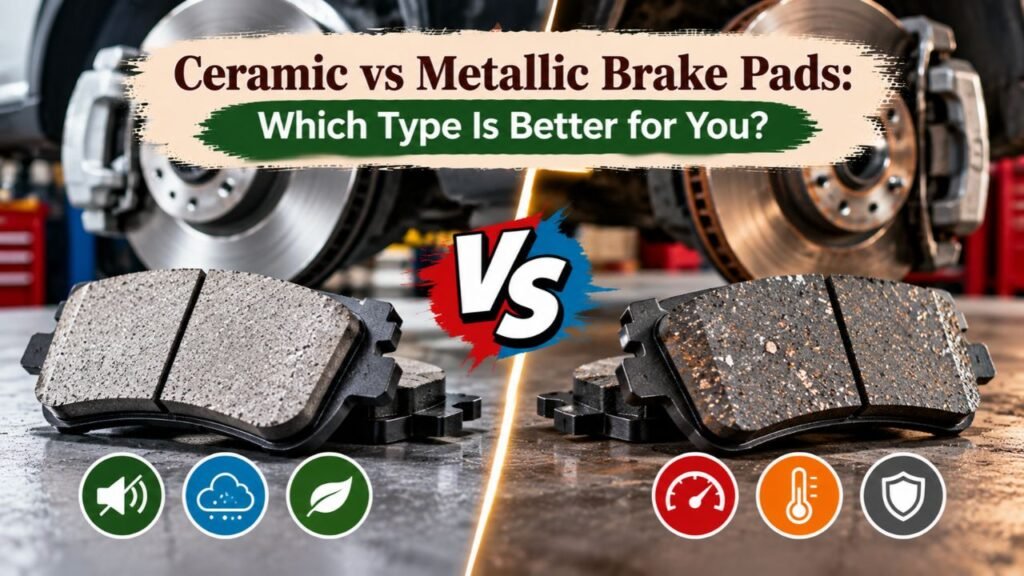
This comparison covers stopping feel, dust, noise, heat, rotor wear, pad life, towing, performance driving, cost, and the situations where matching the original equipment specification matters more than simply choosing ceramic or metallic.
Ceramic vs Metallic Brake Pads: Main Differences
The broad differences are easiest to see side by side.
| Feature | Ceramic Brake Pads | Semi-Metallic Brake Pads |
| Everyday driving | Excellent | Excellent |
| Brake noise | Usually lower | Usually higher |
| Visible brake dust | Usually lower | Usually higher |
| Dust color | Lighter | Often darker |
| Rotor wear | Generally lower | Can be higher |
| Pad life | Often long | Good, application-dependent |
| Heat handling | Strong | Strong, especially in severe-duty formulas |
| Heavy-duty use | Formula-dependent | Common choice |
| Towing | Good with towing-specific formulas | Strong choice with severe-duty formulas |
| Track use | Street ceramic usually not ideal | Performance metallic formulas more common |
| Pedal/bite character | Often smooth | Often firmer or more aggressive |
| Cost | Commonly higher | Often lower to moderate |
| Best fit | Commuting and comfort | Demanding service and high-load use |
These are category-level tendencies, not guarantees.
A premium ceramic pad engineered for a truck can outperform a basic semi-metallic pad in demanding service. A severe-duty semi-metallic pad can also be quieter and cleaner than an inexpensive metallic pad.
The exact friction formulation matters as much as the label printed on the box.
What Are Ceramic Brake Pads?
Ceramic brake pads use a ceramic-based friction compound reinforced with other materials and binders.
Older ceramic formulas often used copper fibers to control heat and friction characteristics. Modern low-copper and zero-copper requirements have pushed manufacturers toward updated formulations.
Ceramic Pads Produce Less Visible Dust
One of their biggest advantages is wheel cleanliness.
Tire Rack notes that ceramic friction materials produce lighter-colored dust that is less noticeable and less likely to stick heavily to wheels than typical semi-metallic dust.
PowerStop also reports that ceramic pads generally create less visible dust than semi-metallic formulas.
That makes ceramic attractive for vehicles with:
- Large alloy wheels
- Light-colored wheels
- Detailed or polished wheels
- Frequent city driving
All brake pads create wear debris. “Low dust” does not mean dust-free.
Ceramic Pads Are Usually Quieter
Ceramic friction material is commonly selected for low noise.
Bosch lists quieter braking as one of the main advantages of ceramic pads compared with organic and semi-metallic types.
Akebono also builds its ceramic replacement lines around reduced noise, smooth stops, and low rotor wear.
Shims, chamfers, slots, caliper condition, lubrication, rotor finish, and installation quality still influence brake noise.
A ceramic pad cannot fix a sticking caliper or badly worn rotor.
Ceramic Pads Are Often Easier on Rotors
Semi-metallic material contains harder metallic components that can be more abrasive to the disc.
Wagner states that semi-metallic pads can cause more aggressive rotor wear than ceramic pads.
Tire Rack makes a similar distinction, noting that steel fibers in semi-metallic compounds can increase rotor wear.
Less rotor wear may reduce the chance that rotors need replacement solely from friction-material abrasion, though corrosion, overheating, thickness variation, and normal service wear still matter.
Key Takeaway: Ceramic pads are strongest where quiet operation, low visible dust, smooth braking, and reduced rotor wear matter most.
What Are Semi-Metallic Brake Pads?
Semi-metallic pads mix substantial metallic content with friction modifiers, fillers, and resin.
PowerStop describes semi-metallic pads as containing roughly 30% to 65% metal, which may include steel, copper, wire, graphite, or similar materials.
Modern low-copper rules have changed the exact recipes, so steel, carbon, ceramics, and other friction technologies may now carry more of the workload once handled by copper.
Semi-Metallic Pads Handle Demanding Use Well
This category has a long history in:
- Trucks
- Performance cars
- Fleet vehicles
- Police vehicles
- Commercial vehicles
- Towing applications
Wagner’s severe-duty pads use a semi-metallic carbon-based formulation engineered for extreme heat, frequent stopping, gear hauling, and heavy payloads.
That does not mean every semi-metallic pad is automatically a severe-duty pad.
A replacement pad should still be selected by vehicle and operating category.
Semi-Metallic Pads Can Feel More Aggressive
Drivers sometimes describe quality semi-metallic pads as having stronger initial bite.
That sensation comes from friction characteristics, pad formula, rotor pairing, temperature, booster calibration, and vehicle design rather than metal content alone.
A driver moving from a comfort-focused ceramic compound to a performance-oriented semi-metallic formula may notice a firmer response.
That does not automatically mean the car stops in a shorter distance.
Tires, ABS calibration, road grip, rotor size, brake balance, and the friction curve all contribute to actual stopping distance.
Semi-Metallic Pads Usually Make More Dust
The tradeoff for their demanding-service capability can be wheel dust.
PowerStop states that semi-metallic pads generally create more dust than ceramic pads, and that the dust tends to be darker and more noticeable on wheels.
Wagner also lists higher dust output among the disadvantages of semi-metallic friction material.
Semi-Metallic Pads Can Be Noisier
Metallic friction compounds can transmit more vibration and sound.
Quality pads reduce this through:
- Multilayer shims
- Chamfers
- Slots
- Vehicle-specific friction formulations
- Proper hardware
A premium semi-metallic pad can still be very quiet.
The material category simply gives ceramic an advantage in this area on average.
Key Takeaway: Semi-metallic pads are well suited to demanding braking conditions and heavy service, but they commonly create more noise, visible dust, and rotor wear than ceramic alternatives.
Which Brake Pads Stop Better?
There is no sound rule that says all ceramic pads stop better or all metallic pads stop better.
Friction material is engineered for the vehicle.
Bosch notes that brake-pad friction material is selected with the brake-disc material and specific vehicle application in mind.
For normal street driving, quality ceramic and semi-metallic pads designed for the vehicle can both provide strong braking.
The difference is more likely to appear in:
- Pedal feel
- Initial bite
- Noise
- Dust
- Repeated high-temperature braking
- Wear characteristics
A budget semi-metallic pad should not be assumed to outperform an OE-grade ceramic pad simply because it contains metal.
Likewise, a comfort-oriented ceramic pad should not be assumed to outperform a severe-duty or track-focused friction compound during repeated hard stops.
For a road vehicle, fitting the correct pad for the brake system is more useful than chasing one friction material by name.
Ceramic vs Metallic Brake Pads for Heat and Brake Fade
Braking turns vehicle motion into heat.
Managing that heat is central to repeated braking performance.
Ceramic Pads Have Strong Temperature Stability
Bosch describes ceramic brake pads as having stable braking across a broad temperature range and good heat dissipation.
Wagner also notes that ceramic friction can disperse heat well.
This makes quality ceramic pads perfectly capable for normal road use, highway braking, and stop-and-go commuting.
Semi-Metallic Formulas Are Common in Severe-Duty Applications
Manufacturers frequently use semi-metallic or hybrid metallic compounds for vehicles exposed to:
- Frequent heavy stops
- High payloads
- Commercial operation
- Fleet use
- Severe-duty braking
Wagner’s SD semi-metallic pads are specifically tested around extreme heat and heavy loads.
Its police-pursuit pads use a hybrid blend incorporating metallic, carbon, and ceramic technologies and are tested up to 1,000°F for extreme use.
That example also shows why broad labels have limits. Modern performance pads often combine several material technologies rather than fitting neatly into one category.
Key Takeaway: Both materials can manage heat well, but demanding fleet and performance applications often use semi-metallic or hybrid formulas engineered specifically for repeated high-temperature braking.
Which Pads Are Better for Daily Driving?
Ceramic is often the more appealing option for an ordinary commuter.
Daily street driving usually puts a premium on:
- Quiet stops
- Clean wheels
- Smooth engagement
- Long service life
- Low rotor wear
Bosch recommends ceramic pads for commuting and city driving, especially for drivers who want less visible black brake dust.
Wagner similarly describes ceramic pads as a good fit for normal driving applications.
Semi-metallic pads still work perfectly well on daily drivers, especially when that is the formulation originally selected for the vehicle.
If the car came with semi-metallic pads and the braking system was tuned around that friction curve, changing compound solely to reduce dust may alter pedal feel.
Ceramic vs Metallic Brake Pads for Towing
Towing needs more nuance than simply saying metallic is always better.
Extra vehicle mass increases the energy the brakes must convert to heat, especially on downhill grades and during repeated stops.
Severe-Duty Semi-Metallic Pads Fit Heavy Work
Wagner’s SD line uses semi-metallic carbon-based material specifically for frequent stops, towing, gear hauling, and heavy payloads.
This type of application-specific pad is a strong choice for hard-working trucks.
Some Ceramic Pads Are Built for Towing Too
Do not rule out ceramic solely because of the material label.
PowerStop’s Z36 Truck & Tow pads use a carbon-fiber ceramic formulation built for towing and high-load truck use.
That is different from a quiet commuter ceramic pad.
If you tow regularly, shop for a truck/tow or severe-duty friction rating, not simply ceramic or metallic.
Key Takeaway: For towing, choose a pad engineered for towing and heavy heat loads; both severe-duty semi-metallic and specialized carbon-ceramic formulas exist.
Which Is Better for Performance Driving?
Performance street and track use create repeated high-temperature stops that normal commuter pads may never encounter.
Standard street ceramic pads are usually not the first choice for track use.
Bosch specifically separates ceramic commuter applications from severe-duty use such as heavy towing and track driving.
PowerStop’s dedicated Track Day pads use a carbon-fiber and metallic compound engineered around high-temperature fade resistance rather than low dust or low noise.
Performance pads may create:
- More noise
- More dust
- Faster rotor wear
- Different cold behavior
Those compromises can be acceptable on a track car but unnecessary on a commuter.
For spirited street driving, select a performance-street pad approved for the vehicle rather than jumping directly to race friction material.
Which Brake Pads Last Longer?
Ceramic pads often have an advantage in normal street service.
Bosch lists longer service life among the advantages of ceramic friction compared with organic or semi-metallic material.
Tire Rack also reports strong durability from ceramic compounds.
Akebono’s ceramic replacement pads are designed around minimized pad and rotor wear.
No fixed mileage applies to either type.
Brake-pad life changes with:
- Vehicle weight
- City versus highway driving
- Driving style
- Towing
- Terrain
- Caliper condition
- Rotor condition
- Pad formulation
- Regenerative braking on hybrids and EVs
A semi-metallic pad engineered for fleet use may outlast an economy ceramic pad in severe service.
Which Type Is Easier on Brake Rotors?
Ceramic usually has the advantage for ordinary street applications.
Metal fibers in semi-metallic compounds can be more abrasive to the rotor surface. Wagner and Tire Rack both identify increased rotor wear as a possible tradeoff of semi-metallic material.
That does not mean semi-metallic pads damage rotors.
Brake rotors are wear components, and the pad and rotor are designed to work together.
For severe service, accepting some extra rotor wear can be a reasonable trade for the friction and temperature characteristics required by the application.
Ceramic vs Metallic Brake Pads Cost
Ceramic pads commonly cost more than conventional semi-metallic replacements.
Tire Rack notes that ceramic pads are generally priced somewhat above conventional premium pads.
Actual price changes by:
- Vehicle
- Axle
- Brand
- Included hardware
- Friction grade
- OE versus aftermarket
- Performance category
Do not choose the cheapest pad based solely on friction-material name.
A premium semi-metallic pad with quality shims, hardware, corrosion protection, and vehicle-specific engineering may cost more than a basic ceramic set.
Look at the complete pad design and intended vehicle use.
Ceramic vs Metallic Brake Pads: Pros and Cons
Ceramic Brake Pad Pros
Ceramic pads commonly offer:
- Quiet braking
- Low visible dust
- Cleaner wheels
- Smooth pedal feel
- Long pad life
- Lower rotor wear
- Stable street performance
Their strongest use is usually normal passenger-car and light-truck driving.
Ceramic Brake Pad Cons
Possible drawbacks include:
- Higher purchase price
- Less suitable formulas for some severe-duty applications
- Commuter ceramics may not suit track use
- Friction feel may differ from an OE semi-metallic setup
Do not treat these disadvantages as universal. Specialty ceramic and hybrid pads can be engineered for much harder service.
Semi-Metallic Brake Pad Pros
Common advantages include:
- Strong friction characteristics
- Good heat transfer
- Many severe-duty options
- Good fit for frequent stops
- Strong selection for trucks, fleets, and performance use
- Often lower initial price
Semi-Metallic Brake Pad Cons
Common tradeoffs include:
- More dark dust
- Greater chance of brake noise
- Potentially faster rotor wear
- Less clean-looking wheels
Premium hardware and pad engineering can reduce several of these drawbacks.
Key Takeaway: Ceramic focuses heavily on comfort, cleanliness, and street durability; semi-metallic formulas are common where demanding heat and load performance carry more weight.
Should You Replace Metallic Pads With Ceramic?
You can often change friction material, but the new pad should be specifically listed for your vehicle.
Do not select pads only by dimensions.
Brake engineers tune pad compounds around:
- Vehicle weight
- Rotor design
- Caliper system
- ABS and stability-control behavior
- Front-to-rear brake balance
- Noise targets
- Temperature range
If your car came from the factory with ceramic pads, replacing them with a quality OE-style ceramic formula is a straightforward route.
If it came with semi-metallic pads, a ceramic replacement may work well if the manufacturer lists it for that exact application.
Heavy-duty trucks, performance cars, and vehicles that tow regularly deserve extra care before changing friction category.
How to Choose Between Ceramic and Metallic Brake Pads
Start with the vehicle manufacturer’s requirements.
Then look at how the vehicle is actually used.
Choose a street-oriented ceramic pad if most of your priorities are:
- Daily commuting
- Quiet operation
- Low wheel dust
- Smooth braking
- Long pad and rotor life
Look toward an application-specific semi-metallic or severe-duty compound if your priorities are:
- Frequent heavy braking
- Commercial service
- Heavy payloads
- Repeated towing
- Performance use
For towing, do not exclude specialized carbon-ceramic truck pads.
For track work, do not assume a normal semi-metallic street pad is enough either. Buy a friction material specifically rated for the temperatures and workload expected.
Brake Pad Installation Matters as Much as Material
New pads can perform poorly if the rest of the brake system has problems.
Inspect:
- Rotor thickness and condition
- Caliper slide pins
- Caliper pistons
- Pad hardware
- Brake hoses
- Dust boots
- Hub runout where applicable
Clean and lubricate the correct sliding contact points with brake-compatible lubricant.
Never put lubricant on the friction face of a pad or rotor.
Follow the pad or vehicle manufacturer’s bedding procedure. Some replacement pads are designed for minimal break-in, while others call for a specific sequence of controlled stops.
If you are unsure about brake condition or installation, have the system inspected by a qualified technician. Brakes are a safety-critical vehicle system.
Conclusion
For ceramic vs metallic brake pads, ceramic is usually the stronger choice for ordinary commuting if you value quiet stops, cleaner wheels, long service life, and lower rotor wear.
Semi-metallic pads make a strong case for trucks, fleet vehicles, frequent heavy stops, and other demanding service. They commonly produce more dark brake dust and may be harder on rotors, but properly engineered severe-duty formulas are built for environments where heat and load are high.
Do not choose by material name alone. Modern pads can combine ceramic, metallic, carbon, and other friction technologies, and specialized carbon-ceramic pads can even be designed specifically for towing.
Start with a pad approved for your vehicle, then match the friction category to your driving conditions. That approach matters far more than assuming either ceramic or metallic is automatically superior.
FAQs About Ceramic vs Metallic Brake Pads
Are Ceramic Brake Pads Better Than Metallic?
Ceramic pads are often better for daily street driving because they tend to create less visible dust, less noise, and lower rotor wear. Semi-metallic pads can be the stronger choice for demanding service, repeated heavy braking, or specialized performance applications.
Do Ceramic Brake Pads Stop Better?
Not automatically. Stopping performance depends on the specific friction compound, vehicle, tires, rotors, brake temperature, and brake-system design. Both ceramic and semi-metallic pads can provide strong street braking when engineered for the vehicle.
Do Ceramic Brake Pads Last Longer?
Ceramic pads often last longer in normal street use, and manufacturers such as Bosch and Akebono promote ceramic formulations around low wear. Severe-duty conditions can change the comparison substantially.
Do Metallic Brake Pads Wear Rotors Faster?
They can. Wagner states that semi-metallic pads use harder friction materials that may produce more aggressive rotor wear than ceramic pads. Pad formulation and rotor metallurgy still affect the actual wear rate.
Which Brake Pads Make Less Dust?
Ceramic pads generally make less visible dust. Their dust also tends to be lighter in color and less noticeable on wheels than the darker residue commonly produced by semi-metallic pads.
Are Ceramic Brake Pads Good for Towing?
Some are. Normal commuter ceramic pads may not be intended for severe towing, but truck-specific carbon-ceramic products such as PowerStop’s Z36 are engineered for towing and high-load use.
Are Semi-Metallic Brake Pads Noisy?
They can produce more noise than ceramic pads because of their harder metallic friction material. Premium shims, slots, chamfers, rotor condition, and proper installation can reduce noise substantially.
Can I Switch From Semi-Metallic to Ceramic Brake Pads?
Yes, if the ceramic pads are listed for your exact vehicle and driving application. Check vehicle compatibility and avoid changing to a comfort-oriented pad if the vehicle needs a severe-duty friction compound for towing, fleet work, or performance driving.