Can You Add New Brake Fluid to Old? Safe Top-Up and DOT Rules
Yes, you can add new brake fluid to old brake fluid when topping up is necessary and the new fluid meets the vehicle manufacturer’s specification. However, adding fresh fluid doesn’t renew the old fluid in the brake lines, and a low reservoir level may signal worn pads or a hydraulic leak.
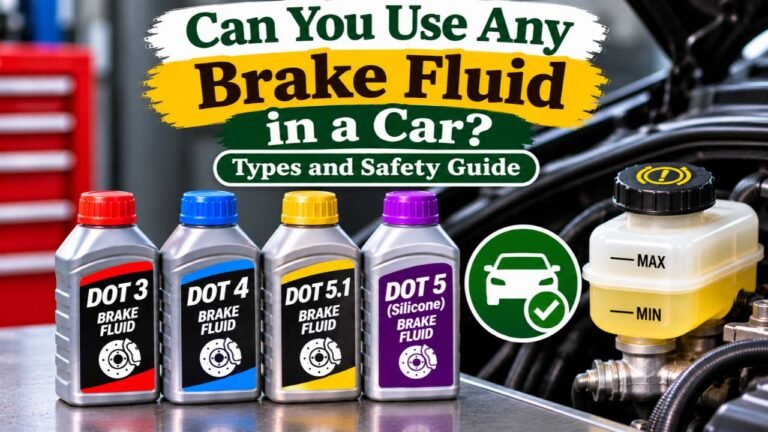
Most cars use glycol-based DOT 3, DOT 4, or DOT 5.1 brake fluid. Different brands of the same approved grade can generally be used, but mixing different DOT grades requires manufacturer approval. Silicone-based DOT 5 must not be mixed with glycol-based fluids. Use fresh fluid from a sealed container and avoid contaminating the reservoir.
A slight drop in level can be normal as brake pads wear. Adding fluid without inspecting them can cause overfilling when new pads are installed. A sudden drop, soft pedal, warning light, or visible leak requires professional attention.
In this article, I explain when adding new brake fluid to old is appropriate, how to check fluid compatibility and reservoir level, and when a complete replacement is needed. I also cover moisture, safe top-up precautions, and mistakes that can compromise braking.
Can You Add New Brake Fluid to Old? The Short Answer
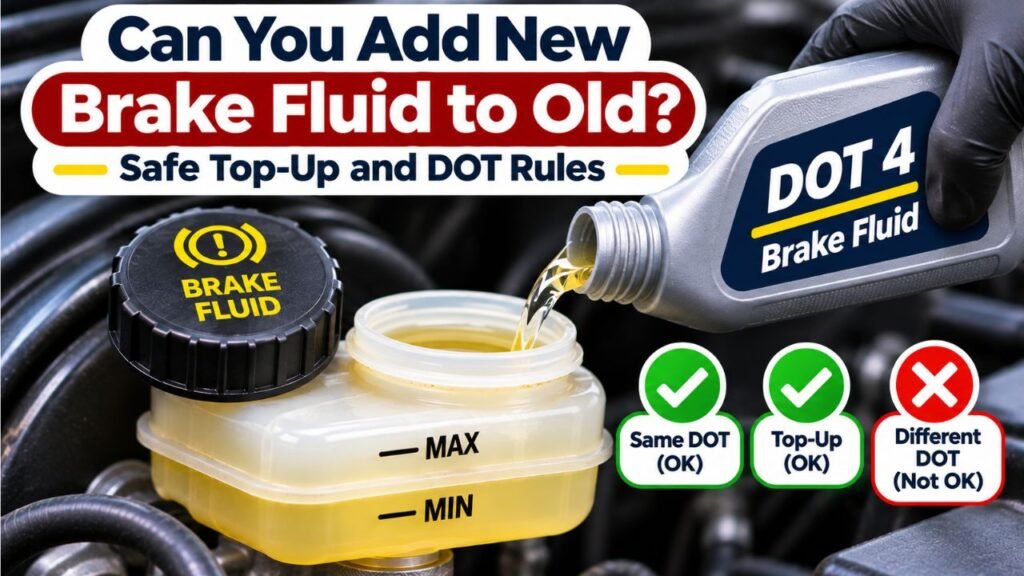
Adding new brake fluid to existing fluid is acceptable in certain situations, provided the fluid is compatible and the reason for the low level has been identified.
However, topping up and changing brake fluid are different maintenance procedures.
When Adding New Fluid May Be Appropriate
A top-up may be appropriate when:
- The vehicle manufacturer permits it.
- The new fluid meets the exact required specification.
- The reservoir level genuinely needs adjustment.
- The brake system has been inspected for leaks.
- Brake pad wear has been considered.
- The existing fluid is not known to be contaminated.
- The fluid replacement interval has not been ignored.
When You Should Not Simply Add More
Avoid treating topping up as a solution when:
- The brake pedal feels spongy or sinks.
- The reservoir level suddenly drops.
- A hydraulic leak is suspected.
- The brake warning light indicates a system problem.
- The existing fluid contains visible contamination.
- The wrong type of fluid has been added.
- The fluid is overdue for replacement.
- The existing fluid’s specification is unknown.
Quick Brake Fluid Top-Up Guide
| Situation | Can You Add New Brake Fluid? | Recommended Action |
| Correct fluid, adjustment required after service | Yes | Follow manufacturer instructions |
| Fluid slightly lower because pads are worn | Usually unnecessary | Inspect pad wear before adding |
| Reservoir below MIN | Do not assume topping up is enough | Inspect for wear and leaks |
| Old fluid due for replacement | Top-up is not a substitute | Schedule a complete fluid change |
| DOT 3 already in system, new DOT 3 | Generally compatible if approved | Confirm manufacturer specification |
| DOT 4 already in system, new DOT 4 | Generally compatible if approved | Use clean fluid from a sealed bottle |
| DOT 3 and DOT 4 mixed | Depends on vehicle approval | Follow manufacturer instructions |
| DOT 5 mixed with glycol fluid | No | Stop and arrange professional assessment |
| Fluid contaminated with oil or another substance | No | Professional inspection and repair |
| Brake pedal feels soft or sinks | No | Do not drive until diagnosed |
According to Ford’s official guide to adding brake fluid, owners should check the reservoir level, use the manufacturer-recommended fluid from a clean, unopened container, and avoid overfilling.
Ford also advises inspection when the fluid level continues to decrease.
Key Takeaway: Adding fresh fluid can restore the correct reservoir level, but it does not correct old-fluid deterioration or an underlying brake-system problem.
What Happens When You Add New Brake Fluid to Old Fluid?
When compatible fluid is added to the reservoir, it mixes with the fluid already present.
However, the effects depend on the condition of the existing fluid.
The Fluid Level Increases
The immediate result is an increase in reservoir fluid level.
This may be appropriate after certain hydraulic maintenance procedures.
However, more fluid doesn’t automatically improve braking.
The reservoir must contain the correct amount for the system’s condition.
New Fluid Mixes With Existing Fluid
Compatible fluids of the same required specification can generally mix.
For example, adding a suitable DOT 4 product to a system containing DOT 4 does not normally create an incompatibility simply because the brands differ.
However, the new fluid must meet any additional manufacturer requirements.
Old Fluid Remains in the Brake Lines
Adding fluid to the reservoir does not remove aging fluid throughout the system.
Old fluid remains in components such as:
- Brake lines
- Flexible hoses
- Brake calipers
- Wheel cylinders
- Master cylinder
- ABS hydraulic unit
A proper fluid exchange is required to replace fluid throughout the applicable circuits.
Moisture Contamination Is Not Eliminated
If the old fluid contains absorbed moisture, adding a small amount of fresh fluid doesn’t remove that moisture.
It may dilute the fluid inside the reservoir, but the condition of the complete hydraulic system remains important.
The Overall Boiling Resistance Is Not Fully Restored
Fresh fluid generally has better boiling resistance than moisture-contaminated fluid of the same type.
However, adding a small amount of new fluid to old fluid does not restore the entire system to a fresh-fluid condition.
Can New Fluid Damage Old Fluid?
Not simply because the fluid is new.
The real concern is chemical compatibility, contamination, and whether the new fluid meets the required specification.
Key Takeaway: Topping up affects reservoir quantity. A proper brake fluid change addresses the fluid’s condition throughout the hydraulic system.
Can You Mix Different Brands of Brake Fluid?
In many cases, yes.
Brake fluid compatibility is determined primarily by specifications and chemistry rather than brand names.
However, brand interchangeability does not override vehicle-specific requirements.
Mixing Two Brands of DOT 3
If a vehicle requires DOT 3 and both products meet the required specification, they are generally designed to be compatible.
However, always follow the owner’s manual.
Mixing Two Brands of DOT 4
Different DOT 4 products are generally chemically compatible when they meet the required standard.
However, some vehicles require specialized low-viscosity fluids or additional specifications.
A generic DOT 4 product may not meet every vehicle’s requirements.
Mixing Two Brands of DOT 5.1
DOT 5.1 products are glycol-based.
However, the vehicle must permit DOT 5.1, and the new product must meet the required properties.
Does Brake Fluid Color Matter?
Color isn’t a reliable guide to compatibility.
Two fluids may have similar colors but different chemistry.
Conversely, compatible products can vary slightly in appearance.
Always read the DOT classification and product specifications.
What About Premium Brake Fluid?
Premium branding doesn’t automatically make a product suitable.
The correct fluid must meet the manufacturer’s requirements for:
- Chemical composition
- DOT classification
- Boiling-point performance
- Viscosity
- Other applicable standards
The correct specification matters more than the brand printed on the bottle.
Can You Mix DOT 3 and DOT 4 Brake Fluid?
DOT 3 and DOT 4 are glycol-based brake fluids.
They are generally chemically miscible, but that doesn’t mean mixing is approved for every vehicle.
Adding DOT 4 to DOT 3
Some vehicle manufacturers permit DOT 4 in systems originally specifying DOT 3.
However, others require a particular fluid.
Check the owner’s manual before substituting grades.
Adding DOT 3 to DOT 4
This is generally not recommended unless the manufacturer explicitly permits it.
DOT 3 has lower minimum boiling-point requirements.
Adding it may reduce the performance of the mixture compared with the intended DOT 4 fluid.
Does Mixing DOT 3 and DOT 4 Create Sludge?
Properly formulated, compatible glycol-based fluids do not normally create sludge simply because DOT 3 and DOT 4 are combined.
However, contamination, deterioration, or incompatible additives can cause problems.
Is It Better to Use the Same Grade?
Yes.
When topping up a system, use the exact grade and additional specification approved by the manufacturer.
If the reservoir cap says DOT 4, the simplest choice is an appropriate DOT 4 fluid.
Don’t substitute another grade without approval.
Can You Mix DOT 4 and DOT 5.1?
DOT 4 and DOT 5.1 are both glycol-based fluids.
However, they have different minimum performance requirements.
Is DOT 5.1 an Upgrade?
DOT 5.1 has higher minimum dry and wet boiling-point requirements than standard DOT 4.
However, this does not make it a universal replacement.
Some brake systems require specific viscosity characteristics.
Can You Add DOT 5.1 to Old DOT 4?
Only when the vehicle manufacturer permits the substitution.
A fluid’s higher DOT number doesn’t guarantee complete compatibility with the system’s specifications.
What Happens to Boiling-Point Performance?
The resulting mixture won’t necessarily retain the original published performance of the higher-rated product.
The actual performance depends on the fluids and their condition.
What About DOT 4 Low-Viscosity Fluid?
Some modern ABS and electronic stability-control systems require particular low-viscosity formulations.
Don’t substitute a different fluid solely because its minimum boiling point is higher.
Follow the complete specification in the owner’s manual.
Why You Must Not Mix DOT 5 With Other Brake Fluids
DOT 5 is silicone-based, while DOT 3, DOT 4, and DOT 5.1 are glycol-based.
This chemical difference is critical.
DOT 5 Is Not the Same as DOT 5.1
Despite their similar names, DOT 5 and DOT 5.1 belong to different fluid families.
DOT 5 is silicone-based.
DOT 5.1 is glycol-based.
They must not be mixed.
What Happens if DOT 5 Is Added to DOT 4?
Mixing incompatible fluids can affect the system’s intended hydraulic performance.
Depending on the materials and system, contamination may require extensive corrective work.
Do not assume that the system can be restored simply by removing fluid from the reservoir.
Can Silicone Fluid Damage Brake Systems?
Using fluid that is not approved for the system can create compatibility and performance concerns.
The exact consequences depend on the brake-system design and materials.
What Should You Do if You Added DOT 5 by Mistake?
Do not drive the vehicle.
Have a qualified technician assess the contamination and follow the manufacturer’s repair procedure.
Do not attempt to solve the problem by adding more DOT 4 or DOT 5.1.
Brake Fluid Mixing Compatibility Chart
| Existing Fluid | New Fluid | General Guidance |
| DOT 3 | DOT 3 | Suitable when exact specification is met |
| DOT 3 | DOT 4 | Only if manufacturer permits |
| DOT 4 | DOT 3 | Avoid unless specifically approved |
| DOT 4 | DOT 4 | Suitable when exact specification is met |
| DOT 4 | DOT 5.1 | Only if manufacturer permits |
| DOT 5.1 | DOT 5.1 | Suitable when exact specification is met |
| DOT 5 | DOT 5 | Only in a system designed for DOT 5 |
| DOT 5 | DOT 3, 4, or 5.1 | Do not mix |
| DOT 3, 4, or 5.1 | DOT 5 | Do not mix |
| Any DOT fluid | Mineral oil or power steering fluid | Do not mix |
Chemical compatibility and manufacturer approval are separate requirements. Both must be considered.
Why Is the Brake Fluid Reservoir Low?
A low fluid level doesn’t always mean the system simply needs more fluid.
Possible causes include normal brake pad wear, leakage, or an incorrect previous fluid level.
Brake Pad Wear
As disc brake pads wear, caliper pistons move farther outward to maintain contact with the pads.
This movement increases the volume occupied by fluid inside the calipers.
As a result, the level in the reservoir can gradually decrease.
This is a normal feature of many hydraulic disc brake systems.
Why Adding Fluid Can Be a Problem
Suppose the fluid level has fallen because the brake pads are worn.
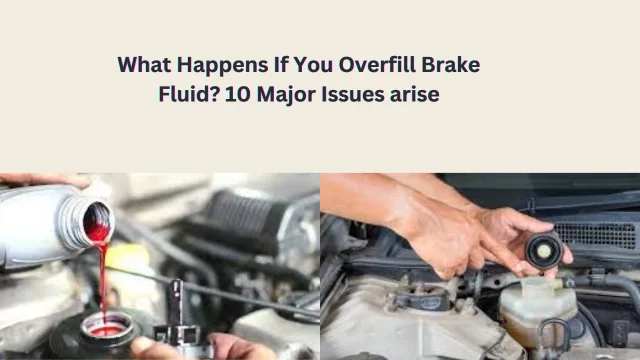
If you fill the reservoir to MAX without considering the pads, the system may become overfilled when new pads are installed and the caliper pistons are pushed back.
The displaced fluid can raise the reservoir level.
Excess fluid may spill or require removal.
Hydraulic Leaks
Low brake fluid can also result from leaks involving:
- Brake hoses
- Steel brake lines
- Caliper seals
- Wheel cylinders
- Master cylinder
- Hydraulic fittings
- Certain ABS hydraulic components
A leaking brake system can become dangerous.
Incorrect Fluid Level After Service
An improperly completed repair or bleeding procedure may leave the reservoir level incorrect.
The technician should check and adjust it according to the manufacturer’s instructions.
What If the Fluid Suddenly Drops?
A sudden or substantial loss should be treated as a possible hydraulic leak.
Do not simply add fluid and continue driving.
According to Bosch Car Service’s brake fluid change and inspection guide, low fluid may reflect brake wear or leakage, and simply topping up can conceal a problem without correcting it.
Key Takeaway: A small, gradual decrease may accompany brake pad wear. An unexplained or sudden decrease requires investigation before more fluid is added.
Should You Add Brake Fluid if the Level Is Between MIN and MAX?
Usually, no.
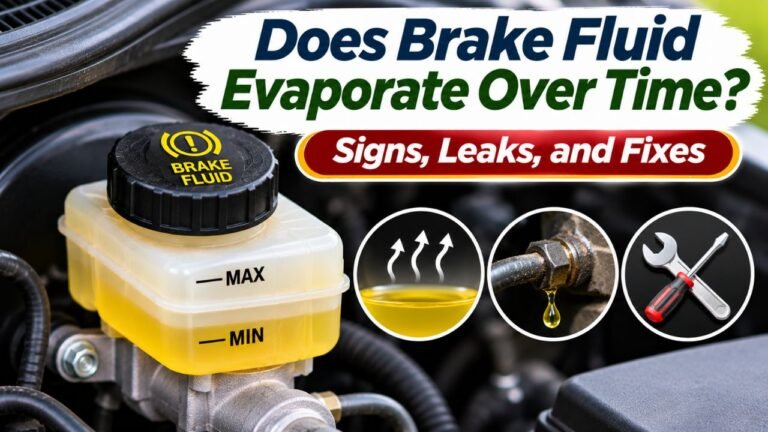
Most brake fluid reservoirs have minimum and maximum markings.
If the level is within the manufacturer’s specified range, topping up may not be necessary.
What Does MIN Mean?
MIN identifies the manufacturer’s lower reference level under the specified inspection conditions.
A level below MIN requires attention.
However, the proper response depends on the cause.
What Does MAX Mean?
MAX identifies the upper reference limit.
It should not be exceeded.
A reservoir filled beyond the specified maximum can create problems during heat expansion or brake servicing.
Should the Reservoir Always Be at MAX?
Not necessarily.
The correct level depends on brake pad condition and the manufacturer’s inspection procedure.
A reservoir within the specified range may be normal.
What if the Level Is Just Above MIN?
Check the maintenance instructions and brake pad condition.
Do not assume you should add fluid until MAX.
If the pads are significantly worn, service may be more appropriate than topping up.
What if the Fluid Is Below MIN?
Have the system inspected promptly.
The cause could be worn friction components, a leak, or another problem.
If the warning light is on or braking feels abnormal, do not drive.
How to Add New Brake Fluid to Old Brake Fluid Safely
Topping up may be straightforward when the manufacturer permits it and the braking system has been checked.
However, brake fluid is safety-critical.
Don’t open the reservoir or add fluid unless it is genuinely required.
Step 1: Check the Owner’s Manual
Locate the vehicle’s specified brake fluid type.
The recommendation may be printed on the reservoir cap.
For example:
- DOT 3
- DOT 4
- DOT 4 LV
- DOT 5.1
Some specialized systems use different fluid requirements.
Verify the exact specification.
Step 2: Park Safely
Park on level ground.
Switch off the engine and follow any model-specific inspection instructions.
Keep the vehicle secured.
Step 3: Inspect the Reservoir
Look through the reservoir wall if it is translucent.
Check the MIN and MAX markings.
If the level is within the specified range, adding fluid may be unnecessary.
Step 4: Consider Brake Pad Wear and Leaks
Before adding fluid, determine why the level is low.
If there is an unexplained decrease, have a qualified technician inspect the system.
Do not use topping up to compensate for an active leak.
Step 5: Obtain the Correct Fresh Fluid
Use brake fluid that meets the manufacturer’s exact specification.
Choose a clean, sealed container.
Avoid using fluid from an unknown bottle.
Step 6: Protect the Vehicle
Wear appropriate eye and hand protection.
Brake fluid can damage painted surfaces and may irritate skin or eyes.
Cover nearby painted areas.
Step 7: Clean the Reservoir Cap Area
Remove dirt and debris from around the cap before opening it.
This reduces the chance of contamination.
Step 8: Add Only the Necessary Amount
If the manufacturer permits topping up and the cause has been addressed, carefully add the specified fluid.
Follow the owner’s manual for the correct level.
Do not exceed MAX.
Step 9: Close the Reservoir Securely
Reinstall the cap according to the manufacturer’s instructions.
Avoid leaving the system open longer than necessary.
Step 10: Verify Normal Brake Operation
The brake pedal should behave normally.
If the pedal is unusually soft, sinks, or braking effectiveness has changed, do not drive.
Arrange professional inspection.
Important: These are general precautions for an approved reservoir top-up, not instructions for repairing a defective brake system. Hydraulic leaks and bleeding problems require vehicle-specific service procedures.
Do You Have to Flush Old Brake Fluid Before Adding New?
Not always.
A routine top-up doesn’t normally require a complete brake fluid flush if the existing fluid is suitable, the exact specification is used, and the manufacturer permits the adjustment.
However, a flush or fluid replacement is necessary in different situations.
When a Top-Up May Be Sufficient
A top-up may be appropriate when:
- The fluid is within its service life.
- The hydraulic system is functioning normally.
- The specification is confirmed.
- The reason for the level adjustment is understood.
- The manufacturer permits it.
When a Complete Fluid Change Is Better
A complete change is appropriate when:
- The scheduled service interval has arrived.
- The old fluid is moisture-contaminated.
- The service history is unknown and inspection supports replacement.
- The fluid has deteriorated.
- Hydraulic service requires fluid exchange.
- A qualified technician determines it is necessary.
When a Flush Alone May Not Be Enough
If petroleum-based fluid or another incompatible substance enters the system, changing the fluid may not be sufficient.
Seals and other components may require inspection or replacement.
Do not assume the system is safe after a simple flush.
What Is the Difference Between Topping Up and Changing Brake Fluid?
A top-up and a complete fluid change accomplish different things.
Brake Fluid Top-Up
A top-up adds a small quantity of fluid to the reservoir.
It does not remove aging fluid throughout the system.
Brake Fluid Change
A fluid change replaces old brake fluid with fresh fluid according to the manufacturer’s procedure.
It helps restore heat resistance and reduce contamination.
Brake Fluid Flush
A flush generally describes exchanging aging fluid throughout the required hydraulic circuits.
The procedure varies by vehicle.
Brake Bleeding
Bleeding is intended to remove trapped air or gas from the hydraulic system.
It may be required after certain repairs or as part of a proper fluid exchange.
Comparison Table
| Service | Purpose | Removes Old Fluid? | Fixes a Leak? |
| Top-up | Adjusts reservoir level | No | No |
| Brake bleeding | Removes trapped air | May remove some fluid | No |
| Brake fluid change | Replaces aging fluid | Yes | No |
| Brake fluid flush | Exchanges old fluid through the required circuits | Yes | No |
| Hydraulic repair | Corrects failed components | Depends on repair | Yes, when the leaking part is repaired |
A proper fluid change is preventive maintenance.
A top-up is a level adjustment, not a substitute for fluid replacement.
Does Adding New Fluid Improve Old Brake Fluid?
Only in a limited sense.
Adding fresh fluid changes the composition of fluid in the reservoir, but it doesn’t make the entire hydraulic system equivalent to a freshly serviced system.
Moisture Remains in the Old Fluid
Glycol-based brake fluid absorbs moisture over time.
A small amount of fresh fluid doesn’t remove water already present in older fluid.
Boiling Resistance May Still Be Reduced
Moisture lowers the fluid’s boiling point.
Adding fresh fluid only to the reservoir may not meaningfully restore the condition of fluid elsewhere in the system.
Corrosion Products May Remain
If aging fluid contains contamination from internal corrosion, topping up won’t remove deposits or repair damaged components.
Can Fresh Fluid Dilute Old Fluid?
Yes, where the fluids mix.
However, dilution isn’t equivalent to replacing contaminated fluid.
The resulting condition depends on the amount added, the fluid’s chemistry, and contamination throughout the system.
What Is the Better Approach?
If the old fluid is due for replacement, perform the required fluid service.
HELLA’s technical guide to changing and testing brake fluid explains how moisture lowers boiling-point performance and why fluid testing, replacement, and proper bleeding are important.
Key Takeaway: New brake fluid can restore reservoir quantity, but it cannot fully restore old fluid’s heat resistance without an appropriate system-wide exchange.
What Happens if You Keep Topping Up Old Brake Fluid?
Repeatedly adding fluid without investigating the cause can conceal an underlying problem.
Moisture Continues to Accumulate
If the fluid isn’t changed at the required interval, its condition can continue deteriorating.
Internal Corrosion Risk May Increase
Moisture and contamination can contribute to corrosion of hydraulic components over time.
A Leak May Become Worse
If a damaged component is allowing fluid to escape, topping up does not repair it.
The loss may continue or worsen.
Brake Pad Wear Can Be Overlooked
A gradual decrease in reservoir level may indicate increasing caliper piston extension as pads wear.
Adding fluid without checking the brakes can delay necessary maintenance.
Overfilling May Occur
When worn pads are replaced, the pistons are typically moved back.
If the reservoir was repeatedly filled to MAX, excess fluid may need to be removed.
Can Repeated Top-Ups Cause Brake Failure?
The topping-up action isn’t necessarily the direct cause.
However, ignoring a leak, contamination, or a malfunctioning hydraulic system can lead to dangerous braking conditions.
A repeated need for fluid should trigger inspection rather than repeated refilling.
How Old Is Too Old for Brake Fluid?
Brake fluid replacement intervals vary by vehicle.
Many passenger vehicles specify replacement approximately every two to three years.
However, some use different schedules.
Does Brake Fluid Age Even When You Don’t Drive?
Yes.
Time and moisture exposure affect glycol-based fluid, even when a vehicle is used infrequently.
Low mileage doesn’t automatically mean the fluid remains suitable.
What if Brake Fluid Is Five Years Old?
If the fluid hasn’t been replaced for five years, check the vehicle’s maintenance schedule.
It may be significantly overdue.
A qualified technician can assess its condition and carry out the required service.
Can Brake Fluid Last Ten Years?
Some vehicles may operate for years without obvious symptoms.
However, that doesn’t prove the fluid remains within specification.
If the manufacturer’s interval has been exceeded, arrange appropriate service.
Does Fluid Color Show Its Age?
Not reliably.
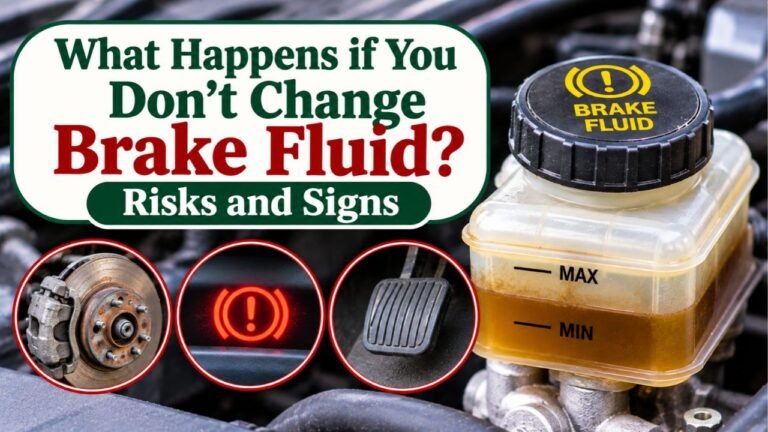
Dark or cloudy fluid can indicate contamination or deterioration.
However, clear fluid may still contain absorbed moisture.
Use maintenance records and appropriate testing.
What About Brake Fluid Moisture Testers?
Certain testers estimate moisture through electrical properties.
Others assess boiling-point performance.
A qualified technician should interpret results according to the fluid and vehicle.
An inexpensive test pen should not be treated as a complete brake-system inspection.
Can You Add Brake Fluid From an Old Opened Bottle?
Using brake fluid from an old opened container is generally a poor choice, especially when storage history is uncertain.
Why Opened Brake Fluid Is a Concern
DOT 3, DOT 4, and DOT 5.1 absorb moisture from the environment.
Once a bottle has been opened, exposure to air can affect the fluid.
Is a Tightly Closed Bottle Safe?
Proper sealing reduces exposure, but it does not guarantee indefinite storage life.
Suitability depends on the product, storage conditions, and manufacturer guidance.
What About an Unopened Bottle?
A properly stored, sealed container may remain suitable within the manufacturer’s stated storage period.
Check the product’s instructions and condition.
Should You Reuse Drained Brake Fluid?
No.
Drained brake fluid may contain moisture, debris, and other contamination.
Never pour used fluid back into the reservoir.
What Is the Safest Choice?
For a safety-critical hydraulic system, use fresh, manufacturer-approved fluid from a sealed container.
This reduces uncertainty about contamination.
Can You Add New Brake Fluid if the Old Fluid Is Dark?
Dark fluid may indicate aging or contamination, but color alone cannot determine its exact condition.
Is Dark Brake Fluid Always Bad?
No.
Brake fluids can vary in appearance.
However, significant darkening, cloudiness, or particles warrant closer inspection.
Does Adding Fresh Fluid Make Dark Fluid Better?
It may make the reservoir fluid appear lighter if it mixes.
However, it doesn’t remove the underlying contamination.
What if the Fluid Is Cloudy?
Cloudiness may indicate contamination.
Do not assume that adding fresh fluid is an appropriate fix.
Have the fluid and braking system assessed.
What if There Are Particles in the Reservoir?
Visible debris can indicate contamination or deterioration.
A technician should determine the cause before servicing the system.
Should You Flush Dark Brake Fluid?
A fluid change may be appropriate depending on age, test results, and manufacturer requirements.
However, color alone isn’t enough to diagnose the complete system.
Can You Add New Brake Fluid to Old Fluid in a Motorcycle?
The same general principles apply to motorcycles with hydraulic brakes.
However, motorcycle brake systems have model-specific requirements.
Check the Motorcycle’s Fluid Specification
Many motorcycles specify DOT 4.
Some require DOT 3, DOT 5.1, or silicone-based DOT 5.
Do not assume all motorcycles use the same type.
Does Motorcycle Brake Fluid Mix With Car Brake Fluid?
A properly specified product may be suitable regardless of whether it is marketed for cars or motorcycles.
However, the motorcycle manufacturer’s requirements take priority.
Can You Top Up a Motorcycle Reservoir?
Only when needed and permitted by the manufacturer.
A low reservoir level can indicate pad wear or leakage.
Inspect the system before adding fluid.
What if the Motorcycle Has ABS?
Some motorcycle ABS systems require special bleeding procedures or fluid specifications.
Do not use an incompatible product.
What if the Brake Lever Feels Spongy?
Don’t ride the motorcycle.
A spongy lever may indicate air, vapor, fluid loss, or a hydraulic problem.
Professional inspection is necessary.
Can You Add New Brake Fluid to Old Fluid in an ABS Car?
Yes, if the manufacturer permits topping up and the new fluid meets the exact required specification.
However, ABS-equipped vehicles may have additional hydraulic service requirements.
Does ABS Use Different Brake Fluid?
Many ABS-equipped vehicles use standard DOT 3 or DOT 4 fluid.
Others specify particular low-viscosity formulations.
The exact requirements vary.
Does Topping Up Require ABS Bleeding?
A routine approved top-up generally does not require bleeding when the hydraulic system remains closed and no air has entered.
However, a low level caused by leakage or an empty reservoir can indicate a more serious problem.
Does a Brake Fluid Flush Require Special ABS Equipment?
Some vehicles require diagnostic procedures to operate ABS valves during certain bleeding operations.
Follow the vehicle manufacturer’s service instructions.
Can Adding Fluid Fix an ABS Warning Light?
Not necessarily.
ABS warning lights can result from electronic, sensor, wiring, or hydraulic faults.
The correct cause must be diagnosed.
Signs You Should Not Simply Add More Brake Fluid
The following symptoms require more than a routine fluid adjustment.
Spongy Brake Pedal
A spongy pedal may indicate air, vapor, or a hydraulic problem.
Adding fluid to the reservoir won’t necessarily fix it.
Pedal Sinks Toward the Floor
This can indicate a serious hydraulic fault.
Do not continue driving.
Brake Warning Light
A brake warning light may indicate low fluid or another braking problem.
Follow the owner’s manual and investigate the cause.
Visible Brake Fluid Leak
Fluid near a wheel, line, or hydraulic component can indicate leakage.
A leaking system must be repaired.
Sudden Reservoir Level Drop
An unexpected decrease is more concerning than the gradual change associated with normal pad wear.
Reduced Braking Power
If stopping performance changes, the vehicle requires immediate inspection.
Brake System Symptoms Chart
| Symptom | Possible Cause | Recommended Action |
| Gradual reservoir-level decrease | Brake pad wear | Inspect pads and fluid level |
| Sudden level decrease | Possible hydraulic leak | Stop driving and inspect |
| Soft or spongy pedal | Air, vapor, or hydraulic fault | Professional diagnosis |
| Pedal sinks under pressure | Possible master-cylinder or leakage problem | Do not drive |
| Dark fluid | Aging or contamination | Inspect condition and service history |
| Brake warning light | Low fluid or system fault | Follow manufacturer guidance |
| Fluid below MIN | Wear, leak, or incorrect level | Determine cause before topping up |
| Wrong fluid added | Chemical incompatibility | Stop use and seek professional repair |
Important: If the vehicle has abnormal braking, a sinking pedal, or a suspected hydraulic leak, do not drive it to see whether topping up helps. Arrange roadside assistance or towing.
Common Mistakes When Adding New Brake Fluid to Old
Several mistakes can turn a simple level check into a serious braking-system problem.
Using the Wrong DOT Grade
Always confirm the required specification.
Don’t substitute a different grade solely because it has a higher number.
Mixing DOT 5 With Glycol-Based Fluid
DOT 5 silicone fluid is not interchangeable with DOT 3, DOT 4, or DOT 5.1.
Filling the Reservoir to MAX Without Checking Pads
A lower level may reflect brake pad wear.
Overfilling can create problems when the pads are replaced.
Ignoring a Leak
Adding fluid doesn’t repair damaged hoses, seals, or brake lines.
Using an Old Opened Bottle
Improperly stored fluid may have absorbed moisture.
Use suitable fresh fluid.
Opening the Reservoir Unnecessarily
Opening the cap exposes the system to possible moisture and dirt.
Check the translucent reservoir without opening it when possible.
Allowing Dirt Into the Reservoir
Contamination can affect hydraulic components.
Clean the cap area before servicing.
Using Another Automotive Fluid
Never substitute:
- Power steering fluid
- Automatic transmission fluid
- Engine oil
- Coolant
- Mineral oil
These products are not suitable replacements for DOT brake fluid in systems designed for it.
Assuming a Top-Up Replaces a Flush
Old fluid remains in the hydraulic lines.
Follow the required replacement schedule.
Driving With a Spongy Pedal
A soft or sinking pedal can indicate serious brake failure.
Don’t assume new fluid will solve the problem.
Is It Better to Add Brake Fluid or Replace It Completely?
The correct choice depends on why the system needs attention.
Add Fluid Only When Necessary
A limited top-up can be appropriate when the manufacturer permits it, the cause of the low level is understood, and the existing fluid remains suitable.
Replace Fluid When Service Is Due
A full fluid replacement is preferable when the existing fluid is old, contaminated, or overdue according to the manufacturer’s schedule.
Repair the System When There Is a Fault
If fluid is leaking or braking performance is abnormal, the problem must be diagnosed and repaired.
A top-up or flush alone may be insufficient.
Practical Decision Guide
| Condition | Best Next Step |
| Fluid level normal | No top-up necessary |
| Level slightly lower, pads worn | Inspect and service pads as needed |
| Approved top-up required after maintenance | Add specified fresh fluid |
| Old fluid overdue | Replace according to service procedure |
| Fluid contaminated | Professional fluid and system assessment |
| Wrong fluid mixed | Stop use and arrange professional repair |
| Spongy pedal | Diagnose and repair |
| Suspected leak | Do not drive; inspect hydraulic system |
The key is understanding the difference between correcting a fluid level and restoring the condition of the braking system.
Conclusion
You can add new brake fluid to old brake fluid when topping up is necessary, the new fluid meets the vehicle manufacturer’s exact specification, and the braking system is otherwise healthy.
Different brands of the same approved DOT grade can generally be used together, but changing DOT classifications requires manufacturer approval.
Never mix silicone-based DOT 5 with glycol-based DOT 3, DOT 4, or DOT 5.1.
Before adding fluid, check the reservoir level and determine why it is low. A gradual decrease can accompany brake pad wear, while an unexpected drop may indicate a dangerous hydraulic leak.
Adding fresh fluid does not remove moisture or contamination from old fluid throughout the brake lines.
If the fluid is overdue for replacement, a proper fluid change is the correct maintenance procedure.
Use fresh fluid from a sealed container, protect the reservoir from contamination, and avoid overfilling.
Most importantly, never use a brake fluid top-up to conceal a leak, soft pedal, or other braking-system fault. Those symptoms require diagnosis and repair before driving.
FAQs About Can You Add New Brake Fluid to Old
Is It Okay to Mix New Brake Fluid With Old Brake Fluid?
Yes, when the fluids are compatible and meet the exact specification approved for the vehicle.
However, adding new fluid doesn’t eliminate deterioration or contamination already present in the system.
Do You Have to Remove Old Brake Fluid Before Adding New?
Not for every approved top-up.
However, if the fluid is due for replacement, the proper service involves exchanging the old fluid rather than simply adding more to the reservoir.
Can You Add DOT 4 Brake Fluid to Old DOT 4?
Generally, yes, if both products meet the vehicle’s required specification and the manufacturer permits topping up.
Use fresh fluid from a clean, sealed container.
Can You Add DOT 3 to Old DOT 4?
Avoid doing so unless the manufacturer explicitly permits it.
DOT 3 has lower minimum boiling-point requirements and may not meet the vehicle’s intended DOT 4 performance specification.
Can You Add DOT 4 to DOT 3?
Some manufacturers permit DOT 4 in systems originally specifying DOT 3.
However, the correct answer depends on the vehicle.
Check the owner’s manual before substituting grades.
Can You Add DOT 5.1 to DOT 4?
Only when the vehicle manufacturer permits it.
Both are glycol-based, but additional fluid requirements may apply.
Can You Add DOT 5 to DOT 4?
No.
DOT 5 is silicone-based, while DOT 4 is glycol-based.
They must not be mixed.
Can You Add Brake Fluid From Different Brands?
Usually, when the products meet the same required specification.
However, certain specialized systems may require additional fluid properties.
Always follow manufacturer guidance.
Can Adding New Brake Fluid Improve Old Brake Fluid?
Only to a limited extent.
Adding fresh fluid can dilute fluid in the reservoir, but it doesn’t remove moisture or contamination throughout the hydraulic system.
A proper fluid exchange is required when the fluid needs replacement.
Can I Top Up Brake Fluid if It Is Below MIN?
Don’t automatically top it up without checking the cause.
The level may be low because of worn pads, leakage, or another issue.
Follow the manufacturer’s instructions and arrange inspection when necessary.
Should Brake Fluid Always Be at MAX?
No.
The correct level depends on the vehicle and the condition of the brake components.
Avoid overfilling the reservoir.
Can I Add Brake Fluid Without Bleeding the Brakes?
A routine manufacturer-approved top-up generally doesn’t require bleeding if the hydraulic system remains closed and no air has entered.
However, trapped air or hydraulic repairs may require proper bleeding.
Will Adding Brake Fluid Fix a Spongy Pedal?
Not necessarily.
A spongy pedal may be caused by trapped air, vapor, leakage, or a defective component.
Do not drive until the underlying cause is diagnosed.
Can I Add Brake Fluid to a Hot Car?
Brake fluid handling should follow the vehicle manufacturer’s precautions.
For a routine check or top-up, park safely, turn off the engine, and avoid hot components.
Protect against fluid spills and contamination.
Can You Use Brake Fluid From an Open Bottle?
A previously opened bottle may have absorbed moisture, especially if it was not sealed or stored correctly.
Using fresh fluid from a sealed container is the safer option.
How Long Can Brake Fluid Stay in a Car?
Replacement intervals vary.
Many passenger vehicles specify a time-based interval of approximately two to three years, but the manufacturer’s schedule takes priority.
Why Does My Brake Fluid Keep Getting Low?
Possible causes include brake pad wear or a hydraulic leak.
Repeated or sudden fluid loss requires inspection.
Do not repeatedly top up the reservoir without determining the cause.
Does Adding Brake Fluid Make Brakes Work Better?
Adding fluid can correct an approved level adjustment, but it doesn’t automatically improve braking performance.
Old fluid, trapped air, and mechanical faults require appropriate maintenance or repairs.
What Happens if You Overfill Brake Fluid?
Excess fluid may overflow or create problems when caliper pistons are pushed back during brake service.
Follow the manufacturer’s fill-level instructions.
Can You Add New Brake Fluid to Old Fluid in a Motorcycle?
Yes, when the motorcycle manufacturer permits it and the fluid meets the exact specification.
However, low fluid may indicate pad wear or leakage, and some motorcycles use fluid chemistries that must not be mixed.
Is It Better to Flush Brake Fluid Instead of Topping Up?
A flush or complete fluid change is better when the fluid is old, contaminated, or due for replacement.
A top-up is appropriate only for a necessary level adjustment after the cause has been assessed.