How to Activate Parking Brake: Hand, Foot, and Electric Steps
To activate the parking brake, bring your vehicle to a complete stop, keep your foot firmly on the regular brake pedal, and engage the parking-brake control. Pull the handbrake lever upward, press the dedicated parking-brake foot pedal, or pull the electronic parking-brake switch, depending on your vehicle. Confirm that the parking-brake indicator illuminates before leaving the driver’s seat.
The exact procedure depends on whether your car has a manual cable-operated parking brake or an electronic parking brake (EPB). Some modern vehicles also have an automatic mode that engages the brake when you shift into Park or switch off the vehicle.
Using the parking brake correctly helps prevent unintended movement, especially on slopes. It also provides an additional holding mechanism beyond the transmission’s Park position. However, pulling the wrong control, failing to engage it fully, or assuming an automatic feature is active can leave the vehicle unsecured.
This guide explains how to activate parking brake systems using a hand lever, foot pedal, or electronic switch. It also covers automatic activation settings, safe parking on hills, dashboard indicators, common activation problems, and the proper way to release the brake before driving.
How to Activate Parking Brake Based on the Control Type
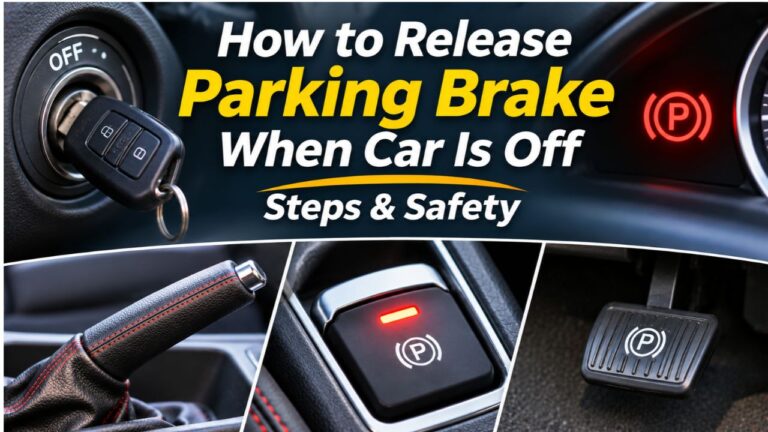
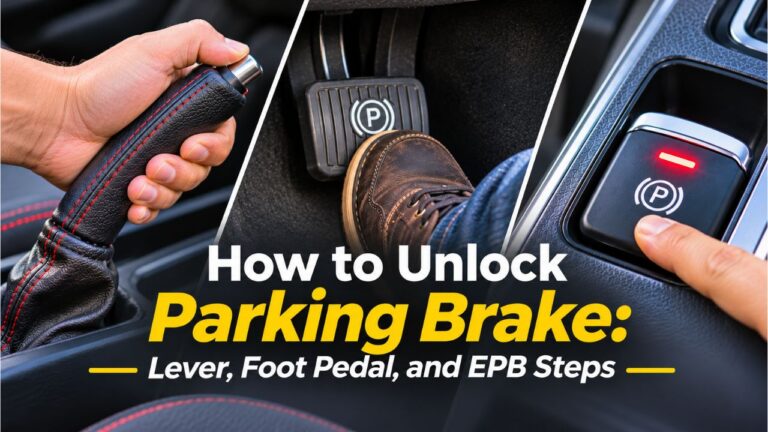
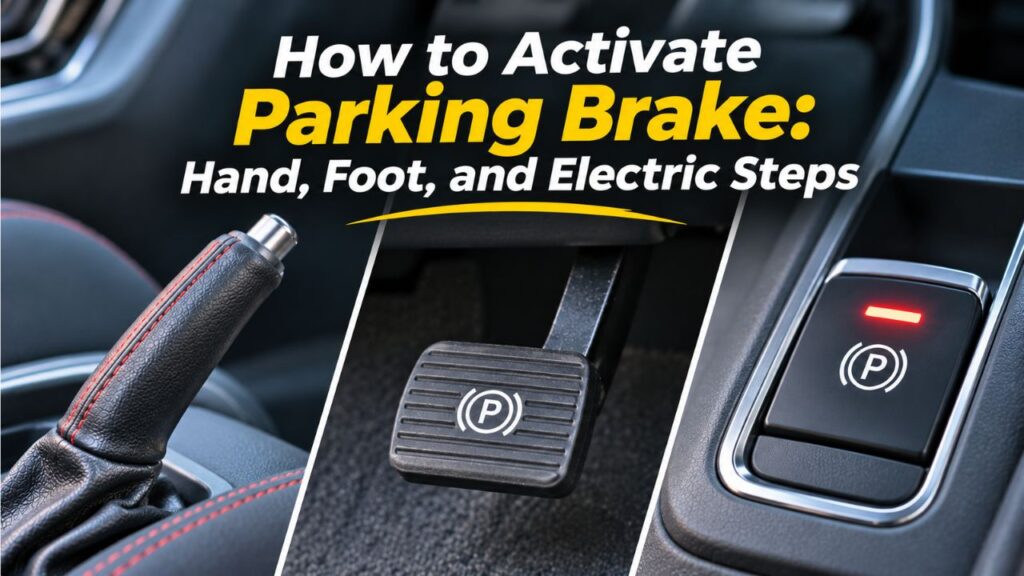
Most passenger vehicles use one of three parking-brake controls. The first step is identifying which system is installed in your car.
| Parking Brake Type | Typical Location | How to Activate |
| Hand-operated parking brake | Between the front seats or beside the driver’s seat | Pull the lever upward firmly |
| Foot-operated parking brake | Far left of the driver’s footwell | Press the dedicated pedal down fully |
| Electronic parking brake (EPB) | Center console or dashboard | Operate the switch in the specified apply direction |
All three are intended to secure a stationary vehicle, but they transmit force differently.
Mechanical parking brakes generally use cables and levers to apply the rear brake hardware. Electronic parking brakes use electrically operated actuators that mechanically apply the brakes.
The electronic version may also have automatic application and release functions. These features are vehicle-specific and should not be assumed to work identically across different manufacturers.
How to Activate a Hand-Lever Parking Brake
A traditional hand-operated parking brake has a lever, usually between the front seats. Pulling it tensions a cable connected to the parking-brake mechanism.
Step 01: Bring the Vehicle to a Complete Stop
Reduce speed normally and press the regular brake pedal until the vehicle is fully stationary. Select a safe parking location with enough space around the vehicle.
Keep your foot firmly on the brake pedal throughout the parking procedure. This prevents movement while you engage the handbrake.
Never pull the handbrake suddenly during ordinary driving. Applying the rear brakes abruptly while moving can affect vehicle stability.
Step 02: Locate the Parking Brake Lever
Look beside the driver’s seat or along the center console for a lever with a release button near its tip.
The lever is usually in its lowered position when the parking brake is released.
Make sure nothing blocks the handle, including bags, clothing, or other items stored around the center console.
Step 03: Pull the Handbrake Lever Upward
Grip the handle and pull it upward firmly until it reaches the fully engaged position specified by the manufacturer.
You may hear a series of clicking sounds as the ratchet mechanism locks the lever at progressively higher positions.
Do not press the release button while pulling the lever upward unless your vehicle’s instructions specifically require otherwise. The ratchet should engage and hold the selected position.
Ford’s official parking-brake instructions describe firmly pressing the service-brake pedal and pulling the parking-brake lever to its fullest extent.
Step 04: Check That the Lever Stays Engaged
Release your grip carefully without pressing the button. The lever should remain locked in position.
If the handle immediately falls back down or moves freely without resistance, the parking-brake mechanism may not be functioning correctly.
A lever that rises unusually high or reaches its travel limit without providing adequate holding force may indicate a cable or adjustment problem.
Do not rely on an obviously defective handbrake to secure the vehicle.
Step 05: Secure the Transmission and Confirm the Brake
For an automatic transmission, shift into P (Park) while continuing to hold the regular brake pedal.
For a manual transmission, use the gear position recommended by the manufacturer when parking. First gear or reverse is commonly specified, particularly on slopes.
Check the parking-brake warning indicator if the vehicle is powered on. Slowly release the regular brake only after the parking brake and transmission are properly secured.
The vehicle should remain stationary. If it shifts unexpectedly or feels unsecured, press the regular brake immediately and investigate before leaving.
How to Activate a Foot-Operated Parking Brake
Foot-operated parking brakes are common on some cars, SUVs, and pickup trucks. They have a separate pedal positioned to the far left of the normal service-brake pedal.
The pedal may be labeled PARK, PARK BRAKE, or display a parking-brake symbol.
Step 01: Stop the Vehicle and Hold the Regular Brake
Bring the vehicle to a complete stop using the main brake pedal.
Keep your right foot firmly on the regular brake while operating the parking brake with your left foot.
Holding the main brake prevents the vehicle from moving during application and reduces the load placed on the parking-brake mechanism.
Step 02: Locate the Dedicated Parking Brake Pedal
Look below the dashboard on the driver’s side, near the left kick panel.
The parking-brake pedal is usually narrower than the main brake pedal and positioned farther left. It may sit higher when released.
Confirm that you have identified the correct pedal before applying pressure.
Do not confuse it with the footrest, clutch pedal, or a pedal-operated dashboard adjustment.
Step 03: Press the Parking Brake Pedal Down Fully
Using your left foot, press the parking-brake pedal down firmly until it reaches its designed engaged position.
On mechanical systems, you may hear clicking as the pedal locks. The pedal should remain in its applied position when you remove your foot.
Toyota’s Camry parking-brake operating instructions describe fully depressing the parking-brake pedal while holding the regular brake. On the pedal-type system covered, pressing the parking-brake pedal again releases it.
Other vehicles use a separate release handle, so do not assume all foot-operated brakes release the same way.
Step 04: Verify the Pedal Has Locked
Lift your left foot away and confirm that the parking-brake pedal remains engaged.
The dashboard parking-brake indicator should normally illuminate when the ignition or power mode allows the indicator to operate.
If the pedal returns immediately without locking, the mechanism may be faulty or you may be using the wrong control.
Avoid repeatedly forcing the pedal. Excessive force can damage the linkage or related hardware.
Step 05: Shift Into the Proper Parking Gear
Keep the regular brake depressed while shifting an automatic transmission into Park.
If the vehicle has a manual transmission, select the appropriate parking gear as directed by its owner manual.
Once everything is secured, slowly release the service brake and confirm the vehicle stays stationary.
Always check for unintended movement before exiting, especially on sloped pavement.
How to Activate an Electronic Parking Brake
An electronic parking brake replaces the traditional cable lever or foot pedal with an electrical control.
Many vehicles have a small switch marked with a P inside a circle, although the appearance and direction of operation can vary.
Step 01: Stop Completely With the Brake Pedal
Press the main brake pedal and bring your vehicle to a complete stop.
Keep the pedal depressed while engaging the electronic parking brake. Although some systems allow manual application without pressing the regular brake, holding it is a sensible parking practice.
For most routine parking situations, avoid operating the EPB while the vehicle is moving.
Step 02: Locate the Electronic Parking Brake Switch
Look near the gear selector, along the center console, or on the dashboard.
Identify the dedicated parking-brake switch by its symbol or the owner’s manual.
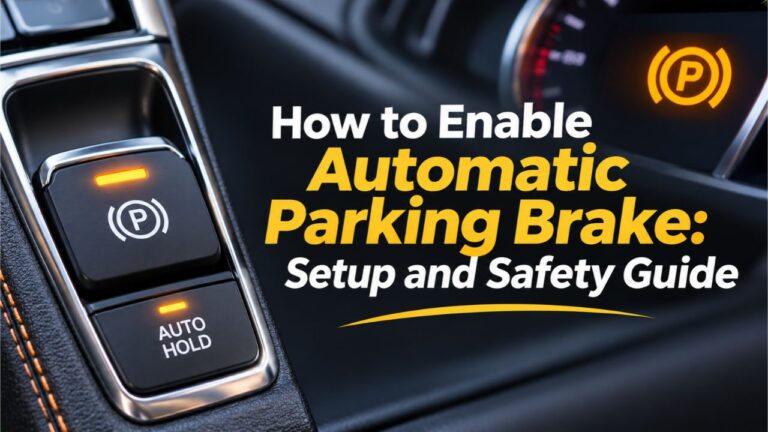
Some vehicles also have a BRAKE HOLD button nearby. These controls are not interchangeable.
Brake Hold usually maintains braking during temporary stops, while the parking brake secures the vehicle when parked.
Step 03: Operate the Switch in the Apply Direction
On many vehicles, pull the parking-brake switch upward gently and securely.
The electronic actuator should begin applying the rear brakes. You may hear a brief electric motor or mechanical whirring sound as it operates.
Honda’s official 2025 Accord brake-system instructions specify pulling the electric parking-brake switch upward to apply it. The instructions also explain that the switch indicator and red parking-brake indicator illuminate.
Not every vehicle uses the same switch direction. Some designs use a different movement or control arrangement. Follow the instructions for your particular model rather than forcing the switch.
Step 04: Wait for the Parking Brake Indicator
After operating the switch, check the dashboard.
You should normally see a red parking-brake indicator or a message confirming that the brake is engaged.
Some electronic parking brakes also illuminate a small light directly on the switch.
Allow the actuator to finish operating before taking your foot off the main brake. If the indicator flashes continuously or a malfunction message appears, consult the owner’s manual.
Step 05: Secure the Vehicle in Park
With your foot still on the regular brake, shift the transmission into Park if equipped.
For other transmission arrangements, follow the vehicle’s specified parking procedure.
Check that the parking brake is engaged before switching the vehicle off and exiting.
If an electronic parking brake fails to engage, do not assume selecting Park alone will always secure the vehicle safely, particularly on a steep incline. Follow the owner’s manual and arrange assistance if the vehicle cannot be secured.
How to Activate Automatic Parking Brake Mode
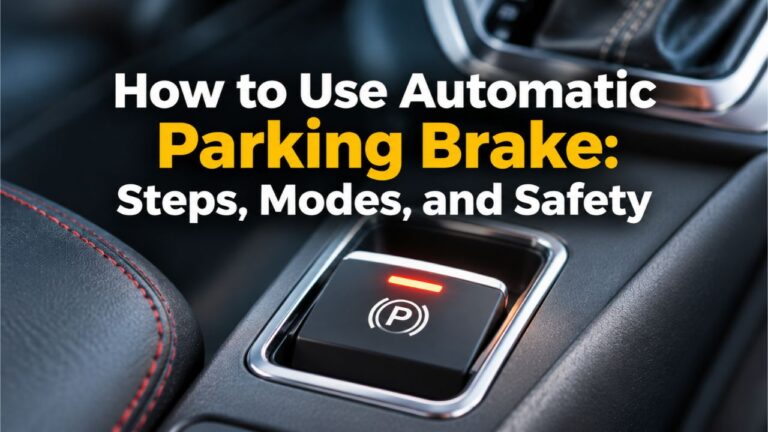
Some vehicles can automatically engage the electronic parking brake when the transmission enters Park or the ignition is switched off.
This feature is often called automatic parking brake, EPB automatic mode, or auto-apply parking brake.
Activating automatic mode is different from simply applying the parking brake once.
Step 01: Check Whether Automatic Mode Is Supported
Open the owner’s manual and look for automatic parking-brake settings.
Some vehicles allow the driver to enable or disable the function. Others have automatic engagement permanently programmed into the braking system.
Do not assume that a vehicle with an EPB switch automatically offers a customizable mode.
Step 02: Park and Power the Vehicle as Required
Stop on level ground, hold the regular brake, and select Park if the vehicle has an automatic transmission.
Make sure the vehicle is in the power or ignition mode specified by the manufacturer.
Automatic-mode settings should be changed only when the vehicle is stationary and properly secured.
Step 03: Enable the Feature Using the Manufacturer’s Procedure
Depending on the vehicle, the setting may be available through the instrument-cluster menu or a specific parking-brake switch sequence.
For example, the Honda Accord instructions linked above describe a model-specific sequence involving the EPB switch and audible confirmation signals.
That sequence should not be used on unrelated vehicles.
Follow your vehicle’s exact instructions, paying attention to button direction, timing, and any confirmation message.
Step 04: Confirm Automatic Activation
After enabling the feature, verify the setting as directed in the owner’s manual.
A supported system may automatically apply the brake when you shift into Park or switch off the vehicle.
Confirm that the appropriate parking-brake indicator illuminates.
Even with automatic mode enabled, check that the parking brake has actually engaged before leaving the vehicle. An electrical malfunction or unmet operating condition may prevent automatic application.
How to Activate the Parking Brake When Parking on a Hill
A hill places additional load on the parking brake and transmission. Correct application and wheel positioning help prevent the vehicle from rolling if a holding mechanism fails.
Step 01: Stop and Keep the Main Brake Applied
Choose a legal parking location and bring the vehicle to a full stop.
Maintain firm pressure on the regular brake pedal while preparing the transmission and parking brake.
Do not allow the vehicle to roll backward or forward to test whether the parking brake is strong enough.
Step 02: Apply the Parking Brake Fully
Engage the hand lever, foot pedal, or electronic switch using the appropriate procedure.
Check for a locked mechanical control or electronic confirmation.
On an automatic transmission, engage the parking brake before transferring the vehicle’s weight to the transmission’s parking mechanism, then select Park as directed by the manufacturer.
On a manual transmission, select the recommended parking gear with the vehicle securely stopped.
Step 03: Position the Front Wheels Correctly
If parking beside a curb, turn the steering wheel according to the slope.
- Facing downhill with a curb: Turn the front wheels toward the curb.
- Facing uphill with a curb: Turn the front wheels away from the curb.
- Parking without a curb: Position the front wheels toward the road’s edge or shoulder, following local guidance.
This positioning helps limit unintended travel if the vehicle starts rolling.
On a particularly steep slope, wheel chocks may provide additional security where appropriate.
Step 04: Verify the Vehicle Remains Secure
With the parking brake applied and transmission secured, gradually ease your foot off the service brake.
If the vehicle begins moving, immediately press the regular brake again.
Do not leave the vehicle until the parking brake and transmission are holding properly.
Avoid depending on the transmission alone to keep a vehicle stationary on a hill.
How to Know Whether the Parking Brake Is Activated
Most vehicles provide at least one physical or visual indication of parking-brake engagement.
For a hand lever, the handle stays raised and locked.
For a foot-operated brake, the pedal remains in its engaged position.
For an electronic parking brake, the instrument panel or switch usually displays an illuminated parking-brake indicator.
Other clues may include:
- A red BRAKE indicator or circled P symbol.
- A parking-brake-applied dashboard message.
- A short actuator sound when an EPB engages.
- Resistance or a locked position in a mechanical control.
- A vehicle that remains stationary after the normal parking procedure.
Do not use the dashboard light alone as a mechanical holding test. Some vehicles share a red brake warning indicator between parking-brake engagement and hydraulic brake problems.
Likewise, the absence of a red indicator after switching off the ignition does not always mean the parking brake released. Some vehicles extinguish the display after a short period while the parking brake remains engaged.
Why Your Parking Brake May Not Activate
A parking brake that does not engage correctly needs attention before it is relied upon to secure a vehicle.
Loose or Damaged Parking Brake Cable
A traditional parking brake may fail because of a stretched, disconnected, seized, or broken cable.
The lever may move unusually far, or a foot pedal may fail to hold its engaged position.
Cable adjustment or replacement requires the correct procedure for the vehicle’s rear brake design.
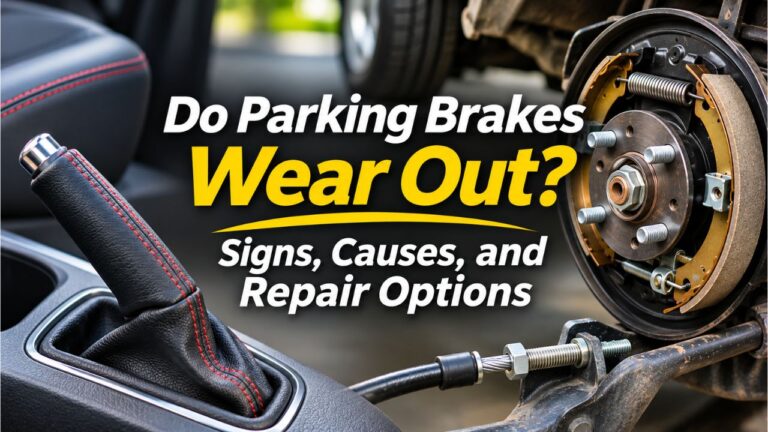
Worn Parking Brake Shoes or Mechanical Parts
Some vehicles use small parking-brake shoes inside rear brake rotors. Others use the ordinary rear brake shoes or an integrated caliper mechanism.
Worn friction material, damaged adjusters, corrosion, or binding linkages can prevent the parking brake from holding securely.
A lever that locks normally does not guarantee that the wheel-brake mechanism works correctly.
Electronic Parking Brake Fault
Electronic systems may refuse to engage because of a failed actuator, switch problem, wiring damage, control-module fault, or inadequate electrical power.
A warning message such as Parking Brake Unavailable indicates that the vehicle needs troubleshooting.
Consult the manual for approved actions. Do not repeatedly operate a malfunctioning actuator or force the rear calipers.
Low Battery Voltage
Most electronic parking brakes require electrical power to operate their actuators.
A discharged 12-volt battery may prevent application or release on some systems.
The exact behavior depends on the vehicle. Use the manufacturer’s approved battery-support and parking procedures rather than assuming an EPB can always be activated with the engine turned off.
Mistakes to Avoid When Applying a Parking Brake
Using the correct control is only part of parking safely. Several simple errors can reduce holding security or damage brake components.
Applying the parking brake while moving: Ordinary parking-brake application should occur after stopping completely. Emergency operation while driving is a separate, vehicle-specific procedure.
Leaving a mechanical brake partly applied: A weakly raised lever or partially pressed pedal may not provide sufficient holding force.
Assuming automatic application always works: Automatic EPB systems depend on operating conditions and may behave differently during faults, towing, or maintenance.
Using Auto Hold as a permanent parking brake: Brake Hold may be designed for temporary stops and can transfer to an EPB under particular conditions. It should not replace the prescribed parking procedure.
Forgetting to release the parking brake: Driving with the parking brake engaged can overheat rear friction components and reduce braking performance.
Ignoring a warning light: A persistent red brake warning after release can indicate a separate hydraulic problem. Do not treat it automatically as a faulty parking-brake switch.
In freezing conditions, consult the owner’s manual for special parking instructions. Some systems can freeze in place after moisture accumulates, and certain manufacturers recommend alternative precautions under specified conditions.
How to Release the Parking Brake Before Driving
Before moving, confirm the correct release method for your vehicle.
A conventional hand lever usually releases when you lift it slightly, press the release button, and lower it completely while holding the regular brake.
Foot-operated systems vary. Some release when the dedicated pedal is pressed again; others use a separate release handle.
Many electronic systems release when you press the regular brake pedal and operate the EPB switch in the release direction. Some offer automatic drive-away release when conditions such as door closure, seat-belt use, and gear selection are satisfied.
Check that the parking-brake indicator switches off before driving.
If the vehicle still resists movement, the rear brakes drag, or a malfunction warning remains, do not force it to move. Have the system inspected.
FAQs About How to Activate Parking Brake
Do You Press or Pull the Parking Brake to Activate It?
It depends on the control. Pull a conventional handbrake lever upward, press a dedicated parking-brake foot pedal, or operate an electronic switch in the direction specified by the vehicle manufacturer. Many electronic systems use an upward pull.
Should You Activate the Parking Brake Before Shifting Into Park?
Applying it while the regular brake pedal is held, before transferring the vehicle’s weight onto the transmission parking mechanism, can help reduce parking-pawl loading. Follow the vehicle manufacturer’s specified sequence and always select Park before leaving an automatic-transmission vehicle.
Can You Activate the Parking Brake With the Engine Off?
Yes, a traditional mechanical parking brake normally works with the engine off. Many electronic parking brakes can also apply without the engine running if sufficient electrical power is available, but the required power mode depends on the vehicle.
How Do You Know if the Electronic Parking Brake Is On?
Look for the illuminated parking-brake indicator on the instrument panel or switch. Some vehicles also display a confirmation message. The indicator may switch off after the ignition is turned off even though the brake remains applied.
Does the Parking Brake Activate Automatically?
Some vehicles automatically apply it when shifting into Park, turning off the power, or meeting specific safety conditions. Others require manual activation every time. Check the owner’s manual for the exact feature and its settings.
Is It Necessary to Use the Parking Brake on Flat Ground?
Using the parking brake whenever the vehicle is parked is a sound habit. It provides an additional holding mechanism and reduces reliance on the transmission’s Park position. Follow the manufacturer’s instructions, including any special conditions for freezing weather or maintenance.
Activate Your Parking Brake Correctly Every Time You Park
Understanding how to activate parking brake controls begins with identifying the system fitted to your vehicle. Pull a traditional hand lever upward, fully press a dedicated foot-operated pedal, or operate the electronic parking-brake switch as instructed. In every case, keep the regular brake pedal applied until the parking brake and transmission are properly secured.
For vehicles with automatic parking-brake functions, confirm whether the feature is enabled and whether its operating conditions have been met. When parking on a hill, proper gear selection and steering-wheel position provide additional protection against unintended movement.
Make parking-brake engagement part of your normal parking routine. Before leaving, verify that the vehicle is securely held, and before driving again, confirm that the parking brake has fully released. If the control fails to engage or the vehicle does not remain stationary, have the system inspected rather than relying on an uncertain parking brake.