How to Identify Brake Master Cylinder: Location and Appearance
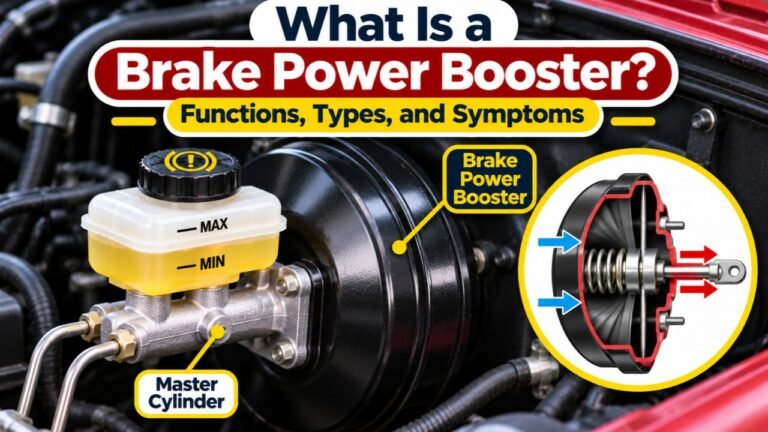
To identify a brake master cylinder, open the hood and locate the brake fluid reservoir, which is usually a small, translucent plastic container near the firewall on the driver’s side of the engine compartment. The master cylinder is typically the metal component directly beneath the reservoir, with rigid brake lines connected to its body. On most conventional power-assisted braking systems, the master cylinder is mounted in front of a large, round brake booster.
The brake master cylinder converts the force applied to the brake pedal into hydraulic pressure that activates the vehicle’s brakes. Although the component is relatively small, it plays an essential role in braking performance and safety.
However, identifying it isn’t always straightforward. Different vehicles have different engine-bay arrangements, and modern hybrid or electric vehicles may use electronically assisted or integrated braking assemblies that look different from traditional systems.
Recognizing the correct component helps when checking for leaks, locating the brake fluid reservoir, diagnosing brake problems, or purchasing replacement parts.
In this article, I explain how to identify brake master cylinder location, appearance, connections, and distinguishing features. You’ll learn how to tell it apart from the brake booster, ABS module, and clutch master cylinder, inspect it safely for possible problems, and confirm the correct replacement part for your vehicle.
How to Identify Brake Master Cylinder: Quick Visual Guide
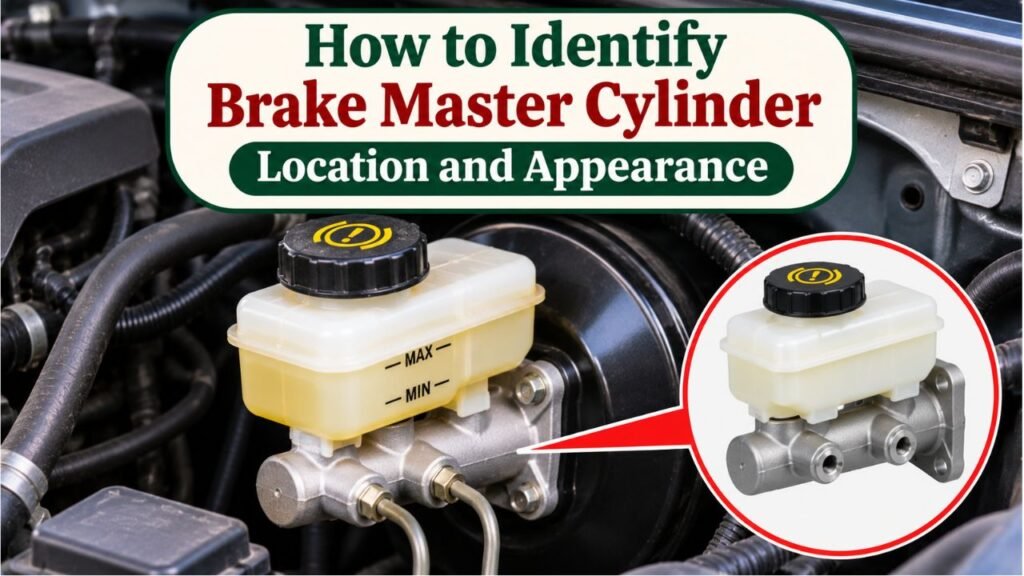
The easiest way to identify a brake master cylinder is to find the brake fluid reservoir and look directly beneath it for the metal cylinder connected to hydraulic brake lines.
On a conventional passenger vehicle, the assembly usually has several recognizable features.
Brake Master Cylinder Identification Chart
| Identifying feature | What to look for |
| General location | Near the firewall, usually on the driver’s side |
| Main body | Compact metal cylinder or cast-metal hydraulic housing |
| Typical color | Silver, gray, or metallic; may darken with age |
| Brake fluid reservoir | Translucent plastic container, commonly mounted above the cylinder |
| Reservoir cap | Often marked DOT 3, DOT 4, or another brake fluid specification |
| Brake line connections | Usually two rigid metal hydraulic lines on modern tandem master cylinders |
| Rear attachment | Commonly bolted to a large brake booster |
| Electrical connections | May have a brake fluid level sensor |
| Main function | Generates hydraulic pressure for the braking system |
These are common characteristics rather than universal requirements.
Some vehicles have remotely mounted reservoirs, different hydraulic port arrangements, or integrated electronic brake components.
According to the CarParts.com guide to master cylinder location, reviewed by an ASE-certified master automobile technician, the cylinder usually sits near the firewall, beneath the fluid reservoir and in front of the brake booster.
The Three Most Reliable Visual Clues
When looking beneath the hood, check for three features together:
- Brake fluid reservoir: A small container with a brake-fluid specification on the cap.
- Metal hydraulic cylinder: A relatively compact metal assembly beneath or connected to the reservoir.
- Rigid brake lines: Small metal tubes attached to the cylinder through threaded fittings.
Finding all three strongly suggests you’ve located the brake master cylinder.
If only one feature is present, inspect more carefully before identifying the component.
Where Is the Brake Master Cylinder Located?
In most conventional vehicles, the brake master cylinder sits in the engine compartment near the firewall.
The firewall separates the engine compartment from the passenger cabin.
The master cylinder is positioned near the brake pedal assembly because the driver’s braking force must be transmitted to it mechanically or through an associated brake-assist system.
Driver-Side Firewall Location
On a left-hand-drive car sold in the United States, the master cylinder is commonly positioned toward the rear of the engine compartment on the driver’s side.
It is often close to the windshield area.
On a right-hand-drive vehicle, the arrangement may be reversed.
However, the precise location depends on the vehicle’s design.
Where to Look in a Typical Car
Start at the back of the engine compartment.
Locate the firewall and then look for a brake fluid reservoir.
The master cylinder is commonly mounted just below the reservoir.
In a traditional vacuum-assisted brake system, it is attached to the front of a circular booster housing.
Where Is It in a Truck or SUV?
Many trucks and SUVs use a similar basic layout.
However, some vehicles use a hydraulic brake booster rather than a conventional vacuum booster.
The master cylinder may still be located near the firewall, but the booster shape and connections can differ.
Where Is It in an Older Car?
Older vehicles may use:
- A single-circuit master cylinder.
- A tandem master cylinder.
- A manually operated brake system without a power booster.
- A cast-metal reservoir instead of a plastic reservoir.
Very old vehicles may place the master cylinder beneath the floor rather than in the modern under-hood location.
Where Is It in a Hybrid or Electric Vehicle?
Modern hybrid and electric vehicles may have:
- Electromechanical brake boosters.
- Brake-by-wire systems.
- Integrated brake control assemblies.
- Separate hydraulic accumulators.
- Remote brake fluid reservoirs.
The master cylinder may not resemble the traditional metal cylinder mounted to a large round vacuum booster.
Use the exact vehicle’s service information when the system isn’t immediately recognizable.
Key Takeaway: Look near the firewall and brake pedal area first, but don’t assume every vehicle has an identical master-cylinder layout.
What Does a Brake Master Cylinder Look Like?
A conventional master cylinder is generally an elongated metal housing with one or more hydraulic outlet ports.
A brake fluid reservoir is often attached above it.
The metal body is much smaller than the booster behind it.
1. Metal Cylinder Body
The main body is typically made from aluminum alloy or another suitable metal.
It contains the hydraulic cylinder bore, pistons, seals, and internal fluid passages.
Its shape may be rounded, rectangular, or irregular depending on casting and mounting features.
Not every master cylinder has a simple smooth cylindrical exterior.
2. Brake Fluid Reservoir
The reservoir supplies brake fluid to the hydraulic circuits.
It is commonly made from translucent plastic so the fluid level can be inspected without removing the cap.
Many reservoirs have:
- MIN marking.
- MAX marking.
- Screw-on cap.
- Brake fluid specification.
- Electrical fluid-level sensor.
The reservoir may be a separate component fitted into the master cylinder with sealing grommets.
3. Brake Line Outlet Ports
A conventional tandem master cylinder usually has two hydraulic outlet connections.
These ports connect to rigid brake lines.
The lines may run directly to an ABS hydraulic control module or through other components, depending on the vehicle.
Some older systems have different numbers or arrangements of ports.
4. Mounting Flange
The master cylinder normally has a mounting flange at its rear.
On many power-assisted systems, bolts or studs secure it to the brake booster.
This joint is an important visual reference.
5. Electrical Fluid-Level Sensor
Some brake fluid reservoirs have a small electrical connector.
This may connect to a low-fluid warning system.
A sensor connector isn’t present on every design.
6. Internal Pistons and Seals
The pistons and seals cannot normally be seen while the master cylinder is installed.
They move inside the housing to generate hydraulic pressure.
Most modern passenger vehicles use tandem systems that provide two hydraulic circuits.
How to Find the Brake Master Cylinder Step by Step
You can usually identify a conventional brake master cylinder through visual inspection without removing any components.
Step 1: Park the Vehicle Safely
Park on level ground.
Shift into Park or the appropriate gear for the vehicle.
Apply the parking brake.
Switch off the engine and allow hot components to cool.
For hybrid and electric vehicles, follow the manufacturer’s instructions because some braking systems can pressurize or operate electrically even when the engine isn’t running.
Step 2: Open and Secure the Hood
Release the hood latch.
Open the hood completely and secure it using the support rod or hood struts.
Make sure it cannot fall while you’re inspecting the engine compartment.
Step 3: Locate the Firewall
Stand in front of the vehicle and look toward the back of the engine compartment.
The firewall is the structure separating the engine bay from the passenger compartment.
You may see hoses, wiring, insulation, and other components attached to it.
Step 4: Find the Brake Fluid Reservoir
Look for a small translucent reservoir near the firewall.
The cap may say:
- DOT 3.
- DOT 4.
- DOT 4 LV.
- Use Only Specified Brake Fluid.
Some caps include a brake warning symbol.
Read the markings rather than identifying the reservoir by color alone.
Step 5: Look Beneath the Reservoir
On many conventional systems, a metal hydraulic cylinder is attached directly beneath the reservoir.
This metal part is the brake master cylinder.
The reservoir may partly obscure it.
Use a flashlight to inspect the visible metal housing.
Step 6: Locate the Brake Line Connections
Look for rigid metal tubes connected to the cylinder.
These tubes may have:
- Steel or coated metal construction.
- Curved routing.
- Hexagonal fittings.
- Connections along one side or end of the housing.
The tubes are hydraulic brake lines.
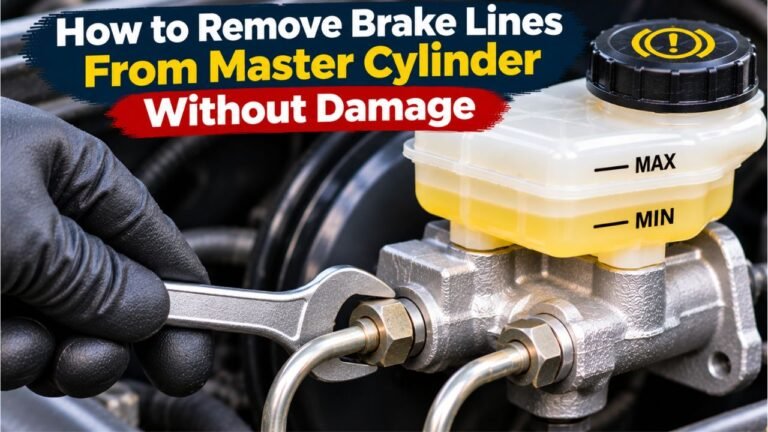
Do not loosen them for identification.
Step 7: Identify the Brake Booster
Look behind the master cylinder.
Many vehicles have a large circular black or dark-metal housing attached to the firewall.
This is the vacuum brake booster.
The smaller master cylinder is attached to its front.
If you can identify the booster and reservoir together, the master cylinder is usually between them.
Step 8: Compare With the Owner’s Manual
If the arrangement is unclear, check the vehicle’s owner’s manual or a model-specific service diagram.
Some vehicles hide the assembly behind plastic trim or use different brake-assist designs.
Step 9: Verify the Part Before Touching Anything
Before attempting any maintenance, confirm:
- The reservoir is for brake fluid.
- The metal component is attached to the braking system.
- The lines are brake hydraulic lines.
- The arrangement matches the vehicle’s technical information.
You do not need to disconnect a hydraulic line, remove a reservoir cap, or unbolt any component merely to identify the master cylinder.
Key Takeaway: A visual inspection is usually enough on conventional systems. Keep the hydraulic system closed unless a specific maintenance procedure requires otherwise.
Brake Master Cylinder vs. Brake Booster: How to Tell Them Apart
The brake master cylinder and brake booster are often mounted together.
This makes them easy to confuse.
However, they have different functions and appearances.
Brake Master Cylinder
The master cylinder:
- Is relatively compact.
- Has a metal hydraulic body.
- Commonly supports the brake fluid reservoir.
- Connects to rigid brake lines.
- Generates hydraulic pressure.
Brake Booster
The booster:
- Is often a large circular housing.
- Sits between the master cylinder and firewall.
- Helps reduce the force required at the pedal.
- May use vacuum, hydraulic, or electrical assistance.
- Is connected mechanically to the master cylinder on many conventional systems.
Brake Master Cylinder vs. Booster Comparison
| Feature | Master cylinder | Brake booster |
| Appearance | Smaller metal hydraulic housing | Often large, round housing |
| Position | Usually in front of booster | Between master cylinder and firewall |
| Brake fluid reservoir | Commonly attached | Usually not directly attached as the fluid-storage component |
| Rigid brake lines | Generally connected | Usually not on a vacuum booster |
| Main function | Generates hydraulic pressure | Provides brake pedal assistance |
| Vacuum hose | Usually not connected directly | Common on vacuum boosters |
Brake component manufacturer Wagner explains in its guide to how the brake system works that the brake booster increases force applied to the master cylinder, which then directs hydraulic pressure to the wheel brakes.
How to Recognize Them Together
Think of the traditional assembly from the firewall outward:
Firewall → Brake booster → Brake master cylinder
The brake fluid reservoir commonly sits above the master cylinder.
The hydraulic brake lines leave the cylinder and connect to the rest of the braking system.
Does Every Vehicle Have a Round Brake Booster?
No.
Some vehicles use Hydro-Boost systems, electric boosters, or integrated brake-control assemblies.
These may look different.
Do not assume the master cylinder is missing simply because a large round booster isn’t visible.
Brake Master Cylinder vs. ABS Module
The ABS hydraulic module is another metal component that can be confused with the master cylinder.
Both may have brake lines attached.
However, they usually have different shapes and functions.
What Does the ABS Module Look Like?
A conventional ABS hydraulic assembly often has:
- A rectangular aluminum hydraulic block.
- Multiple brake line fittings.
- An attached black electronic control unit.
- A large electrical connector.
- Sometimes a visible electric pump motor.
It may be mounted elsewhere in the engine compartment.
What Does the Master Cylinder Look Like?
A conventional master cylinder usually has:
- A more elongated metal body.
- A fluid reservoir attached above or supplied remotely.
- Hydraulic outlet fittings.
- A mounting connection to a booster or brake pedal mechanism.
How Many Brake Lines Are Connected?
A conventional tandem master cylinder often has two hydraulic outlet lines.
The ABS hydraulic module may have several connections for circuits going to individual wheels.
However, don’t identify components solely by counting the lines.
The exact arrangement varies by system.
Comparison Chart
| Feature | Master cylinder | ABS hydraulic module |
| Typical shape | Elongated metal body | Rectangular hydraulic block |
| Reservoir | Commonly connected | Usually supplied by the master-cylinder circuit |
| Brake lines | Often two main outlet lines | Frequently several inlet and outlet lines |
| Electronics | Sometimes a simple level sensor | Typically a substantial electronic connector |
| Main function | Produces hydraulic pressure | Modulates brake pressure during ABS operation |
| Typical location | Near brake pedal and firewall | Varies by vehicle |
Some modern integrated brake systems combine functions that were traditionally housed separately.
Use model-specific diagrams when the components are integrated.
Brake Master Cylinder vs. Clutch Master Cylinder
Manual-transmission vehicles may have a separate clutch master cylinder.
It can look similar to the brake master cylinder.
Both use hydraulic pressure, but they operate different systems.
Brake Master Cylinder
The brake master cylinder receives input from the brake pedal and supplies hydraulic pressure to the braking circuits.
It commonly has multiple hydraulic outlet connections.
Clutch Master Cylinder
The clutch master cylinder receives input from the clutch pedal.
It sends pressure through a hydraulic line to operate the clutch release mechanism.
It is often smaller than the brake master cylinder.
How to Tell Them Apart
| Feature | Brake master cylinder | Clutch master cylinder |
| Connected pedal | Brake pedal | Clutch pedal |
| Main function | Applies hydraulic brakes | Operates clutch release |
| Hydraulic outlets | Usually multiple circuits | Typically one clutch hydraulic outlet |
| Reservoir | Usually present or remotely supplied | May have a separate or shared reservoir |
| Location | Near brake pedal and booster | Near clutch pedal or firewall |
| Size | Often larger | Often smaller |
Can Both Share the Same Reservoir?
Yes.
Some manual-transmission vehicles use a shared brake fluid reservoir to supply both the brake and clutch hydraulic circuits.
In those vehicles, locating the reservoir alone may not distinguish the two master cylinders.
Follow the hydraulic lines and consult the vehicle’s service diagram.
Do Automatic Cars Have a Clutch Master Cylinder?
Conventional automatic-transmission vehicles generally don’t have a clutch pedal-operated master cylinder.
However, transmission and clutch-actuation systems vary, especially on specialized vehicles.
How to Identify a Brake Master Cylinder Without a Reservoir on Top
Not every master cylinder has a reservoir directly attached to its body.
Some vehicles use a remote reservoir.
What Is a Remote Brake Fluid Reservoir?
A remote reservoir is mounted separately from the master cylinder.
Fluid travels between the reservoir and master cylinder through appropriate supply connections.
This arrangement may be used to accommodate limited space or other design requirements.
How to Find the Cylinder
If you locate the brake fluid reservoir but cannot see a metal cylinder beneath it:
- Read the reservoir markings.
- Look for supply hoses or other connections leading away from it.
- Identify the brake hydraulic assembly near the firewall or under the designated cover.
- Look for rigid hydraulic brake lines.
- Compare the arrangement with a model-specific diagram.
Do not pull on hoses or loosen fittings.
Can the Master Cylinder Be Hidden?
Yes.
Some vehicles have plastic covers, cowl panels, or other components that obstruct the view.
On certain models, the master cylinder may be partially concealed within a larger brake-assist assembly.
If the component is not readily visible, consult the owner’s manual rather than dismantling the braking system simply to locate it.
How to Identify a Tandem Brake Master Cylinder
Most modern passenger vehicles use a dual-circuit hydraulic braking system.
A tandem master cylinder has two separate hydraulic pressure circuits.
What Is a Tandem Master Cylinder?
A tandem master cylinder contains two pistons arranged within the same general housing.
It provides pressure to separate hydraulic circuits.
This arrangement helps preserve some braking capability if one circuit develops certain failures.
However, braking performance may be severely reduced after a circuit failure.
Can You See Both Pistons?
No.
The pistons are located inside the cylinder bore.
You generally cannot identify them without disassembly.
How Does a Tandem Master Cylinder Look?
Externally, it may appear similar to a single-circuit master cylinder.
Typical visual clues include:
- Metal body.
- Brake fluid reservoir.
- Two hydraulic outlet connections.
- Rear mounting flange.
- Attachment to brake-assist equipment.
However, port count alone is not a definitive identification method.
Is a Single-Circuit Master Cylinder Still Used?
Single-circuit designs can be found in older vehicles and certain specialized applications.
Modern passenger vehicles generally use dual-circuit hydraulic braking.
When identifying an older master cylinder, refer to the exact vehicle documentation.
How to Identify a Bad Brake Master Cylinder
Finding the master cylinder is different from determining whether it has failed.
Some problems are visible from outside.
Others occur inside the component and require professional diagnosis.
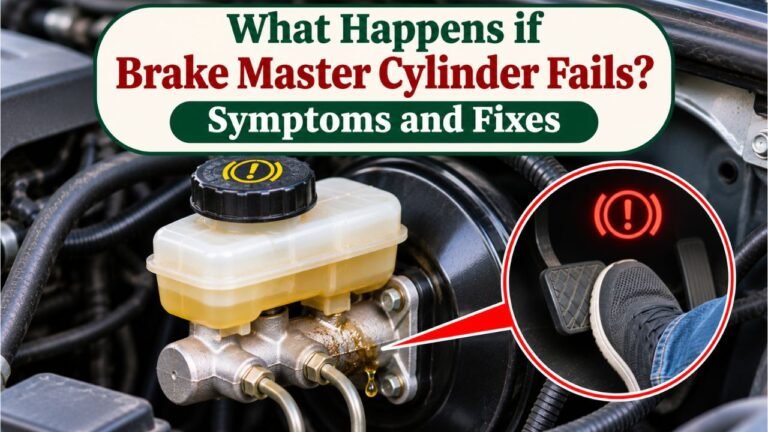
Signs of Possible Master Cylinder Problems
| Symptom | Possible explanation |
| Brake fluid leaking around the cylinder | Damaged seal, fitting, or reservoir connection |
| Fluid near the cylinder-to-booster joint | Possible rear master-cylinder seal leak |
| Brake pedal slowly sinks under steady pressure | Possible internal hydraulic leakage |
| Soft or spongy brake pedal | Air, leaks, fluid vapor, or another hydraulic problem |
| Brake warning light | Low fluid or another brake-system fault |
| Brake fluid level dropping | Pad wear or hydraulic leakage |
| Unusual braking performance | Possible master cylinder or other brake-system problem |
These symptoms aren’t exclusive to master cylinder failure.
Other hydraulic components can produce similar problems.
1. Visible Brake Fluid Leaks
Inspect the exterior of the master cylinder without disturbing its connections.
Look for signs of wetness around:
- The reservoir connection.
- Hydraulic line fittings.
- The cylinder body.
- The rear mounting area.
However, dirt, oil, and moisture from other sources can complicate visual identification.
Don’t assume every wet area is brake fluid.
2. Brake Fluid Near the Booster
A leaking rear master-cylinder seal may allow fluid into or around the brake booster.
This can be difficult to see externally.
A dry exterior doesn’t completely rule out internal leakage.
3. Brake Pedal Sinking
A brake pedal that slowly sinks under steady pressure can indicate hydraulic pressure loss.
A failing master cylinder is one possible cause.
However, other leaks and brake-system faults must also be considered.
According to NAPA’s technical guide to testing a brake master cylinder, internal leakage and seal problems can produce sinking or abnormal pedal behavior even when external leakage isn’t immediately visible.
4. Soft or Spongy Brake Pedal
A spongy pedal may indicate air trapped in the system or other problems.
It doesn’t automatically prove that the master cylinder is defective.
Proper diagnosis may involve checking:
- Brake lines.
- Flexible hoses.
- Calipers.
- Wheel cylinders.
- Fluid condition.
- ABS hydraulic components.
- Master cylinder seals.
5. Low Brake Fluid
Low fluid can be caused by normal brake pad wear or hydraulic leakage.
It doesn’t automatically indicate a defective master cylinder.
A sudden drop in fluid level requires inspection.
6. Brake Warning Lights
A brake warning light can have several causes.
These may include:
- Low brake fluid.
- Parking brake status.
- Hydraulic pressure problems.
- ABS or electronic brake faults.
Use the owner’s manual to interpret the warning.
Important: If the brake pedal sinks abnormally, braking effectiveness is reduced, or a hydraulic leak is suspected, do not drive the vehicle. Arrange professional inspection or towing.
How to Inspect the Brake Master Cylinder Safely
A basic visual inspection can help identify obvious leaks or damage.
It should not require opening the hydraulic system.
Step 1: Switch Off the Vehicle
Park safely and turn off the engine.
For hybrid and electric vehicles, follow any manufacturer-specific inspection instructions.
Step 2: Locate the Assembly
Find the reservoir, master cylinder, and brake-assist unit using the visual indicators described earlier.
Step 3: Check the Reservoir Exterior
Look at the fluid level through the translucent reservoir when possible.
Check for cracks, obvious damage, or wetness.
Avoid opening the cap unless necessary for an approved maintenance procedure.
Step 4: Inspect Accessible Connections
Look for visible damage or leaks at the master cylinder body and line fittings.
Do not tighten or loosen fittings as an exploratory step.
Step 5: Look Around the Booster Connection
Inspect the visible area where the master cylinder meets the booster.
Signs of fluid leakage deserve professional attention.
Step 6: Check for Corrosion
Look for obvious corrosion on accessible metal components and hydraulic fittings.
Corrosion doesn’t always prove that the master cylinder itself has failed, but it may require attention.
Step 7: Compare With Vehicle Service Information
If anything looks unusual, check the vehicle’s repair information.
Avoid removing brake lines or other hydraulic parts without the required service procedure and equipment.
Step 8: Arrange Diagnosis if Problems Are Found
Internal master-cylinder problems usually cannot be confirmed reliably through a simple visual inspection.
A qualified technician can perform the appropriate hydraulic tests.
Key Takeaway: Visual inspection is useful for locating the cylinder and spotting obvious leaks. Internal hydraulic diagnosis requires more than looking at the component.
How to Identify the Correct Replacement Brake Master Cylinder
Identifying the installed cylinder is only the first step if you plan to replace it.
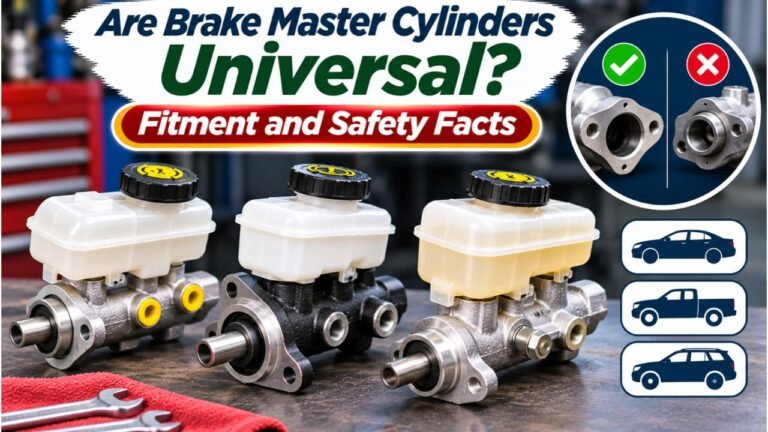
Different vehicles may use master cylinders that look similar but have incompatible specifications.
Check the Vehicle Identification Number
The VIN helps identify the vehicle’s original configuration.
For accurate replacement-part selection, record:
- Vehicle make.
- Model.
- Model year.
- Trim or submodel.
- Engine and drivetrain when relevant.
- VIN.
- Brake-system configuration.
Some vehicles use different master cylinders depending on the brake package or production date.
Confirm ABS Compatibility
Vehicles with and without ABS may use different master cylinders.
The hydraulic port arrangement and internal specifications can vary.
Do not assume the same part fits both versions.
Check the Cylinder Bore Size
Master cylinders have specified internal bore diameters.
Bore size affects the relationship between piston movement and hydraulic pressure.
A physically similar cylinder with the wrong bore may cause incorrect pedal travel or braking characteristics.
Use the manufacturer’s specified replacement.
Compare Brake Line Ports
Important details may include:
- Number of outlet ports.
- Port positions.
- Thread sizes.
- Fitting types.
- Orientation.
Different ports can prevent installation or create unsafe hydraulic connections.
Check Mounting Dimensions
Verify that the replacement matches:
- Mounting flange.
- Bolt spacing.
- Booster interface.
- Pushrod compatibility.
- Overall clearance.
A similar appearance isn’t enough.
Confirm Reservoir Configuration
Some master cylinders are supplied with a reservoir.
Others require transferring an existing reservoir or using a specific remote arrangement.
Check the part description.
Verify Sensor Connections
Brake fluid level sensors and other electrical connections may differ.
Choose a replacement compatible with the original system.
Use OEM or Verified Replacement Information
Compare the manufacturer’s part number with a reputable parts catalog.
If the cylinder has a cast or stamped number, don’t assume that number is the final service part number.
Casting identifiers and complete assembly numbers may differ.
Brake Master Cylinder Replacement Checklist
| Detail | What to verify |
| Vehicle identification | Make, model, year, and VIN |
| Brake system | ABS and stability-control configuration |
| Cylinder bore | Correct manufacturer specification |
| Hydraulic connections | Port count, size, and location |
| Mounting | Flange and booster compatibility |
| Reservoir | Included, transferred, or remote |
| Electrical connections | Correct sensor arrangement |
| Part number | Verified service replacement number |
A parts specialist or qualified technician can help confirm compatibility.
How to Identify Brake Master Cylinder Problems in Different Vehicles
Master cylinder failures can produce similar symptoms across vehicle types, but diagnostic procedures vary.
Conventional Gasoline Cars
Many gasoline-powered vehicles have a traditional master cylinder attached to a vacuum booster.
The assembly is usually relatively easy to identify visually.
However, internal hydraulic faults still require proper diagnosis.
Pickup Trucks and SUVs
Some trucks use hydraulic power-assist systems instead of vacuum boosters.
The master cylinder may resemble a conventional unit, but the booster arrangement and related hydraulic connections differ.
Hybrid Vehicles
Some hybrids use electrically controlled brake pressure systems.
The brake actuator or booster may operate unexpectedly if a service procedure isn’t followed.
Do not assume the system is depressurized merely because the gasoline engine is off.
Electric Vehicles
Electric vehicles may use electromechanical brake boosters and integrated control systems.
The reservoir and hydraulic connections can remain recognizable, but the overall assembly may look different.
Use vehicle-specific service documentation.
Older Classic Cars
Older vehicles may have simpler master cylinders, metal reservoirs, or under-floor mounting positions.
Some lack a conventional vacuum booster.
Identification may require tracing the brake pedal linkage and consulting a service manual.
Common Mistakes When Identifying a Brake Master Cylinder
Confusing the Booster With the Master Cylinder
The large round housing is commonly the brake booster.
The master cylinder is usually the smaller hydraulic component attached to its front.
Mistaking the Reservoir for the Entire Cylinder
The plastic reservoir stores brake fluid.
The metal master cylinder beneath it generates hydraulic pressure.
They are related but distinct components.
Confusing the ABS Module With the Master Cylinder
Both may have brake lines attached.
The ABS module often has a rectangular hydraulic block and a large electronic connector.
The master cylinder is generally associated with the reservoir and brake pedal or booster assembly.
Identifying Components by Color Alone
Metal finishes, dirt, corrosion, and plastic colors vary by vehicle.
Use location, connections, and function instead.
Assuming Every Vehicle Has Two Brake Line Ports
Two hydraulic outlets are common, but other designs exist.
Use vehicle-specific information.
Assuming Every Vehicle Has a Round Vacuum Booster
Hydraulic and electric brake-assist systems can look different.
Opening Hydraulic Lines for Identification
This can introduce air, cause fluid leakage, and create additional brake service requirements.
Visual identification should not require opening the hydraulic system.
Assuming Low Brake Fluid Means a Bad Master Cylinder
Low fluid may be associated with brake pad wear or leaks elsewhere.
The cause must be established.
Using Pedal Feel Alone to Diagnose Failure
A sinking or soft pedal may have several causes.
Proper diagnosis is essential.
Ordering a Replacement Based Only on Appearance
A cylinder that looks similar may have the wrong bore size, port arrangement, or mounting specifications.
Verify the exact part.
Brake Master Cylinder Identification Checklist
Before concluding that you’ve found the correct component, check the following:
- Locate the brake fluid reservoir.
- Check the reservoir cap for brake fluid markings.
- Find the metal hydraulic housing beneath or connected to the reservoir.
- Locate the rigid metal brake lines.
- Check whether the housing is attached to a brake booster.
- Distinguish the booster from the master cylinder.
- Distinguish the ABS hydraulic module from the master cylinder.
- Check for a separate clutch master cylinder, if applicable.
- Compare the assembly with model-specific documentation.
- Inspect the accessible exterior for obvious leaks or damage.
- Avoid disconnecting hydraulic connections.
- Confirm the VIN and part specifications before ordering a replacement.
Conclusion
The easiest way to identify a brake master cylinder is to locate the brake fluid reservoir, find the metal hydraulic component beneath or connected to it, and look for rigid brake lines extending from the cylinder.
On most conventional vehicles, the master cylinder is located near the firewall and mounted directly in front of the brake booster.
However, some older vehicles use different mounting locations, while modern hybrid and electric vehicles may have integrated electronic braking assemblies.
The master cylinder should not be confused with the brake booster, ABS module, or clutch master cylinder.
I recommend beginning with a simple visual inspection and confirming the component’s location using the owner’s manual or vehicle-specific service information. If you’re identifying the part for replacement, verify the VIN, hydraulic port arrangement, mounting details, and manufacturer’s part number.
If you notice brake fluid leakage, a sinking pedal, or reduced braking performance, have the hydraulic system inspected before driving.
Identifying the brake master cylinder correctly is the first step toward understanding the braking system, but diagnosing or repairing it requires careful attention to safety and vehicle-specific procedures.
FAQs About How to Identify Brake Master Cylinder
How Do I Identify a Brake Master Cylinder?
Find the brake fluid reservoir near the firewall.
The master cylinder is commonly the metal component beneath the reservoir, with rigid brake lines attached.
On traditional systems, it is mounted in front of the brake booster.
What Does a Brake Master Cylinder Look Like?
It usually has a compact silver or gray metal housing, a brake fluid reservoir above it, hydraulic outlet fittings, and a mounting flange.
Its exact appearance varies by vehicle.
Where Is the Brake Master Cylinder Located?
On most conventional left-hand-drive vehicles, it is near the rear of the engine compartment on the driver’s side, close to the firewall.
Right-hand-drive and integrated brake-system layouts may differ.
Is the Brake Master Cylinder Attached to the Brake Booster?
Usually, yes, on conventional power-assisted braking systems.
The master cylinder is mounted at the front of the booster.
However, other brake-assist designs exist.
Is the Master Cylinder the Same as the Brake Fluid Reservoir?
No.
The reservoir stores brake fluid.
The master cylinder contains hydraulic pistons that generate pressure when the brakes are applied.
The two components are often connected.
How Many Brake Lines Connect to a Master Cylinder?
Many modern tandem master cylinders have two main hydraulic outlet lines.
However, the number and arrangement of connections vary by vehicle.
Use a model-specific diagram for accurate identification.
Can a Brake Master Cylinder Be Located Under the Car?
Certain older vehicles have under-floor master cylinder mounting positions.
However, most modern passenger cars locate the assembly under the hood near the firewall.
What Is the Difference Between a Master Cylinder and an ABS Module?
The master cylinder generates hydraulic pressure.
The ABS module regulates pressure during anti-lock braking operation.
The ABS hydraulic unit often has multiple brake line connections and an electronic controller.
How Can I Tell a Brake Master Cylinder From a Clutch Master Cylinder?
The brake master cylinder connects to the brake pedal system and supplies the brake circuits.
The clutch master cylinder connects to the clutch pedal and operates the hydraulic clutch.
The clutch cylinder is often smaller, although configurations vary.
How Do I Know if My Brake Master Cylinder Is Bad?
Possible signs include fluid leakage, a sinking brake pedal, abnormal pedal feel, and reduced braking performance.
However, other brake-system problems can produce similar symptoms.
Professional diagnosis is necessary.
Can a Brake Master Cylinder Fail Without Leaking Fluid?
Yes.
Internal seal problems can allow hydraulic pressure loss without an obvious external leak.
A qualified technician can perform appropriate diagnostic tests.
Does a Soft Brake Pedal Always Mean a Bad Master Cylinder?
No.
Air in the hydraulic system, leaking components, fluid vapor, or other faults may cause a soft pedal.
Don’t replace the master cylinder without establishing the cause.
How Do I Find the Brake Master Cylinder on a Hybrid Car?
Look for the brake fluid reservoir and consult the manufacturer’s service diagram.
Some hybrid vehicles have integrated electronic braking assemblies that differ significantly from traditional master cylinder and booster systems.
Can I Identify the Correct Master Cylinder Using the VIN?
Yes.
A VIN helps a parts supplier identify the correct vehicle configuration.
However, verify the brake system, mounting arrangement, hydraulic port specifications, and appropriate replacement part number.
Should I Remove the Master Cylinder to Identify It?
No.
Routine visual identification doesn’t require removing the component.
Disconnecting hydraulic lines introduces additional safety and bleeding requirements.
Can I Drive With a Bad Brake Master Cylinder?
No, if the master cylinder is causing hydraulic pressure loss, leakage, or unsafe braking.
Arrange professional diagnosis and repair before operating the vehicle.