Can You Check Brake Fluid After Driving? When and How to Check
Yes, you can check brake fluid after driving. For most vehicles, you can inspect the brake fluid reservoir shortly after parking, provided the engine is switched off, the vehicle is on level ground, and you avoid touching hot engine components. You generally do not need to wait for the engine to cool completely just to read the fluid level through a translucent reservoir.
The most important thing is to check the level between the MIN and MAX markings without unnecessarily removing the reservoir cap. Unlike engine oil, brake fluid does not normally require a specific waiting period after driving for a basic visual level inspection.
However, checking the level is different from opening the reservoir or adding fluid. The engine compartment may contain hot components, and opening the brake fluid system unnecessarily increases the risk of moisture and dirt contamination.
If the fluid level is unusually low after driving, the cause may involve worn brake pads or a hydraulic leak.
In this article, I explain when to check brake fluid after driving, whether hot or cold conditions affect the reading, and how to inspect the reservoir safely. I also cover proper fluid levels, topping up, warning signs, and when a professional brake inspection is necessary.
Can You Check Brake Fluid After Driving? Quick Answer
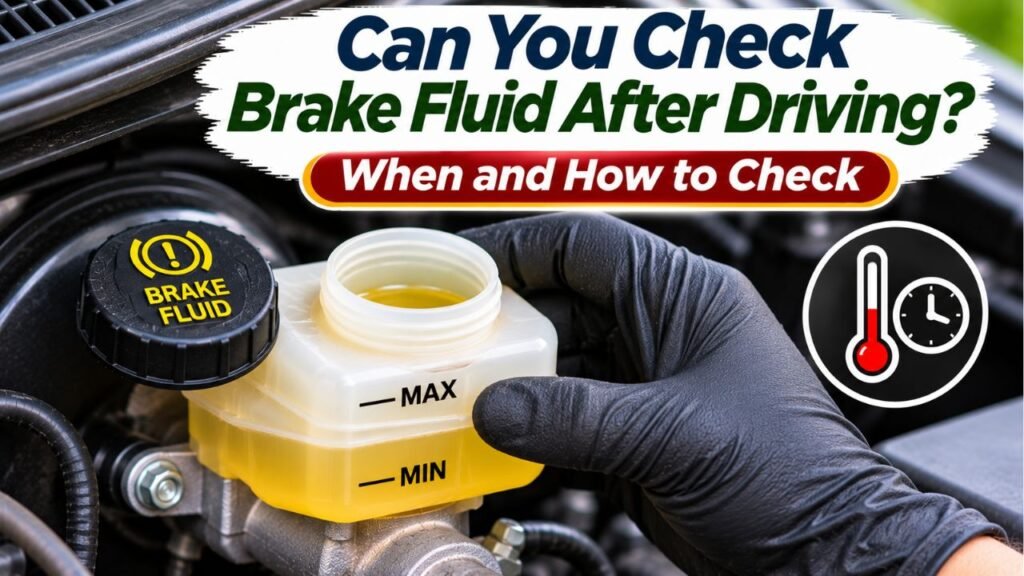
You can normally check the brake fluid level immediately after parking and switching off the engine, as long as it is safe to open the hood and access the reservoir.
For a basic visual inspection, a lengthy cooldown is not generally necessary.
However, waiting for the engine compartment to cool is sensible if you cannot inspect the reservoir without reaching near hot components.
The correct procedure depends on the vehicle.
Brake Fluid Checking Conditions
| Vehicle Condition | Can You Check Brake Fluid? | Important Consideration |
| Immediately after normal driving | Yes, on most vehicles | Switch off the engine and avoid hot components |
| After 5–10 minutes of parking | Yes | A convenient time for a visual inspection |
| After 30 minutes | Yes | Engine compartment may be cooler |
| After several hours | Yes | Often comfortable for routine maintenance |
| With a completely cold engine | Yes | Suitable for most routine checks |
| With the engine running | Generally not recommended | Follow manufacturer-specific instructions |
| After aggressive or track driving | With additional caution | Components may be extremely hot |
| After a brake warning light appears | Only after stopping safely | Abnormal braking may require towing |
| On certain hybrid or electric vehicles | Follow the owner’s manual | Brake accumulator operation may affect the reading |
The official Ford guide on checking brake fluid recommends parking on a level surface and inspecting the fluid through the translucent reservoir.
The procedure focuses on the reservoir markings and does not establish a universal engine cooldown period for a visual check.
Do You Need to Wait 30 Minutes?
Not normally for a simple external level check.
A fixed 30-minute waiting period is not a general requirement for every vehicle.
However, if the engine compartment is very hot or the reservoir is difficult to reach safely, waiting longer is sensible.
Is Brake Fluid Hot After Driving?
Brake fluid can become hot during braking, particularly near the brake calipers and wheel cylinders.
However, the reservoir is located away from the friction surfaces where much of the braking heat is generated.
Its temperature does not necessarily match the temperature of the fluid near the brakes.
Regardless of reservoir temperature, avoid unnecessary contact with hot vehicle components.
Should You Check Brake Fluid When the Engine Is Hot or Cold?
For most conventional vehicles, you can inspect the reservoir with either a warm or cold engine.
The main requirements are proper vehicle positioning, a safe working environment, and compliance with the owner’s manual.
Checking Brake Fluid With a Cold Engine
A cold engine is often more convenient for routine maintenance.
Benefits include:
- Lower risk of touching hot engine components
- More comfortable access to the reservoir
- Easier inspection around the engine compartment
- Less concern about nearby hot exhaust components
If you are performing several maintenance checks, waiting until the engine is cool is a sensible approach.
Checking Brake Fluid With a Warm Engine
A warm engine does not automatically prevent you from checking the brake fluid level.
If you have just completed a normal drive, park safely, shut down the vehicle, and inspect the reservoir without opening it.
Do not lean against hot engine components.
Avoid reaching near the exhaust manifold, radiator, or other hot parts.
Does Temperature Affect Brake Fluid Level?
Temperature can affect fluid volume because liquids expand when heated.
However, a basic brake fluid reservoir check on most conventional passenger cars does not use the same hot-versus-cold procedure found on certain transmission or power-steering systems.
The manufacturer usually specifies a normal fluid range using MIN and MAX markings.
On some vehicles with hydraulic accumulators or electronically controlled braking systems, the level can also vary depending on the operating state of the brake system.
Therefore, follow the exact manufacturer’s checking procedure if the vehicle requires one.
Hot vs. Cold Brake Fluid Checking
| Factor | Warm Engine | Cold Engine |
| Basic reservoir inspection | Usually possible | Usually possible |
| Touching nearby components | Higher burn risk | Lower burn risk |
| Removing reservoir cap | Unnecessary for a visual check | Still unnecessary for a visual check |
| Reading MIN/MAX markings | Usually valid when checked correctly | Usually valid when checked correctly |
| Special brake-system procedures | May apply | May apply |
| Convenience | Depends on access and temperature | Often easier |
For routine maintenance, a cold engine is convenient. However, you do not normally have to wait for a completely cold engine just to look at the brake fluid reservoir.
How to Check Brake Fluid After Driving Step by Step
A basic brake fluid inspection usually takes only a few minutes.
The goal is to determine whether the level is inside the manufacturer’s acceptable range without opening the hydraulic system.
Step 1: Park on Level Ground
Find a safe, level parking area.
Avoid checking the fluid level while the vehicle is parked on a steep incline.
The fluid surface can appear higher on one side of the reservoir when the vehicle is tilted.
Park securely and apply the parking brake according to the manufacturer’s instructions.
Step 2: Turn Off the Engine
Switch off the engine or vehicle power system.
For vehicles with keyless ignition, confirm that the vehicle is fully switched off rather than left in an accessory or ready-to-drive mode.
Some hybrid and electric vehicles have additional braking-system procedures.
Follow the owner’s manual if the vehicle specifies a particular system state for checking brake fluid.
Step 3: Allow Safe Access to the Engine Compartment
You do not normally need a lengthy waiting period, but use caution.
If the engine bay is extremely hot, allow it to cool before reaching inside.
Keep your hands away from:
- Hot exhaust components
- Radiator and cooling-system parts
- Moving belts and pulleys
- Electric cooling fans
- Other components that may remain hot or operate unexpectedly
Electric cooling fans can sometimes run after the engine is switched off.
If you cannot access the reservoir without reaching near hazardous components, wait until the area is safe.
Step 4: Locate the Brake Fluid Reservoir
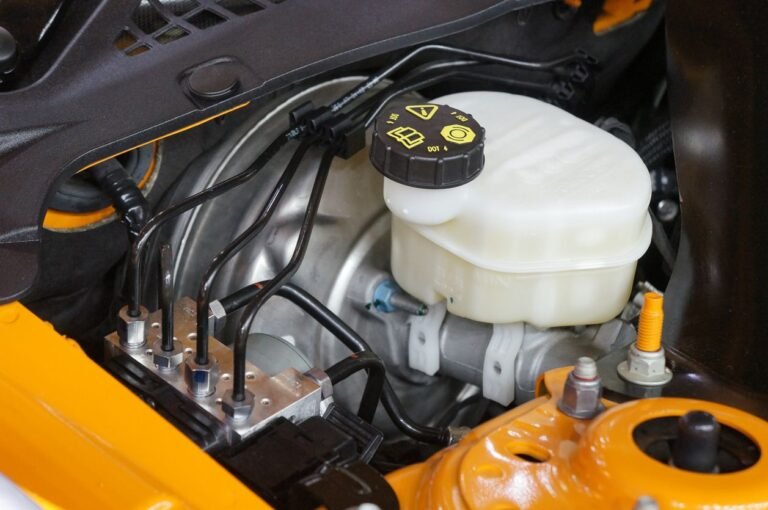
On many vehicles, the brake fluid reservoir is near the rear of the engine compartment, mounted on or connected to the brake master cylinder.
It is commonly a translucent plastic container.
Look for:
- A brake fluid warning symbol
- A cap labeled with the required DOT specification
- MIN and MAX markings
- A reservoir mounted near the firewall
The exact location varies by vehicle.
Do not confuse it with the coolant or windshield washer reservoir.
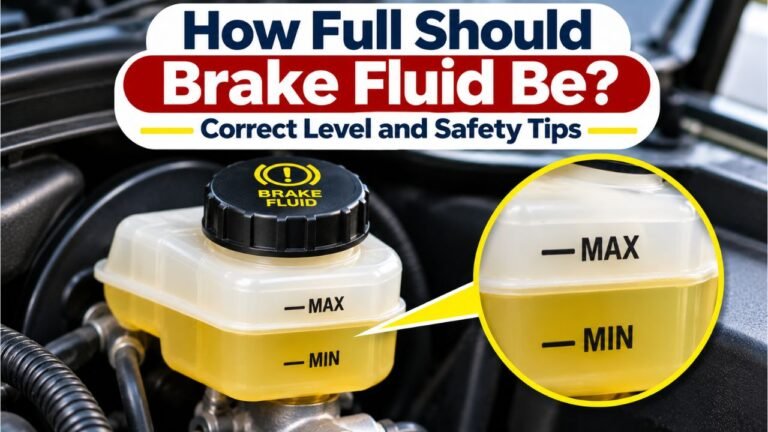
Step 5: Find the MIN and MAX Lines
Look at the side of the reservoir.
Most modern vehicles have two markings:
- MIN: Minimum specified level
- MAX: Maximum specified level
The fluid should normally be between these lines.
If the reservoir is dusty, carefully clean its exterior with a suitable cloth.
Do not remove the cap simply to make the fluid easier to see.
Step 6: Read the Brake Fluid Level
Look through the translucent reservoir.
Identify the boundary between the liquid and the empty space above it.
Compare this line with the MIN and MAX markings.
A flashlight directed through the side can help when the fluid level is difficult to see.
Avoid moving or shaking the reservoir.
Step 7: Check for Unusual Conditions
While inspecting the fluid, look for obvious problems such as:
- Level below MIN
- Fluid above MAX
- Visible leakage around the reservoir
- A damaged cap
- Unexpected changes since the previous check
- Brake warning lights
- Abnormal brake pedal behavior
Do not conclude that the brake system is healthy solely because the reservoir level appears normal.
Step 8: Close the Hood Securely
If the level is acceptable and there are no warning signs, close the hood according to the manufacturer’s instructions.
If the level is below MIN, the brake pedal is abnormal, or a serious warning is present, arrange professional inspection before continuing to drive.
What Should the Brake Fluid Level Be After Driving?
Brake fluid should normally remain between the MIN and MAX markings after driving.
It does not have to reach the MAX line.
A level somewhere between the two marks is generally acceptable.
Brake Fluid Level Guide
| Fluid Level | Interpretation | Recommended Action |
| At MAX | Upper end of specified range | Normally acceptable |
| Slightly below MAX | Normal range | No topping up needed |
| Halfway between MIN and MAX | Normal range | Usually no action required |
| Just above MIN | Within range but worth checking | Inspect maintenance history and brake wear |
| At MIN | Lower boundary | Arrange prompt inspection |
| Below MIN | Outside acceptable range | Do not continue driving until assessed |
| Above MAX | Outside acceptable range | Have level and system checked |
| Reservoir nearly empty | Potential serious fault | Do not drive; arrange professional assistance |
According to Ford’s official brake and clutch fluid maintenance instructions, fluid between the MIN and MAX lines is within the normal operating range and does not require topping up.
Ford also explains that the level gradually decreases as brake components wear and may rise when they are replaced.
Should the Reservoir Be Completely Full?
No.
A brake fluid reservoir should not be filled to the cap or neck.
The MAX mark defines the upper end of the specified range.
Overfilling can cause problems, particularly when hydraulic fluid returns to the reservoir during brake maintenance.
Is Halfway Between MIN and MAX Normal?
Yes.
A fluid level halfway between the markings is generally within the specified range.
However, a sudden drop to that level may still deserve inspection.
The trend matters as well as the current reading.
Should Brake Fluid Rise After Driving?
A large change in reservoir level is not normally expected simply because a conventional car has been driven.
However, temperature, hydraulic-system design, and operating state can affect readings.
Certain vehicles with brake accumulators may show variations that are not directly comparable with a conventional hydraulic brake system.
If the level changes substantially or unexpectedly, follow the vehicle’s manual and have the system inspected when necessary.
Why Might Brake Fluid Look Lower After Driving?
If you notice a low reading after driving, several explanations are possible.
The most important are brake-pad wear, an incorrect reading, or a hydraulic leak.
1. Worn Brake Pads
As disc brake pads wear, the caliper pistons gradually extend to maintain contact with the brake discs.
More hydraulic fluid occupies the expanded space behind the pistons.
That fluid comes from the reservoir.
Over time, the visible reservoir level can decrease.
This is a gradual process associated with brake-pad wear.
It should not normally produce a dramatic drop after a single ordinary drive.
2. Brake Fluid Leakage
Brake fluid may escape from a damaged or leaking hydraulic component.
Possible locations include:
- Brake hoses
- Steel brake lines
- Brake calipers
- Wheel cylinders
- Master cylinder seals
- Hydraulic fittings
A leak is especially concerning if the fluid level decreases rapidly.
Adding fluid does not repair the leak.
3. The Car Was Parked on a Slope
An uneven surface can make the liquid appear higher or lower relative to the markings.
If the first reading was taken on an incline, repeat the inspection on level ground.
4. Changes in Brake-System Operating State
Some hybrid, electric, and electronically controlled brake systems use hydraulic accumulators or electrically operated pumps.
Their reservoir readings may depend on the condition of the hydraulic system.
Do not assume every vehicle behaves like a conventional brake master cylinder.
5. A Recent Brake Service
The level may change after brake maintenance.
For example, retracting caliper pistons during brake-pad replacement can move fluid back toward the reservoir.
If someone previously topped up the reservoir, the level may rise too high after service.
6. An Incorrect Previous Reading
Sometimes a perceived level change results from:
- Poor lighting
- Dirty reservoir walls
- Different parking angles
- Difficulty identifying the liquid boundary
- Comparing readings taken under different procedures
If the reading seems unusual but there are no other symptoms, recheck it carefully using the manufacturer’s method.
If the level is outside the specified range or the braking system behaves abnormally, do not rely on repeated visual checks instead of professional diagnosis.
Can Brake Fluid Get Too Hot After Driving?
Yes.
Brake fluid can reach high temperatures during demanding braking.
The temperature near the wheel brakes may be much higher than at the master-cylinder reservoir.
How Braking Generates Heat
When you press the brake pedal, the braking system applies friction at the wheels.
Friction converts the vehicle’s kinetic energy into heat.
Heat builds up in the brake discs, pads, calipers, and surrounding components.
Some of this heat transfers into the brake fluid.
When Brake Fluid Temperatures Become High
Demanding conditions include:
- Repeated hard braking
- Long downhill drives
- Towing heavy loads
- Track driving
- A dragging brake caliper
- Severe stop-and-go operation
Ordinary commuting generally places less thermal demand on the braking system than repeated aggressive braking.
What Happens if Brake Fluid Boils?
Brake fluid has a specified boiling-point performance.
If the fluid becomes hot enough to form vapor, the resulting gas can compress under brake pressure.
This can produce:
- A soft or spongy brake pedal
- Increased pedal travel
- Reduced braking effectiveness
- Potential brake failure
Brake fluid contaminated with moisture may have a lower boiling point than fresh fluid.
Can You Detect Overheated Brake Fluid by Checking the Reservoir?
Not reliably.
A normal reservoir level does not prove that the brake fluid has not overheated.
Likewise, looking at the reservoir does not tell you the temperature of the fluid inside the calipers.
If the brakes become unusually soft after repeated hard braking, stop safely and arrange inspection.
Do not resume driving simply because the reservoir level looks normal.
Can You Open the Brake Fluid Reservoir After Driving?
For an ordinary visual level check, you should leave the reservoir cap closed.
Most translucent reservoirs are designed to be inspected without opening them.
Why You Should Avoid Unnecessary Opening
Common DOT 3, DOT 4, and DOT 5.1 brake fluids are hygroscopic, meaning they can absorb moisture from the atmosphere.
Moisture can degrade brake fluid performance.
Opening the reservoir also creates opportunities for:
- Dirt contamination
- Water contamination
- Accidental spills
- Incorrect fluid additions
- Damage to surrounding surfaces
Is the Brake Fluid Cap Pressurized Like a Radiator Cap?
A conventional brake fluid reservoir is not the same as a pressurized engine coolant system.
Do not confuse the two.
A hot radiator cap can release scalding coolant under pressure.
A conventional brake reservoir generally serves a different function.
However, electronically controlled brake systems may have special hydraulic service requirements.
Follow the owner’s manual before opening or servicing any brake-system component.
Should You Wait Until the Engine Cools Before Opening the Cap?
If a manufacturer-approved procedure requires opening the reservoir, working in a cooler engine compartment can reduce the risk of accidental burns.
However, simply waiting for the engine to cool does not make an unnecessary top-up appropriate.
First determine why access to the reservoir is required.
For an ordinary fluid-level check, keep the cap installed.
Should You Add Brake Fluid Immediately After Driving?
Not simply because the fluid is below MAX.
If the level remains within the specified range, topping up is generally unnecessary.
When Adding Fluid May Be Appropriate
Adding fluid may be part of a manufacturer-approved maintenance procedure, such as:
- Brake fluid replacement
- Hydraulic brake repair
- Correcting the fluid level during service
- A specific manufacturer-directed top-up
The reason for a low level must still be understood.
Why Topping Up Can Hide Worn Brake Pads
As brake pads wear, fluid gradually moves from the reservoir into the calipers.
If the reservoir is repeatedly filled back to MAX, the lower level associated with pad wear may be hidden.
When new pads are installed, caliper pistons are pushed back and fluid returns toward the reservoir.
This can cause overflow if too much fluid was added earlier.
Why Topping Up Cannot Fix a Leak
If brake fluid is escaping from a hose, line, caliper, or master cylinder, adding more fluid is not a repair.
The leak may continue.
A hydraulic system with a leak can lose pressure and braking ability.
If the reservoir is below MIN, fluid is disappearing unexpectedly, or braking feels abnormal, do not continue driving. Arrange professional inspection and towing when appropriate.
Which Brake Fluid Should You Use?
The correct fluid depends on the vehicle.
Common specifications include:
| Brake Fluid | General Type | Important Consideration |
| DOT 3 | Glycol-based | Use when specified |
| DOT 4 | Glycol-based | Use when specified |
| DOT 5 | Silicone-based | Not interchangeable with common glycol fluids |
| DOT 5.1 | Glycol-based | Different from silicone DOT 5 |
Never choose fluid based only on color.
Check the owner’s manual or reservoir cap for the required specification.
What if the Brake Fluid Warning Light Comes On After Driving?
A brake warning light is more important than the question of whether the engine is hot or cold.
Do not ignore it.
Step 1: Stop Safely
Move away from traffic and stop in a safe location.
Avoid continuing a long drive while trying to determine the cause.
Step 2: Identify the Warning
Some vehicles use different lights for:
- Parking brake status
- Low brake fluid
- Hydraulic brake-system problems
- Anti-lock braking system faults
- Electronic brake-control problems
Check the owner’s manual.
Step 3: Check the Parking Brake
If the warning could be caused by the parking brake, verify that it is fully released.
Do not assume every warning light is related to fluid level.
Step 4: Visually Inspect the Reservoir
If it is safe to do so, switch off the vehicle and check the reservoir.
Look for fluid between MIN and MAX.
Do not remove the cap unnecessarily.
Step 5: Evaluate Brake Performance
Warning signs include:
- Soft brake pedal
- Sinking pedal
- Unusually long pedal travel
- Reduced stopping ability
- Visible hydraulic fluid leakage
- Repeated reservoir-level decreases
If any of these symptoms are present, do not drive the vehicle.
Step 6: Arrange Proper Diagnosis
A low reservoir reading may indicate brake-pad wear or a hydraulic leak.
A normal reading does not rule out other brake-system faults.
Have the problem diagnosed before returning the vehicle to service.
Brake Fluid Checks After Normal Driving vs. Long Trips
The type of driving can affect what you should pay attention to after stopping.
After a Short Daily Commute
A normal visual check can usually be performed after parking.
There is no general need to wait for hours.
Turn off the engine, avoid hot components, and inspect the level through the reservoir.
After Highway Driving
A similar procedure usually applies.
Driving at highway speed does not automatically make the reservoir level invalid.
However, the engine compartment may be hot.
Use caution.
After Mountain Driving
Long downhill routes can generate substantial brake heat.
If you have experienced brake fade, a soft pedal, or an unusual burning smell, treat the issue as a potential braking problem.
Do not rely on the reservoir level alone.
Allow the vehicle to remain safely parked and arrange inspection when necessary.
After Towing
Towing increases braking demands in many situations.
If braking performance changes, stop safely.
A visual fluid-level check may provide information but does not establish the condition of the entire braking system.
After Track Driving
Track use can generate extreme braking temperatures.
Some performance vehicles have manufacturer-specific post-track inspection procedures.
Do not apply ordinary maintenance assumptions to track-driven cars.
Follow the manufacturer’s performance-driving and brake-service guidance.
Is Checking Brake Fluid Different on Hybrid and Electric Cars?
The basic objective is the same: confirm that the brake hydraulic system contains the correct amount of fluid.
However, some hybrids and EVs have electronically controlled brake systems that operate differently from conventional systems.
Regenerative Braking Does Not Eliminate Brake Fluid
Hybrid and electric vehicles may use regenerative braking to slow the vehicle while recovering energy.
However, they also have friction brakes and hydraulic braking components.
Brake fluid remains part of the braking system.
Brake Accumulators Can Affect Fluid Level
Some electronically controlled braking systems use an accumulator to store hydraulic pressure.
Depending on the system’s operating state, fluid may move between the reservoir and accumulator.
This can affect the visible reservoir level.
Do Not Assume the Same Procedure Applies
Some vehicles require the brake system to be placed into a particular state before certain maintenance tasks.
Avoid repeatedly pressing the brake pedal or operating electrical systems in an attempt to manipulate the reservoir reading.
Use the manufacturer’s procedure.
What About Electric Cooling Fans?
Electric vehicles and hybrids may have cooling equipment that operates unexpectedly when certain systems are active.
Even after the power switch is turned off, avoid reaching into areas containing fans or other potentially moving components.
When Should You Seek Professional Help?
If the reservoir is outside its specified range, the brake system displays a fault, or the manufacturer’s checking procedure is unclear, professional assistance is the safer choice.
How to Tell if Brake Fluid Is Bad After Driving
Checking brake fluid level is different from evaluating brake fluid condition.
A reservoir can have the correct amount of fluid even when the fluid has deteriorated.
Can You Check Brake Fluid by Color?
Color can provide clues but is not a reliable measurement of fluid condition.
New conventional brake fluid is often clear to amber.
Over time, fluid may darken.
However, fluid color alone does not determine its moisture content or boiling-point performance.
Can You Smell Brake Fluid to Check Its Condition?
Do not open the reservoir simply to smell the fluid.
An unusual burning smell after driving may originate from overheated brakes, a dragging caliper, or another component.
It does not necessarily indicate that the reservoir fluid itself is defective.
What Causes Brake Fluid to Deteriorate?
Possible factors include:
- Moisture absorption
- Age
- Contamination
- Repeated high-temperature operation
- Chemical incompatibility from incorrect fluid
Does Driving Heat Clean Brake Fluid?
No.
Heating brake fluid does not remove the need for scheduled replacement.
Moisture and contaminants can remain in the hydraulic system.
How Do You Know When Brake Fluid Needs Replacement?
Follow the manufacturer’s maintenance schedule.
A qualified technician may also evaluate the fluid’s condition using appropriate testing methods.
Do not rely solely on its appearance.
Brake Fluid Level vs. Brake Fluid Condition
These two checks answer different questions.
| Check | What It Tells You | What It Cannot Confirm |
| Reservoir level | Whether fluid is between MIN and MAX | Overall brake-system health |
| Fluid color | May reveal obvious discoloration | Precise moisture content |
| Moisture testing | Can help assess certain fluid conditions | Every possible hydraulic fault |
| Brake pedal inspection | May reveal abnormal pedal behavior | Exact cause without diagnosis |
| Brake-pad inspection | Indicates friction-material condition | Every possible fluid leak |
| Hydraulic-system inspection | Can identify leaks or damaged components | Fluid chemistry without appropriate testing |
A safe brake system requires more than the correct reservoir level.
Fluid condition, mechanical components, hydraulic pressure, and electronic controls all matter.
When Should You Check Brake Fluid After Driving?
There is no single mandatory waiting time that applies to every vehicle.
Instead, choose a safe opportunity to inspect the reservoir.
Practical Checking Guide
| Situation | Recommended Approach |
| Routine inspection | Check with the engine off on level ground |
| Immediately after ordinary driving | Visually inspect if safe |
| Engine bay feels excessively hot | Wait until access is safe |
| Fluid warning appeared during driving | Stop safely and investigate |
| Recent brake fluid service | Follow manufacturer and service instructions |
| Recent brake-pad replacement | Confirm correct level after service |
| Hybrid or EV with special hydraulic system | Follow model-specific procedure |
| After unusual brake overheating | Arrange inspection if braking performance changed |
Can You Check It Every Day?
You can visually check the reservoir frequently, but daily checks are not normally necessary for a healthy vehicle unless you are investigating a known concern under professional guidance.
Repeated fluid loss should be diagnosed, not merely monitored indefinitely.
Is Checking Once a Month Enough?
For many vehicles, a periodic visual check during routine maintenance is reasonable.
However, follow your owner’s manual.
Check sooner whenever a brake warning appears or braking performance changes.
Should You Check Before or After a Long Trip?
Both can be useful.
Before a long trip, a visual inspection may identify an existing problem.
After a trip, a check may be helpful if you noticed unusual braking behavior.
However, neither check replaces scheduled brake-system maintenance.
Common Mistakes When Checking Brake Fluid After Driving
Several mistakes can make the process unsafe or produce misleading conclusions.
Checking While the Vehicle Is on an Incline
A slope can change the apparent fluid level.
Park on level ground.
Opening the Reservoir Just to Look Inside
Most modern reservoirs can be inspected through their translucent walls.
Unnecessary opening increases contamination risk.
Touching Hot Engine Components
The engine compartment may remain hot after driving.
Do not reach near the exhaust system, radiator, or other hot components.
Confusing Brake Fluid With Coolant
Both systems may have plastic reservoirs.
However, they use different fluids and have different maintenance requirements.
Never add brake fluid to a coolant reservoir or coolant to a brake reservoir.
Filling Brake Fluid to the Cap
The reservoir should not be filled completely.
Use the manufacturer’s MAX marking.
Assuming Fluid Must Be at MAX
A level between MIN and MAX is usually acceptable.
A slight decrease may occur as brake pads wear.
Adding Fluid Without Identifying the Cause
Low fluid can indicate worn brake pads or a leak.
A top-up does not replace diagnosis.
Using the Wrong Fluid
Incorrect brake fluid can damage hydraulic components or impair braking.
Always verify the specified DOT classification and other manufacturer requirements.
Ignoring a Soft Brake Pedal
A normal reservoir reading does not guarantee that hydraulic pressure is functioning correctly.
Abnormal brake feel requires inspection.
Assuming Hot Brakes Mean Low Fluid
High brake temperatures do not automatically cause a low reservoir reading.
Do not confuse brake overheating with hydraulic fluid loss.
What to Do After Checking Your Brake Fluid
Your next step depends on what you observe.
If the Fluid Is Between MIN and MAX
You generally do not need to add fluid.
Keep the reservoir closed and follow the normal maintenance schedule.
If braking performance is abnormal despite the correct level, arrange inspection.
If the Fluid Is Close to MIN
Review the vehicle’s maintenance history and have the brake system inspected, particularly if the level has decreased noticeably.
Brake-pad wear may be involved.
However, do not assume that a leak is impossible.
If the Fluid Is Below MIN
Do not continue driving until the system has been professionally assessed.
A hydraulic leak or other braking problem may be present.
Arrange towing if necessary.
If the Fluid Is Above MAX
Do not ignore the reading.
An overfilled reservoir may cause problems during brake service.
Have the level checked and corrected according to the manufacturer’s procedure.
If the Brake Warning Light Remains On
Consult the owner’s manual and arrange diagnosis.
Do not assume that the warning is harmless simply because the fluid appears normal.
If the Brake Pedal Feels Soft or Sinks
Stop safely and do not continue driving.
A soft or sinking brake pedal can indicate a serious hydraulic problem.
Professional service is necessary before the vehicle is driven again.
If You Find Visible Fluid Leakage
Do not drive.
Have the vehicle inspected and repaired.
The Hyundai owner’s manual section on checking brake fluid instructs owners to inspect the reservoir level and seek professional service when the fluid is excessively low or frequent additions are required.
This is a useful reminder that maintaining the correct fluid level is only one part of brake safety.
Conclusion
So, can you check brake fluid after driving? Yes. On most conventional vehicles, you can inspect the brake fluid reservoir shortly after parking, switching off the engine, and ensuring the engine compartment is safe to access.
You do not generally need to wait 30 minutes or several hours just to read the level through the reservoir wall.
However, the safest routine approach is to park on level ground, keep the reservoir cap closed, and avoid touching hot engine components.
The brake fluid should normally remain between the MIN and MAX markings.
I recommend checking the level visually rather than opening the reservoir unless the vehicle’s maintenance procedure specifically requires it.
If the reservoir is at or below MIN, the fluid level decreases unexpectedly, or the brakes feel abnormal, do not assume that adding fluid will solve the problem.
Have the braking system inspected before continuing to drive when a serious fault is suspected.
The key distinction is simple: checking brake fluid after driving is generally safe, but opening or servicing the brake hydraulic system requires additional precautions and the correct manufacturer procedure.
FAQs About Checking Brake Fluid After Driving
Can You Check Brake Fluid Immediately After Driving?
Yes. On most conventional vehicles, you can check the reservoir immediately after parking and switching off the engine, provided the engine compartment is safe to access. Use the MIN and MAX markings and avoid opening the reservoir unnecessarily.
How Long Should You Wait to Check Brake Fluid After Driving?
There is no universal waiting period for a basic visual inspection. You can usually check the level shortly after parking. If nearby engine components are hot or difficult to avoid, wait until the area is safe. Follow any model-specific instructions in the owner’s manual.
Should Brake Fluid Be Checked Hot or Cold?
For many conventional vehicles, either condition is suitable for reading the reservoir level with the engine off. However, some electronically controlled brake systems may have special checking procedures. A cold engine is often more convenient for routine maintenance because it reduces burn risks.
Can You Check Brake Fluid With the Engine Running?
For most vehicles, a routine visual brake fluid check should be performed with the engine switched off. Some hybrid or electronically controlled systems have different procedures. Follow the manufacturer’s instructions rather than assuming the same method works for every car.
Does Brake Fluid Level Change After Driving?
A small apparent difference can occur because of vehicle position, temperature, or brake-system operating state. However, a substantial or sudden decrease is not an expected result of ordinary driving. Brake-pad wear typically causes a gradual decline over time, while a sudden drop may indicate a leak.
Is It Safe to Open the Brake Fluid Cap When the Engine Is Hot?
Opening the cap is generally unnecessary for a simple level check. The brake reservoir is not the same as a pressurized coolant reservoir, but hot engine components and contamination risks still matter. If opening is required, follow the vehicle manufacturer’s service procedure and work only when access is safe.
Can You Add Brake Fluid Right After Driving?
The important issue is whether adding fluid is appropriate, not simply whether the engine is warm. If the level is between MIN and MAX, topping up is generally unnecessary. If fluid is low, the cause should be investigated. Use only the specified brake fluid and follow the manufacturer’s service instructions.
What if the Brake Fluid Is Low After a Long Drive?
A low level can be related to brake-pad wear or a hydraulic leak. If the reservoir is at or below MIN, or the pedal feels soft, the brakes need professional assessment. Do not continue driving with suspected hydraulic failure. Adding fluid does not repair a leaking brake system.
Can You Check Brake Fluid After Hard Braking?
You can perform an external visual check once the vehicle is parked safely and the engine compartment is safe to access. However, the reservoir level does not reveal whether fluid near the brakes has overheated. If you experience brake fade, a soft pedal, or reduced braking performance, arrange inspection.
Is Brake Fluid Supposed to Be Full After Driving?
The reservoir should be between MIN and MAX, not filled to the cap. Fluid does not need to remain exactly at MAX. A level within the specified range is generally acceptable, but unexplained changes or abnormal braking symptoms require attention.