Ceramic vs Organic Brake Pads: Which Type Is Better for Your Car?
Ceramic brake pads are usually the better fit for modern daily-driven cars because they tend to last longer, create less visible dust, stay quiet, and handle normal road temperatures well. Organic pads are softer, commonly cost less, and can provide quiet, smooth braking, but they generally wear faster and cope less well with repeated high-temperature stops.
Choosing between these materials affects more than pad life. The friction compound can change pedal feel, wheel dust, brake noise, rotor wear, heat response, and how frequently the pads need replacement.
For a commuter car or family crossover, ceramic pads are often worth the higher purchase price because their strengths match normal street driving. Organic pads still make sense for some lighter vehicles and drivers who want a softer, lower-cost friction material.
The U.S. Environmental Protection Agency’s Copper-Free Brake Initiative called for copper content in motor-vehicle brake friction material to fall below 0.5% by weight by 2025. Modern friction formulas have changed as manufacturers develop materials that meet braking requirements with far less copper and other restricted substances.
My research into ceramic vs organic brake pads also showed why the labels should be treated as broad material categories rather than exact performance ratings. Wagner describes non-asbestos organic pads as softer and generally quieter but faster-wearing, while ceramic pads are associated with low noise, low dust, durability, and normal daily-driving use.
The Federal Highway Administration reports roughly 298 million registered motor vehicles in the United States in 2024, covering everything from lightweight passenger cars to pickups and large trucks. That range of vehicle weight and brake loading is a good reminder that a pad material suited to a small commuter is not automatically suited to a heavier vehicle.
The comparison below covers composition, braking feel, heat, dust, noise, wear life, rotor wear, cost, weather behavior, and the types of drivers who are best served by each pad material.
Ceramic vs Organic Brake Pads: Main Differences
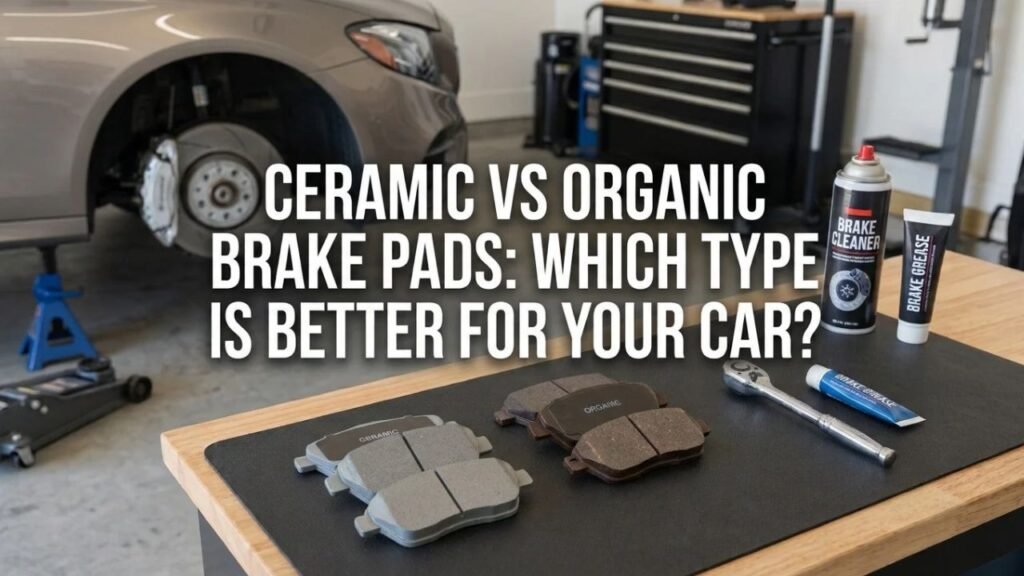
Ceramic and organic pads perform the same basic job: the caliper presses them against the brake rotor, and friction converts the vehicle’s motion into heat.
The main difference is the material used to create that friction.
| Feature | Ceramic Brake Pads | Organic Brake Pads |
| Friction material | Dense ceramic-based compound with friction modifiers | Fibers and fillers held together with resin |
| Noise | Usually low | Usually low |
| Visible dust | Low | Moderate in many applications |
| Pad life | Usually longer | Usually shorter |
| Heat tolerance | Good for normal street driving | Lower under repeated hard braking |
| Rotor wear | Generally low with a matched compound | Usually gentle on rotors |
| Initial feel | Smooth and progressive | Soft and smooth |
| Price | Usually higher | Usually lower |
| Common use | Modern cars, crossovers, daily drivers | Lighter vehicles and lower-load braking |
| Heavy towing | Usually not first choice | Poor match for repeated heavy braking |
These are general tendencies. Friction formulas differ between manufacturers, and an application-specific organic pad can behave differently from another organic pad.
What Are Ceramic Brake Pads Made Of?
Ceramic pads use a dense friction compound built around ceramic materials, fillers, binders, and friction modifiers.
Modern formulations are not simply pieces of ceramic like a coffee mug. They are engineered composites designed to create predictable friction while controlling noise, wear, and heat.
Manufacturers can tune a ceramic formula for a particular vehicle. Akebono, for example, describes its ProACT line as using vehicle-optimized ceramic formulas with low dust, low noise, consistent pedal feel, and reduced rotor wear.
Ceramic compounds have become common on modern passenger vehicles because those traits suit commuting and normal road use.
What Are Organic Brake Pads Made Of?
Organic brake pads are commonly called NAO pads, meaning non-asbestos organic.
They use mixtures of fibers, fillers, carbon-based materials, rubber-like ingredients, glass, aramid fibers, or similar materials held together by resin.
The exact recipe varies widely.
Organic pads replaced older asbestos-based friction materials and remain available for vehicles that do not place extreme heat loads on the brakes.
Their softer composition is a major reason they can operate quietly and produce a smooth brake feel. That softness also means the friction material can disappear faster under repeated braking.
Which Material Is More Common on Modern Cars?
Ceramic and semi-metallic pads are more common choices on many newer passenger vehicles than traditional organic compounds.
Wagner lists NAO, ceramic, and semi-metallic as the three main passenger-vehicle friction-material categories and characterizes ceramic formulations as suited to many normal driving applications.
The original pad material remains a useful starting point when replacement time arrives.
Changing materials may alter pedal feel, dust, noise, and wear even when both pads physically fit the same caliper.
Key Takeaway: Ceramic pads generally offer longer wear, cleaner wheels, and strong everyday heat behavior, while organic pads favor softness, quiet operation, and lower initial cost.
Ceramic vs Organic Brake Pads for Noise and Brake Dust
Both materials can be quiet, but ceramic pads usually have the stronger combination of low noise and low visible dust.
This is a major reason premium ceramic replacement pads are popular with daily drivers.
Which Brake Pads Are Quieter?
Organic pads are naturally soft and often very quiet.
Their resin-rich friction material does not tend to transmit vibration as aggressively as some harder compounds. For a lightly used vehicle, they can provide smooth, low-noise braking.
Ceramic pads are also known for quiet operation.
Quality ceramic pads often combine the friction compound with:
- Multilayer shims
- Chamfered edges
- Pad slots
- Application-specific backing plates
- Noise-control coatings
The final noise level is not determined by friction material alone.
A ceramic pad can still squeal if the rotor is damaged, the hardware is rusty, the caliper is sticking, or the pad is contaminated.
Which Pads Create Less Dust?
Ceramic pads generally win this comparison.
They tend to create less visible wheel dust, and the material that does wear away is often lighter in color than the dark residue produced by more metallic compounds.
Organic pads can produce a greater quantity of wear debris because their softer friction material tends to wear faster.
Wagner specifically notes that NAO pads can wear faster and produce dust, while describing ceramic pads as low-dust products.
For vehicles with light-colored or intricate alloy wheels, that difference can be easy to notice.
Does Low Dust Mean the Pad Is Not Wearing?
No.
Every conventional friction brake loses some pad and rotor material during use.
A clean wheel does not mean the brake pad has stopped wearing. Ceramic friction debris is simply less obvious in many applications.
Pad thickness should still be inspected periodically.
Key Takeaway: Organic and ceramic pads can both run quietly, but ceramic pads usually create less visible wheel dust while also providing strong noise control.
Which Brake Pad Handles Heat Better?
Heat separates the two materials more clearly.
Every stop converts kinetic energy into thermal energy. A series of hard stops raises pad and rotor temperature much more than normal highway braking.
Ceramic Brake Pads and Heat
Quality ceramic pads operate across the temperature range encountered in normal road use and resist fade well under typical commuting conditions.
Their stable friction behavior makes them suitable for:
- City driving
- Highway use
- Suburban commuting
- Family cars
- Crossovers
- Ordinary SUVs
They are not automatically the best material for extreme brake temperatures.
Heavy towing, repeated mountain descents, heavy commercial use, and track driving may call for a semi-metallic or specialty compound designed around greater thermal loads.
Organic Brake Pads and Heat
Organic pads are softer and generally less tolerant of repeated high-temperature braking.
Excess heat can accelerate wear and reduce friction as the pad becomes hotter.
This does not mean organic pads are unsafe in their intended application.
On a lightweight vehicle driven normally, an approved organic pad can work exactly as intended. Problems arise when a low-heat compound is used outside the conditions it was developed for.
What Is Brake Fade?
Brake fade is a reduction in braking response after excessive heat builds in the brake system.
The driver may notice that more pedal pressure is needed to produce the same slowing force.
Pad fade is only one possible form of fade. Brake fluid, rotor temperature, system design, and other components can also influence braking during heavy heat exposure.
A driver who routinely encounters long mountain grades should pay much closer attention to friction-material specifications than someone whose car spends most of its time on flat suburban roads.
Key Takeaway: Ceramic pads generally tolerate normal road heat better than organic pads, while heavy towing, track use, and repeated extreme braking may require a different high-temperature friction compound.
Which Brake Pads Last Longer?
Ceramic pads usually have the advantage in normal passenger-car use.
Their harder, more wear-resistant friction material tends to disappear more slowly than a softer organic compound.
Ceramic Pad Wear
Ceramic pads are commonly chosen when long replacement intervals and low dust are priorities.
Akebono’s current ProACT ceramic line emphasizes low pad wear and rotor-friendly friction characteristics in its manufacturer testing.
Actual service life can still vary widely.
A car driven 80% on open highways may consume pads slowly, while the same model used for constant stop-and-go delivery driving can wear them far faster.
Organic Pad Wear
Organic pads tend to wear faster because the material is softer.
That is not necessarily a defect.
A softer friction material can give quiet operation and place relatively little mechanical aggression on the rotor, but part of that tradeoff is faster pad consumption.
Organic wear becomes more pronounced when the brakes encounter frequent high temperatures.
What Changes Pad Life More Than Material?
Several factors can overwhelm the difference between ceramic and organic compounds:
- Vehicle weight
- Driving speed
- Stop-and-go traffic
- Mountain driving
- Towing
- Driver braking habits
- Rotor condition
- Caliper condition
- Sticking slide pins
- Brake drag
A dragging ceramic pad may wear far faster than a healthy organic pad.
I would diagnose unexpectedly rapid wear before blaming the friction compound.
Key Takeaway: Ceramic brake pads usually last longer in street use, but vehicle weight, braking frequency, caliper condition, and driving environment can have an even larger effect on pad life.
Ceramic vs Organic Brake Pads for Rotor Wear
Neither pad type should damage a compatible rotor during normal operation.
The distinction is more subtle than saying one compound is always “hard” and another is always “soft.”
Are Organic Pads Easier on Rotors?
Organic pads are generally soft, so they are often considered rotor-friendly.
Their friction material can wear instead of placing as much abrasive load on the disc.
That trait can be attractive on lighter vehicles, but it comes with quicker pad wear.
A badly worn organic pad will still damage a rotor if it reaches its steel backing plate.
Do Ceramic Pads Wear Rotors Faster?
Quality ceramic street pads are usually designed to keep rotor wear low.
Akebono markets its current ceramic replacement formulas specifically around longer rotor life, and Bosch offers application-specific NAO-ceramic friction materials across parts of its brake-pad range.
A harder friction material does not automatically equal heavy rotor wear.
Pad formulation matters.
Other Causes of Fast Rotor Wear
Rotor damage may come from:
- Pads worn to metal
- Rust buildup
- A seized caliper
- Constant brake drag
- Contaminated friction surfaces
- Improper pad compound
- Overheating
- Rotors below their service thickness
Changing from organic to ceramic pads will not correct any of these faults.
Key Takeaway: Organic pads are naturally soft and gentle on rotors, but good ceramic street pads are also engineered for low rotor wear when paired with the correct brake system.
Ceramic vs Organic Brake Pads for Stopping Feel
Pad material can change the way a vehicle feels during the first part of pedal application.
That change does not always mean one material produces a shorter stopping distance.
Ceramic Brake Feel
Ceramic street pads often feel smooth and progressive.
Pedal input builds braking force in a controlled way rather than creating an abrupt initial grab.
Many daily drivers prefer this behavior because it makes low-speed stops easy to modulate.
Some drivers switching from a more aggressive factory compound may describe ceramic pads as having less initial bite.
Organic Brake Feel
Organic pads can also provide a soft, smooth response.
Their softer material can feel comfortable during light braking and urban traffic.
Under repeated heavy stops, their response may change as temperature rises.
For a vehicle that rarely sees sustained brake heat, that limitation may never become a noticeable issue.
Do Ceramic Pads Stop a Car Faster?
Pad material alone does not determine stopping distance.
Once the brake system can generate enough force to activate ABS or bring the tire close to its traction limit, tire grip becomes a major limiting factor.
Stopping distance also changes with:
- Tire condition
- Road surface
- Vehicle speed
- Brake temperature
- Vehicle load
- ABS operation
- Rotor and caliper condition
Choose friction material for the complete operating pattern rather than assuming a more expensive pad automatically shortens every stop.
Key Takeaway: Ceramic pads usually provide smooth, progressive street braking; organic pads also feel smooth but are less suited to repeated high-temperature braking.
Ceramic vs Organic Brake Pads: Which Is Better for Daily Driving?
For most modern daily-driven passenger cars, ceramic is usually my first choice when an approved ceramic replacement is available.
Its advantages line up well with what many drivers want from a commuter vehicle.
Choose Ceramic Pads If You Want
Ceramic pads make strong sense if your priorities include:
- Low visible brake dust
- Quiet operation
- Longer pad life
- Smooth pedal response
- Normal city and highway use
- Clean alloy wheels
- Low rotor wear from a quality street compound
They can be especially attractive after living with dusty factory pads.
The higher purchase price may be easier to justify if the pads last longer and reduce how often wheels need cleaning.
Choose Organic Pads If You Want
Organic pads still have a place when:
- The vehicle originally uses them
- The vehicle is light
- Braking demands are modest
- Purchase price matters strongly
- Quiet, soft braking is preferred
- Hard repeated braking is uncommon
I would not switch a heavy vehicle used for hauling to a basic organic pad purely to save money.
The compound should match the thermal load of the brake system.
When Neither Type Is the Best Choice
Some vehicles are better served by semi-metallic or another specialty friction compound.
Examples include:
- Heavy pickups
- Regular towing
- Commercial use
- High-performance driving
- Repeated mountain descents
- Track use
Semi-metallic pads generally manage severe heat better than standard organic formulas and may provide stronger bite, though noise and dust can increase.
Key Takeaway: Ceramic is usually the stronger all-around choice for a modern commuter, while organic pads fit lighter-duty use where low cost, softness, and quiet operation take priority.
Are Ceramic Brake Pads Worth the Higher Price?
For many street vehicles, yes.
Ceramic pads usually cost more upfront because the friction material and product positioning are commonly aimed at the premium replacement market.
The purchase price tells only part of the story.
A ceramic pad may offer:
- Longer wear life
- Less visible dust
- Fewer noise complaints
- Smooth street braking
- Low rotor wear with a matched formula
An organic pad may cost less but need replacement sooner.
The value calculation changes if the car receives little use. A lightly driven secondary vehicle may never consume enough pad material for the ceramic lifespan advantage to matter.
I would prioritize the vehicle maker’s friction requirements before comparing price. Saving money on an unsuitable pad compound is a poor trade on a braking system.
Can You Replace Organic Brake Pads With Ceramic Pads?
Often, yes, if a reputable manufacturer lists a ceramic replacement for the exact vehicle.
Akebono specifically states that some of its ProACT ceramic products can replace original semi-metallic applications, showing that aftermarket friction material does not always need to match the factory category exactly.
The same principle can apply when replacing organic pads, but fitment must be verified.
Check:
- Exact year, make, and model
- Front or rear axle
- Caliper and rotor package
- Pad part number
- Rotor condition
- Manufacturer application listing
Do not assume every ceramic pad with the correct physical shape is suitable.
The friction formula also has to meet the braking requirements for that vehicle.
If switching materials, replace pads as a complete axle set rather than placing ceramic on one side and organic on the other side of the same axle.
Environmental Differences Between Ceramic and Organic Pads
The word “organic” can make NAO pads sound automatically better for the environment, but brake-friction chemistry is more complicated.
Both ceramic and organic formulas contain engineered mixtures of multiple ingredients.
Modern regulation and industry initiatives focus heavily on substances such as copper, lead, mercury, cadmium, asbestiform fibers, and chromium compounds rather than simply labeling one friction family environmentally preferable.
The EPA’s nationwide Copper-Free Brake Initiative called for copper in brake friction material to be reduced to 0.5% by weight by 2025, following earlier requirements in California and Washington.
This is why many current ceramic products advertise low-copper or copper-free formulations.
A product’s current certification and formulation are more informative than assuming “organic” means environmentally harmless.
Conclusion
The main difference in ceramic vs organic brake pads is the balance between durability and softness. Ceramic pads generally offer longer life, low visible dust, quiet operation, and stable everyday braking, while organic pads tend to cost less and provide soft, quiet braking at the expense of faster wear and lower heat tolerance.
For a normal commuter car, family sedan, or crossover, ceramic pads are usually the option I would check first. Organic pads still suit lighter vehicles and lower-load applications where the manufacturer approves them.
The original brake design should remain your starting point. Check the exact application before changing friction material, and do not use a low-heat pad on a vehicle that regularly tows, hauls, or handles long mountain descents.
My preference is to buy a quality application-specific ceramic pad for ordinary street driving rather than choosing material by price alone. A healthy caliper, good rotors, fresh hardware, and correct installation matter just as much as the friction compound printed on the box.
FAQs About Ceramic and Organic Brake Pads
Are Ceramic Brake Pads Better Than Organic?
Ceramic pads are generally better for modern daily driving because they tend to last longer, create less visible dust, stay quiet, and tolerate normal brake temperatures well.
Organic pads still offer quiet operation and low initial cost. They make more sense in lighter-duty applications where repeated high-temperature braking is uncommon.
Are Organic Brake Pads Quieter Than Ceramic?
Organic pads can be extremely quiet because their friction material is soft, but quality ceramic pads are also known for low noise.
Actual brake noise is affected by shims, pad shape, rotor condition, hardware, caliper movement, contamination, and installation quality. Material alone cannot predict every squeal.
Do Ceramic Brake Pads Last Longer Than Organic Pads?
In most normal road applications, ceramic pads tend to last longer.
Organic friction material is softer and normally wears faster, especially when exposed to frequent heat. Driving pattern and brake condition can change the result substantially, so there is no universal mileage difference.
Do Ceramic Brake Pads Produce Less Dust?
Yes, ceramic pads generally produce less visible wheel dust than organic pads.
Ceramic wear particles also tend to be lighter and less obvious on wheels. Both materials still create friction debris because pads and rotors wear during normal braking.
Are Organic Brake Pads Bad?
No. Organic pads are simply designed around a different balance of characteristics.
They can provide quiet, smooth braking and low rotor wear on lighter vehicles. Their main limitations are faster pad wear and reduced tolerance for repeated high-temperature braking compared with many ceramic compounds.
Are Ceramic Brake Pads Good for Towing?
Standard ceramic street pads are not always the best option for frequent heavy towing.
Towing adds vehicle mass and brake heat. A truck-specific semi-metallic, carbon-fiber ceramic, or other high-load compound listed by the brake manufacturer may be a better match.
Can I Switch From Organic to Ceramic Brake Pads?
Yes, if a ceramic pad manufacturer lists an approved replacement for your exact vehicle and brake package.
Replace pads in complete axle sets, inspect the rotors and calipers, and follow the pad maker’s installation instructions. Do not mix ceramic and organic pads from side to side on the same axle.
Which Brake Pads Are Best for a Daily Driver?
For most modern passenger cars and crossovers, a quality ceramic pad is a strong choice because it combines low dust, quiet operation, long wear, and smooth street braking.
If the vehicle was designed around an organic compound and sees only light braking loads, staying with a quality organic pad can also be a sensible option.