Difference Between Loaded and Unloaded Brake Caliper Explained
A loaded brake caliper usually comes with the caliper, mounting bracket, brake pads, and related hardware, while an unloaded brake caliper generally includes only the caliper itself or the caliper and bracket without brake pads.
The difference between loaded and unloaded brake caliper assemblies mainly comes down to what parts are included in the box. Both options can replace a damaged, leaking, or seized caliper, but a loaded caliper provides more of the components needed to complete the brake job.
That difference matters when comparing prices. A loaded caliper normally costs more upfront because it may include new pads, hardware, and a mounting bracket. An unloaded caliper can appear much cheaper, but you may need to buy those additional components separately.
The terminology can also vary between manufacturers and parts stores. One company’s “loaded” caliper may include slightly different hardware than another company’s version. For that reason, always check the exact parts list rather than relying only on the word loaded or unloaded.
This guide explains what each type includes, how they compare, their advantages and disadvantages, and which option makes the most sense for different brake repairs.
What Is the Difference Between Loaded and Unloaded Brake Caliper?
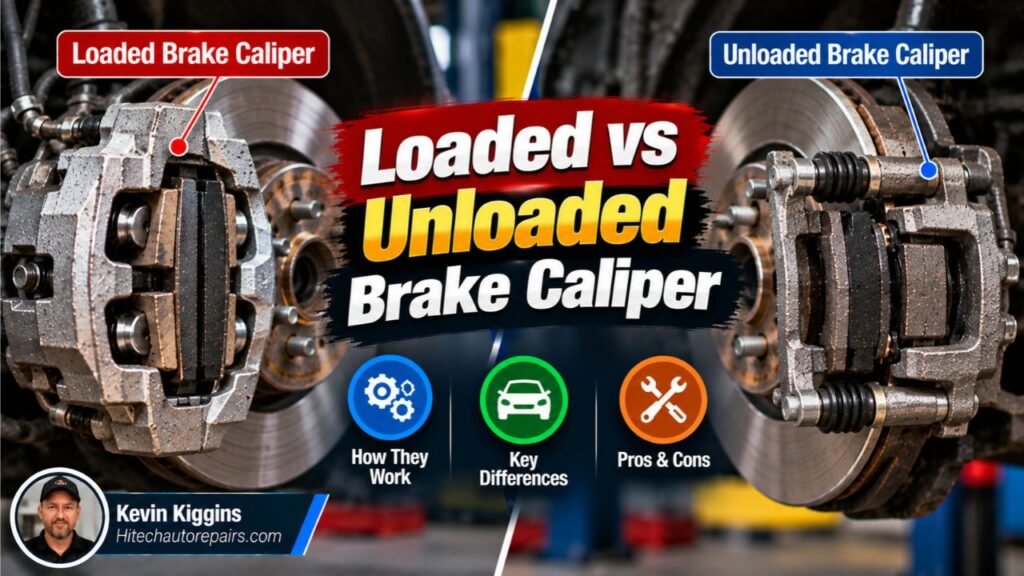
The main difference between loaded and unloaded brake caliper assemblies is that a loaded caliper arrives with more brake components already included, while an unloaded caliper requires you to reuse or purchase additional parts.
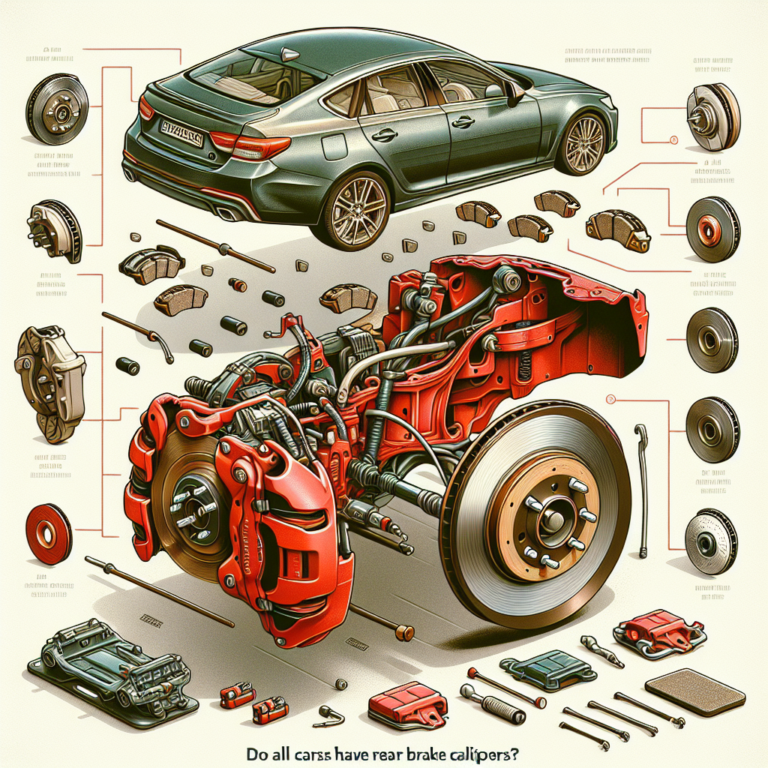
A typical loaded caliper may include:
- Brake caliper
- Caliper bracket
- Brake pads
- Pad clips or abutment hardware
- Slide pins
- Slide-pin boots
- Other installation hardware
An unloaded caliper may include only:
- Brake caliper body
- Caliper piston
- Piston seal
- Dust boot
- Bleeder screw
Some unloaded calipers also include the bracket, so you need to check the product description carefully.
Here is a simple comparison:
| Feature | Loaded Caliper | Unloaded Caliper |
| Caliper body | Yes | Yes |
| Mounting bracket | Usually | Sometimes |
| Brake pads | Usually | No |
| Pad hardware | Usually | Usually not |
| Slide pins | Often | Depends on package |
| Installation convenience | Higher | Lower |
| Upfront cost | Usually higher | Usually lower |
| Part selection flexibility | Lower | Higher |
What Is a Loaded Brake Caliper?
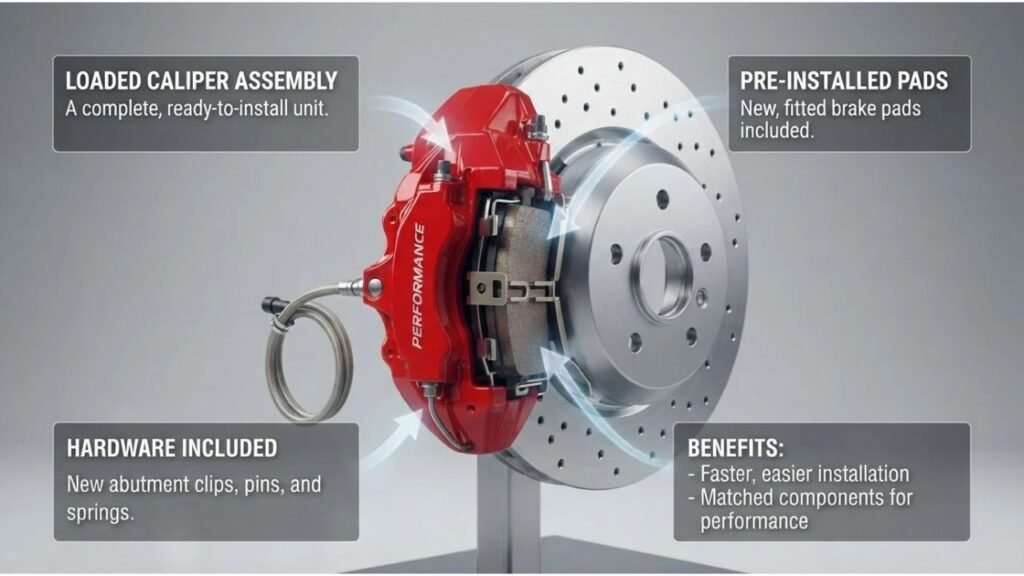
A loaded brake caliper is a more complete brake-caliper assembly intended to reduce the number of separate parts you need to purchase.
In many cases, it comes with the brake pads already positioned in the caliper bracket.
Depending on the manufacturer, the package may also contain:
- Caliper mounting bracket
- New slide pins
- Rubber slide-pin boots
- Pad retaining clips
- Anti-rattle hardware
Because much of the assembly work has already been done, loaded calipers can make brake replacement simpler.
They are particularly convenient if your existing caliper bracket, guide pins, and pads are all worn or damaged.
What Is an Unloaded Brake Caliper?
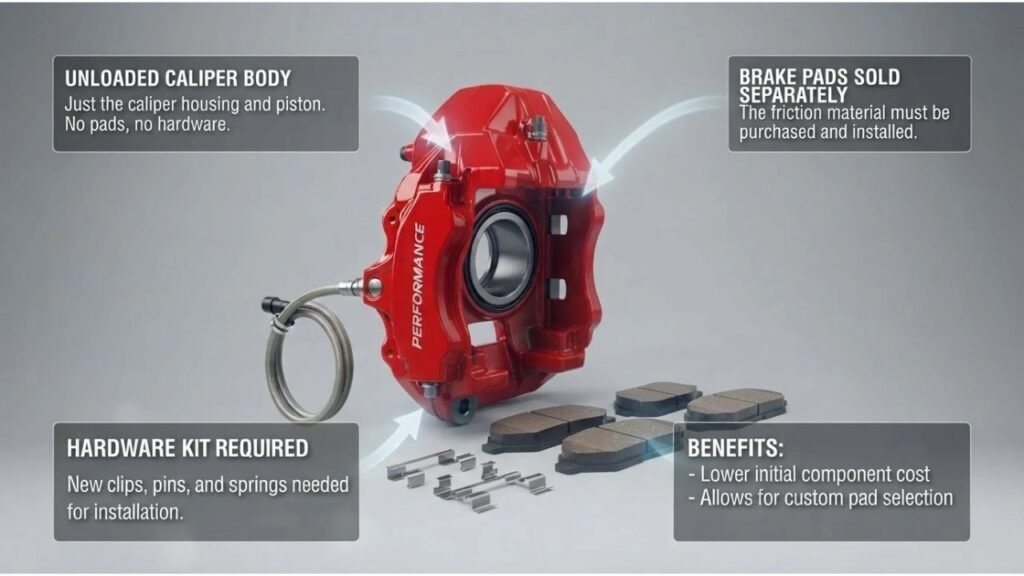
An unloaded brake caliper is a replacement caliper sold without brake pads.
The simplest unloaded version may include only the caliper body and its internal hydraulic components.
Other versions may be sold as a caliper-and-bracket assembly but still exclude brake pads.
You will generally need to provide:
- Brake pads
- Pad hardware
- Possibly a caliper bracket
- Possibly guide pins and boots
An unloaded caliper makes sense when you already have good-quality brake pads or want to choose a specific pad compound separately.
What Does “Semi-Loaded Caliper” Mean?
You may also encounter the term semi-loaded brake caliper.
A semi-loaded caliper normally sits between loaded and unloaded configurations.
It often includes:
- Caliper
- Mounting bracket
- Slide pins
- Boots
- Some installation hardware
But it generally does not include brake pads.
This can be a useful option if you need the complete mechanical caliper assembly but want to choose your own pads.
Because terminology is not standardized across every parts supplier, verify the product contents before buying.
What Does a Loaded Caliper Include?
The exact contents vary by brand, but loaded calipers commonly include several components.
Caliper Body
The main caliper houses the piston or pistons and converts hydraulic brake pressure into clamping force.
Mounting Bracket
On floating-caliper systems, the bracket attaches to the steering knuckle or axle assembly and supports the brake pads and caliper.
Brake Pads
Loaded calipers usually include both the inner and outer pads needed for that wheel position.
However, remember that brake pads are normally replaced on both sides of the same axle, not just one wheel.
Slide Pins
The slide pins allow a floating caliper to move laterally as the brakes apply and release.
Rubber Boots
Slide-pin boots help keep water, salt, dirt, and other contaminants away from the guide pins.
Pad Hardware
The package may include abutment clips, anti-rattle clips, or other pad-retaining hardware.
What Does an Unloaded Caliper Include?
A basic unloaded caliper typically includes the hydraulic portion of the caliper.
That may consist of:
- Cast caliper housing
- Piston or pistons
- Piston seals
- Dust boots
- Bleeder screw
- Fluid inlet
Some manufacturers include additional hardware.
Others sell a very basic replacement that requires you to transfer the existing bracket and guide components from the original caliper.
Read the product listing carefully before assuming anything is included.
Loaded vs. Unloaded Brake Caliper Cost
A loaded caliper usually costs more because you are purchasing more components at once.
However, the sticker price does not tell the entire story.
Suppose an unloaded caliper requires you to purchase:
- Brake pads
- Mounting bracket
- Slide pins
- Hardware
separately.
By the time everything is added together, the total may approach or even exceed the price of a loaded assembly.
The better comparison is total repair cost, not just caliper price.
Advantages of a Loaded Brake Caliper
A loaded assembly offers several practical benefits.
Fewer Parts to Buy
You do not need to search for as many individual components.
This reduces the chance of forgetting pad hardware, guide pins, or another small part.
Faster Installation
Because many components are already assembled or supplied together, installation can be quicker.
This is helpful for DIY brake work and professional repair shops.
New Matching Components
A complete loaded assembly replaces several worn parts at the same time.
You are less likely to install a new caliper while leaving behind corroded slide pins or a badly rusted bracket.
Convenient for Major Brake Repairs
A loaded caliper can be particularly useful when the existing brake assembly has:
- Severe corrosion
- Seized guide pins
- Damaged bracket
- Worn pads
- Torn boots
Replacing everything together can simplify the repair.
Disadvantages of a Loaded Brake Caliper
Loaded assemblies are convenient, but they are not always the best choice.
Higher Initial Price
You pay for the included parts even if some of your existing components are still usable.
Less Choice of Brake Pads
The included brake pads may not be the exact compound or brand you would normally choose.
Drivers who want specific:
- Ceramic pads
- Semi-metallic pads
- Performance pads
- Low-dust pads
may prefer an unloaded or semi-loaded caliper.
Included Components Vary
Not every loaded caliper comes with exactly the same parts.
Never assume everything is included without reading the package description.
Advantages of an Unloaded Brake Caliper
An unloaded caliper provides more flexibility.
Lower Purchase Price
If you only need the hydraulic caliper body, buying an unloaded replacement may cost less.
Choose Your Own Brake Pads
You can select pads based on:
- Driving style
- Noise level
- Brake dust
- Towing
- Performance
- Budget
Reuse Good Existing Parts
If your bracket and hardware are in excellent condition, replacing them may not be necessary.
An unloaded caliper lets you replace only the failed component.
Disadvantages of an Unloaded Brake Caliper
The biggest disadvantage is that additional parts may be required.
You may discover during disassembly that the old bracket has seized guide pins or severe corrosion.
Then the job becomes more complicated because you need additional parts.
An unloaded caliper can also require more cleaning, inspection, lubrication, and assembly work.
Loaded vs. Unloaded Caliper: Which Is Easier to Install?
A loaded caliper is generally easier to install because more of the components are supplied together.
With a typical loaded assembly, you may only need to:
- Remove the old caliper and bracket.
- Install the new loaded assembly.
- Connect the brake hose.
- Bleed the hydraulic system.
- Verify proper brake operation.
The exact procedure depends on the vehicle.
With an unloaded caliper, you may also need to:
- Transfer the bracket
- Clean bracket surfaces
- Service guide pins
- Install new pads
- Install pad clips
- Lubricate appropriate contact points
Neither job should be rushed because brakes are a safety-critical system.
Which Caliper Is Better for DIY Brake Repair?
For a beginner, a loaded caliper can be the easier option because it minimizes the number of separate parts involved.
It can also reduce the chance of reusing worn hardware.
However, an unloaded caliper may be perfectly reasonable if:
- The bracket is good
- Slide pins move freely
- Boots are undamaged
- Brake pads are new
- You understand how to inspect and service brake hardware
The condition of your existing components should guide the decision.
Should You Buy a Loaded Caliper if You Already Have New Pads?
Probably not unless you also need the bracket or hardware included with the loaded assembly.
If you recently purchased high-quality pads, buying another set simply because they come with a loaded caliper may be unnecessary.
In that situation, a semi-loaded or unloaded caliper may provide better value.
Confirm that your existing pads are compatible with the replacement caliper and rotor.
Is a Loaded Caliper Already Ready to Install?
Usually it is closer to being installation-ready, but that does not mean you should bolt it on without inspection.
Before installation, check:
- Correct left or right side
- Bleeder-screw position
- Brake-pad placement
- Slide-pin movement
- Shipping plugs
- Hardware condition
- Brake-hose connection type
Some parts may still require lubrication or adjustment according to the manufacturer’s instructions.
Never assume a new part cannot have a packaging or assembly issue.
Does a Loaded Caliper Come With a Brake Hose?
Usually no.
A brake hose is generally a separate component.
A loaded caliper may include the caliper, bracket, pads, and hardware without including:
- Brake hose
- Rotor
- Brake fluid
- Wheel bearing
- Hub
Read the package contents before starting the repair.
Does a Loaded Caliper Come With a Rotor?
Normally no.
The brake rotor is usually purchased separately.
A complete brake job may therefore require:
- Loaded calipers
- Rotors
- Brake fluid
- Additional hardware
depending on the condition of the existing parts.
Some retailers sell brake kits containing multiple components, but that is different from the definition of a loaded caliper.
Does an Unloaded Caliper Come With a Bracket?
Sometimes.
This is one of the biggest sources of confusion.
Some manufacturers call a caliper with the bracket but without pads “semi-loaded,” while others may describe it differently.
Never judge the package only by its product title.
Check whether the description specifically says:
- Bracket included
- Bracket not included
- Pads included
- Hardware included
This prevents ordering the wrong configuration.
Are Loaded Calipers Better Quality?
Not necessarily.
“Loaded” describes the parts included, not the manufacturing quality of the caliper.
A high-quality unloaded caliper can be better made than a low-quality loaded caliper.
When comparing replacement parts, consider:
- Manufacturer reputation
- New vs. remanufactured construction
- Warranty
- Corrosion-resistant coating
- Piston material
- Hardware quality
- Vehicle compatibility
Do not choose a brake caliper solely because it contains more parts.
New vs. Remanufactured Loaded Calipers
Loaded and unloaded calipers can both be sold as either new or remanufactured.
A new caliper is manufactured using new components.
A remanufactured caliper typically starts with a used caliper housing that is:
- Disassembled
- Cleaned
- Inspected
- Refinished
- Reassembled with replacement wear components
Quality can vary between manufacturers.
A properly remanufactured caliper from a reputable supplier can work well, but it should meet the vehicle’s fitment and braking requirements.
How to Decide Which Brake Caliper to Buy
Consider the overall condition of the brake assembly rather than choosing based only on price.
Choose a Loaded Caliper When:
- Brake pads also need replacement.
- Caliper bracket is damaged or corroded.
- Slide pins are seized.
- You want fewer separate parts to install.
- You are replacing most of the brake assembly anyway.
Choose an Unloaded Caliper When:
- You already have good pads.
- Existing bracket is reusable.
- Guide pins are in good condition.
- You want to choose your own brake-pad brand.
- Only the hydraulic caliper has failed.
Consider a Semi-Loaded Caliper When:
- You need a new bracket and guide hardware.
- You already have brake pads.
- You want more control over pad selection.
Do Brake Calipers Need to Be Replaced in Pairs?
Brake calipers do not always have to be replaced in pairs if only one has failed.
However, replacing both calipers on the same axle may be reasonable when:
- Both are heavily corroded.
- Both are the same age.
- The opposite caliper is beginning to stick.
- The vehicle has very high mileage.
Regardless of whether one or two calipers are replaced, brake pads are normally replaced as a complete axle set.
The braking system should be inspected on both sides.
Common Mistakes When Buying Loaded or Unloaded Calipers
Assuming “Loaded” Means Everything Is Included
Loaded normally means more complete, but it does not guarantee inclusion of every possible brake component.
Forgetting Left and Right Position
Calipers may be side-specific.
One major clue is the bleeder screw, which normally needs to be positioned high enough to allow trapped air to escape.
Buying Only by Vehicle Model
Vehicles can have multiple brake packages within the same model year.
Use the VIN or brake code where possible.
Reusing Bad Hardware With an Unloaded Caliper
If you buy an unloaded caliper, inspect the old bracket, pins, boots, and clips carefully.
Comparing Only Purchase Price
An inexpensive unloaded caliper can become more expensive once you add the required bracket, pads, and hardware.
Safety Considerations When Replacing Brake Calipers
Brake-caliper replacement opens the vehicle’s hydraulic braking system.
After installation, the system normally needs to be properly bled to remove trapped air.
Important precautions include:
- Support the vehicle with rated jack stands.
- Never rely only on a floor jack.
- Do not let the caliper hang by the brake hose.
- Use the correct brake fluid.
- Keep brake fluid off painted surfaces.
- Keep grease and fluid away from pad and rotor friction surfaces.
- Torque brake fasteners to vehicle specifications.
- Check for fluid leaks.
- Confirm a firm brake pedal before moving the vehicle.
If you are not confident working with hydraulic brakes, professional installation is the safer option.
FAQs About Difference Between Loaded and Unloaded Brake Caliper
Does a loaded brake caliper come with brake pads?
Usually yes.
Brake pads are one of the main components that distinguish a loaded caliper from an unloaded one. However, always verify what is included because terminology varies by supplier.
Does an unloaded brake caliper come with brake pads?
Normally no.
You generally need to buy pads separately or reuse compatible pads that are still in serviceable condition.
Does a loaded caliper include the bracket?
Most loaded caliper assemblies include the mounting bracket, although you should confirm this before purchasing.
What is a semi-loaded brake caliper?
A semi-loaded caliper commonly includes the caliper, bracket, and some hardware but does not include brake pads.
Exact contents vary by manufacturer.
Is a loaded caliper worth the extra money?
It can be if you also need pads, a bracket, guide pins, and hardware.
If those components are already new or in excellent condition, an unloaded caliper may be more economical.
Are loaded calipers easier to install?
Generally, yes.
More components are supplied together, reducing the amount of cleaning, transferring, and assembly required.
Can I reuse my old brake pads with an unloaded caliper?
You can reuse pads only if they are compatible, evenly worn, uncontaminated, and still within service limits.
If one caliper was seized and caused abnormal pad wear or overheating, replacing the pads is usually a better choice.
Do loaded calipers include rotors?
Normally no.
Brake rotors are separate components unless you purchase a larger brake kit that specifically includes them.
Conclusion
The difference between loaded and unloaded brake caliper assemblies is primarily the number of components included. A loaded caliper usually comes with the caliper, mounting bracket, brake pads, guide hardware, and related parts, while an unloaded caliper generally provides the hydraulic caliper without brake pads and may or may not include the bracket.
A loaded assembly is often the better choice when several brake components need replacement and you want a simpler installation. An unloaded caliper makes more sense when the existing bracket and hardware remain usable or when you want to select your brake pads separately.
Whichever option you choose, verify exactly what is included, confirm vehicle fitment, and inspect the entire brake assembly rather than replacing only the visibly failed component.