Types of Brake Calipers: The 2 Main Types Explained Simply
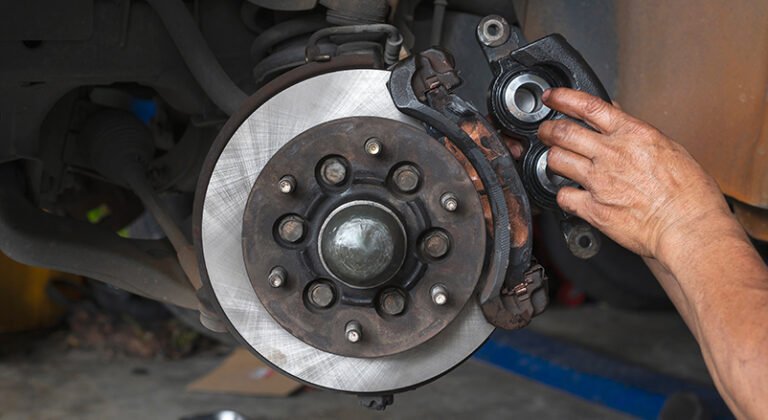
Brake calipers are one of the most important parts of a vehicle’s disc brake system. When you press the brake pedal, the caliper uses hydraulic pressure to squeeze the brake pads against the brake rotor. That friction slows the wheel and eventually stops the vehicle.
Although brake calipers come in many shapes, sizes, and piston configurations, there are 2 main types of brake calipers: fixed calipers and floating calipers. A floating caliper may also be called a sliding caliper because the caliper body moves sideways on guide pins as the brakes are applied.
Understanding the different types of brake calipers can help you understand how your brakes work, why some vehicles use multiple pistons, why caliper slide pins sometimes become stuck, and how performance-oriented braking systems differ from the simpler systems found on many everyday cars.
The distinction is especially useful when diagnosing uneven brake-pad wear, a sticking caliper, pulling while braking, overheating brakes, or problems with caliper guide pins.
What Are the Types of Brake Calipers?
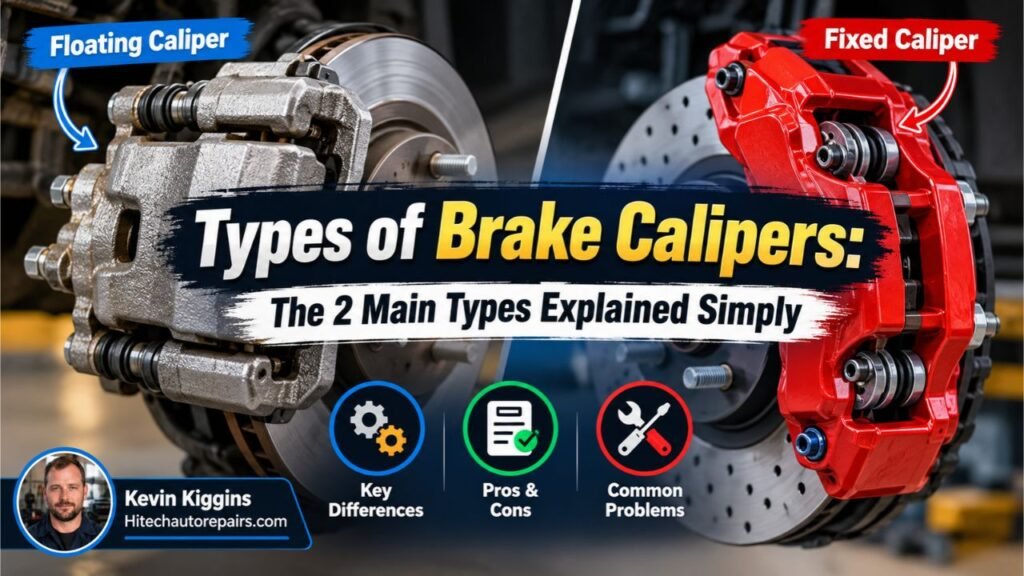
The two main types of brake calipers are:
- Floating or sliding brake calipers
- Fixed brake calipers
The main difference is how the caliper moves and how the pistons apply pressure to the brake pads.
A floating caliper usually has piston or pistons on only one side of the rotor. The entire caliper slides sideways so both pads clamp the rotor.
A fixed caliper stays stationary and normally has pistons positioned on both sides of the rotor. The pistons move inward from both sides to squeeze the brake pads against the rotor.
Both designs perform the same basic job, but their construction, cost, weight, maintenance requirements, and braking characteristics can differ.
How a Brake Caliper Works
Before comparing the two designs, it helps to understand what a caliper actually does.
When you press the brake pedal, the master cylinder creates hydraulic pressure in the brake fluid. That pressure travels through the brake lines and hoses to the brake caliper.
Inside the caliper are one or more hydraulic pistons.
Hydraulic pressure pushes the pistons outward, causing the brake pads to press against the rotating brake rotor.
The resulting friction converts the vehicle’s motion into heat.
When you release the brake pedal, hydraulic pressure decreases. The pistons retract slightly, allowing the brake pads to release enough pressure from the rotor so the wheel can rotate freely.
How those pistons and pads are arranged determines whether the caliper is a floating or fixed design.
Type 1: Floating Brake Calipers
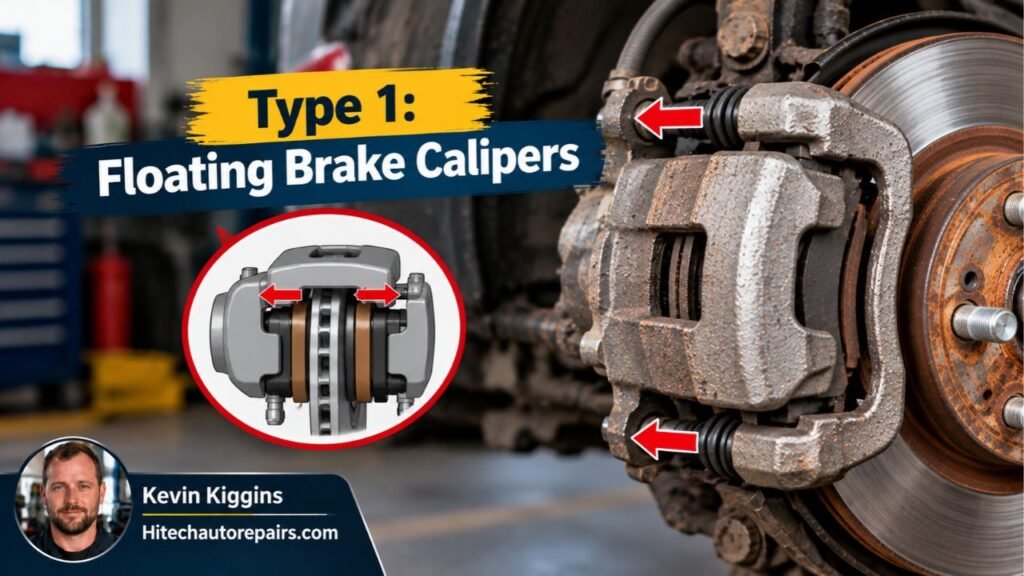
A floating brake caliper is designed to move slightly from side to side on guide pins or slide pins.
It is one of the most common brake-caliper designs used on passenger vehicles.
Floating calipers are also commonly called sliding calipers.
How a Floating Caliper Works
A typical floating caliper has one or more pistons located on the inboard side of the brake rotor.
When you press the brake pedal:
- Hydraulic pressure pushes the piston outward.
- The piston pushes the inner brake pad against the rotor.
- The caliper body slides in the opposite direction along its guide pins.
- This movement pulls the outer brake pad against the opposite side of the rotor.
- Both pads squeeze the rotor and create braking force.
The caliper must slide freely for this system to work correctly.
That is why caliper slide pins are so important on floating brake systems.
Components of a Floating Brake Caliper
A typical floating-caliper assembly includes:
- Caliper housing
- One or more pistons
- Piston seal
- Dust boot
- Brake pads
- Caliper bracket
- Guide pins or slide pins
- Slide-pin boots
- Brake hose connection
- Bleeder screw
The exact design varies among vehicles.
Advantages of Floating Brake Calipers
Floating calipers are widely used because they provide several practical advantages.
Lower Manufacturing Cost
A floating caliper normally uses fewer pistons and a simpler housing than a comparable fixed caliper.
That helps reduce manufacturing costs.
Lower Weight
The simpler design can make floating calipers lighter.
Reducing unsprung weight can benefit vehicle efficiency and suspension behavior.
Compact Design
Floating calipers are often relatively compact, making them easier to package inside ordinary wheel assemblies.
Easier and Less Expensive Maintenance
Brake-pad replacement and caliper servicing are usually straightforward.
Replacement floating calipers also tend to be relatively affordable for common vehicles.
Disadvantages of Floating Brake Calipers
The design also has limitations.
Slide Pins Can Seize
The caliper relies on its guide pins to move smoothly.
Corrosion, damaged rubber boots, incorrect lubrication, or contamination can cause a caliper slide pin to stick.
If the caliper cannot move properly, braking pressure may become uneven.
Uneven Brake Pad Wear
A binding caliper or slide pin can cause one pad to wear faster than the other.
For example, an inner pad may become significantly thinner than the outer pad.
Less Rigid Construction
Because the caliper body moves, a floating caliper may not provide the same rigidity and pedal feel as a well-designed fixed multi-piston caliper in demanding performance applications.
For normal street driving, however, floating calipers can provide strong and reliable braking.
Type 2: Fixed Brake Calipers
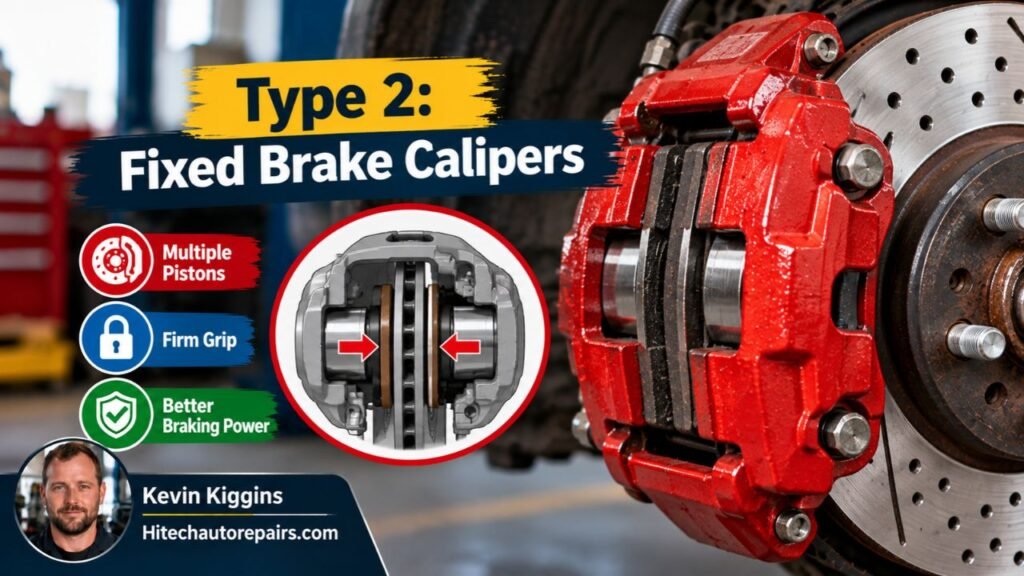
A fixed brake caliper is mounted rigidly in place and does not slide from side to side during braking.
Instead, pistons are located on both sides of the brake rotor.
When hydraulic pressure enters the caliper, opposing pistons push both brake pads toward the rotor simultaneously.
Fixed calipers are common on:
- Performance cars
- Sports cars
- High-performance SUVs
- Some trucks
- Racing vehicles
- Vehicles with upgraded braking systems
However, vehicle design varies, and fixed calipers can also appear on other types of vehicles.
How a Fixed Brake Caliper Works
Unlike a floating caliper, the caliper housing itself remains stationary.
When you press the brake pedal:
- Brake fluid enters the caliper under pressure.
- Pistons on both sides of the rotor move inward.
- The inner and outer brake pads press against the rotor at approximately the same time.
- Friction slows the rotor and wheel.
Because pistons act from both sides, no sliding caliper body is required.
How Many Pistons Can a Fixed Caliper Have?
Fixed calipers can use several piston arrangements.
Common configurations may include:
- Two pistons
- Four pistons
- Six pistons
- Eight pistons or more in specialized applications
More pistons do not automatically mean a vehicle will stop in a dramatically shorter distance.
Braking performance also depends on factors such as:
- Tire grip
- Brake-pad material
- Rotor size
- Hydraulic system design
- Vehicle weight
- Brake balance
- ABS operation
- Road conditions
Multiple pistons can help distribute clamping pressure across a larger brake pad and allow engineers to design larger, more capable braking systems.
Advantages of Fixed Brake Calipers
Greater Caliper Rigidity
The stationary housing can provide a rigid structure.
Reduced caliper flex can contribute to a more consistent brake-pedal feel under heavy braking.
Even Pressure Distribution
Multiple opposing pistons can distribute force more evenly across larger brake pads.
Suitable for High-Performance Braking
Fixed multi-piston calipers work well with large rotors and brake pads, making them popular in performance applications.
No Sliding Guide Pins
Because the caliper does not slide during normal operation, it does not rely on sliding guide pins in the same way a floating caliper does.
This removes one common source of floating-caliper problems.
Disadvantages of Fixed Brake Calipers
More Expensive
Fixed calipers are generally more complicated to manufacture.
Multiple pistons, seals, and more complex cast or forged housings can increase cost.
Potentially More Expensive to Service
A multi-piston caliper contains more components that may eventually require servicing.
Replacement parts can also cost considerably more than common floating-caliper components.
Larger Packaging Requirements
Large fixed calipers may require more clearance inside the wheel.
This is one reason some performance brake upgrades require larger wheels.
Floating vs. Fixed Brake Calipers
The basic differences are easy to see when the two designs are compared directly.
| Feature | Floating/Sliding Caliper | Fixed Caliper |
| Caliper body movement | Slides sideways | Remains stationary |
| Piston location | Usually one side | Both sides |
| Common piston count | Often one or more on one side | Multiple opposing pistons |
| Guide pins | Yes | Generally no sliding guide-pin system |
| Cost | Usually lower | Usually higher |
| Weight | Often lighter | Can be heavier or more complex |
| Common use | Everyday passenger vehicles | Performance and heavy-duty applications |
| Maintenance complexity | Generally simpler | Often more complex |
| Performance potential | Good for normal driving | Well suited to high-performance systems |
Neither design is automatically “good” or “bad.”
Each is engineered for a particular combination of performance, packaging, weight, and cost.
Are Floating and Sliding Calipers the Same?
In common automotive terminology, floating caliper and sliding caliper are often used to describe the same general type of brake-caliper system.
The caliper moves along guide pins or sliding surfaces during brake application.
There can be design differences among manufacturers, but for a beginner learning the two main brake-caliper categories, floating and sliding calipers are normally grouped together.
What Is a Single-Piston Brake Caliper?
A single-piston caliper contains one hydraulic piston.
It is commonly used in floating-caliper systems.
When hydraulic pressure moves the piston outward, the inner brake pad contacts the rotor. The caliper then slides across its guide pins so the outer brake pad also contacts the rotor.
Single-piston floating calipers are common because they are simple, effective, and relatively inexpensive.
What Is a Dual-Piston Brake Caliper?
A dual-piston caliper uses two pistons.
However, piston count alone does not tell you whether the caliper is fixed or floating.
A floating caliper can have two pistons located on the same side of the rotor.
A fixed caliper can have opposing pistons located on both sides.
Therefore, terms such as single-piston, dual-piston, four-piston, or six-piston describe piston configuration rather than the main caliper type.
What Is a Multi-Piston Brake Caliper?
A multi-piston brake caliper contains multiple hydraulic pistons that apply force to the brake pads.
Multi-piston fixed calipers are common in performance braking systems because they can use long brake pads and distribute hydraulic force across a larger area.
Some calipers use pistons of different diameters to help manage pad pressure and wear characteristics.
Does More Pistons Mean Better Brakes?
Not necessarily.
A six-piston caliper may look more impressive than a single-piston caliper, but stopping performance cannot be judged by piston count alone.
A vehicle’s ability to stop depends heavily on its tires because the tires determine how much braking force can actually be transferred to the road.
Brake system performance also depends on:
- Rotor diameter
- Pad compound
- Rotor and pad temperature
- Master-cylinder sizing
- Caliper piston area
- Brake fluid condition
- ABS calibration
- Vehicle weight distribution
A properly engineered single-piston floating system can provide excellent braking for an ordinary passenger vehicle.
Which Type of Brake Caliper Is More Common?
Floating or sliding calipers are very common on everyday passenger vehicles.
Their relatively simple design makes them suitable for mass-produced cars, crossovers, SUVs, and light-duty applications.
Fixed calipers are especially common where manufacturers want greater braking capability, rigidity, or performance.
Some vehicles may even use different caliper designs on the front and rear axles.
Front vs. Rear Brake Calipers
Front and rear calipers can differ even on the same vehicle.
During braking, vehicle weight shifts toward the front. As a result, the front brakes typically handle a large share of the braking load.
Manufacturers may therefore use:
- Larger front rotors
- Larger brake pads
- Larger calipers
- More pistons at the front
Rear calipers may be smaller.
Rear calipers may also incorporate the parking brake mechanism, depending on the vehicle’s design.
Brake Calipers With Integrated Parking Brakes
Some rear brake calipers contain a mechanical or electronic parking-brake mechanism.
Mechanical Parking Brake Caliper
A cable operates a mechanism built into the caliper that applies the brake pad when the parking brake is engaged.
Electronic Parking Brake Caliper
Vehicles with an electronic parking brake (EPB) may use an electric motor mounted on or integrated with the rear caliper.
Servicing these systems may require a scan tool or a manufacturer-specified maintenance mode to retract the caliper correctly.
Trying to force an electronic parking-brake piston backward without following the proper procedure can damage the system.
Common Problems With Floating Brake Calipers
Because floating calipers depend on movement along guide pins, many faults involve the sliding mechanism.
Common problems include:
- Seized slide pins
- Torn slide-pin boots
- Dried or incorrect lubricant
- Rusted caliper brackets
- Sticking pistons
- Uneven pad wear
A stuck slide pin can prevent the caliper from centering itself over the rotor.
This may leave one brake pad in constant contact with the rotor or prevent both pads from applying equal pressure.
Common Problems With Fixed Brake Calipers
Fixed calipers do not have the same sliding-pin arrangement, but they can still develop problems.
Possible faults include:
- Seized pistons
- Damaged piston seals
- Brake-fluid leakage
- Uneven piston movement
- Corrosion
- Damaged dust boots
Because a fixed caliper can contain several pistons, one piston may stick while the others continue moving.
This can contribute to uneven pad wear or uneven pressure across the brake pad.
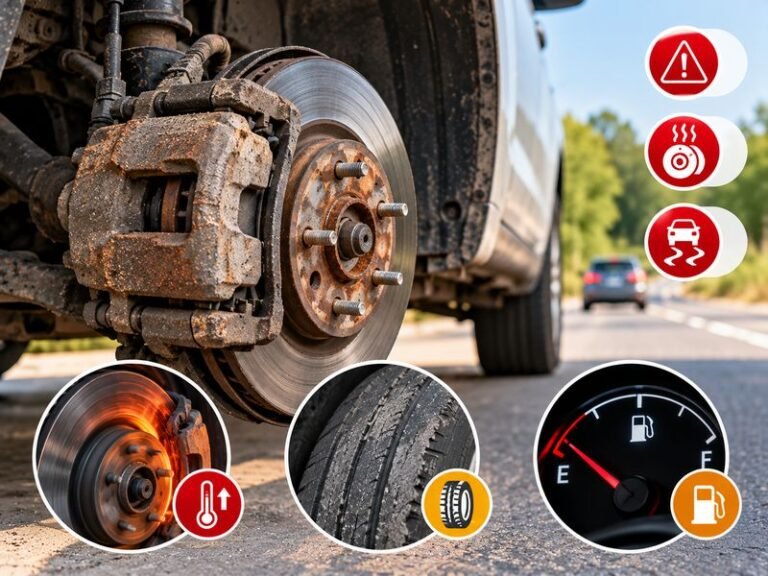
Symptoms of a Bad or Sticking Brake Caliper
Regardless of which type of caliper your vehicle uses, a failing caliper can produce noticeable symptoms.
Possible signs include:
- Vehicle pulling while braking
- One wheel becoming unusually hot
- Uneven brake-pad wear
- Burning smell near a wheel
- Reduced braking performance
- Brake fluid leaking near the caliper
- Grinding or rubbing noises
- Vehicle pulling while driving
- Excessive brake dust on one wheel
- A wheel that does not rotate freely
These symptoms can also have other causes, so proper brake inspection is necessary.
Why Caliper Slide Pins Matter
Slide pins are especially important on floating brake calipers.
The pins allow the caliper housing to move sideways every time the brakes are applied.
If a pin becomes stuck, the caliper may not move enough to apply or release the outer pad properly.
Slide pins usually require an appropriate brake-caliper lubricant that is compatible with the pin, rubber boots, and braking temperatures.
Do not use random grease unless it is specified as suitable for the application.
Fixed vs. Floating Calipers for Performance Driving
A well-designed fixed multi-piston caliper offers several characteristics that are useful under repeated hard braking.
These can include:
- Increased rigidity
- Large brake-pad capacity
- Better pressure distribution
- Compatibility with larger rotors
- More consistent pedal feel
However, installing fixed multi-piston calipers alone does not automatically transform braking performance.
The complete braking system must work together, including the tires, rotors, pads, hydraulic system, brake balance, cooling, and ABS.
Which Brake Caliper Type Is Better?
There is no single best type for every vehicle.
For an everyday passenger car, a floating caliper can provide excellent braking while keeping cost, complexity, and weight relatively low.
For a high-performance vehicle that experiences repeated heavy braking, a fixed multi-piston caliper may provide advantages in rigidity, pad size, and heat-management capability as part of a properly engineered system.
The best brake caliper is the one designed to work correctly with the vehicle’s complete braking system.
Can You Replace Floating Calipers With Fixed Calipers?
Not by simply removing one caliper and installing another.
Converting to fixed calipers normally requires a properly engineered brake upgrade kit containing compatible components such as:
- Calipers
- Mounting brackets
- Rotors
- Brake lines or hoses
- Appropriate brake pads
- Hardware
Wheel clearance, hydraulic piston area, brake balance, master-cylinder compatibility, and ABS behavior must also be considered.
Because brakes are safety-critical equipment, poorly designed modifications can negatively affect braking performance.
Should Brake Calipers Be Replaced in Pairs?
Brake calipers are not universally required to be replaced in pairs in every situation.
However, both sides of the axle should be carefully inspected whenever one caliper fails.
The condition, age, corrosion level, pad wear, and braking balance should all be considered.
Brake pads on the same axle are normally serviced as an axle set rather than replacing pads at only one wheel.
Follow the vehicle manufacturer’s repair procedures and applicable service guidance.
How Long Do Brake Calipers Last?
Brake calipers do not have one universal replacement interval.
Many can remain in service for a long time if the braking system is maintained properly.
Caliper life can be affected by:
- Road salt
- Moisture
- Damaged rubber boots
- Corrosion
- Brake-fluid condition
- Heat
- Driving environment
- Slide-pin maintenance
- Vehicle use
Calipers should generally be replaced or rebuilt based on condition rather than at a fixed mileage unless the manufacturer specifies otherwise.
Brake Caliper Safety
Brake calipers directly affect a vehicle’s ability to stop, so brake work requires careful procedures.
When servicing a brake system:
- Support the vehicle correctly with appropriate jack stands.
- Never rely only on a hydraulic jack.
- Avoid getting grease or brake fluid on friction surfaces.
- Use the correct brake components.
- Tighten fasteners to manufacturer specifications.
- Follow the correct brake-bleeding procedure when the hydraulic system is opened.
- Confirm proper pedal operation before driving.
- Follow special procedures for electronic parking brakes.
If you are uncertain about brake-system diagnosis or repair, having a qualified automotive technician inspect the vehicle is the safer choice.
FAQs About Types of Brake Calipers
What are the 2 types of brake calipers?
The 2 types of brake calipers are floating calipers and fixed calipers.
A floating caliper slides on guide pins and usually has pistons on one side of the rotor. A fixed caliper remains stationary and has pistons on both sides.
What is the most common type of brake caliper?
Floating or sliding calipers are very common on passenger vehicles because they are relatively simple, compact, and cost-effective.
The exact design depends on the vehicle.
What is the difference between fixed and floating brake calipers?
A floating caliper moves sideways on guide pins to apply both brake pads.
A fixed caliper does not move. It uses opposing pistons on each side of the rotor to apply the pads.
Is a sliding caliper the same as a floating caliper?
The terms are commonly used interchangeably when discussing the basic types of automotive brake calipers.
Both describe a design in which the caliper moves laterally to clamp both sides of the rotor.
Is a four-piston caliper always a fixed caliper?
No.
Many four-piston calipers are fixed designs, but piston count alone does not determine caliper type.
Caliper classification depends primarily on whether the caliper housing moves and where the pistons are positioned.
Are fixed brake calipers better than floating calipers?
Fixed calipers can offer greater rigidity and are well suited to high-performance braking systems, but floating calipers are effective and practical for many everyday vehicles.
Neither type is automatically better in every application.
Why do floating brake calipers have slide pins?
The slide pins allow the caliper body to move sideways.
This movement lets a piston on one side of the rotor apply both the inner and outer brake pads.
Do fixed brake calipers have slide pins?
Fixed calipers do not need the same sliding guide-pin mechanism because their housing remains stationary.
Opposing pistons move the brake pads toward the rotor from both sides.
Conclusion
The two main types of brake calipers are floating or sliding calipers and fixed calipers. Floating calipers typically use pistons on one side and move along guide pins to squeeze both brake pads against the rotor. Fixed calipers stay stationary and use opposing pistons on both sides of the rotor.
Floating calipers are widely used because they are simple, compact, and economical. Fixed multi-piston calipers are often used where greater caliper rigidity, larger brake pads, and demanding braking performance are priorities.
Understanding these 2 types of brake calipers also makes brake problems easier to recognize. A floating caliper may develop seized slide pins, while a fixed caliper can have one or more sticking pistons. In either design, proper caliper operation is essential for even brake-pad wear, controlled braking, and safe vehicle operation.