Symptoms of a Faulty Brake Booster: 9 Signs You Shouldn’t Ignore
A brake booster is an important part of a vehicle’s braking system because it reduces the amount of force needed to press the brake pedal. It uses vacuum or another form of power assistance to multiply the force from your foot before that force reaches the master cylinder.
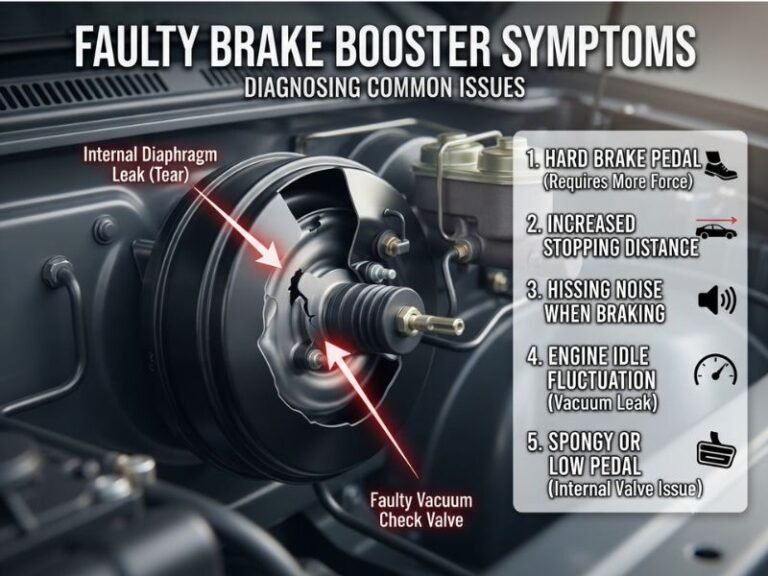
When the booster starts to fail, the change can often be felt through the brake pedal. You may notice a hard pedal, increased braking effort, a hissing noise, or changes in how the engine runs.
The symptoms of a faulty brake booster can sometimes look similar to problems with the master cylinder, vacuum hose, or other brake components. Knowing the common warning signs can help you identify a potential problem and determine when the vehicle needs immediate inspection.
Symptoms of a Faulty Brake Booster: What to Look For
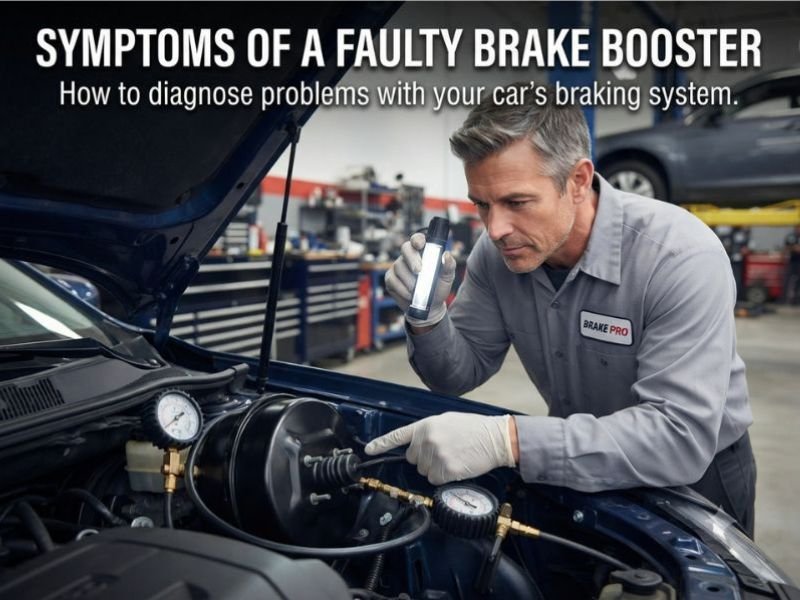
A faulty brake booster can affect both brake pedal feel and the vehicle’s vacuum system. The exact symptoms depend on how the booster has failed and whether the problem is caused by an internal leak, vacuum supply issue, or another component.
Common warning signs include:
- Hard brake pedal
- Increased pedal effort
- Longer stopping distance
- Hissing noise when braking
- Brake pedal does not move as expected when the engine starts
- Rough engine idle
- Engine stalling when braking
- Inconsistent brake assistance
- Reduced overall braking performance
One symptom alone does not always confirm a faulty booster. Several other brake problems can produce similar signs, so proper diagnosis is important.
9 Common Symptoms of a Faulty Brake Booster
1. Hard Brake Pedal
A hard brake pedal is one of the most common signs of a brake booster problem.
Under normal conditions, the booster provides assistance so you do not have to use significant leg force to stop the vehicle. If that assistance is lost, the pedal can feel unusually firm and difficult to push.
You may notice that the pedal requires much more pressure than it normally does, especially when trying to slow down quickly.
A hard pedal can also be caused by vacuum supply problems, a faulty check valve, or other issues, so the booster should be tested rather than replaced based on this symptom alone.
2. Increased Pedal Effort
A faulty booster can make you work much harder to apply the brakes.
You may find yourself pressing the pedal with considerably more force during normal stops. The difference can be especially noticeable when driving in traffic, where repeated braking is required.
The braking system may still function, but the loss of power brake assist means more of the braking force must come directly from your foot.
3. Longer Stopping Distance
If the booster is not providing adequate assistance, stopping the vehicle can become more difficult.
The hydraulic brake system may continue working, but if you cannot apply sufficient pedal force quickly, the vehicle may take longer to stop.
This is particularly concerning during emergency braking. Even if the brakes appear to work during normal driving, reduced braking assistance can become a serious problem when you suddenly need maximum braking force.
4. Hissing Noise When Applying the Brakes
A noticeable hissing sound when pressing the brake pedal can indicate a vacuum leak.
The sound may come from the brake booster, vacuum hose, check valve, or another part of the vacuum system.
Some vehicles can produce a brief sound as the booster operates, so the presence of any noise does not automatically mean the booster has failed. A continuous or unusually loud hissing sound is more concerning.
If the hissing occurs together with a hard brake pedal, the vacuum system should be inspected.
5. Brake Pedal Does Not Drop When Engine Starts
A simple brake booster test can reveal whether the booster is providing assistance.
With the engine off, press the brake pedal several times until it becomes firm. Keep steady pressure on the pedal and start the engine.
In a functioning vacuum-assisted system, the pedal will normally move slightly downward as vacuum assistance becomes available.
If the pedal does not change and remains unusually hard, there may be a problem with the brake booster, vacuum supply, or check valve.
6. Rough Engine Idle
A faulty booster can sometimes affect engine operation because many brake boosters use engine vacuum.
If the booster develops an internal vacuum leak, additional air may enter the engine’s intake system. This can disturb the expected air-fuel mixture.
As a result, you may notice:
- Rough idle
- Unstable engine speed
- Engine hesitation
- Poor idle quality
A rough idle has many possible causes, so it should not automatically be blamed on the brake booster. However, rough idle combined with a hard pedal and hissing noise is a useful clue.
7. Engine Stalling When Braking
A significant vacuum leak can sometimes cause the engine to stall when you press the brake pedal.
When the brake booster has an internal leak, pressing the pedal can allow additional air into the engine’s vacuum system. On some vehicles, this can affect engine operation enough to cause stalling.
This symptom deserves prompt attention because the engine may stall while you are slowing down in traffic.
If the engine repeatedly stalls when braking, avoid unnecessary driving until the problem has been diagnosed.
8. Inconsistent Brake Assistance
Not every brake booster fails completely at once.
A booster may provide normal assistance under some conditions and reduced assistance under others. You might notice that the brake pedal feels normal during one drive but becomes harder during another.
Intermittent brake assist should not be ignored.
A problem that seems minor today can become more severe without warning, potentially leaving you with a much harder pedal when you need to stop suddenly.
9. Reduced Overall Braking Performance
A faulty booster can make the vehicle feel harder to stop even when the hydraulic braking system is still functioning.
You may notice that:
- You need more pedal pressure
- Braking feels less responsive
- Emergency stops require greater effort
- The pedal feels different from normal
Other problems, such as worn brake pads, damaged rotors, air in the brake lines, or a master cylinder issue, can also reduce braking performance.
The entire brake system should therefore be checked when braking behavior changes.
What Causes a Brake Booster to Fail?
Brake boosters can fail for several reasons. Some problems originate inside the booster, while others involve the vacuum system connected to it.
Vacuum Hose Damage
The vacuum hose supplies the booster with the vacuum it needs for power assistance.
Over time, the hose can become cracked, brittle, loose, or damaged. A vacuum leak can prevent the booster from working properly and create symptoms that resemble internal booster failure.
Faulty Vacuum Check Valve
The vacuum check valve helps maintain vacuum inside the booster.
If the valve is defective, the booster may not retain vacuum properly. This can result in reduced or inconsistent brake assistance.
A faulty check valve can sometimes be less expensive to replace than the entire booster, which is another reason proper diagnosis matters.
Internal Diaphragm Failure
Many vacuum brake boosters use an internal diaphragm to separate vacuum chambers.
If the diaphragm becomes damaged or develops a leak, the booster may lose its ability to provide proper assistance.
An internal leak can also create a vacuum leak that affects engine operation.
Damaged Seals or Internal Components
Internal seals and mechanical components can deteriorate over time.
If these components fail, the booster may no longer maintain the correct vacuum or transfer pedal force properly.
Age and Normal Wear
Brake boosters do not usually have a fixed replacement interval. Their service life depends on the vehicle, operating conditions, component quality, and exposure to heat and other environmental factors.
An older booster can eventually develop internal wear or seal problems.
How Does a Faulty Brake Booster Affect Braking?
The main effect of a faulty booster is the loss of normal power assistance.
Loss of Power Assistance
The booster is designed to multiply the force you apply to the brake pedal.
When it fails, you may have to provide much more force yourself to achieve similar braking results.
Harder Brake Pedal
Without normal assistance, the brake pedal can become significantly harder.
This is one of the main differences between a healthy power-assisted braking system and one with a serious booster problem.
Difficulty During Emergency Braking
Emergency braking requires rapid and strong pedal input.
If the booster is not assisting properly, you may not be prepared for the additional force required. This can make emergency stops more difficult and increase the risk of an accident.
How to Test a Brake Booster at Home
A few basic tests can provide useful clues about booster operation. These checks do not replace a professional inspection.
Engine-Off Brake Pedal Test
Turn the engine off.
Press the brake pedal several times. As the stored vacuum is used, the pedal should become firmer.
Keep your foot firmly on the pedal and hold the pressure.
Then start the engine.
Engine-On Brake Pedal Test
When the engine starts, a functioning vacuum-assisted booster will normally provide additional assistance.
You should typically feel the brake pedal move slightly downward.
If the pedal remains very hard and does not change when the engine starts, the booster or its vacuum supply may have a problem.
Check for Vacuum Leaks
Listen around the brake booster and vacuum hose for an unusual hissing sound.
Inspect the vacuum hose and its connections for:
- Cracks
- Loose fittings
- Brittle sections
- Damage
- Disconnected connections
A visible hose problem can sometimes be the actual cause rather than the booster itself.
Professional Brake Booster Testing
If basic tests do not identify the problem, professional testing may be necessary.
A technician can inspect the vacuum system, booster, check valve, master cylinder, and related components to determine why the brake pedal is behaving differently.
Professional diagnosis is particularly important if braking performance has significantly changed.
Faulty Brake Booster vs. Bad Master Cylinder
A faulty booster and a bad master cylinder can sometimes be confused because both affect brake pedal behavior.
| Symptom | Faulty Brake Booster | Bad Master Cylinder |
| Hard pedal | Common | Less common |
| Soft/spongy pedal | Less typical | Common |
| Pedal sinks | Less typical | Common |
| Hissing noise | Possible | Unlikely |
| Increased pedal effort | Common | Possible |
| Loss of power assist | Common | Unlikely |
A hard pedal with a hissing sound is more suggestive of a booster or vacuum problem.
A pedal that slowly sinks while pressure is maintained can point toward a hydraulic problem such as a master cylinder issue.
These symptoms are useful clues but are not enough by themselves to confirm the failed component.
Can You Drive With a Faulty Brake Booster?
It is generally not recommended to drive normally with a faulty brake booster.
The hydraulic brakes may still operate even when the booster has failed, but you may need considerably more force to press the brake pedal.
This can make emergency braking much more difficult.
You should avoid driving if:
- The brake pedal is extremely hard
- The vehicle is difficult to stop
- Stopping distance has increased noticeably
- Brake assistance suddenly disappears
- The engine stalls when braking
- You are not confident in the vehicle’s braking ability
If braking performance is seriously compromised, having the vehicle towed is safer than driving it to a repair facility.
How Much Does It Cost to Replace a Brake Booster?
The total cost depends on the vehicle and the actual cause of the problem.
If the issue is a vacuum hose or check valve, the repair may be relatively simple.
If the booster itself has failed, replacement usually involves more labor.
The total repair can include:
- Brake booster
- Labor
- Vacuum hose
- Check valve
- Seals or mounting hardware
- Diagnostic work
Getting an accurate diagnosis first can help prevent replacing a good booster when the actual problem is a smaller vacuum-system component.
Frequently Asked Questions
What are the most common symptoms of a faulty brake booster?
The most common signs include a hard brake pedal, increased pedal effort, hissing noises, reduced brake assistance, longer stopping difficulty, and sometimes rough engine idle or stalling.
Can a faulty brake booster cause a hard brake pedal?
Yes. A loss of vacuum assistance can make the brake pedal significantly harder to press because the driver has to provide more of the braking force.
Can a bad brake booster cause engine problems?
Yes. On vehicles that use engine vacuum for brake assistance, an internal booster leak can create a vacuum leak that contributes to rough idle, hesitation, or stalling.
How do I know if my brake booster needs replacing?
A hard pedal, failed booster test, persistent vacuum leak, or significant loss of brake assistance can indicate a failed booster. However, the vacuum hose and check valve should also be checked before replacing the booster.
Can you drive with a faulty brake booster?
Although the hydraulic brakes may still work, driving with a faulty booster is not recommended because the pedal can require much more force and emergency braking can become difficult.
How long does a brake booster last?
There is no universal lifespan for every brake booster. Service life depends on the vehicle, component quality, driving conditions, age, and exposure to wear or vacuum-system problems.
Final Thoughts on Symptoms of a Faulty Brake Booster
The symptoms of a faulty brake booster are often noticeable through changes in brake pedal feel. A hard pedal, increased pedal effort, hissing noise, reduced brake assistance, and unusual engine behavior can all indicate a problem with the booster or its vacuum system.
However, similar symptoms can come from a damaged vacuum hose, faulty check valve, master cylinder, or other brake components. Testing the complete system is therefore important before replacing any major component.
If the brake pedal has become significantly harder or the vehicle is more difficult to stop, treat the problem as a safety issue. Have the braking system properly inspected and repaired before returning to normal driving.