
What Is a Parking Brake? Purpose, Location, and How to Use It
A parking brake is a system that holds a vehicle in place after it has stopped, helping prevent it from rolling forward or backward. It is also commonly called a handbrake, emergency brake, or e-brake, although the controls and functions vary between vehicles. Some cars use a hand lever or foot pedal, while others have an electronic switch.
The parking brake is especially important on hills, but it is useful on level roads, too. It provides an additional way to secure a parked vehicle instead of depending entirely on the transmission or regular brake pedal. Many drivers know where their parking brake control is without knowing exactly which wheels it holds or how the system operates.
This guide covers what a parking brake does, what it is used for, and where to find it. It also gives an overview of mechanical and electronic designs, safe parking habits, warning lights, common problems, maintenance, and how parking brakes differ from other braking systems. The goal is to make the whole subject easy to understand without getting lost in complicated repair procedures.
What Is a Parking Brake?
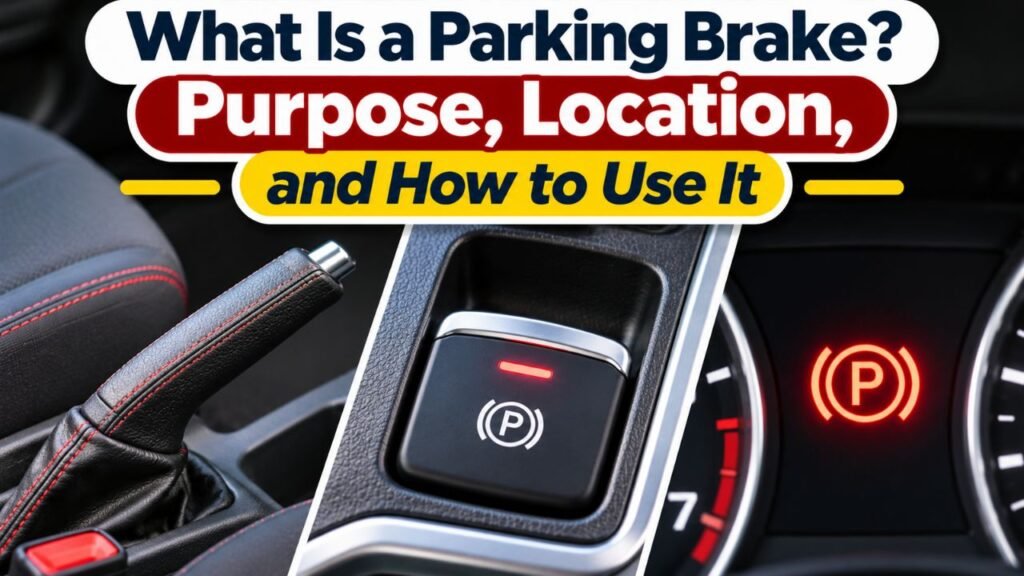
A parking brake is a vehicle braking mechanism designed primarily to keep a stationary vehicle from moving. Unlike the regular brake pedal, which drivers use repeatedly while traveling, the parking brake is intended mainly for securing the vehicle after it stops.
The National Highway Traffic Safety Administration’s explanation of parking brakes describes the parking brake as a mechanism intended to prevent movement of a stationary motor vehicle. On typical passenger cars, it uses friction at the wheels to hold the vehicle still.
The name describes its primary job: parking. Although people often say “emergency brake,” emergency use is secondary and depends on the particular vehicle. A parking brake may be operated by a lever, pedal, electric switch, or automated vehicle function.
What Does a Parking Brake Do?
The parking brake holds the vehicle against rolling after the driver releases the regular brake pedal. It creates holding force at part of the braking system, usually at the rear wheels, and keeps that force applied until released.
Prevents a Parked Vehicle From Rolling
Even a road that looks flat may have a slight slope. Gravity, a bump from another vehicle, or movement during loading can make an unsecured vehicle shift. A properly working parking brake adds protection against unwanted movement, whether the vehicle is parked in a driveway, parking lot, or on the street.
Adds Security Beyond the Transmission
In an automatic vehicle, the transmission’s Park position and the parking brake serve different functions. Using both reduces reliance on a single holding mechanism, especially on a grade. In a manual-transmission vehicle, leaving the correct gear engaged provides another measure of security alongside the brake.
What Is a Parking Brake Used For?
The most common use is keeping a parked car stationary. It also helps when parking on steep roads, securing a manual-transmission vehicle, and holding a car during certain manufacturer-approved situations.
Common uses include:
- Everyday parking: Securing a car at home, work, or a shopping center.
- Hill parking: Helping prevent forward or backward rolling on an incline.
- Manual-transmission parking: Supporting the holding effect of leaving the transmission in gear.
- Certain hill starts: Helping some drivers avoid rolling before moving away, where the vehicle’s design and instructions allow it.
- Additional security during brief stops: Keeping a stationary car secured when the driver intends to park, not simply replacing normal brake-pedal use in traffic.
The parking brake is not a substitute for wheel chocks or approved lifting supports when working underneath a vehicle. It should not be treated as a normal braking method for slowing down during everyday driving.
Where Is the Parking Brake Located?
The parking brake control is usually within the driver’s reach, but its exact position depends on the vehicle’s make, model, and year. The control may be between the front seats, near the driver’s left foot, on the dashboard, or inside an electronic vehicle menu.
Hand Lever Between the Front Seats
A traditional handbrake is commonly positioned on the center console beside the driver. It looks like a long lever with a release button, typically at its tip. Pulling the lever engages the brake, while the release button is used when lowering it.
Foot Pedal Near the Driver’s Left Foot
Some vehicles, including older sedans, SUVs, and trucks, have a smaller parking brake pedal to the far left of the regular pedals. Depending on the model, it releases through a separate handle or another press of the pedal.
Electronic Switch on the Console or Dashboard
Many modern cars use a compact switch marked with a circled P or a parking-brake symbol. It may sit near the gear selector, below the dashboard, or beside other driving controls. A few vehicles place certain parking-brake functions in a touchscreen menu.
If you cannot identify the control, check your owner’s manual before driving. Do not assume that a button labeled P is the parking brake; it may instead select the transmission’s Park position.
What Does a Parking Brake Look Like?
Parking brake controls do not share one universal shape. A hand-operated version resembles a lever that lifts upward. A foot-operated version is a small pedal separate from the main brake. An electronic version may be no larger than a window switch.
Many electric switches show a P inside a circle, often surrounded by curved brackets. On the instrument cluster, a related symbol may illuminate to indicate that the system is engaged. Older cars may show the word BRAKE instead.
A vehicle can also have separate indicators for an engaged parking brake and a parking-brake fault. The owner’s manual is the best way to identify which symbol means what.
How Does a Parking Brake Work?
The basic principle is friction: braking components press against a rotating part connected to the wheels, keeping it from turning. The design determines how the holding force is created and released.
Mechanical Cable-Operated Systems
On a conventional hand or foot parking brake, moving the control pulls one or more steel cables. The cables operate rear brake components that press shoes or pads against a drum or disc-related mechanism. A ratchet or locking mechanism maintains the applied position until the driver releases it.
Electronic Parking Brake Systems
An electronic parking brake (EPB) uses an electrically commanded actuator instead of a long hand lever. Some designs use motors at the rear calipers, while others use an electric actuator connected to cables. Although an electric signal applies the brake, the holding arrangement is designed to keep it engaged after application.
The Honda HR-V electric parking brake owner’s guide shows one example: the driver pulls the switch upward to apply the brake and presses it downward under the specified conditions to release it. Other vehicles may have different controls or automatic functions.
Main Types of Parking Brakes
Most passenger vehicles use one of three familiar control types. The underlying braking hardware may differ even when two vehicles have similar controls.
| Parking Brake Type | Driver Control | Common Characteristic |
| Hand-operated | Lever between seats or near the dashboard | Mechanical feel and manual release |
| Foot-operated | Separate pedal in the driver’s footwell | Hands-free application while seated |
| Electronic | Switch, button, or automated control | Electric actuation and possible automatic features |
These types are not interchangeable labels for the wheel brakes themselves. For example, a handbrake may work with rear drums or a disc-brake arrangement. Electronic systems may use specialized rear calipers or other actuators.
Which Wheels Does the Parking Brake Control?
Most passenger-car parking brakes act on the rear wheels. That arrangement is common because it provides a practical way to secure the vehicle without depending on the hydraulic pressure used during ordinary braking.
Some vehicles have a small drum mechanism inside the rear brake rotor, often called a drum-in-hat design. Others use rear calipers with built-in parking brake mechanisms. Certain older or specialized vehicles use arrangements located elsewhere in the driveline.
The exact layout matters when diagnosing a failure or replacing components. Wheel location cannot be determined reliably from the location of the parking-brake switch or lever alone.
Parking Brake vs. Regular Brake: What’s Different?
The regular brake pedal operates the service brakes, which provide controlled stopping and speed reduction during driving. The parking brake’s main function is to hold the vehicle after it has come to rest.
| Feature | Parking Brake | Regular Brake Pedal |
| Main purpose | Hold a parked vehicle | Slow and stop a moving vehicle |
| Typical control | Lever, pedal, or switch | Main foot pedal |
| Typical operation | Mechanical or electrically actuated holding system | Primarily hydraulic or electronically controlled service braking |
| Typical wheel coverage | Often rear wheels | Generally all four wheels |
| Everyday driving use | Not for routine stopping | Used throughout driving |
The systems can share brake pads, discs, or caliper components while still having distinct operating mechanisms. They are designed to perform different jobs.
Is the Parking Brake the Same as an Emergency Brake or Handbrake?
In everyday speech, parking brake, emergency brake, e-brake, and handbrake often refer to the same general system. The names emphasize different ideas rather than necessarily identifying different parts.
“Handbrake” describes the familiar lever, but it does not fit foot-operated or electronic controls very well. “Emergency brake” reflects the historical possibility of using a separate braking system if the normal brakes fail. That does not mean every modern parking brake behaves the same way at driving speed.
For normal ownership and maintenance, “parking brake” is the most precise general term.
Is the Parking Brake the Same as Park Gear?
No. In an automatic transmission, Park (P) usually engages a parking pawl or another drivetrain-locking arrangement. The parking brake applies holding force through a separate braking mechanism.
Both help keep a parked vehicle stationary, but they are not duplicates. On a slope, vehicle weight may load the parking mechanism in the transmission, sometimes making shifting out of Park feel difficult. Using the parking brake while securing the vehicle helps limit that load.
Some electric vehicles and newer cars coordinate Park selection and parking-brake operation automatically. Even then, the functions and manufacturer instructions should be understood separately.
How to Use a Parking Brake Safely
The precise controls vary, but the basic parking sequence is simple. Follow the vehicle’s manual if its instructions differ, especially with electronic parking brakes and unusual transmission designs.
Step 01: Stop the Vehicle Completely
Bring the vehicle to a complete stop with the regular brake pedal. Keep your foot on that pedal while securing the transmission and parking brake. Never leave the vehicle relying on the parking brake before confirming it is stationary.
Step 02: Apply the Parking Brake
Pull the hand lever, press the parking-brake pedal, or operate the electric switch as directed. Check that the parking brake has engaged. On many vehicles, an indicator lights up in the instrument cluster.
Step 03: Secure the Transmission
For an automatic, select Park before leaving the vehicle. For a manual transmission, select the parking gear recommended in the owner’s manual, commonly first or reverse. On slopes, keep the regular brake applied until the vehicle is fully secured.
Step 04: Release It Before Driving
When departing, hold the service brake, select the appropriate driving gear, and release the parking brake as instructed. Confirm the relevant indicator turns off and the vehicle moves normally. An electronic system may release automatically under certain conditions, but do not assume yours will.
Should You Use the Parking Brake Every Time You Park?
Using the parking brake whenever you park is a sound habit, even on level ground. A flat-looking parking lot can still have enough slope for movement, and using the brake means the transmission is not the only restraint.
This habit is especially useful for drivers who switch between automatic and manual cars. It also provides a consistent routine, reducing the chance that someone forgets the brake on a hill.
Exceptions may apply to certain vehicle storage, towing, transport, or service procedures. Follow the specific manufacturer’s instructions when a parking brake must remain released.
How Should You Use a Parking Brake on a Hill?
When parking on an incline, apply the parking brake and secure the transmission. The position of the front wheels adds another layer of protection by directing a rolling vehicle away from traffic or toward a curb.
The California DMV’s parking-on-a-hill instructions distinguish between uphill parking with a curb, downhill parking, and roads without a curb:
- Downhill beside a curb: Turn the front wheels toward the curb.
- Uphill beside a curb: Turn the front wheels away from the curb, allowing the curb to help block movement.
- No curb: Point the wheels toward the roadside shoulder rather than into traffic.
These are general US driving-guide principles. On a private slope, steep driveway, or unusual roadway, park where the vehicle can be safely secured and follow local rules. Do not leave a vehicle on a grade if its parking brake cannot hold it.
Does a Parking Brake Work With the Engine Off?
A conventional mechanical parking brake does not require the engine to be running to remain engaged. That is one reason it is useful for securing a parked vehicle.
Electronic parking brakes are more dependent on vehicle design. They commonly require battery power to apply or release, although they can remain mechanically held once applied. A dead battery may prevent normal release, and some vehicles have special service procedures.
For long-term parking or vehicle transport, do not guess how an electronic system behaves when power is disconnected. Check the manual, especially if the car must be moved with a discharged battery.
Can the Parking Brake Stop a Moving Vehicle?
A parking brake may offer limited emergency stopping capability if the regular brakes fail, but it should never be used for ordinary braking while driving. A sudden mechanical application can lock wheels, destabilize the vehicle, and greatly increase stopping distance.
Some modern electronic systems have a controlled emergency-braking function when the switch is held in a particular way. That feature is model-specific; on other vehicles, the response may be different or unavailable.
If a braking emergency occurs, use the manufacturer’s emergency guidance and focus on maintaining vehicle control. Do not experiment with emergency-brake application on public roads.
Electronic Parking Brake vs. Auto Hold
An electronic parking brake and Auto Hold are related features on some cars, but they are not the same thing. The parking brake secures the vehicle for parking. Auto Hold generally helps keep the vehicle stationary during brief stops, such as at a traffic light, without the driver continuously pressing the brake pedal.
Depending on the model, Auto Hold may transfer responsibility to the parking brake when the vehicle is switched off or certain conditions occur. Other cars have different behavior. Check the owner’s manual and dashboard indicators instead of assuming the features operate identically.
What Happens If You Drive With the Parking Brake On?
Driving with the parking brake engaged can create friction and heat at the affected brakes. The result may be sluggish acceleration, a burning smell, unusual noises, faster lining wear, or damage to brake components.
Some cars alert the driver with a chime or dashboard warning. Others may automatically release the parking brake when moving away under approved conditions, but this feature is not universal.
If you accidentally drive with it applied, stop safely and release it. If there is smoke, severe heat, unusual pedal behavior, or reduced braking performance, arrange an inspection rather than continuing. Avoid touching hot brake components.
What Do Parking Brake Warning Lights Mean?
The familiar symbol is a P inside a circle, sometimes with brackets on each side. Another common indicator displays the word BRAKE. On many cars, a red light simply confirms that the parking brake is applied.
A light that stays on after release may signal incomplete disengagement, low brake fluid, or another brake-system issue. Amber symbols and messages can identify an electronic parking brake malfunction. Meanings vary by manufacturer and model.
Treat an unexpected red brake warning alongside abnormal braking as a reason to stop safely and seek assistance. Never assume that every illuminated brake symbol refers only to the parking brake.
Signs That a Parking Brake Is Not Working Properly
A functioning parking brake should apply and release according to the manufacturer’s design and hold the vehicle under the conditions for which it is specified. Warning signs include:
- The parked vehicle moves despite correct application.
- A hand lever travels unusually far or feels abnormally loose.
- A foot pedal or release mechanism sticks.
- The parking brake does not disengage completely.
- The rear brakes drag, overheat, or make unusual sounds.
- An electronic parking brake fault message appears.
No single symptom identifies the failed part. Cables, actuators, brake hardware, adjustment mechanisms, and electrical controls can all contribute. Do not park on a slope if the system is unreliable.
Why Does a Parking Brake Get Stuck?
A mechanical parking brake may stick because of corrosion, a seized cable, worn or damaged hardware, or moisture that freezes in cold conditions. Lack of use can also allow exposed parts to corrode or bind.
Electronic systems may stick because of actuator problems, low battery voltage, damaged wiring, or faults in the control system. In some vehicles, maintenance work performed without the required electronic service mode can create additional problems.
Avoid forcing a stuck lever, repeatedly cycling a malfunctioning switch, or driving against a brake that will not release. A repair shop can identify whether the fault is mechanical or electrical.
How Can You Tell Whether the Parking Brake Works?
The simplest owner-level check is to observe how the control and indicator behave while the vehicle is safely stationary on level ground. Check for abnormal effort, warning messages, a control that will not latch, or a brake that does not release normally.
A proper holding-force test may require a specified incline or inspection equipment. Such testing should follow manufacturer procedures in a controlled setting, not by deliberately letting the car roll on a public hill.
If you suspect weak holding ability, have the brake inspected. A dashboard light confirming application is useful, but it does not prove the brake produces adequate holding force.
What Maintenance Does a Parking Brake Need?
Parking brakes need periodic inspection, even though the system may not have a separate routine replacement interval. A technician may check cable condition, corrosion, release travel, rear brake hardware, friction components, and correct adjustment where the design allows it.
Electronic systems may also need diagnostic checks or a manufacturer-specified maintenance mode for rear brake work. Do not assume all parking brakes can be tightened using a cable adjustment; some are self-adjusting, integrated into calipers, or controlled electronically.
Regular use can help drivers notice changes in feel or operation, but it does not replace inspection. Follow the vehicle’s maintenance schedule and have faults corrected promptly.
What Does Parking Brake Repair Involve?
Repair depends on what has failed. A traditional system might need a cable, lever mechanism, return spring, parking brake shoes, or adjustment work. An electronic system might require an actuator, wiring repair, software diagnosis, or rear caliper service.
Repair cost varies widely with the vehicle, labor rates, and whether parts are sold individually or as an assembly. Replacing a switch is a different job from replacing an electronic rear caliper, so broad price averages can be misleading.
Ask for a diagnosis that identifies the fault and confirms normal holding and release after repair. Never select replacement parts based only on the shape of the dashboard switch.
Are Parking Brakes Different on Trucks, SUVs, and Electric Cars?
The basic purpose stays the same, but the hardware differs. Many passenger cars and SUVs use rear wheel friction brakes, whether the control is a lever, pedal, or switch. Pickups may use a foot pedal or electronic control depending on generation and trim.
Electric cars often coordinate parking functions with software and the transmission or drive-control system. Heavy commercial trucks may use air-operated spring parking brakes, which differ substantially from the systems fitted to ordinary passenger vehicles.
Motorcycles, recreational vehicles, trailers, and specialized equipment can have their own parking or holding arrangements. The correct operating method always comes from the specific equipment’s instructions.
Parking Brake Habits That Prevent Common Problems
A few habits cover most everyday parking situations:
- Engage the brake before leaving a parked vehicle, even if the ground looks level.
- Use Park or the appropriate manual gear as an additional restraint.
- Check the warning indicator and release the brake before moving.
- Turn the wheels appropriately when parking on a hill.
- Never depend on a parking brake alone when raising or working beneath a vehicle.
- Do not ignore unusual resistance, burning smells, warning messages, or poor holding ability.
For unusual winter conditions, long-term storage, towing, or automated parking features, follow the vehicle-specific manual. A consistent routine is useful, but it should not override special manufacturer instructions.
Conclusion
A parking brake is the system that holds a stopped vehicle in place, usually by applying braking force at the rear wheels. It may be operated by a traditional lever, a separate pedal, or an electronic switch. Its main purpose is to prevent rolling, while its role in emergency stopping is limited and vehicle-dependent.
Knowing what a parking brake does, what it is used for, and where it is located makes everyday parking safer and easier. Use it with the appropriate transmission setting, pay extra attention on slopes, and address warning lights or poor holding performance before they create a bigger problem.
FAQs About What Is Parking Brake
Is a Parking Brake Necessary on Flat Ground?
Yes, it is a good habit to use it on level surfaces. Even a small grade can cause unwanted movement, and using the parking brake adds protection beyond the transmission’s parking position.
Can a Parking Brake Work Without Brake Fluid?
Many conventional parking brakes use a mechanical cable and do not need hydraulic pressure to remain engaged. However, that does not make a vehicle with low or missing service-brake fluid safe to drive. Some integrated systems have different designs.
Does a Parking Brake Lock All Four Wheels?
Usually not. Most passenger cars apply their parking brakes at the rear wheels, although specialized vehicles can use other arrangements. The regular service brake normally acts on all four wheels.
Will an Electronic Parking Brake Release Automatically?
Some models release it when the driver selects a gear and begins moving with the required conditions met. Others require manual switch operation. Check the model-specific owner’s manual rather than assuming automatic release.
Is It Safe to Use the Parking Brake in Winter?
Usually, yes, but wet, freezing conditions may cause certain mechanical brake components or cables to stick. Follow manufacturer guidance for extreme weather or extended storage, particularly if the brakes are already wet or damaged.
Does the Parking Brake Use the Same Pads as the Regular Brakes?
Sometimes. Certain rear calipers use their regular friction pads for parking, while other designs have separate shoes inside the rear rotor. Both arrangements are common, so the answer depends on the vehicle.
Can You Drive if the Parking Brake Does Not Work?
A failed parking brake leaves the vehicle without an important parking safety feature and may also indicate broader brake problems. Arrange prompt inspection, avoid slopes, and do not drive if any service-brake performance is questionable.
