Is Hydraulic Fluid the Same as Brake Fluid? Differences Explained
Brake fluid is a specialized hydraulic fluid, but the bottles sold as hydraulic fluid or hydraulic oil are generally not substitutes for automotive brake fluid. A braking system needs the exact fluid type specified by the vehicle manufacturer because its seals, valves, temperature range, and braking characteristics are designed around that fluid.
Hydraulic systems use liquid to transmit pressure. A car’s hydraulic brake system does exactly that: pressing the brake pedal moves fluid through the master cylinder and brake lines to apply the brakes.
That shared operating principle does not make every hydraulic liquid interchangeable. Hydraulic oil used in machinery, power-steering fluid, automatic transmission fluid, jack oil, and conventional automotive brake fluid have different chemical bases and performance requirements.
NHTSA’s Federal Motor Vehicle Safety Standard No. 116 specifically distinguishes conventional motor-vehicle brake fluid from hydraulic system mineral oil. NHTSA has also stated that conventional brake fluid and hydraulic-system mineral oil are not compatible.
For is hydraulic fluid the same as brake fluid, the most accurate answer is that brake fluid belongs to the broad family of hydraulic fluids, but only fluid approved for the specific brake system belongs in the brake-fluid reservoir.
Most modern passenger vehicles use glycol-based DOT 3, DOT 4, or DOT 5.1 brake fluid. Some less-common automotive systems use mineral hydraulic fluid such as LHM, while DOT 5 is a different silicone-based brake-fluid class.
Putting the wrong fluid into a brake system can damage seals and other hydraulic components and may compromise braking. The reservoir cap, owner’s manual, or manufacturer service information should identify the required specification.
Is Hydraulic Fluid the Same as Brake Fluid?
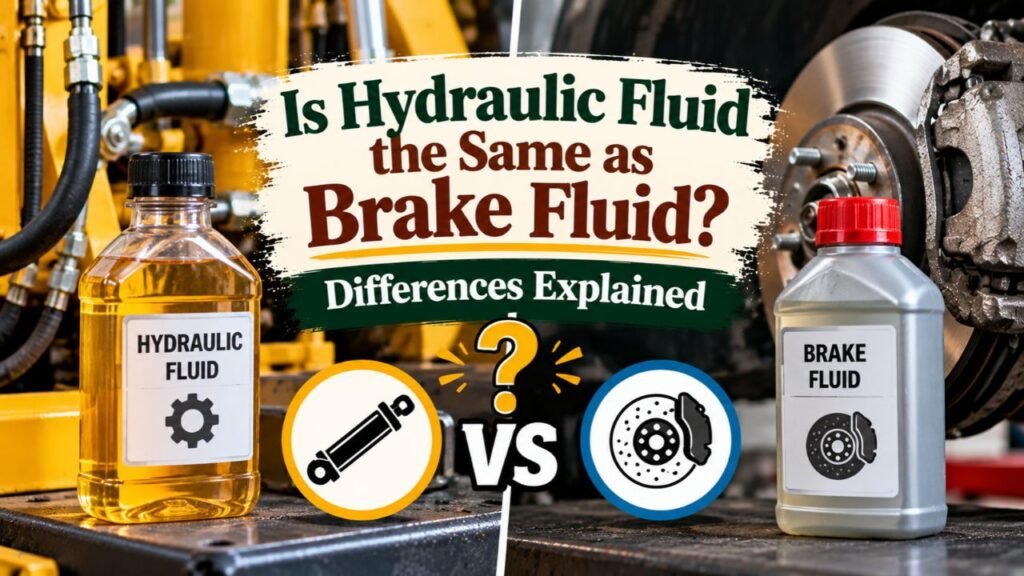
In a technical sense, brake fluid is a hydraulic fluid because it transmits force through a hydraulic circuit.
In a practical automotive sense, brake fluid and general hydraulic fluid should not be treated as the same product.
Brake Fluid Is Made Specifically for Braking Systems
Brake fluid must operate through:
- Master cylinders
- ABS hydraulic units
- Brake lines
- Calipers
- Wheel cylinders
- Hydraulic clutch components on some vehicles
NHTSA defines motor-vehicle brake fluid as liquid designed for use in a hydraulic brake system and sets performance requirements through FMVSS No. 116.
Those requirements address characteristics such as boiling behavior, viscosity, corrosion, chemical stability, and compatibility with brake-system elastomers.
Hydraulic Fluid Is a Broad Category
“Hydraulic fluid” can describe many unrelated liquids used in:
- Construction equipment
- Hydraulic jacks
- Tractors
- Forklifts
- Industrial machinery
- Power steering
- Suspension systems
- Specialized vehicle braking systems
Many of these products are petroleum- or mineral-oil-based.
They are not automatically compatible with seals and components designed for conventional DOT brake fluid.
Similar Purpose Does Not Mean Similar Chemistry
Both fluids can transfer force, but chemistry determines how they behave around heat, moisture, rubber seals, plastics, and metals.
NHTSA distinguishes conventional brake fluid from hydraulic-system mineral oil specifically because the systems and compatible elastomers differ.
Key Takeaway: Brake fluid performs a hydraulic function, but general hydraulic oil and conventional automotive brake fluid are separate fluid classes and should not be interchanged.
Brake Fluid vs Hydraulic Fluid: Main Differences
The comparison becomes clearer when the two are placed side by side.
| Feature | Automotive brake fluid | General hydraulic oil |
| Main application | Vehicle brake systems | Machinery and hydraulic equipment |
| Common base | Glycol ether for DOT 3/4/5.1 | Often mineral/petroleum oil |
| Silicone version | DOT 5 | Not the normal basis of hydraulic oil |
| High-temperature braking requirement | Yes | Product-specific |
| Brake-seal compatibility | Designed around brake systems | Not assumed |
| Moisture behavior | Glycol types absorb moisture | Varies by fluid |
| DOT specification | DOT 3, DOT 4, DOT 5, DOT 5.1 | Normally no brake DOT rating |
| Safe substitute for brake fluid | Only approved brake-fluid specification | No |
Brake Fluid Must Handle High Temperatures
Brakes convert vehicle motion into heat.
Some of that heat reaches the caliper and fluid.
If brake fluid boils, vapor can form in the hydraulic circuit. Vapor is much more compressible than liquid, so pedal travel may increase and braking performance can deteriorate.
FMVSS No. 116 sets minimum boiling-point requirements for DOT brake fluids. Current NHTSA test documentation lists separate dry and wet boiling requirements for DOT classes.
Brake Fluid Has Specific Viscosity Requirements
Modern ABS and stability-control systems move brake fluid through small valves and passages.
Brembo notes that low-temperature viscosity matters in vehicles equipped with systems such as ABS, ESP, traction control, and electronic brake-force distribution.
General hydraulic oil is not automatically formulated for those braking-system requirements.
Brake Fluid Must Match Brake-System Seals
Hydraulic brake components contain seals made for a specific fluid chemistry.
Using an incompatible oil can cause elastomer swelling, deterioration, leakage, or hydraulic-unit trouble.
NHTSA’s definitions distinguish brake fluid from hydraulic-system mineral oil partly according to the elastomer materials found in their intended systems.
Key Takeaway: Brake fluid differs from general hydraulic oil in chemistry, boiling performance, viscosity, and seal compatibility, even though both transmit hydraulic pressure.
What Are DOT 3, DOT 4, DOT 5, and DOT 5.1 Brake Fluids?
The DOT number is more than a product name.
It identifies a brake-fluid performance class under FMVSS No. 116.
DOT 3 Brake Fluid
DOT 3 is widely associated with older and many conventional hydraulic brake systems.
It is generally glycol ether based.
Use it only where the vehicle specification permits it.
DOT 4 Brake Fluid
DOT 4 is also glycol based and is common in modern passenger vehicles.
Brembo notes that DOT 3 and DOT 4 are glycol-based fluids, though their chemical formulations and performance characteristics differ.
Numerous low-viscosity DOT 4 formulations are aimed at modern ABS and stability-control systems.
DOT 5 Brake Fluid
DOT 5 is the major chemistry exception in the familiar DOT numbering sequence.
It is silicone based.
Do not assume DOT 5 is simply a higher-performance replacement for DOT 4.
ATE specifically warns that its glycol ether-based DOT 5.1 must never be mixed with silicone-based DOT 5.
DOT 5.1 Brake Fluid
DOT 5.1 sounds closely related to DOT 5, but its chemistry is different.
ATE describes DOT 5.1 as glycol ether based, placing it chemically with DOT 3 and DOT 4 rather than silicone DOT 5.
This naming causes frequent mistakes.
The safe rule is simple: use the specification listed by the vehicle manufacturer instead of choosing by the largest DOT number.
Key Takeaway: DOT 3, DOT 4, and DOT 5.1 are normally glycol-based brake fluids, while DOT 5 is silicone based and should not be mixed into a glycol-based system.
Can You Use Hydraulic Fluid Instead of Brake Fluid?
For a normal passenger vehicle specifying DOT brake fluid, no.
Do not put ordinary hydraulic oil into the brake-fluid reservoir.
Hydraulic Oil May Damage Brake Seals
Brake-system rubber is selected for compatibility with its specified fluid.
Petroleum- or mineral-based contamination can affect components intended for glycol-based brake fluid.
Damage may involve:
- Master-cylinder seals
- Caliper seals
- Wheel-cylinder seals
- ABS hydraulic components
- Flexible brake-system parts
The result may not appear immediately after contamination.
Braking Performance May Change
An incorrect fluid may not have the required:
- Boiling characteristics
- Low-temperature viscosity
- Lubricity
- Corrosion protection
- Chemical stability
Braking systems are safety-critical hydraulic systems, so “it seems to work” is not a valid compatibility test.
Hydraulic Jack Oil Is Not Brake Fluid
Hydraulic jack fluid is intended for hydraulic lifting equipment.
Do not use it as a DOT brake-fluid substitute.
Tractor Hydraulic Fluid Is Not Brake Fluid
Tractor hydraulic and transmission fluids are formulated around agricultural hydraulic, transmission, and wet-brake systems.
They are not substitutes for DOT 3, DOT 4, or DOT 5.1 in an automotive brake master cylinder.
Key Takeaway: Ordinary hydraulic oil, jack oil, and tractor hydraulic fluid should not replace DOT brake fluid in a brake system designed for conventional automotive brake fluid.
Are There Cars That Use Mineral Hydraulic Fluid for Brakes?
Yes, and this is one reason the terminology needs care.
Some specialized vehicle systems use mineral-based hydraulic fluid rather than conventional DOT brake fluid.
LHM Is a Mineral Hydraulic Fluid
Brembo lists LHM PSA as a mineral-based hydraulic fluid intended for vehicle integrated brake, suspension, and steering circuits requiring the PSA B71 2710 specification.
Brembo also notes that some vehicles with centralized brake and clutch or hydraulic systems use LHM rather than the glycol-based fluid found in most modern cars.
LHM and Conventional DOT Fluid Are Not Interchangeable
A vehicle designed around mineral hydraulic fluid has seals and hydraulic components selected for that chemistry.
NHTSA has explicitly stated that conventional brake fluid and hydraulic-system mineral oil are not compatible.
Never assume an LHM-equipped vehicle should receive DOT 3 or DOT 4 simply because the system operates the brakes.
Read the Reservoir Label
A specialized system often has a clear fluid specification on:
- Reservoir cap
- Reservoir label
- Owner’s manual
- Service documentation
Use that specification exactly.
Key Takeaway: A few vehicles use mineral hydraulic fluid such as LHM for braking and other hydraulic functions, but these systems are designed specifically for it and should not receive conventional DOT brake fluid.
Is Power Steering Fluid the Same as Brake Fluid?
No.
Power-steering fluid is another hydraulic fluid, but it is formulated for a different hydraulic system.
Depending on the vehicle, power steering may use:
- Dedicated power-steering fluid
- ATF
- A manufacturer-specific hydraulic fluid
- Specialized mineral fluid
None of those classifications means the fluid belongs in a conventional brake reservoir.
Brake fluid and power-steering fluid can also behave very differently around rubber materials.
If power-steering fluid enters a DOT brake system, treat it as contamination rather than topping the reservoir with brake fluid and continuing to drive.
Is Transmission Fluid the Same as Brake Fluid?
No.
Automatic transmission fluid is also used hydraulically inside an automatic transmission, but it has a very different formulation.
ATF handles jobs such as:
- Hydraulic pressure control
- Lubrication
- Clutch operation
- Cooling
- Gear and bearing protection
It is generally petroleum or synthetic-oil based and should not be poured into a conventional DOT brake system.
The fact that both fluids operate hydraulic components does not make them interchangeable.
Is Clutch Fluid the Same as Brake Fluid?
Often, but not always.
Many manual-transmission vehicles use DOT 3 or DOT 4 brake fluid in the hydraulic clutch circuit.
Some vehicles even share the same reservoir for the brake and clutch systems.
In those cases, a bottle labeled “clutch fluid” may simply meet the required brake-fluid specification.
Other hydraulic clutch systems may specify another fluid.
Check the reservoir cap and vehicle manual before adding anything.
The label “clutch fluid” alone does not tell you the chemistry.
Why Brake Fluid Absorbs Moisture
Most DOT 3, DOT 4, and DOT 5.1 fluids are hygroscopic, meaning they absorb moisture over time.
That behavior is part of why brake fluid receives periodic service.
Water Lowers the Boiling Point
NHTSA states that moisture absorbed into brake fluid lowers the fluid’s boiling point and can increase the chance of vapor formation and brake-system corrosion.
Brakes can become very hot during:
- Repeated hard stops
- Mountain descents
- Towing
- Track driving
- Heavy vehicle use
Lower wet boiling performance leaves less thermal margin.
Keep New Brake Fluid Sealed
An opened container can begin absorbing atmospheric moisture.
Use clean fluid from a properly sealed container and follow the product and vehicle instructions for storage.
NHTSA-required brake-fluid warnings historically emphasize keeping the fluid clean and dry and protecting it from contamination.
Hydraulic Oil Behaves Differently
General mineral hydraulic oil does not share the same hygroscopic behavior as conventional glycol brake fluid.
That is another sign that these liquids are not interchangeable simply because both are hydraulic media.
Key Takeaway: Glycol brake fluid absorbs moisture, which lowers its boiling performance over time; this moisture behavior is another major difference from many mineral hydraulic oils.
What Happens If You Put Hydraulic Oil in the Brake Reservoir?
Treat this as a serious contamination event.
Do not assume that siphoning the reservoir and replacing the visible liquid solves the problem.
Contamination Can Travel Through the System
If the brake pedal has been pressed or the vehicle driven, contaminated fluid may move into:
- Master cylinder
- ABS hydraulic control unit
- Brake lines
- Calipers
- Wheel cylinders
The farther it spreads, the more involved the repair may become.
Seals May Be Damaged
Petroleum-based contamination can affect sealing materials intended for glycol brake fluid.
Symptoms may include:
- Swollen seals
- Internal leakage
- Brake drag
- Fluid leakage
- Abnormal pedal feel
Damage can remain after the visible contamination is removed.
Do Not Drive the Vehicle
If the wrong fluid has entered the brake system, avoid driving the vehicle.
Have it transported to a qualified repair facility.
The repair approach should follow the vehicle manufacturer’s service procedure and may require far more than a simple brake-fluid flush if incompatible oil has contacted rubber components.
Key Takeaway: Hydraulic oil in a conventional brake reservoir should be treated as serious contamination; stop driving and have the system serviced according to manufacturer procedures.
What Happens If Brake Fluid Is Put in a Hydraulic-Oil System?
The opposite mistake is also a problem.
A hydraulic-oil system may contain seals, pumps, hoses, and valves built for mineral or petroleum-based fluid.
Glycol brake fluid may be incompatible with those materials and may not deliver the lubrication characteristics the pump requires.
If brake fluid has been added to:
- Power steering
- Hydraulic jack
- Tractor hydraulics
- Suspension hydraulics
- Industrial hydraulic equipment
stop using the system and check the equipment manufacturer’s contamination procedure.
Do not assume that diluting the incorrect fluid with more hydraulic oil makes the system safe.
Can Different DOT Brake Fluids Be Mixed?
This question needs a more careful answer than “all DOT fluids mix.”
DOT 3, DOT 4, and DOT 5.1 Share Glycol-Based Chemistry
These fluids are generally chemically related.
Some products are marketed as compatible across several glycol DOT classes.
For example, Bosch states that its ENV6 glycol-base brake fluid can replace specified standard glycol fluids including DOT 3, DOT 4, and DOT 5.1 in supported applications. Bosch also warns that it is not suitable for mineral-oil or silicone-based systems.
Vehicle Specification Still Controls
Brembo advises using the brake-fluid specification chosen for the vehicle rather than treating every glycol DOT fluid as universally interchangeable.
A modern ABS system may require a particular low-viscosity DOT 4 formulation rather than any random DOT 4 product.
DOT 5 Is Different
Silicone DOT 5 should not be mixed with glycol DOT 3, DOT 4, or DOT 5.1 unless the manufacturer specifically designed a procedure for conversion.
ATE expressly warns against mixing glycol DOT 5.1 with silicone DOT 5.
Key Takeaway: Some glycol DOT fluids are chemically compatible, but use the vehicle-specified product; silicone DOT 5 and mineral hydraulic fluids belong to different fluid families.
How to Identify the Correct Fluid for Your Vehicle
Do not identify brake fluid by appearance alone.
Check the Reservoir Cap
The cap may state:
- DOT 3
- DOT 4
- DOT 4 LV
- DOT 5
- DOT 5.1
- Mineral fluid specification
- Manufacturer-specific standard
Use the wording exactly.
Check the Owner’s Manual
The manual may list both the DOT classification and a manufacturer specification.
That second specification can matter on vehicles with sophisticated ABS or stability-control systems.
Use Manufacturer Service Information
If the cap is missing, damaged, or unreadable, verify the fluid through manufacturer service information rather than guessing.
Never Identify Fluid by Color Alone
Brake fluid can darken with age and contamination.
Different products can also have similar colors.
NHTSA has specified color requirements for some brake-fluid categories, including purple for DOT 5 and green for hydraulic-system mineral oil, but color is not a substitute for the proper vehicle specification.
Conclusion
For is hydraulic fluid the same as brake fluid, brake fluid is technically a type of hydraulic fluid because it transfers pressure through a hydraulic brake circuit. That does not mean general hydraulic oil can replace automotive brake fluid.
Most modern vehicles use glycol-based DOT 3, DOT 4, or DOT 5.1. DOT 5 is silicone based, and a smaller number of specialized systems use mineral hydraulic fluid such as LHM. These fluid families are not universally interchangeable.
Use the exact fluid listed on the reservoir cap, in the owner’s manual, or in manufacturer service information. If an incorrect petroleum, mineral, silicone, or glycol fluid has entered a system designed for another chemistry, stop using the vehicle and have the contamination assessed before driving again.
FAQs About Hydraulic Fluid vs Brake Fluid
Is brake fluid considered hydraulic fluid?
Yes. Brake fluid is a specialized hydraulic fluid because it transfers pressure from the brake pedal through the hydraulic braking system. It should still be distinguished from general hydraulic oils used in machinery, power steering, jacks, and industrial equipment.
Can I use hydraulic oil instead of DOT 3 brake fluid?
No. Ordinary hydraulic oil is not a substitute for DOT 3. NHTSA distinguishes conventional motor-vehicle brake fluid from hydraulic-system mineral oil and has stated that those fluid types are not compatible.
Is DOT 4 brake fluid hydraulic fluid?
Yes, in the broad technical sense. DOT 4 is a specialized glycol-based hydraulic brake fluid formulated to meet motor-vehicle braking requirements. That does not make general-purpose hydraulic oil an acceptable replacement.
Is power steering fluid the same as brake fluid?
No. Power-steering fluid serves another hydraulic system and generally uses a different chemistry. Never transfer power-steering fluid into a conventional brake-fluid reservoir.
Is DOT 5.1 the same as DOT 5?
No. DOT 5.1 is glycol ether based, while DOT 5 is silicone based. ATE specifically warns that glycol DOT 5.1 should never be mixed with silicone DOT 5.
What vehicles use mineral hydraulic fluid instead of normal brake fluid?
Some specialized centralized hydraulic systems use mineral fluid such as LHM. Brembo lists an LHM PSA product for integrated braking, suspension, and steering systems that require the PSA B71 2710 specification.
What should I do if hydraulic fluid was put in my brake reservoir?
Do not drive the vehicle. General hydraulic oil may be incompatible with seals and other parts in a conventional DOT-fluid brake system. Have the vehicle transported for inspection and follow the manufacturer’s contamination-repair procedure rather than merely topping up the reservoir with brake fluid.