Can Brake Pads Fall Off? Causes, Risks, Warning Signs, and Fixes
A brake pad can physically come out of its caliper assembly, but that is not normal wear. It usually takes severe neglect, the wrong parts, faulty installation, a loose or damaged caliper, failed retaining hardware on designs that use it, or enough wear and damage to create space for the pad to escape.
A properly assembled disc brake traps each pad between the rotor, caliper or caliper bracket, and the pad’s locating surfaces. Under normal conditions, routine vibration and braking force should not let a complete pad simply drop onto the road.
A missing pad is more serious than ordinary squealing. Continued driving can damage the rotor and caliper, let a piston extend farther than intended, create a brake-fluid leak in some failures, and reduce braking on that wheel. A sudden change in pedal feel, hard pulling, grinding, or visible fluid calls for immediate attention.
NHTSA’s National Motor Vehicle Crash Causation Survey, based on crashes investigated from 2005 through 2007, attributed 25% of the vehicle-related critical reasons in its sample to failed or degraded brakes. That does not mean brakes caused 25% of all crashes; it shows why a serious brake defect deserves prompt action.
What stood out to me during the research is that people asking can brake pads fall off may be describing two different failures. The entire pad assembly can leave its normal position, or the friction material can separate from the steel backing plate while the plate stays in the caliper. Those failures have different causes.
Brembo’s current pad-fitting instructions call for correct placement of springs, pins, clips, screws, and other safety hardware used by the specific caliper design, along with correct pad seating and caliper fastener torque. That supports a simple rule: a pad found outside the brake assembly means something beyond routine pad wear needs to be inspected.
The most useful next step is to identify how a pad could leave its position, which symptoms appear first, what damage may follow, and which parts should be inspected before the vehicle returns to the road.
Can Brake Pads Fall Off Under Normal Driving?
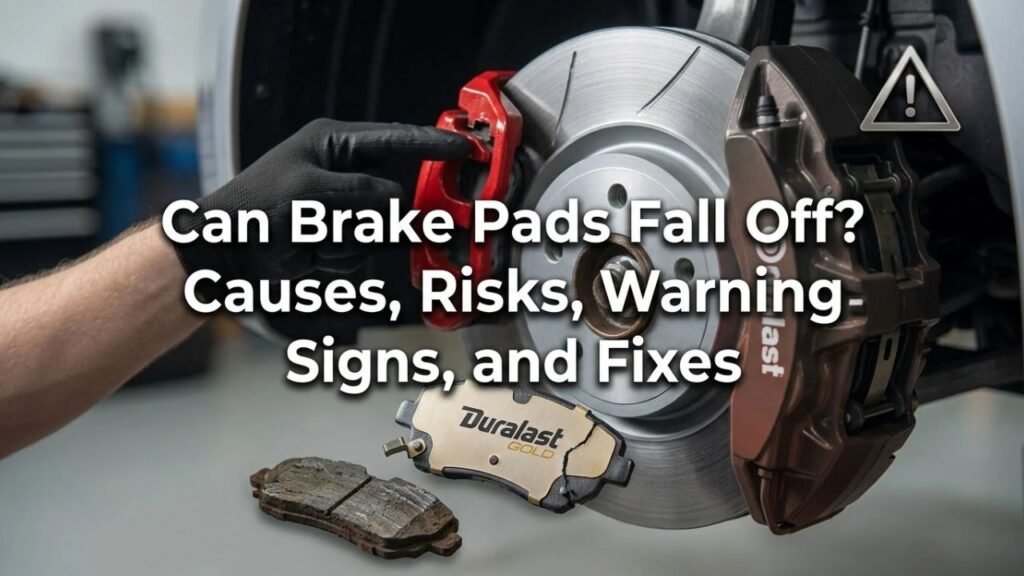
Yes, a brake pad can fall out, but a correctly installed, correctly sized pad in an undamaged brake assembly should remain captured during normal driving.
Most floating disc-brake systems use a caliper bracket with abutment areas that locate the pad ears. The caliper body then fits over the pads and rotor. Fixed calipers may use retaining pins, springs, screws, or other hardware. The exact design varies by vehicle, but the pad should not have enough freedom to escape when all parts are correct and secured.
This distinction matters because an intact pad found loose near a wheel is evidence of a fault. It may point to an installation error, incorrect part, loose caliper, damaged bracket, extreme wear, or failed retention parts. Simply installing another pad without finding the cause can leave the same failure path in place.
A second situation is friction-material separation. HELLA documents cases where the lining separates partly or fully from the backing plate due to thermal or mechanical overload, corrosion under the lining, poor fit, handling damage, or a noncompliant pad. In that case, the metal backing plate may still be located in the caliper even though much of the working friction material is gone.
Why can brake pads fall off?
A pad usually leaves the caliper only after another fault changes the geometry or retention of the brake assembly. I would focus on the following causes before blaming the pad by itself.
Severe Pad and Rotor Wear
A brake pad becomes thinner each time it rubs against the rotor. If wear is ignored far beyond the normal replacement point, the friction material can disappear and the backing plate can begin grinding directly on the rotor.
Continued metal-to-metal contact can remove material from both the pad backing and rotor. On some brake designs, enough combined wear can create abnormal clearance inside the caliper assembly. That may let a badly worn remnant shift out of position.
There is no universal “fall-out thickness” that applies to every passenger vehicle. Caliper geometry, rotor thickness, backing-plate design, and pad shape vary. The safe approach is to follow the vehicle maker’s pad and rotor limits rather than waiting for a pad to reach an extreme state.
Incorrect Brake Pad or Rotor Fitment
A pad made for a different caliper can have ears, tabs, backing-plate dimensions, or overall shape that do not match the bracket correctly. A rotor with the wrong dimensions can also change the relationship between the pad, caliper, and disc.
The pad should fit its bracket correctly and move as the design intends without excessive free play. If the pad is visibly loose, can twist out of its seat, or does not match the old part and service data, the fitment needs to be checked before the wheel goes back on.
This is one reason I would verify the exact vehicle configuration rather than rely only on year, make, and model. Brake packages can differ by engine, trim, axle, towing package, production date, or rotor size.
Loose or Missing Caliper Fasteners
A floating caliper normally pivots or slides only as its design permits. If a caliper bolt, guide-pin fastener, or mounting bolt is missing or loose, the caliper may move far beyond its intended range.
That can remove the physical barrier that normally keeps a pad captured. It can also let the caliper strike the wheel, damage a brake hose, or place the pads at an abnormal angle.
A pad that falls out soon after brake service should make caliper mounting and fastener condition an early inspection point. The vehicle should not be driven back to the shop for diagnosis if a pad is actually missing.
Missing or Incorrect Retaining Hardware
Some brake designs use retaining pins, springs, clips, screws, or pad-specific hardware to locate and secure the pads. Brembo instructs installers to refit the safety accessories used by the caliper and verify correct pad fixing before the brake is returned to service.
Not every small anti-rattle clip is the sole part preventing a pad from falling out. Many clips mainly control movement and noise. The role of the hardware depends on the caliper design, so missing hardware should be compared with the factory layout rather than judged from appearance alone.
Broken or Severely Corroded Caliper Parts
A cracked bracket, damaged pad abutment, heavily corroded mounting area, or failed retaining pin can change the pad’s support. Corrosion can also keep a pad from sliding freely, producing uneven wear and extra heat.
Ferodo describes corrosion between the friction material and backing plate as a cause of material separation. Its troubleshooting information also links sticking caliper parts with uneven or rapid pad wear.
Rust by itself does not mean a pad is about to fall out. Severe structural corrosion, missing metal, a loose bracket, or damaged retention points are different matters and need repair rather than a simple cleaning.
Friction Material Delamination
The friction block can separate from the steel backing plate. This is sometimes described as the “pad falling off,” even though the backing plate remains inside the caliper.
Heat, corrosion beneath the lining, mechanical overload, poor fit, or damage can contribute. Once a large piece of lining separates, braking on that pad is badly reduced and the remaining metal can damage the rotor.
Key Takeaway: A complete pad normally needs a fitment, mounting, wear, hardware, or structural problem before it can leave the caliper; lining separation is a different failure that can look similar from the driver’s seat.
Warning Signs a Brake Pad Is Loose or Has Fallen Out
A pad can fail with little warning after a service error or broken fastener, but many cases produce noise, uneven braking, or visible damage first.
Sudden Grinding or Scraping
A loud metallic grinding sound is a strong warning that friction material may no longer be between metal brake parts. Worn pads can cause the same sound, so grinding does not prove a pad has fallen out.
If the noise begins suddenly and is much harsher than a prior squeal, stop driving as soon as a safe place is available. Continuing to grind metal against the rotor can turn a pad problem into a rotor and caliper repair.
A Clunk Followed by Different Brake Feel
A clunk near one wheel may come from a loose caliper, shifting pad, broken hardware, or another suspension or brake part. If it is followed by longer pedal travel, pulling, grinding, or weaker braking, treat the combination as a brake fault.
Pedal behavior is not identical in every pad-loss case. A missing outer pad may present differently from an inboard failure that lets a piston extend abnormally. A firm pedal therefore does not prove all pads are still correctly located.
Vehicle Pulls During Braking
If one wheel produces much less braking force than the wheel on the opposite side, the vehicle may pull when the pedal is applied. Pulling can also come from a seized caliper, contaminated pad, tire problem, hydraulic fault, or suspension issue.
A new pull that appears with grinding or after recent brake work deserves an inspection before more driving.
Brake Fluid Around the Wheel
A missing inboard pad can create enough extra space for the caliper piston to travel farther than normal. If a piston overextends or a hydraulic component is damaged, brake fluid may leak.
Fluid loss can increase pedal travel and reduce hydraulic braking. If brake fluid is visible near a caliper or the reservoir level has dropped for no explained service reason, the vehicle should be towed.
One Pad Looks Missing Through the Wheel
Some wheel designs give a partial view of the rotor and caliper. If one side of the caliper appears empty, do not assume the diagnosis from a quick glance, because the pad may be hidden by the caliper body.
A proper wheel-off inspection should confirm the condition. If a pad has already been found on the road or inside the wheel, no road test is needed to prove there is a problem.
Key Takeaway: Grinding, a clunk, changed pedal travel, pulling, fluid leakage, and a visibly missing pad are reasons to stop normal driving and inspect the brake assembly.
What Happens If a Brake Pad Falls Off?
The affected wheel can lose much of the friction pair that normally squeezes the rotor. Braking force may drop, become uneven, or feel inconsistent.
The rotor may then contact a pad backing plate, piston, caliper surface, or other metal part that was never meant to serve as the friction surface. Deep scoring can develop quickly. A severely damaged rotor may need replacement rather than resurfacing.
The caliper can also be damaged. Excess piston travel can harm the piston or seal in some failure scenarios, while a loose caliper can hit the wheel or strain its hose. The exact damage depends on which pad is missing and why it came out.
A modern split hydraulic system may retain some braking after a hydraulic fault, but that reserve is not a reason to keep driving. NHTSA notes that brake systems are designed to tolerate single faults in ways that may preserve some braking capability, while hydraulic circuit faults can still produce longer pedal travel and increased stopping distance.
What Should You Do If a Brake Pad Falls Off While Driving?
If you have direct evidence that a pad has fallen out, stop using the vehicle for normal travel.
Move out of traffic as safely as conditions permit. Avoid unnecessary speed, abrupt steering, or repeated brake testing. If braking feel has changed, use the vehicle owner’s manual instructions for a brake emergency and focus on reaching a safe stopping location rather than trying to diagnose the fault while moving.
Once stopped, turn on the hazard lights if the vehicle could be exposed to traffic and arrange a tow. Do not drive a short distance to “see if it is okay.” The missing pad may be only one part of the failure, and the rotor, caliper, hydraulic system, or mounting hardware may already be damaged.
If the pad came out shortly after brake service, photograph the loose pad, wheel area, visible caliper condition, and any fluid on the ground if that can be done safely. A repair facility can then inspect the installation, part numbers, caliper mounting, rotor dimensions, bracket condition, and hardware.
Safety Tip: Do not reach into a hot wheel or touch the rotor or caliper soon after a brake fault. A dragging or metal-to-metal brake can become hot enough to cause a burn.
How a Technician Should Diagnose a Missing Brake Pad
Replacing the missing pad is not enough. The inspection needs to identify the path that let it leave the assembly.
Confirm the Correct Parts
The pad set, rotor, caliper, and bracket need to match the vehicle’s exact brake package. Part numbers and dimensions should be checked against the correct catalog or factory service information.
The opposite wheel on the same axle can provide a useful visual comparison, but it should not replace the correct specification. A previous repair may have installed an incorrect part on both sides.
Inspect Caliper and Bracket Mounting
All caliper and bracket fasteners should be present, undamaged, and tightened to the vehicle maker’s specification. Threads, guide pins, boots, mounting ears, and bracket surfaces also need inspection.
Brembo’s fitting procedure directs installers to check damaged components, replace corroded guide bolts, position springs correctly, and tighten the caliper fasteners to the torque specified by the vehicle or caliper maker.
Check Both Pads for Uneven Wear
One pad can disappear after wearing much faster than the pad beside it. A seized slide pin, stuck piston, or pad binding in the bracket can create that pattern.
HELLA lists stuck guide sleeves, a stuck caliper piston, and a sticking pad among causes of excessive or uneven wear. If one pad is destroyed and its partner still has substantial material, the underlying movement problem needs repair before new pads are fitted.
Inspect the Rotor and Caliper for Secondary Damage
Look for deep rotor grooves, abnormal rotor thickness loss, piston damage, torn boots, fluid leakage, impact marks, cracked castings, and damaged pad contact points.
The brake hose also deserves inspection if the caliper moved out of position. A hose that was stretched, kinked, rubbed, or twisted during a caliper failure should not be ignored.
Verify Hardware and Pad Orientation
Retaining pins, clips, springs, wear indicators, and directional pads need to match the design and be fitted in the correct position. Some pad sets use inner and outer pads that are not interchangeable.
After repair, the technician should verify pedal feel, fluid level, free wheel rotation where appropriate, and proper brake operation according to the service procedure before the vehicle returns to the road.
Key Takeaway: Diagnosis should verify fitment, caliper mounting, pad wear pattern, rotor condition, hydraulic damage, and all model-specific retaining hardware before new pads are trusted.
Can a Brake Pad Fall Off Right After Replacement?
Yes. A pad falling out soon after a brake job makes installation, fitment, and caliper mounting high-priority checks.
A wrong pad set may not sit correctly in the bracket. A loose caliper bolt can let the caliper move. A fixed-caliper design may have a missing pin or spring. A floating-caliper assembly may have hardware fitted incorrectly or a damaged bracket.
Brembo’s installation guidance repeatedly calls for correct pad fixing, correct spring positioning, correct pin placement where used, and vehicle-specified tightening of caliper fasteners. Those steps show why a post-service pad loss should be inspected as an assembly fault rather than dismissed as normal bedding-in.
If a brake shop performed the work, contact the shop after the vehicle is safely parked and arrange towing or another safe transport method. A separate inspection may also be reasonable if the failure caused major damage or the cause is disputed.
How to Reduce the Chance of a Brake Pad Coming Loose
Routine brake service should catch most conditions that can progress toward pad loss. The goal is not just measuring friction material; it is checking the parts that locate and move the pads.
Inspect pads before they reach severe wear, and pay attention to differences between the inner and outer pads. A large difference can point to a sticking piston, seized guide pin, or pad that is binding in the bracket.
Use the correct pads, rotors, and hardware for the exact brake package. Do not grind pad ears or modify retaining parts simply to make an incorrect or corroded assembly fit.
Replace damaged clips, pins, springs, boots, guide parts, or brackets when the service information calls for replacement. Clean pad contact surfaces without removing structural metal from the bracket.
After brake work, any new clunk, grinding sound, fluid leak, strong pull, or large pedal change should be checked before normal driving continues.
Conclusion
If you are asking can brake pads fall off, yes, they can, but it is rare in a correctly assembled and maintained brake system. A complete pad usually needs severe wear, wrong parts, loose mounting, damaged hardware, structural damage, or another fault before it can escape the caliper.
The most useful clue is the condition surrounding the failure. A pad that vanishes after months of grinding points toward extreme wear; one that drops out just after service raises stronger questions about fitment and assembly. Friction material separating from the backing plate is another failure and should not be confused with the whole pad leaving the caliper.
Do not drive with a confirmed missing pad. Have the vehicle towed and ask for a full inspection of the rotor, caliper, bracket, mounting bolts, guide pins, hydraulic components, and pad hardware. I would not accept a repair that simply inserts a new pad without explaining how the first one got out.
FAQs About Brake Pads Falling Off
Can a brake pad actually fall out of the caliper?
Yes. It is rare, but an entire pad can leave the caliper if severe wear, wrong parts, loose caliper mounting, damaged bracket geometry, or failed model-specific retaining parts create enough movement. A properly fitted pad in an intact, fully assembled brake should remain captured.
Can worn brake pads fall out while driving?
They can in an extreme wear case. Once friction material is gone, continued driving may grind away the backing plate and rotor, changing the clearances inside the brake. There is no universal thickness where a pad suddenly drops out, so the vehicle maker’s wear limits should be followed before metal-to-metal contact begins.
Can missing brake clips make a pad fall out?
It depends on the brake design. Some calipers use pins, springs, clips, or screws as part of pad retention. Other clips mainly reduce movement and noise while the caliper and bracket geometry physically capture the pad. Missing hardware should be compared with the factory parts layout instead of assuming every clip serves the same job.
What does it sound like when a brake pad falls off?
A driver may hear a clunk followed by grinding or scraping, but there is no sound that proves a pad has fallen out. Severe normal wear, a loose caliper, rotor damage, and other faults can sound similar. A new metallic noise with changed braking behavior calls for an inspection rather than continued driving.
Will the brake pedal go to the floor if a pad falls out?
Not in every case. Pedal feel depends on which pad is missing, the caliper design, piston position, and the condition of the hydraulic circuit. If a piston overextends or fluid escapes, pedal travel can increase sharply. A normal-feeling pedal does not make a confirmed missing pad safe to drive on.
Can brake pad material fall off without the whole pad falling out?
Yes. The friction lining can separate from its steel backing plate while the backing plate remains in the caliper. HELLA and Ferodo identify heat, mechanical stress, corrosion, poor fit, and related damage among causes of lining separation. The pad set and affected brake parts need inspection and replacement as required.
Is it safe to drive with one brake pad missing?
No. A missing pad can reduce braking at that wheel and may damage the rotor, caliper, piston, or hydraulic system. If a pad is confirmed missing, park the vehicle and arrange a tow. Driving farther risks turning a brake repair into a larger failure.