5 Best Bosch Brake Pads: QuietCast and Blue Lines Compared Simply
As an Amazon Associate, we earn from qualifying purchases made through links in this post, at no extra cost to you.
Buying the wrong brake pad can leave you with squealing stops, extra wheel dust, or a set that does not fit the caliper. A front pad installed on the rear axle, or a pad chosen for the wrong trim, can waste a repair afternoon and send you back for another part.
The biggest buying details are axle position, exact vehicle fit, and pad construction. Ceramic friction material can help reduce noise and visible dust, while a shim helps limit vibration between the pad and caliper hardware, but neither feature can rescue a pad that does not match your vehicle.
Here’s what you’ll learn:
- How to confirm front or rear fitment before ordering.
- What ceramic material, shims, slots, and chamfers actually do.
- How to bed new pads without creating avoidable noise.
- Which care habits protect the pads, rotors, and caliper hardware.
Quick Picks
-
Best For Toyota And Lexus Front Brakes

BOSCH BC1293 QuietCast Premium Ceramic Disc Brake
Ceramic friction material and multilayer shims support quiet, low-dust stops for select Toyota and Lexus front brakes.
-
Best For Honda And Acura Rear Brakes
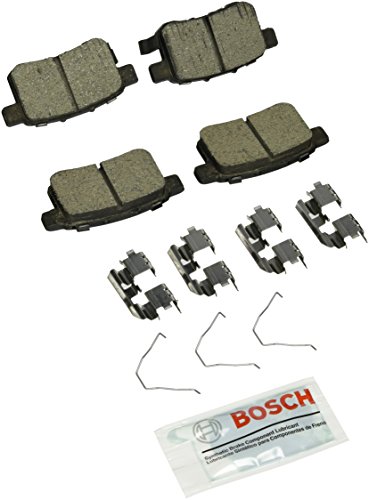
BOSCH BC1451 QuietCast Premium Ceramic Disc Brake
A rear-axle ceramic pad set with pre-attached shims suits select Accord and TSX owners seeking quieter braking.
Top 5 Bosch Brake Pads at a Glance
Start with BC1293 if you need front pads for a listed Toyota Avalon, Toyota Camry, Lexus ES300h, or Lexus ES350. BC1451 is the natural starting point for listed rear brakes on a Honda Accord or Acura TSX, while the other choices cover different rear and front applications across Toyota, Lexus, Subaru, Pontiac, and larger Toyota trucks.
| Product image | Product name | Check product |
|---|---|---|
| 1 |
BOSCH BC1293 QuietCast Premium Ceramic Disc Brake | Check Price |
| 2 |
BOSCH BC1451 QuietCast Premium Ceramic Disc Brake | Check Price |
3 |
BOSCH BC1212 QuietCast Premium Ceramic Disc Brake | Check Price |
4 |
BOSCH BC1324 QuietCast Premium Ceramic Disc Brake | Check Price |
5 |
BOSCH BC1303 QuietCast Premium Ceramic Disc Brake | Check Price |
5 Best Bosch Brake Pads: Detailed Reviews
When I chose the best bosch brake pads, I paid attention to axle position, listed vehicle coverage, ceramic friction material, shim construction, and the included hardware or lubricant. Those details matter because wrong fitment causes wasted work, while pad noise, dust, and rusty backing plates are the annoyances most drivers notice after installation.
The group separates mainly by brake position and vehicle family, not by a completely different braking design. Comparing the part numbers side by side makes the decision simpler: first match the vehicle and axle, then choose the set whose coverage and included pieces fit the repair.
1. BOSCH BC1293 QuietCast Premium Ceramic Disc Brake
Ceramic friction material and multilayer shims support quiet, low-dust stops for select Toyota and Lexus front brakes.
- ColorFront
- SizeBC1293
- Number Of Items1
- Noise[QUIETER STOPS] – The industry’s best pre-attached OE style multilayer rubber core shims ensure the highest qu
Bosch BC1293 is a front-axle ceramic pad set for select Toyota Avalon, Toyota Camry, Lexus ES300h, and Lexus ES350 applications.
Ceramic friction material
The ceramic friction material is the pad compound that presses against the brake rotor to create stopping force. Bosch describes this compound as designed for quiet operation, low dust, and strong friction, which can help keep front wheels cleaner than a dustier pad compound.
That benefit matters most on vehicles where the front wheels collect the most visible brake dust. The Bosch BC1293 front pad set still depends on a healthy rotor and correctly moving caliper, so changing pads alone will not fix a sticking caliper, a deeply grooved rotor, or a warning light.
Multilayer rubber core shims
A shim is a thin layer between the pad backing and caliper hardware that helps manage vibration. Bosch BC1293 uses pre-attached OE-style multilayer rubber core shims, so the pad has a built-in barrier intended to reduce noise and resist corrosion at the bond.
The practical gain is less chance of a sharp squeak caused by pad vibration, though brake noise can also come from worn hardware, poor cleaning, glazed rotors, or incorrect lubrication. Bosch BC1293 includes pads for one axle, meaning two wheels, rather than a complete front-and-rear brake replacement.
Powder-coated backing plate
The backing plate is the metal portion behind the friction material. Bosch BC1293 uses a powder-coated plate intended to resist rust and corrosion, which can help the pad remain sound in wet or salted-road conditions.
The listed slots and chamfers also matter. Slots are channels in the pad face, while chamfers are angled edges, and both can help the pad meet the rotor more smoothly during normal braking.
Pros:
- Ceramic material supports quiet, low-dust braking.
- Pre-attached shims help manage pad vibration.
- Powder-coated backing plate resists rust and corrosion.
- Slots and chamfers support proper pad contact.
- Hardware kit and synthetic lubricant are included where available.
Cons:
- Fitment depends on the exact vehicle trim and engine.
- This set covers one front axle, not all four wheels.
- A pad replacement may also require rotor or hardware service.
Buy it if: you need listed front pads for a Toyota Avalon, Toyota Camry, Lexus ES300h, or Lexus ES350 and want ceramic material with built-in shims.
Skip it if: you need rear pads or drive a vehicle outside the listed applications, because a rear-specific or differently fitted brake pad set would suit you better. For another fit, consider BOSCH BC1451 QuietCast Premium Ceramic Disc or BOSCH BC1212 QuietCast Premium Ceramic Disc.
I’d pick Bosch BC1293 when the fit checker confirms a listed Toyota or Lexus front application. The combination of ceramic material, pre-attached shims, and a coated backing plate addresses the three complaints that send many drivers back to the parts counter: dust, squeal, and visible corrosion. Double-check the front axle, model year, engine, and trim before buying.
Bosch BC1293 is best for a driver replacing front pads on a compatible midsize Toyota or Lexus.
2. BOSCH BC1451 QuietCast Premium Ceramic Disc Brake
A rear-axle ceramic pad set with pre-attached shims suits select Accord and TSX owners seeking quieter braking.
- ColorRear
- SizeBC1451
- Number Of Items1
- Noise[QUIETER STOPS] – The industry’s best pre-attached OE style multilayer rubber core shims ensure the highest qu
Bosch BC1451 is a rear-axle ceramic pad set for select Honda Accord and Acura TSX applications.
Rear-axle fit
The rear axle helps stabilize the vehicle while braking, but rear pads are not interchangeable with front pads simply because both sets are ceramic. Bosch BC1451 is marked for the rear position and has a part number tied to specific Honda and Acura applications.
That distinction prevents one of the most common brake-parts mistakes: ordering by brand alone. Confirm the year and exact vehicle before starting work, because trim and brake package differences can change the pad shape or hardware.
Ceramic compound and low dust
Bosch BC1451 uses ceramic friction material, the working compound that grips the rotor. The listed design aims for strong stopping, quiet operation, and low dust, which can be useful on rear wheels that are difficult to clean around suspension parts.
Low dust does not mean no dust. Rotor condition, driving style, road grit, and caliper movement all affect what you see on the wheel, so a new pad cannot erase every source of brake residue.
Rubber core shims
The pre-attached multilayer rubber core shim sits between the pad backing and caliper contact area. Bosch presents the shim as a way to create a strong bond between rubber and steel while reducing vibration and helping resist corrosion.
BC1451 also includes slots and chamfers for fit and contact, plus a hardware kit and synthetic lubricant where available. Lubricant belongs only on the specified sliding contact points, never on the friction face or rotor.
Pros:
- Rear-specific design suits listed Honda and Acura applications.
- Ceramic compound supports quiet, low-dust braking.
- Pre-attached shims help reduce vibration-related noise.
- Coated backing plate helps resist corrosion.
- One-axle set simplifies a rear-pad replacement.
Cons:
- Only fits selected Honda Accord and Acura TSX applications.
- The set does not replace front pads.
- Hardware availability may vary by package.
Buy it if: you need rear pads for a listed Honda Accord or Acura TSX and want a ceramic set with pre-attached shims.
Skip it if: your brake repair is on the front axle or your vehicle is not listed, because a correctly matched front or vehicle-specific set would suit you better. BOSCH BC1293 QuietCast Premium Ceramic Disc and BOSCH BC1212 QuietCast Premium Ceramic Disc are worth a closer look instead.
What I like about Bosch BC1451 is the clear rear-axle focus. A buyer who confirms the application gets ceramic material, a rubber core shim, and the usual pad-face details without trying to adapt a front set. Check the exact year and brake position carefully, especially on an Accord with more than one brake package.
Bosch BC1451 is the sensible pick for a compatible Honda or Acura rear-brake job.
3. BOSCH BC1212 QuietCast Premium Ceramic Disc Brake
The catalog lists [THE BOSCH ADVANTAGE] – The Bosch QuietCast line draws on over 77 years of OE braking excellence; promising th. Compare fit and care needs before choosing.
- ColorRear
- SizeBC1212
- Number Of Items1
- Noise[QUIETER STOPS] – The industry’s best pre-attached OE style multilayer rubber core shims ensure the highest qu
Bosch BC1212 is a rear-axle ceramic pad set covering selected Lexus, Toyota, and Pontiac applications.
Broad listed vehicle coverage
BC1212 is listed for select Lexus ES300h, Lexus ES350, Lexus HS250h, Pontiac Vibe, Toyota Avalon, Toyota Camry, Toyota Matrix, and Toyota RAV4 vehicles. The wide application range can help owners of older and mixed Toyota-family vehicles, but the long list makes exact fitment especially important.
The rear label is the first filter. A Toyota Camry may use different pads by year, trim, axle, or brake package, so the vehicle name by itself is not enough to guarantee a match.
Ceramic friction material
The ceramic compound is the portion that contacts the rotor during a stop. Bosch describes BC1212 as engineered for stopping power, quiet operation, and low dust, giving daily drivers a sensible balance for commuting and ordinary road use.
The compound works as part of a complete braking system. A rotor with heavy grooves or heat damage can shorten the useful life of fresh rear pads, and a caliper that does not release can keep pressure on the rotor after the pedal is released.
Corrosion-resistant backing
BC1212 uses a powder-coated backing plate intended to help limit rust and corrosion. That matters on rear brakes exposed to road spray, winter salt, and moisture, where untreated metal can become rough around contact points.
Slots and chamfers are also listed for fit and function. They are small details, but correctly shaped pad edges can make contact more predictable than a poorly matched replacement.
Pros:
- Rear position covers many listed Toyota and Lexus vehicles.
- Ceramic material supports lower dust and quieter stops.
- Coated backing plate helps resist rust.
- Pre-attached shims reduce vibration at the pad backing.
- Included lubricant supports specified sliding contact points.
Cons:
- Broad coverage does not remove the need for exact fitment.
- This is a rear set for one axle only.
- Pontiac Vibe and Toyota applications may vary by year.
Buy it if: you need listed rear pads for a Toyota, Lexus, or Pontiac application and want ceramic friction material with corrosion-focused backing protection.
Skip it if: you need front pads or cannot confirm the exact rear application, because a front set or better-matched part number would suit you better. If those trade-offs rule it out, BOSCH BC1293 QuietCast Premium Ceramic Disc or BOSCH BC1451 QuietCast Premium Ceramic Disc may suit you better.
I’d choose Bosch BC1212 for a listed Toyota-family rear application when the fit details line up. The part earns its place through broad coverage without abandoning useful features such as ceramic material, shims, slots, and a coated backing plate. The main hesitation is not the pad design, but the chance of choosing the wrong application from a long vehicle list.
Bosch BC1212 is best for careful buyers handling a compatible Toyota, Lexus, or Pontiac rear brake job.
4. BOSCH BC1324 QuietCast Premium Ceramic Disc Brake
The catalog lists [THE BOSCH ADVANTAGE] – The Bosch QuietCast line draws on over 77 years of OE braking excellence; promising th. Compare fit and care needs before choosing.
- ColorFront
- SizeBC1324
- Number Of Items1
- Noise[QUIETER STOPS] – The industry’s best pre-attached OE style multilayer rubber core shims ensure the highest qu
Bosch BC1324 is a front-axle ceramic pad set for selected Lexus, Toyota, Subaru, and related applications.
Front coverage for SUVs and crossovers
BC1324 is listed for vehicles such as the Lexus NX and RX families, Toyota Highlander, RAV4, Sienna, Camry, Avalon, Crown, and selected electric or hybrid applications. It also lists Subaru Solterra and Toyota bZ4X applications, which makes axle and model-year checking especially important.
Front brakes do much of the work during a normal stop, so the pad must match the caliper and rotor dimensions exactly. A similar-looking pad is not an acceptable substitute for a confirmed fit.
Ceramic stopping material
The ceramic friction material is designed to press evenly against the rotor and create braking friction. Bosch lists the compound for strong stopping with quiet, low-dust operation, a useful combination for family vehicles that spend time in traffic or on errands.
A ceramic pad can still make noise if the hardware is worn, the rotor surface is poor, or the pad is installed without proper cleaning. The pad compound is only one part of the repair.
Pad edges and hardware
BC1324 uses slots and chamfers, which are shaped features on the friction surface and edges. They can help manage contact and fit, while the pre-attached multilayer rubber shim helps reduce vibration between the pad and its support points.
The powder-coated backing plate is intended to resist rust and corrosion. The set includes pads for one axle, with hardware and synthetic lubricant where available, so check the package contents before beginning the job.
Pros:
- Front application covers many listed SUVs and crossovers.
- Ceramic material supports low-dust daily braking.
- Pre-attached shims help limit vibration noise.
- Powder-coated backing plate resists corrosion.
- Slots and chamfers support correct contact and fit.
Cons:
- The long application list requires careful year checking.
- Hybrid and electric applications need especially close verification.
- One set covers one axle, not the complete vehicle.
Buy it if: you need listed front pads for a compatible Lexus, Toyota, Subaru, or related crossover and want ceramic material with a coated backing plate.
Skip it if: you are replacing rear pads or cannot confirm the exact hybrid, electric, or gasoline application, because a more precisely matched axle set would suit you better.
To me, Bosch BC1324 is the useful choice for owners of larger Toyota and Lexus vehicles who want a front set with familiar QuietCast features. The combination of ceramic friction material, shims, slots, chamfers, and coated backing covers the practical details a beginner can understand. Verify the vehicle year and powertrain before ordering, since the application list spans several types.
Bosch BC1324 is best for a confirmed front-brake fit on a listed crossover, SUV, or family vehicle.
5. BOSCH BC1303 QuietCast Premium Ceramic Disc Brake
The catalog lists [THE BOSCH ADVANTAGE] – The Bosch QuietCast line draws on over 77 years of OE braking excellence; promising th. Compare fit and care needs before choosing.
- ColorFront
- SizeBC1303
- Number Of Items1
- Noise[QUIETER STOPS] – The industry’s best pre-attached OE style multilayer rubber core shims ensure the highest qu
Bosch BC1303 is a front-axle ceramic pad set for selected Lexus LX570 and Toyota Land Cruiser, Sequoia, and Tundra applications.
Heavy-vehicle application
BC1303 is aimed at larger Lexus and Toyota vehicles, including the LX570, Land Cruiser, Sequoia, and Tundra in listed years. Those vehicles can carry more weight than a small sedan, making correct pad and rotor matching especially important.
The front label matters because BC1303 is not a complete vehicle set. A buyer replacing all four corners needs a confirmed rear part separately, while a front-only repair needs this set to match the actual caliper.
Ceramic friction material
The ceramic friction material is the working surface that presses into the rotor. Bosch lists BC1303 for strong stopping, quiet operation, and low dust, which can help keep large front wheels cleaner during normal driving.
The pad cannot compensate for worn rotors, a sticking caliper, or a brake system that needs bleeding. If the pedal feels soft or the vehicle pulls during braking, a broader inspection is needed instead of a pad-only order.
Corrosion protection and fit details
BC1303 uses a powder-coated backing plate to help resist rust and corrosion. Slots and chamfers are included to support fit and function, while a pre-attached rubber core shim is intended to reduce vibration between the backing plate and caliper hardware.
The package includes pads for one axle, plus hardware and synthetic lubricant where available. The lubricant should be used only at specified sliding contact points, because contamination on the rotor or friction surface can reduce braking performance.
Pros:
- Front fitment covers listed Toyota and Lexus trucks.
- Ceramic compound supports quiet, low-dust stops.
- Coated backing plate helps resist road corrosion.
- Pre-attached shim helps control vibration.
- Slots and chamfers support pad contact and fit.
Cons:
- Exact truck year and trim still determine fitment.
- Front-axle set does not include rear pads.
- A pad change may expose worn truck rotors or hardware.
Buy it if: you need front pads for a listed Lexus LX570, Toyota Land Cruiser, Sequoia, or Tundra and want a ceramic set with corrosion protection.
Skip it if: you drive a smaller vehicle or need rear pads, because a vehicle-specific rear or lighter-application set would suit you better.
I’d place Bosch BC1303 last only because its fit is narrower, not because the listed construction is missing useful details. The pad has the same practical QuietCast themes, including ceramic material, shims, chamfers, slots, and a coated backing plate, but large-truck owners must inspect the rest of the brake system carefully. Check the exact axle, year, and trim before ordering.
Bosch BC1303 is the right direction for a confirmed front fit on a listed Toyota or Lexus truck.
How to Choose the Best Bosch Brake Pads
The best bosch brake pads are the set that matches your vehicle, axle, and brake package before material or noise claims enter the discussion. Use the vehicle fit tool, compare the part number, and confirm whether the repair is front or rear.
Confirm the axle position
Front and rear pads have different shapes and work with different calipers. Look for front or rear markings in the part details, then compare that position with the wheel you are repairing.
A front pad is right only when the vehicle application and front axle agree. A rear pad is right only when both the vehicle application and rear position agree, even if the brand and ceramic compound are the same.
Match the exact vehicle
Vehicle names are not enough because one year can have more than one engine, trim, brake package, or hybrid system. Use the full year, make, model, engine or powertrain, and trim when available.
The listed applications vary widely, from Honda Accord and Acura TSX to Lexus SUVs and Toyota trucks. If the fit tool gives a conflict, pause before ordering rather than hoping a similar-looking pad will fit.
Decide if ceramic suits the job
Ceramic brake pads use a ceramic-based friction compound that is commonly chosen for quiet operation and lower visible dust. That makes ceramic a sensible starting point for daily drivers, family vehicles, and buyers who dislike dark wheel residue.
Ceramic does not mean every stop will be silent or every wheel will stay clean. Rotor condition, caliper hardware, bedding, weather, and driving habits still affect the result.
Inspect the shim and backing plate
A shim sits behind the friction material and helps reduce vibration. Pre-attached shims can simplify installation because the noise-control layer is already fitted to the pad, though the caliper hardware still needs inspection.
A coated backing plate helps protect the metal from rust. Look for a pad with a backing plate that matches the old shape and sits correctly in the caliper bracket without forcing or bending.
Check what the set includes
A brake pad set normally covers one axle, meaning two wheels. Confirm whether hardware and lubricant are included, since package contents can vary and old clips may be too rusty to reuse.
Do not assume one box replaces all four corners. A complete brake job may need two axle-specific sets, and the rear set may have a different part number from the front set on the same vehicle.
Consider rotor and caliper condition
New pads need a usable rotor surface and a caliper that moves correctly. Deep grooves, blue heat marks, a lip at the rotor edge, uneven pad wear, or a vehicle pulling to one side are signs to inspect more than the pad alone.
A fresh pad cannot correct a seized slide pin or a leaking caliper. Buyers handling a larger truck or SUV should be especially careful because heavier vehicles put more demand on the complete braking system.
Brake material also differs across brands, so a comparison with PowerStop brake pads can help clarify whether the preferred priority is ceramic quietness, towing use, or another friction approach. A separate look at Wagner brake pad types is useful when you are weighing noise-control designs against severe-duty applications.
How to Use Bosch Brake Pads for the Best Results
Use new brake pads with clean contact surfaces, correctly placed lubricant, and a careful bedding period. Rushing the first few stops can create heat and uneven deposits before the pad has settled against the rotor.
- Park on a level surface and secure the vehicle with the correct support equipment.
- Confirm the new pad shape and axle position against the old parts before removing everything.
- Inspect the rotor for deep grooves, cracks, heavy rust, or blue heat marks.
- Clean the caliper bracket and pad contact points without spreading grease onto the rotor.
- Apply the supplied synthetic lubricant only where the instructions or hardware design calls for sliding contact.
- Install the pad and hardware without forcing a part that does not sit naturally.
- Reassemble the wheel, tighten fasteners to the vehicle maker’s specification, and pump the brake pedal before moving.
- Perform gentle stops in a safe area, then follow a gradual bedding process appropriate for the vehicle and brake parts.
Bedding means making a series of controlled stops so the pad and rotor develop an even contact layer. Avoid holding the brake pedal firmly while stopped immediately after repeated hard braking, since concentrated heat can create uneven deposits.
If the pedal remains soft, the vehicle pulls, the wheel becomes unusually hot, or the brake warning light appears, stop driving and arrange an inspection. Noise alone can have several causes, but heat, pulling, and a soft pedal deserve prompt attention.
How to Make Your Bosch Brake Pads Last Longer
Brake pads last longer when the caliper releases fully, the rotor remains in usable condition, and the driver avoids unnecessary hard stops. Good maintenance also prevents a small pad problem from damaging a more expensive rotor.
Keep the brake area free from contamination during service. Grease, anti-seize, cleaner residue, and oily fingerprints do not belong on the friction face or rotor surface.
Inspect pad thickness during routine tire rotations or brake checks. The exact replacement point depends on the vehicle maker’s guidance and the condition of the entire system, so do not rely only on a dashboard light.
Watch for uneven wear from inside to outside or left to right. Uneven wear can point to seized slide pins, a sticking piston, damaged hardware, or a hose problem, and replacing pads without correcting the cause may repeat the repair.
Avoid riding the brake pedal downhill. Select an appropriate lower gear when the vehicle and road allow it, leave extra following distance, and use smooth pressure instead of repeated last-second braking.
Wash heavy road salt and grime from the wheel area when practical, while avoiding aggressive water aimed directly at hot brakes. After washing, gentle driving and normal braking help dry the rotors.
Store unused pads in a dry place in their original packaging. Keep friction faces away from oil, coolant, brake fluid, and loose metal debris, because contamination can make a new pad unsafe to install.
For another ceramic-focused comparison, Akebono brake pad options can help explain how low-dust and quiet-stopping priorities are handled across different brands. The useful lesson is simple: material claims matter only after fitment and brake-system condition are confirmed.
Common Mistakes to Avoid When Buying and Using Bosch Brake Pads
Most brake-pad problems start with a fitment shortcut or an installation detail that gets overlooked. These mistakes are easy to avoid with a short check before ordering and another before the first drive.
- Ordering by vehicle name only: Different trims and years may use different pads. Match the complete application and part number.
- Confusing front and rear pads: Axle positions are not interchangeable. Confirm the wheel position before opening the box.
- Assuming one set covers four wheels: Most sets cover one axle. Check whether the repair needs one set or two.
- Reusing rusty hardware automatically: Corroded clips can limit pad movement. Inspect the hardware and replace it when the brake design calls for replacement.
- Putting lubricant on the friction face: Grease on the pad or rotor can reduce braking. Lubricate only the specified sliding contact points.
- Skipping rotor inspection: Worn or heat-damaged rotors can create noise and uneven wear. Measure or inspect them according to the vehicle service guidance.
- Driving hard immediately after installation: Fresh pads need controlled bedding. Use gentle, progressive stops in a safe area before normal driving.
A related mistake is treating a quiet pad as a cure for every brake sound. Squealing can come from hardware, rotor deposits, caliper movement, dust, or installation errors, so listen to the symptom and inspect the whole corner.
How to Set Up Bosch Brake Pads
Brake-pad setup is not complicated in concept, but safe support, clean contact points, and correct piston movement matter. If you do not have the right lifting equipment or cannot verify the brake procedure for your vehicle, use a qualified repair shop.
- Confirm the parts: Match the part number, axle label, pad shape, and vehicle application before lifting the vehicle.
- Secure the vehicle: Park on level ground, use the parking brake as appropriate, chock the wheels, and support the vehicle with equipment rated for its weight.
- Remove the wheel and inspect: Look at the rotor, caliper, slide pins, hose, and old pad wear before taking the old pads out.
- Prepare the bracket: Remove rust and debris from pad contact points, taking care not to damage rubber boots or spread dust.
- Retract the piston correctly: Use the vehicle’s required method, especially if the rear brake includes a parking-brake mechanism that must be wound or placed in a service position.
- Fit the new pads: Install each Bosch pad in the correct direction and position, and confirm that the pad can move in the bracket without binding.
- Lubricate only contact points: Use the included synthetic lubricant where specified, keeping the rotor and friction surfaces completely clean.
- Finish and check: Reinstall the wheel, tighten fasteners to the vehicle specification, pump the pedal, check the fluid level, and perform a cautious test stop.
The most common stumbling point is piston retraction. A piston that is forced the wrong way can damage the caliper or parking-brake mechanism, so check the vehicle-specific procedure before applying pressure.
Common Questions About Bosch Brake Pads
Are Bosch ceramic brake pads good for daily driving?
Bosch ceramic brake pads are suited to daily driving when the part matches the vehicle and axle. The listed QuietCast pads use ceramic friction material aimed at quiet, low-dust operation, but rotor condition, caliper movement, road conditions, and bedding still affect real-world braking.
Do Bosch brake pad sets include all four wheels?
No, the listed Bosch sets cover one axle, or two wheels. A front set does not replace rear pads, and a rear set does not replace front pads, so check the package position and determine whether your repair involves one axle or both.
How do I know which Bosch pad fits my car?
Use the complete vehicle details, including year, make, model, engine or powertrain, trim, and front or rear position. The cataloged applications include multiple versions of Toyota, Lexus, Honda, Acura, Pontiac, Subaru, and related vehicles, so the model name alone is not enough.
Can new Bosch pads stop brake squeal?
New Bosch pads may reduce noise when the ceramic material, pre-attached shim, hardware, rotor, and caliper are all in good condition. Squeal can still come from worn clips, a rough rotor, contamination, poor bedding, or a caliper that does not move freely.
Should I replace rotors with Bosch brake pads?
Replace or service rotors when inspection shows damage, excessive wear, deep grooves, heat marks, or a surface that cannot meet the vehicle’s requirements. Pads can be installed with usable rotors, but new friction material will not correct a damaged or badly uneven rotor.
How long should Bosch brake pads last?
There is no single safe mileage promise because traffic, vehicle weight, terrain, towing, braking habits, and caliper condition change pad wear. Check thickness and wear pattern during routine service, and investigate uneven wear or warning signs instead of waiting for a fixed mileage number.
Make the Fitment Check Before You Buy
The next step is simple: write down the vehicle year, make, model, engine or powertrain, trim, and axle position, then confirm the Bosch part number against those details. If the application does not match exactly, pause the order and have the brake corner inspected rather than trying to make a similar pad work.