How Do Rear Brake Calipers Work: Key Facts and Helpful Guidance
Rear brake calipers convert hydraulic pressure into the clamping force that slows a vehicle. When you press the brake pedal, brake fluid pushes a caliper piston against the brake pads, forcing them against the spinning rear rotor.
If you are asking how do rear brake calipers work, the short answer is that they use fluid pressure, pistons, and friction material to create controlled resistance at the rear wheels. The design may also include a mechanical or electronic parking-brake mechanism.
How Rear Brake Calipers Work
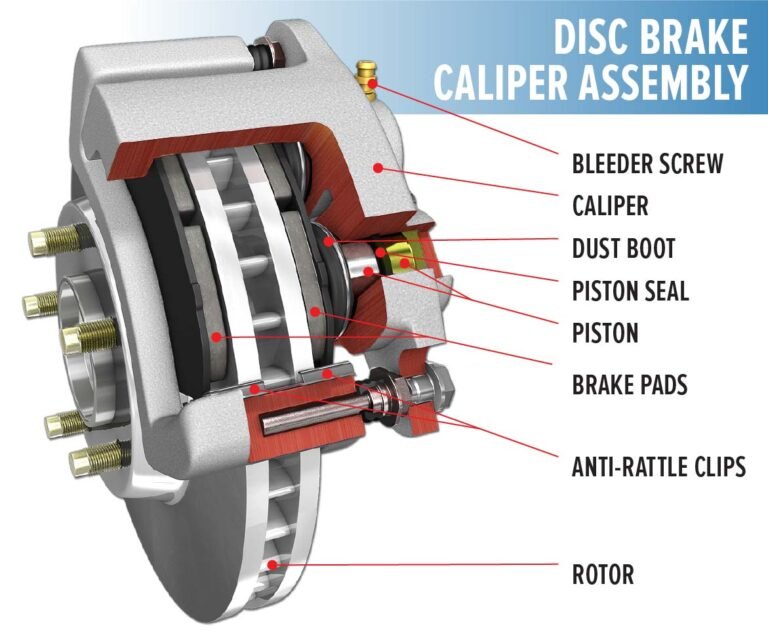
A rear disc-brake system typically includes a brake pedal, master cylinder, hydraulic lines, a caliper, brake pads, and a rotor attached to the wheel hub. Each part has a specific role, but the caliper is the component that applies the pads to the rotor.
- You press the brake pedal.
- The master cylinder creates hydraulic pressure in the brake fluid.
- That pressure travels through the brake lines to the rear caliper.
- Fluid pressure moves the caliper piston outward.
- The piston pushes one brake pad against the rotor.
- The caliper body or additional pistons apply the other pad.
- Friction between the pads and rotor slows the wheel.
The rotor turns with the wheel, while the caliper is mounted to the vehicle and remains stationary. When the pads clamp the rotor, the resulting friction changes the vehicle’s motion into heat. The heat must then move through the pads, rotor, and surrounding air.
Main Caliper Components
Caliper body
The caliper body is a strong metal housing that holds the piston, seals, brake pads, and mounting hardware. It sits over the edge of the rotor so the pads can contact both sides of the disc.
Piston and bore
The piston fits inside a machined bore in the caliper. Pressurized brake fluid acts on the piston’s rear surface. As the piston moves, it transfers force to the inner brake pad.
Most rear calipers use one piston, although some vehicles use multiple pistons. More pistons do not automatically mean better braking; piston size, pad design, rotor dimensions, hydraulic balance, and the vehicle’s overall brake system also matter.
Square-cut seal
A hydraulic seal around the piston prevents brake fluid from escaping. It also helps the piston retract slightly after the pedal is released. This small amount of movement creates running clearance between the pad and rotor without pulling the piston completely back into the caliper.
Brake pads
The pads contain friction material that contacts the rotor. The backing plates support that material and transfer caliper force across the pad. The inner and outer pads must move correctly in their guides so they can apply and release evenly.
Slide pins or mounting points
A floating caliper moves on slide pins or another guiding arrangement. These guides allow the caliper to shift laterally as the piston pushes the inner pad, bringing the outer pad against the opposite side of the rotor.
Floating and Fixed Rear Calipers
Floating calipers
A floating, or sliding, caliper has a piston on one side of the rotor. When hydraulic pressure pushes the piston and inner pad outward, the caliper body reacts in the opposite direction. That movement pulls the outer pad into the rotor.
This design is common because it is compact, relatively simple, and effective for many passenger vehicles. Its operation depends on clean, properly lubricated slide pins and free-moving pad hardware. If a slide pin binds, one pad may wear faster than the other.
Fixed calipers
A fixed caliper does not slide across the rotor. Instead, it uses pistons on both sides of the rotor. Hydraulic pressure moves the opposing pistons outward at the same time, pressing both pads against the disc.
Fixed calipers can provide consistent pad movement, but they require more precise components and may cost more to manufacture or service. The basic braking principle remains the same: hydraulic pressure creates pad force, and pad-to-rotor friction slows the wheel.
What Happens When You Release the Pedal?
When you release the brake pedal, hydraulic pressure drops. The piston seal returns slightly toward its relaxed position, and the pads move away from the rotor by a very small distance. The rotor can then turn with minimal drag.
The pads do not normally retract a large distance. They remain close to the rotor so the brakes respond quickly the next time the pedal is pressed. A slight amount of noise or very light contact can occur, but continuous heavy rubbing indicates a problem.
A caliper may fail to release fully if the piston is corroded, the seal is damaged, the brake hose has an internal restriction, or the slide pins and pad guides are seized. Any of these conditions can create heat, uneven wear, pulling, or reduced fuel economy.
How the Rear Parking Brake Works
Many rear calipers include the parking-brake mechanism because the rear brakes must hold the vehicle when it is parked. The exact design depends on the vehicle.
Mechanical caliper mechanism
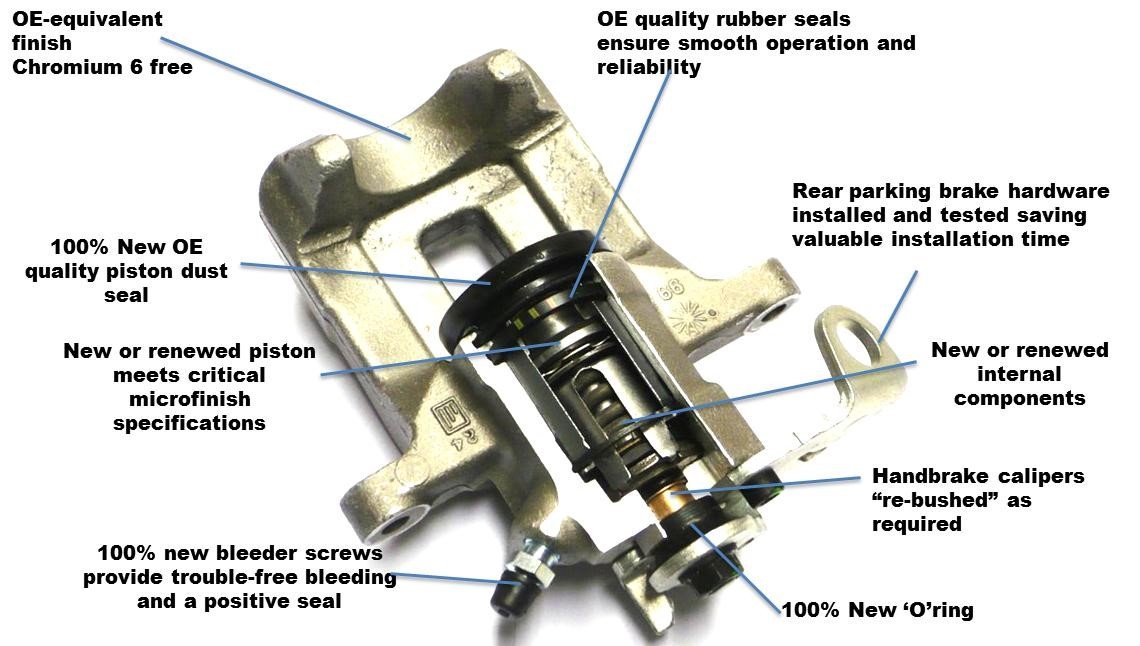
In a mechanical system, a parking-brake cable pulls a lever on the rear caliper. The lever turns a screw, cam, or similar mechanism that moves the piston or applies the pads. Releasing the cable allows the mechanism to return, although the caliper’s internal parts must remain free to move.
This arrangement combines normal hydraulic braking and parking-brake operation in one caliper. A worn or seized mechanism can cause rear brake drag even when the hydraulic system is working normally.
Electronic parking brake
With an electronic parking brake, an electric motor applies the rear brake. The motor may be mounted directly on the caliper or connected to an actuator mechanism. Vehicle control modules manage application and release based on switch input and operating conditions.
Electronic systems can require a service or maintenance mode before the rear piston is retracted for pad replacement. The correct procedure varies by vehicle. Forcing the piston or disconnecting parts without following the manufacturer’s instructions can damage the actuator.
How ABS Affects Rear Calipers
The anti-lock braking system does not replace the caliper. It controls hydraulic pressure to help prevent a wheel from locking during hard braking. Wheel-speed sensors monitor rotation, and the ABS control unit can reduce or restore pressure at an individual wheel.
During normal braking, the caliper receives pressure through the vehicle’s hydraulic system. During ABS operation, the system rapidly adjusts that pressure. The caliper responds to those changes by increasing or reducing the force on the pads.
Electronic stability control may also adjust brake pressure at individual wheels. These systems help manage traction and vehicle direction, but they cannot correct a mechanically seized caliper, badly worn pad, damaged rotor, or leaking hydraulic component.
Why Rear Brakes Behave Differently
Rear brakes generally perform a different share of the stopping work than front brakes. When a vehicle slows, weight transfers toward the front, increasing the front tires’ available grip. Rear brake force is therefore controlled to help prevent the rear wheels from locking too easily.
That does not make rear calipers unimportant. They help stabilize the vehicle, contribute to total stopping power, and operate the parking brake on many vehicles. Rear brake hardware may be smaller than the front system, but it still must apply and release smoothly.
The rear caliper must also work with the vehicle’s brake-bias strategy. Proportioning functions, ABS controls, tire grip, loading, and electronic stability systems can all affect how much braking force reaches the rear wheels.
Signs of a Rear Caliper Problem
A faulty rear caliper can cause several noticeable symptoms. The symptoms depend on whether the caliper is failing to apply, failing to release, leaking, or applying unevenly.
- Uneven pad wear: One rear pad is much thinner than the other, often indicating a seized slide pin, restricted movement, or a piston problem.
- Vehicle pulling: The vehicle may pull during braking if one side produces more braking force than the other.
- Brake drag: A stuck piston, seized guide, or parking-brake mechanism may keep a pad against the rotor.
- Excessive heat: One rear wheel may be noticeably hotter than the other after normal driving. Do not touch a suspected hot brake component.
- Brake fluid leakage: Wetness around the caliper, piston, hose connection, or bleeder can reduce hydraulic pressure and create a safety risk.
- Grinding or constant scraping: This can occur when friction material is exhausted or a component is not releasing correctly.
- Soft or sinking pedal: Air, fluid loss, or another hydraulic fault can prevent the caliper from receiving and maintaining proper pressure.
- Parking-brake trouble: The parking brake may not hold, release fully, or operate evenly if the caliper mechanism or actuator has a fault.
Some brake noises are caused by pad movement or surface conditions rather than a failed caliper. However, noise combined with heat, pulling, fluid loss, or uneven wear should be inspected promptly.
Basic Inspection and Service Cautions
A visual inspection can reveal a damaged dust boot, leaking fluid, severely worn pad, corroded hardware, or a brake hose problem. Comparing the left and right rear brakes can also reveal uneven pad wear or unusual rotor discoloration.
Brake repairs should be performed with the vehicle securely supported and with the correct tools. Never rely on a jack alone. Brake dust should not be blown into the air, and brake fluid should not contact painted surfaces for longer than necessary.
Before replacing rear pads, identify whether the caliper piston pushes straight in or must be rotated as part of the parking-brake mechanism. An electronic parking brake may need to be placed in service mode first. The vehicle’s repair information should determine the correct method.
After hydraulic work, the brake system may need bleeding to remove air. The correct fluid type, bleeding sequence, torque specifications, piston procedure, and parking-brake adjustment depend on the vehicle. A brake pedal that remains soft after service is not normal and requires further diagnosis before driving.
If a caliper is leaking, severely corroded, seized, or damaged, replacing or professionally rebuilding it is generally safer than continuing to drive. Brake components should be evaluated as a system because a caliper fault may also damage the pads, rotor, hose, or parking-brake hardware.
Conclusion
Understanding how do rear brake calipers work comes down to following the force path: the pedal creates hydraulic pressure, the pressure moves the caliper piston, and the piston applies the pads to the rotor. Floating calipers move their housing, fixed calipers use opposing pistons, and rear designs may add a mechanical or electronic parking-brake mechanism. Smooth pad movement, clean hydraulic pressure, and proper release are essential for safe, even braking.