Do You Need to Use Your Emergency Brake When Parking? Key Reasons
Yes, you should use your emergency brake whenever you park, even on flat ground. The emergency brake, also called the parking brake, helps prevent your vehicle from rolling and provides an additional means of securing it. On automatic vehicles, it also reduces the load placed on the transmission’s parking mechanism. On manual vehicles, it helps keep the car stationary alongside the selected gear.
Many drivers only use the emergency brake when parking on a steep hill. Others assume shifting an automatic transmission into Park is enough to secure the vehicle. Although the Park position normally holds a stationary vehicle, relying on it alone isn’t the preferred parking practice.
Using the parking brake regularly is a simple safety habit, but the correct procedure depends on your transmission, parking conditions, and brake design. Vehicles with electronic parking brakes may even apply them automatically.
This guide explains why the emergency brake matters, when to use it, how it works with automatic and manual transmissions, and what precautions to take on hills, flat surfaces, and freezing days.
Do You Need to Use Your Emergency Brake When Parking Every Time?
Using the emergency brake every time you park is the recommended practice for most passenger vehicles. It provides a dedicated holding mechanism instead of relying entirely on the transmission or engine to prevent movement.
The recommendation applies to ordinary parking situations, including:
- Flat driveways and residential streets
- Shopping center parking lots
- Parking garages
- Sloped roads and driveways
- Parallel parking spaces
- Long-term vehicle storage, subject to manufacturer guidance
Even a parking area that appears level may have a slight slope for water drainage. A parked vehicle can also move unexpectedly if the transmission isn’t fully engaged or another holding component fails.
Using the emergency brake doesn’t mean you can ignore the transmission. Automatic vehicles should still be placed in Park, while manual vehicles should be left in the gear recommended by the manufacturer.
The parking brake is an additional safeguard, not a replacement for proper gear selection.
Why Using the Emergency Brake Is Better Than Relying on Park Alone
Automatic transmissions commonly use a mechanical device called a parking pawl to prevent the transmission’s output mechanism from rotating when Park is selected.
When the driver shifts into P, the pawl engages a corresponding part of the transmission. If the vehicle moves slightly after the service brake is released, the pawl may take the load holding the vehicle stationary.
On level ground, this mechanism usually holds the car without difficulty. However, on a slope, the load can become more noticeable.
The AAA Club Alliance guide to using your emergency brake recommends applying the parking brake whenever you park, including on flat surfaces, to reduce unnecessary stress on the transmission’s parking pawl.
Reduces Pressure on the Transmission Parking Pawl
When the parking brake holds the wheels, it can reduce the force transmitted through the parking pawl after the service brake is released.
This is especially helpful on an incline, where the vehicle’s weight tends to pull it downhill.
If you notice a noticeable clunk or resistance when shifting out of Park on a slope, the transmission may have been holding substantial load against the pawl.
Using the parking brake before allowing the vehicle to settle can reduce that loading.
Provides Additional Protection Against Rolling
The parking brake holds the vehicle through its braking components, independently of the automatic transmission’s parking mechanism on most conventional designs.
If the transmission isn’t properly engaged, a functioning parking brake provides another means of resisting movement.
Neither system guarantees that a vehicle can never roll. Correct gear selection, sufficient brake-holding force, and proper wheel positioning all matter.
How to Use the Emergency Brake When Parking an Automatic Car
For most conventional automatic vehicles, the goal is to engage the parking brake before releasing the service brake so the vehicle doesn’t settle against the parking pawl.
Follow this sequence unless your owner’s manual specifies another procedure.
- Stop the vehicle completely. Keep your right foot firmly on the service brake pedal.
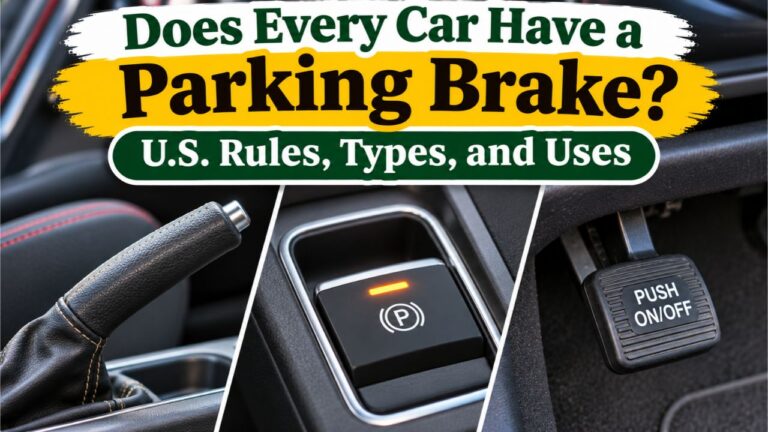
- Apply the parking brake. Pull the handbrake lever, press the parking brake pedal, or operate the electronic switch as specified. Confirm it is fully engaged.
- Shift the transmission into Park. With your foot still on the service brake, move the gear selector to P.
- Release the service brake carefully. Make sure the vehicle remains stationary. Turn off the engine or power system and confirm the vehicle is secured.
Some manufacturers specify selecting Park before applying the parking brake. That order is also appropriate when you keep the service brake depressed until both systems are engaged.
The important principle is to avoid letting the vehicle roll against the parking pawl before the parking brake takes the load.
Vehicles with automatic electronic parking brakes may handle part of this process themselves. Follow their displayed instructions and verify that the brake is applied before leaving.
Should You Use the Emergency Brake With a Manual Transmission?
Yes. Using the parking brake is especially important with a manual transmission because manual vehicles generally don’t have the same Park position found in conventional automatic transmissions.
Instead, the driver selects a gear to help resist vehicle movement after the engine is turned off.
A reliable parking procedure includes applying the service brake, engaging the parking brake fully, turning off the engine, and leaving the transmission in the recommended gear.
Some manufacturers specify first gear for uphill parking and reverse for downhill parking. Others provide different guidance depending on vehicle design.
For example, Ford’s official parking brake instructions describe applying the parking brake and leaving the manual transmission in the specified gear.
Never leave a manual-transmission vehicle in Neutral and depend on the parking brake alone during ordinary parking.
Using both the parking brake and the correct gear offers better protection against unintended rolling.
Do You Need the Emergency Brake When Parking on a Hill?
Yes. The parking brake is particularly important on a hill because gravity continuously acts on the vehicle.
Whether you drive an automatic or manual vehicle, use the parking brake and the appropriate transmission position.
You should also turn the front wheels so that the vehicle is directed away from moving traffic or restrained by the curb if the parking system fails.
The California DMV’s parking-on-a-hill instructions explain the proper combination of parking brake application, gear selection, and wheel positioning.
Parking Uphill With a Curb
Turn the front wheels away from the curb.
If the vehicle begins rolling backward, the front tire should contact the curb and help limit further movement.
Keep your foot on the brake while applying the parking brake and selecting the appropriate gear.
Do not deliberately roll the vehicle forcefully into the curb.
Parking Downhill With a Curb
Turn the front wheels toward the curb.
If the parking system fails and the car moves forward, the wheel should contact the curb rather than allowing the vehicle to continue directly downhill.
Apply the parking brake fully and leave an automatic transmission in Park or a manual transmission in the manufacturer’s specified gear.
Parking on a Hill Without a Curb
When parking on the right side of a road without a curb, turn the front wheels toward the roadside or shoulder so that an unintended roll would direct the vehicle away from the traffic lane.
Apply the parking brake and use the appropriate gear.
For particularly steep slopes or special parking situations, suitable wheel chocks may provide additional security.
Is It Necessary to Use the Emergency Brake on Flat Ground?
Yes, using it on flat ground is still a good habit.
A level driveway or parking lot generally places less rolling force on the transmission than a steep hill. However, the parking brake still provides another holding mechanism and helps establish a consistent parking routine.
One practical advantage is that you don’t have to judge whether a surface has enough slope to justify using the brake.
Many parking lots have small gradients that are difficult to notice from the driver’s seat.
The parking brake may not carry a significant load on a truly level surface, but regular use helps ensure you don’t forget it when parking somewhere steeper.
There is usually no reason to avoid a properly functioning parking brake during ordinary parking simply because the ground looks flat.
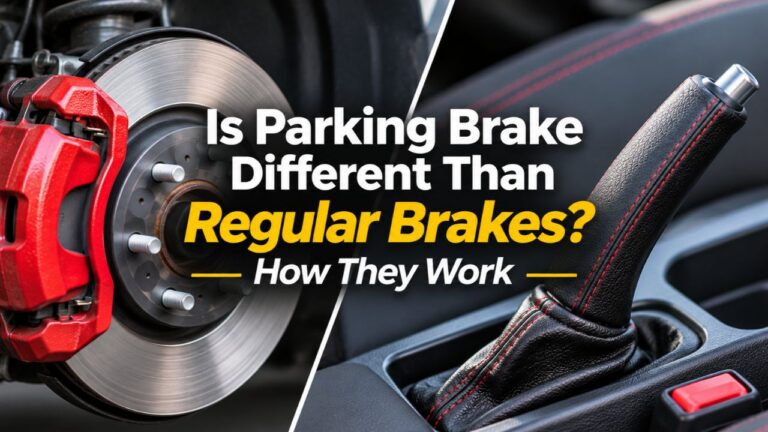
Emergency Brake vs. Parking Brake: Are They Different?
In most everyday automotive discussions, emergency brake and parking brake refer to the same vehicle system.
The names emphasize different uses. Parking brake describes its main purpose of holding a stationary vehicle, while emergency brake reflects its potential use as a backup braking method if the normal service brakes fail.
| Brake System | Main Purpose | Typical Operation |
| Service brake | Slow and stop the moving vehicle | Regular brake pedal |
| Parking or emergency brake | Keep the parked vehicle stationary | Hand lever, foot pedal, or electronic switch |
| Automatic Brake Hold | Temporarily hold the vehicle during a stop | Electronic brake control |
The parking brake commonly acts on the rear wheels, although its mechanical design varies.
Some systems use cables, while electronic parking brakes use electric actuators. Neither should be confused with the ordinary service brake pedal.
Although emergency braking may be possible with certain systems, the correct emergency-use procedure depends on the vehicle and should not be improvised.
What If Your Car Has an Electronic Parking Brake?
An electronic parking brake (EPB) replaces the traditional hand lever or parking brake pedal with an electrically operated mechanism.
The driver commonly applies it by pulling a small switch marked with a parking brake symbol.
Some vehicles automatically engage the EPB when the driver shifts into Park or switches off the power system.
Others require manual application unless a specific automatic mode is enabled.
Before leaving the vehicle, check the instrument panel for the parking brake indicator or appropriate confirmation message.
Do not assume the EPB has engaged simply because the vehicle is in Park.
Electronic parking brake systems may also have automatic release functions that operate when certain conditions are met, such as selecting a driving gear and pressing the accelerator.
The exact behavior varies by manufacturer, model, and operating mode.
Does Using the Emergency Brake Every Day Wear It Out?
Normal, proper use is what the parking brake is designed for. Applying it every time you park should not cause unusual wear in a properly maintained system.
A mechanical parking brake uses cables, levers, or other components that experience movement when the brake is applied and released.
An electronic system uses actuators designed for repeated operation.
However, regular use doesn’t eliminate maintenance needs.
Parking brake cables can corrode, adjustment mechanisms can wear, and electronic actuators can develop faults.
The holding components may also require inspection or adjustment as part of ordinary brake maintenance.
If the brake feels unusually loose, requires excessive travel, or fails to hold the vehicle, have it inspected.
Do not keep pulling harder on a damaged lever or repeatedly operating a malfunctioning electronic switch.
When Should You Be Cautious About Using the Emergency Brake?
There are a few situations where special precautions are necessary.
Parking in Freezing Weather
Moisture around parking brake cables, linkages, or friction surfaces can sometimes freeze.
This is more likely when components are wet and temperatures drop below freezing.
A frozen parking brake may remain engaged even after the driver releases the control.
Follow the owner’s manual for cold-weather parking recommendations. Some manufacturers specify alternative precautions under particular freezing conditions.
If the parking brake is frozen, do not force the vehicle to move against it. Use an appropriate thawing or repair procedure.
Parking for an Extended Period
Vehicles stored for weeks or months can develop corrosion around brake components.
In some storage conditions, parking brake shoes or pads may stick to their contact surfaces.
Long-term storage instructions may recommend wheel chocks and alternative means of securing the vehicle, depending on the model and environment.
Follow the manufacturer’s storage guidance rather than applying a universal rule.
Parking Brake Malfunctions
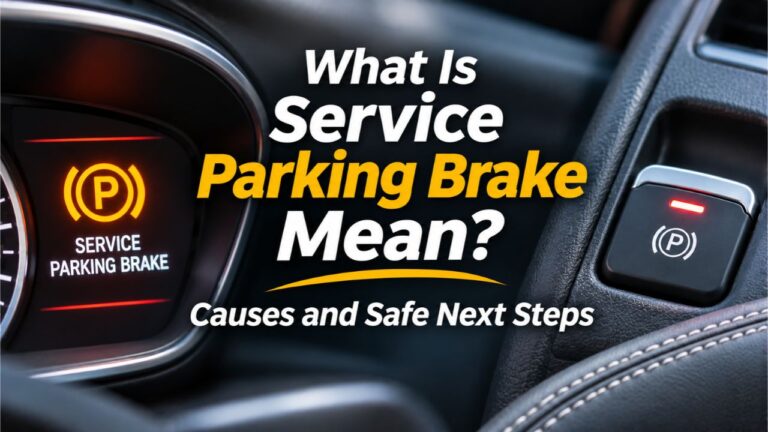
If the parking brake doesn’t hold, doesn’t release, or displays a warning, it needs attention.
A defective parking brake should not be relied upon to secure the vehicle on a slope.
Park only where the vehicle can be secured safely, use appropriate precautions, and arrange repairs.
Do not substitute a failed parking brake with improvised objects or depend on the transmission alone in a hazardous parking location.
What Happens If You Forget to Use the Emergency Brake?
On a conventional automatic vehicle, the Park position will normally hold the car when properly engaged.
Forgetting the parking brake once on level ground doesn’t mean immediate transmission damage will occur.
However, repeatedly relying only on Park can place unnecessary holding loads on the parking mechanism, especially on hills.
On a manual vehicle, leaving the transmission in gear may resist rolling, but engine compression and drivetrain resistance are not substitutes for a functioning parking brake.
If the vehicle is parked on an incline without the parking brake, unexpected movement becomes a greater concern.
The safest approach is to return to the vehicle and apply the parking brake if you discover that it was forgotten and the vehicle can be approached safely.
How to Know Whether Your Emergency Brake Is Working
A properly functioning parking brake should engage fully, hold the stationary vehicle under the conditions specified by the manufacturer, and release completely.
Signs that the system may need service include:
- Excessive handbrake lever travel
- Parking brake pedal that feels unusually loose
- Electronic parking brake malfunction messages
- Vehicle movement despite full parking brake application
- Grinding or abnormal noises during engagement
- Brake dragging after the parking brake is released
A parking brake that holds on level ground may still be unable to hold the vehicle on a slope if it is worn or incorrectly adjusted.
Have the brake inspected if performance is questionable.
Do not perform a risky hill-holding experiment to diagnose a suspected failure. Proper inspection and manufacturer-specified testing are safer.
FAQs About Do You Need to Use Your Emergency Brake When Parking
Is It Bad to Park Without the Emergency Brake?
Parking without it isn’t guaranteed to cause immediate damage, especially on level ground. However, using the parking brake provides additional protection against rolling and can reduce load on an automatic transmission’s parking pawl.
Should You Apply the Emergency Brake Before Putting the Car in Park?
For many conventional automatic vehicles, applying the parking brake before shifting into Park is a useful practice. The key is to keep the service brake depressed until both are engaged. Follow the manufacturer’s required sequence.
Do You Need the Emergency Brake in a Parking Garage?
Yes. Parking garages may have slight slopes even when the surface appears flat. Using the parking brake helps secure the vehicle, particularly on ramps or inclined parking levels.
Can the Parking Brake Damage Your Transmission?
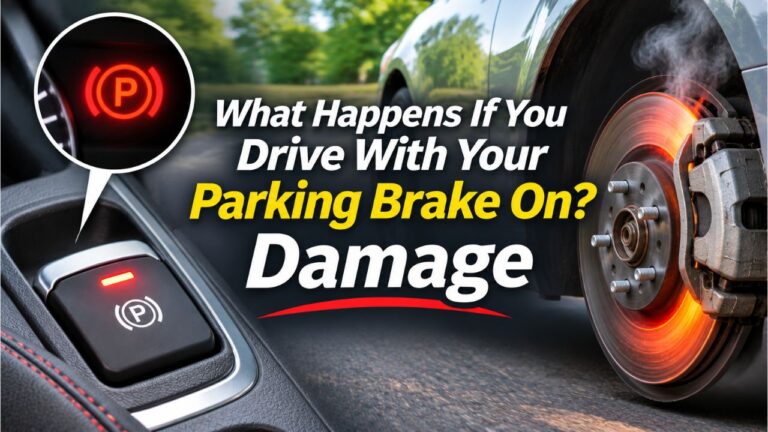
Proper parking brake use does not normally damage the transmission. It can reduce the load placed on the parking pawl. Problems are more likely if the brake is left engaged while driving or if the system is defective.
Will an Electronic Parking Brake Apply Automatically?
Some vehicles apply the electronic parking brake automatically when shifted into Park or switched off. Others require the driver to operate a switch. Check your owner’s manual and confirm the brake indicator before leaving.
Should You Use the Emergency Brake When Parking Overnight?
Yes, under normal conditions. Overnight parking doesn’t change the basic recommendation. However, freezing weather and long-term vehicle storage may require special precautions described in the owner’s manual.
Make the Emergency Brake a Regular Part of Parking
So, do you need to use your emergency brake when parking? The practical answer is yes, under normal conditions, whether your vehicle has an automatic or manual transmission. A functioning parking brake helps prevent unintended movement and adds protection beyond the transmission’s holding mechanism.
For automatic vehicles, apply the parking brake and select Park before releasing the service brake. For manual vehicles, use the parking brake together with the correct gear. On hills, also turn the wheels in the proper direction to reduce the risk of rolling into traffic.
Using the parking brake consistently is a straightforward safety habit. Keep the system maintained, follow your vehicle’s operating instructions, and confirm that the brake is holding before leaving your parked car.