Does Every Car Have a Parking Brake? U.S. Rules, Types, and Uses
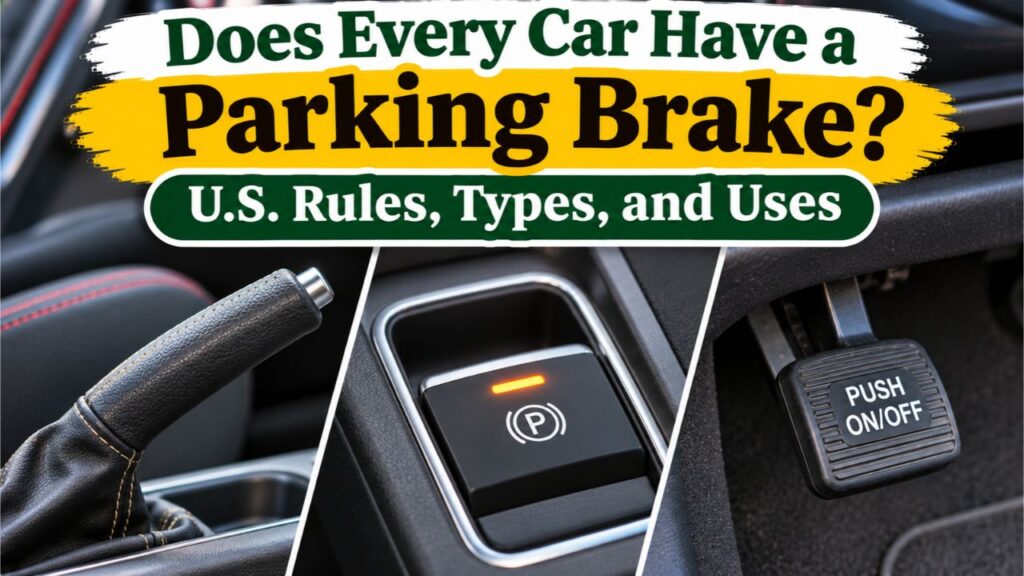
Yes, essentially every modern passenger car sold for road use in the United States has a parking brake, whether it uses an automatic or manual transmission. The control may be a traditional hand lever, a separate foot pedal, or a small electronic switch. You might not see a familiar handbrake, but that does not mean the car lacks a parking brake system.
A parking brake holds a vehicle in place after it stops. It serves a different purpose from the regular brake pedal and an automatic transmission’s Park position. That distinction matters when parking on hills, driving a rental car, or trying to locate the control in an unfamiliar vehicle.
The word “every” needs a qualification. Purpose-built race cars, some off-road-only machines, and improperly modified vehicles may not follow the same requirements as new road-legal passenger cars. Older models and vehicles sold outside the United States also need to be assessed under the rules that applied to them.
This guide explains which cars have parking brakes, where different controls are located, how mechanical and electronic versions work, and how to use the system properly.
Does Every Car Have a Parking Brake Under U.S. Rules?
For new passenger cars covered by federal safety standards, a parking brake is required equipment, not an optional feature reserved for manual transmissions. The requirement also applies to cars with automatic transmissions, even though their gear selectors include a Park position.
In its official interpretation of parking-brake requirements, the National Highway Traffic Safety Administration states that passenger cars with automatic transmissions must have parking brakes. The agency identifies Federal Motor Vehicle Safety Standard No. 135, which applies to passenger cars manufactured on or after September 1, 2000.
That rule requires a friction-type parking brake held engaged by mechanical means. The driver may operate an electrically controlled switch, but the holding mechanism must meet the applicable standard. Other vehicle categories and older production dates may fall under different federal provisions.
These requirements concern vehicles manufactured for the regulated market; they do not prove that every automobile anywhere in the world still has a functioning parking brake today. An owner might encounter a broken, disconnected, or illegally altered system, which is a repair problem rather than a normal factory design.
What Does a Parking Brake Actually Do?
The parking brake helps prevent an unattended car from rolling. It applies holding force to designated brake components, usually at the rear wheels, and keeps that force in place until released. It is particularly useful on slopes, but a parking space that looks level may still have enough grade for a vehicle to move.
Unlike the regular service brakes, its primary job is to secure a stationary car. It does not need to operate identically to the main foot brake, and it should not be used for routine slowing during driving.
The system also provides a second way to secure a vehicle when the transmission is placed in Park or a manual car is left in gear. Those methods complement rather than replace one another.
Where Is the Parking Brake Located in Different Cars?
Parking-brake controls have changed substantially over time. Their location is often the reason a driver mistakenly believes a vehicle does not have one.
Hand Lever Beside the Driver
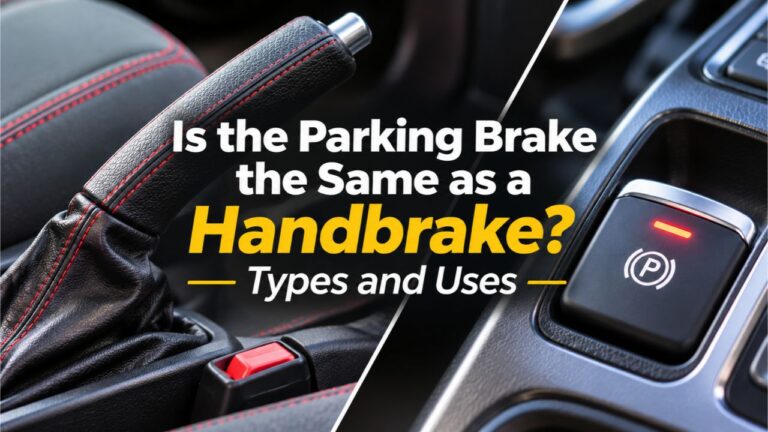
Many older cars and some current models use a hand-operated lever between the front seats. Pulling it generally engages a cable-operated brake; a button or other release mechanism allows the lever to return. The lever may also sit beside the driver’s seat or beneath the dashboard on certain designs.
Foot Pedal Near the Driver’s Left Foot
Some sedans, SUVs, and pickups have a smaller pedal to the left of the regular brake pedal. It may release with a separate dashboard handle or by another action on the pedal, depending on the model. Because the control sits low in the footwell, it is easy to overlook.
Electronic Switch Near the Gear Selector
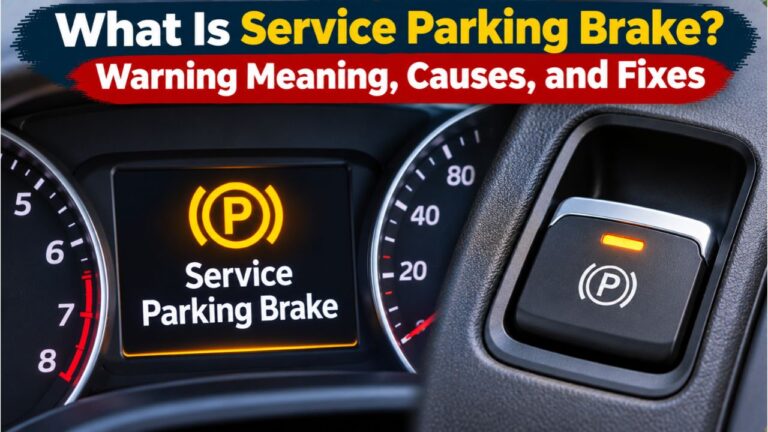
Modern vehicles may use a compact switch marked with a circled P symbol. It often sits on the center console or lower dashboard. The switch does not look like a mechanical lever, but it still activates a parking-brake system.
Look for the symbol in the owner’s manual if the location is not obvious. Do not assume that the P button selecting an automatic transmission’s Park position is the same control.
What Types of Parking Brakes Do Cars Have?
Cable-Operated Mechanical Parking Brakes
A traditional hand lever or foot pedal pulls a cable connected to brake hardware. Depending on the design, the cable can move brake shoes, operate a rear caliper mechanism, or act on another approved arrangement. A ratchet or similar device keeps the brake applied after the driver releases the control.
Mechanical systems are relatively straightforward to recognize, but cables and linkages can corrode, stretch, or seize. They still need periodic inspection.
Electronic Parking Brakes
An electronic parking brake (EPB) uses an electrical command to activate an actuator. Some systems use small motors at the rear calipers; others use a motorized cable mechanism. An electronic switch can replace the familiar physical lever while performing the same basic parking function.
The 2023 Honda Civic Hatchback electric parking-brake guide shows a driver pulling a switch to apply the brake and pressing it while holding the service brake to release it. These instructions are specific to that model; other vehicles may also offer automatic application or release.
Electronic does not mean the system depends on continuous electricity to remain engaged. Its holding mechanism is designed for parking, although electrical power may be needed to apply or release it normally.
Do Cars With Automatic Transmissions Have Parking Brakes?
Yes. An automatic transmission does not eliminate the need for a parking brake. When the selector is placed in Park, a mechanical parking mechanism inside the transmission typically helps prevent the drivetrain from turning. The parking brake separately restrains the vehicle through its braking system.
On a hill, placing the full load on the transmission’s parking mechanism may make the selector feel difficult to move later. Using the parking brake while the service brake is still held helps reduce that load. Follow the sequence specified in the owner’s manual, particularly on models that apply the parking brake automatically.
A transmission’s Park mode is not an excuse to ignore a defective parking brake. Both functions are intended to contribute to secure parking.
Do Manual-Transmission Cars Have Parking Brakes?
Yes. Manual-transmission cars generally have parking brakes too, even though their drivers can leave a gear engaged after shutting off the engine. Gear engagement is useful backup protection, not a substitute for the parking brake.
A manual car can roll if left in Neutral, and drivetrain resistance alone should not be relied on to hold it on a slope. The parking brake provides the intended holding force independently of ordinary clutch and gear selection.
Traditional hand levers are common in manual cars, but a manual transmission does not guarantee a cable-operated handbrake. Some models also use electronically controlled parking brakes.
Do Electric and Hybrid Cars Have Parking Brakes?
Electric vehicles and hybrids still need a secure way to stay stationary when parked. Modern U.S.-market passenger models have parking-brake systems even if the driver does not see a conventional lever or separate brake pedal.
Many use electronic controls that work with the gear selector or vehicle shutdown sequence. A vehicle may automatically apply its parking brake when Park is selected, the power is switched off, or another model-specific condition is met. Those behaviors should be verified in the owner’s manual rather than assumed.
Regenerative braking is not a parking brake. Regeneration uses the drive motor to slow the car and recover energy; it does not replace the dedicated stationary holding function. Similarly, an Auto Hold feature that keeps a car stopped briefly in traffic is not necessarily the same as setting its parking brake for unattended parking.
Are There Cars Without a Parking Brake?
The strongest exceptions are vehicles outside the category of ordinary road-legal passenger cars. A purpose-built race car may use specialized equipment and operate under competition rules rather than passenger-car road regulations. Certain off-road-only machines, prototypes, or custom builds may also have unconventional holding arrangements.
Some very old automobiles were built before today’s braking standards. Their original hardware and applicable legal requirements cannot be determined from age alone. Many classic cars do have parking brakes, even when they use old-fashioned controls, so “old car” does not mean “no parking brake.”
A car can also have its parking brake removed, disconnected, or left inoperative during an improper modification. That does not make the absence normal or legal for street use. If a modern passenger car seems to lack a parking brake, inspect its documentation and have the system checked before assuming it was designed that way.
Parking Brake vs. Park Gear vs. Regular Brakes
These three systems have different jobs, even when modern electronics coordinate them.
| System | Main Purpose | Typical Driver Control |
| Parking brake | Hold the car after parking | Lever, pedal, or electronic switch |
| Transmission Park | Restrain the transmission’s output | Gear selector or Park button |
| Service brakes | Slow and stop the moving car | Main brake pedal |
The service brakes normally act at all four wheels. Most passenger-car parking brakes apply at the rear wheels, although specialized designs differ. A vehicle’s parking brake may use friction components also used by the service brakes or a separate set of small brake shoes.
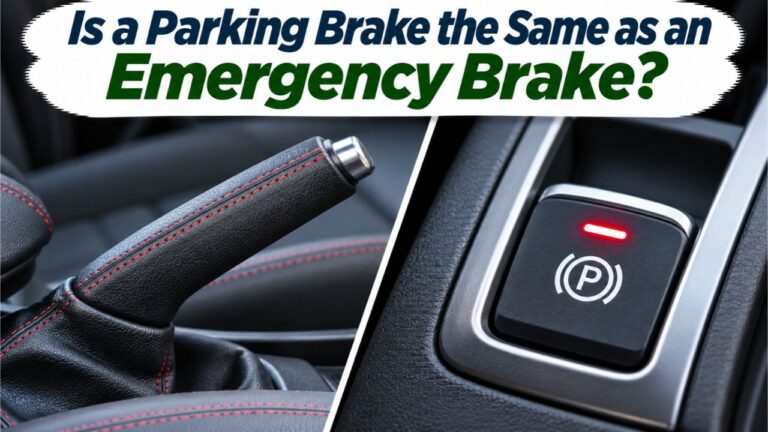
The term emergency brake is often another name for the parking brake. That does not mean it can safely substitute for the regular brake pedal while driving. Emergency behavior varies, especially on electronically controlled systems.
When Should You Use Your Car’s Parking Brake?
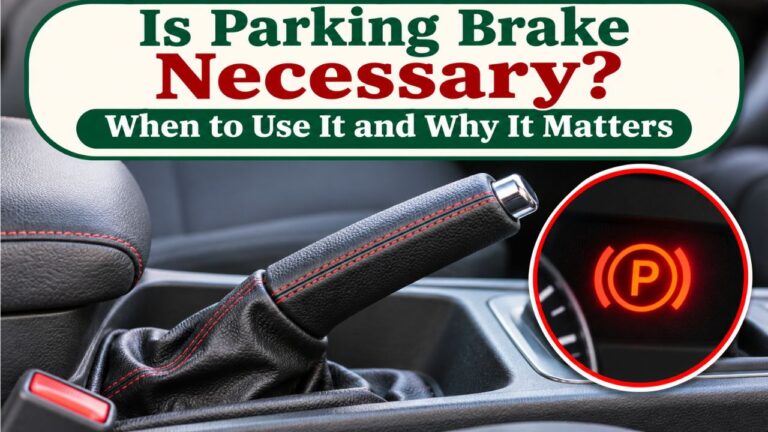
Using it whenever the vehicle is parked is a sound habit, even on level pavement. Apply it before leaving the driver’s seat and keep the regular brake pressed until the transmission and parking brake have secured the car.
Hill parking requires extra care. The California DMV’s parking-on-a-hill guidance advises setting the parking brake and leaving an automatic in Park or a manual in gear. It also explains how to turn the wheels toward or away from a curb based on the direction of the slope.
Do not count on the parking brake alone when lifting a car, changing a wheel, or working underneath it. Use appropriate wheel chocks and correctly rated supports. For towing, long-term storage, or unusual freezing conditions, follow model-specific instructions because some procedures require a different parking setup.
How Do You Know Whether Your Parking Brake Is Working?
A dashboard indicator often illuminates when the parking brake is applied. Many displays show P inside a circle or the word BRAKE, although warning symbols vary. An indicator confirms the control or system status; it is not a complete measurement of holding force.
Problems worth investigating include a lever that pulls unusually high, a pedal that does not latch, a switch that displays an error, or brakes that continue dragging after release. A vehicle that moves despite correct application may have a weak or defective parking brake.
Do not test a questionable system by letting the car roll down a public hill. Have a technician inspect cable adjustment, rear brake hardware, electric actuators, and relevant control faults using the approved service procedure.
What if You Cannot Find a Parking Brake in Your Car?
First, check the owner’s manual for “parking brake,” “electronic parking brake,” or “EPB.” Look around the center console, lower dashboard, and far-left footwell. Some vehicles also show a parking-brake menu or status message on their instrument display.
If you are driving a rental or unfamiliar car, identify the control before parking on a hill. Do not press unidentified switches while moving. If the manual lists a parking brake but its control is missing or does not operate, arrange inspection rather than relying solely on the transmission.
FAQs About Does Every Car Have a Parking Brake
Do All New Cars Have Electronic Parking Brakes?
No. Many newer cars have electronic parking brakes, but the control design varies by model. A conventional hand lever or foot pedal can still provide the required parking function.
Can a Car Have a Parking Brake Without a Handbrake Lever?
Yes. The driver may operate it with a foot pedal or electric switch. Some electronically controlled systems can also apply automatically under specified conditions.
Can an Automatic Car Be Parked Without Using Its Parking Brake?
Selecting Park may restrain the drivetrain, but the recommended habit is to use the parking brake as well. It supplies an additional holding mechanism and is especially valuable on slopes.
Does the Parking Brake Work When the Engine Is Off?
A mechanical parking brake remains engaged without the engine running. Many electronic systems also remain applied after shutdown, although battery power may be needed for normal operation or release.
Are Parking Brakes Only Connected to the Rear Wheels?
Most passenger cars use rear-wheel parking brakes, but the exact hardware varies. Some designs use separate shoes inside rear rotors, while others operate the rear calipers or another approved arrangement.
Is It Legal to Drive Without a Working Parking Brake?
That depends on the jurisdiction and the vehicle, but an inoperative parking brake can fail roadworthiness or safety inspections. It also creates a rollaway risk. Repair it rather than assuming the transmission’s Park position is sufficient.
Why Your Car’s Parking Brake Is Easy to Miss but Important to Use
So, does every car have a parking brake? For modern passenger cars manufactured for the U.S. road market, the answer is yes: it is required equipment, regardless of whether the car is automatic, manual, gasoline-powered, hybrid, or electric. The exceptions involve specialized vehicles, historical designs, or missing and defective equipment—not the ordinary design of a modern street car.
If no hand lever is visible, look for a separate foot pedal or an electronic switch before concluding the system is absent. The owner’s manual will identify the correct control and any automatic features.
Using a working parking brake alongside the proper transmission setting helps keep a parked vehicle where it belongs. If the control cannot be found or the brake will not hold, have it checked before relying on the car for routine parking.