Is Transmission Fluid the Same as Brake Fluid? Key Differences
No, transmission fluid and brake fluid are not the same, and they should never be used interchangeably. Transmission fluid is formulated to lubricate, cool, and operate transmission components, while brake fluid transfers hydraulic pressure through the braking system. Their chemical compositions, additives, performance requirements, and compatibility with seals are fundamentally different.
Most automatic transmission fluids are oil-based, while conventional DOT 3, DOT 4, and DOT 5.1 brake fluids are glycol-based. Using transmission fluid in a brake reservoir can damage rubber seals, cause hydraulic problems, and potentially lead to brake failure.
Similarly, adding brake fluid to an automatic transmission can interfere with lubrication and friction characteristics, potentially damaging internal components.
Although both liquids may be described as hydraulic fluids, that doesn’t make them compatible. Each is engineered for a specific automotive system.
In this article, I explain the differences between transmission fluid and brake fluid, including their ingredients, functions, appearance, and maintenance requirements. You’ll learn why they cannot be mixed, what happens if the wrong fluid enters either system, how to respond safely, and how to identify the correct fluid for your vehicle.
Is Transmission Fluid the Same as Brake Fluid?

Transmission fluid and brake fluid are two different automotive fluids designed for separate mechanical systems.
Transmission fluid helps a vehicle’s transmission operate correctly by providing lubrication, friction control, cooling, and, in many automatic transmissions, hydraulic pressure.
Brake fluid transfers pressure from the brake pedal through hydraulic components to apply the brakes.
Transmission Fluid vs. Brake Fluid Comparison
| Feature | Transmission fluid | Brake fluid |
| Main purpose | Lubrication, cooling, and transmission operation | Hydraulic braking |
| Primary system | Transmission | Hydraulic brake system |
| Typical chemical base | Petroleum-derived or synthetic oil-based | Glycol-based for DOT 3, DOT 4, and DOT 5.1 |
| Main performance requirements | Lubrication, friction characteristics, thermal stability | Boiling point, hydraulic performance, seal compatibility |
| Common specifications | DEXRON, MERCON, CVT and manufacturer-specific fluids | DOT 3, DOT 4, DOT 4 LV, DOT 5, DOT 5.1 |
| Typical appearance | Often red or amber; varies by product | Often clear to amber; varies by product |
| Moisture absorption | Generally not hygroscopic like glycol brake fluid | Glycol-based types absorb moisture |
| Designed for brake-system rubber seals | No | Yes, when correctly specified |
| Suitable for the transmission | Correct type only | No |
| Can replace the other? | No | No |
The most important distinction is that the fluids are designed to interact with different materials and operate under different conditions.
Even if both appear similar in a bottle, their chemistry and intended functions are not interchangeable.
Key Takeaway: Brake fluid belongs in the hydraulic braking system, while transmission fluid belongs in the transmission specified for that product. Never substitute one for the other.
What Is Transmission Fluid?
Transmission fluid is a specially formulated lubricant that helps maintain the performance and durability of a vehicle’s transmission.
The exact formulation depends on the transmission design.
Automatic transmissions, manual transmissions, continuously variable transmissions, and dual-clutch transmissions can have different fluid requirements.
What Does Automatic Transmission Fluid Do?
Automatic transmission fluid, commonly called ATF, performs several important functions.
These include:
- Lubricating gears, bearings, and other moving components.
- Helping control friction within clutch assemblies.
- Transmitting hydraulic pressure where required.
- Carrying heat away from components.
- Reducing wear and corrosion.
- Supporting hydraulic and electronic shifting mechanisms.
According to Castrol’s guide to automatic and manual transmission fluids, automatic transmission fluid must provide specific friction characteristics for clutches and bands while maintaining viscosity and thermal stability.
These requirements differ significantly from those of ordinary automotive brake fluid.
What Is Automatic Transmission Fluid Made Of?
Automatic transmission fluid generally contains a base oil and performance additives.
Depending on the formulation, ingredients may include:
- Petroleum-derived or synthetic base oils.
- Friction modifiers.
- Anti-wear additives.
- Oxidation inhibitors.
- Corrosion inhibitors.
- Viscosity-control additives.
- Anti-foaming agents.
These ingredients help maintain proper transmission operation.
However, the precise formulation varies by manufacturer and specification.
Is Manual Transmission Fluid the Same as ATF?
Not necessarily.
Many manual transmissions require specific gear oils or manual transmission fluids.
Some manual transmissions are designed to use ATF or another manufacturer-approved lubricant.
Therefore, you should not assume that all transmission fluids are interchangeable with one another.
The correct product depends on the vehicle’s transmission design.
What About CVT Fluid?
Continuously variable transmissions often require specialized CVT fluid.
These fluids are engineered for particular friction and lubrication requirements.
Using ordinary ATF in a CVT that requires dedicated CVT fluid may cause transmission problems.
Always follow the manufacturer’s specifications.
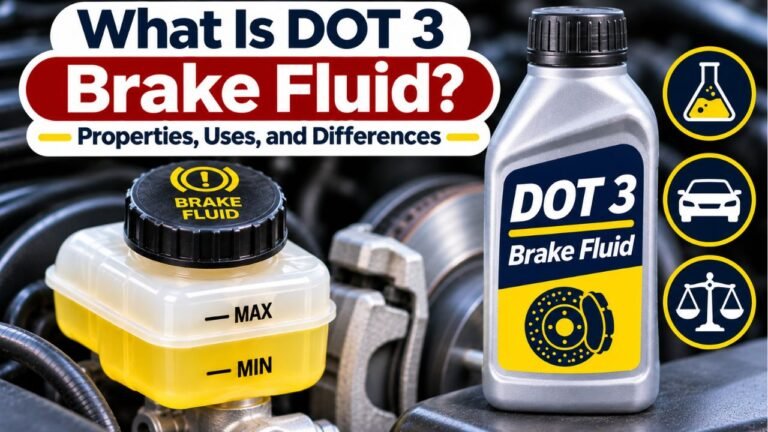
What Is Brake Fluid?
Brake fluid is a hydraulic fluid designed to transfer pedal force through a vehicle’s braking system.
Most passenger vehicles use brake fluid meeting a particular Department of Transportation specification.
How Does Brake Fluid Work?
When you press the brake pedal, hydraulic pressure develops inside the brake system.
That pressure travels through the fluid and hydraulic lines.
The pressure activates components such as brake calipers or wheel cylinders, which apply the friction brakes.
Because liquid brake fluid is effectively incompressible under normal operating conditions, it transmits hydraulic pressure efficiently.
What Is Brake Fluid Made Of?
Most conventional automotive DOT 3, DOT 4, and DOT 5.1 brake fluids are glycol-based.
These formulations typically contain:
- Glycol ethers or related compounds.
- Additional formulation components.
- Corrosion inhibitors.
- Other performance additives.
DOT 4 formulations may contain borate esters to help achieve their required performance characteristics.
DOT 5 is different because it is silicone-based.
Why Is Brake Fluid Special?
Brake fluid must maintain suitable hydraulic performance across a wide range of operating temperatures.
It also needs to work with materials found inside the braking system.
Important characteristics include:
- High boiling-point performance.
- Appropriate viscosity.
- Resistance to corrosion.
- Compatibility with specified hydraulic seals.
- Chemical stability.
- Reliable pressure transmission.
Conventional glycol-based brake fluid also absorbs moisture over time, which is why many manufacturers specify periodic replacement.
Why Can’t You Use Transmission Fluid as Brake Fluid?
Transmission fluid cannot safely replace conventional DOT brake fluid because its oil-based chemistry is incompatible with many seals and components designed for glycol-based brake fluid.
This can lead to serious braking-system damage.
1. Transmission Fluid Can Damage Rubber Seals
Conventional hydraulic braking systems commonly contain elastomeric seals formulated for glycol-based brake fluid.
Oil-based transmission fluid may cause those seals to swell or deteriorate.
Affected components may include:
- Master cylinder seals.
- Brake caliper seals.
- Wheel cylinder seals.
- Hydraulic hose linings.
- ABS hydraulic components.
A damaged seal may fail to maintain the pressure needed for proper braking.
2. Brake Pedal Problems May Develop
When seals swell or hydraulic components become damaged, the brake pedal may begin behaving abnormally.
Possible symptoms include:
- Excessive pedal travel.
- A soft or spongy pedal.
- A pedal that doesn’t return correctly.
- Brakes that drag.
- Reduced braking performance.
- Hydraulic leakage.
However, contamination may initially produce no obvious symptoms.
Normal pedal feel is not proof that the system remains safe.
3. Brake System Components May Become Damaged
Oil contamination can affect more than the reservoir.
Once contaminated fluid circulates through the hydraulic system, multiple components may be exposed.
In an official Mitsubishi Motors technical service bulletin on proper brake fluid replacement, the manufacturer documents swelling and damage to master cylinder rubber components associated with mineral-oil contamination.
The bulletin identifies incorrect fluid as a possible cause of poor brake operation.
4. ABS Components May Be Affected
Modern anti-lock braking systems can contain intricate hydraulic valves and passages.
Contaminated brake fluid may reach these components.
Depending on the vehicle and extent of contamination, the ABS hydraulic unit may require inspection or replacement.
5. Brake Failure Is Possible
If hydraulic seals lose their ability to function correctly, braking performance may deteriorate.
The consequences can be severe.
Do not drive a vehicle if transmission fluid has accidentally been added to the brake fluid reservoir.
Arrange a professional inspection and towing.
What Happens if You Put Transmission Fluid in the Brake Reservoir?
The result depends on the amount added, whether the brakes were operated afterward, and the specific system design.
However, any confirmed petroleum-based contamination of a conventional glycol-brake-fluid system deserves immediate attention.
If You Added Transmission Fluid but Haven’t Driven
Do not start driving or press the brake pedal to test the system.
The safest approach is to stop using the vehicle and arrange professional assistance.
Tell the technician exactly what product was added and approximately how much.
The technician can determine whether contamination remains localized or whether other components may have been exposed.
If You’ve Already Driven the Vehicle
Stop using the vehicle as soon as it is safe to do so.
Arrange towing rather than attempting to drive to a repair shop.
Fluid may have circulated through hydraulic components.
The braking system requires an appropriate inspection and repair plan.
Can a Small Amount Cause Problems?
Yes.
Even a relatively small amount of incompatible fluid may affect rubber components.
The actual damage depends on factors such as exposure time, the system, and the fluid involved.
There is no universally established safe amount of ATF that can be added to a conventional brake hydraulic system.
Will the Damage Happen Immediately?
Not always.
Some seals may swell or deteriorate after exposure.
That means the absence of an immediate braking problem doesn’t establish safety.
Should You Keep the ATF Bottle?
Yes.
Keep the product container or take a photograph of the label.
The exact product information can help the technician identify what entered the braking system.
Key Takeaway: If transmission fluid enters a brake reservoir, stop using the vehicle and seek professional service. Don’t wait for brake symptoms to develop.
Can You Flush Transmission Fluid Out of the Brake System?
A fluid flush may be part of the repair, but flushing alone may not be sufficient after petroleum contamination.
This is because transmission fluid can damage hydraulic seals and other rubber components.
Why a Simple Flush May Not Work
Removing contaminated liquid doesn’t automatically repair components that have already been affected.
For example, a seal that has swollen or deteriorated may remain damaged even after fresh brake fluid is added.
The system can therefore continue to malfunction.
What Components May Need Replacement?
Depending on the vehicle and contamination, a technician may need to evaluate:
- Brake master cylinder.
- Flexible brake hoses.
- Brake calipers.
- Wheel cylinders.
- ABS hydraulic control unit.
- Other hydraulic components containing compatible elastomers.
Some manufacturer repair procedures require extensive replacement of rubber-containing hydraulic components following petroleum contamination.
The exact repair must follow the vehicle manufacturer’s service instructions.
Can You Drain Only the Reservoir?
Removing fluid from the reservoir may not remove contamination from the rest of the hydraulic system.
It also cannot reverse damage to rubber seals.
Do not assume that a reservoir-only fluid change makes the vehicle safe.
Can You Replace the Master Cylinder Only?
Not necessarily.
If petroleum-based fluid circulated throughout the braking system, other components may also have been exposed.
A qualified technician should evaluate the complete hydraulic system.
Is Brake System Repair Expensive?
It can be.
Costs depend on:
- Vehicle make and model.
- Components exposed.
- Whether the ABS hydraulic unit is affected.
- Replacement parts.
- Labor rates.
- Required bleeding procedures.
Extensive contamination repairs can cost substantially more than a routine brake fluid flush.
This is why preventing fluid mix-ups is particularly important.
Can You Use Brake Fluid as Transmission Fluid?
No. Brake fluid should not be used in a transmission that requires ATF, CVT fluid, manual transmission fluid, or another specified lubricant.
Even though brake fluid transmits hydraulic pressure, it doesn’t provide the full range of lubrication and friction-control properties needed by transmission components.
1. Brake Fluid Has Different Lubrication Properties
Transmissions contain moving gears, bearings, and friction components.
The required transmission lubricant is designed to protect these components under mechanical load.
Brake fluid is not formulated to replace that lubricant.
2. Transmission Friction Characteristics May Change
Automatic transmissions rely on carefully controlled friction within clutch packs and other components.
The wrong fluid may interfere with those characteristics.
Possible results include poor shifting, slipping, and abnormal operation.
3. Internal Components May Be Damaged
Brake fluid may be incompatible with certain materials inside the transmission.
It may also fail to provide the protection required by internal components.
This can contribute to wear and damage.
4. Transmission Overheating May Occur
The wrong fluid can interfere with proper lubrication and thermal management.
However, the actual consequences depend on the amount of contamination and whether the transmission was operated.
5. Transmission Failure Is Possible
Severe fluid incompatibility or continued operation with the wrong lubricant may cause major transmission damage.
Do not continue driving if brake fluid has accidentally entered the transmission.
What Should You Do if Brake Fluid Gets Into the Transmission?
If you accidentally pour brake fluid into the transmission, take action before operating the vehicle.
Step 1: Stop Adding Fluid
Don’t add more of either fluid.
Avoid trying to dilute the brake fluid with additional ATF.
Dilution doesn’t guarantee that the mixture will meet the transmission’s required specifications.
Step 2: Do Not Start or Drive the Vehicle
If the engine has not been started, keep the vehicle off until a qualified technician evaluates the contamination.
Some transmissions circulate fluid whenever the engine or drivetrain operates.
Preventing circulation may reduce the extent of exposure.
Step 3: Identify the Product and Quantity
Record:
- Which brake fluid was added.
- Approximately how much entered the transmission.
- Which transmission fluid is specified.
- Whether the vehicle was started or driven.
- Whether abnormal operation occurred.
Step 4: Contact a Transmission Specialist
Explain what happened.
A technician can determine the appropriate draining, inspection, and service procedure.
Step 5: Follow the Correct Repair Procedure
Depending on the vehicle, the technician may need to:
- Remove contaminated fluid.
- Inspect accessible transmission components.
- Service or replace filters where appropriate.
- Restore the correct fluid.
- Check for damage.
- Verify transmission operation.
However, a simple drain-and-fill cannot always guarantee that all contamination has been removed.
Step 6: Monitor the Transmission After Repair
If the transmission is returned to service, watch for:
- Slipping.
- Delayed engagement.
- Harsh shifting.
- Unusual noises.
- Warning lights.
- Fluid leakage.
If a problem develops, arrange further inspection.
Transmission Fluid vs. Brake Fluid: Chemical Differences
The chemical composition explains much of the incompatibility.
Transmission Fluid Is Generally Oil-Based
Most automatic transmission fluids use petroleum-derived or synthetic oil-based materials.
They are formulated for lubricating and controlling transmission components.
The additive package supports friction control, corrosion protection, and long-term stability.
DOT 3 and DOT 4 Brake Fluids Are Glycol-Based
Most conventional passenger-car brake systems use glycol-based brake fluid.
These fluids are formulated to work with the hydraulic braking system’s seals and operating conditions.
DOT 5 Is Silicone-Based
DOT 5 differs from DOT 3 and DOT 4 because it is silicone-based.
However, silicone DOT 5 is still brake fluid—not transmission fluid.
It should not be substituted for oil-based ATF.
Does Silicone DOT 5 Make Transmission Fluid Compatible?
No.
The fact that DOT 5 isn’t glycol-based does not make it equivalent to transmission fluid.
Its formulation and performance requirements are entirely different.
Can the Fluids Separate?
Depending on the products, incompatible fluids may separate or form visibly inconsistent mixtures.
However, appearance alone is not a reliable contamination test.
Do not assume that a mixture is harmless because it appears uniform.
Why Are Brake Fluid and Transmission Fluid Both Called Hydraulic Fluids?
The term hydraulic fluid describes a function rather than one universal chemical composition.
Hydraulic systems use liquids to transmit pressure and operate mechanical components.
However, different systems require different fluid properties.
Hydraulic Braking System
Brake fluid transfers pressure from the master cylinder through the hydraulic circuits.
The fluid must meet specified boiling-point, viscosity, and material-compatibility requirements.
Automatic Transmission Hydraulic System
ATF can transmit pressure to operate clutches and other transmission mechanisms.
However, it must also lubricate gears and bearings while maintaining particular friction characteristics.
Are All Hydraulic Fluids Interchangeable?
No.
Hydraulic systems can require:
- Glycol-based fluids.
- Mineral-oil-based fluids.
- Synthetic hydrocarbon fluids.
- Silicone-based fluids.
- Other specialized formulations.
The fact that two liquids transmit hydraulic pressure doesn’t make them chemically interchangeable.
Are There Exceptions in Automotive Brake Systems?
Yes.
Certain specialized braking systems use mineral-oil-based hydraulic fluids rather than conventional DOT 3 or DOT 4.
However, these systems require their own specific approved fluids.
An exception that uses mineral oil does not mean ordinary ATF is an approved substitute.
Always follow the manufacturer-approved specification.
Can You Tell Brake Fluid and Transmission Fluid Apart by Color?
Color can provide a clue, but it is not a reliable way to establish a fluid’s identity.
Typical Fluid Appearance
| Fluid | Common appearance | Important limitation |
| DOT 3 brake fluid | Clear to light amber | Appearance varies by product and condition |
| DOT 4 brake fluid | Clear to amber | Similar appearance to DOT 3 |
| DOT 5.1 brake fluid | Often clear to amber | Not the same as silicone DOT 5 |
| Automatic transmission fluid | Often red or pink | Some products are amber or other colors |
| Manual transmission fluid | Often amber or brown | Depends on formulation |
| CVT fluid | Varies by manufacturer | Color is not standardized across all products |
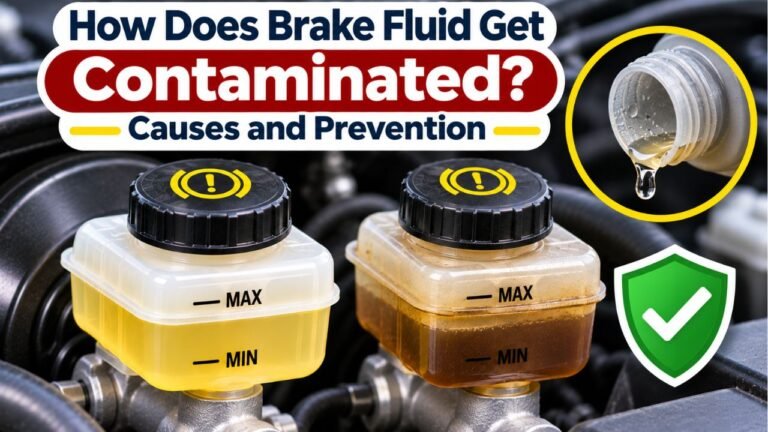
A fluid’s color may also change with age and contamination.
Is Red Fluid Always Transmission Fluid?
No.
Although many ATF products are red, color alone is not definitive.
Other automotive fluids may also be dyed.
Is Clear Fluid Always Brake Fluid?
No.
Some new transmission fluids may be relatively light-colored.
Similarly, older brake fluid can darken.
Can You Identify Fluid by Smell?
Odor isn’t a safe or reliable method of identifying automotive fluids.
Avoid intentionally inhaling vapors.
What Is the Best Way to Identify the Fluid?
Use:
- The original labeled container.
- Vehicle manufacturer specifications.
- Service records.
- Professional inspection when the fluid’s identity is uncertain.
If an unknown liquid has entered a safety-critical system, don’t attempt to identify it solely by appearance.
Where Do You Put Transmission Fluid and Brake Fluid?
The two systems have different fill locations.
However, the exact location varies by vehicle.
Brake Fluid Reservoir Location
In many passenger vehicles, the brake fluid reservoir is located in the engine compartment near the firewall and brake master cylinder.
The reservoir cap often identifies the required fluid specification.
Common markings include:
- DOT 3.
- DOT 4.
- DOT 4 LV.
- Other manufacturer-specific requirements.
Some vehicles have less conventional reservoir arrangements, so consult the owner’s manual.
Transmission Fluid Fill Location
Transmission fluid may be added through:
- A designated transmission fill tube.
- A transmission dipstick opening.
- A transmission case fill plug.
- A manufacturer-specific service port.
Many modern vehicles have transmissions without a traditional owner-accessible dipstick.
These systems may require specialized filling procedures and temperature checks.
Can You Pour Fluid Into the Wrong Reservoir by Mistake?
Yes.
Fluid mix-ups can occur when containers are not clearly labeled or when a person mistakes one component for another.
Do not open or fill an unfamiliar reservoir until you have positively identified it.
How Can You Prevent a Mix-Up?
Before adding fluid:
- Read the vehicle owner’s manual.
- Identify the exact fill location.
- Check the cap or service-port markings.
- Verify the product label.
- Use a clean funnel dedicated to that fluid.
- Avoid using containers previously filled with other automotive liquids.
Never reuse a funnel contaminated with transmission oil for brake fluid.
Is Brake Fluid the Same as Clutch Fluid?
In some vehicles, the hydraulic clutch system uses the same type of fluid as the brake system.
This can cause confusion.
Hydraulic Clutch Fluid
Many manual-transmission vehicles use DOT brake fluid in a hydraulic clutch circuit.
Some even share a reservoir between the brake and clutch hydraulic systems.
Does That Mean Brake Fluid Belongs Inside the Transmission?
No.
The clutch hydraulic system and the transmission’s internal lubrication system perform different functions.
The clutch hydraulic circuit may use DOT fluid, while the gearbox requires a separate lubricant.
What Fluid Should You Use for the Clutch?
Follow the vehicle’s specific requirements.
Some hydraulic clutches use DOT brake fluid.
Others may require a different approved hydraulic fluid.
Do not assume every clutch uses the same product.
Can ATF Be Used in a Hydraulic Clutch?
Only when specifically required by the manufacturer.
Do not substitute ATF into a clutch circuit designed for glycol-based brake fluid.
The same seal-compatibility concerns may apply.
Key Takeaway: A manual transmission vehicle may use DOT fluid for its clutch hydraulics, but that doesn’t make brake fluid a gearbox lubricant.
Can You Mix Transmission Fluid and Brake Fluid?
No.
The two fluids should not be mixed for use in either system.
What Happens When You Mix ATF With DOT 3?
ATF is generally oil-based, while DOT 3 is glycol-based.
The combination is unsuitable for conventional brake systems and can damage seals.
It also won’t function as a manufacturer-approved transmission lubricant.
Can You Mix ATF With DOT 4?
No.
DOT 4 is also generally glycol-based.
The same incompatibility concerns apply.
Can You Mix ATF With DOT 5.1?
No.
DOT 5.1 is generally glycol-based despite its name.
It should not be mixed with transmission fluid.
Can You Mix ATF With DOT 5?
No.
Silicone-based DOT 5 is not an approved substitute for transmission fluid, nor is ATF an approved substitute for DOT 5.
Does Mixing a Small Amount Make It Safe?
No.
There is no universal safe ratio for mixing brake fluid and transmission fluid.
Adding one liquid to the other doesn’t produce a certified or manufacturer-approved product.
What Are the Signs of Transmission Fluid Contamination in the Brake System?
Symptoms can vary depending on the vehicle and the extent of contamination.
Some problems may not become obvious immediately.
Possible Warning Signs
- Abnormal brake pedal travel.
- Soft or sinking pedal.
- Brake drag.
- Uneven braking.
- Hydraulic fluid leakage.
- Brake warning lights.
- Damaged or swollen reservoir seals.
- Unusual brake-system operation.
However, these symptoms can also have other causes.
Can the Brakes Feel Normal After Contamination?
Yes, initially.
That doesn’t prove the hydraulic components remain undamaged.
A contaminated system may continue functioning temporarily while damage develops.
Can ATF Cause a Brake Pedal to Stick?
It can contribute to seal swelling or hydraulic component problems.
Mitsubishi’s technical bulletin documents swelling and damage to master cylinder rubber components caused by mineral-oil contamination.
However, pedal problems require proper diagnosis.
Should You Test the Brakes by Driving?
No.
If petroleum-based fluid was added to a conventional brake system, don’t conduct a road test to see whether braking performance changes.
Arrange professional evaluation and towing.
Can You Use Transmission Fluid Instead of Brake Fluid in an Emergency?
No. Using ATF as an emergency substitute for conventional brake fluid is unsafe.
A brake system must contain fluid that meets the manufacturer’s requirements.
What if You’re Stranded With Low Brake Fluid?
If the brake fluid is dangerously low, the cause may be a hydraulic leak.
Adding an incompatible fluid may worsen the situation.
Do not attempt to drive with unsafe brakes.
Arrange roadside assistance.
Can Water Be Used as Brake Fluid?
No.
Water doesn’t meet automotive brake fluid requirements.
It has inadequate boiling-point and corrosion-control performance for conventional automotive braking systems.
Can Power Steering Fluid Replace Brake Fluid?
No.
Many power steering fluids are oil-based and are not compatible with conventional glycol-based brake systems.
Can Engine Oil Replace Brake Fluid?
No.
Engine oil is also unsuitable for conventional automotive brake hydraulics.
What Should You Do Instead?
Use only the manufacturer’s approved brake fluid.
If it isn’t available and the braking system is unsafe, arrange transport rather than using an improvised substitute.
How to Choose the Correct Brake Fluid and Transmission Fluid
Choosing the right product is essential for safe vehicle maintenance.
Step 1: Identify the Vehicle
Record the:
- Make.
- Model.
- Model year.
- Engine, if relevant.
- Transmission type.
Some vehicles use different fluid requirements depending on their drivetrain configuration.
Step 2: Check the Owner’s Manual
Look for the sections labeled:
- Brake fluid.
- Brake system.
- Transmission fluid.
- Fluids and capacities.
- Maintenance specifications.
Step 3: Confirm the Exact Specification
For brakes, the manual may specify DOT 3, DOT 4, DOT 4 LV, or another formulation.
For transmissions, it may specify a particular ATF, CVT, DCT, or manual transmission lubricant.
Step 4: Check the Product Label
Verify that the bottle explicitly meets the required specification.
A label saying multi-vehicle doesn’t guarantee compatibility with every transmission.
Step 5: Use Clean, Appropriate Equipment
Keep funnels, transfer pumps, and containers dedicated to each fluid.
This is especially important for brake fluid because petroleum contamination can damage hydraulic seals.
Step 6: Follow the Correct Service Procedure
Transmission fluid changes and brake fluid changes require different procedures.
Both may involve special equipment.
Do not substitute one servicing method for the other.
Common Mistakes When Handling Brake Fluid and Transmission Fluid
Assuming All Hydraulic Fluids Are the Same
Fluids can perform hydraulic functions while having completely different chemical compositions.
Using ATF to Top Off the Brake Reservoir
This can contaminate the system and damage rubber components.
Never use it as a substitute for the specified brake fluid.
Using Brake Fluid in an Automatic Transmission
Brake fluid cannot provide the required lubrication and friction properties.
Relying on Fluid Color
Color is not a reliable method of identifying an automotive fluid.
Ignoring the Transmission Type
Automatic, manual, CVT, and dual-clutch transmissions can require different fluids.
Using the Same Funnel for Both Systems
Residue from ATF can contaminate brake fluid.
Use separate clean equipment.
Trying to Dilute Contaminated Brake Fluid
Adding more correct fluid doesn’t necessarily reverse damage or restore safe system performance.
Assuming a Reservoir-Only Flush Fixes Contamination
Contaminated fluid may have reached hoses, seals, calipers, and ABS components.
A professional diagnosis is required.
Continuing to Drive After a Fluid Mix-Up
Operating the vehicle can spread contamination and increase the risk of component damage.
Ignoring the Manufacturer’s Specifications
Fluid requirements vary by vehicle.
The manufacturer’s complete specification should always take priority.
Quick Decision Guide: What to Do After a Fluid Mix-Up
| Situation | Recommended action |
| You have ATF but need brake fluid | Do not use ATF |
| You have brake fluid but need ATF | Do not use brake fluid |
| ATF was accidentally added to brake reservoir | Do not drive; arrange professional inspection and towing |
| Brake fluid was accidentally added to transmission | Do not start or drive; contact transmission specialist |
| ATF entered the brake reservoir but brakes weren’t used | Do not drive; have contamination assessed |
| ATF entered the brakes and the vehicle was driven | Stop using the vehicle; arrange towing |
| Brake pedal becomes unusually soft | Stop driving and arrange inspection |
| Transmission shifts abnormally after contamination | Stop driving and arrange professional service |
| Fluid identity is unknown | Do not add or mix it; identify the product |
| Brake fluid level is unexpectedly low | Inspect for brake wear or hydraulic leaks |
| You’re unsure which fluid the car requires | Consult the owner’s manual or manufacturer service information |
Conclusion
Transmission fluid and brake fluid are not the same and must not be used interchangeably.
Transmission fluid is formulated to lubricate, cool, and operate transmission components. Brake fluid transfers hydraulic pressure through the braking system while meeting specific requirements for boiling point, viscosity, and seal compatibility.
Most automatic transmission fluids are oil-based, while conventional DOT 3, DOT 4, and DOT 5.1 brake fluids are glycol-based.
Putting transmission fluid into a conventional brake system can damage rubber seals and hydraulic components, potentially leading to brake failure. Adding brake fluid to a transmission can interfere with lubrication and operation.
I recommend checking the owner’s manual before adding either fluid and keeping separate, clearly labeled equipment for each system.
If the wrong fluid has already been added, don’t try to correct the mistake by mixing in more fluid. Have the vehicle professionally inspected and serviced before operating it.
The safest rule is simple: use only the exact brake fluid and transmission fluid specifications approved by your vehicle manufacturer.
FAQs About Transmission Fluid vs. Brake Fluid
Is Transmission Fluid the Same as Brake Fluid?
No.
Transmission fluid is designed for transmission lubrication and operation.
Brake fluid is designed to transmit hydraulic pressure through the braking system.
They have different chemical formulations and cannot safely replace each other.
Can You Use Transmission Fluid Instead of Brake Fluid?
No.
Ordinary ATF is not compatible with conventional glycol-based brake systems.
It may damage rubber seals and cause serious brake problems.
What Happens if You Accidentally Put Transmission Fluid in the Brake Reservoir?
Oil-based transmission fluid can contaminate the brake hydraulic system and damage seals.
Do not drive the vehicle.
Arrange professional inspection and towing.
Will a Small Amount of Transmission Fluid Damage the Brakes?
Even a small amount may cause problems.
The extent of damage depends on the fluid, exposure, and system design.
There is no established safe mixing amount.
Can You Flush Transmission Fluid Out of Brake Lines?
A professional fluid exchange may be part of the repair, but flushing alone may not restore damaged rubber seals.
Additional hydraulic components may require replacement.
Can Brake Fluid Be Used in an Automatic Transmission?
No.
Brake fluid doesn’t provide the specified lubrication and friction-control characteristics required by an automatic transmission.
Using it may damage internal components.
What Happens if You Put Brake Fluid in a Transmission?
The transmission may experience lubrication or friction-control problems, potentially resulting in poor operation and damage.
Do not start or drive the vehicle until a qualified technician evaluates the contamination.
Are Brake Fluid and ATF Both Hydraulic Fluids?
Yes, they can both transmit hydraulic pressure.
However, hydraulic fluid describes a function rather than one universal chemical formulation.
They aren’t interchangeable.
Is DOT 3 Brake Fluid the Same as Transmission Fluid?
No.
DOT 3 is a glycol-based brake fluid.
Automatic transmission fluid is generally oil-based and contains additives designed for transmission operation.
Is DOT 4 Brake Fluid the Same as ATF?
No.
DOT 4 is a brake fluid with specific hydraulic performance requirements.
It should not be used as transmission fluid, and ATF should not replace DOT 4.
Can You Mix Brake Fluid and Transmission Fluid?
No.
The combination is not approved for conventional brake systems or transmissions.
Mixing can cause contamination and component damage.
Is Red Brake Fluid Actually Transmission Fluid?
Not necessarily.
Fluid color isn’t a definitive identification method.
Many transmission fluids are red, but colors vary.
Use the original product label and manufacturer specifications.
Can Brake Fluid Be Used for the Clutch?
Some hydraulic clutch systems use the same DOT fluid specified for the vehicle’s brakes.
However, the clutch hydraulic system is separate from the transmission’s internal lubricant supply.
Always check the manual.
Is Transmission Fluid the Same as Power Steering Fluid?
Not always.
Some power steering systems are designed to use certain types of ATF.
Others require specialized power steering fluid.
Neither should automatically be used in the brake reservoir.
Can Transmission Fluid Cause Brake Failure?
Yes.
Petroleum contamination can damage hydraulic brake seals and components.
Severe damage may lead to loss of braking performance.
Do not drive after a confirmed contamination event.
Does Transmission Fluid Damage Brake Rubber Seals?
It can.
Many conventional brake systems use seals formulated for glycol-based brake fluid.
Oil-based transmission fluid may cause those seals to swell or deteriorate.
Can You Replace Transmission Fluid With DOT 5?
No.
DOT 5 is silicone-based brake fluid, not transmission lubricant.
It isn’t an approved replacement for ATF or manual transmission fluid.
Should You Drive After Mixing Brake Fluid and Transmission Fluid?
No.
If the wrong fluid entered the brake system, arrange towing and professional inspection.
If brake fluid entered the transmission, avoid starting or driving the vehicle until the contamination has been evaluated.
How Do You Know Which Fluid Your Car Needs?
Check the owner’s manual, reservoir markings, and manufacturer specifications.
For transmissions, identify the exact transmission type and required lubricant.
If you’re uncertain, verify the information before adding any fluid.