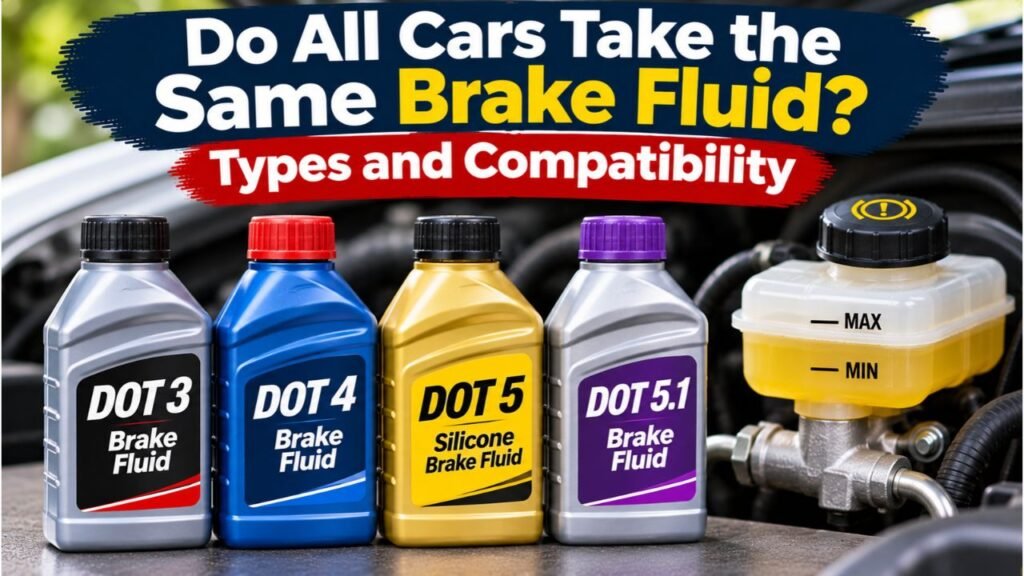
Do All Cars Take the Same Brake Fluid? Types and Compatibility
No, all cars do not take the same brake fluid. Different vehicles require different brake fluid specifications, including DOT 3, DOT 4, DOT 4 Low Viscosity (LV), DOT 5, or DOT 5.1. The correct type depends on the vehicle manufacturer’s requirements, hydraulic brake-system design, and operating conditions.
For example, some Mazda vehicles specify DOT 3 brake fluid, while certain Hyundai models require DOT 4 LV fluid meeting additional low-temperature viscosity standards. Although several brake fluids share similar chemical properties, they are not automatically suitable substitutes for one another.
Using the wrong brake fluid can affect braking performance, damage hydraulic seals, interfere with ABS operation, or cause expensive repairs. This is especially concerning when silicone-based DOT 5 fluid or petroleum-based hydraulic oil enters a system designed for conventional glycol-based brake fluid.
The safest way to identify the correct fluid is to check the owner’s manual or brake fluid reservoir cap before purchasing anything.
In this article, I explain the differences between common brake fluid types, which fluids may be chemically compatible, and why manufacturer approval matters. I also cover real vehicle examples, brake fluid labeling, replacement intervals, warning signs, and what to do if the wrong type has already been added.
Do All Cars Take the Same Brake Fluid? Quick Answer
No. Cars may use different brake fluids even when their braking systems look similar.
Most modern passenger vehicles with conventional hydraulic brakes use glycol-based brake fluid, commonly DOT 3 or DOT 4.
However, certain vehicles require DOT 4 LV, which must meet particular viscosity requirements. Other vehicles may specify DOT 5.1, and some specialized applications use silicone-based DOT 5 or a different hydraulic fluid.
The manufacturer’s specification determines what is acceptable.
Brake Fluid Compatibility Overview
| Brake Fluid Type | Base Chemistry | Typical Application | Interchangeable With Every Type? |
| DOT 3 | Glycol-based | Many conventional passenger vehicles | No |
| DOT 4 | Glycol-based | Many modern passenger vehicles | No |
| DOT 4 LV | Glycol-based | Vehicles requiring lower-viscosity fluid | No |
| DOT 5 | Silicone-based | Certain specialized brake systems | No |
| DOT 5.1 | Glycol-based | Vehicles requiring its performance characteristics | No |
| Mineral-oil hydraulic fluid | Mineral-oil-based | Certain specialized hydraulic systems | No |
The distinction is important because chemical compatibility does not automatically mean a fluid meets the vehicle’s required performance specification.
For example, DOT 3 and conventional DOT 4 fluids are generally chemically compatible.
However, adding DOT 3 to a vehicle requiring DOT 4 may reduce the mixture’s high-temperature performance below the manufacturer’s requirements.
Likewise, ordinary DOT 4 should not automatically replace DOT 4 LV when low-temperature viscosity is part of the specified standard.
Key Takeaway: Always use brake fluid that meets the exact specification listed for your vehicle. Do not choose a replacement solely because it has a higher DOT number.
Why Do Different Cars Require Different Brake Fluids?
Brake systems vary in design and operating requirements.
Although most passenger vehicles use hydraulic pressure to activate their brakes, they may have different components, materials, temperature requirements, and electronic control systems.
Brake System Design
Vehicles use different hydraulic components.
These may include:
- Master cylinders
- Brake calipers
- Wheel cylinders
- Flexible brake hoses
- ABS hydraulic control units
- Electronic stability control systems
- Brake-by-wire components
- Hydraulic accumulators
The fluid must work correctly with the relevant seals, valves, and hydraulic passages.
Operating Temperature
Brake fluid experiences heat generated during braking.
A performance vehicle used for repeated heavy braking may place different demands on its fluid than a vehicle used primarily for ordinary commuting.
Manufacturers select brake fluid specifications partly according to the expected braking conditions.
ABS and Stability Control Requirements
Modern ABS and electronic stability control systems may use rapidly operating hydraulic valves.
Some systems require fluid with particular low-temperature viscosity characteristics.
A fluid that is too viscous under specified conditions may affect system response.
This is one reason certain vehicles require DOT 4 LV rather than ordinary DOT 4.
Seal and Material Compatibility
Hydraulic systems use seals and components designed for specific fluid chemistries.
Introducing incompatible fluids can cause swelling, deterioration, or other damage.
Petroleum-based hydraulic fluids are especially problematic in systems designed for conventional glycol brake fluids.
Manufacturer Testing
Vehicle manufacturers evaluate brake-system performance using specified fluids.
The recommended fluid is selected based on more than its general DOT classification.
For that reason, two vehicles from the same manufacturer may have different brake fluid requirements.
What Are the Different Types of Brake Fluid?
The common classifications include DOT 3, DOT 4, DOT 5, and DOT 5.1.
Some products also carry additional specifications such as DOT 4 LV or ISO 4925 Class 6.
Understanding these labels helps prevent incorrect substitutions.
DOT 3 Brake Fluid
DOT 3 is a glycol-based brake fluid widely used in conventional hydraulic braking systems.
It provides standardized boiling-point and other performance characteristics.
Common applications include passenger cars, light trucks, and older vehicles whose manufacturers specify DOT 3.
However, not every vehicle that originally used DOT 3 should automatically receive another fluid type.
Follow the manufacturer’s instructions.
DOT 4 Brake Fluid
DOT 4 is also generally glycol-based.
It has higher minimum dry and wet boiling-point requirements than DOT 3.
DOT 4 is common in many modern passenger vehicles.
However, different DOT 4 products may have additional specifications related to viscosity and other properties.
A product labeled DOT 4 is not automatically identical to every other DOT 4 formulation.
DOT 4 Low Viscosity Brake Fluid
DOT 4 LV is a low-viscosity formulation intended for applications requiring particular fluid-flow characteristics, especially at low temperatures.
Some vehicles specify DOT 4 LV meeting ISO 4925 Class 6.
It remains a glycol-based brake fluid, but it has additional performance requirements beyond the general DOT 4 label.
Ordinary DOT 4 may not meet those requirements.
DOT 5 Brake Fluid
DOT 5 is generally silicone-based.
Unlike conventional glycol-based brake fluids, silicone-based DOT 5 is not hygroscopic in the same way.
However, this does not mean it is suitable for every vehicle.
Silicone DOT 5 is not interchangeable with glycol-based DOT 3, DOT 4, or DOT 5.1.
It must only be used in a braking system specifically designed or approved for it.
DOT 5.1 Brake Fluid
DOT 5.1 is generally glycol-based, despite its similar name to DOT 5.
It has higher minimum boiling-point requirements than DOT 3 and DOT 4.
However, that does not automatically make it the correct fluid for every vehicle.
Some manufacturers require additional properties or an exact fluid specification.
Mineral-Oil Hydraulic Fluids
Certain specialized vehicle hydraulic systems use mineral-oil-based fluids rather than conventional DOT brake fluid.
These systems must use the fluid specified by the manufacturer.
Mineral oil and conventional glycol-based brake fluid are not interchangeable.
Using the wrong chemistry can damage seals and other hydraulic components.
DOT 3 vs DOT 4 vs DOT 5 vs DOT 5.1: Main Differences
The differences include chemical composition, boiling-point requirements, viscosity, and intended applications.
Brake Fluid Comparison Table
| Feature | DOT 3 | DOT 4 | DOT 5 | DOT 5.1 |
| Main chemistry | Glycol-based | Glycol-based | Silicone-based | Glycol-based |
| Minimum dry boiling point | 401°F | 446°F | 500°F | 500°F |
| Minimum wet boiling point | 284°F | 311°F | 356°F | 356°F |
| Absorbs moisture | Yes | Yes | Not in the same way | Yes |
| Compatible with conventional glycol fluid | Generally | Generally | No | Generally |
| Suitable for every car | No | No | No | No |
| Requires manufacturer approval | Yes | Yes | Yes | Yes |
These boiling points are minimum laboratory performance requirements.
Actual commercial products may exceed them.
The U.S. Federal Motor Vehicle Safety Standard No. 116 establishes brake fluid performance requirements, including boiling points, viscosity, compatibility, corrosion resistance, and labeling.
The standard also distinguishes silicone-based DOT 5 from nonsilicone DOT 5.1.
What Is Dry Boiling Point?
Dry boiling point describes brake fluid performance under standardized testing before moisture conditioning.
It represents the fluid’s high-temperature capability under those test conditions.
What Is Wet Boiling Point?
Wet boiling point describes performance after the fluid has undergone a standardized moisture-conditioning procedure.
It helps demonstrate how moisture affects high-temperature performance.
It does not mean that every brake fluid reaches the published wet boiling point after a specific number of months.
Why Does Boiling Point Matter?
Braking generates heat.
Some of that heat reaches the brake fluid.
If the fluid becomes hot enough to form vapor, the gas can compress under hydraulic pressure.
This may produce a soft pedal or reduce braking effectiveness.
Is the Highest Boiling Point Always Best?
Not necessarily.
Boiling-point performance is important, but it is not the only requirement.
Viscosity, seal compatibility, fluid chemistry, and manufacturer specifications also matter.
A fluid with a higher boiling point but unsuitable viscosity may not be appropriate for a particular ABS system.
What Brake Fluid Do Honda, Toyota, Ford, and Other Cars Use?
Brake fluid requirements vary by manufacturer, model, year, and sometimes market.
The vehicle’s exact documentation is more reliable than a general brand-based rule.
Real Manufacturer Examples
| Vehicle Example | Published Brake Fluid Specification | What It Shows |
| 2026 Mazda CX-5 | SAE J1703 or FMVSS 116 DOT 3 | Some current cars still specify DOT 3 |
| Hyundai vehicle using the referenced 2025 owner’s manual | DOT 4 LV, SAE J1704, ISO 4925 Class 6 | Some vehicles require low-viscosity DOT 4 |
| Other cars and specialized vehicles | Varies by exact model | Specifications cannot be assumed from the brand alone |
Mazda Brake Fluid Example
The official 2026 Mazda CX-5 owner’s manual lists:
SAE J1703 or FMVSS 116 DOT 3
This provides a clear example of a modern vehicle whose manufacturer specifies DOT 3.
It would be incorrect to assume that every newer car automatically requires DOT 4 or DOT 5.1.
Hyundai Brake Fluid Example
Hyundai’s official brake fluid checking instructions specify a fluid meeting:
- SAE J1704 DOT 4 LV
- ISO 4925 Class 6
- FMVSS 116 DOT 4
The instructions also emphasize using only the specified brake fluid to maintain braking and ABS/ESC performance.
This illustrates why the additional LV and Class 6 specifications matter.
Do All Hondas Use DOT 3?
No manufacturer should be treated as having one universal brake fluid specification across every model and production year.
Many Honda passenger vehicles specify Honda Heavy Duty Brake Fluid DOT 3.
However, the correct requirement must be confirmed for the exact vehicle.
Do not assume that a recommendation for one Honda model applies to every Honda or Acura vehicle.
Do All Toyotas Use the Same Brake Fluid?
Not necessarily.
Toyota vehicles may specify DOT 3, DOT 4, or other requirements depending on the vehicle and market.
Check the owner’s manual or manufacturer service information.
Do All Ford Vehicles Use DOT 4?
No universal assumption should be made.
Some Ford vehicles specify DOT 4 LV meeting additional manufacturer requirements.
Other Ford models may have different specifications.
Always identify the vehicle’s model year and exact fluid requirement before purchasing.
Can Cars From the Same Brand Use Different Fluids?
Yes.
Manufacturers change brake-system designs over time.
A newer vehicle may use different hydraulic components or controls from an older model.
Two cars from the same brand may therefore require different brake fluids.
The most reliable identification method is the exact year, make, model, and manufacturer specification—not the brand name alone.
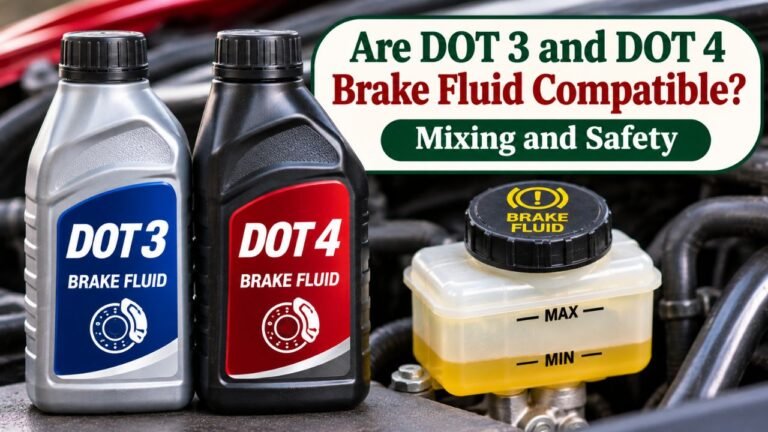
Can You Mix DOT 3 and DOT 4 Brake Fluid?
DOT 3 and conventional DOT 4 are generally chemically compatible because they are glycol-based, but that does not mean mixing them is always manufacturer-approved.
This distinction is important.
Are DOT 3 and DOT 4 Physically Compatible?
They are generally formulated to be miscible.
However, mixing can change the final fluid’s performance characteristics.
For example, adding DOT 3 to DOT 4 may reduce the mixture’s boiling-point performance.
Can You Put DOT 4 in a DOT 3 Car?
Sometimes, if the vehicle manufacturer permits it.
However, you should not assume that a higher DOT number automatically means an approved upgrade.
Some manufacturers specify a particular fluid or allow an alternative only temporarily.
Follow the owner’s manual.
Can You Put DOT 3 in a DOT 4 Car?
Do not do so unless the manufacturer explicitly approves it.
A vehicle designed around DOT 4 requirements may not meet those requirements after DOT 3 is added.
Is Mixing DOT 3 and DOT 4 Dangerous?
Chemical miscibility alone does not determine safety.
The mixture must still satisfy the vehicle’s performance requirements.
If the wrong fluid has been added, consult a qualified technician before continuing to operate the vehicle.
Does Mixing DOT 3 and DOT 4 Create DOT 4 Fluid?
No.
You cannot assume that mixing two fluid grades produces a final mixture that meets the higher grade.
A mixture’s properties depend on the ingredients and proportions.
The safest approach is to use one manufacturer-approved specification during service.
Can You Mix DOT 4 and DOT 5.1 Brake Fluid?
DOT 4 and DOT 5.1 are generally glycol-based.
However, their chemical compatibility does not automatically establish that a mixture is suitable for your vehicle.
What Is the Main Difference?
DOT 5.1 has higher minimum boiling-point requirements.
Its low-temperature performance characteristics also differ from those of some conventional DOT 4 fluids.
However, specific commercial formulations vary.
Can DOT 5.1 Replace DOT 4?
Only if it meets the vehicle manufacturer’s requirements.
A DOT 5.1 product may be acceptable in some applications, but not universally.
Check viscosity and any additional manufacturer specifications.
Is DOT 5.1 Better for ABS?
Not automatically.
Some DOT 5.1 formulations have suitable low-temperature properties for certain ABS systems.
However, an ABS system requiring a specific DOT 4 LV fluid may have requirements that are not satisfied by every DOT 5.1 product.
Choose the exact approved specification.
Should You Upgrade From DOT 4 to DOT 5.1?
Not simply to obtain a higher boiling-point rating.
If the manufacturer recommends DOT 4 LV, use a fluid meeting that specification.
If the manual allows DOT 5.1, follow the applicable conditions.
Can You Mix DOT 5 With Other Brake Fluids?
No. Silicone-based DOT 5 should not be mixed with conventional glycol-based DOT 3, DOT 4, or DOT 5.1.
These fluid families are fundamentally different.
Why DOT 5 Is Different
DOT 5 is typically silicone-based.
It does not absorb water in the same way as glycol-based fluid.
It also behaves differently in hydraulic systems.
Its use requires a brake system designed or approved for that fluid.
Can You Add DOT 5 to DOT 3?
No.
A conventional DOT 3 braking system should not receive silicone DOT 5 unless the manufacturer specifically provides an approved conversion procedure.
Simply adding silicone fluid is not an acceptable conversion.
Can You Add DOT 5 to DOT 4?
No.
The fluids should not be mixed.
Can You Add DOT 5 to DOT 5.1?
No.
Despite the similar names, DOT 5 and DOT 5.1 are different fluid types.
DOT 5.1 is generally glycol-based.
What if DOT 5 Was Added by Mistake?
Do not drive the vehicle until the braking system has been professionally evaluated.
A simple reservoir top-up or partial fluid removal is not a reliable correction.
The technician must determine what entered the system and what repairs or fluid replacement procedures are required.
Is DOT 4 LV the Same as Regular DOT 4?
No.
DOT 4 LV is a low-viscosity formulation intended to meet additional requirements, often including ISO 4925 Class 6.
Regular DOT 4 may meet the general DOT 4 boiling-point requirements without meeting the specific viscosity characteristics of an LV product.
What Does Low Viscosity Mean?
Viscosity describes a fluid’s resistance to flowing.
A lower-viscosity brake fluid flows more readily under specified conditions.
This can be important for electronically controlled hydraulic systems.
Why Does ABS Need the Correct Viscosity?
ABS and electronic stability control systems may operate hydraulic valves rapidly.
The specified fluid must perform reliably over the expected temperature range.
In some designs, low-temperature viscosity is an important parameter.
Can You Use Regular DOT 4 Instead of DOT 4 LV?
Not unless the manufacturer explicitly approves it.
A standard DOT 4 bottle may not satisfy the required LV specification.
Does Every Car With ABS Need DOT 4 LV?
No.
Many ABS-equipped vehicles use other approved brake fluid specifications.
The presence of ABS alone does not determine the fluid type.
How Do You Identify DOT 4 LV?
Look for the relevant specifications on the brake fluid container.
These may include:
- DOT 4 LV
- Low Viscosity
- ISO 4925 Class 6
- A particular manufacturer specification
The exact listed requirements must match the vehicle manual.
Do not assume every product labeled DOT 4 is equivalent.
How to Find Out What Brake Fluid Your Car Takes
The safest way to select brake fluid is to identify the manufacturer’s required specification before opening the reservoir.
Step 1: Check the Owner’s Manual
Locate the maintenance or fluid specifications section.
Look for:
- Brake Fluid
- Brake/Clutch Fluid
- Recommended Fluids
- Lubricants and Capacities
- Hydraulic Brake System
The specification may include both a DOT classification and an additional standard.
Step 2: Inspect the Brake Fluid Reservoir Cap
On many vehicles, the cap has a label indicating the required brake fluid.
You may see:
- DOT 3
- DOT 4
- DOT 4 LV
- Another approved fluid specification
However, the cap may not contain every requirement.
The owner’s manual takes priority when additional details are specified.
Step 3: Confirm the Model Year and Market
Fluid requirements can differ among production years or regional versions.
Check the documentation for your exact vehicle.
For imported cars, do not assume a manual from another market always applies.
Step 4: Read the Brake Fluid Bottle
Verify that the product meets the required specifications.
Look beyond the marketing description.
A bottle labeled High Performance does not automatically meet every vehicle manufacturer’s requirements.
Step 5: Check the Complete Specification
If your owner’s manual requires DOT 4 LV meeting ISO 4925 Class 6, verify those requirements.
Do not substitute ordinary DOT 4 based only on the shared DOT number.
Step 6: Consult the Manufacturer When Uncertain
If the specifications are missing or contradictory, consult the manufacturer’s service information or a qualified service technician.
Do not guess.
Quick Brake Fluid Selection Checklist
| What to Check | Why It Matters |
| Vehicle make | Identifies manufacturer |
| Model | Determines brake-system application |
| Model year | Accounts for revisions |
| Market or regional version | Specifications can vary |
| DOT type | Identifies basic fluid classification |
| Viscosity requirement | Important for certain ABS/ESC systems |
| Manufacturer standard | May impose additional requirements |
| Fluid chemistry | Prevents incompatible substitutions |
| Bottle condition | Helps avoid contamination |
Does Brake Fluid Brand Matter?
Brand is usually less important than meeting the exact manufacturer-approved specification.
However, that does not mean any inexpensive fluid with a matching DOT number is automatically suitable.
Can You Use an Aftermarket Brake Fluid?
Often, yes, when the vehicle manufacturer permits a fluid meeting the required standard.
The product must satisfy all specified requirements.
For example, if a vehicle requires DOT 4 LV meeting ISO 4925 Class 6, an aftermarket product should clearly meet that requirement.
Is Genuine Brake Fluid Better?
Manufacturer-branded brake fluid is selected for the vehicle’s requirements.
It can reduce uncertainty about compatibility.
However, an appropriately specified aftermarket product may also be suitable when permitted by the manufacturer.
Does Expensive Brake Fluid Work Better?
Not automatically.
A higher price does not guarantee better compatibility.
Choose the fluid based on performance standards and manufacturer approval.
Are Racing Brake Fluids Suitable for Daily Cars?
Not necessarily.
Some racing brake fluids prioritize high-temperature performance.
They may have characteristics or service requirements that differ from ordinary road-car fluids.
A racing label does not guarantee suitability for ABS, stability control, or normal maintenance intervals.
Use racing fluid only when appropriate for the vehicle and application.
What Happens if You Put the Wrong Brake Fluid in Your Car?
The consequences depend on the type of fluid added and the system’s requirements.
Some incorrect substitutions may mainly reduce specified performance.
Other errors can cause serious damage.
Possible Problems From Incorrect Brake Fluid
| Wrong Fluid Situation | Potential Problem |
| DOT 3 used where DOT 4 is required | Reduced boiling-point performance |
| Ordinary DOT 4 used where DOT 4 LV is required | Incorrect low-temperature viscosity |
| Silicone DOT 5 added to a glycol-based system | Incompatible fluid chemistry |
| Mineral oil added to a glycol brake system | Potential seal damage |
| Engine oil added to brake reservoir | Serious hydraulic contamination |
| Water added to brake fluid | Reduced boiling point and corrosion risk |
| Unknown old fluid used | Moisture or contamination concerns |
| Correct DOT type but wrong additional specification | Potential braking-system performance problems |
Can Wrong Brake Fluid Cause Brake Failure?
Yes, in serious cases.
Incorrect fluid can affect seals, hydraulic operation, or the fluid’s ability to withstand high temperatures.
The severity depends on the specific mistake and how much fluid entered the system.
Can Wrong Brake Fluid Damage ABS?
Potentially.
Hydraulic control units require fluid that meets the system’s specifications.
Incorrect viscosity or contamination may affect operation.
However, not every ABS malfunction is caused by fluid.
Can Wrong Brake Fluid Damage Seals?
Yes.
Incompatible fluid chemistry can cause certain rubber components to swell or deteriorate.
This is especially concerning when petroleum-based oil enters a system designed for glycol brake fluid.
Will the Car Immediately Stop Braking?
Not necessarily.
Some incorrect fluid additions may produce no immediate symptoms.
That does not prove the system is safe.
Damage or performance problems may develop later.
What Should You Do if You Added the Wrong Type?
If you know or suspect that an incorrect fluid was added:
- Do not continue driving.
- Do not add another fluid to dilute it.
- Do not repeatedly press the brake pedal in an attempt to mix it.
- Identify the exact product and approximate quantity added.
- Contact a qualified brake technician.
- Have the system evaluated and corrected according to the vehicle manufacturer’s procedure.
If petroleum-based fluid or incompatible silicone fluid has entered the hydraulic system, component replacement may be necessary.
The correct repair depends on the contamination and vehicle design.
Can You Use the Same Brake Fluid for Brakes and Clutch?
Some manual-transmission vehicles use brake fluid in the hydraulic clutch system.
However, not every manual-transmission vehicle has the same arrangement.
Shared Brake and Clutch Reservoir
Some vehicles use a common fluid reservoir for the brake and clutch hydraulic systems.
In this case, the manufacturer generally specifies a fluid appropriate for both systems.
Separate Clutch Reservoir
Other vehicles have separate brake and clutch fluid reservoirs.
The specified fluids may be the same, but this must be confirmed.
Can You Put Brake Fluid in Every Clutch System?
No.
Some hydraulic clutch systems have specialized fluid requirements.
Do not assume that every vehicle’s clutch uses ordinary brake fluid.
How Do You Find the Correct Clutch Fluid?
Check the clutch hydraulic-system section of the owner’s manual.
Use the exact specification.
Do not substitute transmission oil or another hydraulic fluid unless explicitly required.
Do Electric and Hybrid Cars Use the Same Brake Fluid as Gas Cars?
Electric and hybrid vehicles still use hydraulic braking systems.
However, they do not automatically share the same fluid requirements as gasoline vehicles.
Electric Vehicle Brake Fluid
EVs often combine regenerative braking with conventional friction brakes.
The hydraulic braking system still requires appropriate fluid.
The correct specification depends on the vehicle.
Does Regenerative Braking Eliminate Brake Fluid Changes?
No.
Regenerative braking may reduce friction-brake use, but it does not eliminate brake fluid aging.
Glycol-based brake fluid can absorb moisture over time even when the vehicle is driven relatively little.
Follow the manufacturer’s maintenance schedule.
Do Hybrids Need Special Brake Fluid?
Some hybrids have electronically controlled brake systems or hydraulic accumulators.
These systems may have particular fluid and servicing requirements.
Do not assume that a fluid suitable for a conventional model is automatically correct for its hybrid version.
Do EVs Always Use DOT 4 LV?
No.
Fluid requirements vary among electric vehicles.
Check the exact owner’s manual.
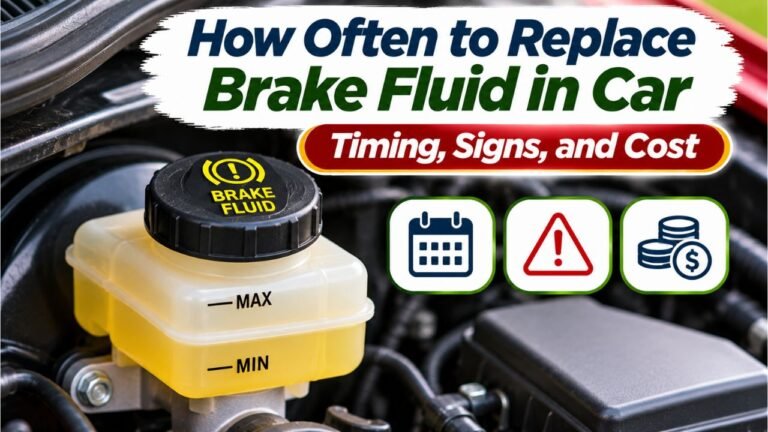
How Often Should You Change Brake Fluid?
Brake fluid replacement intervals depend on the vehicle.
Many manufacturers specify time-based intervals because conventional glycol-based fluid can absorb moisture.
Common Maintenance Guidance
| Situation | Recommended Approach |
| Manufacturer specifies 2 years | Follow the 2-year interval |
| Manufacturer specifies 3 years | Follow the 3-year interval |
| Manufacturer uses another schedule | Follow that schedule |
| Service history is unknown | Arrange inspection and determine whether replacement is due |
| Fluid is contaminated | Have the system evaluated |
| Wrong fluid was added | Obtain professional diagnosis before driving |
| Hydraulic system was repaired | Follow manufacturer bleeding and replacement procedure |
| Brake pedal is abnormal | Immediate brake-system inspection |
There is no universal replacement interval that applies to every car.
Does DOT 4 Last Longer Than DOT 3?
Not necessarily.
DOT 4 has higher minimum boiling-point requirements, but fluid life also depends on the formulation, operating conditions, and manufacturer schedule.
Do not assume DOT 4 automatically lasts longer.
Does DOT 5.1 Need Changing?
Yes, when required by the manufacturer.
DOT 5.1 is generally glycol-based and can absorb moisture.
Does DOT 5 Last Forever?
No.
Silicone-based DOT 5 behaves differently from glycol fluid, but the braking system still requires appropriate inspection and maintenance.
Can Old Brake Fluid Cause Braking Problems?
Yes.
Moisture contamination can reduce boiling-point performance and contribute to corrosion.
However, brake fluid may need replacement even when the pedal still feels normal.
Does Brake Fluid Color Tell You Which Type It Is?
No.
You should not identify brake fluid type by appearance alone.
Under U.S. brake fluid standards, conventional DOT 3, DOT 4, and nonsilicone DOT 5.1 fluids are generally colorless to amber when supplied.
Silicone-based DOT 5 is specified as purple.
However, color can change with age, contamination, and mixing.
Can You Tell DOT 3 From DOT 4 by Color?
Not reliably.
Both commonly appear clear to amber.
The only dependable way to choose the correct fluid is to confirm the specification.
Does Dark Brake Fluid Mean DOT 5?
No.
Old glycol-based brake fluid can darken over time.
Dark color does not identify the fluid’s DOT classification.
Can You Identify Brake Fluid by Smell?
No.
Smell is not a safe or dependable identification method.
Do not open the reservoir merely to smell its contents.
What if You Don’t Know What Fluid Is Already in the System?
Do not guess or mix in an unknown fluid.
Check the vehicle’s service history and manufacturer specifications.
If there is evidence of prior incorrect fluid use, have the system professionally assessed.
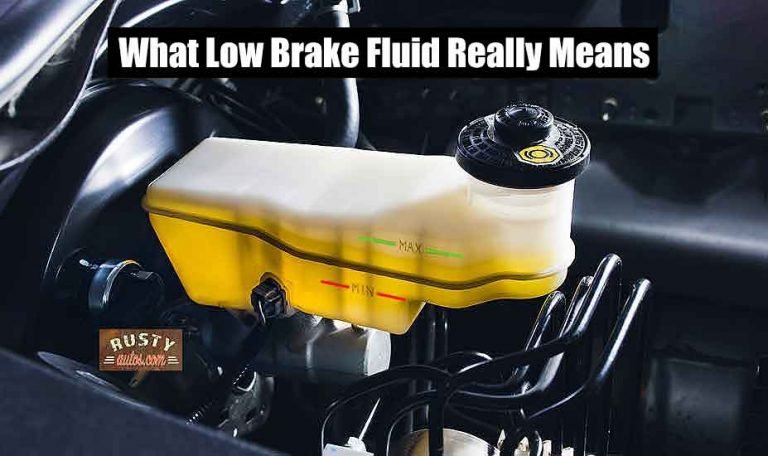
How Full Should the Brake Fluid Reservoir Be?
For most vehicles, brake fluid should be between the MIN and MAX markings.
It does not necessarily need to be at MAX.
Is It Normal for the Level to Drop?
A gradual decrease can occur as brake pads wear.
As the pads become thinner, caliper pistons extend farther, and more fluid occupies the hydraulic circuit.
The reservoir level may decrease as a result.
Should You Top Up When the Level Is Below MAX?
Not automatically.
If the level remains between MIN and MAX, topping up is generally unnecessary unless the manufacturer specifies otherwise.
What if the Level Is Below MIN?
Do not continue driving until the cause has been professionally assessed.
A low level may indicate worn brake components or a hydraulic leak.
Adding fluid does not repair a leak.
Why Is Overfilling a Problem?
When brake caliper pistons are pushed back during pad replacement, fluid returns toward the reservoir.
If someone previously overfilled it, the reservoir may overflow.
Brake fluid can damage painted surfaces.
Follow the manufacturer’s checking and service procedure.
Common Mistakes When Choosing Brake Fluid
Avoid these misunderstandings when buying or using brake fluid.
Assuming Every Car Uses DOT 3
Many vehicles use DOT 3, but others require DOT 4, DOT 4 LV, DOT 5.1, or specialized fluids.
Thinking DOT 5 Is Better Than DOT 4
DOT 5 uses a different base chemistry.
It is not a universal upgrade.
Confusing DOT 5 With DOT 5.1
DOT 5 is generally silicone-based, while DOT 5.1 is glycol-based.
They should not be treated as interchangeable.
Buying Regular DOT 4 Instead of DOT 4 LV
Some vehicles require additional low-viscosity performance.
The product must meet those requirements.
Assuming All Glycol-Based Fluids Are Approved Substitutes
Chemical compatibility is not enough.
The fluid must meet the manufacturer’s specification.
Choosing Based on Price Alone
A cheaper brake fluid is not a good value if it does not meet the vehicle’s requirements.
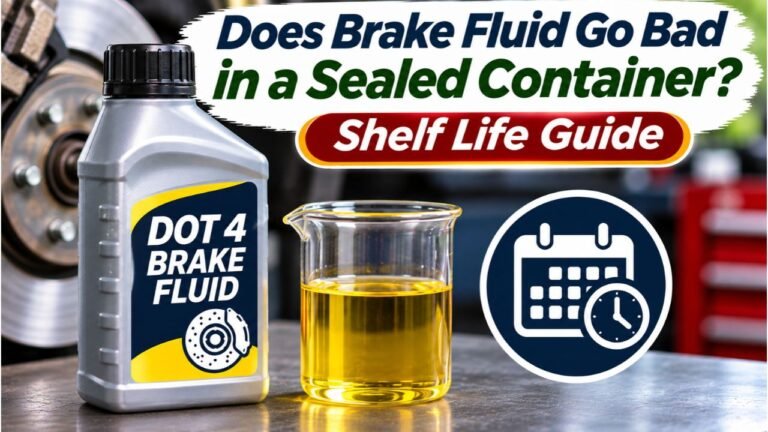
Using an Old Opened Bottle
Glycol-based brake fluid can absorb moisture during storage.
Use fresh fluid from a properly sealed container during service.
Adding Fluid Without Checking the Cause of a Low Level
A low level can indicate brake-pad wear or a hydraulic leak.
Do not use topping up as a substitute for diagnosis.
Mixing Brake Fluid With Engine Oil
Engine oil and other petroleum-based fluids are not substitutes for conventional brake fluid.
Even small amounts can contaminate a braking system.
Ignoring the Owner’s Manual
The correct specification is determined by the vehicle manufacturer.
A generic online compatibility chart cannot cover every production year and regional variation.
How to Choose the Correct Brake Fluid Before Buying
A simple checklist can prevent expensive mistakes.
Brake Fluid Buying Checklist
| Question | What to Verify |
| What vehicle do you drive? | Exact year, make, model, and market |
| What does the owner’s manual specify? | Exact fluid classification |
| Does it require DOT 4 LV? | Additional low-viscosity standard |
| Does it list a manufacturer specification? | Exact matching approval or performance requirement |
| Is the fluid glycol- or silicone-based? | Correct system chemistry |
| Is the bottle sealed? | Fresh, uncontaminated product |
| Does the fluid meet all listed standards? | Check package specifications |
| Has another fluid already been added? | Confirm service history |
| Is the reservoir level low? | Investigate the cause |
| Is the brake system functioning normally? | Seek inspection if symptoms exist |
For many drivers, the safest purchasing process is straightforward: check the owner’s manual, identify the exact specification, and buy a fresh product that meets it.
Do not choose a higher DOT number simply because it sounds more advanced.
Conclusion
So, do all cars take the same brake fluid? No. Different vehicles require different brake fluid specifications depending on their hydraulic components, ABS and stability control systems, temperature requirements, and manufacturer recommendations.
DOT 3 and DOT 4 are common glycol-based fluids, while DOT 4 LV has additional low-viscosity requirements.
DOT 5 is generally silicone-based and should not be mixed with conventional glycol brake fluid.
DOT 5.1 is glycol-based despite its similar name to DOT 5.
For some vehicles, the manufacturer specifies more than a basic DOT classification. A fluid may also need to meet ISO 4925 Class 6 or another manufacturer-specific requirement.
I recommend checking the exact owner’s manual and reservoir-cap information before selecting brake fluid. Use an approved fluid from a properly sealed container, and avoid unnecessary mixing.
If the wrong fluid has already entered the braking system, do not continue driving until a qualified technician has evaluated the situation.
The safest brake fluid is not the one with the highest DOT number or most expensive label. It is the fluid that meets your vehicle manufacturer’s exact specification.
FAQs About Whether All Cars Use the Same Brake Fluid
Do All Cars Use DOT 3 Brake Fluid?
No. Some vehicles specify DOT 3, while others require DOT 4, DOT 4 LV, DOT 5.1, or another approved fluid. Certain specialized hydraulic systems use different fluid chemistry altogether. Check the owner’s manual for the exact vehicle before purchasing.
Can I Use DOT 4 Brake Fluid in a Car That Takes DOT 3?
Sometimes, if the manufacturer explicitly permits it. DOT 3 and DOT 4 are generally glycol-based and chemically compatible, but that does not mean every vehicle approves the substitution. Follow the owner’s manual rather than assuming DOT 4 is always an acceptable upgrade.
Can I Put DOT 3 in a DOT 4 Brake System?
Do not do so unless the manufacturer explicitly allows it. DOT 3 has lower minimum boiling-point requirements than DOT 4. Adding it may reduce the resulting mixture’s high-temperature performance below the vehicle’s specification.
Is DOT 5 Brake Fluid Compatible With DOT 3 or DOT 4?
No. Silicone-based DOT 5 is not interchangeable with conventional glycol-based DOT 3 or DOT 4. Adding it to an incompatible brake system can create serious hydraulic problems. Use DOT 5 only in systems specifically approved for it.
Is DOT 5.1 the Same as DOT 5?
No. DOT 5.1 is generally glycol-based, while DOT 5 is silicone-based. Despite their similar names, they have different chemical properties and should not be mixed. Always check the exact fluid specification.
Can You Use Regular DOT 4 Instead of DOT 4 LV?
Not automatically. DOT 4 LV has additional low-temperature viscosity requirements. Vehicles specifying DOT 4 LV or ISO 4925 Class 6 may require those characteristics for proper hydraulic and electronic brake-control operation. Use fluid that meets every listed requirement.
Does Brake Fluid Brand Matter?
The exact manufacturer-approved specification is generally more important than brand name. However, not every aftermarket product with the same basic DOT label meets additional vehicle-specific requirements. Check the product’s complete specifications and the manufacturer’s instructions.
What Happens if You Use the Wrong Brake Fluid?
The consequences depend on the mistake. Incorrect fluid can reduce boiling-point performance, affect hydraulic-system response, damage seals, or cause brake malfunction. If an incompatible fluid has been added, do not drive until the system has been professionally evaluated.
Do Electric Cars Use Different Brake Fluid?
Not necessarily, but their requirements vary by model. Electric cars still have hydraulic braking systems despite regenerative braking. Some require particular low-viscosity or manufacturer-specific fluids. Follow the EV’s owner’s manual rather than using a generic recommendation.
Can You Mix Different Brake Fluid Brands?
Sometimes, when the products have compatible chemistry and meet the exact specifications required by the vehicle. However, matching DOT labels alone may not establish that all performance requirements are satisfied. Avoid unnecessary mixing and use the manufacturer’s recommended specification.