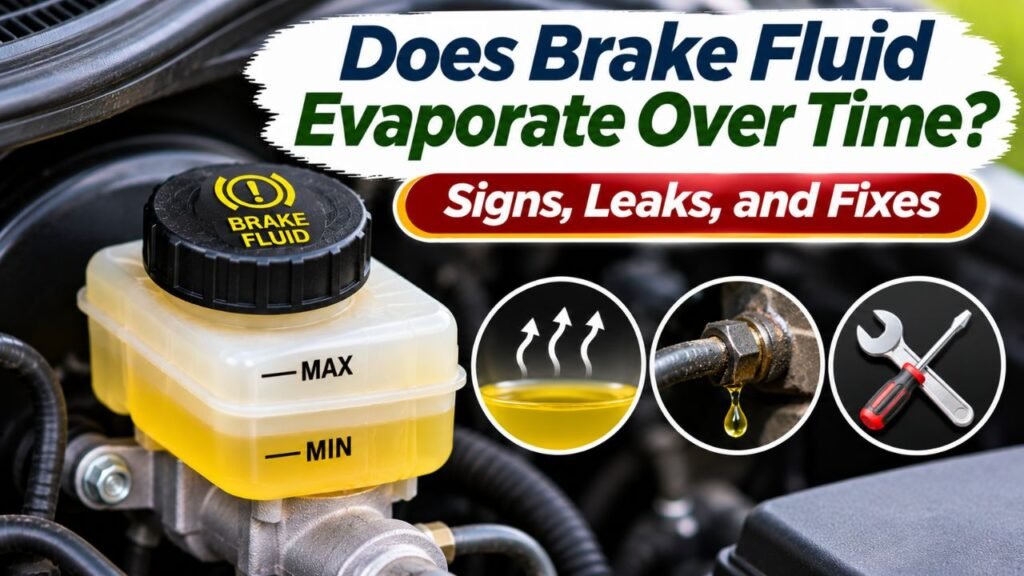
Does Brake Fluid Evaporate Over Time? Signs, Leaks, and Fixes
Brake fluid does not normally evaporate in any significant amount from a properly functioning vehicle braking system. Unlike gasoline or water left in an open container, automotive brake fluid is designed to withstand high temperatures and remain inside a largely closed hydraulic system. If the brake fluid level drops noticeably, worn brake pads or a hydraulic leak are more likely explanations than evaporation.
However, brake fluid does change over time. Most passenger vehicles use glycol-based DOT 3, DOT 4, or DOT 5.1 fluid, which gradually absorbs moisture from its surroundings. This can lower its boiling point and increase the risk of reduced braking performance during heavy use.
Brake fluid can also boil under excessive heat, forming vapor bubbles inside the hydraulic system. This is different from the slow evaporation people often associate with other automotive fluids.
Understanding these differences is important because a falling fluid level may indicate a safety problem that requires attention.
In this article, I explain whether brake fluid evaporates over time, why reservoir levels change, how heat and moisture affect brake fluid, and how to recognize leaks. I also cover brake fluid types, replacement intervals, safe fluid-level checks, and common maintenance mistakes.
Does Brake Fluid Evaporate Over Time? Quick Answer
No, brake fluid should not gradually disappear through ordinary evaporation in a properly maintained hydraulic braking system.
Brake fluid is specifically formulated to transmit hydraulic pressure while tolerating the temperatures generated during braking.
Although its components have physical vapor pressures and can vaporize under extreme conditions, normal operating conditions do not produce significant ongoing fluid loss through evaporation.
Brake Fluid Changes Explained
| Condition | Does It Happen? | Effect on Brake Fluid |
| Normal evaporation from a closed brake system | Negligible | Should not cause noticeable fluid loss |
| Moisture absorption | Yes, for glycol-based fluid | Reduces boiling-point performance |
| Fluid level dropping with brake pad wear | Yes | More fluid occupies the wheel brake components |
| Hydraulic fluid leak | Possible | Causes actual fluid loss |
| Brake fluid boiling under excessive heat | Possible | Produces compressible vapor bubbles |
| Fluid deterioration over time | Yes | Can reduce braking-system protection and performance |
| Evaporation from an open bottle | Some loss is physically possible | Moisture exposure and contamination are greater concerns |
| Loss through a damaged reservoir cap | Possible under abnormal conditions | Requires inspection |
According to HELLA’s technical guide to brake fluid and maintenance, brake fluid must withstand high operating temperatures without evaporating during normal braking. The guide also explains that glycol-based brake fluids absorb moisture, which can reduce their boiling points.
Why Is This Important?
A driver may notice the reservoir level slowly falling and assume the fluid is disappearing naturally.
However, hydraulic brake systems do not normally consume brake fluid the way an engine consumes gasoline.
The level may change as brake components wear, but actual fluid loss requires investigation.
Key Takeaway: Brake fluid does not normally evaporate away. A falling reservoir level should prompt inspection of brake wear and possible leaks.
Why Doesn’t Brake Fluid Evaporate Like Water?
Brake fluid has different chemical and physical properties from water or gasoline.
It is formulated to function under high temperatures and pressure.
1. Brake Fluid Has a High Boiling Point
Conventional automotive brake fluids have boiling points substantially higher than that of water.
Water boils at approximately 212°F (100°C) at standard atmospheric pressure.
Fresh DOT 3, DOT 4, and DOT 5.1 fluids are required to meet much higher minimum boiling-point specifications.
These properties help brake fluid remain effective when braking components become hot.
2. The Braking System Is Largely Closed
A typical hydraulic braking system includes:
- Brake fluid reservoir
- Master cylinder
- Brake lines
- Flexible brake hoses
- ABS hydraulic components
- Brake calipers or wheel cylinders
These components create a mostly closed hydraulic circuit.
The reservoir may have a diaphragm or other pressure-compensation arrangement, and moisture can still enter slowly through certain materials.
However, there is no normal process in which large amounts of brake fluid evaporate into the atmosphere.
3. Brake Fluid Is Designed for Hydraulic Pressure
Brake fluid transmits pressure from the master cylinder to the brakes.
For effective operation, it must remain a liquid under expected conditions.
Liquids are much less compressible than gases.
If brake fluid forms vapor bubbles, the brake pedal may feel soft because those bubbles compress under pressure.
4. Brake Fluid Has Different Volatility From Gasoline
Gasoline contains relatively volatile compounds and readily produces vapor under ordinary conditions.
Brake fluid is formulated for a very different purpose.
Its comparatively low volatility under normal conditions is one reason it can remain inside a hydraulic braking system for extended periods.
Key Takeaway: Brake fluid resists normal evaporation because of its formulation, high boiling point, and largely closed operating environment.
Why Does Brake Fluid Level Drop Over Time?
If brake fluid is not evaporating, why does the reservoir sometimes show a lower level?
There are two major explanations:
- Normal displacement of fluid as brake pads wear.
- Actual fluid loss from a leak.
Other changes, such as service errors or certain component failures, can also affect the level.
Main Reasons for Low Brake Fluid
| Cause | Is It Normal? | Recommended Action |
| Gradual brake pad wear | Can be normal | Check pad thickness and fluid level |
| Worn brake shoes | Can influence hydraulic component position | Inspect brake condition |
| External brake fluid leak | No | Arrange immediate repair |
| Internal master cylinder failure | No | Diagnose hydraulic performance |
| Damaged reservoir or seal | No | Inspect and replace damaged components |
| Improper bleeding or servicing | No | Correct according to service procedure |
| Brake fluid evaporation | Not a normal explanation | Investigate other causes |
| Temperature-related volume changes | Small variations possible | Evaluate level under specified conditions |
A low fluid level should never be dismissed automatically as evaporation.
How Worn Brake Pads Lower the Fluid Level
Brake pad wear can cause the brake fluid reservoir level to decrease gradually without any fluid actually leaving the braking system.
This is one of the most important distinctions when inspecting the reservoir.
How Does Brake Pad Wear Affect the Fluid?
Disc brakes use pistons inside the brake calipers.
When the brake pedal is pressed, hydraulic pressure pushes the pistons outward, forcing the brake pads against the rotors.
As the friction material wears down, the pistons remain progressively farther outward to compensate for the reduced pad thickness.
More hydraulic fluid occupies the expanded volume behind those pistons.
Consequently, less fluid remains in the reservoir.
Does This Mean the Fluid Is Lost?
No.
The fluid has moved to another part of the hydraulic system.
It has not necessarily leaked or evaporated.
Is a Gradually Falling Level Normal?
A gradual reduction within the manufacturer’s acceptable range may accompany normal brake wear.
For example, the 2026 Hyundai owner’s manual instructions for checking brake fluid explain that the reservoir level can decrease as brake linings wear.
However, Hyundai also warns that an excessively low level or repeated need for additional brake fluid requires brake-system inspection.
Why Shouldn’t You Always Top Off the Reservoir?
If the level has fallen because the brake pads are worn, adding fluid to the MAX mark without considering pad condition can create another problem.
When new brake pads are installed, the caliper pistons are normally returned toward their original positions.
This pushes fluid back toward the reservoir.
If the reservoir was previously overfilled, fluid may overflow during brake service.
Brake fluid can damage painted surfaces and create other hazards.
What Should You Do Instead?
Inspect the brake pads and follow the vehicle manufacturer’s fluid-level guidance.
If the level is unexpectedly low, inspect for leakage.
Do not assume every low reading can be corrected simply by adding fluid.
Key Takeaway: Brake pad wear can lower reservoir fluid levels without actual fluid loss. The fluid remains within the hydraulic system.
Can a Brake Fluid Leak Look Like Evaporation?
Yes.
A small hydraulic leak may gradually lower the reservoir level without producing an obvious puddle beneath the vehicle.
A driver may incorrectly assume that the fluid is evaporating.
Common Brake Fluid Leak Locations
Potential leak points include:
- Brake lines
- Flexible brake hoses
- Caliper piston seals
- Wheel cylinders
- Master cylinder
- Brake fluid reservoir
- Reservoir connections
- Hydraulic fittings
- ABS hydraulic components
The exact locations depend on the vehicle’s brake-system design.
Why Are Small Leaks Difficult to Notice?
A leak may occur only when the system is pressurized.
Fluid may collect inside a wheel assembly, protective cover, or other concealed area.
In some situations, the amount of fluid reaching the ground is very small.
A leak near the master cylinder may also be difficult to identify without inspection.
Signs of a Possible Leak
Warning signs include:
- Brake fluid level repeatedly dropping
- Brake warning light
- Wetness around hydraulic components
- Fluid stains near wheels
- Soft or spongy brake pedal
- Brake pedal sinking unusually far
- Reduced braking performance
- Need for frequent brake fluid top-ups
Not every symptom proves a leak.
For example, a soft pedal can also result from trapped air or overheated brake fluid.
Can a Brake Fluid Leak Be Dangerous?
Yes.
A hydraulic leak can reduce the system’s ability to generate the pressure needed for braking.
If the pedal sinks abnormally, braking performance changes, or a leak is suspected, do not continue driving the vehicle.
Arrange appropriate inspection and transportation.
Key Takeaway: A slow brake fluid leak can resemble gradual evaporation. Repeated fluid loss requires diagnosis rather than routine topping off.
Does Brake Fluid Evaporate When It Gets Hot?
Brake fluid can vaporize if it becomes hot enough to boil, but this is not the same as normal evaporation over time.
This distinction matters because brake fluid boiling can seriously affect braking performance.
How Hot Can Brake Fluid Get?
Braking converts vehicle movement into heat.
The heat is generated primarily at the contact between brake pads and rotors, or brake shoes and drums.
Some of that heat transfers to the calipers, wheel cylinders, and brake fluid.
During extended downhill driving, towing, or repeated heavy braking, fluid temperatures can rise considerably.
What Happens When Brake Fluid Boils?
If the fluid reaches its boiling point, vapor bubbles can form.
These bubbles are compressible.
When the driver presses the pedal, some of the hydraulic force compresses the bubbles rather than efficiently operating the wheel brakes.
This can result in:
- Spongy pedal feel
- Increased pedal travel
- Reduced braking response
- Longer stopping distances
- Severe braking loss
What Is Vapor Lock?
Vapor lock occurs when vapor formation within the hydraulic system interferes with proper pressure transmission.
According to Brembo’s explanation of brake fluid and vapor lock, excessive brake fluid temperatures can create vapor bubbles that compromise hydraulic pressure and braking efficiency.
Does Brake Fluid Boiling Empty the Reservoir?
Not normally.
Boiling within a hydraulic system does not mean the fluid is simply escaping into the atmosphere.
Vapor may form within the system and change the way pressure is transmitted.
However, severe overheating can be associated with other problems requiring inspection.
Can Brake Fluid Boil at Normal Temperatures?
Fresh, correct-specification brake fluid is formulated to withstand normal operating temperatures.
However, moisture contamination lowers its boiling point.
This increases the likelihood of vapor formation during heavy braking.
Key Takeaway: Brake fluid can boil under excessive heat, causing vapor bubbles and braking problems. That is different from gradual evaporation or normal reservoir-level reduction.
Does Brake Fluid Absorb Moisture Over Time?
Yes. Most conventional automotive brake fluids are hygroscopic, meaning they absorb moisture from the surrounding environment.
This is a major reason brake fluid requires periodic replacement even when the reservoir level remains normal.
Which Brake Fluids Absorb Moisture?
The most common glycol-based types include:
- DOT 3
- DOT 4
- DOT 4 LV
- DOT 5.1
These fluids absorb moisture over time.
DOT 5 silicone-based brake fluid behaves differently and does not absorb water in the same way.
However, DOT 5 is not interchangeable with the glycol-based products.
How Does Moisture Enter a Closed Brake System?
A brake system is largely closed but not perfectly isolated from the environment.
Moisture can gradually enter through:
- Certain flexible brake hose materials
- Reservoir ventilation or diaphragm interfaces
- Service exposure
- Improperly sealed fluid containers
- Contaminated replacement fluid
Even when the vehicle is rarely driven, this process can continue.
Does Moisture Increase or Decrease Brake Fluid Volume?
Moisture absorption changes the fluid’s composition.
It does not explain a noticeable loss of brake fluid from the reservoir.
In fact, moisture is entering the fluid rather than the fluid evaporating away.
The quantity absorbed is not a useful method for estimating reservoir-level changes.
Why Is Moisture Harmful?
Excessive moisture can:
- Lower brake fluid boiling point
- Increase the risk of vapor formation
- Promote corrosion in some hydraulic components
- Reduce reliability during heavy braking
- Affect the long-term condition of the braking system
Can Brake Fluid Be Bad Even When the Level Is Full?
Yes.
A full reservoir does not guarantee the fluid is in good condition.
The level indicates the amount of fluid present, not its moisture content, boiling point, or chemical suitability.
Key Takeaway: Moisture absorption is a more important long-term concern than evaporation. Brake fluid can deteriorate while remaining at a normal level.
Brake Fluid Boiling Points: DOT 3 vs. DOT 4 vs. DOT 5.1
Brake fluid specifications include minimum boiling-point requirements.
These standards help distinguish between fresh fluid and fluid containing a defined amount of moisture.
Minimum Boiling-Point Comparison
| Brake Fluid | Minimum Dry Boiling Point | Minimum Wet Boiling Point |
| DOT 3 | 401°F (205°C) | 284°F (140°C) |
| DOT 4 | 446°F (230°C) | 311°F (155°C) |
| DOT 5.1 | 500°F (260°C) | 356°F (180°C) |
These values represent standard minimum performance requirements, not the actual boiling point of every commercial product.
Some formulations exceed these minimums.
What Is Dry Boiling Point?
Dry boiling point describes the performance of new fluid under standardized testing conditions.
It is an important measure of the fluid’s initial high-temperature capability.
What Is Wet Boiling Point?
Wet boiling point describes the fluid’s performance after a standardized moisture-conditioning procedure.
It illustrates how moisture can reduce boiling resistance.
Why Is the Difference Important?
Suppose a fluid initially has a high boiling point.
As moisture accumulates, it may begin to boil at a much lower temperature.
During prolonged braking, this increases the risk of vapor bubbles.
Is Higher DOT Number Always Better?
No.
The vehicle’s braking system is designed around specific fluid requirements.
Some modern vehicles require particular low-viscosity DOT 4 formulations for ABS and stability-control performance.
DOT 5 silicone fluid is chemically different from DOT 5.1 glycol-based fluid.
Always follow the vehicle manufacturer’s specification.
Key Takeaway: Brake fluid has a high boiling point when fresh, but moisture can significantly reduce heat resistance. Use the correct fluid and follow the specified service interval.
Does Brake Fluid Evaporate From an Open Container?
An open bottle behaves differently from fluid inside a properly maintained hydraulic braking system.
Some physical evaporation of volatile components is possible, especially with heat and extended exposure.
However, moisture absorption and contamination are usually the more important concerns for conventional brake fluid left open.
Why Should Brake Fluid Bottles Stay Sealed?
Glycol-based brake fluid can absorb moisture from the surrounding air.
An open container exposes the fluid to changing humidity and potential contamination.
Over time, its condition may become unsuitable for reliable brake-system service.
Does an Open Bottle Lose Fluid?
Small amounts of certain components may evaporate under particular conditions.
However, the fluid’s volume is not a reliable indication of whether it is still usable.
A bottle can remain nearly full while the fluid absorbs enough moisture to affect its performance.
Can You Use Brake Fluid Left Open Overnight?
The safest approach is to avoid using fluid that has been exposed to open air for an extended or uncertain period.
Vehicle manufacturers commonly recommend using fresh brake fluid from a properly sealed container.
Check the product and vehicle instructions before use.
What About a Previously Opened but Recapped Bottle?
The condition depends on:
- How long it has been stored
- How tightly it was resealed
- Humidity exposure
- Storage temperature
- Product instructions
- Whether contamination occurred
There is no universal period that guarantees every previously opened bottle remains suitable.
When fluid condition is uncertain, using a new sealed container is generally more dependable.
Can You Heat Brake Fluid to Remove Moisture?
Do not attempt to heat or boil used brake fluid to restore it.
Heating does not provide a safe or reliable method of restoring brake-fluid performance.
Contaminated or deteriorated fluid should be replaced according to the proper service procedure.
Key Takeaway: Open brake fluid containers should be tightly sealed, and fluid exposed to air for an extended period should not be assumed safe.
Is Brake Fluid Loss Normal Over Time?
It is important to distinguish a falling reservoir reading from actual loss of hydraulic fluid.
Normal Changes
A gradual fluid-level decrease may accompany normal brake pad wear.
As the caliper pistons extend to compensate for worn friction material, more brake fluid occupies the caliper chambers.
Small temperature-related changes in fluid volume are also possible.
Abnormal Changes
Fluid loss is concerning when:
- The reservoir level drops suddenly.
- The level falls below the permitted range.
- The reservoir needs frequent refilling.
- Visible leaks appear.
- Brake warning lights activate.
- The pedal becomes soft or sinks unusually far.
- Braking performance changes.
Does Brake Fluid Need Regular Topping Up?
Not ordinarily in a healthy, properly serviced system.
Fluid levels should be monitored according to the owner’s manual.
If brake pad wear explains a gradual decline, topping off may not be necessary.
If fluid is being lost through a leak, topping off does not solve the problem.
Can Brake Fluid Disappear Without a Visible Leak?
Yes, fluid may leak into areas that are difficult to inspect visually.
For example, some master cylinder failures can allow fluid to leak into adjoining components rather than onto the ground.
This is why repeated fluid loss deserves professional investigation even when no puddle is visible.
Key Takeaway: Normal brake wear can change the reservoir level. Actual hydraulic fluid loss is not normal and should be investigated.
How to Check Whether Your Brake Fluid Is Low
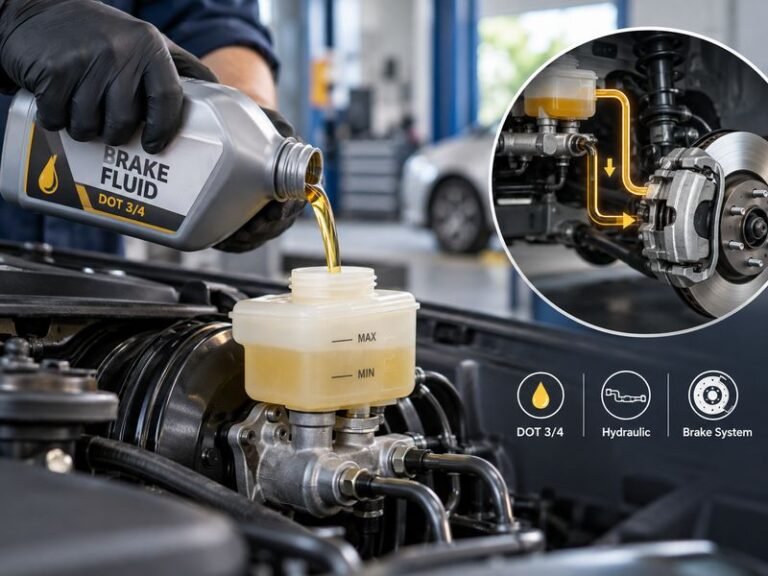
Most passenger vehicles have a translucent brake fluid reservoir with MIN and MAX markings.
The inspection method varies by vehicle.
Step 1: Park Safely
Park on level ground.
Turn off the vehicle and secure it.
Follow the owner’s manual if the vehicle requires a particular operating condition for fluid-level inspection.
Step 2: Locate the Reservoir
Open the hood and identify the brake fluid reservoir.
It is often mounted near the master cylinder.
Do not confuse it with the coolant, washer-fluid, or power-steering reservoir.
Step 3: Clean the Outside
Wipe away dirt so the markings are easier to read.
Keep the reservoir cap closed unless the manufacturer requires it to be opened for service.
Step 4: Check the Fluid Level
Observe the level relative to the MIN and MAX marks.
The correct reference range depends on the vehicle.
Step 5: Inspect for Warning Signs
Look for:
- Reservoir cracks
- Wetness around hydraulic connections
- Visible leaks
- Warning lights
- Abnormal brake-pedal response
Do not assume a low reading is caused by evaporation.
Step 6: Check Brake Pad Condition
If the level has decreased gradually, brake pad wear may be contributing.
Have pad thickness and brake components inspected as appropriate.
Step 7: Seek Service When Needed
If the fluid level is unusually low or repeatedly decreases, arrange brake-system inspection.
If braking behavior changes or a leak is suspected, do not continue driving.
Key Takeaway: Inspect the reservoir level without unnecessarily opening it, and investigate any unexpected fluid decrease.
Can You Just Add More Brake Fluid When the Level Drops?
Sometimes additional fluid is required, but topping off should not be the automatic response to every low reading.
When Might Topping Off Be Appropriate?
It may be appropriate when the manufacturer’s procedure calls for it and the cause of the level change has been assessed.
Always use the specified brake fluid.
When Should You Avoid Simply Adding Fluid?
Do not rely on topping off when:
- The level is dropping repeatedly.
- A hydraulic leak is suspected.
- The brake pedal feels abnormal.
- The brake warning light is active.
- The fluid is contaminated.
- The brake pads are significantly worn and scheduled for replacement.
Why Can Overfilling Cause Problems?
When worn brake pads are replaced, the caliper pistons are pushed back into their bores.
This returns hydraulic fluid toward the reservoir.
If the reservoir was previously overfilled, it may overflow.
Brake fluid can damage paint and other surfaces.
Can You Mix DOT 3 and DOT 4?
Do not assume different brake fluid specifications are interchangeable for your vehicle.
Certain glycol-based fluids are chemically compatible in general, but vehicle manufacturers may require specific formulations.
Follow the owner’s manual rather than mixing fluids based only on the DOT label.
Never substitute silicone-based DOT 5 for DOT 5.1 or other glycol-based fluids unless the system was explicitly designed for it.
What Happens if the Wrong Fluid Is Added?
Petroleum-based products such as engine oil or power steering fluid can damage rubber components in many conventional braking systems.
If an incompatible fluid was added, stop using the vehicle and obtain professional service.
Key Takeaway: Adding fluid may temporarily restore the level, but it does not repair leaks or correct deteriorated brake fluid.
How Often Should Brake Fluid Be Replaced?
Brake fluid should be replaced according to the vehicle manufacturer’s maintenance schedule.
Unlike gasoline, it is not consumed during normal operation.
However, its condition can deteriorate as moisture enters the system.
Typical Replacement Guidance
Some manufacturers recommend brake fluid replacement approximately every two years.
Others specify three years, different initial and recurring intervals, or maintenance schedules based on vehicle-specific requirements.
There is no universal interval appropriate for every vehicle.
Does Low Mileage Mean Brake Fluid Lasts Longer?
Not necessarily.
Moisture absorption can occur while a vehicle is parked.
A car driven only occasionally may still require time-based brake fluid maintenance.
Does Brake Fluid Expire Inside the Vehicle?
Its performance can deteriorate with age and contamination.
This is different from evaporation.
The fluid may remain in the reservoir while its boiling-point performance decreases.
Can You Judge Brake Fluid by Color?
Color can provide clues, but it is not a reliable measurement of moisture content or boiling point.
Some brake fluids naturally become darker over time.
A clean appearance does not guarantee the fluid meets all performance requirements.
Should You Test Brake Fluid Moisture?
Professional testing can help assess condition.
However, inexpensive moisture testers vary in accuracy and may not fully describe boiling-point performance.
Follow the manufacturer’s replacement schedule rather than relying exclusively on color or a basic tester.
Is a Brake Fluid Flush Necessary?
A proper brake-fluid exchange replaces old fluid through the hydraulic circuits according to the vehicle’s service procedure.
Merely removing fluid from the reservoir and adding fresh fluid does not replace the old fluid in the lines, calipers, or ABS hydraulic unit.
Some systems require specialized bleeding procedures.
Key Takeaway: Brake fluid needs periodic replacement because of moisture and aging, not because it normally evaporates away.
Does DOT 5 Brake Fluid Evaporate Differently?
DOT 5 is a silicone-based brake fluid.
It differs chemically from glycol-based DOT 3, DOT 4, and DOT 5.1 fluids.
Does DOT 5 Absorb Moisture?
Silicone-based DOT 5 does not absorb moisture in the same manner as glycol-based brake fluids.
However, that does not mean water cannot enter a system using DOT 5.
Water may remain separate from the fluid, potentially collecting in localized areas.
Does DOT 5 Last Forever?
No.
Its performance and suitability depend on the system, contamination, and manufacturer requirements.
It should not be assumed maintenance-free.
Can DOT 5 Evaporate?
Like other liquids, it has physical properties that determine its behavior under heat.
However, ordinary brake fluid disappearance is not an expected maintenance condition simply because the product is DOT 5.
Can DOT 5 Be Used in Any Car?
No.
DOT 5 is not a universal substitute for DOT 3, DOT 4, or DOT 5.1.
Use it only in systems approved for silicone-based fluid.
DOT Fluid Comparison
| Type | Base Chemistry | Absorbs Moisture? | Common Consideration |
| DOT 3 | Glycol-based | Yes | Follow replacement schedule |
| DOT 4 | Glycol-based | Yes | Often used in modern vehicles |
| DOT 4 LV | Specialized glycol-based | Yes | Designed for particular viscosity requirements |
| DOT 5 | Silicone-based | Not hygroscopic in the same way | Requires compatible system |
| DOT 5.1 | Glycol-based | Yes | Different from DOT 5 |
Key Takeaway: DOT 5 has different moisture behavior, but no brake fluid type should be assumed to disappear through normal evaporation or remain suitable indefinitely.
What Are the Warning Signs of Bad Brake Fluid?
Brake fluid problems can involve contamination, moisture, leaks, air in the hydraulic system, or component failures.
Symptoms may overlap.
Common Warning Signs
| Warning Sign | Possible Explanation | Recommended Response |
| Fluid level slowly falling | Brake pad wear or leak | Check brake condition |
| Sudden fluid-level drop | Possible hydraulic leak | Stop driving and arrange inspection |
| Spongy brake pedal | Air or vapor in system | Professional diagnosis |
| Pedal sinks toward floor | Hydraulic pressure problem | Do not drive |
| Brakes feel weak after heavy use | Overheating or vapor formation | Stop safely and arrange service |
| Dark or cloudy fluid | Aging or contamination | Inspect fluid condition |
| Visible fluid leaks | Damaged hydraulic component | Repair promptly |
| Brake warning light | Low fluid or another brake fault | Investigate immediately |
| Fluid needs frequent topping off | Possible leak | Professional inspection |
What Does a Spongy Brake Pedal Mean?
A spongy pedal can indicate compressible gas within the hydraulic system.
Possible causes include trapped air and vapor formation from overheated fluid.
Other hydraulic faults can also affect pedal feel.
What if the Brake Pedal Sinks to the Floor?
This can indicate a serious hydraulic braking problem.
Do not drive the vehicle.
Arrange inspection and repair.
Can Old Brake Fluid Cause Brake Failure?
Yes, in certain conditions.
Moisture-contaminated fluid can boil during heavy braking.
The resulting vapor bubbles may reduce effective hydraulic pressure transmission.
Severe contamination or system defects may create additional risks.
Key Takeaway: Brake fluid problems can affect braking safety even when the reservoir is full. Unusual pedal feel, fluid loss, and warning lights should never be ignored.
How to Prevent Brake Fluid Problems Over Time
Preventive maintenance is more effective than waiting for braking symptoms.
1. Follow the Manufacturer’s Replacement Schedule
Check the owner’s manual for the required brake fluid service interval.
Replace fluid according to the specified procedure.
2. Keep the Reservoir Cap Secure
A properly installed cap helps protect the fluid from external contamination.
Do not open it unnecessarily.
3. Use Fresh Brake Fluid
Use the correct specification from a properly sealed container.
Avoid fluid with an uncertain storage or exposure history.
4. Inspect the Fluid Level
Check the reservoir periodically according to the owner’s manual.
Monitor unexpected changes.
5. Inspect Brake Pads
Brake pad wear may explain a gradual reduction in reservoir level.
Do not evaluate the level without considering brake condition.
6. Repair Leaks Immediately
A hydraulic leak can affect braking ability.
Have damaged hoses, lines, seals, and other components repaired promptly.
7. Avoid Incorrect Fluid
Do not introduce oil, water, or incompatible brake fluids into the system.
8. Avoid Excessive Brake Overheating
Use appropriate driving techniques on long downhill roads.
For example, suitable engine braking or regenerative braking, where applicable, can help reduce sustained friction-brake heating.
Follow vehicle-specific operating instructions.
9. Maintain Brake Components
Healthy brake calipers, hoses, master cylinders, and related components help preserve system integrity.
10. Use Qualified Service for Hydraulic Repairs
Brake fluid replacement and bleeding procedures may be complicated on vehicles with ABS or electronically controlled braking systems.
Use appropriate service equipment and procedures.
Key Takeaway: Correct fluid, secure caps, regular inspections, and timely maintenance are the best ways to preserve brake-fluid performance.
Common Misconceptions About Brake Fluid Evaporation
Myth 1: Brake Fluid Naturally Disappears Every Year
Brake fluid does not normally disappear from a healthy hydraulic system.
A falling level may reflect brake wear or an actual leak.
Myth 2: A Low Reservoir Always Means a Leak
Not necessarily.
Disc brake pad wear can move fluid from the reservoir into the calipers.
However, an unexpected drop still requires investigation.
Myth 3: Brake Fluid Cannot Boil
It can.
Excessive temperatures may create vapor bubbles and compromise braking performance.
Myth 4: A Full Reservoir Means the Fluid Is Good
No.
Moisture and contamination can affect fluid performance without noticeably reducing its level.
Myth 5: Adding Fresh Fluid Restores Old Fluid
Topping off does not remove moisture or contamination from the rest of the hydraulic system.
Proper replacement requires the specified service procedure.
Myth 6: Brake Fluid Should Be Replaced Only When It Looks Dark
Color alone cannot establish the fluid’s moisture content or boiling point.
Use the manufacturer’s maintenance schedule.
Myth 7: DOT 5 and DOT 5.1 Are the Same
They are chemically different.
DOT 5 is silicone-based, while DOT 5.1 is glycol-based.
Myth 8: Brake Fluid Boiling Is the Same as Evaporation
No.
Boiling inside the hydraulic system can create dangerous vapor bubbles.
Normal evaporation would involve fluid gradually escaping from its container or system, which should not be occurring in a healthy brake system.
Myth 9: A Small Leak Is Harmless
Even a small hydraulic leak can worsen and reduce braking performance.
It needs prompt attention.
Myth 10: Brake Fluid Never Needs Changing if the Car Is Rarely Driven
Glycol-based brake fluid can absorb moisture over time even when a vehicle sees little use.
Time-based maintenance may still be necessary.
Key Takeaway: The most important distinction is between normal brake wear, hydraulic fluid leakage, moisture absorption, and high-temperature vapor formation.
Conclusion
Brake fluid does not normally evaporate over time in a properly functioning automotive braking system. It has a high boiling point and is contained within a largely closed hydraulic circuit designed to transmit braking pressure.
If the reservoir level gradually decreases, normal brake pad wear may explain the change. As pads wear, the caliper pistons extend and additional fluid moves into the calipers.
However, a sudden drop, repeated need for topping off, or visible fluid loss may indicate a hydraulic leak that requires immediate attention.
Brake fluid can still deteriorate without a noticeable change in volume.
Most conventional glycol-based fluids absorb moisture over time, lowering their boiling points. Under excessive braking heat, this can lead to vapor bubbles that interfere with hydraulic pressure transmission.
This high-temperature vapor formation is different from ordinary evaporation.
I recommend checking brake fluid level and brake pad condition according to the vehicle manufacturer’s instructions, investigating unexpected fluid loss, and replacing the fluid at the specified maintenance interval.
If the brake pedal feels soft, sinks unusually far, or braking effectiveness changes, stop driving and have the system inspected.
A healthy brake system should not require routine fluid replacement simply because the fluid has supposedly evaporated.
FAQs About Does Brake Fluid Evaporate Over Time
Does brake fluid evaporate when a car is parked for months?
Brake fluid should not noticeably evaporate from a properly functioning brake system while the car is parked. However, glycol-based brake fluid can continue absorbing moisture over time. If the reservoir level drops significantly during storage, inspect for leakage rather than assuming evaporation caused it.
Why is my brake fluid low if there is no leak?
Brake pad wear is a common explanation. As disc brake pads become thinner, caliper pistons extend farther, allowing more fluid to occupy the calipers and reducing the amount in the reservoir. However, some hydraulic leaks are difficult to see, so an unexpectedly low level should be investigated.
Does brake fluid evaporate in hot weather?
Normal summer temperatures should not cause significant brake fluid evaporation from a healthy hydraulic system. Brake fluid is formulated to withstand temperatures much higher than ordinary ambient conditions. However, extreme braking heat can cause fluid to boil, particularly when it contains excessive moisture.
Can brake fluid disappear without leaving a puddle?
Yes. Small hydraulic leaks may occur in concealed locations or release too little fluid to create an obvious puddle. The reservoir level can also decrease as brake pads wear without any fluid escaping. Repeated or sudden fluid loss requires professional inspection.
Does brake fluid evaporate from an open bottle?
Some evaporation of certain components is physically possible, but moisture absorption and contamination are usually greater concerns for an open container of conventional brake fluid. A bottle may remain nearly full while the fluid’s properties deteriorate. Use fresh fluid stored according to the manufacturer’s instructions.
How often should you add brake fluid?
A properly maintained brake system should not require frequent topping off. The reservoir level may gradually decrease as brake pads wear, but repeated additions can indicate a hydraulic leak. Check the fluid level and brake condition according to the owner’s manual rather than automatically refilling the reservoir.
Can brake fluid evaporate and cause a soft brake pedal?
Normal evaporation should not cause a soft brake pedal. However, overheated brake fluid can boil and form vapor bubbles inside the hydraulic system. These bubbles compress when the brakes are applied, potentially making the pedal feel spongy and reducing braking effectiveness. This requires prompt brake-system service.