How to Properly Store Brake Fluid: Shelf Life & Safety Guide
Store brake fluid upright in its original container with the cap tightly sealed, in a cool, dry indoor location away from sunlight, water, dirt, petroleum products, and food. Keep opened bottles exposed to air for as little time as possible because common glycol-based brake fluids absorb atmospheric moisture, which gradually lowers their boiling performance.
DOT 3, DOT 4, and DOT 5.1 fluids used in many vehicles are hygroscopic, meaning they absorb moisture. NHTSA requires brake-fluid containers sold in the United States to warn users to keep the fluid clean and dry, store it only in its original container, and keep the container tightly closed to limit moisture absorption.
For how to properly store brake fluid, moisture control matters more than almost anything else. A bottle left uncapped during a brake job or stored with a poorly sealing cap can take on water even though the fluid still looks normal.
Moisture lowers brake fluid’s boiling point and can contribute to corrosion inside hydraulic brake components. Castrol notes that glycol brake fluid absorbs moisture as it ages and reports that about 3.5% water can reduce brake-fluid performance substantially.
Shelf life is not one universal number. ATE currently lists up to five years for one DOT 4 product when stored in its original sealed container within the stated temperature range. A racing DOT 4 fluid from Brembo carries much stricter instructions, telling users to use an opened bottle within two days.
That difference is why the date on the bottle and the manufacturer’s storage instructions matter more than a generic rule such as “opened fluid lasts one year.”
The sections below cover container sealing, temperature, humidity, opened versus unopened bottles, garage storage, DOT-fluid differences, contamination, shelf life, and signs that stored fluid should be discarded.
How to Properly Store Brake Fluid Step by Step
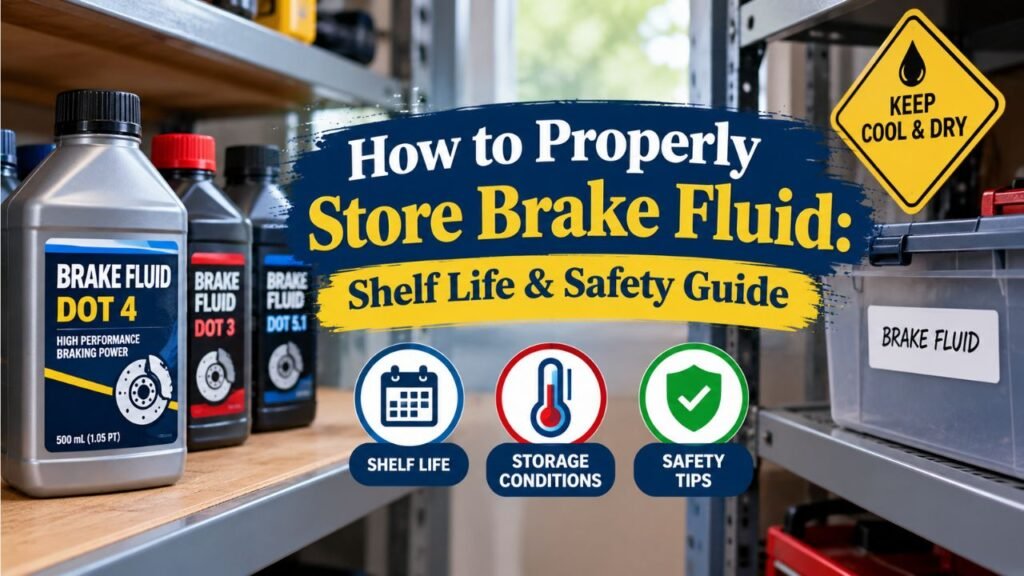
Brake fluid does not require special refrigeration or complicated equipment. Good storage mainly means keeping moisture and contamination out.
1. Keep It in the Original Container
Leave unused brake fluid in the bottle supplied by the manufacturer.
NHTSA’s brake-fluid labeling requirements specifically call for storing brake fluid only in its original container. The required warning also says not to refill the container or use it for other liquids.
The original bottle gives you several advantages:
- Correct product identification
- DOT specification
- Lot or packaging information
- Safety warnings
- Compatible container material
- Proper resealable cap
Pouring leftover fluid into an unlabeled jar, drink bottle, oil container, or generic plastic container creates contamination and identification risks.
2. Tighten the Cap Immediately After Pouring
Do not leave the bottle open while completing the rest of a brake job.
Pour what you need, then reinstall the cap tightly.
Glycol-based brake fluid can absorb moisture from ambient air. A large amount of headspace and repeated opening increase the fluid’s exposure to humid air.
Wipe contamination from the bottle neck before resealing it, but do not introduce water or dirty shop towels into the bottle.
3. Store the Bottle Upright
Keep the container standing on its base.
An upright bottle reduces the chance of fluid leaking around the cap and keeps stored liquid away from the closure for long periods.
Castrol’s current safety information also instructs that opened containers should be carefully resealed and kept upright.
A shallow chemical-resistant tray beneath stored automotive fluids can contain a small leak.
4. Choose a Cool, Dry Location
A closed cabinet in a dry garage, workshop, or utility area is a good location if temperatures remain within the product’s stated storage limits.
ATE’s current DOT 5.1 safety data recommends storage at roughly 50°F to 95°F (10°C to 35°C) and specifically calls for dry conditions and a tightly sealed container.
Different products may list different limits, so check the bottle or safety data sheet.
5. Keep It Out of Direct Sunlight
Do not leave brake fluid on a sunny windowsill, dashboard, truck bed, or shelf exposed to direct afternoon sun.
Castrol’s storage guidance calls for keeping its product in the original container, protected from direct sunlight in a cool, dry, ventilated location.
A closed cabinet also protects the bottle from dust and accidental damage.
6. Separate It From Other Automotive Fluids
Brake fluid must remain free of petroleum contamination.
Do not store it where motor oil, power-steering fluid, penetrating oil, gasoline, or solvent can drip into an open bottle during service.
Even a small amount of petroleum contamination can damage brake-system rubber components.
Keep the brake-fluid bottle labeled and physically separated from fluids that could be mistaken for it.
Key Takeaway: Store brake fluid upright in its original bottle, cap it immediately after pouring, and keep it in a cool, dry indoor location away from sunlight, water, dirt, and petroleum products.
Why Moisture Is a Problem for Stored Brake Fluid
The concern with an opened bottle is not simply that water dilutes the fluid.
Moisture changes the thermal behavior of the braking fluid.
DOT 3, DOT 4, and DOT 5.1 Absorb Moisture
Most passenger vehicles use glycol-ether-based DOT 3, DOT 4, or DOT 5.1 fluid.
These fluids are hygroscopic.
They gradually take moisture into the fluid rather than allowing all water to remain as separate droplets.
Brembo notes that common glycol-based brake fluids absorb atmospheric moisture, which reduces their original braking characteristics over time.
The same property that affects fluid inside a vehicle also matters to an opened bottle.
Moisture Lowers the Boiling Point
Brakes generate substantial heat.
Fresh brake fluid is formulated to resist boiling at temperatures that may occur around calipers and wheel cylinders.
Water has a much lower boiling point than fresh brake fluid.
As moisture content rises, the fluid’s boiling point falls.
NHTSA specifically notes that moisture absorption can lower brake-fluid boiling temperature and increase the chance of vapor lock and brake-system corrosion.
Contamination Can Be Invisible
Do not assume brake fluid is safe simply because it still looks clear.
Moisture can enter without creating visible droplets or obvious discoloration.
That is one reason good storage is more dependable than trying to judge an old opened bottle by appearance alone.
Key Takeaway: Glycol-based brake fluid can absorb invisible atmospheric moisture, lowering its boiling performance even while the fluid still looks clean.
How Long Does Brake Fluid Last in Storage?
Shelf life depends heavily on whether the factory seal is intact.
Unopened Brake Fluid
A sealed bottle generally lasts far longer than an opened one.
For example, ATE currently specifies a shelf life of up to five years for its Super DOT 4 fluid in the original sealed container when kept within its stated storage range of approximately -4°F to 104°F (-20°C to 40°C).
That five-year figure should not be automatically applied to every brand.
Check:
- Production or lot date
- Expiration date if provided
- Bottle condition
- Manufacturer technical data
- Storage history
An unopened bottle that spent years in extreme heat or has a damaged seal deserves more caution than one stored properly indoors.
Opened Brake Fluid
Opening the seal starts a very different storage situation.
The bottle now contains humid atmospheric air, and new air enters each time the cap is removed.
There is no single safe opened-bottle period across every product.
Some standard brake fluids may not state a precise post-opening limit, while specialty products can be much stricter.
High-Performance Brake Fluid Can Have Short Opened Life
Brembo’s current storage instructions for its Racing LCF 600 Plus DOT 4 fluid say to keep the bottle sealed until needed and use it within two days after opening.
That is a racing product, not a universal requirement for all DOT 4 fluid.
It does show why assuming that any opened bottle is good for years can be a mistake.
When the Storage History Is Unknown
If you find a partly used bottle and do not know:
- When it was opened
- How long the cap was off
- If water entered
- If another fluid contaminated it
- Where it was stored
using a fresh sealed bottle is the safer choice for brake service.
Brake fluid is inexpensive compared with replacing ABS hydraulic components, calipers, or dealing with reduced braking performance.
Key Takeaway: Sealed bottles may last several years when the manufacturer permits it, but opened-bottle life varies greatly; follow the product instructions and avoid questionable fluid with an unknown history.
Can You Store Brake Fluid in a Garage?
Yes, a garage can be a suitable storage location if it stays reasonably dry and does not expose the bottle to extreme temperatures.
Choose an Indoor Cabinet
A cabinet keeps the container out of sunlight and away from rain, wash water, and general shop dirt.
Store it upright where it cannot be knocked over.
Keep it away from children’s reach and areas used for food or beverages.
Avoid Hot Areas
Do not store the bottle:
- Beside a furnace
- Directly over a heater
- On a sunny windowsill
- In a vehicle cabin during summer
- Next to welding or grinding areas
High temperatures are unnecessary and can shorten the useful storage life of many chemical products.
Avoid Damp Locations
Do not keep an opened bottle on a wet floor, outside shed ledge, or shelf where rain regularly blows in.
Brake-fluid storage guidance commonly calls for dry conditions.
ATE specifically identifies its glycol-based DOT 5.1 product as hygroscopic and recommends keeping the container tightly sealed and dry.
Protect It From Large Temperature Swings
A garage that swings between extreme heat and cold is not ideal for long-term chemical storage.
Repeated temperature changes can expand and contract the air inside a previously opened bottle and place extra demand on the cap seal.
The manufacturer’s stated storage range remains the deciding reference.
Key Takeaway: Garage storage is fine when the bottle stays indoors, dry, tightly sealed, upright, shaded, and within the manufacturer’s temperature range.
Why Brake Fluid Should Stay in Its Original Container
The original bottle is more than convenient packaging.
U.S. brake-fluid regulations require specific information to remain on the package, including its DOT classification, packager information, lot identification, wet boiling point, and safety warnings.
Keeping the fluid in that container reduces the chance of accidentally mixing it with:
Motor oil, transmission fluid, power-steering fluid, coolant, windshield washer fluid, or another brake-fluid specification.
It also avoids compatibility questions about generic storage containers.
Never pour old brake fluid back into a fresh bottle.
Once fluid has entered a bleeder, reservoir, catch container, funnel, or service tool, treat it as used or potentially contaminated.
How to Tell if Stored Brake Fluid Should Be Discarded
Brake fluid does not always provide a clear visual warning before moisture becomes a concern.
Still, several storage problems make disposal an easy decision.
The Factory Seal Was Damaged
An unopened-looking bottle with a broken seal has effectively been opened.
If you do not know when the damage occurred, the moisture history is unknown.
The Cap Was Left Loose
A cap that sat loose for weeks or months gave humid air far more access than a properly sealed container.
Do not rely on retightening it and assuming the fluid returned to fresh condition.
The Fluid Is Cloudy or Contains Debris
Fresh brake fluid is normally clear to amber depending on formulation.
Cloudiness, suspended particles, dirt, separated material, or visible water contamination are reasons not to use it.
The Bottle Is Unlabeled
Never guess the DOT rating by color.
Brake fluid selection should come from the vehicle manufacturer’s requirement and the product label.
Discard unknown fluid rather than experimenting with a braking system.
It Was Transferred Into Another Container
NHTSA labeling instructions specifically warn users to store brake fluid only in its original container.
Fluid stored in an old water bottle, oil bottle, jar, or unmarked container should not go into a brake system.
The Storage History Is Poor
Extreme heat, outdoor exposure, water intrusion, a damaged bottle, or long-term storage with an unreliable cap can all justify replacement.
Key Takeaway: Discard stored brake fluid when its identity, seal condition, cleanliness, or storage history is uncertain rather than judging it only by color.
How Storage Differs by Brake Fluid Type
DOT ratings identify different performance requirements and formulations.
Storage rules overlap, but the fluids are not chemically identical.
DOT 3 Brake Fluid
DOT 3 is commonly glycol-ether based and hygroscopic.
Keep it:
- Dry
- Tightly capped
- In its original container
- Away from contamination
- Within the product storage-temperature range
Moisture absorption is the main concern after opening.
DOT 4 Brake Fluid
DOT 4 is also normally glycol based and moisture-sensitive.
Many modern passenger vehicles use DOT 4 or a higher-performance variation of it.
Some high-performance DOT 4 products have unusually strict opened-container instructions, so check the label before saving leftovers.
DOT 5.1 Brake Fluid
DOT 5.1 is non-silicone brake fluid despite the “5” in its name.
It is normally glycol based and hygroscopic like DOT 3 and DOT 4.
ATE’s Super DOT 5.1 safety data explicitly describes the product as hygroscopic and calls for dry storage in a tightly sealed container.
DOT 5 Silicone Brake Fluid
DOT 5 is silicone based and differs chemically from DOT 3, DOT 4, and DOT 5.1.
It is not normally considered hygroscopic in the same way as glycol fluids.
That does not mean careless storage is acceptable.
NHTSA’s packaging rules still identify DOT 5 silicone fluid separately and require brake-fluid containers to carry storage and contamination warnings.
Keep DOT 5 clean, sealed, and in its original container.
Never assume DOT 5 and DOT 5.1 are interchangeable because their numbers look similar.
Key Takeaway: DOT 3, DOT 4, and DOT 5.1 are commonly moisture-absorbing glycol fluids; DOT 5 is silicone based, but every brake-fluid type still needs clean, sealed storage and correct identification.
Common Brake Fluid Storage Mistakes
One common mistake is saving a half-full bottle indefinitely simply because the cap has been replaced.
A closed cap slows moisture exposure but does not erase the humid air that already entered the bottle.
Another mistake is transferring leftovers into a smaller household container. That introduces contamination risk and removes the DOT specification and product identification from the fluid.
Do not store funnels inside an open brake-fluid bottle. A funnel can carry dust, oil, cleaner, or water from previous work.
Do not combine leftovers from different bottles merely to reduce shelf space. Even compatible specifications can have different formulations and storage histories.
Never pour fluid removed during bleeding back into the original bottle.
Keep brake fluid away from painted vehicle panels during storage and service. Spilled glycol brake fluid can damage some automotive finishes, so wipe accidental spills using the vehicle or product maker’s recommended procedure.
How to Store Brake Fluid During a Brake Job
A brake-fluid bottle may spend only an hour on the workbench, but that is still the easiest time for contamination to enter.
Open the bottle only when you are ready to add fluid.
Do not leave the cap resting loosely on top.
Keep the bottle away from:
- Open drain pans
- Used brake fluid
- Brake cleaner
- Engine oil
- Coolant
- Water buckets
- Grinding debris
Use clean dedicated brake-service equipment.
If you pour fresh fluid into a temporary bleeding container, do not return unused fluid from that container to the bottle.
Cap the original bottle as soon as you finish pouring.
How to Dispose of Old Stored Brake Fluid
Do not pour unwanted brake fluid onto the ground, into a storm drain, or down a household drain.
Brake fluid should be handled through an appropriate automotive-fluid or household hazardous-waste collection route based on local rules.
Keep waste brake fluid in a compatible, clearly labeled waste container.
Do not mix it with used engine oil unless your recycling facility specifically permits that mixture.
Used brake fluid contaminated with solvents or petroleum products may need different handling.
Contact your local hazardous-waste or automotive-fluid collection facility for its acceptance rules.
Conclusion
For how to properly store brake fluid, keep it in the original container, tightly capped, upright, clean, dry, and protected from direct sunlight and excessive temperature. Those simple steps limit the moisture and contamination that can reduce brake-fluid performance.
Unopened shelf life can extend for years when the product maker states so; ATE, for example, gives one current DOT 4 product up to five years in a sealed original bottle under specified storage conditions. Opened fluid requires more caution because moisture exposure begins as soon as the factory seal is broken.
There is no single opened-bottle deadline that fits every brake fluid. Some specialty fluids have extremely short post-opening recommendations. Check the label and technical information for the exact product.
I would use a new sealed bottle whenever an old container has an unknown opening date, loose cap, questionable storage history, contamination, or missing label. Brake fluid is a poor place to gamble on a questionable leftover chemical.
FAQs About Storing Brake Fluid
How long can unopened brake fluid be stored?
It depends on the product. Some manufacturers specify several years when the bottle remains factory sealed and stays within the stated storage conditions. ATE currently lists up to five years for one DOT 4 fluid in its original sealed container.
How long can brake fluid be stored after opening?
There is no universal period for every brand or DOT formulation. Glycol-based fluid begins being exposed to atmospheric moisture after opening. Some specialty racing fluids specify extremely short periods; Brembo, for example, says to use one racing DOT 4 product within two days after opening.
Should brake fluid be refrigerated?
No. Brake fluid normally belongs in a cool, dry storage area rather than a food refrigerator. Follow the manufacturer’s storage-temperature range and keep it separated from food and drinks.
Can I store brake fluid in the garage?
Yes, if the garage stays dry and the bottle remains upright, tightly sealed, shaded, and within the manufacturer’s temperature limits. Avoid shelves exposed to direct sun, rain, or large heat sources.
Can I transfer brake fluid to another bottle for storage?
Do not do that. NHTSA-required labeling specifically instructs users to store brake fluid only in its original container. Transferring it also creates contamination and misidentification risks.
Does brake fluid go bad if the bottle is never opened?
It can age, but an intact factory seal greatly slows moisture contamination. Follow the manufacturer’s stated shelf life, inspect the bottle condition, and consider how it was stored before using very old fluid.
Can I use brake fluid that has been open for a year?
Only if the manufacturer permits that storage period and you are confident the bottle remained tightly sealed and uncontaminated. If the product gives no clear guidance or its storage history is questionable, fresh fluid is the safer choice.
Does DOT 5 brake fluid absorb moisture like DOT 3 or DOT 4?
DOT 5 silicone fluid behaves differently from glycol-based DOT 3, DOT 4, and DOT 5.1 and is not normally hygroscopic in the same way. It should still remain clean, tightly closed, correctly labeled, and stored in its original container.