Is Brake Fluid the Same as Steering Fluid? Differences Explained
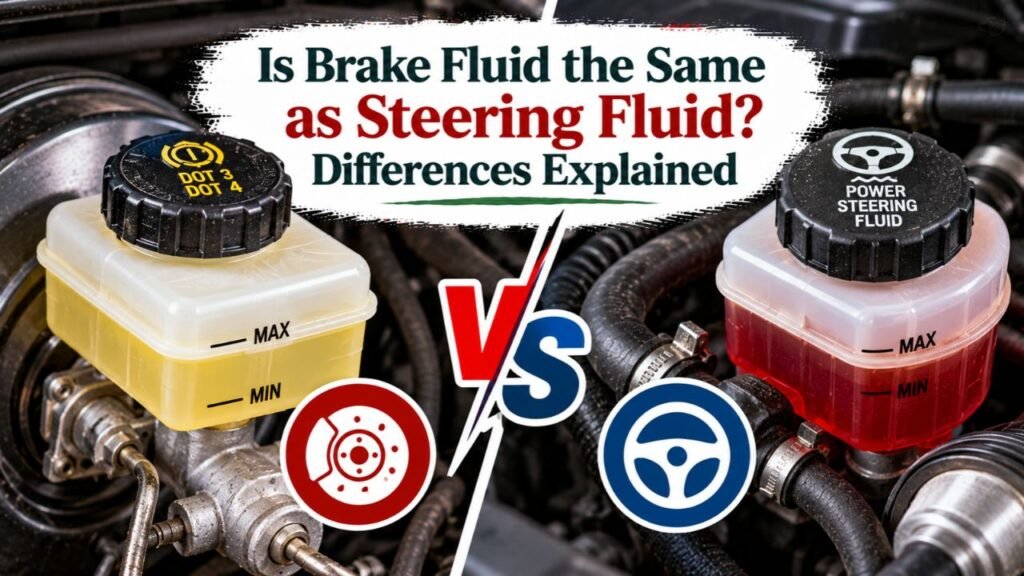
No. Brake fluid and power steering fluid are different hydraulic fluids made for different systems, pressures, temperatures, seals, and operating conditions. Never substitute one for the other unless the vehicle manufacturer specifically lists that exact fluid for that system. Putting steering fluid into a brake reservoir can damage brake-system seals and create a serious braking problem.
Brake fluid transfers pedal force through the master cylinder, brake lines, ABS components, and calipers or wheel cylinders. Most passenger vehicles specify a DOT-rated brake fluid such as DOT 3, DOT 4, or DOT 5.1.
Hydraulic power steering fluid works in the steering pump, hoses, control valves, and steering gear or rack. The required fluid varies widely. Some vehicles use dedicated power steering fluid, while others specify a type of automatic transmission fluid such as DEXRON.
A current 2026 GMC Savana provides a clear example: GM specifies DOT 4 hydraulic brake fluid for the brake system and GM Power Steering Fluid for the steering system. GM warns that using the wrong steering fluid can damage hoses and seals.
So, is brake fluid the same as steering fluid? No. The two reservoirs may both operate hydraulic systems, but the fluid chemistry and system requirements are not interchangeable.
Some newer vehicles make the distinction even simpler because they use electric power steering and have no steering-fluid reservoir at all. GM states that vehicles fitted with electric power steering do not use power steering fluid.
Brake Fluid vs Power Steering Fluid at a Glance
| Feature | Brake Fluid | Power Steering Fluid |
| Main job | Transfers braking force | Provides hydraulic steering assist |
| Common specifications | DOT 3, DOT 4, DOT 5, DOT 5.1 | PSF, ATF, vehicle-specific hydraulic fluid |
| Typical reservoir | Brake master cylinder reservoir | Power steering reservoir |
| Works with | Master cylinder, ABS, calipers, wheel cylinders | Pump, rack/gear, hoses, steering valves |
| Can absorb moisture? | Many DOT brake fluids do | Depends on steering-fluid type |
| Can replace the other? | No | No |
| Used in electric power steering? | Brake system still uses brake fluid | No steering fluid in full EPS systems |
| Wrong-fluid risk | Brake seal damage and brake failure | Pump, seal, hose, or steering damage |
The names may sound similar because both systems use hydraulic pressure on many vehicles. Their chemical requirements are very different.
What Does Brake Fluid Do?
Brake fluid carries hydraulic pressure from the brake pedal to the wheel brakes.
It Transfers Pedal Force
When you press the brake pedal, the master cylinder pressurizes the brake fluid.
That pressure travels through the brake lines to:
- ABS hydraulic components
- Brake calipers
- Wheel cylinders on drum brakes
The pressure then moves the brake pads or shoes against the rotor or drum.
Bosch describes brake fluid as the medium that transmits pressure through the hydraulic brake system while also lubricating components and protecting internal parts from corrosion.
It Must Handle High Brake Temperatures
Braking creates heat.
Brake fluid therefore needs a sufficiently high boiling point so vapor does not form during heavy braking.
Bosch lists minimum dry boiling points of about 205°C for DOT 3 and 230°C for DOT 4 in its brake-fluid specifications.
Moisture absorbed over time lowers the fluid’s boiling point, which is one reason brake-fluid condition and service intervals matter.
It Must Be Compatible With Brake-System Seals
Brake systems contain rubber components made for approved brake-fluid chemistry.
NHTSA-hosted vehicle service information warns that petroleum-based contamination can damage brake seals and may lead to partial or complete brake failure.
That warning is directly relevant to steering fluid because many steering fluids are petroleum- or oil-based.
Key Takeaway: Brake fluid is a specialized hydraulic fluid made for the brake system’s seals, temperatures, pressure transfer, and boiling-point requirements. Petroleum-based steering fluids do not belong in that system.
What Does Power Steering Fluid Do?
Hydraulic power steering fluid performs a different job.
It Transfers Hydraulic Pressure for Steering Assist
In a traditional hydraulic steering system, an engine-driven or electric hydraulic pump pressurizes the steering fluid.
That pressure reduces the effort required to turn the steering wheel.
The fluid circulates through components such as:
- Power steering pump
- Pressure hose
- Return hose
- Steering rack or gearbox
- Reservoir
It also lubricates internal steering parts and protects seals and moving surfaces.
Different Vehicles Use Different Steering Fluids
There is no single universal power steering fluid specification.
A vehicle may call for:
- Dedicated power steering fluid
- DEXRON-type ATF
- Manufacturer-specific ATF
- Synthetic hydraulic fluid
- A brand-specific steering fluid
For example, Subaru service information lists DOT 3 or DOT 4 for the brake system but permits Subaru ATF, DEXRON III-type ATF, or Idemitsu ATF HP in the power steering system on the cited application.
Toyota has also specified DEXRON II or III automatic transmission fluid for the power steering systems of some models.
That alone shows why brake fluid should never be substituted merely because both systems contain hydraulic fluid.
Electric Power Steering Uses No Hydraulic Fluid
Many newer cars use electric power steering, often called EPS.
An electric motor supplies steering assist instead of a hydraulic pump.
GM states that its electric power steering systems on applicable vehicles do not use power steering fluid and need no steering-fluid maintenance.
Key Takeaway: Hydraulic steering systems may use PSF, ATF, or another vehicle-specific fluid. Electric power steering has no hydraulic steering fluid at all.
Why Brake Fluid and Steering Fluid Cannot Be Interchanged
The two fluids differ in chemistry and in the materials they are meant to contact.
Brake Seals May Be Damaged by Steering Fluid
This is the greatest safety concern.
Many power steering fluids and ATFs are petroleum-based or oil-based products.
Brake hydraulic seals are not meant to be exposed to petroleum contamination.
NHTSA-hosted service information states that petroleum-based fluid contamination can damage brake-system sealing components and lead to brake failure.
A Mitsubishi technical bulletin goes further, warning that mineral-based oil contamination can cause brake master-cylinder rubber cups to swell and become damaged.
Brake Fluid Is Wrong for Steering Pumps and Seals
The reverse substitution is also a problem.
Power steering systems are built around a specified fluid viscosity, lubrication behavior, additives, seals, and pump design.
GM’s 2026 Savana manual warns that incorrect steering fluid can cause leaks and damage hoses and seals.
Brake fluid should therefore never be poured into a steering reservoir unless the vehicle maker explicitly specifies it, which is extremely uncommon in normal passenger-car steering systems.
Color Is Not a Safe Identification Method
Do not choose fluid because the color looks right.
Depending on brand, age, and specification, automotive fluids may appear:
- Clear
- Amber
- Yellow
- Red
- Green
- Brown as they age
Check the reservoir cap, owner’s manual, service information, or fluid specification instead.
Key Takeaway: The wrong fluid can attack seals, alter lubrication, change viscosity, and damage hydraulic components. Identify fluid by specification, not by color or reservoir appearance.
What Types of Brake Fluid Are Common?
Brake fluid is commonly identified by its DOT specification.
DOT 3
DOT 3 is commonly found in older and many current hydraulic brake systems.
Bosch lists DOT 3 brake fluid as meeting FMVSS 571.116 DOT 3 requirements.
DOT 4
DOT 4 is widely used in modern passenger vehicles and generally has higher minimum boiling-point requirements than DOT 3.
The 2026 GMC Savana, for example, specifies GM-approved DOT 4 fluid.
DOT 5.1
DOT 5.1 is another brake-fluid specification used in selected applications.
Use it only when approved for the vehicle.
DOT 5
DOT 5 should not be assumed to be an upgrade for a DOT 3 or DOT 4 system.
Brake-fluid compatibility depends on the complete system specification.
Always use the grade stated by the vehicle manufacturer rather than choosing from the DOT number alone.
Key Takeaway: DOT 3, DOT 4, DOT 5, and DOT 5.1 are brake-fluid specifications. None of those labels means the fluid should be used as ordinary power steering fluid.
Is Power Steering Fluid the Same as ATF?
Sometimes a vehicle uses ATF in its power steering system, but that does not mean all power steering fluid is ATF.
Some manufacturers specifically call for automatic transmission fluid.
Subaru lists DEXRON III-type ATF among the approved steering fluids for the application in its service information.
Toyota has also specified DEXRON II or III ATF in certain hydraulic steering systems.
Other vehicles need a dedicated power steering fluid or a manufacturer-specific hydraulic fluid.
Valvoline also notes that some steering fluids are not suitable for systems that call for ATF.
Check the exact vehicle specification before adding anything.
What Happens If You Put Power Steering Fluid in the Brake Reservoir?
Treat this as a serious brake-system contamination issue.
Do Not Drive the Vehicle Normally
Power steering fluid can be incompatible with brake-system rubber parts.
NHTSA-hosted service material warns that petroleum contamination may damage brake seals and lead to partial or complete brake failure.
If the brake pedal has already been operated, contaminated fluid may have traveled farther into the system.
Do Not Simply Suck Out the Reservoir and Refill It
Removing fluid from the reservoir does not guarantee the contamination has been removed from:
- Master cylinder
- ABS hydraulic unit
- Brake lines
- Calipers
- Wheel cylinders
The repair approach depends on the amount of contamination, how long it has been present, and if the brakes have been operated.
Get the Brake System Assessed
Because seal damage can affect braking safety, professional inspection is the sensible response.
Mitsubishi’s technical bulletin states that mineral-oil contamination can swell and damage master-cylinder rubber cups.
The correct repair may involve flushing and replacement of contaminated rubber-containing components according to manufacturer service procedures.
Key Takeaway: Power steering fluid in the brake reservoir is not a harmless mix-up. Stop using the vehicle normally and have the brake system inspected before driving further.
What If Brake Fluid Was Added to the Power Steering Reservoir?
Stop running the steering system if the mistake is discovered quickly.
Brake fluid is not formulated as a replacement for normal hydraulic steering fluid or ATF.
Do Not Start the Engine Just to See What Happens
On an engine-driven hydraulic steering system, starting the engine can circulate contaminated fluid through:
- Pump
- Hoses
- Steering rack
- Steering gearbox
That makes cleanup more involved.
Check the Manufacturer’s Repair Procedure
If the engine has not been started, removing contaminated reservoir fluid may limit how far it spreads.
If it has circulated, the steering system may need a more extensive service.
GM warns that incorrect power steering fluid can damage hoses and seals.
Do Not Mix More Fluid in an Attempt to Dilute It
Adding extra steering fluid does not make brake fluid compatible.
The goal should be to remove contamination according to the correct repair procedure.
Key Takeaway: Brake fluid in the steering reservoir should be removed before the system is operated. Once circulated, inspection and a vehicle-specific service procedure may be needed.
How to Tell the Brake Fluid and Steering Fluid Reservoirs Apart
Do not add fluid until you know which reservoir you are opening.
Brake Fluid Reservoir
The brake reservoir is normally:
- Mounted on or near the brake master cylinder
- Positioned toward the rear of the engine compartment
- Made from translucent plastic on many vehicles
- Marked with MIN and MAX lines
- Labeled with a DOT brake-fluid specification on many caps
GM’s owner manuals describe the brake master-cylinder reservoir as containing the specified DOT brake fluid.
Power Steering Reservoir
A hydraulic steering reservoir may be:
- Near the power steering pump
- Connected to larger hydraulic hoses
- Round or irregularly shaped
- Equipped with a dipstick in the cap
- Marked HOT/COLD or ADD/FULL
The 2026 GMC Savana uses a steering reservoir with a dipstick and ADD/FULL markings.
Your Vehicle May Not Have a Steering Reservoir
If the car uses electric power steering, there may be no power steering reservoir to find.
For example, GM’s current Corvette manual states that the electric steering system contains no power steering fluid.
Key Takeaway: The brake reservoir is connected to the master cylinder and normally identifies a DOT fluid. A hydraulic steering reservoir has its own steering-fluid specification, while an EPS vehicle may have no steering reservoir.
How to Find the Correct Fluid for Your Vehicle
The safest source is the manufacturer’s specification for the exact year, make, model, and powertrain.
Check the Reservoir Cap
Brake caps often display wording such as:
- DOT 3
- DOT 4
- Use only DOT 4
Power steering caps may state a fluid name or tell you to check the owner’s manual.
Check the Owner’s Manual
Look under:
- Recommended Fluids and Lubricants
- Vehicle Care
- Brake Fluid
- Power Steering Fluid
The 2026 GMC Savana’s recommended-fluid table lists DOT 4 for the hydraulic brake system and GM Power Steering Fluid for the steering system as two separate products.
Use the Exact Specification
Do not choose a fluid merely because the bottle says:
- Universal
- Multi-vehicle
- Synthetic
- Premium
Confirm that the product lists the specification required by the vehicle.
Key Takeaway: Reservoir labels and the owner’s manual should determine fluid selection. Match the exact specification instead of selecting fluid by color, brand familiarity, or a generic label.
Conclusion
Is brake fluid the same as steering fluid? No. Brake fluid is made for the hydraulic brake system, while power steering fluid is made for hydraulic steering systems. They differ in chemistry, seal compatibility, lubrication properties, viscosity requirements, and service specifications.
Brake systems normally call for a DOT-rated fluid such as DOT 3 or DOT 4. Hydraulic steering systems may use dedicated PSF, automatic transmission fluid, or another specified hydraulic fluid. Some modern vehicles use electric steering and need no power steering fluid.
Never substitute one fluid for the other. Steering fluid in the brake reservoir is especially serious because petroleum contamination can damage brake-system rubber seals.
Check the owner’s manual or reservoir cap before adding fluid. If the wrong fluid has already been added, avoid operating the affected system and get the correct repair guidance for the vehicle.
FAQs About Brake Fluid and Steering Fluid
Can I use brake fluid as power steering fluid?
No. Brake fluid should not be used as a general substitute for power steering fluid. Hydraulic steering systems may require dedicated PSF, ATF, or another manufacturer-specified fluid. Using the wrong fluid can damage steering hoses and seals.
Can I use power steering fluid as brake fluid?
No. This can create a serious safety problem. Many steering fluids are petroleum-based, and petroleum contamination can damage brake-system seals. NHTSA-hosted vehicle service information warns that such contamination can cause partial or complete brake failure.
Is DOT 3 brake fluid the same as power steering fluid?
No. DOT 3 is a brake-fluid specification. Power steering systems use a different fluid specification that varies by vehicle. A vehicle may use PSF or ATF for steering while still requiring DOT 3 in the brake master cylinder.
Is DOT 4 brake fluid the same as steering fluid?
No. DOT 4 is made for compatible hydraulic brake systems. The 2026 GMC Savana, for example, specifies DOT 4 brake fluid and GM Power Steering Fluid as separate fluids.
Can automatic transmission fluid be used for power steering?
Yes, on vehicles that specifically call for it. Subaru has listed DEXRON III-type ATF for certain power steering systems, and Toyota has specified DEXRON II or III in some models. Do not assume ATF fits every steering system.
Does every car have power steering fluid?
No. Cars with full electric power steering use an electric motor rather than a hydraulic pump and reservoir. GM states that its electric power steering systems on applicable models contain no power steering fluid.
What should I do if I accidentally put steering fluid in the brake reservoir?
Do not continue driving normally. Avoid pressing the brake pedal unnecessarily, and have the brake system assessed. Petroleum contamination can swell or damage brake seals, and simply removing fluid from the reservoir may not remove fluid that has already entered the hydraulic system.
How do I know which fluid my car needs?
Check the reservoir cap and the Recommended Fluids and Lubricants section of the owner’s manual. Match the exact DOT grade, ATF type, PSF specification, or manufacturer hydraulic-fluid requirement listed for your vehicle.