Are Semi Metallic Brake Pads Better Than Ceramic? Pros and Cons
Semi-metallic pads are usually the stronger pick for heavy braking, towing, mountain driving, and performance use because their metal content transfers heat well and can provide firm initial bite. Ceramic pads are usually better for ordinary commuting because they run quieter, create less visible dust, and tend to be easier on rotors. Neither material is automatically better for every vehicle.
Choosing by material alone can lead to the wrong result. A quiet ceramic pad may disappoint on a heavily loaded truck, while an aggressive semi-metallic pad may add noise and dark wheel dust to a commuter that rarely sees high brake temperatures.
For most daily drivers, ceramic pads provide the comfort traits people notice every day: smooth stops, low noise, and cleaner wheels. Semi-metallic pads make more sense when repeated heat, added vehicle load, or harder braking matters more than cabin quietness.
NHTSA states that there is no Federal Motor Vehicle Safety Standard written specifically for brake pads. Instead, federal standards such as FMVSS 105, 121, 122, and 135 regulate complete brake systems for different vehicle categories. That distinction matters because pad material is only one part of total stopping behavior.
For drivers asking are semi metallic brake pads better than ceramic, my research points to a use-case answer rather than a universal winner. AutoZone, Tire Rack, Brembo, Bosch, and PowerStop all describe meaningful trade-offs among heat handling, noise, dust, rotor wear, and driving style.
The comparison below focuses on braking feel, heat, cold response, dust, noise, rotor wear, pad life, towing, commuting, and cost so you can match the pad material to how the vehicle is actually used.
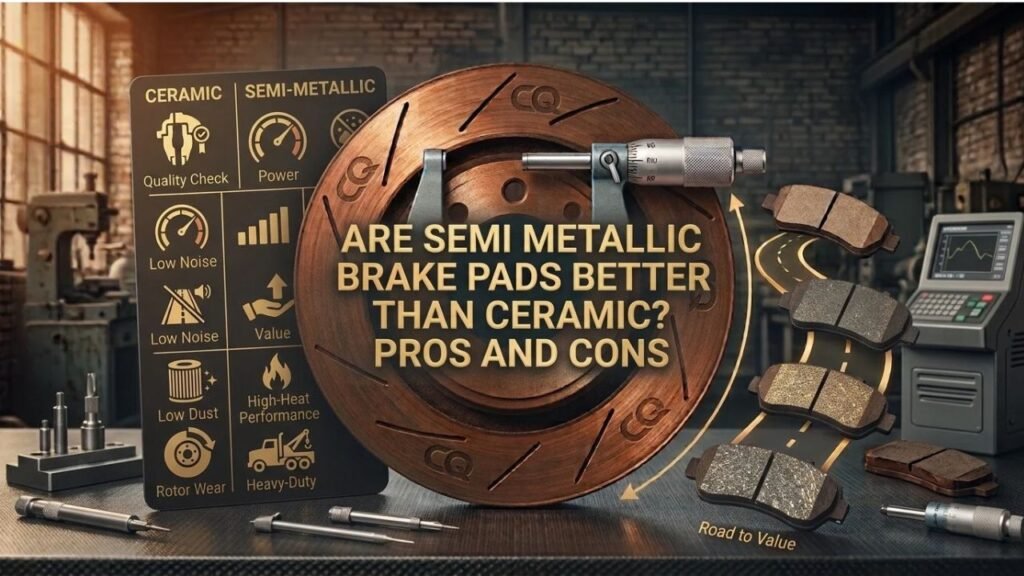
Semi-Metallic vs Ceramic Brake Pads at a Glance
Semi-metallic and ceramic pads can both work very well on street vehicles. Their strengths are simply different.
| Feature | Semi-Metallic Pads | Ceramic Pads |
| Initial bite | Usually stronger | Usually smoother |
| High-heat use | Strong | Good for normal street use |
| Towing and hauling | Often better suited | Less favored for repeated heavy loads |
| Noise | Usually higher | Usually lower |
| Visible brake dust | Usually higher | Usually lower |
| Rotor wear | Can be higher | Often lower |
| Cold response | Often strong | Can feel less aggressive in some compounds |
| Daily commuting | Good | Often the better fit |
| Performance driving | Often favored | Depends on the exact compound |
| Price | Often lower | Often higher |
A pad’s exact formula matters more than the category name alone. Manufacturers tune friction compounds for specific vehicles, axle positions, temperatures, noise goals, and rotor materials. Bosch, for example, offers both ceramic and semi-metallic formulations as platform-specific products rather than treating one material as suitable for every application.
What Are Semi-Metallic Brake Pads?
Semi-metallic pads use a friction compound containing a substantial amount of metal blended with fillers, friction modifiers, and binding resin. The metal portion may include iron, steel, copper substitutes, or other metallic ingredients depending on the formulation.
Their metal content gives them good thermal conductivity. Heat created at the pad and rotor interface can move through the pad more readily, which is useful during repeated hard stops.
Strong Bite and Heat Handling
Semi-metallic pads are often chosen for vehicles that see heavier braking loads.
AutoZone describes semi-metallic pads as a strong fit for trucks, SUVs, towing, hauling, and spirited driving because of their bite and heat resistance. PowerStop also notes that semi-metallic formulas suit higher-stress driving conditions.
This does not mean every semi-metallic pad is a performance pad. Friction level and temperature behavior still vary by product.
More Noise and Dark Dust
The trade-off is usually comfort and cleanliness.
Metallic ingredients can transmit more vibration and create more audible brake noise, especially when cold. Semi-metallic pads also tend to create darker dust that is easier to see on wheels. Tire Rack and PowerStop both describe these traits as common differences from ceramic compounds.
Possible Increase in Rotor Wear
A more abrasive friction compound can wear the rotor faster than a softer or less aggressive pad.
Tire Rack notes that steel fibers in semi-metallic formulas can add rotor wear. The actual amount depends on the pad formula, rotor material, temperature, driving style, and maintenance condition.
Key Takeaway: Semi-metallic pads usually make the most sense when heat handling, strong bite, towing, hauling, or harder braking matters more than low noise and clean wheels.
What Are Ceramic Brake Pads?
Ceramic brake pads use a dense ceramic-based friction material mixed with fibers, fillers, and other friction ingredients. Modern copper-reduced and copper-free formulas vary by manufacturer and application.
Ceramic pads became popular on passenger vehicles because they combine stable street braking with low noise and light-colored dust.
Quieter Street Braking
Ceramic compounds tend to damp brake noise well.
Brembo markets its Prime Ceramic pads around reduced noise and vibration, while Tire Rack also identifies low noise as a major ceramic-pad advantage.
That does not mean a ceramic pad can never squeal. Rotor condition, pad hardware, caliper movement, contamination, bedding, and installation quality can all create noise.
Less Visible Brake Dust
Ceramic pads generally produce less visible dark dust than semi-metallic pads.
Tire Rack notes that ceramic dust tends to be lighter in color and less noticeable on wheels. Brembo also promotes its ceramic car pads for reduced dust and cleaner rims.
For drivers with light-colored or open-spoke wheels, this difference can be noticeable between washes.
Smooth Daily-Driving Behavior
Ceramic pads are widely used for commuting because their friction behavior suits normal road temperatures and repeated light-to-moderate stops.
AutoZone currently places ceramic pads primarily in the daily-driving category, citing low noise and low dust as main benefits.
I would usually start with a quality ceramic pad for a sedan or crossover that spends most of its life commuting, provided that material matches the vehicle’s intended brake setup.
Key Takeaway: Ceramic pads are usually the better fit for quiet, clean, smooth daily driving, especially on passenger cars and crossovers that are not regularly exposed to heavy braking loads.
Are Semi Metallic Brake Pads Better Than Ceramic for Stopping Power?
Semi-metallic pads can provide a stronger initial bite, but the material label alone does not determine total stopping distance.
Tires, road grip, ABS calibration, brake temperature, rotor condition, caliper force, vehicle weight, and the pad’s exact friction curve all affect how quickly a vehicle stops.
Initial Bite
Initial bite describes how strongly the brakes respond as the pads first clamp the rotors.
Semi-metallic compounds often feel more immediate because many formulas are designed to generate strong friction from the start of pedal application. This can feel reassuring in a truck, performance car, or vehicle carrying extra load.
Ceramic pads often feel smoother and more progressive. For daily driving, that softer response is not a defect; many drivers prefer it.
Repeated Hard Stops
Repeated hard braking converts large amounts of vehicle energy into heat.
Semi-metallic pads generally move heat well because of their metal content, which can make them a strong choice for repeated heavy stops. Ceramic street pads can manage normal road use very well, but a comfort-focused ceramic compound may not be the best match for repeated high-load braking.
Total Vehicle Stopping Distance
A pad with more aggressive bite does not automatically shorten every stop.
Once a tire reaches its available grip and ABS begins controlling wheel slip, tire-road traction becomes a major limiting factor. Pad choice still matters for consistency and heat resistance, but it should not be judged as an isolated stopping-distance upgrade.
Key Takeaway: Semi-metallic pads often feel stronger at the pedal and handle repeated heat well, but complete stopping performance depends on the whole brake system, tires, road surface, and vehicle load.
Which Pad Handles Heat Better?
For heavy thermal load, semi-metallic pads usually have the edge over comfort-oriented ceramic pads.
Metal conducts heat well. That property lets semi-metallic compounds transfer heat away from the friction surface more readily during repeated braking.
Towing and Hauling
A loaded vehicle carries more kinetic energy at the same speed than the same vehicle at a lighter weight. The brakes must convert that extra energy into heat during deceleration.
For frequent towing or hauling, a semi-metallic or purpose-built heavy-duty pad is often a better starting point than a comfort-focused ceramic pad. AutoZone places semi-metallic pads in its towing and hauling category for this reason.
Mountain Driving
Long downhill grades can create repeated braking cycles with little cooling time.
Semi-metallic pads are often well suited to that environment, though proper downhill technique, transmission use, brake condition, and vehicle loading still matter.
Track Driving
Neither a generic ceramic street pad nor a generic semi-metallic street pad should automatically be treated as a track pad.
Track compounds are designed around much higher operating temperatures and different friction targets. Tire Rack separates street pads from dedicated autocross and track products for this reason.
Key Takeaway: Semi-metallic pads generally have the advantage under repeated high heat, but track use calls for a pad designed specifically for track temperatures rather than relying on material type alone.
Which Is Quieter and Produces Less Dust?
Ceramic pads usually win both categories.
For a commuter, these traits may matter more day to day than a small difference in pedal bite.
Brake Noise
Semi-metallic formulas can be more prone to audible squeal or scraping-type friction sounds, especially at low temperatures.
Ceramic compounds tend to generate less noticeable noise, and many premium ceramic pads use shims, slots, and chamfers to reduce vibration further.
Wheel Dust
Semi-metallic pads tend to leave darker dust that shows clearly on silver, polished, or light-colored wheels.
Ceramic dust is usually lighter and less visible. It can still accumulate, since every friction pad wears as it operates.
Why Hardware Still Matters
Pad material is only part of brake noise.
Worn abutment clips, rust under the hardware, seized guide pins, damaged shims, glazed rotors, or contamination can make either pad type noisy. Replacing a squealing semi-metallic pad with ceramic without correcting a mechanical fault may leave the noise unchanged.
Key Takeaway: Ceramic pads are usually quieter and cleaner, but pad hardware, rotor condition, and caliper movement still have a major effect on noise.
Which Brake Pad Type Lasts Longer?
Ceramic pads often last well in ordinary street use, but there is no fixed rule that ceramic always outlasts semi-metallic.
Pad life depends on compound hardness, vehicle weight, brake balance, driving habits, heat cycles, rotor surface, caliper condition, and the type of driving.
Ceramic Pad Life
Ceramic compounds are often chosen for low wear during normal commuting.
Tire Rack describes ceramic compounds as having strong durability compared with many conventional friction materials.
For a lightly loaded commuter that sees mostly normal road speeds, ceramic can provide long service with low dust.
Semi-Metallic Pad Life
Semi-metallic pads can also last a long time, especially when designed for the vehicle and used within their intended temperature range.
Hard driving may consume any pad quickly. A high-friction compound chosen for repeated heavy braking may trade pad or rotor life for stronger thermal behavior.
Uneven Wear Matters More Than Material
One pad wearing much faster than its partner is a mechanical warning sign.
A sticking caliper piston, seized slide pin, rusted bracket, hose restriction, or pad binding can destroy a new set regardless of friction material.
I would inspect wear pattern before blaming ceramic or semi-metallic material for short pad life.
Key Takeaway: Ceramic often gives long life in normal commuting, but pad formulation and brake condition matter more than the material label alone.
Do Semi-Metallic Pads Wear Rotors Faster?
They can.
The harder metallic particles that improve bite and heat behavior may also be more abrasive against the rotor. Tire Rack specifically identifies increased rotor wear as a possible semi-metallic trade-off.
Ceramic pads are often considered gentler on rotors during normal road use.
That difference should not be overstated. A high-quality semi-metallic pad matched to the vehicle can provide normal rotor life, while a sticking ceramic pad can damage a rotor quickly.
Rotor wear is also affected by corrosion, heat, pad deposits, debris, rotor quality, and how often the vehicle is driven.
Are Semi-Metallic Pads Better in Cold Weather?
Semi-metallic pads often provide strong cold bite, which can make them attractive in colder conditions.
Some ceramic formulations may feel less aggressive during the first few cold stops, though modern ceramic compounds are designed to work across normal road temperatures.
The exact formula matters. Bosch lists both ceramic and semi-metallic pads as platform-specific friction materials, which is a good reminder that broad material categories cannot predict every product’s cold behavior.
For a street car, use a pad approved for the vehicle rather than changing material solely because winter temperatures drop.
Ceramic vs Semi-Metallic Pads for Different Drivers
The easiest way to choose is to match the pad to the vehicle’s workload.
Daily Commuter
Ceramic is usually my first pick.
Low noise, low visible dust, smooth pedal response, and good street-temperature behavior match typical commuting well.
Truck Used for Towing
Semi-metallic is usually the stronger starting point.
The added heat transfer and aggressive bite suit repeated braking with added load. A heavy-duty vehicle-specific compound may be an even better fit if towing is frequent.
SUV Used Mostly Around Town
Ceramic often makes more sense.
An SUV does not automatically need a semi-metallic pad. If it spends most of its time commuting without heavy loads, quiet operation and lower dust may be more useful.
Performance Street Car
Semi-metallic often deserves serious consideration.
Drivers who brake hard, drive mountain roads, or want stronger pedal bite may prefer its characteristics. Some performance ceramic or hybrid formulations can also work well, so compare the exact temperature and friction specifications.
Luxury Car
Ceramic is often attractive for comfort.
Low dust, quiet braking, and smooth response match what many luxury-car drivers expect. The safest approach is still to match the OEM friction specification or a reputable equivalent.
Key Takeaway: Ceramic suits most comfort-focused daily drivers, while semi-metallic suits drivers who place more emphasis on bite, thermal load, towing, or harder street use.
Should You Switch From Ceramic to Semi-Metallic?
You can switch in many applications, but the replacement pad should be approved for the vehicle and compatible with the rotor and braking system.
Do not switch simply because one material sounds stronger.
A vehicle engineered around a quiet ceramic-style pad may gain noise and dust without a meaningful real-world braking benefit from a more aggressive semi-metallic compound.
A truck that frequently tows may gain more from a high-quality semi-metallic or heavy-duty pad, especially if the current comfort-oriented pad struggles with heat.
Check these points before changing material:
- Vehicle maker recommendations
- Pad fitment and axle position
- Rotor type and condition
- Towing or payload use
- Typical brake temperatures
- Noise tolerance
- Wheel-dust preference
- Driving environment
Safety Tip: Replace pads in matching axle sets and inspect rotor thickness, caliper movement, brake hoses, and hardware during the job. Pad material cannot correct a sticking caliper or damaged rotor.
Conclusion
For anyone asking are semi metallic brake pads better than ceramic, semi-metallic pads are better in some driving conditions, not across the board. They are often the stronger match for towing, hauling, repeated hard braking, mountain use, and drivers who prefer firm initial bite.
Ceramic pads usually make more sense for commuting and normal street driving. They tend to run quieter, leave less visible dust, and place less abrasive load on rotors while still providing the braking behavior a typical passenger vehicle needs.
My preference is to keep the choice tied to vehicle use. I would choose ceramic for a normal commuter and look first at semi-metallic or a vehicle-specific heavy-duty compound for a truck that regularly tows or a vehicle exposed to repeated brake heat.
The best pad is the one that matches the vehicle’s brake design, rotor material, load, temperature range, and driving pattern. A reputable vehicle-specific pad is a safer choice than selecting friction material from one advertised trait alone.
FAQs About Semi-Metallic and Ceramic Brake Pads
Which Stops Better, Ceramic or Semi-Metallic Brake Pads?
Semi-metallic pads often have stronger initial bite and handle repeated high heat well. That can make them feel stronger during hard braking.
Total stopping distance also depends on tires, road grip, ABS, vehicle weight, rotor condition, and pad temperature. A more aggressive pad does not automatically shorten every stop.
Are Semi-Metallic Brake Pads Good for Daily Driving?
Yes. Semi-metallic pads can work very well for daily driving, and many vehicles use them successfully.
The trade-offs are usually more noise and darker brake dust than ceramic pads. If quiet operation and clean wheels matter more than aggressive bite, ceramic may suit a commuter better.
Are Ceramic Brake Pads Better for SUVs?
They can be. An SUV used mainly for commuting and family transportation may work very well with ceramic pads if the vehicle application supports them.
An SUV used for frequent towing, hauling, or long mountain descents may be better matched to semi-metallic or another heavy-load friction compound.
Do Semi-Metallic Brake Pads Squeak More?
They can. Their metallic ingredients can transmit more vibration, which may make brake noise more noticeable.
Pad design, shims, rotor finish, hardware condition, bedding, and caliper movement also affect squeal, so material is not the only cause.
Do Ceramic Brake Pads Wear Rotors Less?
Ceramic pads are often less abrasive to rotors during normal street use than many semi-metallic compounds.
Rotor life still varies with pad formula, corrosion, driving style, caliper condition, heat, and rotor quality. A seized brake component can cause rapid rotor wear with either material.
Are Semi-Metallic Brake Pads Better for Towing?
They are often a better fit for frequent towing because their metal content transfers heat well and many formulas provide strong bite under load.
For heavy or repeated towing, check for a pad specifically rated for that vehicle and workload rather than relying on the semi-metallic label alone.
Are Ceramic Brake Pads Worth the Extra Cost?
For a daily driver, they often are if low noise, cleaner wheels, and smooth braking matter to you.
A driver focused on towing, high heat, or aggressive braking may get more useful performance from a semi-metallic or heavy-duty pad instead.