Do Rotors Need to Be Replaced With Brake Pads? When to Replace
Brake rotors do not automatically need replacement every time new pads are installed. A rotor can often stay in service if it remains above its minimum thickness, has a sound braking surface, has no serious cracks or heat damage, and does not create excessive vibration or runout.
Replacing good rotors unnecessarily adds parts cost, while keeping badly worn rotors can shorten new-pad life and create noise, vibration, poor pad contact, or heat problems. The condition of the rotor matters more than following a fixed “pads plus rotors every time” rule.
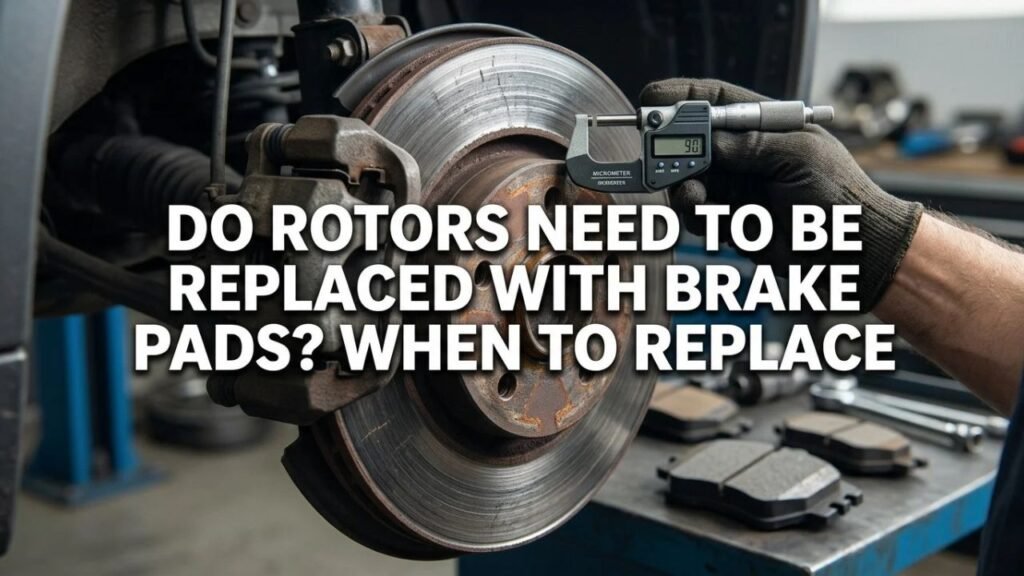
A proper brake job therefore includes measuring the rotor rather than judging it only by appearance. Brembo states that rotor thickness should be checked at several points and compared with the minimum thickness specification marked on the rotor or supplied for the vehicle. A rotor below that limit must be replaced.
S&P Global Mobility reported that the average age of U.S. light vehicles reached 12.8 years in 2025, with about 289 million light vehicles in operation. An aging vehicle fleet makes condition-based brake inspection especially relevant because many cars go through several sets of pads and more than one set of rotors during their service lives.
The practical answer to do rotors need to be replaced with brake pads is no, not every time. Some brake manufacturers recommend replacing or resurfacing rotors with new pads to create a fresh friction surface, while other service guidance focuses on measured thickness and physical condition. PowerStop, for example, recommends a fresh rotor surface with new pads, while Firestone states that rotors do not always require replacement with every pad change.
What stood out to me during the research was the difference between a rotor that merely looks used and one that is actually out of specification. Light surface marks can be acceptable on some vehicles, while deep scoring, cracks, excessive thickness loss, heat damage, or measurable deformation can make replacement the better repair.
The sections below explain when old rotors can remain, when replacement is required, how thickness is checked, when resurfacing makes sense, and what symptoms mean a pad-only brake job may not be enough.
Do Rotors Need to Be Replaced With Brake Pads Every Time?
No. Brake pads normally wear faster than rotors, so a rotor may last through more than one set of pads.
Brembo states as a general rule that rotors may need replacement around every other pad change, but it still bases the actual decision on wear, damage, and minimum thickness. Firestone also states that rotors do not always need replacement when pads are changed.
You Can Reuse Rotors That Remain Within Specification
A rotor may stay in service if:
- Thickness remains above the vehicle or rotor minimum
- The braking surfaces are sound
- There are no serious cracks
- There is no excessive scoring
- The rotor is not causing objectionable pulsation
- Heat damage is not present
- Runout and thickness variation remain within specification
A technician should inspect both faces of the rotor rather than looking only through the wheel.
New Pads Need a Suitable Rotor Surface
A new brake pad starts with a flat friction face. If it is pressed against a deeply grooved or badly irregular rotor, only part of the new pad may initially contact the disc.
Poor contact can contribute to noise, uneven wear, slower bedding, or inconsistent pedal feel.
Akebono recommends inspecting rotor surfaces for grooves and abnormalities, then resurfacing within the allowable thickness specification or installing new rotors.
Rotors Do Not Have to Look Brand New
Minor discoloration or light wear marks do not automatically condemn a rotor.
The important questions are measurable thickness, surface condition, cracking, runout, thickness variation, heat damage, and the manufacturer’s limits.
A technician who recommends new rotors should be able to explain which condition justifies replacement.
Key Takeaway: New pads do not automatically require new rotors, but the existing rotors must remain within specification and provide a suitable friction surface.
When Should Rotors Be Replaced With Brake Pads?
Some conditions make rotor replacement much more sensible than installing pads alone.
Rotor Thickness Is at or Below the Minimum
Every rotor loses a small amount of metal as it wears.
Manufacturers specify a minimum usable thickness because a rotor that becomes too thin has less material to absorb and release braking heat. It also loses structural margin.
Brembo instructs technicians to measure rotor thickness at at least four points and use the lowest reading. If that measurement is below the marked minimum thickness, the rotor needs replacement.
A rotor should not be machined below its permitted thickness just to avoid buying a replacement.
The Rotor Has Deep Grooves
Light circumferential marks are common after normal use.
Deep scoring is different. It can reduce pad contact area and create an uneven surface for the new friction material.
Brembo lists deep circular scoring as one of the conditions that can call for rotor replacement.
Grooves caused by a completely worn pad are especially concerning because the steel backing plate may have cut heavily into the rotor.
The Rotor Is Cracked
A cracked rotor should not be treated as a normal wear surface.
Thermal cracks can form after severe heating, heavy-duty braking, or continued use after the rotor becomes too thin.
Brembo lists radial cracking as a rotor-replacement condition.
There Are Strong Heat Spots or Blue Areas
Dark spots or blue discoloration can point to extreme localized heat.
The cause may involve repeated hard braking, a dragging caliper, severe pad deposits, or another fault.
Installing new pads without checking the reason for the heat can damage the new friction material too.
The Vehicle Pulsates During Braking
Pedal pulsation or steering-wheel shake during braking can point to rotor runout, disc-thickness variation, uneven friction deposits, or another wheel-end problem.
Firestone lists vibration and pulsation among common signs that rotor inspection is needed.
The rotor should be measured before parts are replaced because wheel bearings, hub corrosion, or mounting issues can sometimes create similar symptoms.
Key Takeaway: Replace rotors that are below minimum thickness, deeply scored, cracked, badly heat-damaged, or outside the vehicle’s permitted runout and thickness limits.
How to Check Rotors Before Installing New Brake Pads
A visual glance through the wheel is not enough for a full rotor assessment.
A proper inspection combines measurement with surface and hardware checks.
Measure Rotor Thickness
A micrometer is normally used to measure the braking surface.
Measurements should be taken at several locations around the rotor because wear may not be perfectly uniform.
Brembo advises using at least four measurements and comparing the lowest result with the minimum thickness value. The rotor may have MIN TH followed by a millimeter measurement marked on it.
If no usable marking can be found, use the correct service specification for that exact vehicle and brake package.
Inspect Both Rotor Faces
The outer face can look smooth while the inner face is badly scored or corroded.
Remove the wheel and inspect both sides when doing a full brake check.
Look for:
- Deep grooves
- Cracks
- Heavy rust scaling
- Blue or dark heat spots
- Uneven wear
- Surface damage
- A heavy outer lip
Rotor condition should also be compared left to right on the same axle.
Check for Runout and Thickness Variation
Lateral runout is side-to-side movement of the rotor as it turns.
Disc thickness variation, often shortened to DTV, means rotor thickness changes around the braking surface.
Either condition can contribute to pulsation and uneven pad contact.
A rotor can remain thick enough yet still have a condition that requires correction or replacement.
Inspect the Caliper Before Blaming the Rotor
A sticking piston or seized slide pin can overheat one side of a rotor and destroy a new set of pads.
Uneven inner-versus-outer pad wear is an important clue.
I would correct a caliper or slide problem before installing fresh pads and rotors rather than treating the damaged friction parts as the only problem.
Key Takeaway: Measure rotor thickness, inspect both faces, check runout or DTV when symptoms call for it, and correct caliper faults before deciding on a pad-only repair.
Can You Put New Brake Pads on Old Rotors?
Yes, new pads can be installed on existing rotors if the rotors remain serviceable and their surface condition meets the brake-system requirements.
That does not mean every old rotor should be reused.
Smooth, In-Spec Rotors May Be Reused
If the rotor has plenty of thickness, no cracks, no serious grooves, no troublesome pulsation, and a suitable surface, a pad-only replacement can be reasonable.
Firestone specifically notes that good rotors can remain while the worn pads are replaced.
This approach is common when the pads have worn normally and the rotor has not reached its service limit.
Rough Rotors Can Affect New Pad Bedding
New pads need to establish stable contact with the rotor surface.
Deep grooves or irregular wear can prevent the friction face from mating evenly during the early miles after installation.
PowerStop recommends replacing or resurfacing rotors during a pad change to give the new pads a suitable surface for bedding.
That is a manufacturer recommendation rather than proof that every used rotor must be discarded.
New Pads Should Be Installed in Axle Sets
Pads are normally replaced on both sides of an axle rather than one wheel at a time.
Replacing only one side can create differences in friction characteristics and pad condition across the axle.
If one side has worn abnormally faster than the other, find the cause before the new pads go on.
Key Takeaway: New pads can run on old rotors if the rotors pass inspection, but badly grooved or irregular surfaces can interfere with proper pad contact and bedding.
Should Brake Rotors Be Resurfaced Instead of Replaced?
Resurfacing removes a thin layer of metal from the braking faces to create a flatter, cleaner surface.
It can be an option on some rotors, but only if enough thickness will remain after machining.
Resurfacing Requires Enough Remaining Metal
A rotor already close to its discard thickness may become too thin once material is removed.
Raybestos states that a rotor below discard thickness must be replaced and that machining is only an option when thickness permits it.
The technician needs to account for the amount of material that will be removed, not just the rotor’s thickness before machining.
Resurfacing Can Correct Some Surface Problems
Machining may remove moderate grooves, uneven friction material, or minor surface irregularities.
It cannot safely rescue every rotor.
Cracks, severe heat damage, major corrosion, or inadequate remaining thickness point toward replacement instead.
Replacement Is Often Chosen Instead
Modern replacement rotors are readily available for many vehicles, and machining adds labor.
A shop may find that installing new rotors costs little more than setting up and machining old ones.
That cost calculation differs by vehicle. Large, specialty, performance, or expensive rotors may make resurfacing more attractive if the manufacturer permits it.
Key Takeaway: Resurfacing can save an in-spec rotor with suitable damage, but it must leave enough thickness afterward and cannot repair cracks or severe structural damage.
Should Both Rotors on an Axle Be Replaced Together?
If one rotor has reached its minimum thickness or requires replacement for serious wear, replacing the pair on that axle is the standard approach.
Brembo explicitly states that rotors should be replaced on both sides when one of the pair falls below the minimum wear level.
A matched pair provides similar rotor thickness, surface condition, heat capacity, and bedding conditions on the left and right sides.
The brake pads should also be replaced as a complete axle set when new rotors are installed.
Brembo’s fitting instructions state that when rotors are replaced, the related pads should also be replaced.
Signs You Need Pads and Rotors at the Same Time
A normal worn-pad warning does not always mean the rotors are finished too.
Several symptoms raise the chance that both parts need attention.
Grinding From Metal-to-Metal Contact
If the friction material wears completely away, the steel pad backing can grind directly against the rotor.
This can carve deep grooves into a rotor quickly.
A driver who continues through loud grinding may turn an ordinary pad replacement into a pad-and-rotor repair.
Brake Pedal Pulsation
A repeating pulse during braking can point to rotor runout, thickness variation, deposits, or another wheel-end fault.
If measurements show the rotor is outside specification and cannot be corrected, replacement is appropriate.
Deep Visible Scoring
A rotor with deep grooves may not give fresh pads a suitable mating surface.
Measure the rotor before deciding on resurfacing because machining removes additional metal.
Cracks or Major Heat Damage
Radial cracks, strong blue areas, and serious heat damage call for more than fresh pads.
The brake system should also be checked for dragging calipers, driving conditions, or other causes that created excessive temperature.
Rotor Thickness Near the Service Limit
A rotor may still be technically above minimum thickness when the pads are changed but have too little material left to reasonably last through the next pad set.
In that situation, replacing the rotors now can avoid repeating much of the labor later.
My preference is to look at the actual measurement and expected service use rather than replace a rotor solely because it has already gone through one pad set.
Key Takeaway: Grinding damage, pulsation, deep scoring, cracking, severe heat damage, and low remaining thickness are strong reasons to replace pads and rotors together.
Is It Bad to Replace Rotors Without Replacing Brake Pads?
In most normal brake repairs, new rotors should receive new pads.
Old pads have already worn to the surface pattern of the old rotors. Moving those used pads to fresh rotor faces can create poor initial contact and transfer an uneven wear pattern.
Brembo states that brake pads should be replaced when the related rotors are replaced.
There may be unusual service situations in which pads have almost no use and a manufacturer publishes another procedure, but a typical worn-rotor repair should pair fresh rotors with fresh pads.
How Long Do Brake Rotors Usually Last Compared With Pads?
There is no universal rotor mileage.
Brake wear changes with traffic, vehicle weight, terrain, towing, driving style, friction material, corrosion, caliper condition, and rotor design.
Brake pads usually wear faster because their friction material is meant to be consumed.
Brembo gives a broad rule that rotors may be replaced around every other pad change, while also stressing actual inspection and minimum thickness rather than a fixed schedule.
A well-maintained rotor may last through more than one pad set. A rotor damaged by metal-to-metal braking may be ruined during the first pad set.
For that reason, a measured inspection is more useful than a mileage estimate.
Conclusion
The answer to do rotors need to be replaced with brake pads is no, not automatically. A rotor can often remain in service through another pad set if it stays above minimum thickness, has a sound surface, and remains within the applicable runout and wear limits.
Replacement makes more sense when the rotor is too thin, cracked, deeply scored, badly heat-damaged, severely corroded, or responsible for braking pulsation that cannot be corrected. Resurfacing may be an option if enough metal remains afterward and the manufacturer permits machining.
Measure before spending money. A good brake inspection should produce actual rotor thickness readings and identify visible damage rather than relying on a blanket rule that every pad job needs rotors.
I would keep a sound rotor that clearly passes the vehicle’s specifications, but I would not try to squeeze another pad cycle from a rotor already close to its limit just to postpone replacement.
FAQs About Replacing Rotors With Brake Pads
Do I Need New Rotors Every Time I Change Brake Pads?
No. Rotors often last longer than brake pads. If the rotor remains above minimum thickness, has no serious damage, and stays within the applicable wear and runout specifications, it may be reused. Some brake brands recommend resurfacing or replacing rotors during each pad job to provide fresh mating surfaces.
Can I Replace Brake Pads and Leave the Old Rotors?
Yes, if the old rotors pass inspection. Measure thickness and check both braking surfaces for cracks, deep scoring, heavy corrosion, heat damage, and conditions linked with pulsation. New pads should not be installed on a rotor that is already below its minimum specification.
How Do I Know If My Rotors Are Too Thin?
Measure the rotor braking surface with a micrometer at several positions and compare the lowest reading with the specified minimum thickness. Brembo recommends measuring at least four points. Many rotors have a minimum-thickness marking, often shown as MIN TH, on the rotor itself.
Should I Resurface Rotors When Changing Brake Pads?
Resurfacing may be suitable when the rotor has enough remaining thickness and the surface condition can be corrected by machining. A rotor near its discard limit, cracked, or badly heat-damaged should be replaced instead. The finished rotor must remain within the vehicle or rotor maker’s service specification.
Do Grooved Rotors Need to Be Replaced?
Light marks do not always require replacement. Deep grooves may reduce pad contact and can justify resurfacing or replacement. Rotor thickness must be measured before machining because resurfacing removes additional metal.
Should Front Rotors Be Replaced in Pairs?
Yes. If one front rotor requires replacement for wear or damage, replacing both front rotors keeps the braking surfaces and rotor condition matched across that axle. The same principle applies to a rear rotor pair.
Do New Rotors Need New Brake Pads?
For a normal rotor replacement, yes. Old pads have already worn to the shape and surface pattern of the old rotors. Brembo directs installers to replace the associated pads when fitting replacement rotors.
Can Bad Rotors Ruin New Brake Pads?
Yes. Deep grooves, heavy corrosion, heat damage, or an irregular friction surface can cause poor pad contact, noise, uneven wear, and bedding problems. A sticking caliper or excessive rotor runout can also shorten the life of fresh pads, so those conditions should be corrected during the brake job.