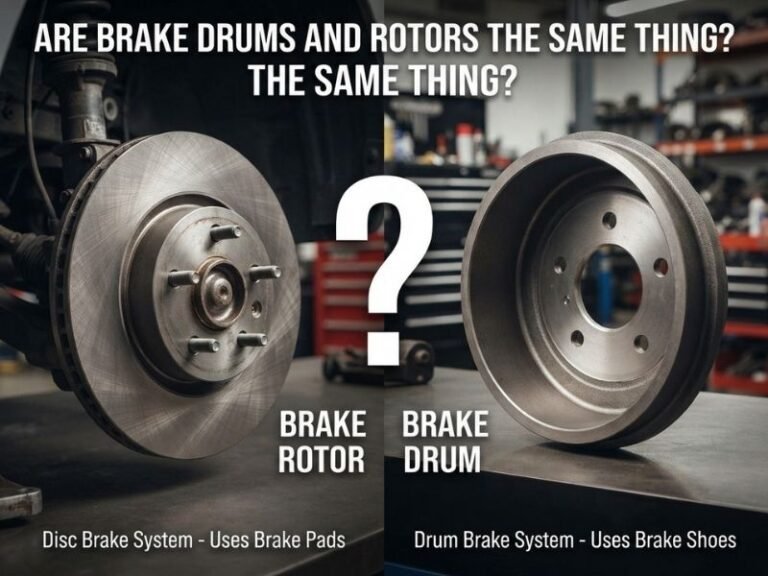
Are Brake Pads and Rotors the Same Thing: Differences That Matter
No, brake pads and rotors are not the same thing; they are two separate components that work together to stop your vehicle. The brake pads are the friction material that clamps onto the rotor, while the rotor is the metal disc that the pads squeeze to slow the wheel. This article explains the functional differences, why they wear at different rates, and how to tell which part actually needs attention.
When a car starts to vibrate, squeal, or pull to one side during braking, the true source of the problem is rarely obvious. A rushed diagnosis often leads to replacing the wrong part, spending money on components that still have life left, or leaving a dangerous issue unaddressed. The confusion is understandable because these parts are installed together, wear together, and are often sold as a set.
Yet they perform distinct jobs and fail in different ways.
The distinction matters for your wallet, your safety, and your vehicle’s stopping distance. Over the next few minutes, I will break down the anatomy of each part, explain how they interact, and give you clear signs that point to one component or the other. You will learn why a warped rotor feels different from worn pads, why pad replacement alone can sometimes cause new problems, and when it is wise to replace both at the same time.
By the end, you will be able to speak confidently with a mechanic and make an informed decision about your next brake repair.
What Brake Pads Actually Do
Brake pads are the replaceable friction material that presses against the rotor to convert kinetic energy into heat. They are the consumable part of the braking system, designed to wear down over time so that the more expensive rotor does not. Most pads consist of a steel backing plate with a friction compound bonded to the front surface.
That compound is what grabs the rotor when you press the pedal.
The pad sits inside the brake caliper, which acts like a clamp. When you apply the brakes, hydraulic fluid pushes a piston in the caliper, forcing the inner pad against the rotor. The caliper then slides or moves to pull the outer pad into contact as well.
This creates the friction necessary to slow the wheel.
Pads are made from several different materials, each with its own trade-offs. Organic pads are soft and quiet but wear quickly. Semi-metallic pads contain metal fibers and offer strong stopping power but can be noisy and generate more dust.
Ceramic pads are popular for daily drivers because they produce less dust, run quietly, and handle heat well. The material affects how long the pad lasts and how it feels under heavy braking.
Because pads are designed to be the sacrificial layer, they wear out faster than rotors. A typical set of front pads lasts between 30,000 and 50,000 miles, though aggressive driving or heavy vehicles can shorten that range. When the friction material gets thin, the backing plate can contact the rotor directly, causing metal-on-metal grinding and severe damage.
What Brake Rotors Actually Do
Brake rotors, sometimes called discs, are the smooth metal surfaces that the pads clamp onto. They are attached to the wheel hub and spin with the wheel at the same speed. When the pads squeeze the rotor, the friction slows the rotation, which in turn slows the vehicle.
Rotors are usually made of cast iron or a composite material, and they must withstand extreme heat without warping. Every time you brake, the rotor surface heats up and cools down. Over time, this thermal cycling can cause the metal to distort, creating a condition known as runout or thickness variation.
That distortion is what you feel as a pulsing brake pedal or a vibration through the steering wheel.
There are several types of rotors available. Solid rotors are simple one-piece discs used on many rear axles. Vented rotors have internal cooling fins between two friction surfaces, allowing air to circulate and dissipate heat more effectively.
Drilled and slotted rotors feature holes or grooves that help release gas and water, but they are mostly for performance use and can crack under severe stress.
Rotors are built to last longer than pads, often surviving two or three pad replacements. However, they are not lifetime parts. The friction surface gradually wears thinner, and once the rotor falls below the minimum thickness specification stamped on the hub, it must be replaced.
Warping, scoring, cracking, or excessive rust are other reasons a rotor may need to be swapped out.
How the Two Parts Work Together
The relationship between pads and rotors is one of constant contact and controlled friction. When you press the brake pedal, the caliper piston moves the pads inward. The pads grip the rotor from both sides, and the resulting friction slows the rotor’s spin.
That rotational energy is converted into heat, which is why brakes can get extremely hot during hard stops.
This system works only if both parts are in good condition. A new pad on a badly scored rotor will not seat properly, leading to poor braking performance and accelerated pad wear. Likewise, a smooth rotor with worn-out pads will not generate enough friction to stop the car effectively.
The two components are partners, and the condition of one directly affects the other.
The wear process is not always even. The inner pad often wears faster than the outer pad because it is pushed directly by the caliper piston. The rotor may develop a lip on its outer edge where the pad has not made full contact.
These uneven wear patterns are normal, but they can make it harder to judge when replacement is truly necessary.
Key Differences in Wear and Failure Signs
Understanding how these parts fail is the most practical way to tell them apart. Each component produces distinct symptoms when it reaches the end of its service life.
Signs That Point to Worn Brake Pads
- Squealing or squeaking noise: Many pads have a small metal wear indicator that rubs against the rotor when the friction material is low. This produces a high-pitched sound when you brake.
- Grinding noise: A deep metal-on-metal grinding means the pad backing plate is contacting the rotor. This is an urgent issue that can ruin the rotor.
- Reduced braking response: If the pedal feels soft or the car takes longer to stop, the pads may be too thin to generate adequate friction.
- Visible thinness: You can often see the pad through the spokes of the wheel. If the friction material is less than a quarter-inch thick, replacement is due.
Signs That Point to Rotor Problems
- Pulsing brake pedal: A rhythmic pulsing or vibration through the pedal usually indicates a warped rotor or uneven thickness.
- Steering wheel vibration: If the front rotors are distorted, you may feel shaking in the steering wheel during braking.
- Scoring or grooves: Deep grooves on the rotor surface mean the pad has worn unevenly or foreign debris has become embedded.
- Blue discoloration: Overheating can cause the metal to turn blue, which indicates the rotor has been subjected to severe thermal stress.
It is possible for both parts to fail at the same time. If you have ignored a squealing pad for too long, the rotor may already be damaged. In that case, replacing only the pads would leave you with a rough surface that will quickly wear down the new friction material.
When to Replace Both Together
Many mechanics recommend replacing pads and rotors at the same time, and there are solid reasons for this advice. If the rotor is already worn to near its minimum thickness, installing new pads on an old rotor is a short-term fix. The new pad will have to conform to the old rotor’s surface, which can cause uneven contact and reduced braking efficiency.
There is also a practical cost consideration. The labor to replace pads alone is nearly the same as the labor to replace pads and rotors together. Since the caliper has to be removed and the wheel has to come off anyway, adding a rotor replacement does not significantly increase the time at the shop.
If the rotors are already borderline, paying for the extra parts now can save you from a second labor charge later.
However, replacing both is not always necessary. If the rotors are still within thickness specifications, have a smooth surface, and show no signs of warping, they can be reused. In that case, a mechanic may resurface the rotors to create a clean, flat surface for the new pads.
This process, called turning or machining, removes a thin layer of metal to restore the rotor’s finish. Some modern rotors are too thin to be resurfaced and must be replaced if they are damaged.
The Cost Difference and Value Decision
Brake pads are generally inexpensive, with aftermarket sets ranging from $30 to $100 for most vehicles. Rotors are more costly, often $50 to $150 each, depending on the type and brand. When you add labor, a pad-only replacement might cost $150 to $300 per axle, while a pad-and-rotor job could run $300 to $600 per axle.
The value decision depends on the condition of your rotors. If they are smooth and thick, keep them and save the money. If they are warped, scored, or near the minimum thickness, replace them with the pads.
Trying to save money by reusing bad rotors will only lead to premature pad wear and a second repair bill in the near future.
Another factor is the age of the vehicle. On a car with high mileage, the rotors have likely been through several heat cycles and may be close to the end of their life. On a newer car with low miles, the original rotors are probably still in good shape and can handle another set of pads.
Safety Considerations and Professional Help
Braking is the most critical safety system on your vehicle, so guessing is never a good strategy. If you are unsure whether you need pads, rotors, or both, have a qualified mechanic inspect the system. They can measure the rotor thickness with a micrometer, check for runout with a dial indicator, and visually assess the pad material.
Driving on worn pads is dangerous because it increases stopping distance and can damage the rotors. Driving on warped rotors is uncomfortable and can cause the brakes to grab unevenly, which is especially hazardous in wet or slippery conditions. Neither condition should be ignored.
If you are comfortable working on your own car, the job is manageable with basic tools. You will need a jack, jack stands, a lug wrench, a caliper tool, and the correct replacement parts. Always follow the manufacturer’s torque specifications when reinstalling the caliper bolts and lug nuts.
If you have any doubt about your ability to complete the job safely, professional installation is worth the cost.
FAQ
Can I replace just the brake pads and not
Yes, you can replace only the brake pads if the rotors are still in good condition. The rotors must be smooth, free of deep grooves, and above the minimum thickness specification. If the rotors are warped or badly scored, new pads will wear unevenly and braking performance will suffer.
How do I know if I need new rotors
Pay attention to the symptoms. A squealing noise usually means the pads are worn. A pulsing pedal or vibration during braking points to the rotors.
If you hear grinding, both parts may be damaged and need replacement.
Why do mechanics always recommend replacing rotors with pads?
Mechanics often recommend this because the labor cost is nearly the same, and installing new pads on worn rotors can lead to poor performance and premature pad wear. If the rotors are near the end of their life, replacing them at the same time is more cost-effective in the long run.
How long do brake rotors last compared to pads?
Brake pads typically last 30,000 to 50,000 miles, while rotors can last 60,000 to 70,000 miles or more. Rotors often survive two or three pad replacements, but they are not lifetime parts and will eventually need to be changed.
What happens if I drive with worn brake pads?
Driving with worn pads reduces braking power and increases stopping distance. Once the pad material is gone, the metal backing plate grinds against the rotor, causing deep scoring and ruining the rotor. This turns a simple pad replacement into a much more expensive rotor replacement.
Are brake pads and rotors the same thing on any
No, brake pads and rotors are never the same thing on any vehicle. They are always two distinct components, though their size, shape, and material may vary between different makes and models. The basic function remains the same across all vehicles.
Conclusion
Brake pads and rotors are not the same thing, but they are inseparable partners in your vehicle’s stopping system. The pads are the replaceable friction material that wears down over time, while the rotors are the durable metal discs that provide the surface for the pads to grip. Each part fails in its own way, and recognizing the difference between a squealing pad and a pulsing rotor can save you money and keep you safe.
The most important takeaway is to never replace one component without checking the condition of the other. A thorough inspection of both the pad thickness and the rotor surface will tell you exactly what is needed. If you are unsure, a professional measurement of rotor thickness and runout is a small price to pay for confidence in your brakes.
Address brake issues promptly, because delaying a simple pad replacement can turn into a costly rotor replacement or a dangerous brake failure.