Why Is My Parking Brake Loose? Causes, Tests, and Safe Repairs
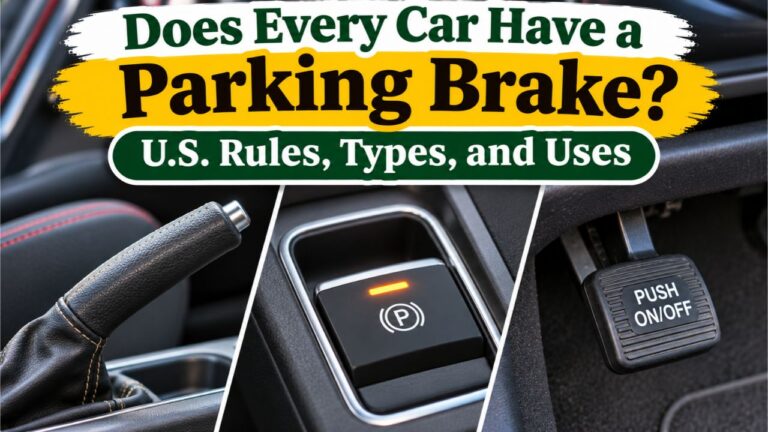
A loose parking brake is usually caused by excess cable slack, worn or poorly adjusted rear brake shoes, or a damaged parking-brake lever mechanism. A cable that has slipped out of its mounting bracket or broken can also leave the handbrake almost completely free of resistance. The exact cause depends on whether the vehicle uses a hand lever, a foot pedal, or an electronic parking brake.
You might notice that the lever pulls much higher than before, the pedal moves unusually far, or the car no longer stays securely parked. Sometimes the control still clicks normally but the rear brakes barely engage. These symptoms deserve attention because an unreliable parking brake can allow a vehicle to roll, even when its regular brakes seem fine.
The fix is not always tightening a cable. Rear brake adjustment, damaged hardware, and uneven cable movement must be checked first. This guide explains the most likely causes, safe stationary checks, what different symptoms mean, and when adjustment or replacement is appropriate.
Why Is My Parking Brake Loose? The Most Likely Causes
A mechanical parking brake transfers force from a lever or pedal through cables and linkages to the rear brakes. Extra slack anywhere in that path can make the control travel farther before the brake applies. However, the cable may be perfectly intact while worn friction material or a failed adjuster creates the same sensation.
1. Excessive Slack or Incorrect Cable Adjustment
The most straightforward cause is a cable system that is no longer adjusted to the correct travel. With too much slack, part of the lever’s movement merely takes up free play instead of pulling the brake mechanism. You may hear many ratchet clicks before feeling firm resistance.
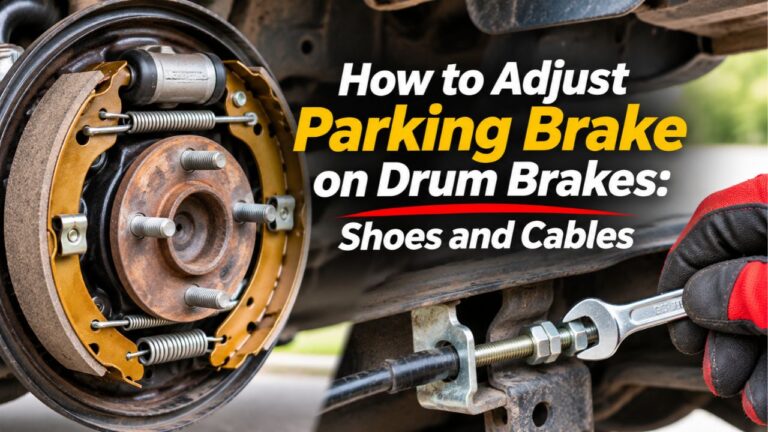
According to NAPA’s parking-brake repair guide, cable adjustment varies by vehicle and may be located at the hand lever, foot pedal, or underneath the car. Rear brake adjustment may also be needed. Tightening the cable without checking the wheel-end parts can conceal the real problem.
2. A Stretched, Corroded, or Broken Parking Brake Cable
Steel parking-brake cables run inside protective sleeves. Wear, corrosion, damaged outer sheaths, or a loose cable end can interfere with how force reaches the rear brakes. If a cable snaps or detaches, the handle may suddenly move with almost no resistance. Damage on one side may leave the brake holding unevenly.
Haynes’ handbrake cable replacement guide identifies fraying, corrosion, damaged sleeves, and excessive lever travel as reasons to inspect the cable. A cable that is badly corroded or broken needs replacement rather than repeated adjustment.
3. Worn Parking Brake Shoes or Rear Brake Pads
Some rear disc-brake vehicles use separate parking-brake shoes inside the rear rotor. Others apply the parking brake through the regular rear caliper pads, while drum-brake designs may share the service-brake shoes. As the relevant friction material wears, the mechanism may need more movement to contact the braking surface.
Driving with the parking brake partly engaged can accelerate wear by overheating the shoes or pads. If a loose lever appeared after an episode of dragging brakes, inspect the friction material and its mating surfaces. Cable tightening cannot restore lining that is too thin, damaged, or contaminated.
4. Rear Drum or Parking Brake Shoe Adjuster Problems
In drum-style systems, the shoe-to-drum clearance needs to remain within specification. A seized, incorrectly installed, or ineffective adjuster can leave the shoes too far from the drum. The lever then moves farther before sufficient holding force develops.
This problem is especially worth considering if the handbrake became loose after rear brake service. Some designs use self-adjusting mechanisms, but not all adjust automatically in the same way. The proper repair may be correcting shoe clearance and hardware rather than simply shortening the cable.
5. Worn Ratchet, Lever, Pedal, or Equalizer Hardware
The handle and pedal assembly contain parts that hold the parking brake in its applied position. A damaged ratchet or release mechanism may let the lever rise without staying locked. A worn pivot can create unusual free movement. On cable-operated systems, an equalizer divides pull between the rear brakes; damage or a disconnected cable end can disrupt that movement.
If the lever does not click, will not stay raised, or releases unexpectedly, inspect its locking mechanism. A loose grip or trim piece is different from a mechanically loose brake: the control may wobble while the braking function still works. Both symptoms should be identified correctly before ordering parts.
6. Incorrect Cable Routing or Recent Repair Work
A parking brake that becomes loose immediately after rear caliper replacement, drum service, or cable installation may have an assembly problem. A cable might not be fully seated in its bracket, an adjuster may have been left backed off, or the wrong replacement part may be installed. Routing that differs from the factory arrangement can change available travel or cause binding.
Tell the technician exactly what was repaired and when the symptom began. Checking the installation against the vehicle-specific service information is more useful than assuming the new cable simply needs a few extra turns of adjustment.
What Different Loose Parking Brake Symptoms Mean
How the control feels often helps narrow the problem, although no symptom identifies a failed component with certainty.
| What You Notice | Possible Cause | Sensible Next Check |
| Lever pulls unusually high | Slack cable or excessive shoe clearance | Cable travel and rear adjustment |
| Lever moves freely with almost no resistance | Broken or detached cable or linkage | Cable ends and lever connection |
| Lever clicks but will not stay set | Ratchet or release mechanism fault | Lever assembly inspection |
| Parking brake holds on one side only | Uneven cable movement or wheel-end fault | Both rear brake assemblies |
| Foot-operated brake pedal travels too far | Cable slack or rear brake adjustment issue | Pedal linkage and rear brakes |
| Rear brake drags after release | Seized cable, mechanism, or excessive adjustment | Wheel-end release and heat inspection |
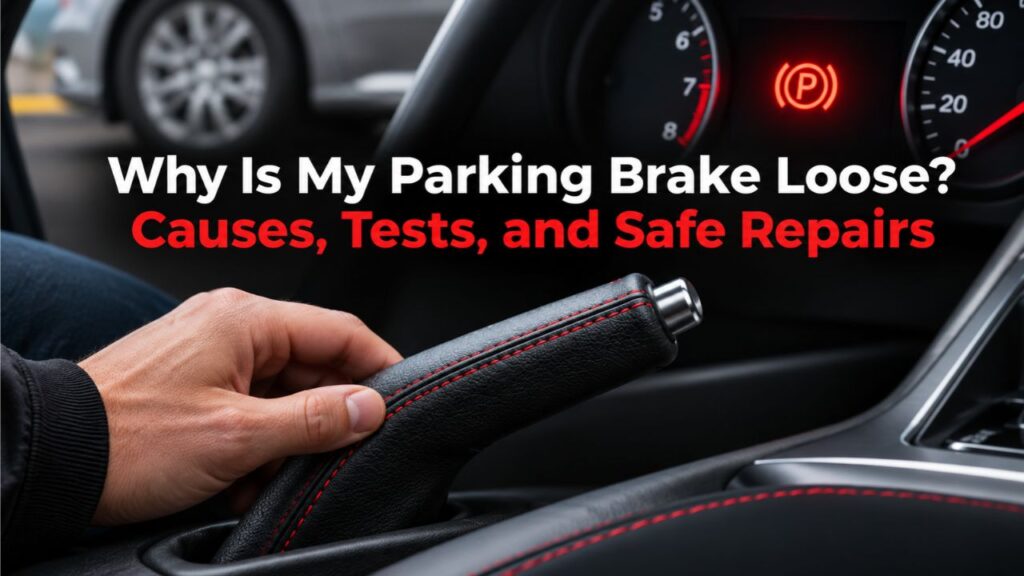
A dashboard parking brake light only indicates a switch or electronic status condition; it cannot independently prove that the mechanical brake holds with sufficient force. A normal-looking indicator should not override a clear change in the lever’s resistance.
How to Check a Loose Parking Brake Without Risking a Rollaway
You can gather useful observations without deliberately allowing the vehicle to roll on a hill. These checks are for identifying symptoms, not certifying that the brake is safe. If it already fails to hold, arrange an inspection and avoid unattended parking on an incline.
Step 01: Secure the Car on Level Ground
Stop on firm, level pavement, keep the regular brake pressed, and put an automatic transmission in Park. For a manual transmission, select the gear specified for parking. Chock the wheels if needed. Switch the engine off and keep the vehicle stationary throughout the checks.
Do not test holding force by accelerating against the parking brake or releasing the foot brake on a steep driveway. Those methods can cause unexpected movement or brake damage.
Step 02: Observe Lever or Pedal Travel
Apply the parking brake slowly and note when resistance starts. Does the handle travel much farther than it did previously? Does the foot pedal nearly reach its stop? Does the lever click but fail to latch? Release it normally and check whether the control returns to its rest position.
Click counts are vehicle-specific, so do not assume every parking brake should engage after the same number of notches. A sudden change from the vehicle’s normal behavior is more informative than comparing it with another model.
Step 03: Check for Accessible Cable or Linkage Damage
With the vehicle secured and the engine off, inspect only parts visible without getting underneath an unsupported car. Look for a loose cable end near the interior lever, a damaged mounting bracket, obvious fraying, or corrosion around accessible linkage. A cable may be detached rather than stretched.
Do not pull on a frayed cable with bare hands or dismantle rear brakes while the car rests on a jack. A technician can use approved lifting points and stands to inspect the rest of the cable route safely.
Step 04: Note Recent Brake Service and Other Symptoms
Record whether the looseness started after replacing pads, shoes, rotors, a caliper, or a cable. Also note scraping sounds, excessive heat, a burning odor, or a rear wheel that seems reluctant to rotate after release. Those signs may point to binding or damage, even when the handle itself feels loose.
If the regular brake pedal is also soft or sinks, treat that as a separate possible hydraulic fault requiring prompt diagnosis. A loose parking brake cable does not ordinarily cause a spongy service-brake pedal.
Step 05: Have Brake Holding and Release Verified Properly
A repair shop can check cable travel, rear brake clearance, friction-material condition, and holding force with the equipment and procedures specified for the vehicle. After adjustment, the brakes must also release completely. Do not accept a shorter handle travel as proof that the repair worked if the rear wheels still drag or the brake will not hold.
Should You Tighten the Parking Brake Cable Yourself?
Only if the cable and rear brake components are in good condition and you have the exact vehicle-specific adjustment procedure. Cable adjustment is not a universal fix. Some models require shoe clearance to be set first; others depend on a caliper self-adjusting mechanism or a factory-prescribed lever sequence.
The Mitsubishi Motors parking-brake lever adjustment procedure illustrates why specifications matter: for the covered vehicle, it requires checking rear caliper mechanism position and warns that excessive tightening can cause rear brake drag. Its lever-travel specification does not apply to every vehicle.
When Adjustment May Be Enough
Adjustment may be appropriate when the cables move freely, the friction surfaces are serviceable, the rear mechanisms return correctly, and measured travel is outside the manufacturer’s range. The repair should restore proper holding force without leaving either rear brake partly engaged after release.
When Parts Need Replacement Instead
Replace damaged cables, worn shoes or pads, seized hardware, or a defective lever mechanism as required. If a cable has snapped, tightening the remaining adjuster cannot restore the missing connection. If one rear wheel has a stuck caliper mechanism, increasing tension may worsen the problem and overheat the brakes.
After any repair, the technician should verify equal application where applicable, free release, and correct routing. Brake work involving lifted wheels or electronic actuators requires suitable equipment and proper procedures.
Is a Loose Electronic Parking Brake the Same Problem?
Usually not. Many electronic parking brakes apply the rear brakes with motors at the calipers rather than a hand-operated cable. Other designs use a powered cable mechanism. If an EPB switch feels physically loose, that may be a switch or mounting problem; if the parking brake fails to apply, the fault may involve power supply, wiring, an actuator, or the rear brakes.
Do not try to tighten a nonexistent cable or force an electronic caliper piston. Read the dashboard message and have the EPB/ABS module scanned when needed. Some systems require a dedicated service mode for rear brake repairs.
Can You Keep Driving With a Loose Parking Brake?
A weak parking brake can let a parked car roll, even if the regular service brakes still function. Do not leave it unattended on an incline or assume Park alone makes an unresolved problem acceptable. Secure the vehicle on level ground, use chocks when appropriate, and arrange a prompt repair.
If the parking brake drags, a rear wheel overheats, the regular brakes behave abnormally, or the vehicle cannot be secured reliably, do not drive it. Arrange suitable towing or professional assistance. The urgency depends on whether the fault affects only stationary holding or also the normal braking system, which an inspection must establish.
FAQs About Why Is My Parking Brake Loose
Can a Parking Brake Cable Stretch Over Time?
Yes, a cable system can develop excess travel through wear, adjustment changes, or damaged components. A severely corroded, frayed, detached, or broken cable needs repair or replacement rather than simply more tension.
Why Does My Handbrake Pull All the Way Up?
Excessive travel commonly points to cable slack, overly large rear shoe clearance, or a damaged linkage. Check the vehicle’s specified travel and inspect the wheel-end brake components before adjusting the lever.
Why Is My Parking Brake Loose After Changing Rear Brakes?
Incorrect shoe adjustment, a cable that was not reconnected properly, or a caliper mechanism that has not been set according to the service procedure may be responsible. Check the repair work before replacing more parts.
Will Low Brake Fluid Make the Parking Brake Loose?
Not normally on a conventional cable-operated parking brake, because it works mechanically. Low brake fluid is a separate safety concern that may indicate worn pads or a hydraulic leak and deserves prompt attention.
Can a Loose Parking Brake Fix Itself?
Do not count on it. Some brake designs have self-adjusting mechanisms, but a damaged cable, worn friction material, or broken ratchet will not reliably repair itself. Confirm the cause before using the brake for parking.
Restore Firm Parking Brake Operation Before Relying on It
If you’re asking why is my parking brake loose, start with excess cable slack, rear brake wear or adjustment, and the lever’s connecting hardware. A handle that suddenly moves freely suggests a broken or detached connection, while gradual extra travel can point toward wear or misadjustment.
The right repair restores both secure holding and complete release. Avoid tightening the cable blindly, have damaged parts replaced, and keep the vehicle safely secured until its parking brake can be trusted again.