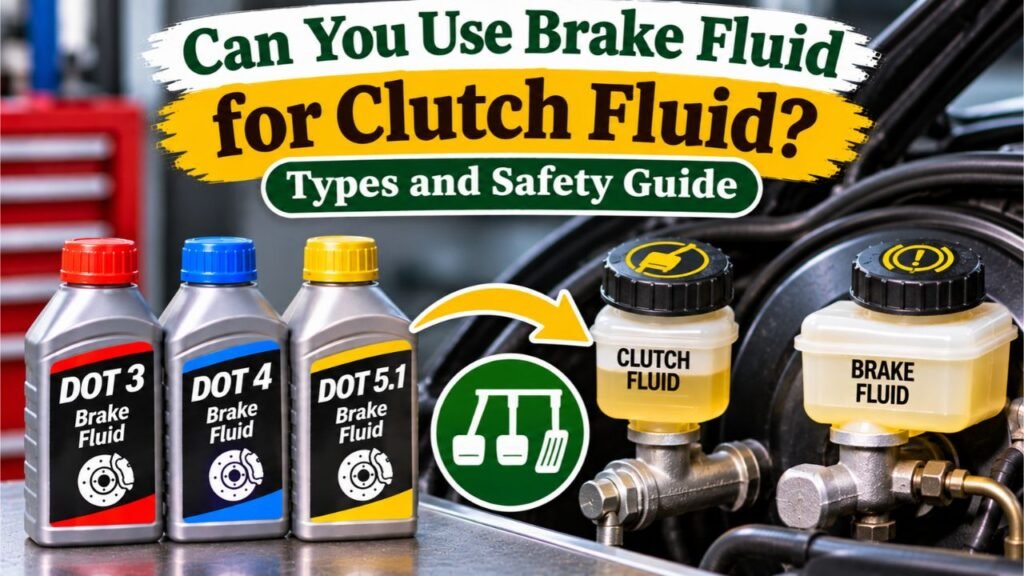
Can You Use Brake Fluid for Clutch Fluid? Types and Safety Guide
Yes, you can use brake fluid for clutch fluid in many vehicles with a hydraulic clutch, provided the brake fluid meets the manufacturer’s exact clutch hydraulic-system specification. Many manual-transmission cars use DOT 3, DOT 4, or another approved glycol-based brake fluid to operate the clutch. Some vehicles even share one fluid reservoir between the brake and clutch systems.
However, not every hydraulic clutch uses conventional brake fluid. Some motorcycle clutch systems and specialized hydraulic applications require mineral oil or another specific fluid. Adding ordinary brake fluid to one of these systems can damage seals and cause clutch failure.
The correct fluid also varies between vehicles. One car may specify DOT 3, while another requires DOT 4 LV with additional low-temperature viscosity requirements. Using the wrong type can affect hydraulic operation even when the fluid appears similar.
Before adding anything, check the owner’s manual, reservoir cap, and manufacturer specifications.
In this article, I explain when brake fluid can replace clutch fluid, how hydraulic clutches work, and which DOT types are commonly used. I also cover shared reservoirs, fluid compatibility, low clutch-fluid symptoms, safe topping-up procedures, and what to do if the wrong fluid has already been added.
Can You Use Brake Fluid for Clutch Fluid? Quick Answer
Brake fluid is the correct clutch hydraulic fluid for many manual-transmission cars. However, it must meet the specification required by the clutch system.
The term clutch fluid often describes the function of the liquid rather than a completely different chemical product.
For example, if your vehicle’s manual specifies DOT 3 brake/clutch fluid, you can use the appropriate DOT 3 brake fluid in its hydraulic clutch system.
Similarly, if the manual specifies DOT 4 LV, the fluid must satisfy that specification.
The problem arises when someone assumes that any brake fluid can be used in any hydraulic clutch.
Brake Fluid vs. Clutch Fluid Compatibility Chart
| Clutch System Requirement | Can You Use Brake Fluid? | Important Condition |
| DOT 3 hydraulic clutch | Yes | Use the specified DOT 3 fluid |
| DOT 4 hydraulic clutch | Yes | Use DOT 4 meeting manufacturer requirements |
| DOT 4 LV hydraulic clutch | Yes | Use the specified low-viscosity formulation |
| DOT 5.1 hydraulic clutch | Yes | Use approved DOT 5.1 fluid |
| Silicone DOT 5 clutch system | Only if specifically approved | Do not substitute glycol fluid |
| Mineral-oil hydraulic clutch | No conventional DOT brake fluid | Use the specified mineral oil |
| Cable-operated clutch | No | No clutch hydraulic fluid is required |
| Automatic transmission with no conventional hydraulic clutch pedal | Not applicable | Follow its transmission-fluid requirements |
| Specialized clutch actuator | Depends on design | Follow the exact actuator specification |
Is Brake Fluid the Same as Clutch Fluid?
In many cars, yes.
A bottle of DOT 3 or DOT 4 brake fluid may be the exact product required for the hydraulic clutch.
However, the names are not universally interchangeable.
A product labeled hydraulic clutch fluid may contain mineral oil or another formulation intended for specific clutch hardware.
The most important rule is to match the manufacturer’s fluid specification rather than relying only on the product name.
Why Do Hydraulic Clutches Use Brake Fluid?
Hydraulic clutches and hydraulic brakes operate using similar principles.
Both systems use liquid to transmit force from a driver-operated control to a mechanical component.
How a Hydraulic Clutch Works
When you press the clutch pedal, the clutch master cylinder creates hydraulic pressure.
This pressure travels through the hydraulic line to the clutch slave cylinder.
The slave cylinder moves the clutch release mechanism.
That movement disengages the clutch so the driver can change gears.
The process can be summarized as:
Clutch pedal → Master cylinder → Hydraulic fluid → Slave cylinder → Clutch release mechanism
When you release the pedal, the hydraulic components return according to the system’s design.
Why Brake Fluid Works in Many Clutch Systems
The fluid must:
- Transmit hydraulic pressure consistently
- Work with the system’s seals
- Maintain suitable viscosity
- Resist corrosion
- Provide appropriate lubrication for hydraulic components
- Remain stable under normal operating temperatures
Glycol-based brake fluids can meet these requirements in clutch systems designed for them.
Does the Clutch Use the Same Pressure as the Brakes?
Not necessarily.
The two systems have different operating purposes and component designs.
A hydraulic clutch needs enough force and travel to operate the clutch release mechanism.
A braking system needs to develop pressure to activate the wheel brakes.
Even when both use the same fluid, their operating pressures, cylinder sizes, and hydraulic circuits can differ.
Does Brake Fluid Lubricate the Clutch?
Brake fluid provides lubrication to certain internal hydraulic components.
However, it does not directly lubricate the clutch disc or friction surfaces.
The clutch’s friction components normally operate separately from the hydraulic fluid.
If hydraulic fluid reaches the clutch disc because of a leak, it can contaminate the friction material and cause additional problems.
What Type of Brake Fluid Should You Use for a Clutch?
The correct type depends on the vehicle manufacturer’s specifications.
Common hydraulic clutch fluid requirements include DOT 3, DOT 4, and DOT 4 LV.
Some applications use DOT 5.1.
DOT 3 Brake Fluid for Clutch Systems
DOT 3 is a glycol-based brake fluid.
Many vehicles with hydraulic manual clutches specify DOT 3.
For example, the official 2022 Mazda3 owner’s manual lists SAE J1703 or FMVSS 116 DOT 3 for brake/clutch fluid.
This is a clear manufacturer example of ordinary brake fluid serving as clutch hydraulic fluid.
DOT 4 Brake Fluid for Clutch Systems
DOT 4 is also generally glycol-based.
It has higher minimum boiling-point requirements than DOT 3.
Many hydraulic clutch systems use DOT 4.
However, a vehicle requiring DOT 4 may also have additional manufacturer-specific requirements.
Do not assume any DOT 4 product is acceptable without checking.
DOT 4 Low-Viscosity Clutch Fluid
Some vehicles require DOT 4 LV.
LV stands for Low Viscosity.
These fluids are designed to satisfy particular flow characteristics, especially at low temperatures.
For example, the official 2026 Ford Mustang clutch fluid specification identifies:
- Motorcraft DOT 4 LV High Performance Brake Fluid
- Ford specification WSS-M6C65-A2
This demonstrates that a manufacturer may require a particular brake fluid formulation for clutch operation.
DOT 5.1 Brake Fluid for Clutch Systems
DOT 5.1 is generally glycol-based.
Some hydraulic clutch systems specify it.
However, it should not automatically replace DOT 3 or DOT 4 merely because it has a higher number.
Use DOT 5.1 only when the manufacturer approves it.
DOT 5 Brake Fluid for Clutch Systems
DOT 5 is generally silicone-based.
It is fundamentally different from ordinary glycol-based DOT 3, DOT 4, and DOT 5.1 fluids.
Do not add DOT 5 to a conventional glycol-based clutch system.
Only use it where the manufacturer explicitly specifies silicone-based DOT 5.
Clutch Fluid Type Comparison
| Fluid | Main Chemistry | Suitable for Hydraulic Clutch? |
| DOT 3 | Glycol-based | Yes, when specified |
| DOT 4 | Glycol-based | Yes, when specified |
| DOT 4 LV | Glycol-based, low viscosity | Yes, when specified |
| DOT 5 | Silicone-based | Only in specifically approved systems |
| DOT 5.1 | Glycol-based | Yes, when specified |
| Mineral-oil clutch fluid | Mineral-oil-based | Only in systems designed for it |
| Engine oil | Petroleum-based lubricant | Not a substitute for conventional DOT clutch fluid |
| Power-steering fluid | Varies by formulation | Not a substitute unless explicitly specified |
Do Brake and Clutch Systems Share the Same Fluid Reservoir?
Some vehicles use a shared brake and clutch fluid reservoir.
Others have separate reservoirs.
Both designs are common in manual-transmission vehicles.
Shared Brake and Clutch Reservoir
In a shared-reservoir arrangement, the brakes and hydraulic clutch obtain fluid from the same container.
The systems may still use separate hydraulic circuits after the reservoir.
For example, some Mazda3 and Ford manual-transmission vehicles use this arrangement.
How to Identify a Shared Reservoir
Look for the brake fluid reservoir in the engine compartment.
It may be:
- Mounted near the brake master cylinder
- Made from translucent plastic
- Marked with MIN and MAX lines
- Labeled for brake or brake/clutch fluid
The owner’s manual should explain whether the clutch shares the reservoir.
Do not assume that a single visible reservoir means the systems are shared.
Some clutch reservoirs can be small or partially hidden.
Separate Clutch Fluid Reservoir
Other manual-transmission cars use a dedicated clutch reservoir.
It is often smaller than the brake fluid reservoir.
It may be mounted:
- Near the firewall
- Close to the clutch master cylinder
- Alongside the brake reservoir
- In another manufacturer-specific location
A separate reservoir does not necessarily mean the clutch requires a different fluid.
Both systems may still specify the same DOT classification.
Shared vs. Separate Reservoir Comparison
| Feature | Shared Reservoir | Separate Reservoir |
| Fluid container | One reservoir | Two reservoirs |
| Fluid requirements | Usually one specified fluid | May be the same or different |
| Fluid-level inspection | Check shared reservoir | Check each reservoir |
| Possible leak | Brake or clutch hydraulic circuit | Corresponding hydraulic circuit |
| Service procedure | Vehicle-specific | Vehicle-specific |
| Correct fluid source | Manufacturer documentation | Manufacturer documentation |
Can a Clutch Leak Affect the Brakes?
Potentially, yes.
A shared reservoir means that a clutch hydraulic leak can lower the fluid available in the common reservoir.
Some systems are designed with separate takeoff heights or other measures intended to protect the brake circuit.
However, this is not a reason to ignore a clutch leak.
If fluid loss continues, the braking system may also be affected.
A low shared reservoir requires prompt inspection.
Can You Use Brake Fluid Instead of Mineral-Oil Clutch Fluid?
No. Conventional DOT brake fluid must not be substituted for mineral oil in a clutch system specifically designed for mineral-oil operation.
This is an important exception to the general rule.
Why Some Clutches Require Mineral Oil
Certain hydraulic clutch systems use components and seals designed specifically for mineral-oil-based fluid.
Their internal materials may not be compatible with glycol-based brake fluid.
Example: MAGURA Hydraulic Motorcycle Clutch
MAGURA manufactures hydraulic clutch systems for motorcycles.
Its official HYMEC hydraulic clutch owner’s manual specifies MAGURA Blood mineral oil for the HYMEC system.
It explicitly prohibits DOT brake fluid in that application.
This illustrates why the label clutch fluid cannot always be interpreted as ordinary automotive brake fluid.
What Happens if Brake Fluid Enters a Mineral-Oil Clutch?
Possible consequences include:
- Seal incompatibility
- Hydraulic fluid leakage
- Loss of hydraulic pressure
- Clutch engagement problems
- Damage to internal components
- Clutch-system failure
The exact damage depends on the fluid, materials, and amount introduced.
Can You Flush Out the Wrong Fluid?
Sometimes a specialist may be able to restore a contaminated system through an approved service process.
However, an ordinary flush may not be sufficient if seals or other components have already been damaged.
Do not assume that draining the reservoir alone removes the contamination.
If the wrong chemistry has entered the system, stop using it and obtain professional advice.
Is Clutch Fluid the Same as Transmission Fluid?
No.
Hydraulic clutch fluid and manual transmission fluid serve different purposes.
Even though the clutch and transmission are connected mechanically, they do not necessarily use the same lubricant.
Hydraulic Clutch Fluid
Hydraulic clutch fluid transmits force from the clutch pedal to the clutch release mechanism.
It operates inside the clutch master cylinder, hydraulic lines, and slave cylinder.
Manual Transmission Fluid
Manual transmission fluid lubricates components inside the gearbox.
These include gears, bearings, and other transmission parts.
A vehicle may specify a particular gear oil or manual transmission fluid.
That product should not be poured into the hydraulic clutch reservoir unless explicitly required by a highly unusual system design.
Comparison Table
| Fluid | Main Function | Where It Is Used |
| Brake fluid | Transfers hydraulic pressure | Brake system |
| Hydraulic clutch fluid | Transfers clutch-control pressure | Clutch master/slave cylinders |
| Manual transmission fluid | Lubricates transmission components | Manual gearbox |
| Automatic transmission fluid | Serves transmission hydraulic and lubrication functions | Compatible automatic transmission |
| DCT fluid | Lubricates or operates specified dual-clutch transmission components | Compatible dual-clutch transmission |
| Mineral-oil clutch fluid | Operates a compatible hydraulic clutch | Specialized clutch systems |
Can You Use Gear Oil for Clutch Fluid?
Not in a conventional DOT-fluid hydraulic clutch system.
Gear oil has different viscosity, additives, and chemical properties.
It can damage components or prevent proper hydraulic operation.
What About Dual-Clutch Transmissions?
Dual-clutch transmissions are different from conventional manual clutches operated by a pedal.
A dual-clutch transmission may use specialized transmission fluid, separate actuator fluid, or other manufacturer-specified fluids.
The words clutch fluid in this context may refer to a different service component.
Do not pour ordinary brake fluid into a dual-clutch transmission.
Check the manufacturer’s exact specifications.
How to Check Hydraulic Clutch Fluid Level
Checking clutch fluid is relatively straightforward on vehicles with an accessible reservoir.
However, the procedure depends on whether the clutch has a separate reservoir or shares one with the brakes.
Step 1: Park on Level Ground
Park safely and switch off the engine.
Apply the parking brake.
A level surface makes the reservoir reading more reliable.
Step 2: Find the Reservoir
Open the hood.
Locate the fluid reservoir identified in the owner’s manual.
If the car uses a shared brake/clutch reservoir, inspect that container.
If the clutch has a separate reservoir, locate the clutch master-cylinder reservoir.
Step 3: Read the MIN and MAX Marks
Most translucent reservoirs have minimum and maximum markings.
The correct level is generally within that range.
However, the exact checking conditions are manufacturer-specific.
Step 4: Check for a Low Fluid Level
If the fluid is at or below MIN, investigate the cause.
A low clutch fluid level can indicate a hydraulic leak.
For a shared brake/clutch reservoir, low fluid can also be related to brake-pad wear or a brake-system leak.
Step 5: Inspect for Leaks
Look for obvious signs of fluid leakage around accessible components.
Potential locations include:
- Clutch master cylinder
- Hydraulic hose
- Hydraulic fittings
- Clutch slave cylinder
- Transmission bellhousing area
An internal concentric slave-cylinder leak may not be visible without further inspection.
Step 6: Avoid Unnecessary Opening
If the reservoir is translucent, inspect the level without removing the cap.
Conventional glycol-based brake fluid can absorb moisture from the air.
Opening the cap unnecessarily increases contamination risk.
How Full Should the Clutch Fluid Reservoir Be?
For many conventional hydraulic clutch systems, the correct fluid level is between MIN and MAX.
However, use the vehicle manufacturer’s specific markings and procedure.
Clutch Fluid Level Guide
| Fluid Level | Possible Meaning | Recommended Action |
| Near MAX | Normally acceptable | No addition needed |
| Halfway between MIN and MAX | Usually within specification | Monitor during routine maintenance |
| Near MIN | Low end of operating range | Check service history and possible leaks |
| At MIN | Requires attention | Arrange inspection |
| Below MIN | Possible hydraulic problem | Do not continue driving until assessed |
| Reservoir appears empty | Serious hydraulic concern | Arrange professional service |
| Above MAX | Overfilled or incorrect reading | Have level checked |
Does Clutch Fluid Naturally Get Low?
A hydraulic clutch system does not normally consume fluid like an engine consumes fuel.
A persistent decrease may indicate leakage or another system issue.
In a shared brake/clutch reservoir, brake-pad wear can also lower the visible level.
Should You Fill Clutch Fluid to MAX?
Not automatically.
The correct level depends on the owner’s manual.
If it is within the specified range, adding fluid is usually unnecessary.
Do not overfill the reservoir.
What if Clutch Fluid Keeps Disappearing?
Repeated fluid loss is not normal.
The system should be checked for leaks.
A top-up may temporarily raise the level but does not repair the underlying fault.
Can You Top Up Clutch Fluid With Brake Fluid?
Yes, but only when the hydraulic clutch requires that exact brake fluid specification and topping up is appropriate.
Do not add fluid until you have identified both the required type and the reason for the low level.
When Topping Up May Be Appropriate
Adding fluid may be part of an approved procedure after:
- A hydraulic component has been repaired
- The system has been properly serviced
- The manufacturer directs fluid replenishment
- A technician has determined the correct level needs to be restored
When Topping Up Is Not Enough
Do not treat a top-up as the solution if:
- The clutch pedal sinks to the floor
- Fluid disappears repeatedly
- Gear engagement becomes difficult
- The clutch hydraulic system is visibly leaking
- The shared brake reservoir is below MIN
- The specified fluid is unknown
- An incompatible fluid may have been added
These conditions require diagnosis.
Safe Clutch Fluid Top-Up Procedure
If the manufacturer permits a top-up and the cause of low fluid has been addressed:
- Park the vehicle safely on level ground.
- Switch off the engine.
- Confirm the exact required hydraulic fluid.
- Clean the outside of the reservoir and cap.
- Use fresh fluid from a properly sealed container.
- Open the reservoir according to the service procedure.
- Add only the necessary amount.
- Avoid exceeding the specified maximum.
- Secure the cap correctly.
- Check for leaks and verify the system according to the manufacturer’s procedure.
Brake fluid can damage painted surfaces.
Avoid spills and follow the manufacturer’s cleanup instructions.
If the clutch hydraulic system has been opened or has drawn in air, proper bleeding may be required.
Can You Mix DOT 3 and DOT 4 in a Clutch System?
DOT 3 and conventional DOT 4 are generally glycol-based and chemically compatible.
However, that does not automatically make mixing them suitable for every clutch system.
Why Manufacturer Approval Matters
DOT 3 and DOT 4 have different minimum performance requirements.
A vehicle specifying DOT 4 may require properties that a DOT 3 mixture does not reliably provide.
Some clutch systems also require specific viscosity characteristics.
Can DOT 4 Replace DOT 3?
Sometimes, if the manufacturer explicitly approves it.
However, do not assume a higher DOT number is always a suitable replacement.
Can DOT 3 Replace DOT 4?
Not unless the manufacturer approves it.
Use the exact specified fluid.
Can DOT 5.1 Replace DOT 4?
Only if the product meets the complete manufacturer requirements.
Some systems have additional performance standards.
Can You Mix DOT 5 and DOT 4?
No.
Silicone-based DOT 5 should not be mixed with conventional glycol-based DOT 4.
DOT 5 and DOT 5.1 are also different fluid families.
Do Different Brake Fluid Brands Matter?
Two fluid products may be chemically compatible, but the correct choice depends on their full specifications.
Use a fresh product that meets the manufacturer’s requirements.
Avoid mixing fluids unnecessarily.
What Happens if You Use the Wrong Clutch Fluid?
Incorrect fluid can cause significant hydraulic-system problems.
The consequences depend on the particular fluid and system.
Possible Problems
| Wrong Fluid | Potential Consequence |
| DOT 3 used where a specific DOT 4 fluid is required | May fail to meet performance requirements |
| Ordinary DOT 4 used where DOT 4 LV is required | May not meet viscosity requirements |
| Silicone DOT 5 added to a glycol system | Incompatible fluid chemistry |
| Glycol brake fluid added to a mineral-oil clutch | Potential seal damage and hydraulic failure |
| Mineral oil added to a DOT-fluid clutch | Potential seal damage and loss of function |
| Engine oil added to a hydraulic clutch | Contamination and component damage |
| Transmission fluid added to a conventional clutch reservoir | Incorrect fluid and possible hydraulic damage |
| Water added to glycol-based fluid | Reduced boiling-point performance and corrosion risk |
Can the Wrong Fluid Damage Clutch Seals?
Yes.
The seals inside the clutch master and slave cylinders are designed for particular fluid chemistries.
An incompatible liquid can cause swelling, deterioration, or loss of sealing performance.
Can the Clutch Stop Working?
Yes.
If the hydraulic system loses pressure, the slave cylinder may no longer move correctly.
The clutch may fail to disengage.
This can make selecting gears difficult or impossible.
Can Wrong Clutch Fluid Damage the Transmission?
Incorrect hydraulic fluid does not necessarily flow into the gearbox itself.
However, a malfunctioning clutch can make gear engagement difficult.
Attempting to force gears when the clutch will not disengage may damage transmission components.
If fluid leaks onto the clutch friction disc, the clutch assembly may also need repair.
Will the Damage Happen Immediately?
Not always.
Some incompatible-fluid problems may develop over time.
The absence of immediate symptoms does not prove that the system is safe.
What Should You Do if You Added the Wrong Fluid?
Do not continue operating the vehicle.
Identify the product and approximate amount added.
Have the system professionally assessed.
A technician may need to inspect or replace affected hydraulic components and perform an approved fluid service.
Do not try to correct the mistake by adding more of another fluid.
Signs Your Car Needs Clutch Hydraulic Service
Hydraulic clutch problems can develop because of low fluid, leaks, trapped air, or faulty components.
1. Soft or Spongy Clutch Pedal
The clutch pedal may feel less firm than usual.
Possible causes include air in the system or a hydraulic fault.
2. Clutch Pedal Stays on the Floor
A pedal that fails to return normally can indicate a serious problem.
Potential causes include:
- Clutch master-cylinder failure
- Slave-cylinder failure
- Hydraulic leakage
- Mechanical linkage problems
- Other clutch mechanism faults
Do not assume adding fluid will correct it.
3. Difficulty Shifting Gears
If the clutch does not disengage fully, shifting may become difficult.
This may be especially noticeable when selecting first gear or reverse.
However, transmission or mechanical clutch problems can cause similar symptoms.
4. Gear Grinding
A clutch that does not release properly may contribute to gear grinding during shifts.
Avoid forcing the transmission into gear.
5. Visible Hydraulic Fluid Leakage
Look for fluid near the clutch master cylinder, hydraulic lines, or slave cylinder.
A leak may occur inside the bellhousing when a concentric slave cylinder is used.
6. Repeatedly Low Reservoir Level
A recurring decrease should be investigated.
A healthy hydraulic clutch system should not require frequent refilling.
7. Unusual Clutch Engagement
A clutch engaging very close to the floor may indicate a hydraulic problem.
However, clutch pedal behavior varies by vehicle.
The symptoms must be evaluated together.
Symptoms and Possible Causes
| Symptom | Possible Cause | Recommended Action |
| Soft clutch pedal | Air or hydraulic issue | Inspect and diagnose |
| Pedal remains on floor | Hydraulic or mechanical failure | Do not drive |
| Difficult gear changes | Clutch not fully disengaging | Arrange inspection |
| Fluid below MIN | Leak or shared-reservoir issue | Investigate promptly |
| Fluid leaking near transmission | Possible slave-cylinder problem | Professional inspection |
| Clutch engagement feels inconsistent | Hydraulic or mechanical issue | Diagnose before further driving |
| Brake warning with shared reservoir | Potential braking-system concern | Stop safely and assess |
Can Low Clutch Fluid Cause Gear-Shifting Problems?
Yes.
If a hydraulic clutch system loses fluid or draws in air, the slave cylinder may not receive the pressure needed to disengage the clutch.
Why Low Fluid Affects the Clutch
When you press the pedal, the master cylinder must move fluid through the hydraulic circuit.
A leak or trapped air can reduce effective hydraulic operation.
As a result, the clutch may remain partially engaged.
What Happens When the Clutch Does Not Fully Disengage?
Possible symptoms include:
- Difficulty selecting gears
- Gear grinding
- Vehicle movement when the clutch should be disengaged
- Abnormal pedal travel
- Inability to select a gear normally
Can You Keep Driving?
If the clutch does not disengage properly, continued driving is unsafe and can cause additional mechanical damage.
Do not force the gearshift.
Arrange repair or towing as appropriate.
If the vehicle uses a shared brake/clutch reservoir and fluid level is low, treat possible brake-system problems as an additional safety concern.
How Often Should Clutch Fluid Be Changed?
There is no universal clutch fluid replacement interval.
The schedule depends on the vehicle, hydraulic system, and fluid specification.
Why Clutch Fluid Ages
Common DOT 3, DOT 4, and DOT 5.1 fluids are glycol-based and hygroscopic.
They can absorb moisture over time.
Moisture and contamination may contribute to corrosion and hydraulic component problems.
Does Clutch Fluid Need Changing Every Two Years?
Some vehicles specify a two-year brake/clutch fluid replacement interval.
Others have different schedules.
Do not assume every clutch hydraulic system requires replacement every two years.
What if Brakes and Clutch Share a Reservoir?
A shared reservoir does not necessarily mean that replacing brake fluid through the wheel circuits automatically replaces all fluid within the clutch hydraulic circuit.
The clutch circuit may require its own bleeding or fluid replacement procedure.
Can You Just Add New Fluid?
Topping up does not remove old fluid from the hydraulic line and slave cylinder.
If fluid replacement is required, follow the proper procedure for the entire clutch circuit.
Does Clutch Fluid Need Changing if You Rarely Drive?
Possibly.
Conventional glycol-based fluids can deteriorate with time, not just mileage.
Follow the manufacturer’s service requirements.
What About Mineral-Oil Clutch Fluid?
Mineral-oil systems have different fluid properties and maintenance requirements.
Do not automatically apply a DOT brake-fluid replacement interval to a mineral-oil clutch.
Use the manufacturer’s schedule.
Can You Bleed a Hydraulic Clutch With Brake Fluid?
Yes, if the hydraulic clutch is designed for the specified brake fluid.
Bleeding removes trapped air from the system.
However, the procedure varies by vehicle.
Why Clutch Bleeding Is Necessary
Air can enter the hydraulic system when:
- A component leaks
- A hydraulic line is opened
- The reservoir runs too low
- A master or slave cylinder is replaced
- Maintenance introduces air
Air is compressible.
It can reduce the movement transferred from the clutch pedal to the release mechanism.
Basic Clutch Bleeding Principles
A typical procedure involves:
- Using the correct fluid.
- Maintaining the correct reservoir level.
- Following the manufacturer’s bleeding method.
- Allowing trapped air to escape.
- Preventing the reservoir from running dry.
- Checking hydraulic operation afterward.
Some vehicles require pressure or vacuum bleeding.
Others have manufacturer-specific procedures.
Can You Use a Brake Bleeder Kit?
Some brake bleeding equipment can also be used for hydraulic clutches.
However, compatibility depends on the system and tools.
Do not reuse equipment contaminated with mineral oil in a DOT-fluid system.
Can You Bleed the Clutch by Pumping the Pedal?
Some conventional systems permit pedal-operated bleeding.
Others require different procedures.
Improper bleeding can leave air trapped in the system or damage components.
Use the correct service instructions.
Should You Drive Immediately After Bleeding?
Only after the hydraulic system has been properly serviced, leaks have been ruled out, and clutch operation has been verified.
If the clutch pedal still feels abnormal or gear selection remains difficult, do not continue driving.
Can You Use Brake Fluid in a Motorcycle Clutch?
Sometimes, but motorcycle hydraulic clutch systems vary considerably.
Some use DOT 4 or DOT 5.1.
Others require mineral oil.
DOT Brake Fluid Motorcycle Clutches
A motorcycle with a hydraulic clutch designed for glycol-based brake fluid may specify DOT 4 or DOT 5.1.
Use the exact specification.
Mineral-Oil Motorcycle Clutches
Some motorcycle clutch systems require mineral oil.
MAGURA HYMEC is one verified example.
Conventional DOT brake fluid must not be used in that system.
Cable-Operated Motorcycle Clutches
Many motorcycles use a clutch cable rather than hydraulic fluid.
A cable-operated clutch does not have a hydraulic clutch-fluid reservoir.
It requires cable and mechanical adjustment or maintenance according to the motorcycle’s manual.
How to Identify Your Motorcycle Clutch Fluid
Check:
- The clutch reservoir cap
- Owner’s manual
- Clutch master-cylinder markings
- Manufacturer service instructions
Never decide based solely on the motorcycle brand.
Different models can use different clutch systems.
Common Mistakes When Using Brake Fluid for a Clutch
Several mistakes can cause hydraulic damage or interfere with normal clutch operation.
Assuming All Clutches Use DOT Brake Fluid
Some hydraulic clutches require mineral oil or other specialized fluid.
Always check the specification.
Using DOT 5 Instead of DOT 5.1
DOT 5 and DOT 5.1 use different base chemistries.
They are not interchangeable.
Using Ordinary DOT 4 Instead of DOT 4 LV
Low-viscosity fluid requirements matter.
A product labeled DOT 4 may not meet the complete specification.
Adding Transmission Fluid to the Clutch Reservoir
Manual transmission fluid is not an alternative to conventional hydraulic clutch fluid.
Using Power-Steering Fluid as a Substitute
Power-steering fluids have different formulations.
They should not be added to a conventional DOT-fluid clutch system.
Ignoring a Low Fluid Level
Clutch hydraulic fluid should not require repeated topping up.
Investigate possible leaks.
Mixing Unknown Fluids
Do not combine fluids when the type already in the system is unknown.
Seek professional confirmation.
Using Old Brake Fluid From an Open Bottle
Glycol-based brake fluid can absorb atmospheric moisture.
Use fresh, appropriately stored fluid during maintenance.
Overfilling the Reservoir
Use the manufacturer’s fluid-level markings.
Excess fluid may spill during service or create other problems.
Assuming New Fluid Fixes a Failed Clutch
A failed master cylinder, leaking slave cylinder, or worn clutch assembly may require mechanical repair.
Adding fluid alone cannot correct every problem.
How to Choose the Correct Fluid for Your Hydraulic Clutch
Before purchasing or adding fluid, confirm the following details.
Clutch Fluid Selection Checklist
| Question | What to Verify |
| Is the clutch hydraulic? | Hydraulic or cable-operated |
| Does it share the brake reservoir? | Shared or separate system |
| What fluid does the manual specify? | Exact DOT or alternative classification |
| Is low viscosity required? | DOT 4 LV or another standard |
| Does it require mineral oil? | Specific mineral-oil product |
| Is the fluid glycol- or silicone-based? | Correct chemistry |
| Is the bottle freshly sealed? | Avoid moisture contamination |
| Is the reservoir actually low? | Read specified level markings |
| Has the level dropped repeatedly? | Inspect for leaks |
| Does the pedal operate normally? | Diagnose symptoms before driving |
Best Approach for Most Car Owners
I recommend starting with the owner’s manual rather than selecting a bottle labeled clutch fluid.
If the manual specifies DOT 3, purchase the approved DOT 3 fluid.
If it specifies DOT 4 LV, choose fluid meeting all the additional requirements.
If it specifies mineral oil, use the exact mineral-oil product or approved equivalent.
If the specification is unclear, consult the vehicle manufacturer or a qualified technician.
Conclusion
So, can you use brake fluid for clutch fluid? Yes, in many vehicles with hydraulic manual clutches. Ordinary brake fluid is often the manufacturer-specified hydraulic clutch fluid.
For example, some Mazda3 models specify DOT 3 brake/clutch fluid, while the 2026 Ford Mustang manual specifies DOT 4 LV meeting a particular Ford standard.
However, not every clutch hydraulic system uses conventional DOT brake fluid.
Some motorcycle and specialized clutch systems require mineral oil, and substituting brake fluid can damage hydraulic components.
The correct choice depends on the system’s fluid chemistry, viscosity requirements, and manufacturer specifications.
I recommend checking the owner’s manual and reservoir labeling before adding anything. If the fluid is low, investigate why rather than repeatedly topping up.
If the wrong fluid has already been added, avoid operating the vehicle until the system has been professionally assessed.
The safest rule is simple: brake fluid can be clutch fluid, but only when your specific hydraulic clutch system is designed to use it.
FAQs About Using Brake Fluid for Clutch Fluid
Can I Use DOT 3 Brake Fluid for Clutch Fluid?
Yes, if your vehicle’s hydraulic clutch specifically requires DOT 3. Some manual-transmission cars use DOT 3 for both brakes and clutch operation. However, do not add DOT 3 to a clutch system requiring DOT 4 LV, mineral oil, or another specification without manufacturer approval.
Can I Use DOT 4 Brake Fluid in My Clutch?
Yes, if the manufacturer specifies DOT 4. Many hydraulic clutches use it. However, some vehicles require a particular formulation such as DOT 4 LV. Check the complete specification before adding fluid.
Are Brake Fluid and Clutch Fluid the Same Thing?
In many cars, yes. The clutch hydraulic system uses the same type of glycol-based fluid commonly sold as brake fluid. However, some specialized hydraulic clutches use mineral oil or another fluid, so the terms are not universally interchangeable.
Can I Use Brake Fluid Instead of Clutch Fluid in a Motorcycle?
Only if the motorcycle’s hydraulic clutch requires that DOT brake fluid specification. Some motorcycle clutches use DOT 4 or DOT 5.1, while others require mineral oil. Never use conventional brake fluid in a clutch system that specifies mineral oil.
Can You Mix Brake Fluid and Clutch Fluid?
If the products are the same manufacturer-approved fluid specification, they may effectively be the same liquid. However, do not mix unknown formulations, incompatible DOT types, or glycol brake fluid with mineral-oil clutch fluid. Confirm the exact requirements before mixing.
What Happens if I Put Brake Fluid in a Mineral-Oil Clutch?
The incorrect fluid may damage seals, cause leakage, reduce hydraulic pressure, or lead to clutch failure. Stop using the system and obtain professional assessment. A simple fluid top-up or reservoir drain may not correct the damage.
Can I Use Transmission Fluid for My Hydraulic Clutch?
Not in a conventional hydraulic clutch that specifies DOT brake fluid. Transmission fluid has different characteristics and may damage clutch hydraulic components. Use the manufacturer’s exact specified fluid.
Do Brakes and Clutch Use the Same Reservoir?
Some manual-transmission vehicles have a shared brake and clutch fluid reservoir. Others use separate containers. A shared reservoir usually supplies the same specified fluid to both systems, but a separate reservoir does not necessarily require a different fluid.
Why Is My Clutch Fluid Low?
Low clutch fluid can indicate leakage from the master cylinder, slave cylinder, or hydraulic lines. If the clutch shares a reservoir with the brakes, brake-pad wear or a brake-system leak may also affect the level. Repeated fluid loss requires inspection.
Can Low Clutch Fluid Stop a Car From Shifting?
Yes. If hydraulic pressure becomes insufficient, the clutch may not disengage completely. This can cause difficult gear changes, grinding, or a pedal that fails to operate normally. Avoid forcing gears and have the system inspected.
Can I Top Up Clutch Fluid Without Bleeding?
If the manufacturer permits a top-up and no air has entered the system, bleeding may not be required. However, a reservoir that has run dry, an opened hydraulic line, or an abnormal pedal may require proper bleeding and repair. The cause of fluid loss must be identified first.